The Six Seasons of Nepal: A Trek for Every Time of Year
Published Oct 27, 2026 Updated Oct 27, 2026 8 min read
Quick answer
Nepal's traditional calendar has six seasons (ritu) of about two months each: Basanta, Grishma, Barkha, Sharad, Hemanta and Shishir. For trekking, Sharad (mid-September to mid-November) and Basanta (mid-March to mid-May) are best. But there is a good trek in every season: low hill treks in winter, and rain-shadow routes such as Upper Mustang in the monsoon.
Ask a farmer in the hills above Pokhara what season it is and you will not hear spring or autumn. You will hear one of six ritu, each tied to the work in the fields and the festivals that follow it. Trekkers who plan by these six seasons rather than four get a better picture of what the trail will be like. This guide walks through the year the Nepali way, with the treks that suit each season.
Key facts
SeasonsSix ritu of about two Nepali months each
Best for trekkingSharad (autumn) and Basanta (spring)
MonsoonRoughly mid-June to late September or early October (late Grishma and Barkha); about 80% of the year's rain
Monsoon treksRain-shadow routes such as Upper Mustang
ColdestShishir, mid-January to mid-March
Biggest festivalsDashain and Tihar, in Sharad
RhododendronsMarch to April in the middle hills
The six seasons at a glance
In the Nepali calendar, Bikram Sambat, each season covers two months, running from the middle of one Western month to the middle of another. The dates below are approximate, and the weather never follows the calendar exactly.
Season (ritu)
Nepali months
Roughly
Weather in the hills
Trekking
Basanta (spring)
Chaitra, Baisakh
Mid-March to mid-May
Warm days, rhododendrons, haze builds by May
Excellent
Grishma (early summer)
Jestha, Asar
Mid-May to mid-July
Hot and humid low down, cloud and first rains
Shoulder, then rain-shadow routes
Barkha (monsoon)
Shrawan, Bhadra
Mid-July to mid-September
Rain, cloud, leeches, landslides
Rain-shadow routes
Sharad (autumn)
Asoj, Kartik
Mid-September to mid-November
Clear, settled, cold nights
The best
Hemanta (late autumn)
Mangsir, Poush
Mid-November to mid-January
Clear and dry, getting cold
Very good, quieter
Shishir (winter)
Magh, Falgun
Mid-January to mid-March
Coldest, often clear, snow higher up
Low and mid-altitude treks
In practice the monsoon does not wait for Shrawan: it usually reaches Nepal in the first half of June and withdraws in late September or early October. Nepal's Department of Hydrology and Meteorology puts the monsoon's share of the year's rain at about 80%. That single fact shapes the whole trekking year.
Basanta (बसन्त ऋतु): rhododendrons and long days
Basanta (बसन्त ऋतु - spring) is the second-best trekking season and, for many people, the most beautiful. The days are warm, the high trails are open, and the rhododendron forests flower up the hillsides from late February to May, starting low and finishing high. Late March to mid-April is usually the best time to see them in the middle hills of the Annapurna region.
Festivals: Holi falls in Falgun or Chaitra, around March; the Nepali New Year is on 1 Baisakh, in mid-April; Buddha Jayanti is on the full moon of Baisakh, in late April or May.
Heads up
Early in Basanta, old snow can sit on the higher trails. On the way to Annapurna Base Camp, the stretch from Deurali to Machhapuchhre Base Camp is exposed to avalanches after heavy snow in winter and early spring. Our guides cross it early in the morning and wait when conditions are bad.
Grishma (ग्रिष्म ऋतु): green, hot and the start of the rain
Grishma (ग्रिष्म ऋतु — Summer / Early Summer) brings heat to the low valleys and the first pre-monsoon storms. Views get hazy and less reliable, leeches appear on the lower trails, and by June the monsoon has usually arrived. In the villages this is rice-planting time: Asar 15, National Paddy Day, in late June, is a day of planting and mud fights in the terraces.
Good treks: early Grishma still works for higher routes, but as the rain comes the best choices move north into the rain shadow behind the Himalaya. Upper Mustang is at its liveliest in May, when the Tiji festival is held in Lo Manthang.
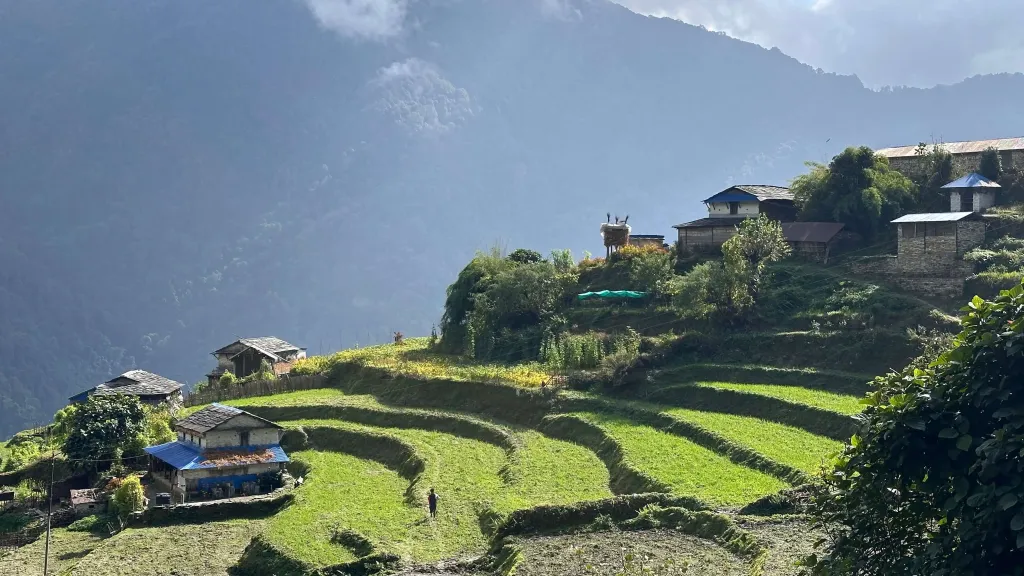
Terraced fields near Ghandruk. In Grishma they are flooded and planted with rice. Photo: North Nepal Travel & Trek.
Barkha (वर्षा ऋतु): the rain-shadow season
Barkha (वर्षा ऋतु — Monsoon / Rainy Season) is the wet heart of the year. On the southern side of the Himalaya the trails are muddy and slippery, leeches are everywhere below about 2,500 m, clouds hide the peaks, and landslides cut roads. The hills around Pokhara are among the wettest places in Nepal. The upside is lush green valleys, empty trails and lower prices.
The answer is to go behind the mountains. The high peaks wring the rain out of the monsoon clouds, leaving places like Upper Mustang, Manang and Dolpo much drier. Upper Mustang is our first choice for July and August; see our monsoon treks guide for the others.
Festivals: Janai Purnima and Gai Jatra in August, and Teej, the women's festival, in late August or September.
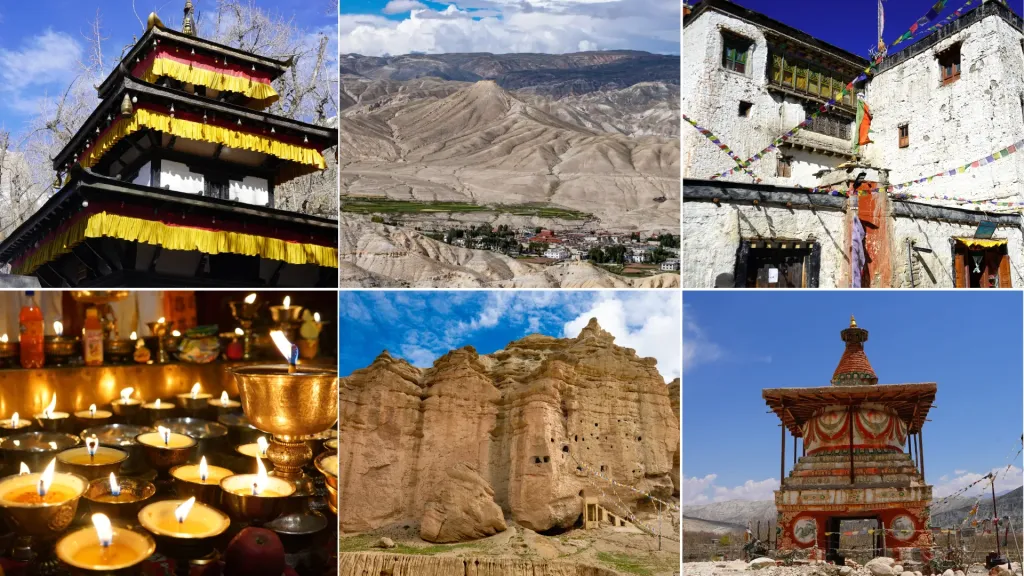
Upper Mustang, in the rain shadow north of the Annapurnas: the classic monsoon trek. Photo: North Nepal Travel & Trek.
Sharad (शरद ऋतु): the best trekking season
Sharad (शरद ऋतु — Autumn) is why most people trek in October. The monsoon has washed the air clean, the skies are clear, and the views are the sharpest of the year. Nights are cold at altitude but the days are settled. It is also the busiest season, so lodges on the popular routes fill up and flights need booking early.
Every classic trek works in Sharad. In recent years, though, the season has started and ended with more storms than it used to: in late September 2026 floods closed roads in Manang and heavy snow fell in the upper Khumbu. Keep spare days, and read our conditions update before you go.
Festivals: Dashain and Tihar, the two biggest festivals of the year. In 2026 Dashain tika fell on 21 October and Tihar runs from 6 to 11 November. Trekking carries on, but offices close and buses fill up; our Dashain and Tihar guide explains what changes.
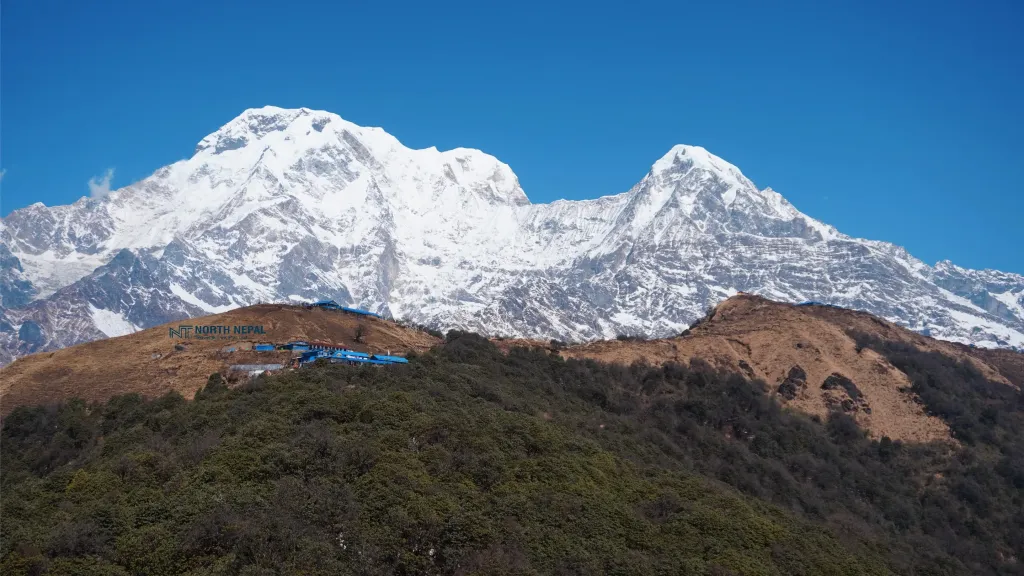
Clear autumn skies over Annapurna South and Hiunchuli from the Mardi Himal trail. Photo: North Nepal Travel & Trek.
Hemanta (हेमन्त ऋतु): clear, quiet and cold
Hemanta (हेमन्त ऋतु — Pre-Winter / Late Autumn) is the most underrated season. The harvest is in, the festivals are over, the crowds thin out, and the skies usually stay clear and dry. It gets steadily colder: by December nights at high altitude are well below freezing, and snow becomes more likely on the high passes towards January.
Good treks: Annapurna Base Camp, Mardi Himal, Poon Hill and Everest Base Camp in late November and December, for trekkers with good warm gear. Our Manaslu in December post covers a winter crossing of the Larkya La.
Festivals: Tamu Lhosar, the Gurung new year, on 15 Poush, around 30 December. The Gurung are the main community along the Annapurna Base Camp trail, and villages such as Ghandruk celebrate with dancing and food.
Clear December light on the Manaslu Circuit, in Hemanta. Photo: North Nepal Travel & Trek.
Shishir (शिशिर ऋतु): cold, clear and empty
Shishir (शिशिर ऋतु — Winter) is the coldest season, but often the most stable, with crisp blue skies between snowfalls. High passes such as the Thorong La and Larkya La can close after snow, and some high lodges shut. The lower and middle hills are pleasant, quiet and very clear.
Good treks: Poon Hill, Ghandruk, Panchase and other treks below about 3,500 m. Higher treks are possible for experienced trekkers with proper winter gear and flexible dates.
Festivals: Maghe Sankranti on 1 Magh, in mid-January; Sonam Lhosar (Tamang), usually in late January or February, and Gyalpo Lhosar (Sherpa and Tibetan), in February or early March.
Basanta (spring), Grishma (early summer), Barkha (monsoon), Sharad (autumn), Hemanta (late autumn) and Shishir (winter). Each covers about two months of the Nepali calendar.
Sharad, from about mid-September to mid-November, for the clearest skies. Basanta, from mid-March to mid-May, is a close second, with rhododendrons in flower.
Yes, best in the rain shadow north of the Himalaya. Upper Mustang is our first choice for July and August; trails south of the main range are wet, leech-ridden and cloudy.
From late February to May, starting low and moving higher. In the middle hills of the Annapurna region, late March to mid-April is usually best.
For lower and mid-altitude treks such as Poon Hill, yes: it is clear and quiet. High passes can close after snow.
They move with the lunar calendar. In 2026 Dashain tika fell on 21 October and Tihar runs from 6 to 11 November.
Tell us when you can travel and we will suggest the trek that suits that season. See our treks or message Mohan on WhatsApp (+977 985 601 6904).
Sources
Department of Hydrology and Meteorology, "Preliminary weather report of monsoon season, 2010 across Nepal", Journal of Hydrology and Meteorology 7(1), 2010 (monsoon about 80% of annual rainfall): https://nepjol.info/index.php/JHM/article/view/5619/4619
A native of the Annapurna region, he brings over 17 years of firsthand experience leading treks across the mountains of Nepal. His deep local roots and proven guiding expertise make him a trusted authority on authentic Himalayan adventures.