Pikey Peak Trek - 5 Days

Pikey Peak Trek - 5 Days
DESTINATION Nepal
MAX. ELEVATION 4,065 m (13,336 ft)
WALKING DISTANCE ~ 53 km
GRADE Moderate
BEST SEASON Spring and Autumn
DURATION 5 Days
MEALS INCLUDED Breakfast, Lunch & Dinner
ACCOMMODATION Teahouse

OVERVIEW & HIGHLIGHTS

Pikey Peak Trek's Overview

Pikey Peak Trek is a short but mesmerizing trek that takes you through charming villages, lush landscapes, and authentic Sherpa culture in the Solukhumbu region of Nepal. This trek offers you a glimpse of the Sherpa community without trekking to the expensive and difficult Everest Base Camp Trek. The Sherpa Pikey Peak viewpoint stands at an altitude of 4,065 m (13,336 ft) and offers breathtaking panoramic views of the Himalayan giants, including Everest and Kanchenjunga. On this 5-day Pikey Peak Trek, immerse yourself in the tranquility of nature, experience the warm hospitality of local communities, and witness the stunning sunrise or sunset spectacle from the peak. The Pikey Peak Trek promises a unique blend of adventure and cultural exploration in the heart of the Himalayas.

The Pikey Peak trek is a short 5-day trek in the lower Everest (Solu) region to Pikey Peak (4,065 m) — the viewpoint Sir Edmund Hillary named his favourite in the Himalayas. It's run by North Nepal Travel & Trek, a TAAN-registered operator, and the 2026 price starts at USD 600 per person in a group (USD 800 solo), including transport from Kathmandu, a licensed guide, all permits, teahouse accommodation and three meals a day.

It's the trek to choose if you want a wide Everest panorama — Everest, Lhotse, Makalu and Kanchenjunga on a clear day — without the Lukla flight, the altitude or the crowds of the main Everest Base Camp trail. It's graded moderate, reached entirely by road via Dhap, and works in autumn, spring and even winter. You need the Gaurishankar Conservation Area permit, Sagarmatha National Park entry permit, and a Local Area Permit; we arrange all three. This trek offers you a glimpse of the Sherpa community without trekking to the expensive and difficult Everest Base Camp Trek.

Pikey Peak Table with Route, Starting Altitude, Maximum Altitude, Final Altitude, and Altitude Loss in the table below.

Day

Route

Starting Altitude

Final Altitude

Altitude Gain

Altitude Loss

1

Kathmandu → Jhapre

1,400 m

2,921 m

1,521 m 

–

2

Jhapre → Pikey Peak Base Camp

2,921 m

3,640 m

719 m

–

3

Base Camp → Pikey Viewpoint → Junbesi

4,065 m

2,700 m

425 m

940 m

4

Junbesi → Salleri

3,640 m

2,362 m

–

1,278 m

5

Salleri → Kathmandu

2,362 m

1,400 m

–

962 m

Top 6 Reason to Choose Pikey Peak Trek in Nepal

  • Explore lesser-known trekking routes in the lower Everest region.
  • Ascend to Pikey Peak summit for glorious sunrise and sunset panoramas over the Himalayan ranges.
  • Enjoy breathtaking views of Mt. Everest, Lhotse, Cho-Oyu, Makalu, the Numbur range, and Kanchenjunga.
  • Immerse yourself in the rich Sherpa culture and experience their warm hospitality.
  • Visit ancient Buddhist monasteries in the lower Khumbu region.
  • Learn about the significance of chortens, mani walls, and prayer flags along the trek.
Mohan Raj Bhandari Jeewan Tamang
Itinerary review by

Mohan Raj Bhandari, Founder/Managing director / Jeewan Tamang, Trekking Guide / Mountain Climber / Trail Runner

Pikey Peak Trek route and pacing are drawn from 12+ years guiding the Everest region. Mohan founded North Nepal Trek in 2015, and our guides know this classic Everest-viewpoint trek intimately, from Junbesi's forests to the Pikey summit sunrise.

Pikey Peak Trek Itinerary

Toggle all
Day 1

Drive from Kathmandu to Dhap and trek to Jhapre

HIGHEST ALT. 2,921 m (9,583 ft)
DURATION 4 - 5 hours
Distance
DISTANCE ~ 11 km

We start our day early in the morning and drive from Kathmandu to Dhap. The distance from Kathmandu to Dhap is 240 kilometers, and it takes about 7-8 hours to reach there. The first half of the route has decent roads, but when we get closer to Dhap, the route changes to off-road, filled with dust.

However, after crossing the BP highway, we will see greenery and terraced farming, and the cities change into countryside filled with dense forests and many rivers. While some trekkers enjoy the bumpy road as part of the adventure, others try to forget the bumpy road conditions with scenery of driving along the banks of the Sunkoshi River, hills, and forest. 

Views on the way to Jhapre, clicked by North Nepal during Pikey Peak Trek.
Photo: Views on the way to Jhapre

We will reach Dhap village. We take a short break here and then start our trek to Jhapre.

The trail to Jhapre village is filled with Buddhist monasteries and offers an incredible landscape. The trek from Dhap to Jhapre takes 4 - 5 hours, depending on our pace. We will start by walking along a dusty road to a village called Signae. There is a motor road up to Signae; however, only tractors with huge tires can drive on this road.

Following the village of Signae, we reach Jhapre, a small village perched above a deep valley. You can see the views of Everest starting from Jhapre. There are Buddhist Gompas and Stupas, and a limited number of cafes and teahouses. We can also witness the Tibetan Buddhist rituals performed at the local monastery. Overnight stay at Jhapre. 

Day 2

Trek from Jhapre to Pikey Peak Base Camp

HIGHEST ALT. 3,640 m (11,943 ft)
DURATION 5 - 6 hours
Distance
DISTANCE ~ 12 km

On the second day, we will have our breakfast at the teahouse and trek to Pikey Peak Base Camp. The trek from Jhapre to Pikey Peak Base Camp takes 5 - 6 hours. We will walk along the trail with views of Everest, Numbur Chuli, and some eastern Himalayas. The trail first ascends and takes us to Bhulbule via the Lhamuje Danda.

Views on the way to Pikey Peak Base Camp, clicked by North Nepal trek during Pikey Peak Trek
Photo: Views on the way to Pikey Peak Base Camp

The uphill climb is filled with pine and rhododendron forests until Bhulbule. During the spring and monsoon seasons, this trek section is filled with various colors of rhododendrons and greenery. From Bhulbule, we walk further with ups and downs until we reach Lhamuje. From Lhamuje, the path separates, and we will take the right towards the Pikey Peak Base Camp.

The trek along the ridge offers spectacular views of the Himalayas, and en route, you will witness some mani stones, several old yak homes, and grazing yaks on the pasture. Following the zigzag trails from here, we will reach our destination after 2 hours of trekking. We can visit a cheese factory here in Pikey Peak Base Camp. Overnight stay at a teahouse.

Day 3

Pikey Peak Base Camp to Pikey Peak Viewpoint & trek to Junbesi

HIGHEST ALT. 4,065 m (13,336 ft)
DURATION 6 - 7 hours
Distance
DISTANCE 15.65 km

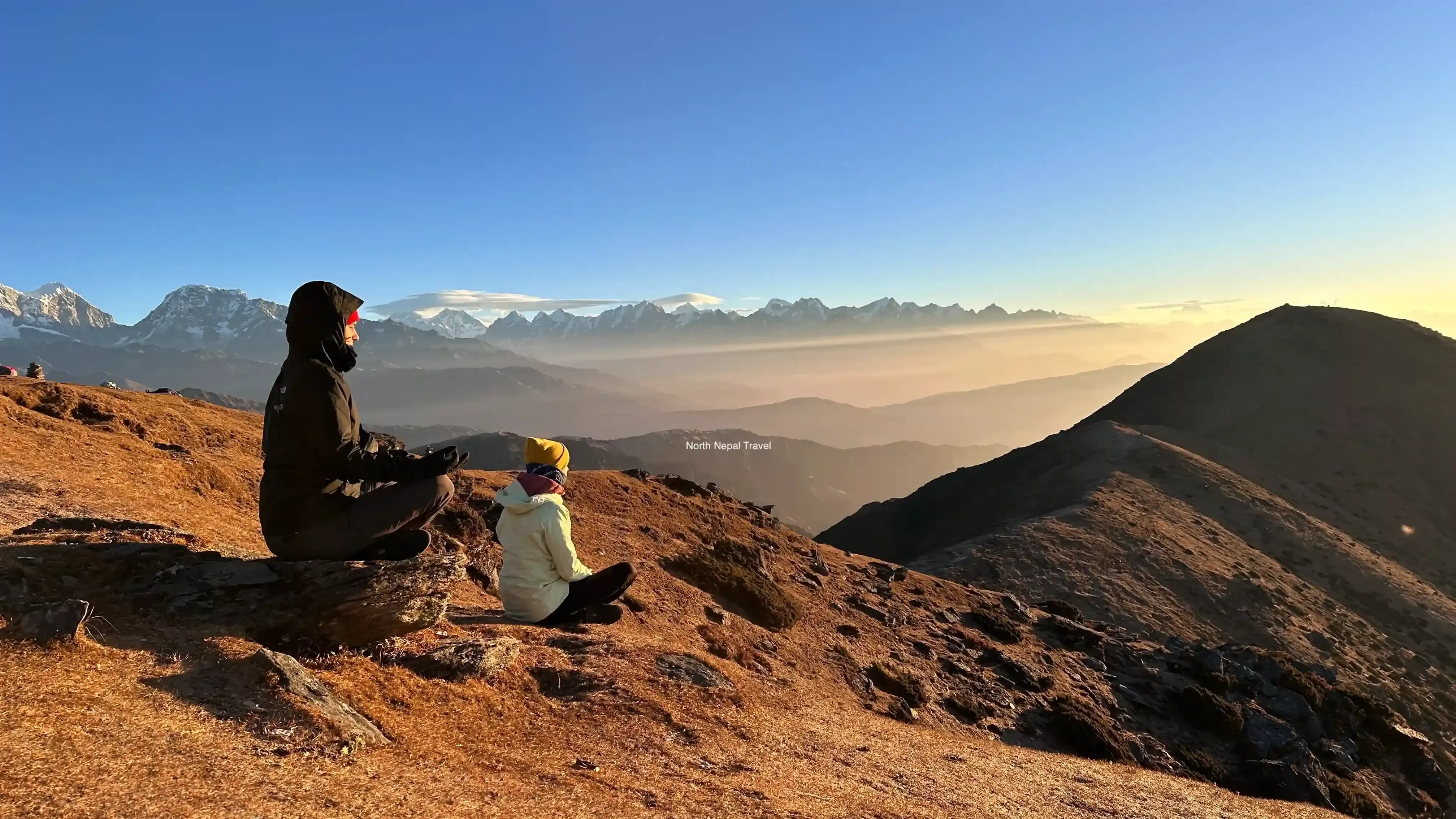
Depending on the season of our trek, we can either pack or have our breakfast at the teahouse. We will get up early in the morning and hike towards Pikey Peak Viewpoint. The summit takes about 45 min to 1 and ½ hours, depending on your pace. The route is uphill with very few sections of a straight path. Once at the top, we will see the prayer flags fluttering and golden rays of sunrise on top of snowcapped peaks.

Sunrise at Pikey Peak Viewpoint, and two trekkers meditating clicked by North Nepal Trek
Photo: Sunrise view from Pikey Peak.

This mesmerizing view of sunrise over mountains like Everest, Thamserku, Khangtega, Khatang, Karyoling, Gauri Kanchenjunga, Dorje, and Dhaulagiri is the major highlight of this trek. After enjoying the sunrise, we trek toward Junbesi; the route takes us downhill with rhododendrons till we reach Lamjura. We will have our lunch at Lamjura, and the ridges will slowly vanish from here. We will further descend and walk along the valley filled with fir and rhododendrons until we reach Taktor.

From here, the path is mostly straight, and we pass through several Mani walls and stones covered with chortens. Finally, after 6 - 7 hours of trekking, we reach Junbesi. Compared to other teahouses along the route, the teahouses here are well-established. We will visit the old monastery, from where we can also see the Numbur Chuli on the horizon. Overnight stay at Junbesi.

Day 4

Junbesi to Salleri

HIGHEST ALT. 2,700 m. (8,858 ft)
DURATION 5 - 6 hours
Distance
DISTANCE ~ 13 km

Today is the last day of the Pikey Peak trek. After breakfast, we start our descent to Salleri. After descending, we must cross the river and continue through the forest till Salung. Even during this section of the trek, we can catch glimpses of Everest, Makalu, and Chamalang.

Two trekkers trekking along, Junbesi village.
Photo: Trekking along Junbesi.

Following the view of the majestic mountains, we will continue our trek to Phaplu, following the edge of the hillside and the river stream. We will cross the same river. After that, we ascend upward to Rigmo. From Rigmo, we ascend further into a difficult path until we reach Salleri. Overnight stay at Salleri.

Day 5

Salleri to Kathmandu

DURATION 7 - 8 hrs

Today is the final day of the Pikey Peak Trek. We will have breakfast and drive from Salleri to Kathmandu. The total distance from Salleri to Kathmandu is 267 km, and driving takes 7 - 8 hours. We cross Jiri, the entryway to the Everest Region, and then continue driving to Kathmandu.

Views during Salleri to Kathmandu, during Pikey Peak Trek clicked by North Nepal Trek.
Photo: Views on the way to Kathmandu from Salleri

This route, starting from Kathmandu, is also called the alternative to the Lukla flight. Moreover, you witness the traditional life of people in this region. The beautiful landscapes and mountain ranges also follow you during this drive. Overnight in Kathmandu.

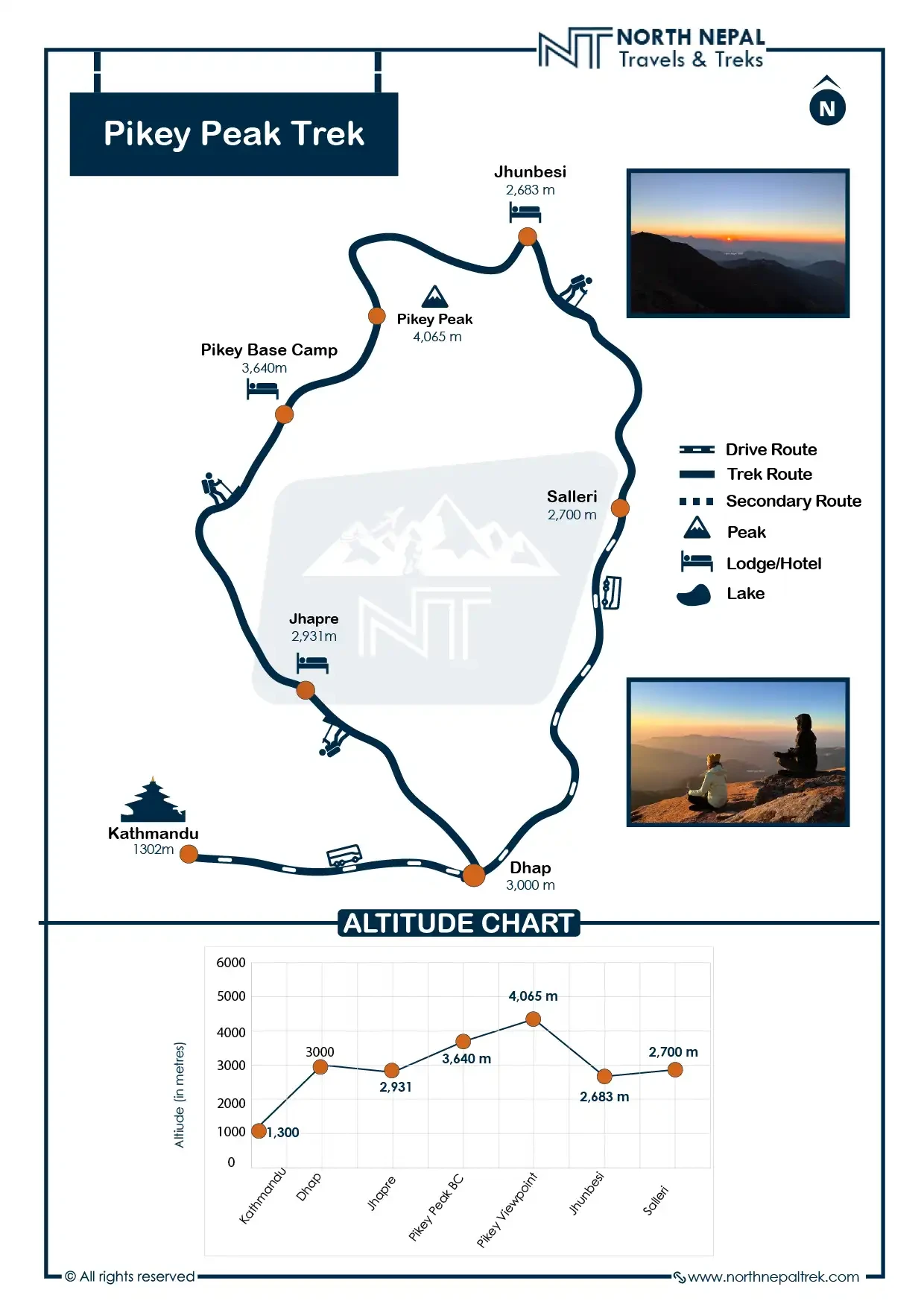
Pikey Peak Trek Map and Elevation Graph

Pikey Peak Trek Map and Elevation Graph

What's Included & Excluded

  • Tea House accommodation during the trek. 
  • Kathmandu to Dhap and  Phaplu to Kathmandu by Bus / local shared jeep 
  • We provide 3 meals per day (Breakfast, Lunch, and Dinner) and Himalayan Tea twice a day. Please note that each meal is served as a single serving.
  • Trekking gear duffel bag for your trekking stuff.
  • Medical Kit Bag with Oximeter on the trek. 
  • Mountain-trained English-speaking professional guide.
  • Staff insurance, well-paid salary, equipment, food & Hotel.
  • Worst case, the arrangement of Emergency Helicopter service, if needed (paid by your Travel insurance).
  • Achievement certificate after the completion of the trek.
  • Government taxes and office service charges.
  • Additional cost for a private jeep for both ways.
  • International airfare & Nepal visa fee.
  • Travel & Trekking insurance that covers emergency high-altitude rescue.
  • Lunch and Dinner in Kathmandu.
  • Porter carries up to a 22 kg bag combined (1: 2 ratio, one porter for two trekkers)
  • Personal Insurance & personal expenses.
  • Tips & gratuities for Guide and Porter (expected but not mandatory).
  • Hotel accommodation in Kathmandu.
  • Anything not mentioned in the What's Included section.

Pikey Peak Trek - 5 Days's Detail Information

Toggle all

Accommodation & Food in the Pikey Peak Trek

The food and accommodation during the pikey peak trek are very basic. Unlike the well-known Everest Base Camp Trek, pikey peak is still flourishing as the main highlight of the region; the EBC trek shadows it. The major accommodations of the Pikey Peak Trek are in the teahouses, run by locals from here. The teahouses are very basic, and you can’t find any luxury hotel like Everest during this trek. They offer rooms on a shared basis and have a common dining room where you can have your meal. Most tea houses have Wi-Fi; however, they charge you extra rupees. Other services like hot drinking water, laundry, and hot showers also cost extra. 

The food items during the pikey peak trek offer a mix of local and western food items. 

They offer options like Tibetan bread with curry, chapati bread, various egg dishes, porridge, muesli, and pancakes for breakfast. 

The menu/food items for lunch and dinner are similar, so you can choose according to your preferences. The items include Dal Bhat(unlimited refills), fried rice or noodles, Mo Mo, Thukpa, spring rolls, burgers, pasta, pizza, and potatoes.

Pikey Peak Trek Permit

You require three permits for the Pikey Peak Trek:

  1. Sagarmatha National Park entry permit/Khumbu region permit: NPR 3,000/person ($25 - $30)
  2. Gaurishankar Conservation Area Permit (GCAP): NPR 3,000/person ($25 - $30)
  3. Local Area Permit: NPR 2,000 per person/week

Note: Permit fees in USD depend on the current exchange rate of Nepal.

Pikey Peak Difficulty level

The Pikey Peak Trek is moderate in terms of difficulty. It is suitable for trekkers with a moderate level of fitness. Complete beginners with a good level of fitness can also hike the Pikey Peak trek; however, North Nepal Travel & Trek recommends the 7-day pikey peak itinerary for better acclimatization.

Pikey Peak stoned paved trail through the Alpine forestPhoto: Pikey Peak stoned paved trail through the Alpine forest

The maximum altitude during the Pikey Peak Trek is 4,065 m (13,335 ft), and it is the Pikey Peak Viewpoint. We will spend one night at Pikey Peak Base Camp, which works as an acclimatization stop. Moreover, as we will spend a few hours on the viewpoint, there won’t be any altitude-related issues. 

Like most of the other treks in the Himalayas of Nepal, the terrain on the Pikey Peak Trek also varies in each section, with many ascents and descents. You will be walking on some well-maintained and forested trails, which slowly lead to uneven or rocky trails, but the Pikey Peak trek isn’t overly technical.

It is already known that weather conditions in the Himalayas aren’t predictable, even during peak trekking seasons. You should prepare accordingly and accommodate your safety if the weather changes or unforeseen events occur. We suggest you take experienced guides on the Peaky Peak Trek to reduce the chances of unforeseen events. If you want to learn more about the best weather conditions, check out the best season for trekking in the Pikey Peak Trek section.  

The pikey peak trek is also accessible in terms of walking duration and distance. The longest day will be during the Pikey Peak summit day, as it is 7 - 8 hours of trekking. Other than this, the two days are a drive of 7 - 8 hours, and the remaining two days are more manageable, with only 5 - 6 hours of trekking each day.

Packing Essentials for the Pikey Peak

Pack essential items like a sleeping bag, water purifier, and trekking gear & clothes to enhance your Pikey Peak trek in Nepal. Does purchasing trekking gear and clothes feel like a waste of money? You can always rent them. Bringing personal snacks and energy bars ensures you're prepared for long trekking days without relying on teahouse offerings.

Pikey Peak or Everest Base Camp — which should you choose?

Choose the 5-day Pikey Peak trek if you want a wide Everest view on a short, moderate, low-cost trek — no Lukla flight, no 5,000 m altitude, and almost no crowds. It's ideal for limited time, a first Himalayan trek, families, or as a winter option when higher treks are snowed in.

Choose the Everest Base Camp trek if standing at the foot of Everest is the goal and you have about two weeks, a bigger budget, and the fitness for high altitude.

Location & Geography of Pikey Peak Trek

The Pikey Peak is located at an altitude of 4,065 m (13,336 ft) inside the Tapting VDC in Solukhumbu District of Koshi Province.

Solukhumbu is home to the world's highest mountain, Mt. Everest. Undoubtedly, leads the way towards the most popular trekking route, the Everest Base Camp Trek.

The Pikey Peak trekking route starts from Dhap, a small village in the Lower Khumbu region of Solukhumbu district inside the Sagarmata Zone of north-eastern Nepal. Depending on your itinerary, the route ends either at Dhap or Salleri. 

Trekking to Pikey Peak is accessible via road or air. The journey to Dhap takes either a 7 - 8 hour drive by road or a 30-minute flight by air, landing at the Phalpu airport. However, you will still need to drive after reaching the Phalpu airport by flight. 

Where is Pikey Peak Located?

The Pikey Peak is located at an altitude of 4,065 m (13,336 ft) inside the Tapting VDC in Solukhumbu District of Koshi Province.

Solukhumbu is home to the world's highest mountain, Mt. Everest. Undoubtedly, leads the way towards the most popular trekking route, the Everest Base Camp Trek.

The Pikey Peak trekking route starts from Dhap, a small village in the Lower Khumbu region of Solukhumbu district inside the Sagarmata Zone of north-eastern Nepal. Depending on your itinerary, the route ends either at Dhap or Salleri. 

Trekking to Pikey Peak is accessible via road or air. The journey to Dhap takes either a 7 - 8 hour drive by road or a 30-minute flight by air, landing at the Phalpu airport. However, you will still need to drive after reaching the Phalpu airport by flight. 

Why Trek With Us — Pikey Peak Trek

100% Locally Owned & Nepal-Based Experts

We are proudly based right here in Nepal with deep roots in the Himalayan adventure community. Booking directly with us keeps your investment local, directly supports authentic mountain teahouses, and guarantees reliable, hands-on support from day one.

Officially Licensed & TAAN-Registered

We are a fully government-registered trekking agency and an active member of the Trekking Agencies' Association of Nepal (TAAN). We guarantee complete legal compliance, professional financial security, and the highest safety standards on every trip.

Specialized Solukhumbu & Ridge Route Expertise

The trail leading through the rolling green hills, quiet forests, and Sherpa settlements of the lower Everest region requires specialized knowledge of local trail variations, seasonal weather shifts, and community lodge logistics. We bring over a decade of hands-on experience mastering these scenic ridge routes.

Expert Local Leadership

Your trek is personally led by our government-certified, English-speaking local guides who maintain close personal ties with the local Sherpa communities, bringing village traditions, monastery history, and panoramic geography vividly to life.

Top-Rated Client Satisfaction

Backed by a 4.9/5 rating across global review platforms, our travelers consistently praise our warm hospitality, expert high-altitude pacing, and unforgettable off-the-beaten-path cultural experiences away from the heavily crowded trails.

Live Trail Update of Pikey Peak Trek - 5 Days Live

Last updated: Live Trail Update of Pikey Peak Trek

Updated: Jiwan Tamang

Trail Condition Good
Weather Sunny Day
Wifi/Network Weak at High Altitude
Teahouses Mostly open

Trekker Alerts

  • Carry microspikes above Lobuche (Editable Fields)
  • Afternoon clouds affecting flights
  • Water filters recommended
  • ATM unavailable in Dingboche
Reviews From The Trail

Hear it from those who've walked with us.


Safety Policy

Professional & Certified Guides

Every trek is accompanied by an experienced, licensed, English-speaking local guide trained in wilderness trail navigation, cultural interpretation, and first-aid response. Guides carry comprehensive medical kits equipped with essential pharmaceuticals and pulse oximeters to monitor health and oxygen levels daily during the ascent toward Pikey Peak (4,065 m / 13,336 ft).

High-Altitude & Terrain Management

While the Pikey Peak Trek reaches a moderate maximum altitude of 4,065 m (13,336 ft), our itineraries feature steady pacing across forested ridges, stone paths, and terraced hillsides. Guides conduct daily health assessments for early symptoms of Acute Mountain Sickness (AMS). If severe symptoms appear, standard protocol mandates immediate descent to lower elevations.

Emergency Rescue Coordination

In cases of severe injury, acute altitude illness, or extreme weather conditions on remote ridgelines, emergency helicopter evacuation is coordinated directly through local rescue services, adhering to regional aviation regulations. Evacuations are initiated promptly upon assessment by your guide in communication with our Kathmandu and Pokhara offices.

Mandatory Travel Insurance

All trekkers must hold comprehensive travel insurance covering emergency medical treatment, high-altitude trekking (up to 4,500 m), and emergency helicopter rescue/evacuation. Insurance details must be submitted prior to the departure of the trek to streamline emergency logistics if required.


Pikey Peak Trek Departure Date for 2026/2027

Secure the Pikey Peak Trek for 2026/2027 before the seat gets fully booked.


Terms, Conditions & Feasibility

  1. All bookings are made with North Nepal Travel & Trek Pvt. Ltd Registered Company Number 162883/073/074 (hereafter referred to as The Company) whose office is in Lakeside, Pokhara-6, Nepal.
  2. The term "trip" used in this website and booking conditions refers to all itineraries described on this website including those which might otherwise be known as walking, tours, trekking trips, sightseeing, climbing, mountaineering, expeditions, or holidays.
  3. We accept your last-minute booking as well, but full payment of the total tour cost should be made in advance if necessary or can be paid fully on arrival day. See More


Frequently Asked Questions

Booking & Company Policies

1. Is a guide mandatory for the Pikey Peak Trek in 2026?

Yes, absolutely. As of April 1, 2023, the Nepal Tourism Board (NTB) banned solo independent trekking (FIT) in all National Parks and Conservation Areas. Since the Pikey Peak route crosses into the Solu region (and often buffers the Gaurishankar/Sagarmatha areas), you must trek with a licensed guide hired through a registered agency like North Nepal Trek.

3. Is solo trekking allowed if I am an experienced hiker?

No. The ban applies to all foreign nationals regardless of experience level. Checkpoints at Dhap and Phaplu strictly enforce this. However, "Solo" trekking is still possible in the sense that you can book a Private Trip with North Nepal Trek, just you and your guide, giving you independence without breaking the law.

23. Which company runs the best Pikey Peak trek, and what does it cost in 2026?

Choose a TAAN-registered Nepali operator that knows the Solu region road access and the small teahouses. North Nepal Travel & Trek runs the 5-day Pikey Peak trek with licensed guides who know the route in every season, from USD 600 per person in a group in 2026, including transport, a guide, all permits, and full board.

Trekking Permits & Logistics

2. Should I visit Nepal Tourism Board for permits?

No, you don't have to visit the Nepal Tourism Board's office. North Nepal Trek will issue your trekking permit for all the treks in Nepal. 

4. What permits do I need?

You typically need three permits:

  1. Sagarmatha National Park entry permit/Khumbu region permit
  2. Gaurishankar Conservation Area Permit (GCAP)
  3. Local Area Permit

Note: If your itinerary enters the Everest boundary, a Sagarmatha National Park Permit may apply. We manage the exact permit stack based on the current trail status.

General Information

5. How difficult is the Pikey Peak Trek?

It is rated as Moderate. Unlike the Everest Base Camp trek, you do not spend days above 4,000m. The daily walking hours are manageable (5 to 6 hours), but the summit day involves a steep ascent to 4,065m and a sharp descent to Loding. It is an excellent choice for first-time trekkers or families.

6. Can I see Mount Everest from Pikey Peak?

Yes, it offers one of the best views of Everest. Sir Edmund Hillary famously claimed the view from Pikey Peak was his favorite. Unlike the view from Kala Patthar (where Nuptse blocks part of Everest), Pikey Peak offers a wide panoramic sweep of the 8,000m giants: Mt. Everest, Makalu, Kanchenjunga, and Lhotse.

7. What is the maximum altitude I will reach?

The highest point is the Pikey Peak Summit at 4,065 meters (13,335 ft). You will typically sleep at Pikey Base Camp (~3,640 m) the night before, which helps with acclimatization.

8. Which itinerary is better: 5 Days or 7 Days?

5 Days: Rushed. Involves long drives (8+ hours) on Day 1 and Day 5 with no rest days. Good if you are short on time.

7 Days: Recommended. Allows you to walk slowly, acclimatize better at Jhapre, and perhaps visit the Thupten Choling Monastery in Junbesi, adding deep cultural value to the scenic trek.

11. Is there Wi-Fi and electricity on the trail?

Electricity is available at almost all teahouses to charge phones (expect to pay a small fee, approx $2–$3). Wi-Fi is available in lower villages (Dhap, Jhapre, Junbesi), but signals are often weak or non-existent at Pikey Base Camp. We recommend buying an Ncell SIM card with a data package in Kathmandu for the best coverage.

20. Can I do this trek with children?

Yes. Pikey Peak is one of the most family-friendly treks in Nepal due to its moderate altitude and shorter duration. We have successfully guided families with children as young as 7 years old. We can customize the pace and add extra porters to make it easier for kids.

21. Is Pikey Peak Trek a good alternative to EBC?

Well, Pikey Peak cannot be the alternative to the famous Everest Base Camp trek. If you want fewer crowds, cheaper costs, and views of Mt. Everest, Pikey Peak is the best trek. Remember, it's one of the best viewpoints of Sir Edmund Hilary for the view of Everest. 

22. Is Pikey worth it for Everest views without the crowds?

Yes, that's exactly its appeal. Sir Edmund Hillary rated the Pikey summit his favourite Himalayan viewpoint, and on a clear morning you see Everest, Lhotse, Makalu, Kanchenjunga and Cho Oyu in one sweep, usually with barely another trekker in sight. You trade the base-camp bragging rights for a wider panorama, a lower price and solitude.

25. What do reviews say about the Pikey Peak trek?

Trekkers consistently highlight the sunrise Everest panorama and the quiet, authentic Sherpa villages of the Solu region, with very few crowds. See our verified TripAdvisor reviews for North Nepal Travel & Trek for first-hand accounts of guided Pikey Peak departures.

Transportation

9. How do we get from Kathmandu to the start of the trek?

The standard transport is a Jeep drive to Dhap Bazaar (approx. 240km).

Road Condition: The first 5 hours to Okhaldhunga are on paved blacktop (BP Highway). The final 3–4 hours to Dhap are off-road, bumpy, and dusty.

Flight Option: You can fly to Phaplu Airport (25 mins) and trek in reverse, but flights are weather-dependent and often cancelled.

15. What is the difference between a Private Jeep and a Shared Jeep?

Shared Jeep: Cheap ($20–$30/seat), but very crowded (10 people squeezed in), departs only when full, and takes longer.

Private Jeep: Comfortable, leaves on your schedule, allows stops for photos, and is much faster. We strongly recommend a private jeep for the dusty road to Dhap.

Accommodation & Food

10. What kind of accommodation is available?

You will stay in Teahouses (Mountain Lodges).

Dhap/Phaplu: Good-quality lodges with electricity and sometimes attached bathrooms.

Pikey Base Camp: Very basic. Rooms are often small wooden partitions with two beds and a foam mattress. Toilets are usually shared and outside (squat style).

12. What is the food like? Can I get meat?

The menu is standard teahouse fare: Dal Bhat (rice, lentils, curry) is the staple (and unlimited!). You can also get pasta, momos (dumplings), pancakes, and noodle soup. We advise avoiding meat on the trail as refrigeration is unreliable in remote areas; eggs and lentils provide safer protein.

Packing Gear & Rental

13. Do I need a sleeping bag?

Yes, teahouses provide warm blankets. You are advised to carry a sleeping bag with you.

Payments & Extra Costs

14. How much does the Pikey Peak Trek cost in 2026?

A high-quality, full-board package typically ranges from $600 to $900 USD per person, depending on group size and transport (Shared Jeep vs. Private Jeep).

Warning: Avoid packages under $400; they often cut safety corners, use uninsured porters, or hide permit fees.

16. How much cash should I carry?

If you are on a full package (food/permit included), carry approx NPR 15,000–20,000 ($100–$150 USD). This covers extras like Wi-Fi, hot showers ($3–$5), charging devices, soft drinks, and tips for your guide/porter. There are no ATMs on the trail after Phaplu.

24. How many days is the Pikey Peak trek and what's included?

The standard trip is 5 days from Kathmandu, reached by road via Dhap (no flights). The package includes Kathmandu transport, a licensed guide, all required permits, teahouse accommodation, and three meals a day. Personal expenses, insurance,e and tips are extra.

Health & Safety

17. Is altitude sickness a risk on this trek?

The risk is low but present. You sleep at 3,640m (Pikey Peak Base Camp), which is high enough to trigger mild AMS symptoms (headache, nausea). Our itinerary is designed to ascend gradually. Drinking 3 to 4 liters of water daily and listening to your guide are essential.

19. Do I need travel insurance?

Yes, travel insurance is mandatory. Your policy must cover Emergency Helicopter Rescue up to 4,500m. Even though Pikey Peak is "lower," road access is difficult in emergencies, and a helicopter is often the only rapid evacuation method.

Weather & Seasons

18. What is the best time of year to go?

Spring (March–May): Best for Rhododendrons in full bloom. The hills turn red and pink.

Autumn (Sept–Nov): Best for crystal-clear views. The visibility of Everest is highest in late October/November.

Winter (Dec–Feb): Possible, but expect snow on the summit and very cold nights.

PRIVATE TRIP

5 Days

Price Start from USD 700

USD 500 pp

We Offer Group Discount

No. of PersonsPrice per Person
1 Pax US$ 600
2 Pax US$ 500
3-6 Pax US$ 450
7-25 Pax US$ 400
RECOGNISED · CERTIFIED · TRUSTED

We are associated with