Manaslu Circuit with Tsum Valley Trek - 18 Days
The 18-Day Manaslu Circuit and Tsum Valley Trek package is a stunning journey through Nepal’s...
OVERVIEW & HIGHLIGHTS
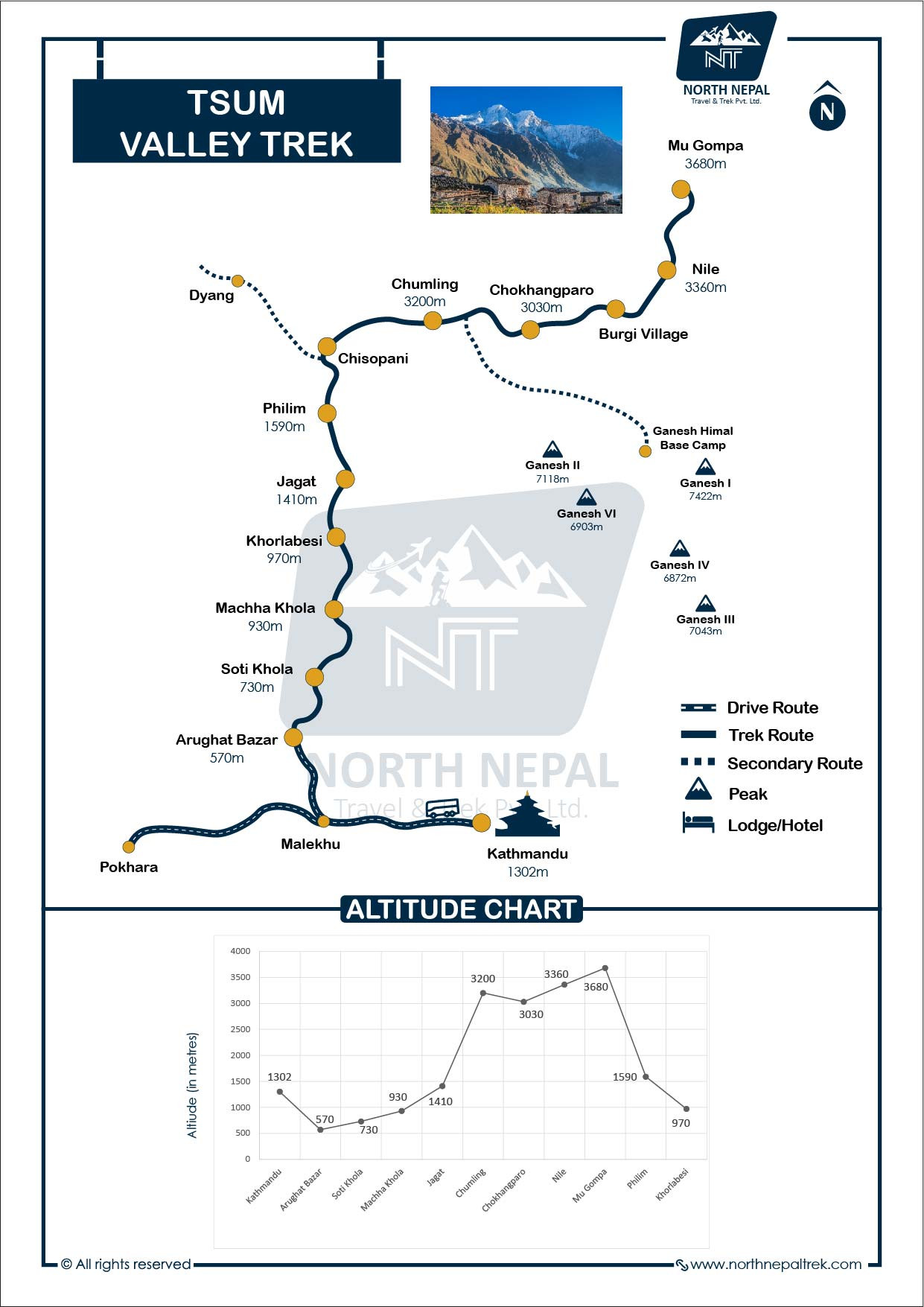
This eight-day trek package takes you into the remote Tsum Valley, a sacred Buddhist valley encompassed in between high mountains. This is located inside Manaslu Conservation Area in Nepal’s Gorkha District, close to the Tibetan border. This walk is through the Upper Budhi Gandaki River corridor, exploring ancient Tibetan-Buddhist culture, local lifestyle, biodiversity, and high snowy mountain ranges.
Permits required: the Tsum Valley Restricted Area Permit (RAP), alongside the Manaslu Restricted Area Permit (RAP) and the Manaslu Conservation Area Permit (MCAP). Graded moderate, this trek offers teahouse accommodation at high altitude.
|
Day |
Route |
Distance |
Duration |
Altitude |
|---|---|---|---|---|
|
1 |
Kathmandu → Jagat |
n/a |
8 to 9 hrs drive |
1,380 m |
|
2 |
Lokpa |
16 km |
6–7 hrs |
2,240 m |
|
3 |
Gho Village |
17 km |
6-7 hrs |
2,415 m |
|
4 |
Nile |
17 km |
6-7 hrs |
3,480 m |
|
5 |
Mu Gompa to Chhekampar |
16 km |
6-7 hrs |
3,700 m |
|
6 |
Chumling |
15.5 km |
6-7 hrs |
2,386 m |
|
7 |
Philim |
13 km |
5-6 hrs |
1,570 m |
|
8 |
Jagat to Drive Kathmandu |
8 km |
3-4 hrs |
n/a |
Altitudes are approximate and may vary depending on the exact route and season.
Dayaram Adhikari, Trekking Guide
Since founding North Nepal Trek in 2015, Mohan Raj Bhandari has kept this Tsum Valley route close to his heart as one of the quietest ways into the Manaslu region. Dayaram Adhikari, who has personally guided groups from Lokpa through Nile and Mu Gompa, shares firsthand insight into pacing this compact 8-day trek through one of Nepal's least-crowded valleys.
Trek starts after check in the permits at the Jagat police checkpoint. From Jagat, the path is flat primarily to Eklebhatti, and two hours of the uphill path. Starting from Jagat, it's a 3.5 km walk to Salleri. Just after Salleri, you'll see the Chamer Mount, as refreshments during the hike on the dusty, motorable, bumpy road.

Photo: Lokpa Village
From Salleri, it's a 2 km, 50-minute walk to Sirdibas on a new track. Just before Sirdibas, you'll leave the motorable track and follow the original trekking trail towards Philim. It's a 1.65 km, 45-minute uphill hike to reach Philim village.
After lunch in Philim, continue the trek to Ekle Bhatti, which is about 3 km and takes an hour. From there, it's another 1 hour and 20 minutes (3.5 km) to reach Nyak Phedi, where the trails split - one to Tsum Valley and the other to Manaslu Circuit and Larkyala Pass.
For Lokpa, you'll continue on a peaceful, forested uphill trail by the Shyar River for 3.4 km, which takes about an hour. After trekking for 6 - 7 hours, covering a 16 km distance, we reach Lokpa.
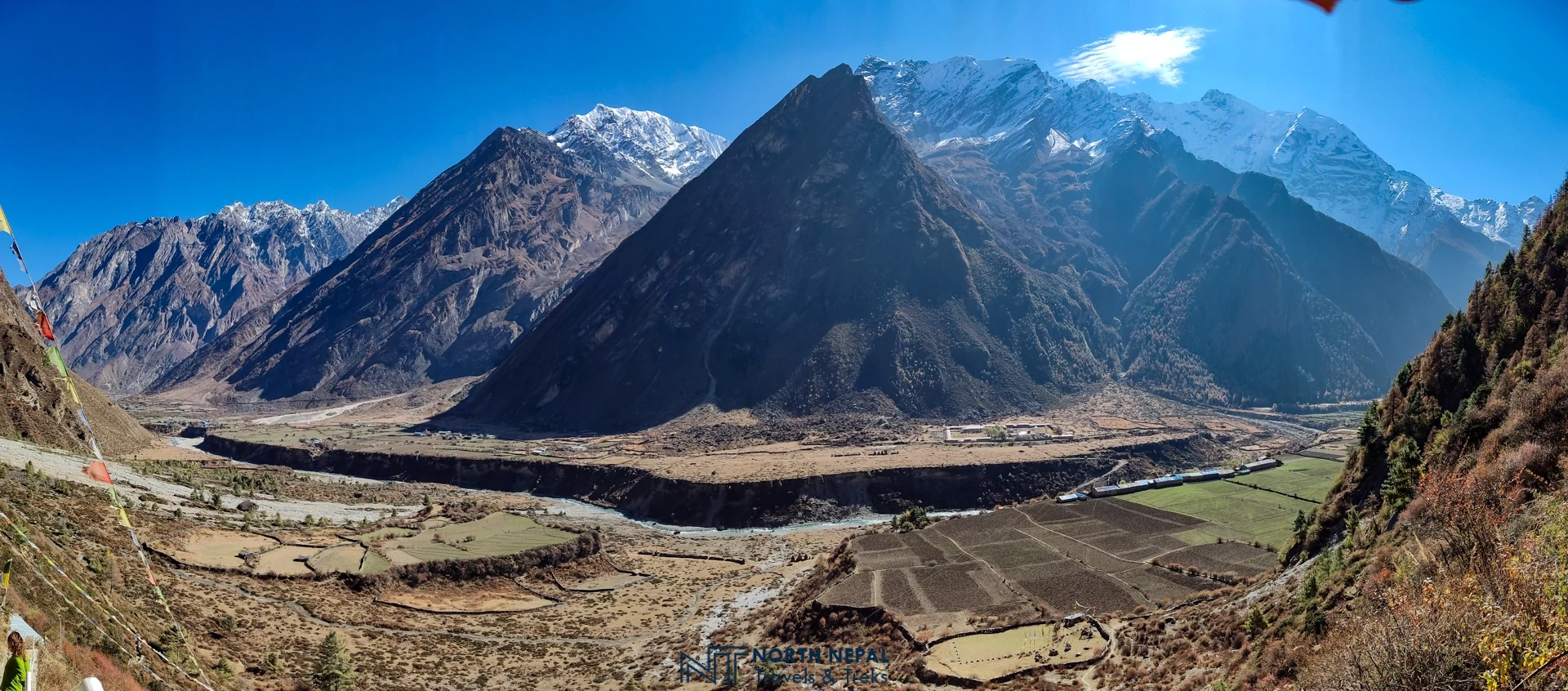
Lokpa is a small town with basic logistic teahouses and the gateway to Tsum Valley. From Lokpa, you can enjoy stunning views of the Himalayan mountains, including Ganesh Himal, Manaslu, and Shringi Himal. Sitting at an elevation of 2,240 meters, Lokpa is surrounded by beautiful landscapes which makes it an ideal starting point for exploring the Tsum Valley.
We start our third day of the Tsum Valley trek from Lokpa after breakfast. The first half of the trek ascends to Chumling, and it descends from there. We walk along the path filled with debris caused by landslides that happened years ago, and it takes 15 - 20 minutes to leave that path behind. From here, the pass ascends and descends, occasionally crossing the suspension bridge.
Photo: Donje Bridge just before Gho village.
During this route, we can also see the Neapl's first cantilever bridge hanging close to the valley. We have our lunch at Chumling after 4 hours of trekking from Lokpa. After trekking for 6 - 7 hours, we will cover 17 km of distance with ups and downs, crossing three suspension bridges and a cantilever bridge, and we will reach the village of Gho. Overnight stay at Gho.
There is only one guest house in Gho Village, so if it is already full, we will trek forward to Renzam Village, which is a 15 - 20 minute trek from Gho.
On the fourth day of our Tsum Trek, we trek from Gho to the Nile. The path from Gho to the Nile starts with a 2- 3 hour uphill journey to Chekampar. From Chhekampar, the whole trek is easy as we trek on flat land with little to no ups and downs. You'll enjoy breathtaking views of the Shayr Khola, the surrounding mountains, and the settlements amidst vast agricultural lands.
From here, you enter the main authentic valley called Tsum, and the people of Tsum Valley are primarily engaged in agriculture and yak rearing. They sell dairy products such as yak cheese, Yarsa Gumba, Churpi, and Yak ghee to the Tibetan market and the Local Nepali market. These local products are in high demand in the local and foreign markets.
The scenery from Gho to the Nile is truly captivating, offering a glimpse into the serene beauty of the Tsum Valley. Before reaching the Nile, we quickly visit a huge monastery in Lamagaun and Rachen Gompa on the next ridge. As you trek towards the Nile, you'll be treated to stunning vistas of the rugged landscape, with towering cliffs and lush greenery lining the path. After hiking 17 km in 6 - 7 hours, we reach the Nile.
We start from the Nile and trek towards Mu Gompa. It takes around 2-3 hours to reach Mu Gompa from the Nile, and the path is mostly flat, and it is just 15 minutes uphill near Gompa. The Mu Gompa looks like a village from afar, but everyone here stays in the Gompa and belongs only to Mu Gompa. Mu Gompa is very close to Tibet, so you can enjoy the traditional Tibetan stone arts during this route.

Photo: Mu Gompa
Moreover, you can also enjoy the fantastic views of Ganesh Himal I 7,422 m (24,350 ft), Ganesh Himal II 7,118 m (23,353 ft), the North face of Manaslu 8,163 m (26781 ft), and Himalchuli 7,893 m (25895 ft).
There are many ancient treasures in Mu Gompa, like a 125-year-old traditional stone sculpture of Buddha, old thangkas with lots of scratches, and books that are so old they cannot be used now, so they are kept on display. There are Buddha pictures engraved on 1000 stone plates, and an ancient statue outside of Nepal is also displayed here.
There is no restriction for taking photos and videos inside gumbas in Mu Gompa, like other old gumbas, such as the Upper Mustang and Langtang region. In Mu Gompa, foreigners, along with their guides, are also welcome to stay overnight here. However, as this isn't any hotel or lodge, there's no menu; you have to accept the meal they prepared for themselves.
After exploring Mu Gompa, you'll head down to Chekampar, following the Shyar Khola River to Lama Gaon. From there, hike downhill to the twin village to reach Chhekampar, where you'll stay at a lodge.
We start our trek to Chumling after breakfast. The broad valley of Chhekampar, with spacious fields filled with barley, maize, and potatoes, slowly narrows to the trail road. The herds of Thar and blue sheep can be seen during this route.
Photo: Chhekampar Village
Enjoying the views of Ganesh Himal and Baudha Peak (6,672 m / 21,889 ft), we cross SerpuKhola and trek downhill, passing some villages with stone houses and chortens fluttering in the wind. From here, we take a path through the forest filled with Langurs.
Near Chumling, we pass a small water-driven prayer wheel and cross a new, growing forest over a recent landslide zone. After crossing a suspension bridge and trekking for 6 -7 hours to cover 15.5 km on a flat and descending route, we reach Chumling. Overnight stay at Chumling.
We trek today from Chumling, descending through terraced fields and lush forests. We'll cross over the Shyar Khola River on a suspension bridge, getting our first glimpses of the beautiful landscapes along this route.
Photo: Cantilever bridge on the way, from Chumling to Philim
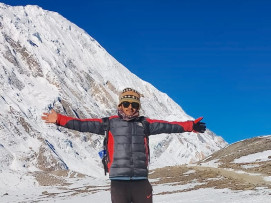
As you continue, we'll reach the impressive Samba Falls. The path winds through small villages, fields, and forests, offering stunning views of the surrounding mountains, including Shringi Himal. Along the way, you'll encounter friendly locals, some grazing yaks, and other livestock.
The trail then heads in the direction of the village of Lokpa, passing by the beautiful Samba Falls. After 6-7 hours of trekking, continuously descending through the forested landscapes and ridges, you'll reach the village of Philim, located at an elevation of 1,570m. You'll spend the night in Philim.
The last day Tsum Valley trek starts from Philim and trek to Jagat. The descend is easy and only takes us three hours to reach Jagat. We will again enjoy the views we started with, cross the Budi Gandaki River from there, and drive from here to Kathmandu.
Eventually, you will reach the beautiful village of Arughat, on the bank of the Budhi Gandaki River in the Manaslu region. Continuing your drive, you will head southeast back towards the capital valley of Kathmandu. The route will take you along the Trishuli and Marsyandghi Rivers, passing through Dhading Besi before finally reaching Kathmandu Valley.
Note: You can include Lunch and Dinner within the package itself, with an extra cost of 15$ - 20$ per day.
Autumn Trail Alert: Trails through Tsum Valley are dry and clear with cold nights above Nile; teahouses are open throughout, though wifi and network stay patchy beyond Chumling.
We recently had an incredibly wonderful and memorable experience with our guide Zeewan and our porter Dayaram on our Manaslu Circuit and Tsum Valley trek. Zeewan came highly recommended from friends. He and Dayaram were exceptional, we always felt we were in safe hands over the 19 days we were completing the trek. Zeewan has so much passion for Nepali wildlife and it shined through and really enriched our experience; while we were trekking, he spotted wild deer, Tahr, Blue Sheep and Himalayan Marmots for us to see. We would absolutely recommend heading out with Zeewan to anyone, we are incredibly grateful for the professionalism and kindness of our guide and porter.
We came as strangers and left as friends. That sums up our experience with North Nepal Travel & Trek (especially Mohan, the manager, and Zeewan, our guide) perfectly. It is definitely the best agency we can imagine. Mohan takes time for his guests, listens to them and then customizes a trekking tour. Everything is highly professional and perfect in terms of safety. When things didn't go fast enough in the kitchen at the guesthouse, Zeewan always stepped in and helped to get the best result for us. As soon as we weren't feeling well with the altitude, he supported us with any problem and helped us to feel better quickly. We even experienced a winter storm during our hike in February and still felt very safe and in best hands, Zeewan knows exactly what he is doing. After the hike, we were welcomed as friends by Mohan and we met again and again for tea, coffee and food many times. Thank you so much for this wonderful experience Mohan and Zeewan, we look forward to seeing you again!!!
We did the Tsum Valley Trek, the Poon Hill trek, and the Australian Base Camp walk with North Nepal Treks in November 2024 and were never disappointed. Everything was perfectly organized, and we especially appreciated the flexibility and constant attention to safety, including altitude sickness management. A big thank you to Mohan, the owner, whose personal concern for our safety and enjoyment made all the difference. We always felt cared for and could fully enjoy these unforgettable treks. Highly recommended! 10/10.
Itineraries are structured with gradual elevation gains to ensure proper acclimatization before reaching high-altitude points like Mu Gompa (3,700 m). Guides conduct daily health assessments for symptoms of Acute Mountain Sickness (AMS). If severe symptoms appear, standard protocol mandates immediate descent to lower elevations.
In cases of severe injury, acute illness, or extreme weather, emergency helicopter evacuation is coordinated directly through local rescue services. Evacuations are initiated immediately upon assessment by your guide in communication with our Kathmandu office.
All trekkers must hold comprehensive travel insurance covering emergency medical treatment, high-altitude trekking (up to 4,000 m), and helicopter evacuation/rescue. Insurance details must be submitted prior to the departure of the trek to streamline emergency logistics if required.
Secure the Tsum Valley Trek for 2026/2027 before the seat gets fully booked.
The standard Tsum Valley Trek takes 8 days, making it suitable for travelers who want to experience the valley’s Buddhist culture, monasteries, villages, and mountain landscapes within a relatively short itinerary. The trek can be extended to 12–18 days for deeper exploration and additional cultural or trekking experiences.
Tsum Valley is in northern Gorkha District, Gandaki Province, within the Manaslu Conservation Area and close to the Tibetan border. The valley is known for its remote mountain scenery, Tibetan-Buddhist heritage, traditional villages, and monasteries.
The trek is graded moderate. Expect around 5–6 hours of walking per day, with changes in altitude and some longer sections. No technical climbing skills are required, but regular walking or hiking preparation is recommended.
Yes. Beginners with reasonable fitness and some basic walking or hiking experience can complete the 8-day route. Preparing with regular walking, hiking, or light cardiovascular exercise before the trek will make the daily stages more comfortable.
Most trekking days involve approximately 5–6 hours of walking. Actual walking time varies according to altitude, terrain, weather, trail conditions, and the pace of the group.
Tsum Valley is known as the Hidden Valley because it is surrounded by high mountains in northern Gorkha and remained culturally isolated for generations. The valley was opened to foreign visitors in 2008, allowing travelers to experience its Tibetan-Buddhist traditions and remote village life.
Mu Gompa, situated at around 3,700 meters, is one of the important ancient monasteries in Tsum Valley. The monastery preserves Buddhist traditions, religious art, and the spiritual heritage of the valley and remains an important destination for trekkers exploring upper Tsum.
You need both the Manaslu Conservation Area Permit (MCAP) and the Tsum Valley Restricted Area Permit (RAP). Because Tsum Valley is a restricted area within the Manaslu Conservation Area, these permits must be arranged before entering the valley.
Partners is not required unlike previous year, but Tsum Valley remains a Restricted Area, so you must travel with a licensed trekking guide and have the required permit approval. The current arrangement means you don't need to find another trekking partner simply to enter the region.
Yes. A government-licensed trekking guide is required for the Tsum Valley Restricted Area. Besides meeting the regulatory requirement, a guide helps with navigation, altitude management, communication with local communities, and respectful visits to monasteries and other culturally important places.
Our guides are licensed professionals, English-speaking, trained in high-altitude first aid, and experienced in the Tsum Valley and Manaslu regions. Their local knowledge is particularly valuable on a route where villages, monasteries, and trail conditions can vary.
Yes. The itinerary can be adjusted according to your travel duration, fitness, and interests. Longer versions can include additional monastery visits, cultural experiences, or time for a slower pace and meditation-focused travel.
A deposit is required to secure the trekking arrangements, including the guiding team and permit processing. Payment can be made by bank transfer, credit card, or cash. The exact deposit amount and payment schedule should be confirmed when booking.
The source material indicates that the best trekking conditions are during the main favorable trekking seasons. Exact seasonal details and months should be confirmed against the current itinerary before publishing, as the supplied FAQ extraction does not include the complete seasonal answer.
Yes, winter trekking is possible. Temperatures are considerably colder and some lodges may close, but winter also brings quieter trails and a peaceful atmosphere that can appeal to travelers interested in solitude and the valley's spiritual character.
Accommodation is primarily in local family-run teahouses. Rooms are basic but comfortable, and staying in these lodges provides direct interaction with local communities and an opportunity to experience village hospitality.
Meals commonly include dal bhat, noodle soup, Tibetan bread, momos, eggs, porridge, rice, vegetables, and tea. Vegetarian and vegan options are widely available along the route, although food choices become more limited in the higher and more remote sections.
Yes. A porter can be arranged to carry your main luggage, allowing you to walk with a lighter daypack. The supplied itinerary information indicates a porter load of approximately 15–22 kg.
The supplied information says a physical trekking map isn't routinely provided. Trekkers can purchase maps in Kathmandu or Pokhara and use suitable GPS-based navigation tools as a supplementary reference. A digital map should not replace the guidance of your licensed trekking guide on this restricted-area route.
The supplied package information lists the guided trek from USD 800 for two persons, depending on group size and services. Because the wording in the source does not clearly establish whether this is a total price or a per-person rate, the final published price should be clarified before going live.
There should be no undisclosed mandatory costs. Optional expenses such as hot showers, charging, snacks, and similar personal services may cost extra and should be explained before purchase. Any applicable payment-processing or card charges should also be stated clearly in the booking terms.
Depending on weather and visibility, the trek provides views of the Ganesh Himal Range, Boudha Himal (6,672 m), and Shingri Himal, together with steep mountain valleys, cliffs, and glacier-shaped landscapes.
The trek begins after traveling from Kathmandu toward the Manaslu region of Gorkha, followed by the road approach to the trekking area. The exact roadhead and transportation arrangement depend on the selected 8-day itinerary and current road conditions.
Connectivity is limited compared with Kathmandu and Pokhara. Some villages may have mobile coverage or internet access, but trekkers shouldn't expect reliable connectivity throughout the valley. It's best to prepare for periods without a normal phone or internet connection.