Mardi Himal Trek – 7 Days, 2026

Mardi Himal Trek – 7 Days, 2026
DESTINATION Nepal
MAX. ELEVATION 4,500 m | 14,764 ft
WALKING DISTANCE ~44 km
GRADE Moderate
BEST SEASON March -May / September-December
DURATION 7 Days
MEALS INCLUDED Breakfast, Lunch & Dinner
ACCOMMODATION Lodge and Teahouse

OVERVIEW & HIGHLIGHTS

Mardi Himal Trek Overview

The 7-Day Mardi Himal trekking itinerary package starts from Pokhara (822m) through the Annapurna Conservation Area (ACAP), following a newly opened 2012 route via Kande, Australian Camp, and Rhododendron and Oak forests of Low Camp and High Camp to Mardi Himal Base Camp (4,500m). The short and moderate trek offers close-up views of Mardi Himal (5,587m), Annapurna I (8,091m), Annapurna South (7,219m), and Machhapuchhre (6,997m) one of the finest Annapurna Massif panoramas accessible in under a week. An ACAP permit (NPR 3,000/~$25) and licensed Guide is mandatory from April 1, 2023. 

Download the all-season packing checklist before you lace up your trekking boots for Mardi Himal Trek.

Annapurna I (8,091m / 26538 ft), Annapurna South (7,219 m / 23,680 ft), Machhapuchre (6,997 meters / 22,950 ft), and Gangapurna Himal (7,454m / 24,450 ft), which makes this trek worth every penny. This trek takes you through the routes of Astam, Kande, Australian Camp, Forest Camp, Low Camp, High Camp, Badal Danda, Kalimati, Pothana, Lwang, and Lumre, depending upon the number of days you choose to trek and the routes available.

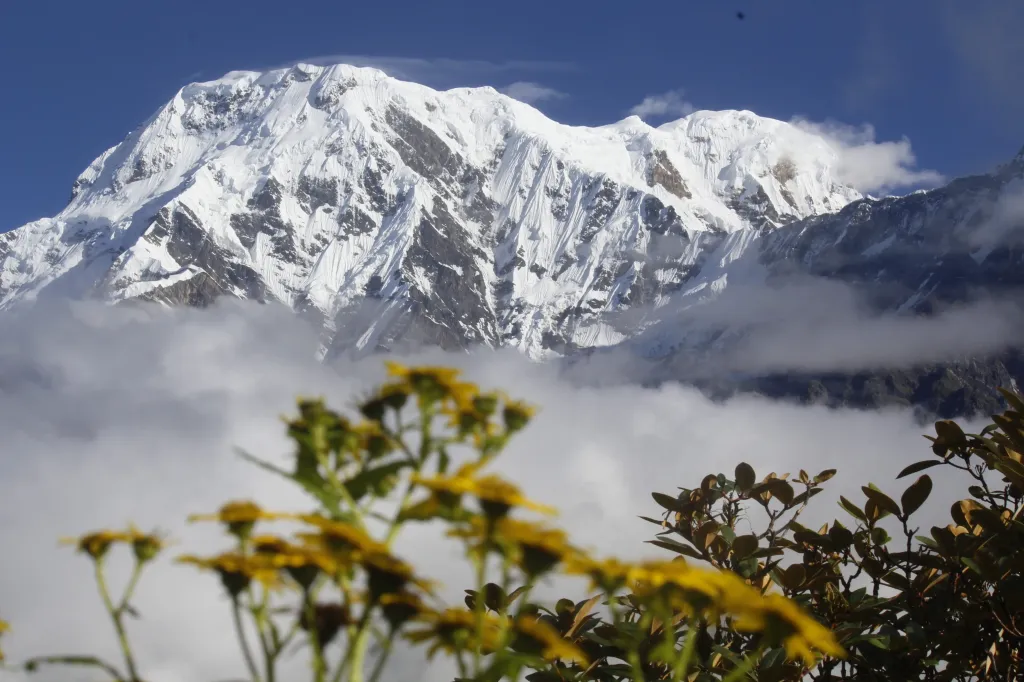
snowy peak seen during Mardi trek in Monsoon seasonPhoto: Snowy peak seen during Mardi trek in Monsoon season

Mardi is the only trek in Nepal that exposes you to diverse landscapes in short range just after walking for 4 days in 4000m+ elevation. Experience lush forests, alpine meadows, and dramatic high-mountain scenery in a compact route. This is not even possible in ABC trek. The growing number of tea houses along the route has made this short trek easier for people with different fitness levels, as options for lunch and dinner with accommodation are readily available. Additionally, this trek mostly passes through forests covered with Oaks and Rhododendrons, so wildlife such as Musk Deer, Langurs, other Monkeys of various species, Danfe (Lophophorus), and Porcupines can be seen during the trek.

This trek is a hidden treasure where one can revel in majestic mountain panoramas, encounter wildlife in verdant forests, and traverse rivers and ridges within a single hike. Travel along the small curving paths through the forests and finally climb out of the woods to witness mesmerizing views of Mardi Himal, Annapurna South, and Machhapuchre from the Badal Danda.

Find the comparison table between Mardi vs. Kori vs. Kapuche Lake; shortest trek from Pokhara

Why you will love the Mardi Himal Trek?

  • Mardi Himal Trek takes you to the Mardi Himal Base Camp at an altitude of 4,500 m (14,764 ft) 
  • Astonishing views of the snow covered mountain ranges; Annapurna I (8,091m/ 26538 ft), Annapurna South (7,219 m / 23,680 ft), Machhapuchre (6,997 meters / 22,950 ft), Gangapurna Himal (7,454m / 24,450 ft), and of course Mardi Himal5,587 me / 18,328 ft).
  • Hike through Rhododendron forests, incredibly vibrant during the spring ( March to April ), the small villages, green forests among the wildlife such as Musk deer and Lophophorus (Himalayan Monal), fast-flowing Seti rivers, and Lwang waterfalls.
  • Immerse in local culture, cuisine, and warm hospitality while interacting with Gurung, Chhetri, Brahmin, and Tamang communities.
  • Opportunity to interact with friendly domestic yaks and calves during early summer seasons.
  • Offers a more peaceful and personal trekking experience compared to other popular routes such as Ghorepani Poon Hill and Annapurna Base Camp. 
  • Trek through diverse landmarks from forests to grasslands, terraced fields to rocky ridges, and finally to the Mardi Himal Base Camp. 
  • Suitable for beginners but also doable in 3 days (recommended for professional only)
Bibek Bhandari
Itinerary review by

Bibek Bhandari, Trekking Guide

Since founding North Nepal Trek in 2015, Mohan Raj Bhandari has kept a close eye on the Mardi Himal Trek, and Bibek Bhandari shares firsthand insight from personally leading this trek, so you know exactly what to expect before you go.

Mardi Himal Trek Itinerary

Toggle all
Day 1

Drive to Hemja and Trek to the Australian camp via Astam

HIGHEST ALT. 2060 m / 6760 ft
DURATION 5- 6 hours
Distance
DISTANCE ~ 8 km

(To reach Pokhara city from Kathmandu, you must take a 25-minute flight or a 7-hour Jeep/bus drive.)

We drive from Pokhara to Hemja (30 min) by car and trek to Astam village situated at 1520 m altitude. After about 3 hours of hiking through the beautiful forest trail, we reach Astam village. After our lunch and brief sightseeing, we trek towards the Dhampus Village through the forests on stairs but 30 minutes of off-track motor road cannot be avoided.

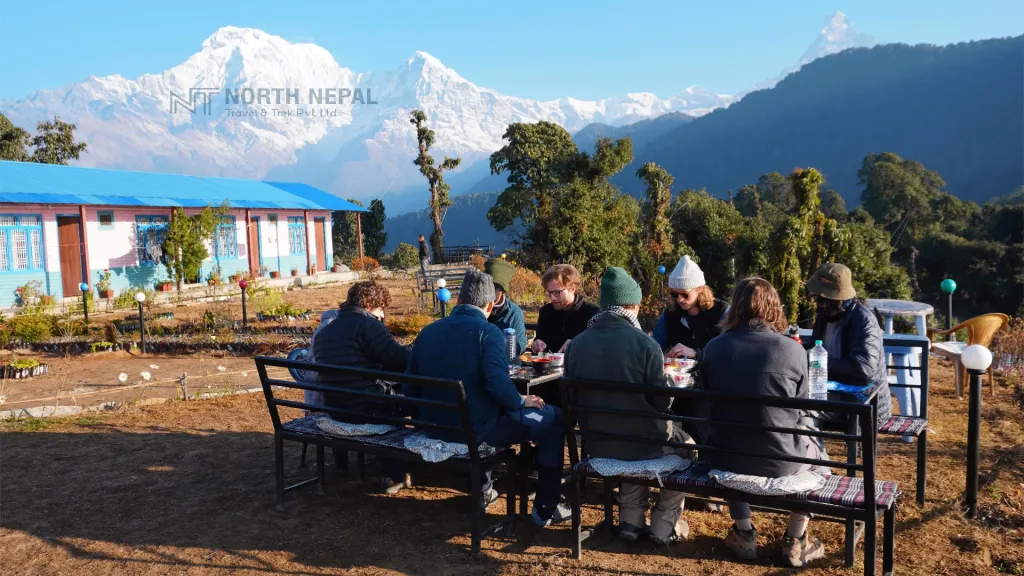
Trekkers from north nepal trek having lunch during mardi himal trek with backdrop of mount machhapuchre

After 2 hours of trekking to Dhampus (1650 m), we take a tea/coffee break and enjoy the Annapurna Mountain Range.  We start our trek toward the Australian Base Camp passing by villages and seasonal farming fields. Dhampus to Australian Camp is about 1 hour through the forests with stairs. Australian Camp is situated at an elevation of 2,060m. It gives a view of the Annapurna mountain range. It is also the best place for sunrise and sunset. Overnight stay at Australian Camp.
 

Day 2

Trek to Forest Camp

HIGHEST ALT. 2550 m / 8366 ft
DURATION 6 hours
Distance
DISTANCE ~ 9 km

After early breakfast, our trek starts at Forest Camp (2,550 m). The trail takes you through dense forests of rhododendrons and bamboo. We pass through popular places like Pothana (1,890) and Pitam Deurali( 2100m), which also offer accommodation for trekkers. Keep your eyes focused for a keen lookout for wildlife and birds in this region.

View from Low Camp during Mardi Himal Trek clicked by North Nepal Trek.
Photo: View from Low Camp during Mardi Himal Trek

Reaching Rest Camp, we will rest and have our lunch (2500 m). The path gradually becomes steeper and steeper until the flat path at the start changes to a steeper climb requiring more physical effort. After steep climbing up along the rhododendrons forest with the chirping sound of birds, we reach Forest Camp in the middle of dense woodlands within 5 -6 hours of trekking. Overnight stay at Forest Camp.

Day 3

Trek Forest Camp to High Camp

HIGHEST ALT. 3580 m / 11745 ft
DURATION 5-6 hours
Distance
DISTANCE ~ 7.6 km

Starting our day with breakfast, we start our trek toward High Camp at an altitude of 3,580m via Badal Danda. The route to Badal Danda (3210 m) is mostly through the rhododendron forest, but you need to walk on the stairs. After a 3 hour trek, we reach Badal Danda. A 10 min detour from the trail will offer you a chance to witness the Baraha Temple of the Gurung community, this sacred temple dedicated to Lord Baraha (an incarnation of Lord Vishnu) holds religious significance for the locals. Take a moment to appreciate the cultural and spiritual aspects of the area.

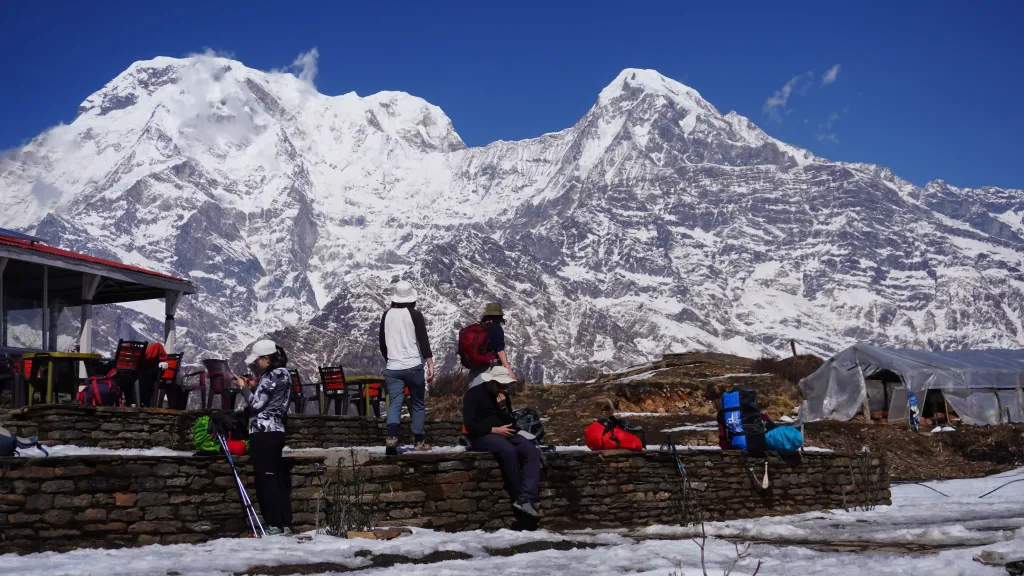
Trekkers from North Nepal Trek enjoying the view of the Mardi Himal from High Camp during the Mardi Himal Trek.
Photo: View from High Camp

The Badal Danda hosts hotels and lodges so we have our lunch here enjoying the view of Mount Machhapuchhre (6,993m). The name of this place originated to be Badal Danda, as it is always covered with Badal i.e. Cloud, Badal Danda meaning Cloudy Hill. The weather here is unpredictable so, after lunch and a bit of rest we hurry our way toward the Highcamp. 

The path from Badal Danda to High Camp changes the forests to pasture grassland which is covered with snow during the snowfall and is pasture grassland during the Monsoon season. The path is steep upward and takes about 3 to 4 hours of trekking to reach the High Camp(3,580 m). The path is mostly covered with stairways replacing the natural challenging paths which lead to the High Camp. Interact with friendly domesticated yaks and calves and witness the Himalayas along the way. The decrease in oxygen level along with fatigue is replaced by the breathtaking mountain views along the way. We will stay overnight at the high camp, but before bed, we will make sure to be well-prepared for the base camp trek tomorrow.

Day 4

Explore Mardi Himal Base Camp and Back to Badal Danda

HIGHEST ALT. 4,500 m / 14,764 ft
DURATION 7 - 8 hours
Distance
DISTANCE 10 km

On the fourth day of our trek, we will walk about 5 hours to reach Mardi Base Camp. After breakfast, we start trekking to Base Camp (4,500 m).

Trekkers from North Nepal Trek posing on Mardi Himal Base Camp with the backdrop of Mardi Himal during Mardi Himal Trek.
Photo: Mardi Himal Base Camp

Ascending to Mardi Base Camp offers breathtaking views, similar to the base camp if not even better than the base camp of the Himalayas such as Annapurna South, Hiunchuli, Annapurna III, Machhapuchhre, and Gandarva Chuli.

Trek can be due to narrow, rocky trails, and the air gets thinner as you climb up. However, all the challenges and hardships during this trek are forgotten when you reach the base camp, which is blessed with stunning mountain views of the pristine surroundings at the Mardi Himal Base Camp.

After enjoying the magnificent views from the Base Camp, we retrace our steps back to the High Camp and have breakfast.

After breakfast, follow the same path we took yesterday to reach the High Camp enjoying the Yaks and beautiful environments; we reach Badal Danda and have lunch. After some rest, explore the Badal Danda. Stay overnight in Badal Danda.

Day 5

Trek from Badal danda to Kalimati

HIGHEST ALT. 3210 m/ 10532
DURATION 5 - 6 hrs
Distance
DISTANCE 7.5 km

On this day, we will trek down to Kalimati Village (1,600 m). After breakfast, our downhill starts from Badal Dada. To reach Kalimati Village we will walk about 6 hours covering 7.5 km.

Mountain peak and cluody valley seen from Badal Danda.Photo: Mountain peak and cluody valley seen from Badal Danda.

We trek from low camp towards Kalimati which is also all the way downhill through the rhododendron forests. After about 3-4 hours of trek, the path through the forest takes you to the organic and scenic Kalimati Village.

The altitude of Kalimati village is about 1600m and it is famous for servings of organic fruits and vegetables produced locally by the Bharmin and Chhetri Communities. 

Kalimati is a beautiful village known for its organic farming practices.  We can offer you the opportunity to indulge in the cooking of organic vegetables in the Kitchen of the famous Mardi Himal Eco-village Hotel and Restaurant.

The eco-friendly village of Kalimati also offers scenic views of the Himalayas and you can interact with the friendly locals. Stay overnight at Kalimati at the Mardi Himal Eco-Village Hotel and Restaurant. 

Day 6

Kalimati to Lwang village (via Pokhara canyoning and Lwang homestay)

HIGHEST ALT. 1600 m / 5250 ft
DURATION 5 - 6 hrs
Distance
DISTANCE 6 km

After early breakfast, we will trek to Lwang Village. It will take about 6 hours of walking to reach Lwang. While trekking to Lwang, we will pass through the Pokhara Canyoning spot on the Kudi waterfall in the village of Ghalel and Lumre Waterfall.

Lwang Village Tea garden.

Photo: Lwang Village Tea garden.(source)

Lwang Village is a beautiful village that offers visitors a traditional Nepali Village experience with a rich Gurung culture. It is also one of the top destinations for homestays worldwide, where you can even enjoy the delightful tea gardens.

The hospitable Gurung inhabitants, the picturesque sceneries of the surroundings, and the pristine waterfalls, famous for the canyoning in Lwang Ghalel, in addition to sunrise views, views of a tea garden, and the bird watching along the way truly make the trip to Lwang Ghalel a must-visit destination.

Day 7

Lwang to Lumre and drive back to Pokhara

HIGHEST ALT. 1550 m / 5086 ft
DURATION 5 - 6 hrs
Distance
DISTANCE 10 km

We wake up early to witness the sunrise in Lwang Ghalel, the sun gradually illuminates the Annapurna Range and the view of Annapurna Range sunbathing is just spectacular.

After the sunrise, we eat breakfast and start our final day of the trek. The up-and-downhill path from Lwang to Lumre is about 10 to 12 kilometers and takes you to Lumre in about 5-6 hours depending on your pace.

You will also pass through small settlements of Gurung Inhabitants during this trail. We will take our Lunch at Lumre situated at an altitude of 1200m and wait for our vehicle.

The drive from Lumre to Pokhara is 60 minutes covering about 20 km distance following the Prithivi Highway or Pokhara-Baglung Highway.

You will enjoy some scenic views of hills and the ever white Seti River during this trail. While most road sections are in the best condition, some drive sections will be through bumpy roads. Stay overnight at Pokhara.

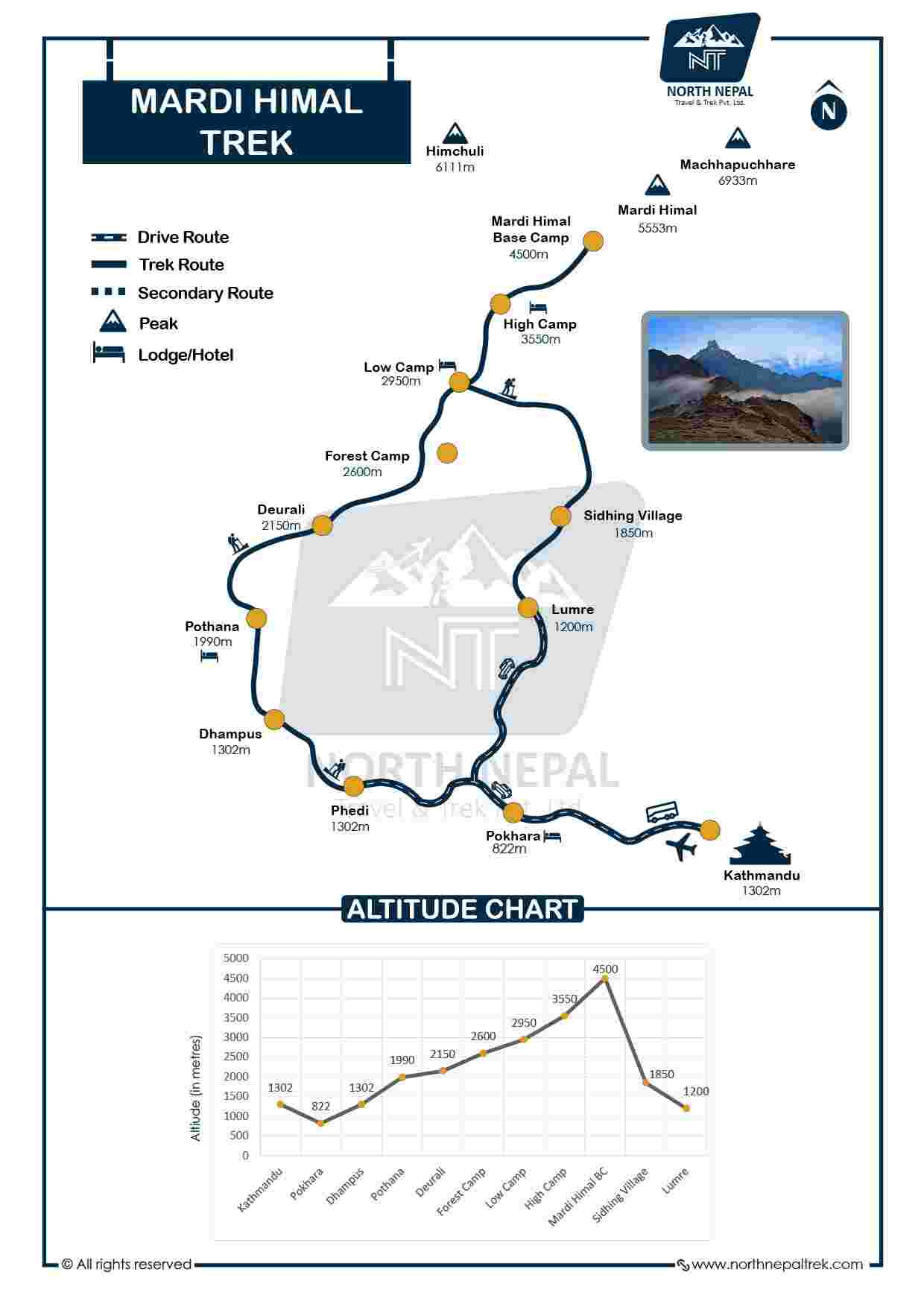
Mardi Himal Trek Route Map

Mardi Himal Trek Route Map

What's Included & Excluded

The included sections refer to details for all the itineraries mentioned above:

  • All ground transfers in private/sharing vehicles as per availability, for every itinerary
  • Tea house accommodation during the trek ( Private room )
  • One highly experienced, helpful, and friendly guide, and his food, accommodation, salary, equipment, and accidental insurance.
  • We provide 3 meals per day (Breakfast, Lunch, & Dinner) and Tea twice daily. Please note that each meal is served as a single serving.
  • All the necessary paperwork and Annapurna conservation entry permit ( ACAP permit & TIMS card, etc.)
  • Fresh/Dry fruits along the trek.
  • First Aid Medical Kit Box with an oximeter.
  • Trek achievement certificate after the trek.
  • Government taxes, TDS, VAT & other legal documents.
  • Anything related to International flight airfares such as Nepal entry visa fees, excess baggage charges, International flight tickets, and so on.
  • Supporter/porter to carry your duffle bags during the trekking. (One porter carries up to 25 kg of 2 pax)
  • Additional assistant guide, if needed.
  • All accommodations and meals before the trek, extra night accommodations due to early arrival in Nepal late departure, or early return from the trek.
  • Personal expenses before the trek such as (renting sleeping bags, buying trekking shoes, and so on), during the trek (any shopping, boiled water, tea coffee ( if more than 2 times ), cold drinks, alcoholic beverages, hot showers, telephone call, Wifi, cell-phone, camera battery recharges and so on).
  • Travel insurance covers high-altitude helicopter rescue and evacuation along with medical costs.
  • Tips and gratitudes for guides and porters.
  • Additional costs, such as additional days due to delays caused by natural/uncontrollable phenomena such as bad weather, landslides, and change of plans (itinerary modifications) due to safety concerns, illness, and so on.
  • Lastly, all of the costs and expenses that aren’t listed in the “What’s Included?” section.

Note: You can include a porter (carries up to 20 kg ), with an extra cost of $ 25 per day.

Complete Guide to the Mardi Himal Trek

Toggle all

History of Mardi Himal Trek

The Mardi Himal Trek was officially opened for trekkers in 2012. However, local shepherds and some adventurous trekkers, along with their expedition tea,m knew about this area long before. The Mardi Himal Trek is located in the Machhapuchhre Rural Municipality, Kaski District of Nepal, within the Gandaki Province. The trek primarily falls under the jurisdiction of the Annapurna Rural Municipality. In terms of mountains, it is located east of the Annapurna Base Camp and lies almost under the impressive Machhapuchhre mountain. The path through thick rhododendron forests that opens up to rough high mountain landscapes filled with ridges makes this trek special. In recent years, the building of teahouses has made this trek easier for visitors who want to explore less-traveled routes.

How to Book Mardi Himal Trek?

You are a step away from booking your Ghorepani Poon Hill Trek. Choose your fixed departure batches and BOOK from the website.

You can WhatsApp: +977 9856016904 or email us at [email protected]. We customize your Ghorepani trek based on your specific requirements, such as accommodations, porter, guide, and other add-ons.

Similarly, we are on TripAdvisor, Get Your Guide, and Tour Radar. You can choose your dates and group size for an easy booking process.

Can’t find a date that works for you? Just contact us, and we’ll help you plan your ideal adventure. Whether you’re joining solo, with friends, or organizing a group, we make it easy to secure your spot and prepare for the trek of a lifetime.

Managing Crowds on Popular Trails

The Mardi Himal Trek stands out for its tranquility, a stark contrast to the often-crowded trails of more renowned routes such as Annapurna Base Camp or Everest Base Camp. The question then arises: how is this peaceful experience preserved amidst the increasing popularity of trekking?

The preservation of this serenity is attributed to several ingenious, community-centric approaches:

  • Small Group Sizes: To ensure safety and personalized attention, trekking organizers usually cap group sizes at 10-15 individuals. This practice also helps minimize noise and environmental impact along the trail.
  • Seasonal and Route Diversification: Alternative trekking routes, such as Mardi Himal, can be promoted over popular spots like Poonhill during peak seasons. This strategy helps disperse adventure seekers throughout the region, preventing over-concentration in specific areas and encouraging exploration of lesser-known tracks.
  • Permit Regulations: To manage the number of hikers and minimize environmental impact, local authorities may limit the trekking permits issued for certain trails, particularly during peak seasons.
  • Dynamic Itinerary Planning: Opting for off-peak or shoulder season treks can be highly rewarding. Many trekking companies provide flexible departure dates and attractive incentives during these times. Trekkers not only experience greater solitude but also benefit from seasonal advantages like vibrant wildflowers or clearer mountain vistas.

What makes the Nepal Himalayas unique compared to other mountain ranges?

The Nepal Himalayas offer a unique and rich tapestry of experiences, distinguishing them from other mountain ranges. Not only do they boast eight of the world's fourteen highest peaks, including the legendary Mount Everest (Sagarmatha) and the iconic Machhapuchhre—each steeped in myth and reverence—but their true distinction extends beyond mere elevation.

The trails here traverse a diverse tapestry of landscapes, ranging from lush subtropical valleys and rhododendron-dense forests to arid alpine meadows and windswept ridges. With every step, a dynamic array of colors unfolds: vivid wildflowers in summer, fiery crimson blossoms in spring, and golden terraces after the monsoon rains. Each bend in the path reveals a fresh vista and a new viewpoint, whether it's the shimmering ice flutes of Annapurna South or the mystical mists drifting over Badal Danda.

The Himalayas boast an unparalleled cultural tapestry. Along ancient trails, welcoming villages are home to Gurung, Magar, Brahmin, Chhetri, and Tamang communities. These communities offer a glimpse into a rich mosaic of traditions, languages, and festivals, including the vibrant Loshar celebration. Local hospitality is renowned; teahouse owners and villagers warmly greet trekkers, sharing stories and home-cooked dal bhat after a day's journey. The spiritual presence is palpable, evident in prayer flags fluttering over scenic passes and serene monasteries nestled in the hills.

The Nepal Himalayas offer a world to be savored with every sense, not merely a destination to conquer. This is thanks to the combination of majestic summits, diverse flora and fauna, timeless culture, and heartfelt connections.

The Choice to Carry Your Pack: Embracing the Trek's True Spirit

While the option to offload your bag for an additional fee exists, we generally advise against it. Opting for extra porters or pack animals places unnecessary strain on the delicate mountain environment and its trails.

More significantly, carrying your own pack is integral to the trek's inherent challenge and appeal. It is precisely this test of your endurance and your readiness to experience some discomfort that elevates the journey into a truly memorable and rewarding adventure. Before considering offloading, weigh whether sacrificing that authentic experience for a lighter load aligns with your trekking goals.

Can I participate in the Mardi Himal trek if I have a specific medical condition?

Undertaking the Mardi Himal trek with a medical condition requires careful consideration of its nature and severity. Before making any trek plans, consult your doctors, especially if you have conditions such as asthma, heart issues, or other chronic illnesses. Since you will trek to an elevation above 3,000 meters above sea level, a doctor's clearance is the safest approach.

Even if you decide to trek, inform your guide or trekking company about your condition in advance. This will help them to design a hike based on your medical conditions. Before the trek, always carry essential medications. Maintain a comfortable pace. Do not rush. Always prioritize your health and safety.

Medical Requirements & Recommendations for Older Trekkers

For trekkers over 60 considering the Mardi Himal Trek, extra preparation is advisable. While generally manageable for healthy adults, a pre-departure consultation with a physician is recommended. It is also highly advisable to carry a recent medical certificate confirming high-altitude trekking fitness, as some trekking agencies may require it.

Before your trek, you should have a general health checkup. Discuss any conditions like hypertension, heart problems, or joint issues with your doctor. Double-check your personal medications, as there are no pharmacies above 2,000 meters at Mardi.

To guarantee a safe and truly pleasant Himalayan adventure, regardless of age, it's crucial to listen to your body, maintain a comfortable trekking pace, stay hydrated, and take frequent breaks.

Mardi Himal Trek's Location& Geography

Mardi Himal Trek is situated inside the Annapurna region of Pokhara, Nepal. It is a popular trek that takes you to cultural villages, choppy landscapes, and proximity to the mountains: Annapurna South (7,219 m), Machhapuchhre (6,993 m), Gangapurna, and Mardi Himal (5,587 m). The weather depends on many factors, such as Mardi Himal trek elevation, mountain ranges, hills, and valleys. The upper region of the Mardi Himal Trek is cooler and drier compared to the lower region of the Annapurna region.

The best aspects of the Mardi Himal Trek are the cultural villages, viewpoints, and mountain peaks. En route to the trek, you reach viewpoints, mountain peaks, Modi Khola, andan occasional view of the Annapurna Base Camp trek route to the south-east. Mardi Himal Trek is a suitable trek both for beginners and pro-trekkers due to its organized teahouses and lodges for accommodation.

You pass through beautiful Gurung villages. You reach different villages: Dhampus, Pothana, Kalimati, Siding, and Pritam Deurali. Gurungs are the main inhabitants of the hilly part of the Mardi. Settlements are mainly on the sloping green hills. The main occupation of the people is farming; however, people are involved in hospitality services due to the rise in tourists. People are mostly Buddhist and celebrate Loshar as the main festival.

To reach Mardi Base Camp situated at an altitude of 4,500 m, you walk through Forest Camp, Rest Camp, Badal Dada, Low Camp, and High Camp. You walk through choppy landscapes, dense forests, and windy trails as you ascend above 3,000 m. Moreover, as you ascend to higher altitudes, the scenery changes from forests filled with tall trees to beautiful meadows filled with colorful wildflowers. Consequently, the summer season offers the best scenery for wildflowers that can’t be witnessed in any other season.

What's unique about the Mardi Himal Trek

Mardi Himal Trek is one of the unique and impressive trekking trails with its eccentric features. You can reach the Mardi Himal trek within 4-5 days. The shortest can be 3 days, and the longest can be 7 days,s Mardi Himal trek. Well, it all dependonon the fitness level and the hiking experience. the 5 day Mardi Himal Trek is suitable for both beginners and experienced trekkers.

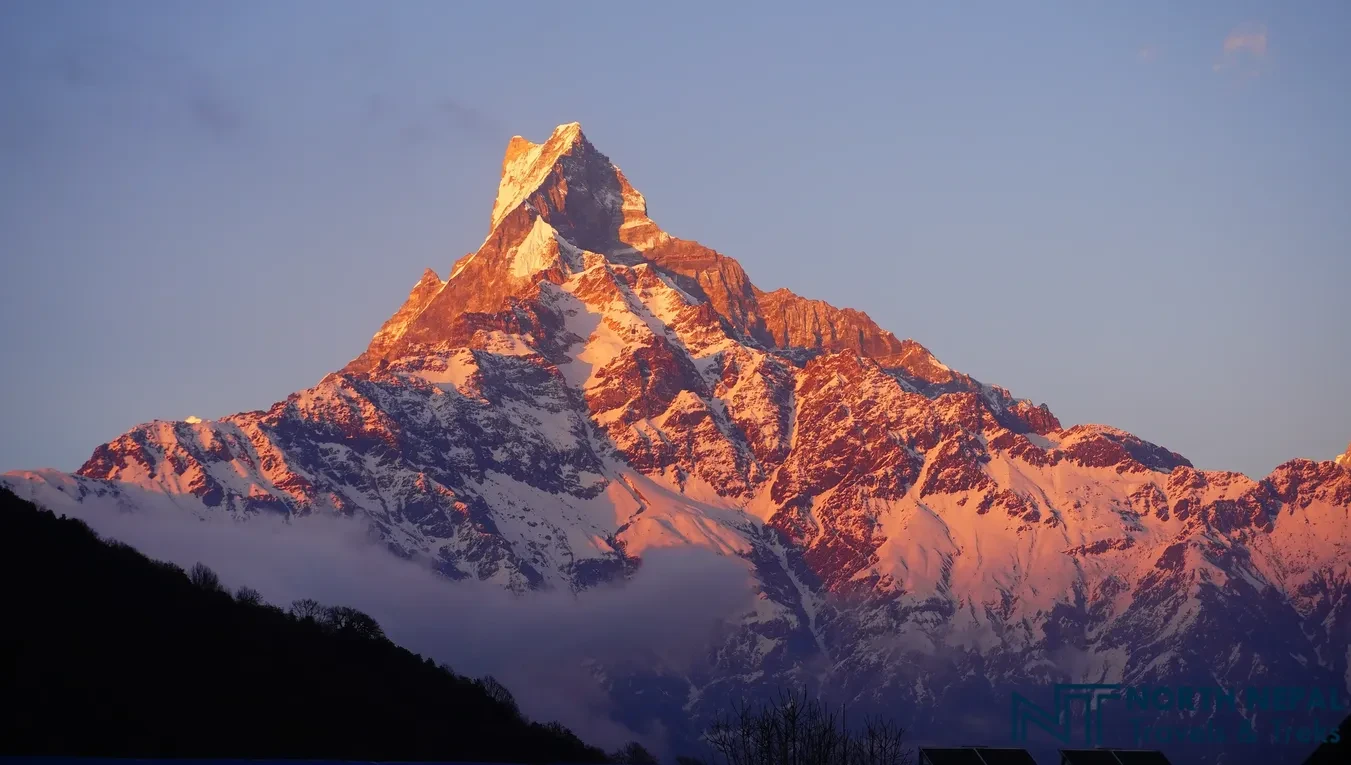
Mardi trek is best for those who preferfewers crowds and more time to appreciate nature. It is peaceful with fewer distractions. Additionally, the true spectacle of this trek reveals itself as the sun breaks the horizon. You'll witness a magical sunrise and sunset coloring Mount Fishtail (Machhapuchhre), Annapurna South, and Hiuchuli in glorious crimson sunlight. These grand peaks stand majestically before your eyes, an unforgettable sight that will surely take your breath away.

In March and April, the Mardi Himal trek transforms into a snow wonderland. Glistening snow covers the entire region of the Mardi, and gives you the feeling of truly climbing a mountain even though you are not. The breathtaking scenery around you feels almost unbelievable. We are sure you will snap a ton of pics during this journey.

Despite being a relatively short trek, the Mardi Himal Base Camp Trek is brimming with picturesque moments and comfortable amenities. There's a range of welcoming tea houses and lodges along the path, complete with wifi, hot showers, and phone charging points, ensuring a comfortable journey without the need for camping.

What is the Best Time for the Mardi Himal Trek?

The best season for the Mardi Himal trek is Spring (Mid-February to May) and Autumn (September to mid-December), like any other Nepali Himalayan Trek. However, the more isolated and pristine trek would be possible during the winter season,n as many trekkers don’t usually travel to this destination during this period.

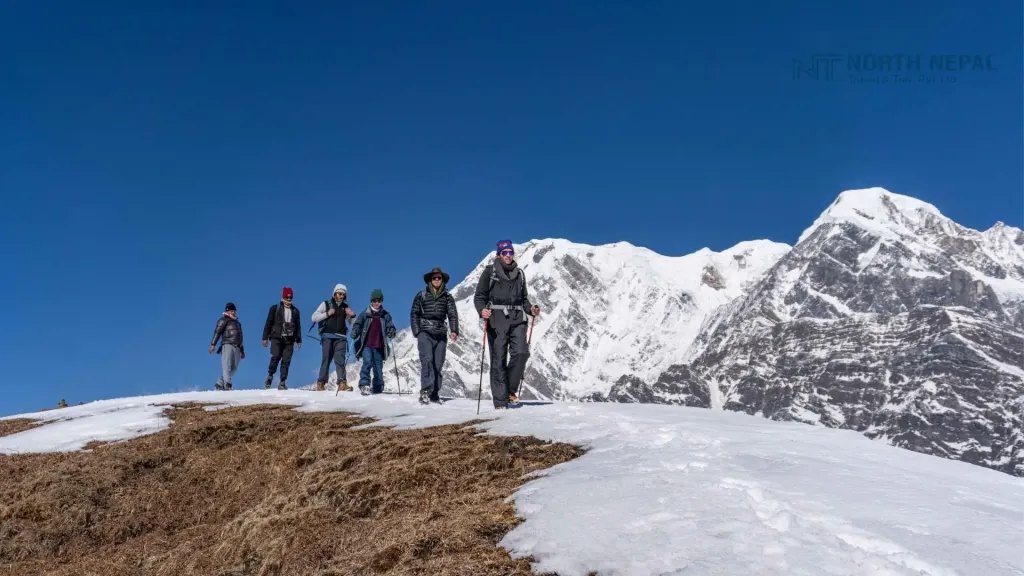
A group of hikers ascends Mardi Himal Base Camp in Nepal during the vibrant spring season, surrounded by stunning mountain scenery.
Photo: Spring Views on the Mardi Himal Trek

The Spring season brings moderate temperatures ranging from 11 to 20 degrees Celsius at the lower altitudes, es and it may be cooler in higher altitudes. The clear skies provide excellent visibility for mountain views, and the blooming rhododendrons throughout the trek decorate the path with vibrant hues of red and pink. Even during the peak season of Spring, the Mardi Himal Trek will not be as crowded as the other popular treks like Annapurna Base Camp and Everest Base Camp Trek.

Furthermore, during the Spring season, even the lower altitude of the Mardi Himal Trek is covered with snow, so you get the feeling of climbing the mountain itself, in this trek. Additionally, due to clear weather,r the sunrise views during this trek, as the sunrises over the Mardi Himal, truly create an awe-inspiring sight.

During the Autumn season, the temperature ranges from 8 to 15 degrees, making trekking ever so comfortable. Due to the stable weather, suitable for both trekking and observing the views, the autumn season is considered the best overall season for trekking in Nepal, not just for the Mardi Himal Trek but for the other treks of the Himalayan Region.

Autumn view of Badal Dada, High Camp, and tea houses on the Mardi Himal Trek in October 2024.Photo: Autumn Glory at Mardi Himal

The clear weather with minimal rainfall offers you clear mountain views of Annapurna and Machhapuchhre and many other mountains, which is truly a sight to behold. You may expect hikers on the trails from different countries during this season, so prepare yourself to make new friends along the way.

The summer season brings rainfall, which hinders the trek routes as it makes some parts of the trails muddy, so some trekkers avoid treks during this season. However, some experienced trekkers go for an adrenaline-pumping adventure, for sceneries that can only be experienced in summer. The trek also rewards these courageous trekkers with lush greenery and wildflowers that bloom only during the summer season.

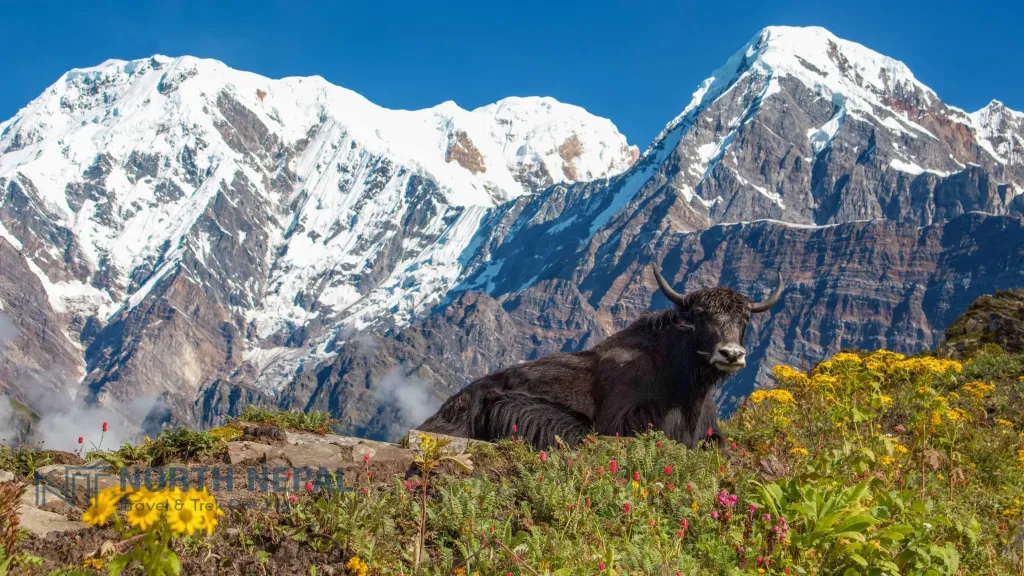
A serene yak sits on green grass, with the stunning summer backdrop of Annapurna South and Hiunchuli, and vibrant wildflowers in Mardi Himal view point. Photo: Summer Vibes at Mardi Himal

Mardi Himal Trek Cost 

Here is a detailed cost breakdown for the 4 Night 5 Days Mardi Himal Trek, so you can select the plan that best suits your needs and budget.


Mardi Himal Trek Cost for Full Board Package

Group

Cost per pax (7 Days)

Cost (5 Days)

1 Pax

USD 600

USD 425

2 Paxes

USD 500

USD 375

3 - 5 Paxes

USD 480

USD 325

6 - 10 Paxes

USD 450

USD 300

11 - 25 Paxes

USD 400

Ask for price

While the cost of the Mardi Himal Trek listed above is the full board package,e including Transportation, Guide, TIMS, Permits, 3 times meals, and accommodation, you can choose the half board package or the guide service.

Mardi Himal Trek Cost for Half Board Package

Group

Cost per pax (7 Days)

Cost per Pax (5 Days)

1 Pax

USD 420

USD 300

2 Paxes

USD 385

USD 275

3 - 5 Paxes

USD 350

USD 250

6 - 10 Paxes

USD 315

USD 225

11 - 25 Paxes

Ask for price

Ask for price

The half-board package cost for the Mardi Himal trek is per person and includes your transportation, Guide, TIMS, Permits, and accommodation with Breakfast as per the BB plan.

Guide or Porter Service for Mardi Himal Trek

The guide for the Mardi Himal Trek costs US$ 40 per day, and the porter costs US$ 25 per day.

Note: You need to understand that your guide isn’t your porter, so they can’t help you carry your big bags. Also, the porter can only have 25 kg, and if the bag is heavier than 25 kg, additional charges may occur without any further notice.

4 Days Mardi Himal Trekking Itinerary (only for professional hikers)


Infographics on 4 Days Mardi Himal Trek Elevation and Distance

Day 1: Drive from Pokhara to Kande to Forest Camp (Kokar)

Driving Hours

1 hr - 1 hr: 30 min

Trekking Hours

6 - 7 hrs

Trekking Distance

15 km

Pokhara Altitude 

822 m

Forest Camp Altitude

2,550 m

Altitude Gain

1,728 m

We drive towards Kande for about 1 hour. After we arrive at Kande, we take a short break to prepare and start trekking toward Forest Camp, which takes nearly 7 hours in total.

We arrive at Australian Camp after trekking for 1.5 hours from Kande, mainly through the forests uphill. After a short break, we continue our hike towards Forest Camp; the total distance is approximately 9 kilometers (5.6 miles). which takes about 4 to 5 hours. With steep climbs, we reach Forest Camp, in the middle of the woods, surrounded by forest from all sides, where we will spend the night.

Day 2: Forest Camp to High Camp

Trekking Hours

5 - 6 hrs

Trekking Distance

20 km

High Camp Altitude 

3,580 m

Forest Camp Altitude

2,550 m

Altitude Gain

1,030 m

Our trek today consists of stone steps to Badal Danda and 2-3 hours of trek from Forest Camp. We will take a lunch break there, relaxing for an hour or so. Following rest, we resume our trek toward the High Camp, which takes nearly 3 to 4 hours of hiking a plain trekking trail thsteeplyeps upward shortly. We will stay the night here, and you can enjoy scenes of the Himalayas from the camp.

Day 3: High Camp to Mardi Himal Base Camp and back to Badal Danda

Trekking Hours

6 - 7 hrs

Trekking Distance

13 km

High Camp Altitude 

3,580 m

Mardi Himal Base Camp Altitude

4,500 m

Badal Danda Altitude

3,210 m

Altitude Gain

920 m

Altitude Loss

1,290 m

We start our day early at 5:00 am for the Mardi Himal Base Camp; the round-trip duration will be about 2 -3 hours of walking, taking you to and from the Mardi Himal Base Camp (4,500m).

Before reaching the base camp, we will stop at the Mardi Himal viewpoint (4000m) to take in the breathtaking views of Annapurna South, Hiunchuli, Annapurna III, Macchapuchre, and Gandarva Chuli. After some rest, we continue the trek to reach Mardi Himal Base Camp in 1.5 hours. After we are done visiting the base camp, we will get back to Badal Danda for an overnight stay.

Day 4: Badal Danda to Sidhing to Lumre, then drive to Pokhara (off-road drive)

Trekking Hours

6 hrs

Trekking Distance

11.2 km

Badal Danda Altitude 

3,210 m

Pokhara Altitude

822 m

Altitude Loss

2,410 m

Following the steep descent trail, we reach the low camp in 45 minutes. After 4-5 hrs of the trek, we reach the Sidhing village. After 2 hours of driving from Sidhing, we will go back to Pokhara.

5-Day Mardi Himal Trek Itinerary from Pokhara

Infographics on Mardi Himal Trek Altitude and Elevatio


Day 01: Pokhara to Phedi by Car and trek to Pitam Deurali via Dhampus and Australian Camp

Total driving hours

45 minutes

Trekking hours

6 hours

Trekking Distance

8 km

Pokhara Altitude

820 meter

Pitam Deurali Altitude

2150 meter

Altitude Gain

1280 meter 

Difficulty

Easy

We drive from Lakeside, Pokhara (800 m) to Phedi covering 19 km in 45 minutes. From Phedi, we trek to Dhampus Village (1,694 m) in 2 hours, heading towards Pothana. We reach Pothan passing through a forest trail in about 3 hours. 

Pothana is at a height of 1,890 m, which gives views of the Annapurna range. After quickly grabbing tea/coffee, we will trek to Pitam Deurali in 2 hours. Pitam Deurali is situated at an altitude of 2,150 meters, a small settlement withthe  Gurung Community. From here, we can enjoy the views of the Annapurna Mountain Range and the up-close view of Mt. Machhapuchhre ( Fishtail). Overnight stay at Pitam Deurali. 


Day 2: Pitam Deurali to Low camp

Trekking Hours

6 hrs

Trekking Distance

12 Km

Pitam Deurali Altitude

2,150 m

Low Camp Altitude

3000 m

Altitude Gain

850 m

Difficulty 

Moderate

Afteran early breakfast, we start our trek to Low Camp. It is situated at an altitude of 3,050 m, and it takes 6 hours of trekking from here. We trek along the rhododendron forest, which gradually ascends uphill for a few hours. After trekking for 1 and ½  hours, we reach Forest camp. It hosts a beautiful settlement in the middle of the woods. We will have our lunch at the Forest Camp and trek towards the Low Camp. 

The trek from Forest Camp to Low Camp takes 4 hours. We walk along dense rhododendron forests and cross small streams on the way. If you are lucky, you will also witness wildlife like Himalayan Thar, Langur Monkeys, and Musk Deer. Low Camp is a beautiful place that provides picturesque views of Mt. Machhapuchhre (6,993 m). Overnight stay at Low Camp. 

Day 3: Low Camp to High Camp

Trekking Hours

4 hrs

Trekking Distance

5 km

Low Camp Altitude

3000 m

High Camp Altitude

3,580 m

Altitude Gain

580 m

After an early breakfast, we start our third-day walk of the Mardi Himal trek 5-day itinerary. The trek from Low Camp to High Camp offers a beautiful view of the mountains. We start trekking along the quiet, dense rhododendron forest of maple and oak trees. After reaching Badal Dada for 1 hour, we will have our lunch. 

Badal Dada to High Camp is a 4-hour walk on the ridges. Further up, we will walk a short section with some rhododendron bushes along the way. Reaching High Camp, we can witness the mesmerizing views of many Himalayas like South Annapurna, Machhapuchhre, and Hiunchuli. Overnight stay at High Camp.

Day 4: High Camp to Mardi Base Camp & back to Badal Danda

Trekking Distance

13 km

Trekking Hours

6 - 7 hrs

High Camp Altitude

3,580 m

Mardi Himal Base Camp Altitude

4,500 m

Badal Danda Altitude

3,210 m

Altitude Gain

920 m

Altitude Loss from Base Camp

1,290 m

After an early breakfast, we will trek to Mardi Himal Base Camp. Before reaching Base Camp, we will reach Mardi Himal Lower View Point, situated at an altitude of 4,000 m. From here, the Mardi Himal Base Camp is 2 hours of trekking.

The trail passes through grassy patches and some steeper sections, but nothing too hard. Along the way, the impressive views of snow-covered mountains and glaciers will surely keep you in awe. Finally, we reach Mardi Himal Base Camp, situated at 4,500m, which offers panoramic views of Mardi, Machapuchhre, South Annapurna, and Hiunchuli. Just make sure you take enough snaps of this rare scenery before hiking back down to High Camp for lunch.  After lunch, we trek down to Badal Danda. Overnight stay at Badal Danda.

Day 5: Badal Danda to Kalimati to Lumre and drive back to Pokhara

Trekking Distance

11.2 km

Trekking Hours

6 hours

Driving Hours

2 hours

Badal Danda Altitude

3,210 m

Pokhara Altitude

800 m

Altitude Loss

2,410 m

The last day of our Mardi Himal Trek starts with an incredible sunrise view over the Annapurna range, at the Badal Dada. After breakfast, we trek towards Kalimati Village down from Badal Danda & Forest camp. As we walk a different path, the scenery is new and refreshing. After trekking 4 hours downhill, we will reach Kalimati, where we will have our lunch.

Kalimati is a beautiful village situated at an altitude of 1,945 m. From here, we trek to Lumre, which takes about 2 hours of trekking. The path is easy, and we will cover itfastere, as we walk after having lunch. From Lumre, we take a drive back to Pokhara, which takes 2 hours. Our trek ends here at Pokhara.

Do you need permits for Mardi Himal Trekking?

You need Annapurna Conservation Area Permit (ACAP) for the Mardi Trek. Permit gather information like trek name, days, entry/exit point, and Guide information. North Nepal Trek handles your ACAP permit through online registration within a minute.  The required documents to get the Permits are:

  • Passport (Digital or Hard Copy)
  • Insurance (Digital or Hard Copy)
  • Four photos (Digital or Hard Copy)

Mardi Himal Trek from Kathmandu

The Mardi Himal Trek starts from Pokhara. If you are planning the Mardi Himal Trekking directly from Kathmandu, we can manage your flight booking or any other means of transport. Simply contact us and send us your location details, and we will reach out to you as soon as possible.

WhatsApp: (+977) 9856016904
Email: [email protected]

Trekking equipment for Mardi Himal Trek

We have prepared a comprehensive packing list for trekking in the Himalayas of Nepal, so check the list and prepare accordingly based on the number of days you plan to trek the Maradi Himal Trek.

While Mardi Himal is a short trek in the Annapurna Region of Nepal, it still takes you to the base camp of Mardi Himal. So, you need to make careful decisions while packing for the Mardi Himal Trek. The section from High Camp to Mardi Himal Base Camp is through ridges, so you need shoes with better grip.

Rumors about the Mardi and Machhapuchhre Expedition

Machhapuchhre (Fishtail) Expedition Overview

Mt. Machhapuchhre, known as "Fishtail" in English, is one of the most well-known peaks in the Annapurna region of Nepal. It is also used to be known as the ‘Matterhorn of Nepal’, but don’t confuse it with the Ama Dablam, the ‘Matterhorn ofthe  Himalayas’. Macchapuchre is famous for its unique shape and the stories surrounding it, like ‘The Virgin Peak’. One of the most spiritual facts about Machhapuchre is the rules against climbing the mountain, which are based on cultural respect and local legends.

The sacred summit Machhapuchhre is considered holy, especially to the local Gurung people. It is believed to be the home of the Hindu god Shiva. People think that climbing it would be disrespectful. This belief has helped keep the peak in its natural state.

The 1957 Expedition

The only known attempt to climb Machhapuchhre was by a British team in 1957, led by Jimmy Roberts. They were allowed to climb on the condition that they would stop before reaching the top, out of respect for local religious beliefs. The team stopped their climb just 150 meters from the summit, keeping their promise to King Mahendra Shah. This expedition was the first and last allowed attempt to climb Machhapuchhre, leading to an official ban on reaching its summit afterward.

Continuing Prohibition

Since the 1960s, the Nepalese government has officially banned climbing Machhapuchhre. It remains one of the few mountains in Nepal that has never been legally climbed to the top. This ban respects the local cultural and religious feelings and adds to the mountain's mystery. It makes Machhapuchhre a symbol of untouched beauty in the Himalayas.

These elements create a story that makes the trekking experience in the region more interesting. Machhapuchhre is admired from a distance, respected, and surrounded by mystery. For trekkers on the Mardi Himal route, the mountain provides a beautiful backdrop rich in history and scenery. This respectful approach ensures that Machhapuchhre remains a sacred and untouched part of the Nepalese Himalayas.

Mardi Himal Expedition Overview

Unlike its neighboring mountain,n Machhapuchhre, which is considered sacred and untouched, Mardi Himal has been more open to climbers and trekkers. Although it's not as high or famous as some of Nepal's taller peaks, Mardi Himal offers unique challenges and attractions for mountaineers.

First Ascent

The first recorded climb of Mardi Himal was in 1961. This expedition was led by BasilGoodfelloww, as part of the wider exploration and mapping activities in the Himalayas during that time. The climb was important, not just for its success, but also for opening up the Annapurna region to more detailed exploration in later years.

Characteristics of the Mardi Himal

Mardi Himal is 5,587 meters (18,330 feet) high and is considered a moderate climb compared to higher peaks in the Himalayas. It's known for its beautiful views and less crowded paths, giving climbers a more solitary experience. The peak provides excellent views of the Annapurna ranges and a unique perspective on the iconic Machhapuchhre, and the best view without climbing Macchapuchhre itself.

Expedition Details

The Mardi Himal expedition is often seen as a preparation climb for those planning to tackle more difficult mountains. It involves trekking through dense forests and alpine meadows before reaching the more challenging parts of the climb. The final ascent includes navigating rocky paths and requires good climbing skills.

The final ascent of the Mardi Himal expedition is both challenging and rewarding, requiring climbers to climb through a mix of rocky paths, snow-covered slopes, and steep ridges. The expedition starts from Mardi Himal Base Camp at around 4,500 meters, where climbers spend time acclimatizing and preparing for the more demanding sections ahead.

The route then leads to High Camp, located at about 4,650 meters. Here, the landscape becomes increasingly rugged, with panoramic views of the surrounding peaks providing a stunning backdrop. From High Camp, the climb begins early in the morning to avoid the strong midday winds, which can make the ascent more difficult.

Climbers first tackle a steep ascent towards a couloir, a narrow passage that lies between Mardi Himal and Machhapuchhre. This section is crucial and requires careful movement,  as the path can be steep and icy. Once at the passage, the final push to the summit involves a demanding climb over snow and rocky terrain. The gradient can reach up to 45 degrees, making this part of the ascent physically taxing and requiring good climbing skills.

Reaching the summit, at 5,587 meters, is a moment of achievement itself, but it also offers breathtaking views of the Annapurna range and beyond. After witnessing the unbelievable scenery, climbers begin their descent, retracing their steps back to Base Camp. The entire summit day typically takes around 7 to 8 hours, depending on conditions and the pace of the group.

Despite being one of the less technical climbs in the region, Mardi Himal still demands respect and preparation. It's an ideal choice for those looking to gain experience before attempting more challenging peaks in the Himalayas​.

Is the Mardi Himal trek for beginners?

This trek is best fit for beginners and pro-trekkers with a rare chance of Altitude sickness and challenging rugged terrain in the upper region. Mardi Himal Trek is a moderate level that takes you up to 4,500 m above sea level.

Mardi Trek is suitable for beginners, even with basic hiking or trekking experience. Trek is not difficult,t but requires some level of stamina to walk uphill. Different itineraries depend upon the level of fitness: 5 days of Mardi Himal Trek, 7 days of Mardi Himal  Trek, and 3 days of Mardi Himal Trek. 

The route to the Mardi Himal Trek is uphill most of the time with a stone-paved ttrail There are well-marked boards for the locations and directions. Mardi Himal Trek has well-organized teahouses and lodges, eliminating the need to camp outside and allowing beginners and children to enjoy the trek without a slight worry.

Teahouse of Low camp at Mardi Trek.

Regarding climatic conditions, the  Mardi Himal Trek weather is best during the spring and autumn seasons. The weather in the upper region can be unpredictable due to the mountains and winds. So you should always be prepared to adjust some of the plans during your trek.

The rare chance of altitude sickness can be further diminished with the help of an experienced guide and a well-planned itinerary, so the Mardi Himal trek is moderately challenging and safe for beginners and children.

Mardi Himal Trek Distance

Trek to Mardi Himal covers a total distance of 45-55 km or 28-34 miles. Distance varies from the location where you start to the location where you end. Since there are different starting places and ending places for the trek, the length may vary. Generally, the trek starts and ends in Pokhara, a popular gateway for various treks in the Annapurna region, and passes through different teahouse lodges or campsites, providing accommodation and food for trekkers along the way.

Mardi Himal Trek Overview & Itinerary Distance Options
Parameter Details
Total Distance 45–55 km (28–34 miles) – varies by start/end point
Gateway / Hub Pokhara
Max Altitude 4,500 m (Mardi Himal Base Camp)
Accommodation Teahouse lodges / Campsites
Fitness Level Moderate (suitable for beginners on 5-day / 7-day itineraries)
4 Days / 3 Nights Itinerary Requires 6–7 hours daily trekking (7–8 hours on Base Camp day)
5 Days / 4 Nights Itinerary Best balanced option for beginners/moderate fitness; avoids long 7–8 hour daily treks
7 Days Itinerary Includes cultural extension to Lwang Ghalel (Gurung villages, waterfalls/canyoning, bird watching)

Being one of the most flexible treks in terms of duration, you can trek up to Mardi Himal Base Camp at (4,500 m) in 4 days, 5 days, or 7 days with a moderate level of fitness. However, you need to push yourself with 6 to 7 hours of trekking every day and 7-8 hrs on the final day of Mardi Himal Base Camp if you plan this trek for 4 days and 3 nights.

Nonetheless, the Mardi Himal Trek package of 5 days and 4 nights is best excluding trips to cultural villages like Lwang Ghalel. This itinerary is the best because you don't need to push yourself for 7-8 hours of trek. This well-planned itinerary fits people with moderate fitness levels and total beginners in trekking. 

Furthermore, Mardi Himal trek's 7-day itinerary takes you through the culturally rich Lwang Ghalel, which offers unique insights into the Gurung communities of the region.

The hospitality of the Gurung inhabitants, the picturesque sceneries of the surroundings, and the pristine waterfalls, famous for the canyoning in Lwang Ghalel, in addition to sunrise views and the bird watching along the way, truly make the trip to Lwang Ghalel a must-visit destination.

Mardi Himal Trek Nepal Elevation Gain Table

Many trekkers trekking in the Himalayas of Nepal always check the elevation of different places and plan their overnight stay accordingly. Everybody loves to follow the climb high, sleep low principle; however, it is not possible during the Mardi Himal trek. Trekkers will climb up continuously, so the altitude the next day will always be higher than the previous day. The recommended altitude gain per day is 800 meters maximum. However, the itinerary becomes lengthy if we follow the recommended altitude gain every day. Moreover, the Mardi Himal Trek is filled with vegetation and tree lines to an altitude of 3,000 m. So, we have made the itinerary with a safe level of altitude gain in mind.

Altitude Table for 5-day Mardi Himal Trekking Itinerary

The standard five-day itinerary of the Mardi Himal trek is perfect for beginners and pro-hikers who want to enjoy the trek without rushing. The elevation gain while following this itinerary is given below:5 Days Mardi Himal Trek Altitude and Trek Distance

Infographic: Elevation Map of 5 Day Mardi Base Camp with trek distance for each day.


Elevation Map Table for 5 Day Mardi Base Camp with trek distance

Days

Destination

Altitude +/-

1

Pokhara-Pitam Deurali

Gain:1,300 m

2

Pitam Deurali-Low Camp

Gain:400 m

3

Low Camp-High Camp

Gain:580 m

4

High Camp-MBC                

MBC-Badal Danda

Gain:920 m
(Climbing MBC)

Loss:1,290 m

5

Badal Danda-Lumre

Lumre-Pokhara

Loss:2,410 m


Altitude Table for 4-day Mardi Himal Trek Itinerary

The four-day Mardi Himal Trek itinerary is only recommended to pro hikers. The trek will be rushed, and you will not be able to enjoy the views to your heart's content. Moreover, it will be a race to Mardi Himal Base Camp and back to Pokhara, rather than being your ideal holiday. If you already have experience trekking the Himalayas of Nepal and have limited time in Nepal, then we recommend the four-day trek to Mardi Himal; there is no need to make a beginner-friendly trek like Mardi Himal a challenging one. The elevation gain while following this itinerary is given below:

Infographics on 4 Days Mardi Himal Trek Elevation and DistanceInfographic: Elevation Map of 4 Day Mardi Base Camp with trek distance for each day.

Elevation Map Table for 4 Day Mardi Base Camp with trek distance

Days

Destination

Altitude +/-

1

Pokhara-Forest Camp

Gain:1,728 m

2

Forest Camp-High Camp

Gain:1,030 m

3

High Camp-MBC

MBC-Badal Danda

Gain:920 m
(Climbing MBC)

Loss:1,290 m 

4

Badal Danda-Lumre 

Lumre-Pokhara

Loss:2,410 m


Elevation Chart for 7-day Mardi Himal Trek Itinerary

Elevation Map of 7 Day Mardi Base Camp with trek distance for each day.

Infographic: Elevation Map of 7 Day Mardi Base Camp with trek distance for each day.

The seven-day Mardi Himal trek is perfect for trekkers who want to explore all the villages in the lower Mardi Himal region. The small villages like Aastam, Sidhing, Kalimati, Lwang, and Lumre offer the typical Nepali culture and the ways of the villagers in the semi-rural lifestyle.

Elevation Map Table for 7 Day Mardi Base Camp with trek distance

Days

Destination

Altitude +/-

1

Pokhara-Australian Camp

Gain: 1,228 m

2 

Australian Camp-Forest Camp

Gain: 500 m

3

Forest Camp-High Camp

Gain: 1,030 m

4

High Camp-MBC

MBC-Badal Danda

Gain: 920 m 
(Climbing MBC)

Loss: 1,290 m 

5

Badal Danda-Kalimati

Loss: 1,912 m

6

Kalimati-Lwang Village

Gain: 312 m

7 

Lwang-Lumre
Lumre-Pokhara

Loss: 728 m

Recently Opened Trekking Route

The Mardi Himal Trekking route was opened in 2012. Eventually, it was popular as one of the best short treks in Nepal. Before that, it was used by shepherds and locals. Few trekking groups would go by carrying tents and food themselves.

Moreover, the Mardi Himal Trek provides a short yet sweet refreshment in 4 days, 5 days, or a week for trekkers with a shortage of time. Subsequently, with the panoramic view from the base camp and the rural community in this region, this is a must-trek destination.

Mardi Himal Trek has everything to offer, from the stone-made stairs made by carving the hills to the hike through forests with rare flora and incredible wildlife, scenic valleys, and breathtaking mountain vistas. Additionally, hike the adrenaline-pumping trails through the ridges while witnessing the views along the way, and even trek on the snowy slopes. The breathtaking views of the Mardi Himal and the surrounding mountains are an experience you will remember forever.

Now, people trek to Mardi Himal in December as well as January. It is an all-around trek destination for panoramic views of the mountain, stunning landscapes, and a chance to witness the local lifestyles of the people. Additionally, you can incorporate this trek with several other treks, like the Annapurna Base Camp Trek, the Poon Hill Trek, and the Khopra Trek.

Live Trail Update of Mardi Himal Trek – 7 Days, 2026 Live

Last updated: 1 Week Ago from the field

Updated: Bibek Bhandari

Trail Condition Good
Weather Rain below 2000m.
Wifi/Network Weak
Teahouses Mostly open

Trekker Alerts

  • Leech gear and rainproof essential
  • Landslide hazards active on trail
  • Microspikes needed above Deurali
  • Filter all drinking water
  • No ATMs past Jhinu
  • Expect weather delays traveling
Reviews From The Trail

Hear it from those who've walked with us.

★★★★★

Amazing Mardi Himal trek !

Amazing Mardi Himal trek ! Our first trek in Nepal, Mohan gave us great advice and guidance, Zeewan our guide was great and kind, he did everything he could to make it work for us! As a bonus we got some great photos and videos of our experience. Thanks again, we will be back!

Z
Zoé C
Nepal · Mardi Himal Trek – 7 Days, 2026 · Jan 2023
★★★★★


Beautiful Mardi Himal trek

I did a five day trek to Mardi Himal together with guide Jun. Great guide; very cordial and knowledgeable about the area. North Nepal Travel and Treks provided excellent, personal service. All was organised smoothly and flexibly. Excellent experience.

T
Tom P
Nepal · Mardi Himal Trek – 7 Days, 2026 · Jan 2023
★★★★★


Track to Mardi Himal

Our track to Mardi Himal passed just great! Our guide - B Peen did everything so that we would get a lot of pleasures and memories.
Very experienced and enjoyable guide. And of course, a great photographer, as he captured all the bright moments from our trip.

E
Evgeniy Varshavskiy
Nepal · Mardi Himal Trek – 7 Days, 2026 · Jan 2023
★★★★★


Great agency in Pokhara!!

這是一間專業友善態度良好的Travel agency ,Mohan在博卡拉協助我們很多。
我們在這裏參與了高空飛索,滑翔傘以及高山遠足,Mohan也為我們安排了回加德滿都的巴士。
Jun Tamang 是我們的嚮導,我們本來的行程是到ABC以及poon hill觀看日出,但是前往abc的路上發生了雪崩,Jun考慮到我們的安全,決定更改到madi himal。在旅途期間,Jun給予我們專業的意見及協助,
讓我們得以順利完成旅程,亦為我們帶來歡樂,十分感激他!
Mohan 和 Jun 帶給我們極大的鼓勵,
讓我們得以在博卡拉愉快地渡過了十一天,我們也覺得很愉快!這絕對是博卡拉的最好選擇,可以放心地讓他們為你安排行程!

Thank you for all the help Mohan and Jun!!

K
Ken
Nepal · Mardi Himal Trek – 7 Days, 2026 · Jan 2023
★★★★★


Mardi Himal Trek

May 2023

We recently did a 4 day trek to Mardi Himal base camp with north Nepal. The services of North Nepal far exceeded our expectations. Balram was an amazing guide - very caring and always so upbeat!! After having gone on multiple treks with several other trek operators, I feel the experience with north Nepal was the best so far. We are looking forward to doing our next trek with them very soon!

A
Anil Bapat
Nepal · Mardi Himal Trek – 7 Days, 2026 · Dec 2023
★★★★★


Fantastic experience overall!

I did two treks with B Peen in November 2021 (Kopra Ridge and Mardi Himal). The experience could not have been better from start to finish! Moane (the owner) spent a lot of time carefully designing the route based on my interests and the weather forecast. Then I was superbly guided by B Peen. He clearly loves guiding tourists and knows everything and everyone in the region. We had the most friendly welcome in each logde thanks to B Peen friendly and super positive demeanor! At the end of my trip, Moane also booked air tickets back to Kathmandu for me at a significant discount vs. internet prices. Highly highly recommended! Thanks for everything guys!

N
Nicolas Bailly
Nepal · Mardi Himal Trek – 7 Days, 2026 · Jan 2024
★★★★★


Super adventure thanks to North Nepal Travels!

Oct 2018 • Couples

Thanks to Mohan and the team we were able to experience and unforgettable, amazing 5 days trek on Mardi Himal while keeping with our reatricted budget. Mohan was super helpful in guiding us on choosing the best route and options.... and surely with no dissapointment! Our guide, Bharat, was super excelent and we experienced the unexpected, even sleeping at 4300m on Mardi to wait for perfect sunrise views.... THANK YOUUUU you guys are amazing! We truly hope we will have another chance to visit 😊😊

C
Compassglobe
Nepal · Mardi Himal Trek – 7 Days, 2026 · Jan 2024
★★★★★


Mardi himal with kids

  • Oct 2024 • Family

I went trekking on Mardi himal route with my kid 5 years old and my friend's daughter 8yrs old. Mohan organize everything for us nice and emphatic and very fast responsive. He took us for dinner after trekking.

Also our guide Razz, He understand the nature of kids so the plan is not rush to allow our kids can walk by themself on their own pace.

As well as our porters who alway smile to us, they're very nice and welcome.

Highly recommended for North Nepal travel.

N
Nitchanan A
Nepal · Mardi Himal Trek – 7 Days, 2026 · Nov 2024
★★★★★


Amazing Mardi Himal trek

  • Oct 2024 • Solo

This agency is not just an agency, it's a very empathetic and personal approach they have. Nothing is forced, everything is very nice and friendly. You talk to them about your ideas about your trek, you answer questions, they tell you what awaits you, how difficult the trek will be and they themselves ask if you can manage it, that's a wonderful approach they have to the client. On the trek, the office is in constant contact with your guide and asks how you are doing. After the trek, there are friendly hugs again, long sittings and it's like being with family. I will definitely go with them again.♥️♥️🤙💪

T
Tomas J
Nepal · Mardi Himal Trek – 7 Days, 2026 · Nov 2024
★★★★★


Mardi Himal View Point in 3 days

Aug 2024 • Friends

Beautiful experience ! The travel agency organised a trek within a few days for us as we did not have much time. Considering our physical fitness, they advised us to do Mardi Himal View Point im 3 days, which was a beautiful experience. Our guide, Gopal Tamang, was so kind ! Always making sure our needs were satisfied and that the walking pace was fine. It was a worry-free trip for us !! Gopal even surprised us with coffee and breakfast at the view point after sunrise 😁 Thank you so much !

M
Mélodie M
Nepal · Mardi Himal Trek – 7 Days, 2026 · Nov 2024

Mardi Himal Trek Departure Date for 2026/2027

Secure the Mardi Himal Trek for 2026/2027 before the seat gets fully booked.


Terms, Conditions & Feasibility

  1. All bookings are made with North Nepal Travel & Trek Pvt. Ltd Registered Company Number 162883/073/074 (hereafter referred to as The Company) whose office is in Lakeside, Pokhara-6, Nepal.
  2. The term "trip" used in this website and booking conditions refers to all itineraries described on this website including those which might otherwise be known as walking, tours, trekking trips, sightseeing, climbing, mountaineering, expeditions, or holidays.
  3. We accept your last-minute booking as well, but full payment of the total tour cost should be made in advance if necessary or can be paid fully on arrival day. See More

Frequently Asked Questions

General Information

1. Is the Mardi Himal trek suitable for beginners?

Yes, the Mardi Himal trek is a moderately easy route and one of the best introductions to Himalayan trekking. You don't need previous trekking experience to complete it. That said, it reaches 4,500m at Mardi Himal Base Camp, so being in reasonable physical shape and acclimatizing properly still matter. Much of the route passes through forest, which keeps the altitude gain gradual. Tell us about your fitness and we'll set the right pace.

2. How hard is the Mardi Himal trek?

The Mardi Himal trek is moderate in difficulty and manageable for most age groups, including beginners. You'll walk around 5 to 6 hours a day, with plenty of teahouses if you want to break the day shorter. The route stays mostly in forest until the final push to base camp at 4,500m, which keeps altitude exposure gradual, though altitude sickness is still possible at that height and should be taken seriously. Your fitness level is the main factor. Talk to us and we'll advise honestly.

3. How long is the Mardi Himal trek?

The standard Mardi Himal trek takes 7 days from Pokhara and back. Experienced hikers comfortable with longer days can do a shorter 4 to 5 day version. Variations in the route can add or trim a day depending on your pace and interests. We build every itinerary around your available days, so tell us your timeframe.

4. What is the highest point of the Mardi Himal trek?

The highest point is Mardi Himal Base Camp at 4,500m, which delivers a panoramic view of the Annapurna range including Mardi Himal, Machhapuchhre (Fishtail), South Annapurna, and Hiunchuli. The Upper Viewpoint at around 3,300m is the other main vantage point on the route. Both are worth the climb.

5. Can I combine the Mardi Himal trek with other treks?

Yes. The Mardi Himal trek pairs naturally with the Annapurna Base Camp Trek or the Poon Hill Trek (northnepaltrek.com/poonhill-trek-from-pokhara) for an extended exploration of the Annapurna region. Combining them gives you both ridgeline walking and classic Annapurna valley scenery. Tell us how many days you have and we'll suggest the best combination.

6. Do I need prior trekking experience for the Mardi Himal trek?

No, prior trekking experience is not required for the Mardi Himal trek to base camp. However, if you want to attempt the Mardi Himal peak climb, that's a technical route along a narrow ridge and requires solid trekking experience. For the standard trek, good fitness and determination are enough.

7. Are there any restrictions on who can do the Mardi Himal trek?

There are no restrictions by age, gender, nationality, or religion. Physical fitness is the main factor because the trek reaches 4,500m and involves 5 to 6 hours of walking a day. If you have decent stamina and no serious medical issues, you can reach Mardi Himal Base Camp. If you have any health concerns, check with your doctor before booking and let us know.

8. What should I not expect on the Mardi Himal trek?

Don't expect luxurious rooms, reliable internet, or hot showers at every stop. The teahouses are basic and built for trekking needs, not hotel-level comfort. Wi-Fi and charging are available at some lodges for a small fee but aren't consistent, especially higher up. If you set your expectations for simple, warm, welcoming mountain lodges with hearty food, you'll enjoy it more than you expect.

9. What should I expect on the return journey from the Mardi Himal trek?

The descent route passes through culturally rich Gurung and Tamang communities, including the Gurung village of Lwang with its tea gardens. There are optional adventure add-ons like canyoning at Kudi waterfall, and you can visit monasteries and a refugee camp near Hemja. The return journey is more than just retracing your steps, so it stays interesting all the way back to Pokhara.

10. Can I see yaks on the Mardi Himal trek?

Yes. The Mardi Himal trail passes through yak grazing areas, and you'll likely spot them on the upper sections of the route, especially around the high pastures before base camp. It's a natural part of the trek rather than a staged encounter, so keep your camera ready.

Trekking Permits & Logistics

1. What permits and documents do I need for the Mardi Himal trek?

The Mardi Himal trek requires two permits: the Annapurna Conservation Area Permit (ACAP), which costs NPR 3,000 (about USD 25), and the TIMS (Trekkers' Information Management System) card. To get them you'll need a passport-size photo and your passport number. Since April 2023 a licensed guide is also mandatory. North Nepal Trek arranges the guide and both permits for you.

2. How should I train for the Mardi Himal trek?

The Mardi Himal trek is moderate, but you'll walk 5 to 6 hours a day with at least a light daypack. Start with regular walking or jogging about three weeks out, and add some steep hill climbs to build your legs for the stone staircases and forest ascents. If you use a treadmill, set it to an incline. Even light, consistent preparation makes a noticeable difference on the trail and helps you enjoy the trek rather than endure it.

Packing Gear & Rental

1. What equipment do I need for the Mardi Himal trek?

The essentials are sturdy trekking boots, warm layered clothing, a waterproof jacket, a backpack, a water bottle, sunglasses, sunscreen, and trekking poles. A sleeping bag is also important for cold nights at the higher camps. We provide a detailed season-specific packing list after booking. See our all-seasons packing guide for the full breakdown.

2. What type of bag will the porters carry on the Mardi Himal trek?

We provide a complimentary 70 to 80 litre duffel bag. Each porter is assigned to two trekkers and carries up to 30 kg of combined gear, so roughly 15 kg per person. You carry a light daypack yourself with water, snacks, a camera, and any layers you need during the day. Pack sensibly and the weight works out comfortably for everyone.

Accommodation & Food

1. What is the accommodation like on the Mardi Himal trek?

You stay in teahouses along the route, which are simple mountain lodges offering basic but comfortable rooms with a bed and blankets. Lower down you'll usually get a private room; higher up, sharing may be necessary during peak season. The lodges are warm and welcoming, with communal dining areas. Don't expect hotel-level facilities, but expect genuine hospitality.

2. What food is available on the Mardi Himal trek?

Teahouses serve hearty local and some international dishes: dal bhat, fried rice, noodles, momos, pasta, eggs, and porridge for breakfast. Vegetarian food is easy to find at every stop. If you have any dietary requirements, whether vegan, gluten-free, or allergy-related, tell us in advance and we'll brief your guide so the teahouses can prepare meals for you. The food is filling and fuels you well for the trail.

Payments & Extra Costs

1. How much does the Mardi Himal trek cost?

The Mardi Himal trek is priced per person on a sliding scale by group size. As a current guide, a fully inclusive 7-day package runs around USD 600 for one person, USD 500 each for two, USD 480 each for groups of 3 to 5, and USD 450 each for groups of 6 to 10, with further discounts for larger groups. The package covers transfers, accommodation, meals, a licensed guide, ACAP permit, TIMS card, first-aid kit, and a trek achievement certificate. Message us for a firm quote for your group and dates.

2. Are there extra charges during the Mardi Himal trek beyond the package?

Yes. Hot water for showers, Wi-Fi, and device charging at teahouses are paid extras, and the fees increase at higher elevations. Budget also for personal expenses like cold drinks, snacks, any additional days beyond the planned itinerary, and tips for your guide and porter. Carry enough Nepalese Rupees in cash because ATMs are scarce on the trail and card payment, while possible at a few teahouses, is unreliable in the mountains.

3. What is the cancellation policy for the Mardi Himal trek?

Our cancellation terms depend on how far ahead you cancel, since we commit to guides, permits, and logistics in advance. Deposits are generally applied against non-refundable costs, while the remaining balance may be partly refundable or transferable to a future trek depending on timing. We set out the exact written terms clearly before you pay, with no hidden clauses. Message us for the current cancellation schedule that applies to your dates.

Booking & Company Policies

1. Can I join a group trek if I'm travelling solo on the Mardi Himal trek?

Yes, solo travellers are welcome to join our group departures, which is a great way to share the experience and split costs. Our groups typically run from 2 to 12 people, keeping the experience personal with a good guide-to-trekker ratio. If you prefer to trek alone with just a guide, we arrange private treks too. Tell us what you'd prefer and we'll set it up.

2. Are there fixed departure dates for the Mardi Himal trek?

We run scheduled group departures on set dates, but outside of those you can start the Mardi Himal trek on any day of the year as a private trip. The best seasons are spring (March to May) and autumn (September to November) for weather and views. Send us your dates and we'll tell you whether a group departure lines up or we'll plan a private start.

2. Are there fixed departure dates for the Mardi Himal trek?

We run scheduled group departures on set dates, but outside of those you can start the Mardi Himal trek on any day of the year as a private trip. The best seasons are spring (March to May) and autumn (September to November) for weather and views. Send us your dates and we'll tell you whether a group departure lines up or we'll plan a private start.

3. Where can I book the Mardi Himal trek and hire a guide?

You can book directly with us at North Nepal Trek, a licensed trekking agency based in Pokhara with over 500 combined reviews from our trekkers. Packages are bookable online and include a licensed guide, permits, accommodation, and meals. Message us with your dates and group size and we'll put together a detailed plan.

Weather & Seasons

1. What is the best time of year for the Mardi Himal trek?

The best seasons for the Mardi Himal trek are spring (March to May) and autumn (September to November), when the weather is most stable and mountain views are clearest. Summer (July to September) is also worth considering if you enjoy lush green landscapes, dramatic cloud formations, and vivid sunrises, though rain is more frequent at lower elevations. Tell us what kind of scenery you want and we'll suggest the right window.

Health & Safety

1. Is the Mardi Himal trek safe?

The Mardi Himal trek is generally safe, with a well-marked trail and teahouses throughout. We always recommend trekking with a licensed guide, especially if you're unfamiliar with the region or high-altitude walking. Guides ensure your safety, monitor for altitude sickness, and know the local terrain and weather patterns. Minor altitude-related issues are the most common concern and are manageable with a good guide and proper pace.

2. Have there been any safety incidents on the Mardi Himal trek?

The Mardi Himal trek has a good safety record. The most common issues are minor altitude-related symptoms, which resolve with rest or descent. Serious incidents are rare when trekkers are well-prepared, acclimatized, and guided. We monitor conditions, carry first-aid equipment, and maintain communication with local contacts throughout. If you're concerned about a specific issue, ask us directly and we'll give you an honest answer.

PRIVATE TRIP

7 Days

Price Start from USD 580

USD 480 pp

We Offer Group Discount

No. of PersonsPrice per Person
1 Pax US$ $ 600
2 Paxes US$ $ 500
3 - 5 Paxes US$ $ 480
6 - 10 Paxes US$ $ 450
11 - 25 Paxes US$ $ 400
RECOGNISED · CERTIFIED · TRUSTED

We are associated with