Mera Peak Climb
Classified as a climbing peak by Nepal Mountain Association (NMA), Mera peak stands at 6476 m altitu...
OVERVIEW & HIGHLIGHTS
Assorted under the trekking peak by Nepal Mountaineering Association (NMA), Lobuche peak is often mentioned along with Mera Peak and Island Peak. Enlisted among the top 5 climbing peaks of Nepal, Lobuche peak is the second most popular trekking peak after Island Peak.
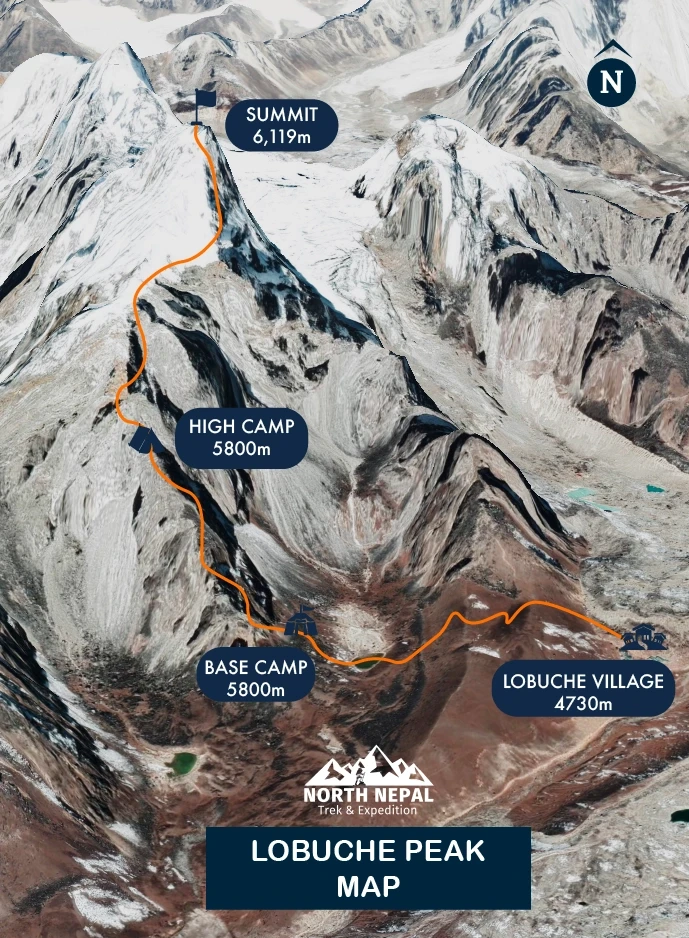
The mountain lies in the Khumbu region and has two prominent peaks, Lobuche East (6119 m) and Lobuche West (6145 m). Similarly, Lobuche east is often used by climbers as a trekking peak whereas Lobuche West is usually used as an expedition peak. Moreover, the climb is fairly easy so, with a little training and proper guidance, it can be easily surmounted.

Likewise, the trails follow the same route as Everest Base Camp Trek so, we pass along many culturally enriched villages, lush vegetation, suspension bridges, and blooming Rhododendron hills. Furthermore, we will experience everything Everest Base Camp Trek has to offer as we ascend both Everest Base Camp (5364 m) and Kala Patthar (5644 m). So, this peak climbing is like killing two birds with a single stone.
The scenic mountain views grasped along the way, religiously significant monasteries, and the soul-stirring view of some of the tallest Himalayas of Everest region from the top of Lobuche peak have increased the fanfare of Lobuche Peak among trekkers. However, Lobuche east peak climbing is considered more by the climbers than Lobuche west peak climbing.
Lobuche east was brought to highlight when Laurence Nielson and Ang Gyalzen Sherpa ascended the peak for the first time on April 24, 1984. On later dates, it was often used as a training peak by the ascenders before mounting even more high Himalayas.
The main appeal of this expedition is the heart-stopping view from both Lobuche west and Lobuche east. The Lobuche west embraces the visitor with majestic and astounding panoramas of the high Himalayas such as Mt.Chola Tse (6440 m), Mt. Tawoche (6494 m), Mt.Ama Dablam (6812 m), Mt.Pokalde (5806 m), Mt.Thamserku (6608 m), and Mt.Kangtega (6782 m).
Similarly, the Lobuche east welcomes us with grand and alluring vistas of the Himalayas such as Mt.Everest (8848 m), Mt. Makalu (8485 m), Mt.Pumori (7161 m), Ama Dablam (6812 m), Mt. Cho Oyu (8188 m), and Thamserku (6608 m).
Since the trail overlaps with Everest Trek, the routes are usually overcrowded during the Spring and autumn seasons. In addition to that, we will be granted a once-in-a-lifetime opportunity to view the tallest mountain in the world from up close. Not only that, the views perceived from the Kala Patthar and Everest Base Camp are also equally hypnotising and enchanting. Moreover, the climb can be combined with EBC Trek.
After an early breakfast, we start our trek towards Namche Bazaar. Enjoying the spellbinding views of the grand Himalayas, waterfalls, and lush green vegetation, we will walk forward to reach the Sagarmatha National Park. We will keep up our hike only after showing our permits and documents to the officials.
After that, the scenery gets even more alluring because of the exotic floras and fauna inside the national park. Moreover, this trek is also used for the Everest Base Camp trek, so we may meet many trekkers along the way. Finally, after crossing the Hillary Suspension Bridge, we will be welcomed by a famed world village, Namche Bazaar. We will spend the night there.
On our third day, we will rest for acclimatization purposes as it is vital to adjust our heart and lungs to higher altitudes to avoid altitude sickness. We will hike towards the nearest viewpoint, called the Syangboche viewpoint, to further adapt our bodies.
The landscapes and the panoramas of the Himalayas seen from the top will take our breath away. After that, we can indulge in the local culture, taste Sherpas's unique cuisines, and explore the place. This village is also known as a gateway to the Everest region. After wandering around the valley, we will spend our night in a lodge.
As usual, our day commences with a nice cup of tea and breakfast towards Tengboche. Leaving behind monasteries, Chortens, and Gompas, along with a scenic view of the Himalayas, we pass through the Mong-La pass situated at 3975 meters to reach Tengboche. Similarly, the top of the pass allows us to perceive the astounding vistas of the high Himalayas, such as Mount Everest, Lhotse, and Aba Dablam.
Tengboche carries a religious significance for the Sherpa community because of the Tengboche Monastery, one of the oldest monasteries in the Khumbu region. The paths near the Tengboche are full of prayer flags. Moreover, we get a peek at the Buddhist culture and various rituals practised by the locals. We will stay overnight in this place.
As on any other normal day, we will get up early to observe the beautiful sunrise view from the Tengboche Monastery. After breakfast, we will give continuity to our expedition by indulging in the spellbinding views of mountains, pasturelands, and landscapes. After crossing the Imja River, we will be welcomed by a gorgeous view of an Ama Dablam, agricultural fields and grazing animals.
As on any other normal day, we will give continuity to our expedition further towards Lobuche. We will cross the steep moraine of the Khumbu glacier and reach Chupki Lara passing where memorials of some of the renowned mountaineers are kept. After that, we will walk further towards our next stop relishing in the beautiful scenic views of the Himalayas like Khumbutse, Lingtren, Pumori and Mahalangur Himal. We will spend our night in a tea house in Lobuche.
After an early breakfast, we will commence our journey towards one of the most popular trekking camps, Everest Base Camp but before that, we have to pass through Gorak Shep. Traversing through the steep paths of the Khumbu glacier, we will reach Gorak Shep. The views from the place are out of the world as we are welcomed by the mountains in all directions including Everest.
Similarly, we trace our walk further towards base camp but we will explore the Gorak Shep Lake first. Finally, the Everest Base Camp will hug us with mesmerizing views of many high Himalayas such as Nuptse, Khumbuste, and Pumori.
However, the close-up view of Everest is not accessible from this place. The hike to Everest Base Camp will further provide a boost and experience to mount Lobuche Peak. We will trace our hike back towards Gorak Shep and spend the night there.
As usual, we will start our journey after a healthy breakfast. Enjoying the beautiful sunrise view along the way and observing the vistas of the Himalayas of the Khumbu region we will ascend towards Kala Pathar sitting at an altitude of 5644 meters. We will pass through several viewpoints on our uphill towards the Kala Pathar so, we can snap pictures along the way.
After soaring to the top, the scenery perceived is something words aren’t enough to portray. The captivating and enthralling view of Mount Everest along with its surrounding mountains will blow our minds away. The Kala Patthar trek will further provide a boost and experience to mount Lobuche Peak later. After that, we descend towards Lobuche to spend our night.
After an early breakfast along with a beautiful sunrise view, we will move towards Lobuche Base Camp. We will walk along the Lobuche Glacier while enjoying the astounding panoramas of Ama Dablam, Cholatse, Pokalde, Thamserku, Kantega, etc. and halt our journey in Lobuche Base Camp. The majority of the climbers will opt to spend the night here but we will head further towards high camp.
The high camp is located at an altitude of 5600m so, we should keenly focus on our health as well as follow the lead of our guides. Finally, we will settle here and set up a camp for our sleep.
Our 10th day is a free day partitioned for the acclimatization purpose. Since we have ascended the 5500m plus altitude, there is a slight chance of altitude sickness. So, we adjust ourselves in the base camp.
Furthermore, our guides will brief us about the usage of tools and gears needed to mount the peak and the ways of fixing ropes in glaciers and crevices. They will interpret the possible dangers ahead and train us to use the equipment efficiently.
Today is the day, we have been eagerly waiting for so, we start our climbing early in the morning. Following the lead and abiding by the suggestions of other experienced climbers, we will slowly ascend towards the Lobuche east. The Lobuche east provides more expansive views of mountains than the Island and Mera Peak.
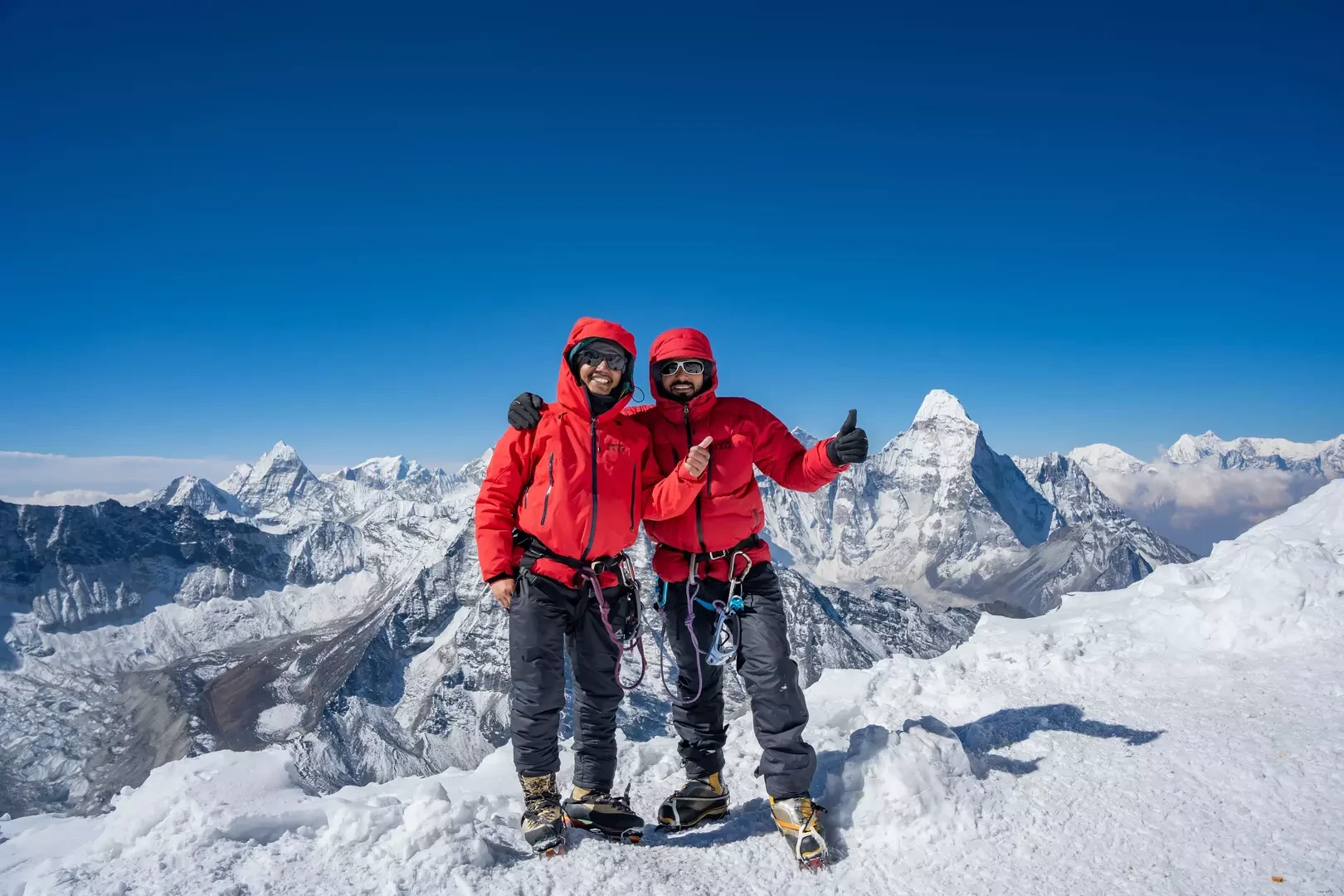
When we put our foot on the summit of Lobuche Peak, we will be hugged with an outstanding grand view of the Himalayas like Everest, Lhotse, Nuptse, Ama Dablam, Cholatse, Pumori, and other nearby peaks. This is the moment when we will realize that our sweat and struggle along the whole expedition is worthwhile. With a proud heart and a sense of achievement for reaching the summit, we will descend down towards Base camp where we will stay overnight.
After a historic accomplishment for us, we trace our way along the same previous route. We will be encompassed with a beautiful breathtaking view of the Himalayas, farmlands, villages, and monasteries along the way. We may opt to celebrate the achievement with the locals and may even try locally prepared alcoholic beverages and cuisines. We will stay overnight in Dingboche.
After an early breakfast, we head back towards Namche Bazaar. We will pass through religiously and culturally enriched Tengboche. The mesmerizing view along the way will become pretty standard up to this day.
Finally, we will halt and stay overnight at Namche Bazaar. If we have spare time, we can explore the place and buy souvenirs for our loved ones.
After an early breakfast, we descend further down towards Lukla, where we will spend the night. We will observe breathtaking views of some of the peaks of the Everest region, such as Cho Oyu, Kongde Peak, etc. We will spend our night in Lukla Village.
After a heartwarming trek and climbing to the beautiful Himalayas, we will catch an early flight to Kathmandu from Lukla. It is just a 35-minute flight, so we have copious spare time. We may explore the Kathmandu Valley as it has a handful of attractions prepared for visitors.
Spring (Mar-May) and Autumn (Sep-Nov) are the best seasons to climb Lobuche Peak - book early to secure your permit and guide.
Lobuche's summit push involves 45-50 degree ice slopes, so crampons, ice axes, ropes, jumars, harnesses, and carabiners are required. We provide a pre-climb briefing and hands-on training at base camp before the summit push, and prior high-altitude trekking experience is required.
Above 6,000 m, the risk of Acute Mountain Sickness (AMS) is significant. Our itinerary includes rest days at Namche Bazaar and Lobuche Base Camp, and our guides monitor every climber closely and will adjust or turn back the ascent if symptoms appear.
Travel insurance covering high-altitude climbing and emergency helicopter evacuation up to at least 6,500 m is mandatory for the Lobuche Peak climb. Please arrange your policy before departure and share the details with us so we can act quickly in case of an emergency.
Secure the Lobuche Peak Climb for 2026/2027 before the seat gets fully booked.
Lobuche Peak Climbing is a 15-day high-altitude climbing expedition in Nepal’s Khumbu region that combines the Everest Base Camp route with a summit attempt on Lobuche East. The itinerary reaches 6,145 meters and includes the major Everest-region highlights such as Namche Bazaar, Tengboche, Everest Base Camp and Kala Patthar.
No. Lobuche Peak Climbing is graded Challenging and is not suitable for first-time trekkers or climbers. The summit section involves steep snow and ice terrain, fixed-rope climbing and prolonged exposure above 6,000 meters. Previous high-altitude trekking and basic mountaineering experience are strongly recommended.
Lobuche has two prominent summits: Lobuche East at 6,119 m and Lobuche West at 6,145 m. Lobuche East is generally treated as the trekking peak, while Lobuche West is normally approached as a more technical expedition peak. The North Nepal Trek itinerary is based around Lobuche East.
The route follows the classic Everest Base Camp trail through Sherpa communities including Namche Bazaar, Tengboche, Dingboche and Lobuche. Along the way, you encounter Buddhist monasteries, gompas, chortens, mani walls and prayer flags while experiencing the mountain culture of the Khumbu.
You need standard high-altitude trekking equipment plus technical climbing gear, including crampons, ice axe, climbing harness, helmet, ropes, jumars and carabiners. The summit route can involve steep ice and snow slopes, so you must be competent with the equipment before attempting the climb.
A warm, high-altitude sleeping bag is essential. Temperatures around high camp and the summit can become extremely cold, with the expedition information indicating possible temperatures around -20°C to -30°C. Your sleeping system should therefore be appropriate for these conditions rather than ordinary trekking temperatures.
The current North Nepal Travel & Trek package is 14 nights and 15 days, with the listed price starting at USD 2,100 per person. Group discounts are available, with the published rate varying according to group size.
Allow extra money for personal expenses, Nepal visa, international flights, personal climbing gear, travel insurance, drinks and snacks, Wi-Fi or charging fees where applicable, and tips. Any additional accommodation or services resulting from itinerary changes may also incur extra costs.
Yes. The published itinerary is offered as a private trip, and group-based pricing is also available. The summit schedule should remain flexible because climbing decisions depend on weather, snow conditions, acclimatization and the team's physical condition.
The main climbing seasons are spring (March to May) and autumn (September to November). These periods generally offer clearer skies and more favorable conditions. The route can be busier during these months because it shares much of the Everest Base Camp trail.
Winter and monsoon are considerably less favorable. Monsoon can bring rain, slippery trails, cloud and rapidly changing conditions, while winter brings severe cold and increased risks from snow and freezing temperatures. The published itinerary specifically describes winter climbing as hazardous.
Yes. The summit reaches 6,119 meters, making altitude one of the expedition's major risks. The itinerary includes acclimatization at Namche Bazaar and Lobuche Base Camp, but acclimatization cannot eliminate altitude sickness. Any symptoms such as persistent headache, nausea, dizziness, unusual fatigue or coordination problems should be reported to your guide immediately.
You should know how to use crampons, ice axe, ropes, jumars, harnesses and carabiners before the summit attempt. Experience with glacier travel, crevasse crossings and fixed-rope climbing is also required. The summit section can involve steep ice and snow slopes, so this is a mountaineering climb rather than simply a difficult trek.
Yes. Travel insurance is required for the climbing permit process and must cover mountaineering, medical treatment and emergency helicopter evacuation from up to 6,500 meters. A standard travel insurance policy that excludes peak climbing is not sufficient. Proof of appropriate insurance is required for the permit application.
The expedition requires a Lobuche Peak climbing permit, along with the applicable trekking and local-area permits for the Everest region. The package states that the required climbing permit, national park permit, local area permit and TIMS are arranged as part of the expedition.
The published permit rate varies by season: USD 250 per person in spring (March to May), USD 125 in autumn (September to November), and USD 70 in winter. The page also lists an additional USD 60 per person for the local-area permit, Sagarmatha National Park entry and TIMS-related fees.
Yes. A USD 500 garbage deposit per climbing team is listed for environmental protection and waste management. The deposit is refundable upon meeting the applicable waste-disposal requirements and bringing the expedition's garbage back.
The itinerary begins with a flight from Kathmandu to Lukla, which takes approximately 35 minutes, followed by trekking through the Khumbu region toward Namche Bazaar, Tengboche, Dingboche and Lobuche. The package includes scheduled Kathmandu-Lukla-Kathmandu flights and related domestic airport transfers and taxes.
The expedition uses a combination of teahouses, lodges and camping. Lower and mid-altitude sections use mountain lodges, while the climbing section uses expedition tents with sleeping, dining, kitchen and toilet facilities.
Breakfast, lunch and dinner are provided throughout the trek and climbing period, along with tea or coffee. During the camping section, the expedition kitchen prepares meals for the climbing team. Safe drinking water is also included in the published package.
Connectivity is available in some established villages, but it becomes less reliable as you move toward the higher sections and climbing camps. Trekkers should not depend on continuous internet or mobile coverage during the summit phase and should keep important information available offline.
The expedition offers exceptional views of Mount Everest, Lhotse, Nuptse, Ama Dablam, Pumori, Makalu, Cho Oyu, Cholatse, Tawoche, Thamserku and Kangtega, depending on the viewpoint and weather. The summit of Lobuche East provides particularly broad views across the high Himalayas.