8 Days Tsum Valley Trek
This eight-day trek package takes you into the remote Tsum Valley, a sacred Buddhist valley encompas...
OVERVIEW & HIGHLIGHTS
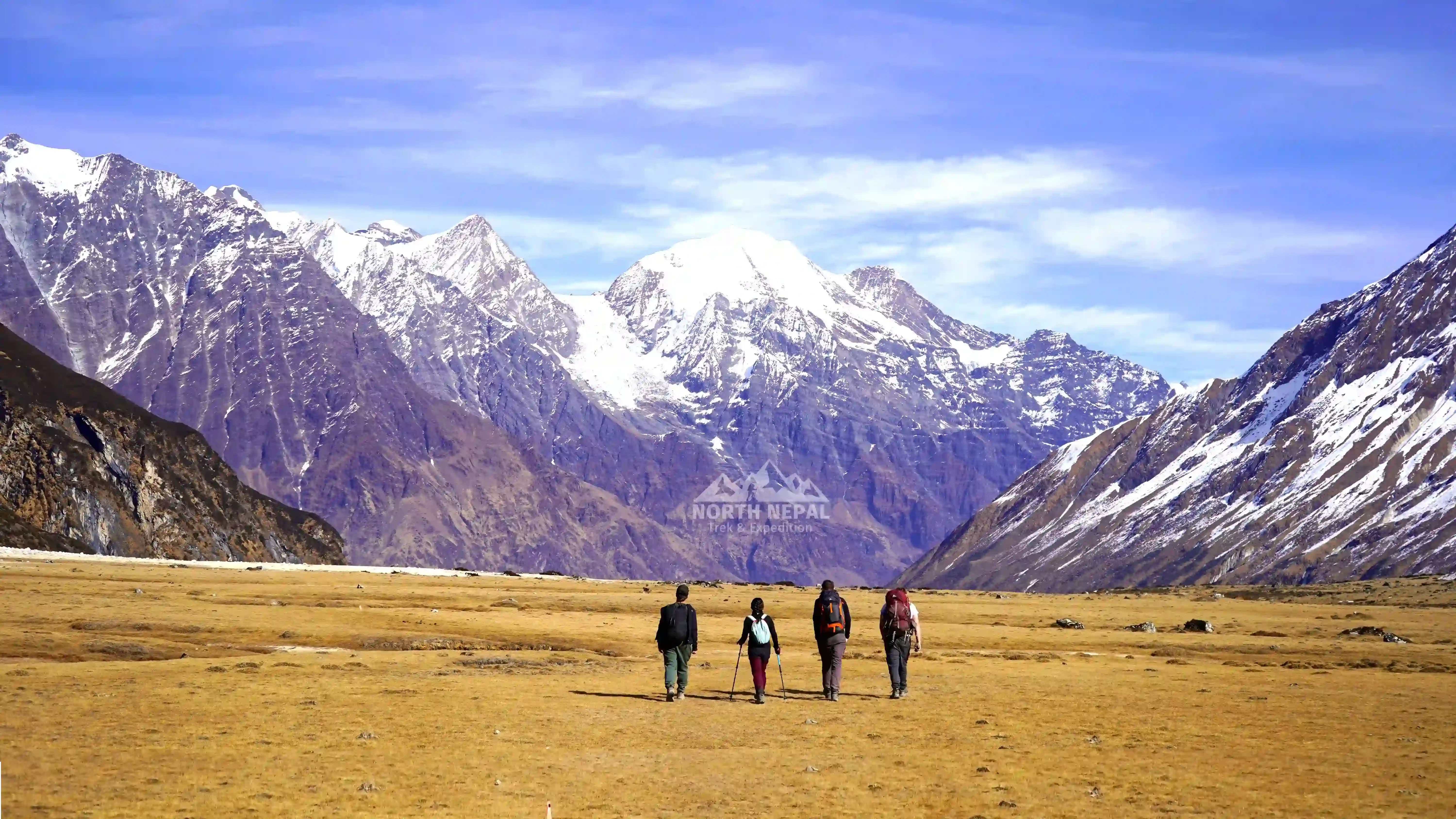
The 11-Day Manaslu Circuit Trek package takes you around Mount Manaslu (8,163 m), Nepal’s eighth-highest peak. Winding through the Manaslu Conservation Area, the trail follows the Budhi Gandaki River, passes ancient Gurung and Tibetan-Buddhist villages, and crosses the challenging Larkya La Pass (5,106 m | 16,752 ft). With fewer trekkers than the Annapurna Circuit Trek or the Everest Base Camp Trek, it offers untouched landscapes, glacier views, and deep cultural immersion in one of Nepal’s most scenic high-altitude regions.
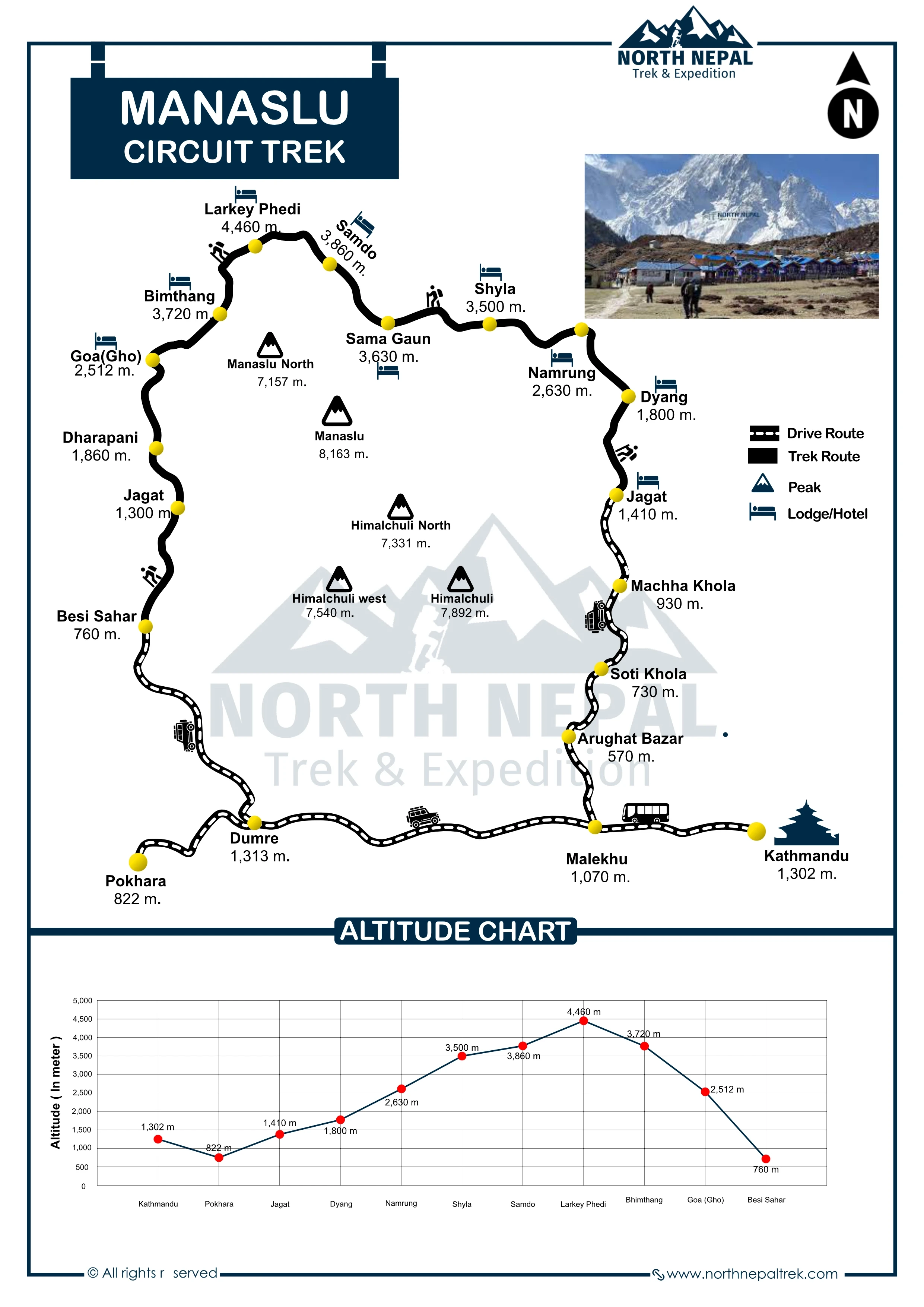
The maximum elevation is 5,106 m at Larkya La Pass. You will cover 177 km of total distance. Starting from Jagat to Besisahar. Permits required: Manaslu Restricted Area Permit (MRAP), Manaslu Conservation Area Project (MCAP), and Annapurna Conservation Area Project (ACAP). Graded moderate to challenging, the trek includes tea-house accommodation, diverse terrain from subtropical valleys to alpine ridges, and unmatched Himalayan panoramas.
| Day | Route | Distance | Duration | Altitude |
|---|---|---|---|---|
| 1 | Drive from Kathmandu to Jagat | ~10 hrs | n/a | 1,324 m |
| 2 | Jagat to Deng | ~18 km | 6–7 hrs | 1,860 m |
| 3 | Deng to Namrung | ~17 km | 6–7 h | 2,630 m |
| 4 | Namrung to Shyala | ~17 km | 5- 6 hrs | 3,530 m |
| 5 | Shyala to Samagaun via Pungen Valley (acclimatization) | ~14 km | 4-5 hrs | 3,530 m |
| 6 | Samagaun to Samdo en route Birendra Lake | ~8 km | 4–5 hrs | 3,875 m |
| 7 | Samdo to Larkya La Phedi (Dharmasala) | ~12 km | 6-7 hrs | 4,460 m |
| 8 | Dharmasala to Bimthang crossing Larkya La Pass | ~14 km | 10-11 hrs | 5,106 m |
| 9 | Bimthang to Ghwo Village | ~13 km | 5-6 hrs | 2,512 m |
| 10 | Ghwo Village to Besisahar Drive to Kathmandu | ~ 7 km | 40 min. | 1,324 m |
| 11 | Departure | – | – | n/a |
Bibek Bhandari, Trekking Guide
I trekked the Manaslu Circuit with North Nepal Trek, founded by Mohan Raj Bhandari back in 2015, and the whole 11-day loop was superbly organized. Our guide paced us perfectly through Samagaun for acclimatization, and crossing Larkya La Pass at 5,106 m at dawn, with the glacial cirque opening up on the Bimthang side, was the highlight of my trekking life.
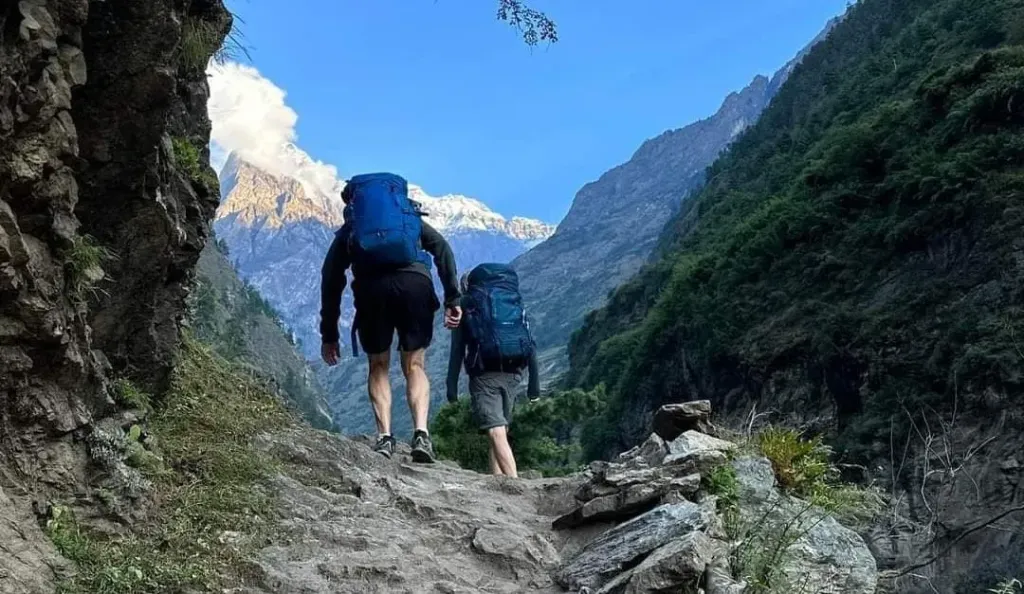
After breakfast, we begin our hike and cross another suspension bridge before reaching Philim. Tibetan-influenced Gurung communities mainly inhabit the village. Filled with traditional houses, serene monasteries, and chortens, it provides stunning insights into the rich Gurung tradition and culture.

Photo: Way to Dyang
After crossing more bridges, we will reach the village of Dyang after 6 hours of trekking. Additionally, famous for its agriculture, you can see different views of lush greenery depending on the season you visit. You can also visit Tibetan-Buddhist monasteries and Gompas here for more cultural insights.
Followed by a short hike after breakfast, the mesmerizing view of Manaslu starts from this trail. The flat trail at the start suddenly ascends to Namrung through lush green forests. The diverse species of birds can also be found here, traversing the rhododendron forests along with ridges and breathtaking views of the valleys; we enjoy our way to Namrung. The Buddhist village with several monasteries, chortens, and prayer flags provides cultural insights about the Buddhist community here. Spend the night here after exploring the monasteries and rest for tomorrow's journey as we ascend to a higher altitude.
After breakfast, we start our Trek along a winding path with magnificent views of not just Manaslu but Gorakha Himal, Lajing Himal, Saula Himal, and other peaks, all at an altitude of 7000m. The route passes through the traditional villages of Banjam, Lihi, Sho, and Lho, featuring steep climbs, mani walls, and ancient monasteries. Subsequently, the air becomes thinner and colder as we ascend uphill, and the lush greenery and rhododendron forests turn into pasture grasslands.

Photo: Shyala Village of Manaslu Circuit Trek
Consequently, you can explore the Tibetan-style village of Lho and its monastery, offering panoramic views of Manaslu, Himalchuli, and Naike Peak, before reaching the high, scenic settlement of Shyala.
This day serves as an acclimatization day with a short hike to Pungyen Valley. Samagaun itself is a beautiful palace. It is surrounded by breathtaking views and a verdant forest. Additionally, exploring Gompas inside Samagaun is possible as it provides cultural insights and beautiful views, making it an ideal place for acclimatization.

Photo: Manaslu Base Camp
A short hike to Pungyen Valley is a chance to explore Punygen Gompa. It is situated below the Manaslu at 8,163 meters (26,781 feet) on the wide alpine grassland of the Manaslu region. It is believed that Nubris (a Tibetan tribe) built this monastery to appease the lord Pungyen, who is the protector of Pungyen Valley.
Furthermore, the Trek to Manaslu Base Camp would be the better option for those who want to conquer everything on this Trek. Following the Birendra Taal, which takes 2 hours from Sama Gaun, climb up to Manaslu Base Camp(4,520 m), which takes about 4 /5 hours of trekking.
The Manaslu Base Camp offers close-up views of the conch-shaped valley and Mount Manaslu.
However, an extra day can be added to your Itinerary if you want to acclimatize and explore the culture in Sama Gaun and then trek to Manaslu Base Camp(4,800 m) the next day.
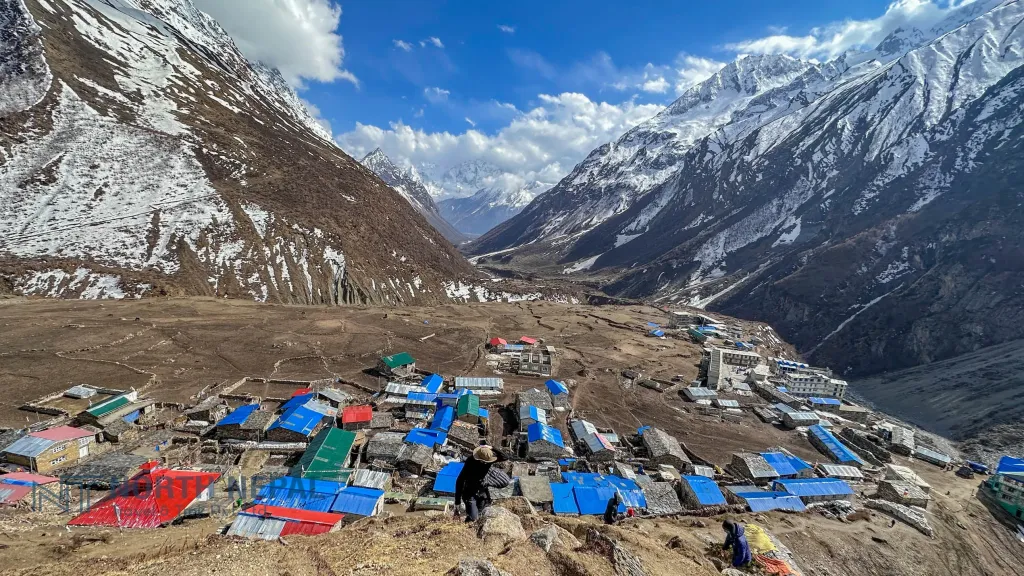
After spending an entire day acclimatizing in the beautiful village of Sama Gaun, we part ways and start climbing uphill through a mostly desert path to Samdo. The 4-5 hour trek takes you through the Manaslu Conservation Area, passing through various landscapes, including meadows and Mountains.
Birendra Lake is just a few hours' walk from Samagaun. The turquoise colored Lake is a gem of this trek route.
Photo: Views from Samdo
Additionally, the trail follows the river upstream, following that for an hour, to the Lela Kharka, a small settlement located at an altitude of 3,800 meters. From Lela Kharka, we continue our climb to Khermo Kharka, another small settlement at an altitude of 4,100 meters.
Moreover, the trail descends slightly to Samdo, our destination, at 3,690 meters(12,103 feet). Samdo is a popular destination for trekkers on the Manaslu Circuit Trek and is also home to several lodges and teahouses. Rest comfortably, as tomorrow we have a long day ahead.
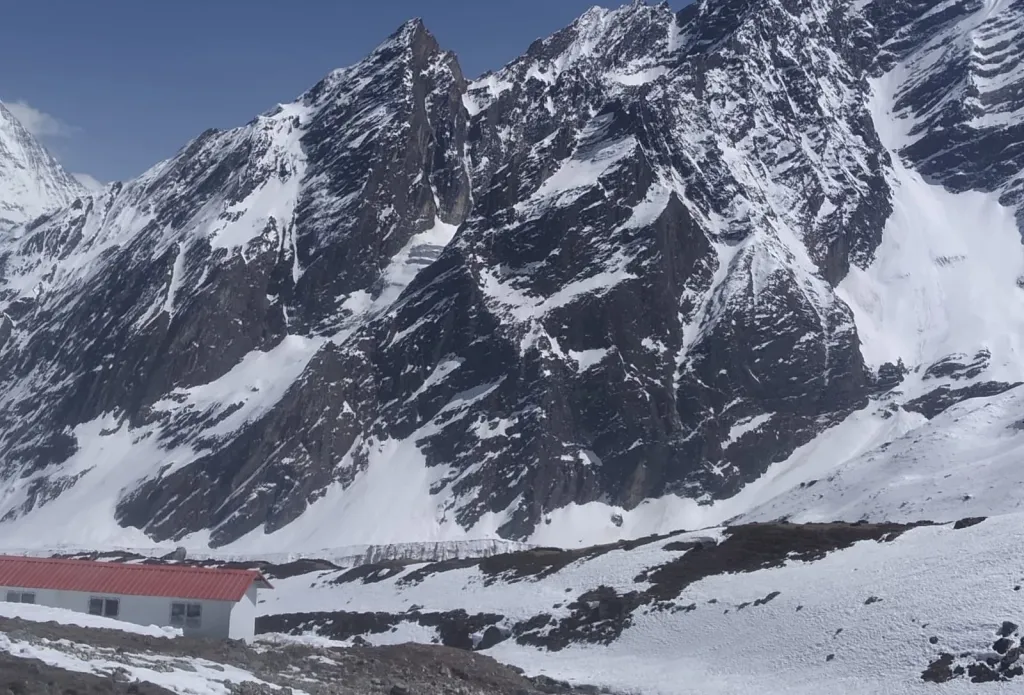
One of the longest trekking days from Samdo to Larkya La Phedi is a 7-8 hour trek that takes you through the Manaslu Conservation Area. The zigzag-up steep path takes you to the Larkya Bazar, a small market town located at an altitude of 4200 meters. Exploring the Larkya Bazar for a bit as time passes, we continue our Trek up to Larkya La Phedi, our destination, a small settlement at an altitude of 4,460 meters. Rest well, as tomorrow we will be at the highest altitude of the Manaslu Circuit Trek.

Photo: Larky La Phedi
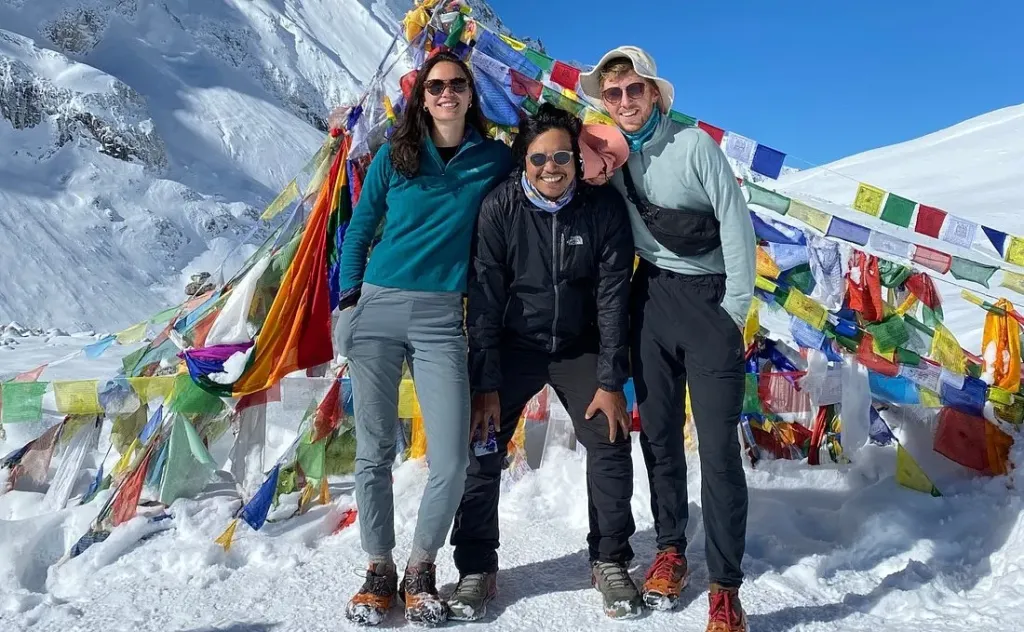
We start the day early after having breakfast; this Trek takes you through the heart of the Manaslu region of Nepal as we head up to Larkya La Pass. The moderately tricky climb takes you along the winding rocky trail. The Trek to Larkya La Pass truly challenges the spirit of the trekker as the Trek at an altitude of 5,106 meters is certainly not easy, but also rewarding. Those who deserve this pass offer breathtaking views of Manaslu Himal and Ratna Chuli, Cheo Himal, and you will remember the scenes for a lifetime. Subsequently, after enjoying the pictures, we descend downhill and encounter some icy lakes before we reach Bimthang.

Photo: Larky La Pass (5,106 m)
The 5-6 hour hike takes us through some of the most beautiful scenery in the Manaslu region of Nepal. We leave Bhimtang(3,800 m) behind, walk across the pastureland, and descend to the valley of Budhi Khola. We walk further, crossing the Budhi Khola and walking through the vibrant colors of red and pink rhododendron forests.
Photo: Ghow (Goa) village of Manaslu Circuit Trek
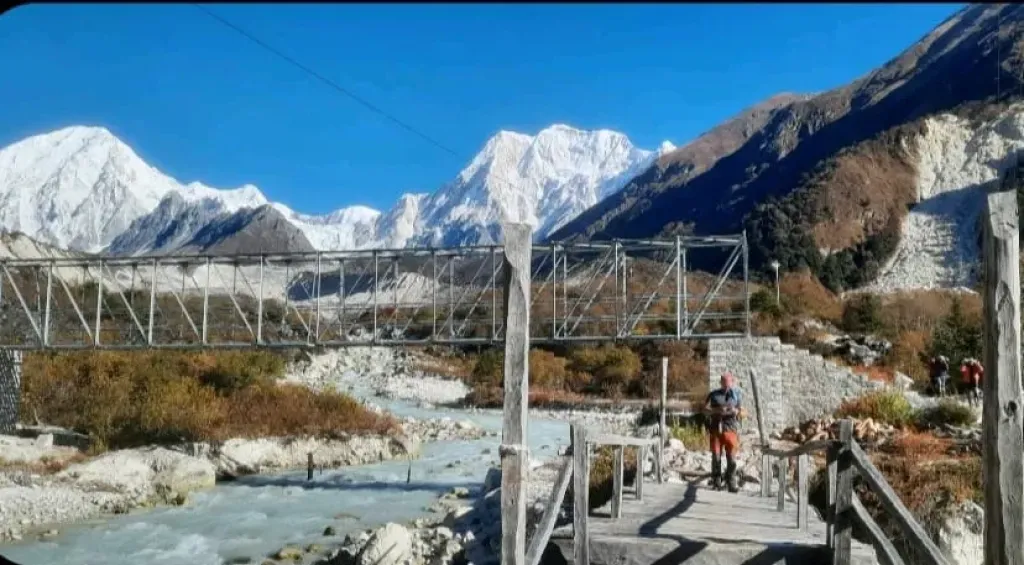
After a couple of hours of hiking, we reach Ghow Village. This will be the night stay, avoiding tourist-packed Dharapani. Also, this adds value by one day more to your itinerary to immerse yourself in the Manaslu region of the Gorkha district.
From Dharapani, we return to Besisahar by Jeep. The roads aren't in good condition, so the ride will be bumpy. Enjoy the scenery of the Marsyangdi River; along the way, we reach Besisahar. Additionally, one of the famous tourist spots, the Lamjung Darbar, can be visited today, as it is only 28 kilometers away and takes 1 hour and 30 minutes to drive from here. The Lamjung Darbar is the palace built in the traditional Newari style of architecture and is decorated with intricate carvings and paintings,s which can provide further insights into the Nepali culture. Stay overnight at Besisahar after exploring the rest of the market.

Photo: Dharapani
The seven-hour bus drive back to Kathmandu will be bumpy due to the absence of decent roads. Arriving in Kathmandu, we will help you with some last-minute shopping for your departure tomorrow. Stay overnight at a three-star hotel in Kathmandu, and rest, recovering from the adventurous journey.
Furthermore, Pokhara is also a must-visit destination in Nepal as it offers many adventure activities like Ultralight, Rafting, Zip Flyer, Bungee Jump, Paragliding, Canyoning, and many more. After a day’s rest,t you can try all these activities till your heart's content. So you can also opt to visit Pokhara on your last day of the trek.
Note:
Autumn Trail Alert: Trails through the Manaslu Circuit are dry and clear with cold, stable skies near Larkya La; teahouses are open and filling fast, though wifi and network stay patchy above Samagaun.
We had a great time trekking with Raj, doing the Manaslu circuit and Tsum Valley. He is an amazing guide who made trekking very fun and enjoyable. This was my girlfriend first trek in Nepal and first trek longer than 8h. Raj is a great guide for beginners, setting up a very reasonable pace through the mountains, while providing great information about the surroundings. I 100% recommend trekking with him if this is your first time trekking in Nepal.
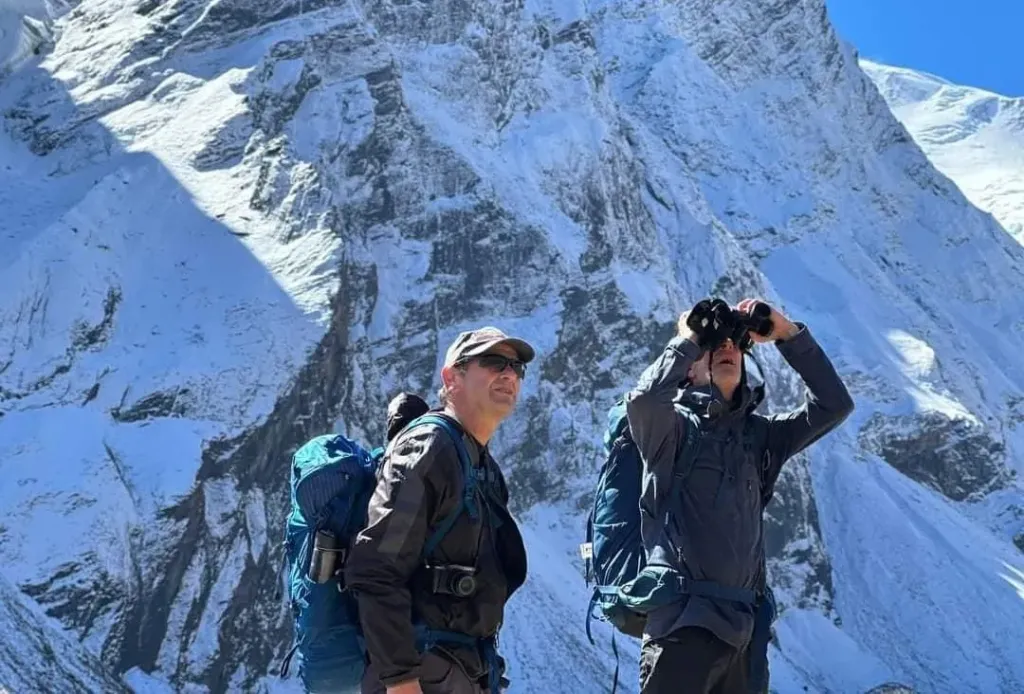
We recently had an incredibly wonderful and memorable experience with our guide Zeewan and our porter Dayaram on our Manaslu Circuit and Tsum Valley trek. Zeewan came highly recommended from friends. He and Dayaram were exceptional, we always felt we were in safe hands over the 19 days we were completing the trek. Zeewan has so much passion for Nepali wildlife and it shined through and really enriched our experience; while we were trekking, he spotted wild deer, Tahr, Blue Sheep and Himalayan Marmots for us to see. We would absolutely recommend heading out with Zeewan to anyone, we are incredibly grateful for the professionalism and kindness of our guide and porter.
We came as strangers and left as friends. That sums up our experience with North Nepal Travel & Trek (especially Mohan, the manager, and Zeewan, our guide) perfectly. It is definitely the best agency we can imagine. Mohan takes time for his guests, listens to them and then customizes a trekking tour. Everything is highly professional and perfect in terms of safety. When things didn't go fast enough in the kitchen at the guesthouse, Zeewan always stepped in and helped to get the best result for us. As soon as we weren't feeling well with the altitude, he supported us with any problem and helped us to feel better quickly. We even experienced a winter storm during our hike in February and still felt very safe and in best hands, Zeewan knows exactly what he is doing. After the hike, we were welcomed as friends by Mohan and we met again and again for tea, coffee and food many times. Thank you so much for this wonderful experience Mohan and Zeewan, we look forward to seeing you again!!!
Just came back from Manaslu circuit excellent arranged by Mohan at North Nepal Treks. Two weeks in heaven together with and old friend and a new one - our guide Zeewan - superman on the planet - and a caring mountain man. We chose North Nepal treks advised from my daugther and her fiance who went on the same trip 6 months earlier after scanning the market of agiencies together with recommendations from her friends. Was our jubilee trip after our Annapurna circuit trip 40 years ago. Meaning we are 64 years old, but still relatively fit and running marathons though. Everything went smooth and easy. We want to go again but only with this company. Seriously
Hi from Hans and Chris from Denmark.
Oct 2024 • Family
North Nepal Travels & Treks was easy to contact and Mohan planned our trek perfectly. We did the 10-day Manaslu Circuit trek with our guide Gopal and porter Karna. It was truly amazing, an absolute recommendation. We enjoyed nature, culture and the talks with our guide, explaining the culture, religions and politics of Nepal.
Oct 2024 • Couples
We had an amazing experience with North Nepal Travel & Trek on the Manaslu Circuit. Mohan was great with communication, and he even took us out to dinner after the trek to hear about our adventure!
Our guide, Jeewan, made the journey unforgettable with his knowledge, positivity, and organization. Our porters, Basanta and Milen, were fantastic—Basanta kept us smiling every day, and Milen, or "Mountain Ferrari," amazed us with his strength and kindness.
We can’t wait for our next trip with them to Pikey Peaks. Highly recommend North Nepal Travel & Trek for a well-organized and memorable trek!
Our itineraries are carefully structured with gradual elevation gains to ensure you have proper acclimatization before reaching high-altitude points like the formidable Larkya La Pass (5,106 m). Your guide will conduct daily health assessments for symptoms of Acute Mountain Sickness (AMS). If severe symptoms ever appear, our standard protocol mandates an immediate descent to lower elevations.
In the rare event of severe injury, acute illness, or extreme weather, emergency helicopter evacuation is coordinated directly through local rescue services. Evacuations are initiated immediately upon assessment by your guide in close communication with our Kathmandu office.
To keep you fully protected, all trekkers must hold comprehensive travel insurance covering emergency medical treatment, high-altitude trekking (up to 6,000 m), and helicopter evacuation/rescue. We require your insurance details to be submitted prior to the trek's departure so we can streamline any emergency logistics if they are ever needed.
Secure the Manaslu Circuit Trek for 2026/2027 before the seat gets fully booked.
The standard Manaslu Circuit Trek takes about 11 days of trekking, covering roughly 177 km from Jagat to Dharapani. The itinerary normally includes acclimatization time before crossing Larkya La Pass.
The Manaslu Circuit Trek is in the Manaslu region of Gorkha and northern Gandaki Province, around Mt. Manaslu, the world's eighth-highest mountain at 8,163 m. The route travels through remote mountain valleys before joining the Annapurna Circuit at Dharapani.
The highest point is Larkya La Pass, at approximately 5,106 m (16,752 ft). The pass crossing is one of the most demanding parts of the trek because of the altitude, steep ascent, cold conditions, and potentially snowy trail.
The trek is graded moderate to challenging. Most days involve around 6–7 hours of walking, with steep and uneven sections and substantial altitude gain. The Larkya La crossing is the toughest stage, so good cardiovascular fitness, leg strength, and previous multi-day trekking experience are strongly recommended.
It isn't the best choice for a first Himalayan trek. Beginners who are very fit can potentially complete it with proper preparation and a carefully paced itinerary, but previous experience on multi-day or high-altitude treks is recommended.
Manaslu is considerably quieter and more remote than the major Everest and Annapurna routes. The lower number of trekkers contributes to its wilderness character, but it also means fewer facilities and greater dependence on your guide and trekking team.
Yes. Adding Tsum Valley extends the journey to roughly 18–19 days and adds monasteries, traditional villages, and a deeper cultural experience. A separate Tsum Valley Restricted Area Permit is required.
The route combines high-altitude mountain scenery, Tibetan-influenced Buddhist culture, remote villages, dramatic river valleys, and the Larkya La Pass in one circuit. Its lower visitor numbers also give the trek a more secluded character than Nepal's busiest trekking routes.
The trek passes through communities strongly influenced by Tibetan Buddhist culture. You encounter monasteries, gompas, prayer walls, chortens, Buddhist rituals, and traditional mountain villages as the landscape changes from lower Gorkha to the high Manaslu valleys.
The upper Manaslu region has maintained a strong Tibetan cultural influence for generations. Monasteries, traditional architecture, Buddhist practices, and village customs remain an important part of everyday life, making cultural interaction one of the defining features of the trek.
The trek requires three main permits:
The ACAP permit is required because the route exits through the Annapurna Conservation Area after crossing Larkya La.
The upper Manaslu region is designated as a restricted trekking area because of its sensitive border location, environmental importance, and cultural heritage. The permit system regulates access while supporting the protection of the region and its communities.
Yes, you don't need a partner under the current rules as of March 22, 2026, but you still need a licensed guide and valid permits because Manaslu remains a restricted area.
A licensed trekking guide is mandatory for the Manaslu restricted area. A porter is optional but useful for carrying your main luggage. The supplied information lists a typical porter rate of around USD 25 per day, with a carrying capacity of approximately 20 kg.
Safety takes priority over keeping the original schedule. If altitude symptoms or poor acclimatization require additional rest, the guide can adjust the itinerary. This may mean shortening or skipping a planned excursion, or extending the trek, with additional guide and porter costs where applicable.
Proper acclimatization is essential. Once above 3,000 m, the itinerary should avoid unnecessarily rapid elevation gain, with around 500 m of sleeping-altitude gain per day used as a practical guideline. Rest and acclimatization time around Sama Gaun is particularly important. Stay hydrated, walk slowly, and report symptoms such as headache, nausea, dizziness, or unusual fatigue to your guide immediately.
Altitude sickness is the principal concern, particularly around the higher sections and Larkya La. Cold weather, steep terrain, fatigue, snowfall, and changing trail conditions can also increase risk. Drink treated or boiled water, maintain good hygiene, follow your guide's instructions, and descend if altitude symptoms become worse.
Yes. Your travel insurance should specifically cover high-altitude trekking above 5,000 m, medical treatment, and emergency helicopter evacuation. Confirm the altitude and evacuation limits with your insurer before departure.
If the pass cannot be crossed safely, the guide will assess the conditions and arrange a safe alternative. The supplied contingency plan is to return via the Samdo–Jagat route rather than attempt an unsafe crossing.
October is the best month for consistently clear mountain views. March and April are also excellent, particularly for rhododendron blooms and milder conditions. The monsoon months of June to August can make trails wet and slippery, while December and January bring severe cold and potentially icy or snowy conditions at higher elevations.
Winter trekking is possible only with careful planning and appropriate equipment, but it is not the preferred season. Heavy cold, ice, snow, and increased avalanche exposure can make the high sections and Larkya La crossing considerably more difficult.
Pack for both lower, warmer valleys and sub-zero high-altitude conditions. Essential equipment includes layered clothing, a warm down jacket, waterproof shell, thermal base layers, gloves, a warm hat, broken-in trekking boots, trekking poles, a headlamp, water purification equipment, and a suitable sleeping bag. A microspike can also be useful when snow or ice affects Larkya La.
Yes. A route map or GPS-enabled navigation device is useful, particularly in poor visibility or snowy conditions. Even when trekking with a guide, it helps to understand your location and the route ahead.
The trek uses local teahouses and lodges. Facilities become simpler as you move higher into the remote Manaslu valleys. Rooms are generally basic, and shared facilities are common at higher elevations.
Teahouses generally serve dal bhat, noodles, rice, soups, vegetables, Tibetan-style breads, eggs, and other simple meals. Food choices become more limited at higher elevations, so carrying energy snacks is useful.
The trek begins with a road journey from Kathmandu or Pokhara toward the Manaslu region and Jagat, depending on the final itinerary. Road conditions can change, particularly during the monsoon, so the exact vehicle and travel time should be confirmed before departure.
The standard circuit finishes around Dharapani, after crossing Larkya La and descending through the Marsyangdi Valley. From Dharapani, you can continue toward Besisahar or connect with the Annapurna Circuit.
Connectivity varies considerably along the route. Some lower villages have mobile coverage and Wi-Fi, but coverage becomes unreliable or unavailable in the remote upper sections. Trekkers should be prepared for periods without normal internet or mobile communication.
The Manaslu Conservation Area supports a diverse range of Himalayan wildlife. Depending on season and luck, trekkers may encounter langur monkeys, musk deer, Himalayan monal, bharal, and other mountain birds and animals. Rhododendron forests and alpine vegetation are especially striking in spring.