8 Days Tsum Valley Trek
This eight-day trek package takes you into the remote Tsum Valley, a sacred Buddhist valley encompas...
OVERVIEW & HIGHLIGHTS
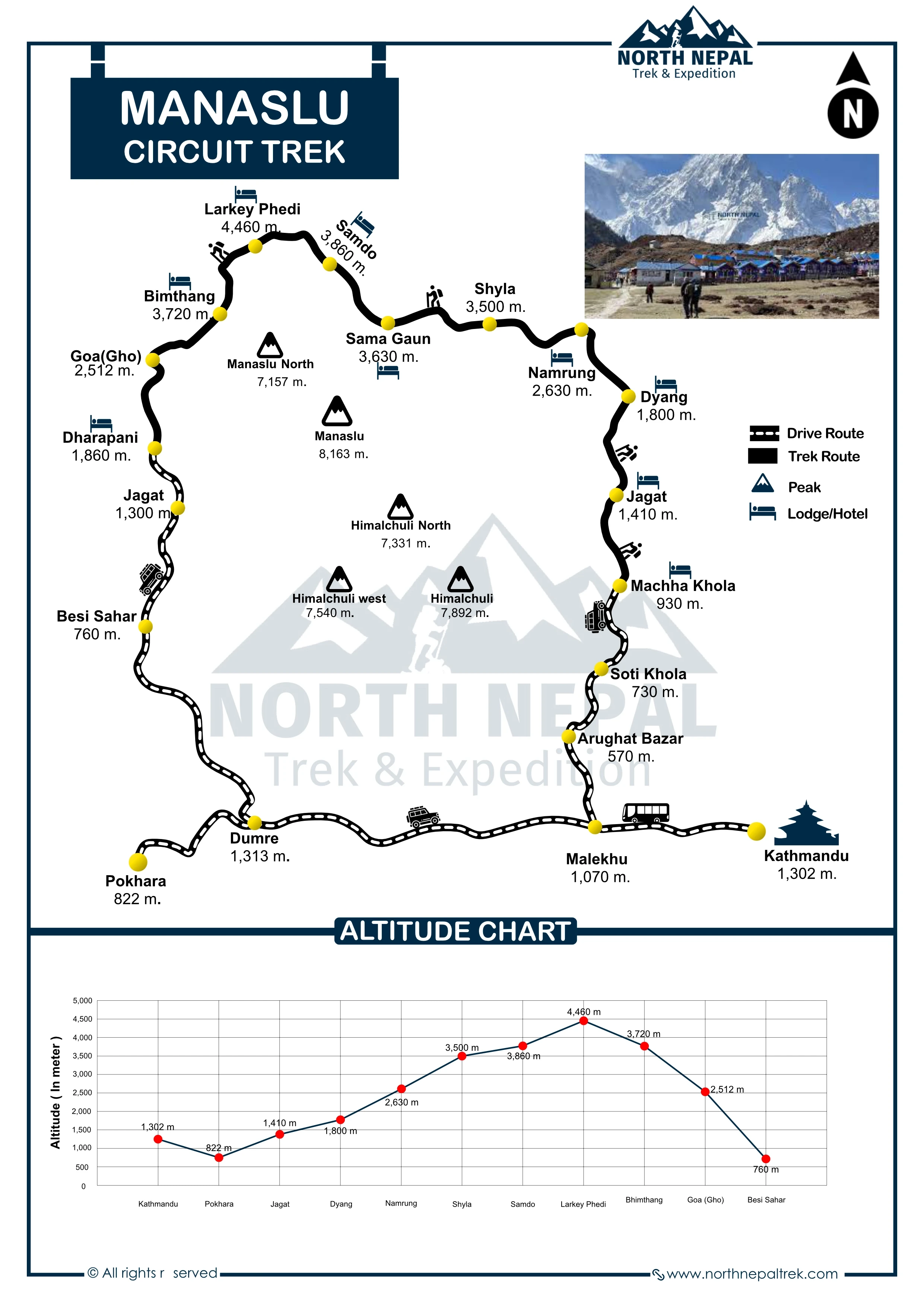
The 11-Day Manaslu Circuit Trekking package offers one of Nepal’s most spectacular high-altitude trekking experiences. This journey circles Mount Manaslu (8,163 m), the world’s eighth-highest peak, through the Manaslu Conservation Area. The route follows the Budhi Gandaki River, passes traditional Gurung and Tibetan Buddhist villages, and ascends to the dramatic Larkya La Pass (5,106 m), one of the highest and most scenic passes in Nepal.
Less crowded than the Annapurna or Everest trails, the Manaslu Circuit trek package offers a rare blend of cultural authenticity, stunning Himalayan scenery, and diverse ecosystems ranging from subtropical to alpine forests. Manaslu received around ~12,000 visitors while Everest had ~35,000–60,000 and Annapurna had ~244,000 in 2025. Trekkers enjoy views of Manaslu, Himalchuli, and Ganesh Himal in ancient Tibetan-influenced villages.
You need a Manaslu Restricted Area (RAP) permit, a Manaslu Conservation Area (MCA) Permit, and an Annapurna Conservation Area Project (ACAP) permit. Difficulty level changes from moderate to challenging. Best for experienced trekkers seeking a remote Himalayan trekking adventure in Nepal, featuring authentic mountain culture, tea-house accommodations, and breathtaking landscapes.
The table contains the 11-Day Manaslu Circuit Trek Itinerary with Distance, Duration, and Elevation
| Day | Destination | Trek Distance | Duration | Elevation |
|---|---|---|---|---|
| 1 | Drive Kathmandu to Machhakhola | n/a | 8 to 9 hrs | 870 m |
| 2 | Jagat | 18 km | 6 to 7 hrs | 1,380 m |
| 3 | Deng | 19 km | 6 to 7 hrs | 1,860 m |
| 4 | Namrung | 17 km | 6 to 7 hrs | 2,630 m |
| 5 | Samagaun | 17 km | 5 to 6 hrs | 3,530 m |
| 6 | Acclimatization Day | n/a | n/a | 3,530 m |
| 7 | Samdo | 8 km | 4 to 5 hrs | 3,875 m |
| 8 | Dharmashala | 6 km | 5 to 6 hrs | 4,460 m |
| 9 | Bimthang (cross Larkya La Pass) | 14 km | 7 to 8 hrs | 5,106 m |
| 10 | Dharapani | 24 km | 5 to 6 hrs | 1,860 m |
| 11 | Kathmandu (drive) | n/a | 11hrs | 1,324 m |
The next day, we will start hiking across the bank of the Budi Gandaki River toward the small village of Khola Besi. The twisting path ascends and takes you to the path through the forest. The forest trails often offer glimpses of monkeys and langurs, and from here, you can enjoy the isolated Manaslu Region. After hiking along the forest path, the trail opens to the Gurung village of Khola Besi. You can witness the typical people here, and this region is famous for herding sheep, so you can also see the shepherds.
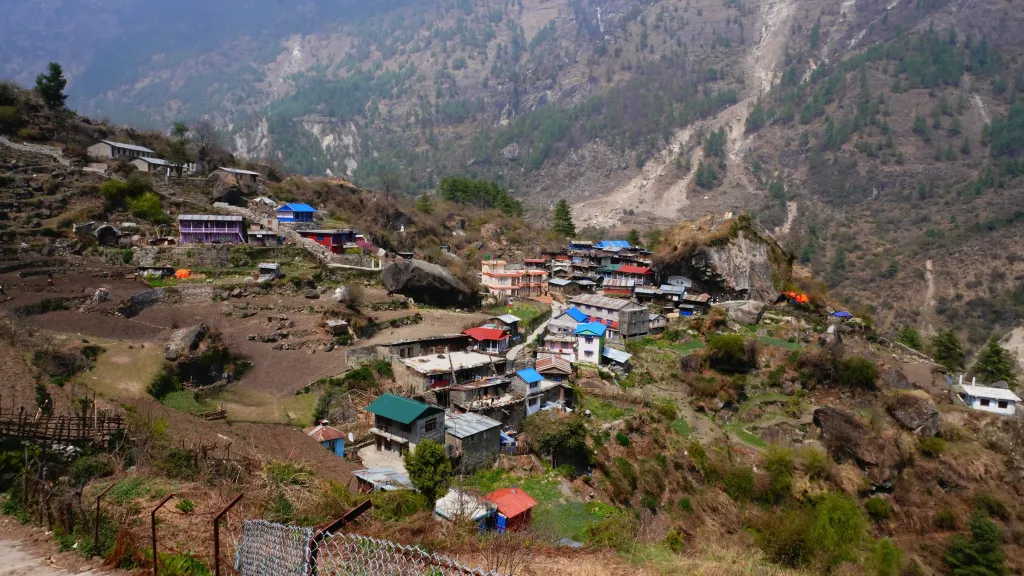
Photo: Jagat Village
After the traditional village, the hike takes you to the Tatopani' hot water', where you can take a warm bath and relax your body. After resting your body, we cross the suspension bridge over the Budi Gandaki River. The valley views from the suspension bridge amaze you even further before reaching Doban.
From Doban, we walk further up and cross a wooden bridge over the Budi Gandaki river, avoiding a long 3-hour climb up. Trekking further, we reach Yaru, a flattened valley. A bridge supported only on one side connects Yaru and Jagat. After crossing the bridge, we reach Jagat after 7 hours of trekking. We will check in to verify our trekking permits at the checkpoint in Jagat. Jagat also marks the beginning of the restricted Manaslu Region. Overnight stay at Jagat.
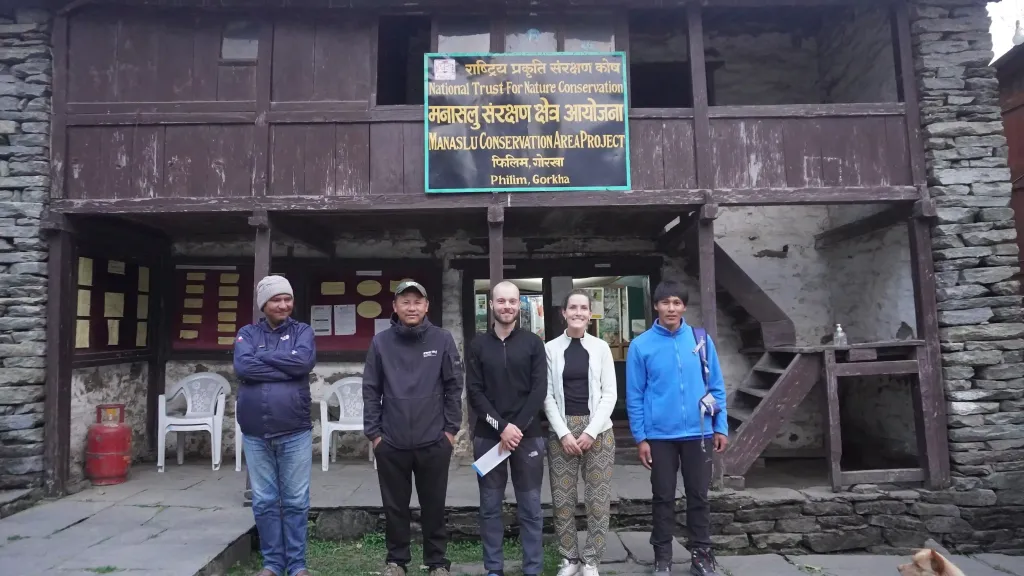
After breakfast, we begin our hike towards Deng/Pewa. The hike takes us to Sakkeri, and then we descend to Sirdibas. After Sirdibas, we will cross a suspension bridge before reaching Philim, and the village will welcome you with Buddhist prayer flags. Philim is a village of Tibetan-influenced Gurungs and hosts several gompas.

Photo: Jagat to Deng
We will also have our permits checked at Philim and then continue along the bank of the river from the western side. The scenery during this trek is amazing, and the sculptures made by the river water on the river rocks are even more amazing. As we hike further, we leave the riverbank and trek through the rhododendron and Pine forests. We will reach a junction upon trekking further and crossing the Siyar Khola Bridge. From here, the path separates the Tsum Valley and Manaslu Circuit Trek. The path on your right takes you to Tsum Valley.
We will continue our trek towards Dyang, and the trail now leads us to Pewa. Pewa is a traditional village with very few teahouses with basic food. From Pewa, we trek for about 15 to 20 minutes, crossing the Bamboo forest to reach Dyang. We reach Dyang after a total of 6 - 7 hours of trekking. It is famous for agriculture, and you can see different views of lush greenery depending on the season you visit. Overnight stay at Dyang.
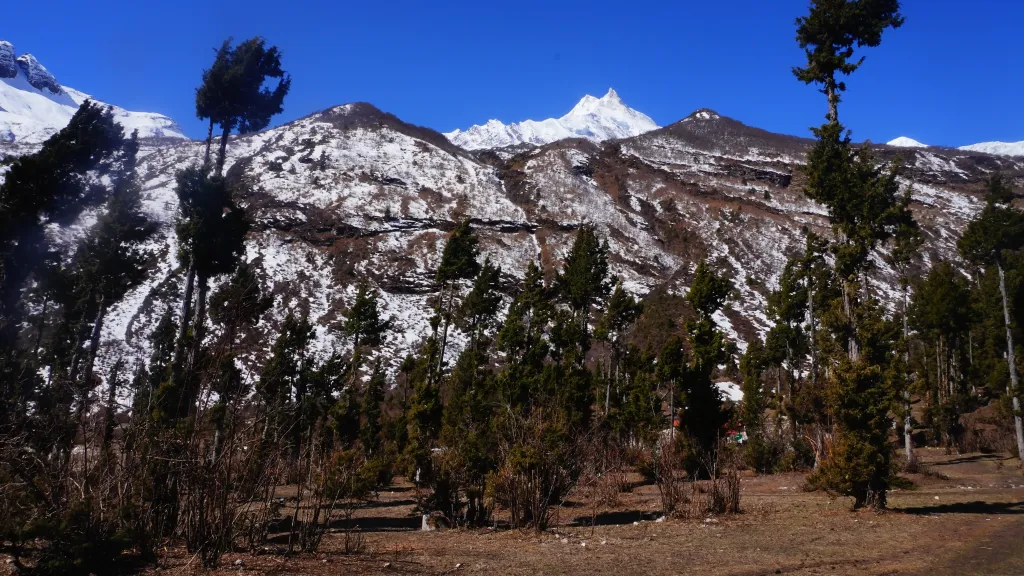
After a short hike, the mesmerizing view of Manaslu starts today. The flat trail ascends, and we cross a suspension bridge to climb to Bhim Phedi. As the trail goes through lush green forests, you can see white-faced monkeys and several bird species. This trail also offers breathtaking valley views to enjoy during your short rests.
Photo: Women in the farm of Namrung
Trekking further, we reach Ghap through several landslide zones. As this section is comparatively difficult, you must be careful and follow your guide's instructions. Following the trail, we reach a zigzag path that winds up to Namrung. We will reach Namrung after climbing the path, and the total trekking time is 6 -7 hours. Namrung is a Buddhist village with many monasteries that show the region's culture. Overnight stay at the teahouse.
After breakfast, we trek towards Sama Gaun. The hike from Namrung to Sama Gaun is short, but you can see the Gorkha Himal, Lajing Himal, Saula Himal, and other peaks over 7000 m. We will pass along the Sho village, which is also Tibetan, and can see the paintings in the gate arches. After trekking further, we will reach a rich Tibetan-styled village known as Lho Gaun.

Photo: On the way from Namrung to Samagaun
The Mani walls, traditional houses, typical lifestyle, and locals in traditional Tibetan dress show the lifestyle and culture of the Nubri people here. The stunning views of Manaslu (8,163 m) and Manaslu North (7157 m) from Lho Gaun will keep you going. After Lho Gaun, the easy trail passing through the pine and rhododendron trees takes you to Shyala.
The air becomes thinner, the lush greenery will turn into yak pastures, and you will see the traditional village after an hour of hiking from Shyala. After trekking for 5 - 6 hours from Namrung, we reach Samagaun. Samagaun is the traditional village of the Nubri people, and it holds many tea houses and luxury hotels. There is a large gompa, a health post, and a heli landing port. Overnight stay at Sama Gaun.
Today, we will acclimatize at Sama Gaun to prevent altitude sickness. You can rest the whole day or trek to the popular destinations nearby. Your guide will explain the best side trip depending on your exhaustion rate, well-being, and other factors. The side trips include a hike to Pungyen Gompa, east of the Nubra Valley, the trek to the Manaslu Base Camp, or a short trip to Birendra Lake.

The Pungyen Gompa lies at an altitude of 4700 m | 15420 ft and is perched on the hilltop; it offers enchanting views of Manaslu. It takes 6 hours of hiking, and you will see the Himalayan Thars and Yaks grazing nearby.
The Birendra Tal/Lake lies 2 hours away north of Sama Gaun, so you can take a stroll to reach there. Birendra Lake is situated at an altitude of 3691 m | 12109 ft, so it is also the easiest side trip during your acclimatization days. The Manaslu Base Camp lies further above here. It is situated at an altitude of 4800 m | 15748 ft. The trek from Sama Gaun to Manaslu Base Camp takes 6 to 7 hours, and it takes 3 hours from Birendra Lake.
Overnight stay at Samagaun.
After breakfast, we will start our trek to Samdo today. The trek takes about 4 - 5 hours; however, we will start walking slowly from this day. As we are in higher altitudes, we will continuously rest, drink water, and walk.

Photo: Village lifestyle in Samdo
The first half of the path to Samdo is filled with extended yak pastures in a broad valley, home to various birds and long mani walls. Slowly, we leave the tree line behind and trek along the trail, following the river and crossing the wooden bridge of the Budi Gandaki River. The trail takes you to the villages of Lela Kharka (3800 m) and Khermo Kharka (4,100 m). Khermo Kharka is a village neighboring Samdo, which is dedicated to Yak Herding.
From Khermo Khara, the trail descends slightly to Samdo. The mostly desert trail takes you to Samdo, our stop for today. You can also trek to Samdo Peak for amazing views if you have enough time and stamina. We will stay overnight at Samdo.
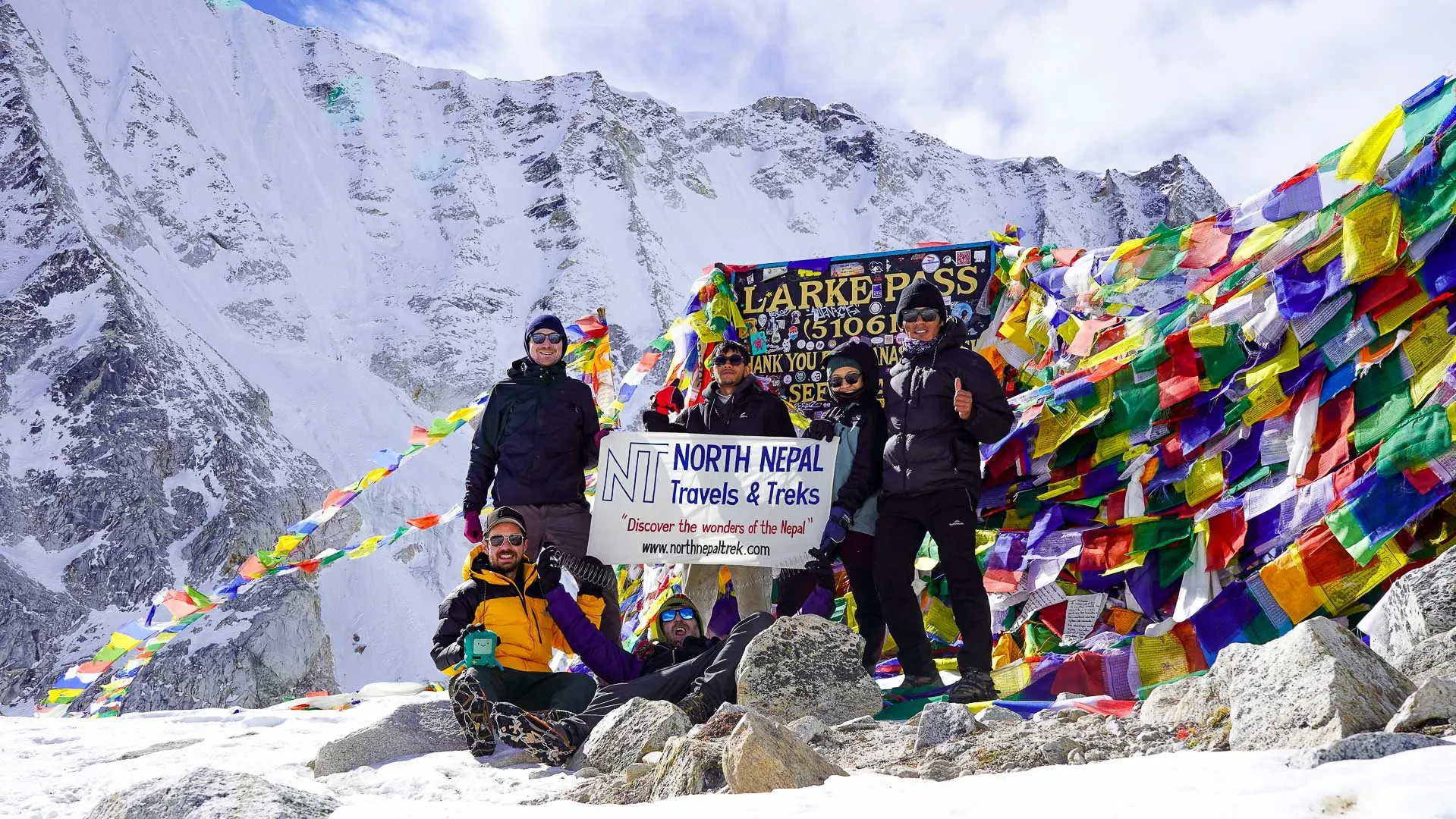
Today we are trekking at a high altitude, it takes 5 - 6 hours to reach Larkya La Phedi. The treks take you to the small market here, known as Larkya La Bazar, located at an altitude of 4200 m (13780 ft).
Photo: Larkya La Pass
We will walk further and reach Larkya La Phedi, also known as Dharmasala. Dharamshala is a small settlement at an altitude of 4,460 m (14,633 ft) that provides tea houses for trekkers attempting the Larkya La Pass the next day.
Rest well, drink plenty of water, and prepare for tomorrow, the biggest day of the Manaslu Circuit Trek.
Today, we will wake up early at about 3 am and have breakfast at the tea house. After breakfast, we trek towards the Larkya La Pass 5,106 m (16,752 ft). We need to cross the Larkya la Pass before the afternoon. After the small section with the tricky climb, we start trekking along the Larkya La Pass.

Crossing the Larkya La Pass can be quite challenging in harsh weather and snow, but our experienced guide will make the correct decision if the weather gets too complicated. Otherwise, Larkya La Pass is doable. The biggest trek day is also the most challenging; however, if you follow the guide's instructions and walk steadily, you can cross the pass successfully.
The strikingly awesome views of Manaslu (8163 m | 26781 ft), Himlung (7126 m | 23379 ft), Annapurna II (7937 m | 26040 ft), Ratna Chuli (6889 m | 22601 ft), Cheo Himal (6820 m | 22904 ft), Nemjung (7140 m | 23425 ft), Gyaji Kang (7074 m | 23208 ft), Kang Guru (6981 m | 22903 ft), and Tibet Kang (7126 m | 23379 ft) while crossing the Larkya pass makes it truly worth the challenge.
After spending your time taking pictures and enjoying the scenery, we descend towards Bhimtang. It takes three hours to reach Bhimtang from the Larkya La Pass. During the descent, enjoy the views of huge icefalls and Pongkar Tal between Pongkar and Slapu glaciers, with mountains in all directions. Finally, we reach Bhimtang after 7 - 8 hrs of trekking.
Today is our final day of trekking in the Manaslu region. The final day will also take us through one of the most beautiful sceneries of the Manaslu trek. In fact, the Bhimtang trek is another popular trek in the Manaslu region, which we will cover during the Manaslu Circuit Trek.

Photo: Odar Village
The trails take you downhill, and we will walk through a lush forest full of flora, fauna, and pasture lands, ultimately descending to the valley of Dudh Khola.
The trek takes us to Karche, where we will have lunch and restore our energy. Upon trekking further, we can see the remains of glacial floods with tree trunks. The path becomes rough, and as we walk, we reach Gurung Gaun, the first village after Samdo.
The valley is more agricultural from here, as we can see while walking along the fields. After Gurung Gaun, we reach Tilche. It is famous for its apple garden and its locally made wine. After hiking for an hour from Tilche, we will reach Dharapani. Total trekking time from Bhimtang to Dharapani is 5- 6 hours. Overnight stay at Dharapani.
From Dharapani, we take a Jeep after breakfast in the morning. The road is full of off-road; however, the scenery of the Marsyangdi River will keep you entertained. The drive from Dharapani to Besisahar takes 3 hours. We can have lunch at Besisahar and then drive back to Kathmandu. The drive from Besisahar to Kathmandu takes 6 to 7 hours.
However, if you feel like it's too much rush or too much driving time, then you can stay one day at Besisahar and drive back to Pokhara/Kathmandu the next day.
Note:
Autumn Trail Alert: Expect rugged, steep trails along the Budhi Gandaki with clear days and freezing nights on the Manaslu Circuit Trek this season. Signal turns sparse past Samagaun, and teahouses grow basic at higher altitude.
Just came back from Manaslu circuit excellent arranged by Mohan at North Nepal Treks. Two weeks in heaven together with and old friend and a new one - our guide Zeewan - superman on the planet - and a caring mountain man. We chose North Nepal treks advised from my daugther and her fiance who went on the same trip 6 months earlier after scanning the market of agiencies together with recommendations from her friends. Was our jubilee trip after our Annapurna circuit trip 40 years ago. Meaning we are 64 years old, but still relatively fit and running marathons though. Everything went smooth and easy. We want to go again but only with this company. Seriously
Hi from Hans and Chris from Denmark.
We recently had an incredibly wonderful and memorable experience with our guide Zeewan and our porter Dayaram on our Manaslu Circuit and Tsum Valley trek. Zeewan came highly recommended from friends. He and Dayaram were exceptional, we always felt we were in safe hands over the 19 days we were completing the trek. Zeewan has so much passion for Nepali wildlife and it shined through and really enriched our experience; while we were trekking, he spotted wild deer, Tahr, Blue Sheep and Himalayan Marmots for us to see. We would absolutely recommend heading out with Zeewan to anyone, we are incredibly grateful for the professionalism and kindness of our guide and porter.
We came as strangers and left as friends. That sums up our experience with North Nepal Travel & Trek (especially Mohan, the manager, and Zeewan, our guide) perfectly. It is definitely the best agency we can imagine. Mohan takes time for his guests, listens to them and then customizes a trekking tour. Everything is highly professional and perfect in terms of safety. When things didn't go fast enough in the kitchen at the guesthouse, Zeewan always stepped in and helped to get the best result for us. As soon as we weren't feeling well with the altitude, he supported us with any problem and helped us to feel better quickly. We even experienced a winter storm during our hike in February and still felt very safe and in best hands, Zeewan knows exactly what he is doing. After the hike, we were welcomed as friends by Mohan and we met again and again for tea, coffee and food many times. Thank you so much for this wonderful experience Mohan and Zeewan, we look forward to seeing you again!!!
Oct 2024 • Family
North Nepal Travels & Treks was easy to contact and Mohan planned our trek perfectly. We did the 10-day Manaslu Circuit trek with our guide Gopal and porter Karna. It was truly amazing, an absolute recommendation. We enjoyed nature, culture and the talks with our guide, explaining the culture, religions and politics of Nepal.
Oct 2024 • Couples
We had an amazing experience with North Nepal Travel & Trek on the Manaslu Circuit. Mohan was great with communication, and he even took us out to dinner after the trek to hear about our adventure!
Our guide, Jeewan, made the journey unforgettable with his knowledge, positivity, and organization. Our porters, Basanta and Milen, were fantastic—Basanta kept us smiling every day, and Milen, or "Mountain Ferrari," amazed us with his strength and kindness.
We can’t wait for our next trip with them to Pikey Peaks. Highly recommend North Nepal Travel & Trek for a well-organized and memorable trek!
Crossing the mighty Larkya La Pass (5,106 m) is an unforgettable highlight, so our itineraries are carefully structured with built-in acclimatization stops in villages like Samagaun and Samdo. We conduct daily health checks for AMS, and if severe symptoms appear, our non-negotiable rule is an immediate descent to lower ground.
Because the Manaslu region is remote, rapid emergency logistics are essential. In the event of a severe injury, acute mountain sickness, or extreme weather, our Kathmandu base team will instantly coordinate a rapid helicopter evacuation to get you to medical care without delay.
To ensure you are 100% protected, all trekkers must hold comprehensive travel insurance explicitly covering high-altitude trekking (up to 6,000 m), emergency medical treatment, and high-altitude helicopter rescue.
Secure the Manaslu Circuit Trek (11 Days) for 2026/2027 before the seat gets fully booked.
The Manaslu Circuit Trek is an 11-day Himalayan trek around Mount Manaslu (8,163 m) in Gorkha, Nepal. The route combines remote mountain landscapes, Tibetan-influenced villages, Buddhist monasteries, glacial lakes, and the crossing of Larkya La Pass, the highest point of the trek.
The standard Manaslu Circuit itinerary takes 11 days of trekking, with the route generally running from Machhakhola toward Dharapani. Longer versions can be arranged by adding destinations such as Tsum Valley or Manaslu Base Camp and allowing additional acclimatization days.
The Manaslu Circuit is graded strenuous. The trek involves long walking days, significant elevation gain, rugged terrain, and the crossing of Larkya La at more than 5,000 meters. Previous high-altitude trekking experience is strongly recommended, especially for the faster 11-day itinerary.
The highest point is Larkya La Pass at approximately 5,106 meters (16,752 feet). The pass is the most demanding section of the circuit because of the altitude, long ascent, weather exposure, and steep descent on the opposite side.
The standard route covers roughly 177 km, although the exact distance varies according to the roadhead, itinerary, and optional side trips. Extended itineraries that include destinations such as Manaslu Base Camp or Tsum Valley cover considerably more ground.
The two treks are comparable in overall difficulty, but Manaslu generally feels more demanding because it is more remote and has fewer facilities in some sections. The descent from Larkya La toward Bhimtang can also be particularly challenging compared with the Thorong La section of the Annapurna Circuit.
The trek passes through communities strongly influenced by Tibetan Buddhism, particularly in the upper Manaslu region. Trekkers encounter traditional villages, Buddhist monasteries, prayer walls, chortens, and centuries-old cultural traditions alongside the mountain scenery.
Notable monasteries and gompas include Ribang Gompa, Lho Monastery, Sama Gompa, Pungyen Gompa, Kargyu Chholing Monastery, Mu Gompa, Rachen Gompa, and Shringi Gompa. Their locations and accessibility depend on the selected itinerary and side trips.
Samagaun and Samdo are important high-altitude villages in the Nubri Valley. Their communities have strong Tibetan cultural influences, reflected in their Buddhist traditions, architecture, language, monasteries, and traditional mountain lifestyle.
The trek requires three main permits:
The required permits are arranged as part of the organized trekking process.
You can travel on the Manaslu route without arranging a trekking partner, but you still need to comply with the current restricted-area rules, including travelling with a licensed guide and holding the required permits.
Yes. Manaslu Base Camp can be visited from Samagaun as a side trip when it is included in the itinerary. The additional hike is demanding and should be planned according to weather, fitness, and acclimatization.
Yes. Altitude sickness is a genuine concern, particularly above 3,000 meters and around the higher villages and Larkya La Pass. Proper acclimatization, gradual ascent, hydration, sensible pacing, and immediate reporting of symptoms to your guide are important.
Acclimatization should be built into the itinerary rather than relying on fitness alone. Above 3,000 meters, the ascent should be controlled, with appropriate acclimatization days and careful monitoring for symptoms such as headache, nausea, dizziness, unusual fatigue, or loss of appetite.
Your guide will assess your condition and determine whether you can safely continue. Depending on the severity, the itinerary may need to be slowed down, a side trip may be cancelled, or you may need to descend to a lower altitude. Safety takes priority over completing the planned itinerary.
The best trekking seasons are spring (March to May) and autumn (September to November). These periods generally offer more stable weather, better visibility, and favorable conditions for crossing Larkya La.
The Manaslu Circuit is primarily a teahouse trek. Accommodation ranges from basic village lodges to more developed teahouses, with facilities becoming simpler at higher elevations. Twin-sharing rooms are standard, and shared bathrooms are common in remote sections.
Lower sections offer a wider selection of Nepali and international dishes, including dal bhat, noodles, pasta, pizza, fried rice, eggs, and other common trekking meals. Higher sections have fewer choices, with staples such as dal bhat, Tibetan bread, porridge, dumplings, and vegetables becoming more common.
Essential equipment includes a suitable backpack, warm layers, down jacket, waterproof jacket, trekking trousers, sturdy hiking boots, sleeping bag, trekking poles, and sun protection. Crampons or microspikes and gaiters may also be useful depending on snow conditions around Larkya La.
The cost generally ranges from around USD 1,200 to USD 2,500 per person, depending on the itinerary, group size, trekking duration, transportation, accommodation, permits, guide services, and included facilities.
Permit costs can differ for trekkers from SAARC countries, including India. Other trip expenses such as accommodation, food, transportation, and guide services are generally based on the selected package rather than nationality.
The standard itinerary begins around the Machhakhola area and finishes toward Dharapani, from where trekkers continue by road toward the next destination. Exact roadheads can change according to the selected itinerary and current road conditions.
Previous experience at elevations above 4,000 meters is strongly recommended, particularly for the standard 11-day itinerary. The trek is strenuous, and experience on routes such as Everest Base Camp or the Annapurna Circuit can help you understand how your body responds to prolonged altitude exposure.
Connectivity varies considerably along the route. Some lower and larger villages have mobile service or Wi-Fi, while remote high-altitude sections can have limited or no reliable connectivity. Trekkers should not depend on continuous internet access during the trek.
The trek combines views of Mount Manaslu, Larkya La Pass, Birendra Lake, glaciers, high mountain valleys, and remote Himalayan landscapes. The changing scenery from lower valleys to the alpine zone is one of the defining features of the circuit.
Birendra Lake, also known as Birendra Tal, is a glacial freshwater lake near Samagaun. It lies in the Manaslu highlands and can be visited as part of the route toward Manaslu Base Camp, depending on the itinerary and conditions.