Everest Base Camp Trek (12 Days) — Cost, Itinerary & Guide for 2026

Home Trekking

Everest Region

Everest Base Camp Trek (12 Days) — Cost, Itinerary & Guide for 2026
DESTINATION Nepal
MAX. ELEVATION 5,644 m (18,519 ft)
WALKING DISTANCE Approx. 5-6 hrs walking
GRADE Moderate to Challenging
BEST SEASON Spring & Autumn
DURATION 12 Days
MEALS INCLUDED Breakfast, Lunch & Dinner
ACCOMMODATION Hotel/Lodge/Teahouse

OVERVIEW & HIGHLIGHTS

Overview of 12-Day Everest Base Camp Trek

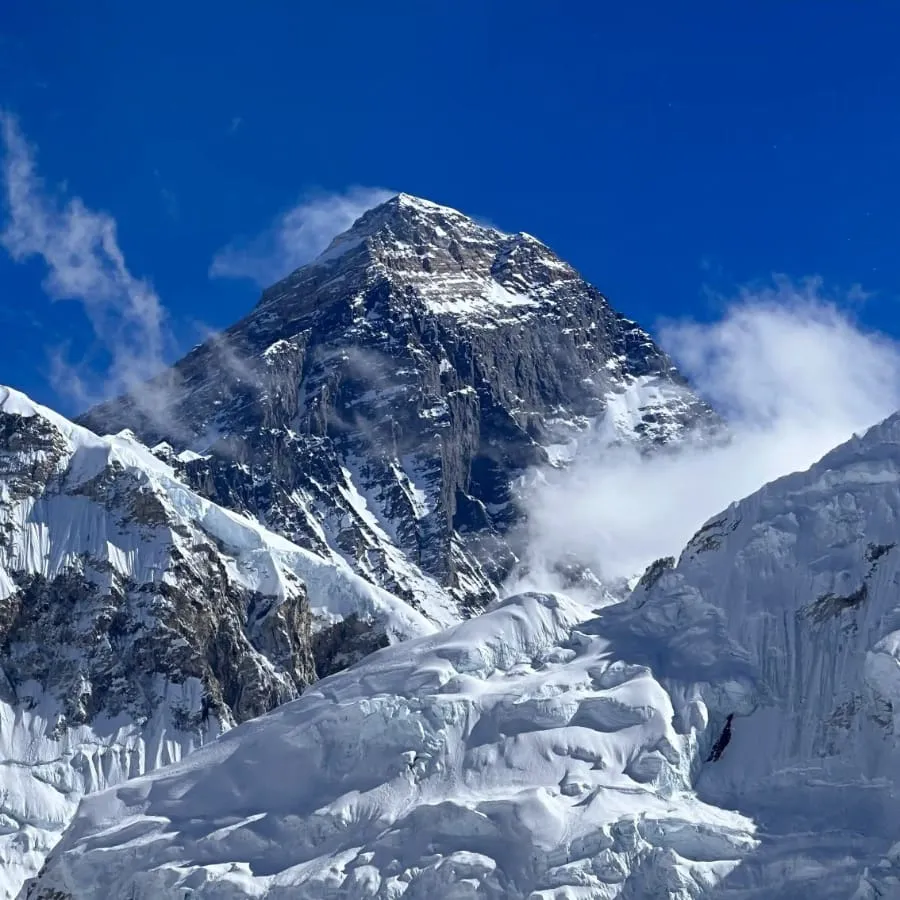
Everest Base Camp is a world-famous trekking destination with the option of a Helicopter tour to EBC. It is situated in the Khumbu region of Solukhumbu district at an altitude of 5,364 m (17,598 ft). Everest Base Camp Trek is a glorious tale of accomplishment and courage at the base of the world's highest mountain, Mt. Everest (8,848.86 m).

Everest Base Camp Trek (EBC) starts from Lukla at an altitude of 2,860 m. It is the gateway to the Mt. Everest Summit and Base Camp Trek in the Himalayan ranges of Nepal. They say, "The best view comes after the hardest climb." This fits perfectly with the Everest Base Camp trek, as Kala Patthar is at an elevation of 5,644 m. It offers more views of Everest than the base camp at 5,364 meters (17,598 feet). In just 12 days, you can trek to Everest Base Camp, which covers a 130 km round trip and offers stunning views of the mountains.

View of Mountain peaks and Teahouse on the trek to Everest Base Camp, Nepal.Photo: Fleeting moment of golden sunrays on the mountain peaks and teahouse on the trek to Everest Base Camp, Nepal.

Everest Base Camp Trek in Nepal takes you through a glorious view of Mt. Everest, Lhotse, Makalu, Cho Oyu, and many more as you ascend the trekking route. Everest Base Camp Trek lies inside Sagarmatha National Park, covering an area of 1,148 sq km, so you get the chance to explore wildlife and vegetation inside the area. Sagarmatha National Park, listed as a UNESCO World Heritage Site, is home to the endangered species Snow Leopard and Red Panda. 

The trek to Everest Base Camp takes you to the community of Sherpa. The Sherpa community, whose stories of resilience and bravery echo all over the world, is known for its exceptional mountaineering skills and for navigating the Himalayas of Nepal. Sir Edmund Hillary and Tenzing Norgay Sherpa were the first people to climb Mt. Everest in 1953.

Download the all-season packing checklist before you join the Everest Base Camp Short trek with us.

The base camp of Everest welcomes you to the base of the world's highest peak as a possible replacement for the climbing experience of Everest. The 12-day trek to Everest Base Camp gives you a sense of accomplishment. Fill you with abundant courage, sometimes testing your limits, and offers a rare chance to immerse yourself in the culture and tradition of the Sherpa community living in the Himalayas of Nepal.

Short Everest Base Camp Elevation, Distance, & Time 

Get all elevation, trek distance, and trek time for the Everest Base Camp itinerary.

Day

Route

Elevation

Trek Distance

Trekking Time

1 Kathmandu to Lukla

1,324 m

45 min flight  

2

Fly from Lukla & Phakding Trek

2,850 m

~ 6.5 km

3-4 hrs

3

Phakding to Namche Bazar

3,440 m

~ 7.4 km

6 hrs

4

 Accommodation at Namche Bazaar 

3,440 m

NA

~2–3 (side hike)

5

Namche Bazaar to Tengboche

3,870 m

~ 6 km

5-6 hrs

6

Tengboche to Dingboche

3,855 m

~ 9.2 km

5-6 hrs

7

Dingboche to Lobuche

4,940 m

~ 8.4 km

6 hrs

8

Lobuche to EBC & back to Gorakshep

5,364 m

~ 8.5 km

5-6 hrs

9

Gorakshep to Kalapattar to Pheriche 

5,643 m

~ 9 km

6-8 hrs

10

Pheriche to Namche Bazaar

3,855 m

~ 9.2 km

5 hrs

11

Namche Bazaar to Lukla

2,850 m

~ 17.7 km 

7-8 hrs

12

Lukla to Kathmandu

1,324 m

45 min flight

NA

Why you will love this Short Everest Base Camp Trek?

  • World's Highest Base Camp: Stand at the foot of Mt. Everest (8,848.86 m).
  • Panorama of Giants: Breathtaking views of Lhotse, Makalu, Cho Oyu, Nuptse, Ama Dablam, Pumori, and Changtse.
  • Sherpa Heartland: Meet legendary Sherpa at Namche Bazaar - gateway of Mount Everest.
  • Spiritual Hub: Explore the historic Tengboche Monastery, framed by Mt. Ama Dablam.
  • Alpine Sunrise: Magical sunrise & sunset views from the iconic vantage point of Kala Patthar (5,644 m.)
  • Wildlife & Flora: Trek through the UNESCO World Heritage Site, Sagarmatha National Park—home to elusive Snow Leopards and Red Pandas—amidst vibrant spring Rhododendron forests.
  • High-Altitude Birds: Possibilities of endangered high-altitude birds; Bearded Vulture, Snowcock, Blood Pheasant, Alpine Chough & Yellow-billed Blue Magpie.
Mohan Raj Bhandari
Itinerary review by

Mohan Raj Bhandari, Founder/Managing director

Everest Base Camp trek route and pacing are drawn from 12+ years guiding the Everest region. Mohan founded North Nepal Trek in 2015; Jiwan has led over 6 Everest Base Camp treks since 2016.

Everest Base Camp Trek Itinerary

Toggle all
Day 1

Arrival at the Kathmandu Airport:

HIGHEST ALT. 1324 m| 4344 ft

Arrive at Tribhuvan International Airport (TIA), Kathmandu. A representative from North Nepal Travel & Trek will greet you at the airport and escort you to the hotel via private transport. 

Kathmandu Durbar SquarePhoto: Kathmandu Durbar Square

After check-in at the hotel, you can rest or explore the city for the day. In the evening, there will be a trip briefing. Here you will meet your guide and have your queries related to the 12-Day Everest Base Camp Trek addressed.

Day 2

Fly to Lukla and trek to Phakding

FLIGHT 20 -30 minutes
HIGHEST ALT. 2,850m / 9,350ft.
DURATION 3-4 hrs
Distance
DISTANCE 6.5 km / 4 miles

During peak seasons of Spring and Autumn, Kathmandu Airport cannot handle international and domestic flights. Domestic flights to Lukla are often transferred to the Ramechhap Airport.

Depending on the trekking season, one of the two scenarios might occur during our first day, and of course, we will discuss this with you during our briefing before the trek.

Flight from Kathmandu (Tribhuvan International Airport) to Lukla:

Early morning drive to the Airport. The 30-minute flight to Tenzing-Hillary Airport, Lukla, with scenic views of the Himalayas.

Flight from Ramechhap Airport (Manthali Airport) to Lukla:

Early drive to Ramechhap Airport,t which takes 4 hours. 20- 25-minute flight to Tenzing-Hillary Airport, Lukla. After reaching Lukla, the itinerary remains the same.

On arrival at Lukla, we have breakfast and meet with the porters. The trek starts from Lukla to Phakding, and the trail descends downhill to Dudh Koshi River Valley, a lovely walk past several villages such as Cheplung(2,700 m) and Ghat (2,530 m). An hour's walk from there takes you to the small settlement of Phakding(2,610 m). 

Day 3

Trek from Phakding to Namche Bazar (3,440 m/11,285 ft)

HIGHEST ALT. 3,440m / 11,285ft
DURATION 6 hours
Distance
DISTANCE 7.4km / 4.6 miles

After an early breakfast, we will start the trek to Namche Bazar. On the third day of the Everest Base Camp Trek, we will cover 7.4km / 4.6 miles walking for 6 hours. The trail takes you through the forest of Pine and Cedar. After walking past the Chumoa village and Monjo Village, we reach the entrance of Sagarmatha National Park.

After registration at the entrance, we will enter Sagarmatha National Park. After lunch at Jorsale and crossing a few suspension bridges, we will walk steeply uphill along the river surrounded by forests. And finally, reach Namche Bazaar. Overnight stay at Namche Bazaar.

Namche Bazar is a beautiful settlement of the Sherpa community. The deep valley is surrounded by snowy mountains and hills. Anyone entering the organized town of Namche will be awe-struck. Dazzled by its beauty, it is a paradise in the Everest region.

This is no ordinary place. This ancient Tibetan-Buddhist town was once a trading junction for Tibet and Nepal. Namche now serves as the gateway to Everest Base Camp and Everest climbing. This is an acclimatization place for trekkers.

Day 4

Rest day in Namche Bazaar and trek to Everest View Hotel (3962 m | 13000 ft)

HIGHEST ALT. 3440 m | 11290 ft
DURATION 3 - 4 hours

On the fourth day of the Everest Base Camp Trek, we will acclimatize in Namche Bazar. It prevents altitude sickness. It is important to adapt your body to the altitude and climate. We will stroll around Namche Bazar and trek to the Everest View Hotel.

Namche offers a great shopping experience as well. You can find all sorts of services you would not generally expect in the deep valley of mountains. It has all the facilities and amenities you can find in any city in Nepal.Everest View Hotel

From several internet cafes, German bakeries, little cafes, and restaurants to an Irish pub, you can enjoy all kinds of services. Namche even has electricity access from the nearby Thame-Namche hydropower plant.

We will hike to Syangboche Airport and the Everest Hotel. Syangboche Airport is the highest airport in the world; however, it is not in operation. Everest Hotel offers splendid views of mountains like Everest, Ama Dablam, Lhotse, etc.

The next excursion on the Everest Base Camp Trek is the Sherpa Culture Museum. It is a great place to learn about the history, culture, and traditions of the Sherpa people. Overnight stay at Everest View Hotel.

Day 5

Trek from Namche Bazaar to Tengboche (3,870m)

HIGHEST ALT. 3,870 m
DURATION 5 - 6 hrs
Distance
DISTANCE 6 km

After an early breakfast, we start our trek to Tengboche. We will walk for 5-6 hours, covering 6 km. We will walk a steep hill trail descending into the Valley of Dudh Koshi River base and ascending again after reaching Pungki Thanka. We will cross the suspension bridge and walk along the alpine vegetation with a view of a mountain peak. We will climb uphill to Tengboche village. Overnight stay at Tengboche.

Tengboche and rocky mountains in the backdrop during Everest TrekPhoto: Tengboche and rocky mountains in the backdrop during Everest Trek.

Tengboche village is a beautiful Sherpa settlement on the hilltop at an altitude of 3,867 m in the Khumbu region. It’s a near-perfect viewpoint for witnessing the wonders of nature like mountain peaks, sunrise, and sunset. It offers a grand panoramic view of peaks like Everest, Ama Dablam, and Lhotse.

Tengboche Monastery is one of the sacred and important landmarks. This ancient Buddhist Monastery has vibrant and contrasting designs and art. Those arts depict the philosophy of Buddha and other spiritual Gurus. Tengboche Monastery closes at 3 pm. If we can make it by 2 pm, we can spare an hour to explore Tengboche and witness a Buddhist religious ceremony.

Day 6

Trek from Tengboche to Dingboche (4,360m)

HIGHEST ALT. 3,855m / 12,850ft
DURATION 5-6 hrs
Distance
DISTANCE 9.2km / 5.7miles

We will trek to Dingboche early in the morning after breakfast. On this day, we will walk for 5-6 hours, covering 9.2 km. The highest altitude we reach is 4,410 m. We will descend towards Dingboche through the alpine forest.

We will follow the Imja River flowing down from the Himalayas. We pass through Sherpa villages like Debouche, Pangboche, and Shomare. Captivating vistas of the Sherpa community and mountain peaks feel like a magical moment. You can find a route to Ama Dablam Base Camp just to the left of Pangboche. Overnight stay at Dingboche.Dingboche

Dingboche is the last Sherpa village during the Everest Base Camp Trek. It is also a popular stop for acclimatization. The majority of the people are Tibetan-Buddhist. Mani walls, prayer flags, and monasteries give you spiritual vibes.

Despite being located in a cold region, it has fertile land. Barley, potato, and Buckwheat are the major crops here. Perhaps these are major crops in the Himalayan region of Nepal. Not to forget, Sherpas are involved in the Tourism industry as well. Their stories of resilience are known to the world. 

Day 7

Trek from Dingboche to Lobuche (4,940 m)

HIGHEST ALT. 4,930m /16,175ft.
DURATION 6 hrs
Distance
DISTANCE 8.4km / 5.2 miles

We will hike to Lobuche early in the morning. We are just a day away from reaching Everest Base Camp. On this day, we will walk for 6 hours, covering about 8.4 km. We walked along the trail to a ridge. The views of Taboche and Cholatse are simply breathtaking.

LobucheWe continued our trek through the yak grassland to a wooden bridge connecting to Duglha(4,620m/15,158ft). We walked steeply uphill for an hour up to the terminal moraine of Khumbu Glacier. We will find memorials built in memory of lost climbers and Sherpas during their Everest expedition. Mesmerizing views of Khumbutsse, Lingtren, and Pumori will blow your mind.

Yet, Everest is hidden behind the majestic Nuptse. We have our lunch at Thungla, and after an hour's climb from here, we reach Lobuche after 5 hours of trekking. Overnight stay at Lobuche after some briefing for tomorrow at Everest Base Camp.

Day 8

Trek to EBC & back to Gorakshep

HIGHEST ALT. 5,364 meters (17,598 feet)
DURATION 5-6 hrs
Distance
DISTANCE 8.5km / 5.2 miles

Finally, we will reach our long-awaited destination: Everest Base Camp. It lies at 5,364 m | 17,598 ft. The trek is comparatively long, but the views of Everest and the surrounding Himalayas from the base camp are worth it. 

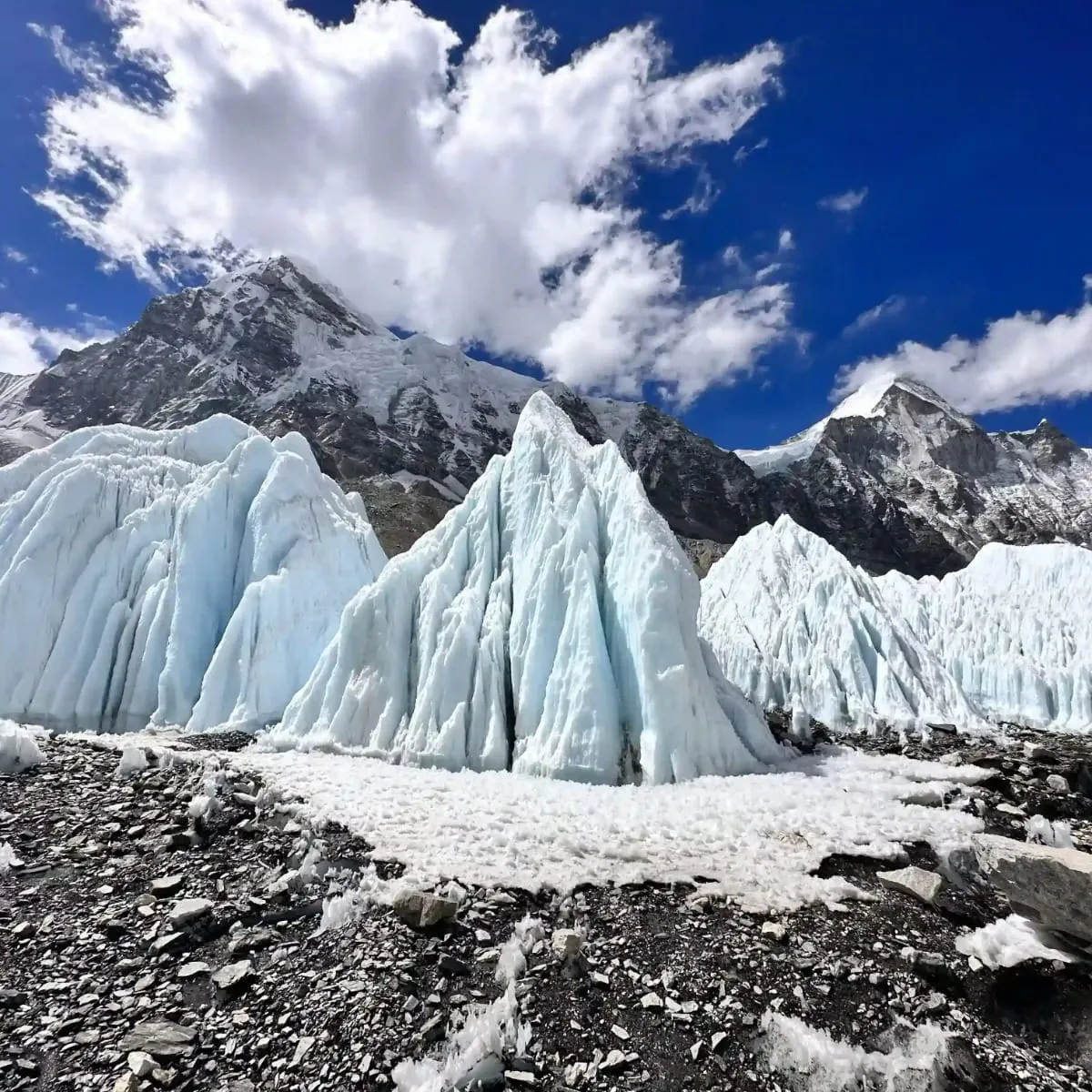
We walk along the wide valley and rocky trails above the Khumbu Icefall and reach Gorakshep. Gorakshep will be our night stay after exploring Everest Base Camp. Gorakshep is a small settlement with several lodges on the way to base camp, just below the Kala Patthar.Gorakhshep

After lunch, we will walk for 3 hours to reach Everest Base Camp. During expedition season, the trail is filled with porters and tourists. The base camp looks like a mini-village full of tents.

The base camp offers you a majestic view of Mt. Everest and two gigantic walls of Lhotse-Nuptse. Similarly, the view of Khumbu Icefalls and glaciers is an out-of-this-world experience. After exploring the base camp, we will return to Gorakshep.

Day 9

Hiking to Kalapattar to Gorekshep to Pheriche

HIGHEST ALT. 5,364m / 17,598ft
DURATION 6-8 hours

We trek to Kala Patthar as early as possible to witness sunrise and avoid the clouds. We hike to Kalapatthar, the highest point of the short Everest Base Camp trek, at an altitude of 5,644 meters.

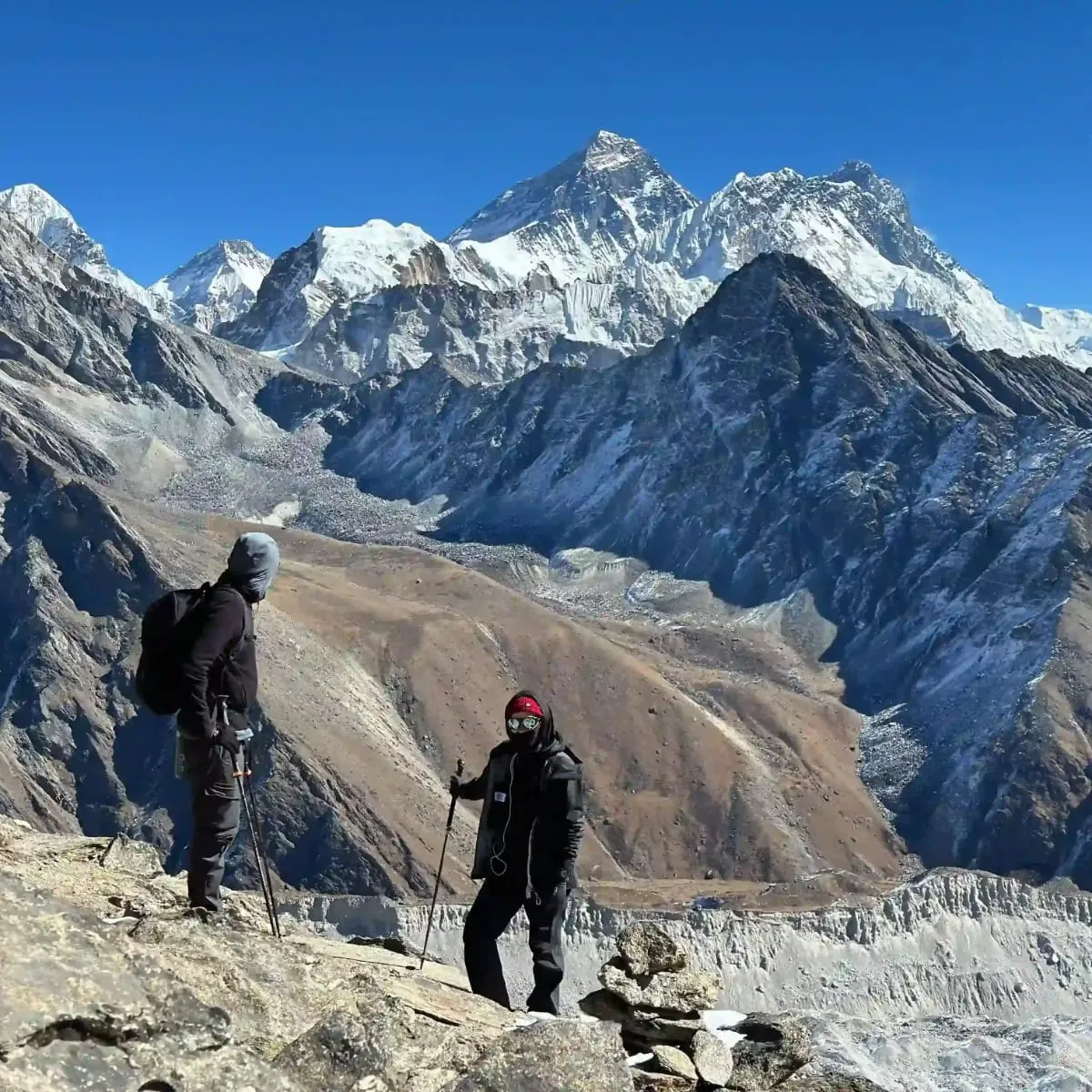
As we gradually walk on steep trails and pass some ridges, we enjoy the views of the Lingtren, Changtse, and Khumbuste mountains. Kalapatthar is the viewpoint that offers mind-blowing views of Everest along with other peaks.

After hiking for 3 hours to Kala Patthar, the panoramic view of Mount Everest, Khumbu Glacier, and other mountains will surprise you. Mt.Everest is very close. It feels like you are climbing the highest mountain in the world.

After indulging in the beauty of the Himalayas, we will hike back to Gorakshep. We have our breakfast at Gorakshep and trek towards Pheriche. We continue to walk downhill to Thugla, where the trail splits into two ways to Dingboche and Pheriche. We take the route to Pheriche, a windy valley with many nice lodges. Overnight stay at Pheriche.

Day 10

Pheriche to Namche Bazaar

HIGHEST ALT. 3,855m / 12,850 ft
DURATION 5 hours
Distance
DISTANCE 9.2km / 5.7miles

We retrace our journey back to Namche Bazaar, the same path we took to start the trek. We will follow the Dudh Koshi River and cross the suspension bridge via Rhododendron and Pine forests. We will move forward, leaving Everest Base Camp behind us.

Teahouse at Pheriche and snowy mountain peaks in the backdrop of Everest region.Photo: Teahouse at Pheriche and snowy mountain peaks in the backdrop of the Everest region.

We may also encounter mountain goats, pheasants, and other wild animals or birds. After reaching Sansa, we will enjoy lunch with the view of Ama Dablam, Nuptse, and Thamserku mountains. After walking for 5 hours, we will reach Namche Bazaar. Overnight stay in Namche Bazaar.

Day 11

Trek from Namche to Lukla

HIGHEST ALT. 2,850m / 9,350ft
DURATION 7-8 hrs
Distance
DISTANCE ~ 17.7 km

After an early breakfast, we will trek down to Lukla. We will cover around 17.7 km distance walking for 7-8 hours. We will walk the same rocky terrain following the Dudh Koshi River and crossing suspension bridges.

We will reach Phakding past Sagarmatha National Park for lunch. After a short rest, we will climb up to Lukla. We will reach Lukla and prepare for our flight back to Kathmandu for tomorrow, and our journey ends with a comfortable, nice lodge at Lukla

Day 12

Fly back to Kathmandu

FLIGHT 20 -30 minutes

It will take 40 minutes to fly to Kathmandu. And a 20-minute flight to Manthali Airport, Ramechhap, and 6 hours drive to Kathmandu. Upon reaching Kathmandu, you will be escorted to your hotel. You can stroll around the cafes and streets of Kathmandu Valley during the day.

Tribhuvan International AirportPhoto: Tribhuvan International Airport

North Nepal Trek will organize a farewell dinner. You will also receive the successful Everest Base Camp trek certificate, and our representative will take you to the airport for your final departure the next day.

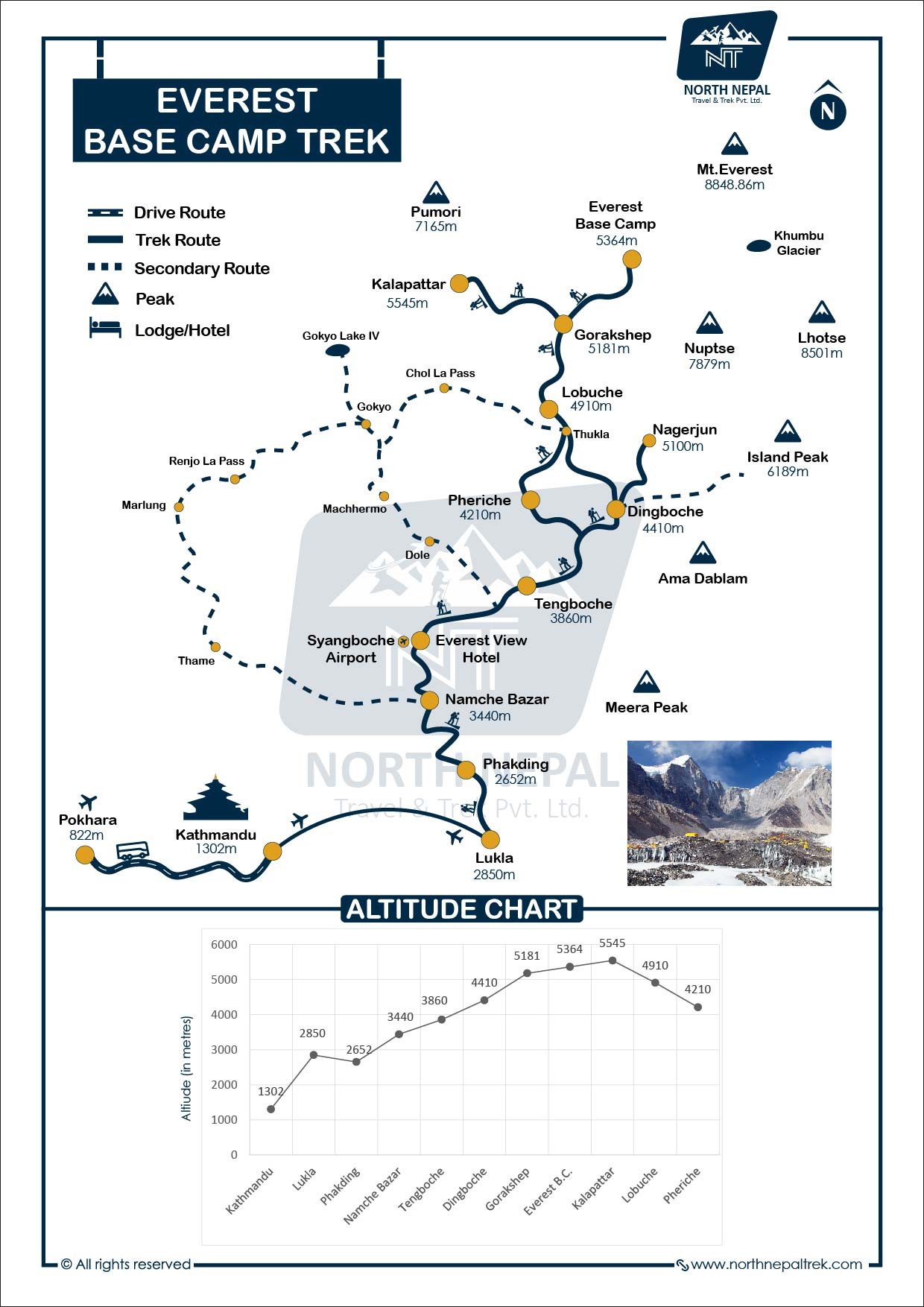
Official Everest Base Camp Trek Map and Elevation Graph

Official Everest Base Camp Trek Map and Elevation Graph

WHAT'S INCLUDED & EXCLUDED

  • All ground transport in private vehicles, including airport transfers.
  • We provide 3 meals per day (Breakfast, Lunch, and Dinner) & Tea twice daily. Please note that each meal is served as a single serving.
  • One highly experienced, friendly, and English-speaking guide, and his food, accommodation, salary, equipment, and accidental insurance for all staff.
  • Round-trip flight Kathmandu / Manthali – Lukla, and Lukla – Kathmandu including departure taxes.
  • Trekking poles, Duffel bag & Crampons, if required.
  • Water purification tablet & First aid medical kit with oximeter.
  • Sagarmatha National Park permit fee & Khumbu Rural Municipality permit. (Please bring 2 passport-size photos for Permit)
  • Achievement certificate after the trek.
  • Government taxes and office service charges.
  • Porters to carry bags up to 30 kg combined
  • Travel & Trekking insurance that covers emergency high-altitude rescue.
  • International airfare and Nepal visa entry fee.
  • Cold Drinks, beverages, Hot water, Mineral water, Fanta, Cola, Beer, Scotch, etc.
  • Snacks and other personal expenses.
  • Personal trekking equipment.
  • WiFi internet and a hot shower during the trek.
  • Tips and gratuities for trekking staff 
  • Additional costs incurred due to causes beyond our control, like landscape, bad weather conditions, illness, change of government policy,etc.
  • Any other expenses that are not mentioned in the included section.

Everest Base Camp Trek (12 Days) — Cost, Itinerary & Guide for 2026's Detail Information

Toggle all

Best Time for Short Everest Base Camp Trek

Spring and Autumn seasons are the best time to go on the Everest Base Camp trek. Both seasons give you mild climatic conditions during the walk. The Everest Base Camp trek is inside Sagarmatha National Park, so the trek offers you beautiful landscapes, wildlife, and green forests. The Everest region has distinct features in different seasons. 

Spring Season (Early March to Late May)

Spring is the peak season of the year for trekking in Nepal, including the Everest trek. It has a clear sky with a warm climate. Sunny days make the weather warm and dry during the day. Being a peak season of the year, the Everest trek is filled with trekkers from around the world. And comparatively an easier trek to go on than in any other season.

However, the short Everest Base Camp Trek is crowded compared to other seasons. During this season, the days are warmer due to sunlight, but the occasional snowfall might make the nights chilly.

In the Spring season, Sagarmatha National Park is covered with rhododendron blossoms and other spring flowers. The spring season also offers a high possibility of witnessing high-altitude wildlife such as Snow Leopards, Himalayan Tahr, Musk Deer, Clouded Leopards, Red Pandas, and Wild Yak.

Furthermore, the spring season offers unblocked panoramic views of high peaks like Mount Everest(8,848 m), Lhotse (8,516 m), Makalu (8,485 m), Cho Oyu (8,188 m), Nuptse (7,861 m), Ama Dablam (6,812 m), Pumori (7,161 m), and Changtse (7,553 m), and many more.

Autumn Season (Late August to Early November)

Autumn is another good season to hike to the Everest Base Camp alongside Spring. As the perfect season, it has neither warm hot days nor cold nights like winter; however, it is a bit chillier than normal weather conditions. 

Due to favorable conditions and climate, it is crowded like the spring season. The teahouses, cafes, and lodges are filled with tourists. You need the best trekking agency, with excellent guides who can manage your accommodations even during busy days. Furthermore, the perfect view of Mt. Everest, surrounding high summits, fresh mountain air, deep-blue sky, and friendly Sherpa locals enhance your short Everest trek experience this season.

Winter Season Mid-November to February)

The Winter Season starts from mid-November to February. Everest Base Camp Trek can be challenging in the winter season. Most of the trekking in the Himalayas is challenging during winter. It is mostly recommended for experienced hikers.

Days in the winter are mildly cold, while nights are extremely cold. The temperature can reach below -10 degrees Celsius. You might expect some snow as well. The trails get filled with heavy snow, so good gear is recommended to navigate the trails during winter.

Trekkers with high physical fitness and good gear can trek to Everest Base Camp in winter. However, an experienced guide is required for navigating snow-covered trails. This season offers less crowded routes, and snow-capped peaks gleam brighter than ever. Gleaming snow on the canopy trees adds beauty to the trek. 

Summer/Monsoon Season (June to Mid-September)

The summer season is not considered the best time to go on a short Everest Base Camp trek as it is followed by the monsoon. The rainy season in Nepal starts in June and lasts up to mid-September. Initially, it starts with hot weather followed by rain. Due to heavy rain, most trekkers avoid the Everest Base Camp trek in the monsoon season.

The route to the 12-Day Everest Base Camp trek can be muddy, and views are blurred due to mist most of the time. Often, it is risky for beginner trekkers due to the possibility of soil erosion. Rain and cloudy skies with hot summer days may make the trip challenging.

However, the trails are pristine and isolated with very few trekkers. If you want to go to short Everest Base Camp on a quiet trail, the summer season is the best time. Monsoon season gives a chance for a peaceful trek while appreciating the beauty of nature. Landscapes are full of greenery, and you can witness Himalayan monals above the timberline in the open.

If you plan the 12-day Everest Base Camp trek in the summer season, make more room for your vacation days. Uncertainty of flights to Lukla may alter your planned itinerary. Comparatively, the short Everest trek to base camp attracts fewer trekkers than in previous seasons.


Everest Base Camp Short Trek Temperature & Weather

The temperature of the Everest base camp varies widely during the day and night. The average temperature reaches about 8-12 degrees Celsius during the day. The temperature at night can reach -3 to -20℃.

The weather at the Everest Base Camp is always unpredictable. It is surrounded by Lhotse, Mount Everest, Nuptse, and many more. Therefore, it is difficult to predict the best month or season appropriate for ascending the base camp. 

However, listening to the weather forecast daily can be helpful for the trek. If the weather changes midway, we can return and try the next day. So, an extra 1 or 2 days are required during this expedition.

Accommodation & Meals for the Everest Base Camp Trek

We will be spending 12 nights in the best available hotel and lodging services. It is also no issue to get single private rooms for solo travellers. Accommodation at Kathmandu will be 4 star hotels closer to Thamel or inside the Thamel area.

Meals at Everest Base Camp Trek

As you climb higher, the choices of food will get shorter. But you will have nutritious food as the trek demands. Basic meals for lunch and dinner that we get around the trekking regions are national foods such as Daal, Bhaat, Tarkari, pickles, and curry. For breakfast, you will get bread, fruits, local porridge, sandwiches, noodles, and soft drinks.

We do not recommend meat items because of quality concerns in higher regions. It is best that you take fresh vegetables, fruits, hot liquids, green tea, lemon tea, and garlic soup that assist you in your trekking journey.

Mineral water bottles are available in all lodges. You can also fill your water bottle with boiled water, which you can purchase in lodges and teahouses.

Electricity for mobile and camera, internet for communication, and n is available throughout the trek in all lodges but comes with an extra service charge.

Acclimatization in Namche Bazaar and Trek to Everest View Hotel

Namche Bazaar and Dingboche are two important acclimatization places in the trek. The former one is called "Gateway to Everest" with a vibrant small town with Pubs, a bakery, and merchandise trekking shops. The latter one is the last settlement area of the trek with an ancient Buddhist monastery.

Acclimatization in Namche Bazaar

Namche Bazaar is a popular acclimatizing spot for trekkers in the Khumbu region. It is situated at an altitude of 3,340 meters. It offers several lodgings and accommodation facilities for travelers. You can find internet cafes, German bakeries, Irish pubs, and restaurants. Namche has easy access to electricity,y so you need no worry about electricity.

To acclimatize in Namche Bazaar, we will stroll around the Himalayan town. Visiting and walking around helps us to prevent altitude sickness. We will hike to the Syangboche Airport and the  Everest Hotel.

Everest Hotel offers some splendid views of mountains like Everest, Ama Dablam, Lhotse, etc. We will also visit the Sherpa Culture Museum. This is the perfect place to learn about the history, culture, and traditions of the Sherpa community. If time permits, we can visit Sagarmatha Park Museum to learn about wildlife and vegetation in Sagarmatha National Park. 

Acclimatization in Dingboche & Trek to Nangkartshang Peak (5,083 m/16,677 ft)

Dingboche is the last Sherpa Village during the Trek. It is also the best place for acclimatization before attempting heights over 4,500 m.

Dingboche is the ultimate Sherpa village of the Everest region and one of the most popular trekking destinations, at an altitude of 4,410 m, as it offers mesmerizing views of Himalayan peaks without reaching any further heights.

As part of the acclimatization process at Dingboche, we trek to Nangkartshang Peak (5,083 m/16,677 ft) and back to Dingboche. It will take about 6 hours.

The Nangkartshang Peak offers enchanting views of Mt. Tawache (6,495 m/ 21,309ft), Ama Dablam, Island Peak, Lhoste, Everest, and Pumori. Furthermore, after days of trekking, you can rest your body at Dingboche, catch up with the latest news, share your experiences with your friends online, or talk with your family over the phone.

Dingboche is also the best place for acclimatization as it has a library for book lovers and an internet cafe with a satellite link. It is difficult to reach Dingboche by road. Goods are transported by yak or Porter. The climate of Dingboche is always cool, rainy in the summer, and dry and cold in the winter because of the high altitude.

Everest base camp trek for beginners

Trekking to Everest Base Camp can be overwhelming to beginner trekkers. The reason is the majestic highest mountain, Mt. Everest. Novice trekkers might fear that walking above 5,000 m can be a difficult journey. They assume it is only for experienced trekkers. Reality is the opposite. Everyone can take a blissful walk to the base of Mt. Everest and other snowy peaks.

Everest Base Camp does not discriminate whether you are a beginner or a professional. You can complete the short Everest base camp trek. Keep things short and simple, with a well-planned itinerary and proper acclimatization.

The most important thing is research. Research on your own, though it takes time. Sometimes researching without prior knowledge can get you more agitated. Saving your time and reassuring you, we have done our research. Hearing personal experience and feedback from clients who were beginners and successfully trekked the Everest Base Camp, we can say Everest Base Camp is a trek for beginners as much as it is for experienced trekkers.

The most challenging aspect of the Everest Base Camp Trek is altitude. The base camp stands at a height of 5,364 m (17,598 ft). Kala Pattahr stands further at an elevation of 5,645 m (18,519 ft), which is the perfect viewpoint for Everest. This challenge is mitigated through proper acclimatization. The trails are in good condition, so do not worry about walking. The cold of Everest can be easily dealt with by proper packing of equipment, which is discussed further below.

Can you walk 5 - 6 hours daily with a light backpack?

Mountains and hills make up 83% of Nepal. If you plan to trek in Nepal, you need to walk for 5-6 hours daily up and downhill. Sometimes, even for 7-8 hours, while carrying a light backpack.

Everest trek is no exception;n however, beginners with strong willpower and determination can make it to the destination. Furthermore, the well-maintained trails, with the availability of teahouses and lodges along the way, make it easy for beginners with basic physical fitness and no serious illness to complete this trek.

Clearing your worries even further, the Everest Base Camp Trek has helicopter access, so even if any unfortunate event unfolds, we can immediately rescue you on the helicopter. So, the Everest Base Camp trek for beginners is possible; make up your mind and navigate towards the base of nature's magnificent Mt.Everest.

Everest Base Camp Trek Via Gokyo Lake

Many trekkers may prefer to ascend base camp via Gokyo. Gokyo Lakes are the world’s highest freshwater lakes at an altitude of 4,700 meters. You can witness the grandeur of Gokyo Lakes with the view of Cho Oyu, Everest, Lhotse, and Makalu.

Gokyo Lakes are oligotrophic lakes in the Sagarmatha National Park, which means they are poor in vegetation nutrients but have a higher level of oxygen at the deeper level. We can soar up to Gokyo Ri at an altitude of 5,357 meters.

Gokyo Ri is famed for the unblemished and breathtaking view of the peak of Everest. After that, we can take the CCho LaPass at an altitude of 5420 meters. Finally, the Everest Base Camp can be conquered after passing through these spectacular places. In this way, the Everest Base Camp Trek via Gokyo Lake is put to completion.

Short Everest Base Camp Helicopter Tour (Luxury Trek)

Everest Base Camp Helicopter Tour is a luxury trek to reach the base of majestic Mt. Everest. The 45-minute EBC helicopter tour offers you aerial views of majestic mountains and the landscapes of Sherpa villages. Witnessing the magical sunrise from Kala Patthar without the pain of walking a single step is a blissful experience. Below you can get an insight into the route of the EBC helicopter tour. WhatsApp now to book your Helicopter Tour to Everest Base Camp.

Everest Base Camp helicopter tour routePhoto: Everest Base Camp Helicopter tour route

The Luxury Helicopter Tour to Everest Base Camp shortens your trek itinerary without missing any of the major locations during the trek, as the descending trail will mostly follow the same path we took during the climb. Also known as the Everest Base Camp Trek with Helicopter return with the option of accommodation at Everest View Hotel. Everest View Hotel is a five-star hotel at the highest altitude. It provides luxury accommodation with a view of majestic Mt.Everest.

Why Trek With Us — Everest Base Camp Trek

When you journey deep into the legendary Khumbu Himalayas to stand beneath the soaring ice walls of Mount Everest and Kala Patthar, your safety, high-altitude success, and comfort depend entirely on expert expedition logistics. Here is why global trekkers choose North Nepal Travel & Trek:

100% Locally Owned & Nepal-Based Experts

We are proudly based in Nepal with deep roots in the Himalayan adventure community. Booking directly with us keeps your investment local, supports authentic mountain families, and guarantees reliable, hands-on support from day one.

Officially Licensed & TAAN-Registered

We are a fully government-registered trekking agency and an active member of the Trekking Agencies' Association of Nepal (TAAN). We guarantee complete legal compliance, financial security, and strict high-altitude safety standards on every journey.

Decades of High-Altitude Himalayan Expertise

The Everest route demands rigorous acclimatization schedules, precise flight logistics through Lukla, and expert handling of alpine weather. We bring over a decade of specialized experience managing complex high-altitude trekking and climbing itineraries.

Elite Local Leadership

Your expedition is led by our government-certified, English-speaking local guides who possess profound technical knowledge of high-altitude safety, local Sherpa culture, and seamless trail navigation.

Top-Rated Client Satisfaction

Backed by a 4.9/5 rating across global review platforms, our travelers consistently praise our rigorous safety protocols, expert physical pacing, and unforgettable hospitality from Kathmandu to the foot of the world's highest peak.

Trip Difficulty of Everest Base Camp Trek

EBC is a moderate trek. Trekkers who can hike for 4 to 6 hours a day with an 8-12 kilogram backpack can complete the trek easily. In case of any medical conditions, such as respiratory or heart conditions, it is best that you consult with your doctor before you decide to go on a trek.

Live Trail Update of Everest Base Camp Trek (12 Days) — Cost, Itinerary & Guide for 2026 Live

Last updated: 1 Week Ago from the field

Updated: Jiwan Tamang

Trail Condition Good
Weather Rain after 2 PM
Wifi/Network Weak
Teahouses Mostly open

Trekker Alerts

  • Carry microspikes above Lobuche
  • Afternoon clouds affecting flights
  • Water filters recommended
  • ATM unavailable in Dingboche
Reviews From The Trail

Hear it from those who've walked with us.

Everest Base Camp Trek (12 Days) — Cost, Itinerary & Guide for 2026

Trekking

Nepal · 2026-05-19
★★★★★

EBC: An amazing experience, Personnel touch and Managed Safely

Wow! Such a great trip to EBC with my daughter, Piper and Jeevan from North Nepal Trek. A bucket list trip for sure. Thanks to the all team for all our questions beforehand, briefing us before departure and a celebration on our return to Kathmandu.
Jeewan safely guided Piper and I from Lukla to EBC through all the mountains, landscapes, local villages, food, customs on the route. Jeewan was very informative with a couple of side trips to local monasteries. He was great to chat to about our experience and was genuinely interested in ensuring we met our goal and enjoyed ourselves.
Jeewan made the trip manageable by giving sound information about how to look after ourselves, how much water to drink, what types of food would help and what pace we should walk at.
The tea house culture was fantastic, meeting all the other trekkers and playing Dumblo (card game) with the guides. Great fun!
Thanks to everyone at North Nepal Trek !!


R
Rich J
Nepal · Everest Base Camp Trek (12 Days) — Cost, Itinerary & Guide for 2026 · Jan 2023
★★★★★

A wonderful & unforgettable trip in EBC with Gopal! 🙏

Mar 2026 • Solo

Agent - North Napal Travel
Guide - Mr Gopal
Porter : Aidhen
Trip : 14 days Everest Base Camp Trekking
I would like to take this opportunity to say : Thank you so much 🙏for my guide - Mr. Gopal and porter Aidhen during my 14 days trekking in EBC! ⛰️

Gopal was extremely caring during the entire trip! 🙏
He also helped me with taking lots of good photos and was always caring & patient to wait for me during harder parts of the trek! 🙏
Specially I suffered from high altitude sickness while hiking, and Gopal made sure I was taken good care of. ❤️
One the trek, he make sure I get enough rest at the tea houses, and would always prepared food for me to ensure I refilled my strength. 💪
We share many stories and fun together during the trip and Gopal is very fun to talk to, and I learnt much about both him and Nepal throughout the entire trip. 🙏

It was really really enjoyable hiking with Gopal and it definitely made my trip memorable.🙂 And I highly recommend Gopal to anyone 👍.

N
N K
Nepal · Everest Base Camp Trek (12 Days) — Cost, Itinerary & Guide for 2026 · Aug 2026

Safety Policy

Professional & Certified Guides

Every trek is accompanied by an experienced, licensed, English-speaking local guide trained in high-altitude wilderness survival, remote navigation, and first-aid response. Guides carry comprehensive medical kits equipped with essential high-altitude pharmaceuticals and pulse oximeters to monitor oxygen saturation levels daily during the ascent toward Everest Base Camp (5,364 m) and Kala Patthar (5,644 m).

High-Altitude Acclimatization & AMS Management

Itineraries are structured with careful elevation profiles and designated acclimatization stops in places like Namche Bazaar and Dingboche to ensure proper preparation before reaching high-altitude points. Guides conduct rigorous daily health assessments for early symptoms of Acute Mountain Sickness (AMS). If severe symptoms appear, standard protocol mandates immediate descent to lower elevations.

Emergency Rescue Coordination

In cases of severe injury, acute altitude illness, or extreme weather conditions on remote trails, emergency helicopter evacuation is coordinated directly through local rescue services, adhering strictly to regional aviation regulations set by CAAN. Evacuations are initiated promptly upon assessment by your guide in communication with our Kathmandu and Pokhara offices.

Mandatory Travel Insurance

All trekkers must hold comprehensive travel insurance covering emergency medical treatment, high-altitude trekking and glacier hiking (up to 6,000 m), and emergency helicopter rescue/evacuation. Insurance details must be submitted prior to the departure of the trek to streamline emergency logistics if required.


Everest Base Camp Trek Departure Date for 2026/2027

Secure the Everest Base Camp Trek for 2026/2027 before the seat gets fully booked.


Terms, Conditions & Feasibility

  1. All bookings are made with North Nepal Travel & Trek Pvt. Ltd Registered Company Number 162883/073/074 (hereafter referred to as The Company) whose office is in Lakeside, Pokhara-6, Nepal.
  2. The term "trip" used in this website and booking conditions refers to all itineraries described on this website including those which might otherwise be known as walking, tours, trekking trips, sightseeing, climbing, mountaineering, expeditions, or holidays.
  3. We accept your last-minute booking as well, but full payment of the total tour cost should be made in advance if necessary or can be paid fully on arrival day. See More


Frequently Asked Questions

General Information

1. What is the Everest Base Camp trek?

The Everest Base Camp trek is a roughly 130 km (80 mile) round-trip hike through Nepal's Khumbu region to the foot of Mount Everest at 5,364m, usually with a side climb up Kala Patthar (5,644m) for the classic Everest sunrise view. The trail starts with a flight to Lukla, then passes through Namche Bazaar, Tengboche, Dingboche, and Gorak Shep. It's the most famous trek in Nepal and suits reasonably fit first-time trekkers. Message us and we'll match the itinerary to your fitness and timeframe.

2. How long does the Everest Base Camp trek take?

The standard Everest Base Camp trek takes about 12 days including two acclimatization days at Namche Bazaar and Dingboche, while a faster 10-day version is possible for experienced trekkers who acclimatize well. We build in the rest days on purpose, and they aren't wasted time: you can day-hike to the Everest View Hotel or up Nangkartshang Peak to aid acclimatization. Beginners do better on the 12-day plan. Tell us your available days and we'll design the right pace, including side trips.

4. How long does the EBC trek typically take?

The short Everest Base Camp Trek takes ten days, which includes proper acclimatization at high altitudes. However, if you are a beginner, we suggest you acclimatize at Namche Bazaar and Dingboche, and the "rest days" are not wasted, as you get to make some side trips to the Everest Hotel and Nangkartshang Peak.

Moreover, you can also trek at your own pace, and even if you decide to make a side trip, we are flexible and will cater to your every request, but additional days in your itinerary are required. So, to complete the 80-mile (130km)round trip that starts from Lukla, a short trek of 10 days, 12 days of treks for beginners, and a fair number of days according to your needs and side trip locations for personalized treks is the required duration.

Health & Safety

3. What happens if we get sick on the way?

The foremost thing to do before embarking on the trek is to do a regular medical check-up. However, if you get altitude sickness or any other sickness along the way, we will consult the local doctors first and review whether you can continue the journey. If you are fit enough to continue, we will resume the trip, and if there are no improvements in your health, we will send you back. In those cases, we will refund after calculating all the expenditures up to sick days on mutual consent.

1. What happens if I get sick on the Everest Base Camp trek?

The most important step is a medical check-up before you travel. If you develop altitude sickness or any other illness on the trail, your guide assesses you and we consult local doctors to decide whether you can safely continue. If you're fit to carry on, we resume the trek; if your condition doesn't improve, we bring you down or arrange evacuation. In that case we refund the balance after accounting for costs incurred up to the sick days, agreed together. Descent is the most effective treatment for altitude sickness.

2. How do I avoid altitude sickness on the Everest Base Camp trek?

Gradual acclimatization is the key, which is why our itinerary includes rest days at Namche Bazaar and Dingboche and follows a climb-high-sleep-low pattern. Drink plenty of water, keep a slow steady pace, skip alcohol, and tell your guide about any headache, nausea, or dizziness the moment it starts. Our guides carry a first-aid kit with a pulse oximeter and know how to spot altitude symptoms early. The single biggest mistake is rushing the ascent, so don't.

3. Is the Everest Base Camp trek safe?

Yes, the Everest Base Camp trek is safe for reasonably fit trekkers who respect the altitude. It's the most popular trekking route in Nepal, so the trail is well maintained and teahouses, food, and help are easy to find along the way. The season you choose affects difficulty, and altitude is the main real risk, which proper acclimatization and an attentive guide manage well. Helicopter evacuation is available from most points if needed, which is why we require high-altitude travel insurance.

4. Do I need travel insurance for the Everest Base Camp trek?

Yes, and it's essential rather than optional. Your policy must cover trekking above 5,000m plus emergency medical treatment and helicopter evacuation, since Everest Base Camp sits at 5,364m and Kala Patthar at 5,644m. Many standard travel policies quietly exclude high altitude, so read the fine print closely. We can tell you what to look for, but buy the policy in your home country before you travel. Bring a copy with the emergency numbers on your phone and printed.

Trekking Permits & Logistics

1. What permits do I need for the Everest Base Camp trek, and how much do they cost?

The Everest Base Camp trek requires two permits. The Sagarmatha National Park entry permit costs NPR 3,000 (about USD 30) and is checked at the Monjo checkpoint after Phakding; you can get it in Kathmandu or at the entrance. The Khumbu Pasang Lhamu Rural Municipality permit costs USD 20 and is bought at Lukla when the trek starts, rising to USD 25 if you stay over four weeks. Bring two passport-size photos. North Nepal Trek arranges all permits for you.

2. Do I need a guide for the Everest Base Camp trek?

The Everest region is one of the few areas in Nepal where solo trekking is still allowed, so a guide is not legally mandatory for Everest Base Camp. That said, we strongly recommend one. A guide handles navigation when snow covers the trail, secures teahouse rooms in packed peak seasons, monitors you for altitude sickness, and coordinates evacuation if something goes wrong, especially on tougher stretches like Dingboche to Lobuche. Our guides are government-licensed and trained in altitude first aid.

3. How do I get from Kathmandu to Lukla for the Everest Base Camp trek?

You fly. The Kathmandu to Lukla flight takes about 30 to 40 minutes and lands at Tenzing-Hillary Airport, one of the most dramatic mountain airstrips in the world. In busy spring and autumn seasons, the flight often shifts to Ramechhap (Manthali), a four to five hour drive from Kathmandu, to reduce air traffic. From Lukla the trek begins on foot to Phakding. We book the flights and arrange any road transfers, and confirm your departure airport in advance.

Packing Gear & Rental

1. What should I pack for the Everest Base Camp trek?

Pack warm layers, an insulated down jacket, a waterproof shell, fleece, thermal base layers, gloves, a warm hat, sturdy broken-in trekking boots, sunglasses, sunscreen, a headlamp, and a sleeping bag rated for freezing temperatures. Trekking poles save your knees on the long descents. Because nights above Dingboche get well below zero, warmth matters more than you'd expect. North Nepal Trek provides a sleeping bag, trekking poles, and a duffel bag, and we send every trekker a full packing checklist after booking.

2. Can I rent or buy trekking gear in Kathmandu?

Yes. Thamel in Kathmandu is full of gear shops where you can rent or buy sleeping bags, down jackets, trekking poles, duffel bags, and backpacks, with both genuine brands and cheaper local copies on offer. Renting bulky, expensive items like a cold-rated sleeping bag makes sense if you rarely trek. For anything that needs to fit well, such as boots, gloves, and base layers, bring your own from home. We're happy to point you to shops we trust and advise what to rent versus buy.

3. How much weight can a porter carry on the Everest Base Camp trek?

A porter typically carries up to 30 kg combined for two trekkers, which usually means one duffel bag of around 15 kg per person. Your duffel goes with the porter while you carry a light daypack of 5 to 7 kg for water, snacks, a camera, and layers. The 15 kg figure also matches the airline luggage limit on the Lukla flight, so packing it keeps everything simple. We provide the duffel and confirm exact limits when you book.

Payments & Extra Costs

1. How much cash should I take on the Everest Base Camp trek?

It depends on your spending habits, but here's a realistic guide. ATMs are available up to Namche Bazaar and then stop, so withdraw what you need there. If you're on a package with us, most costs are covered and you only pay for hot showers, Wi-Fi, charging, souvenirs, drinks, and extras, so around NPR 30,000 is usually enough, or NPR 50,000 if you spend freely. If you're trekking independently, carry at least NPR 100,000 for food, lodging, and extras, excluding guide, porter, and Lukla flights.

2. What extra costs should I budget beyond the Everest Base Camp package price?

Beyond the package, budget for your Nepal visa, travel insurance with high-altitude helicopter cover, meals in Kathmandu, and on-trail extras like hot showers, device charging, Wi-Fi, bottled or boiled water, and snacks, all of which get pricier as you climb. Tips for your guide and porter are customary too. A rough figure is USD 15 to 25 per day for personal extras on the trail. Ask us and we'll give you a clear day-by-day estimate for your itinerary.

3. How much should I tip the guide and porter on the Everest Base Camp trek?

Tipping is customary in Nepal and genuinely appreciated, though never required. A common guideline is around USD 10 to 15 per day for a guide and USD 8 to 10 per day for a porter, usually pooled by the group and handed over at the end of the trek. It's a real recognition of the hard, high-altitude work they do to keep you safe and comfortable. We're always happy to explain the local norms so you feel at ease about it.

Booking & Company Policies

1. How far in advance should I book the Everest Base Camp trek?

For spring and autumn, the two peak seasons, book two to three months ahead. The main reason is Lukla flight seats and teahouse space, both of which fill fast on this popular route. Off-season and last-minute departures are sometimes possible, but availability tightens quickly. Booking early also gives you time to get fit and sort out insurance. Send us your target dates and we'll tell you honestly what's still open.

2. What is your cancellation and refund policy for the Everest Base Camp trek?

Our cancellation terms depend on timing, since we commit to flights, permits, and guides ahead of your arrival. Deposits generally go against non-refundable costs, while the balance may be partly refundable or transferable to a future trek depending on how early you cancel. We also have a fair on-trek policy: if illness forces you to turn back, we refund the balance after deducting costs actually incurred up to that point, agreed with you. We put the exact written terms in front of you before you pay.

3. Is North Nepal Trek a registered and licensed trekking company?

Yes. North Nepal Trek is a government-registered adventure travel company based in Pokhara, Nepal, with a branch in Thamel, Kathmandu, and a member of the Trekking Agencies Association of Nepal (TAAN). We run treks, tours, expeditions, and helicopter tours across Nepal, Bhutan, and Tibet with fully licensed guides. Our whole approach comes down to one line: come as a guest, leave as a friend.

Weather & Seasons

1. What is the best time for the Everest Base Camp trek?

The best time depends on what you want. For reliable weather and the easiest conditions, choose spring (March to May) or autumn (late September to November), when skies are mostly clear and the trails are busiest. Winter (December to February) brings crystal-clear views and quiet trails but serious cold and snow, and needs an experienced guide. The monsoon (June to mid-August) is wet, cloudy, and prone to flight delays, so most trekkers skip it. Tell us your priorities and we'll suggest the right window.

2. How cold does the Everest Base Camp trek get?

Daytime walking in sun can feel mild, but nights get cold fast as you gain altitude. From Dingboche upward, night temperatures regularly drop below freezing, and the pre-dawn climb up Kala Patthar is the coldest, windiest part of the trek. In winter it's significantly colder again. This is exactly why a sleeping bag rated for freezing temperatures and proper layering aren't optional. Your guide plans daily starts around the warmest, safest weather windows.

3. Can I trek to Everest Base Camp in winter?

Yes, if you're fit and properly equipped. Winter, from December to February, rewards you with the clearest mountain views of the year and far fewer people on the trail. The trade-offs are real: deep cold, and snow that can bury sections of the path, so an experienced guide is required to navigate safely. Some higher teahouses also close for the season. If a winter Everest Base Camp trek appeals to you, talk to us first so we can plan the logistics carefully.

Transportation

1. What happens if my Lukla flight is delayed or cancelled?

Lukla flights depend on clear mountain weather, so delays happen, mostly in the monsoon and winter. We build a buffer day into the itinerary to absorb them, and when delays are serious a helicopter shuttle is available as a paid alternative so you don't lose the trek. Our team handles rebooking on the ground, so you're never left to sort it out alone. Because of this, don't book a tight international connection for the day you're due back in Kathmandu.

2. Is airport pickup in Kathmandu included with the Everest Base Camp trek?

Yes. Every North Nepal Trek package includes a private airport pickup and hotel transfer when you land in Kathmandu, plus a drop-off when you leave. A guide or company representative meets you in the arrivals hall holding a North Nepal Trek sign. After a long international flight, not having to negotiate a taxi is a small thing that helps a lot. Just send us your flight details once they're booked.

Accommodation & Food

1. What kind of accommodation is there on the Everest Base Camp trek?

You stay in a mix of hotel and teahouse lodges. Night one is usually a 3-star hotel in Kathmandu, then it's teahouses and guesthouses along the trail, many with attached bathrooms at Phakding, Namche Bazaar, and Tengboche, becoming simpler and colder as you climb higher. Solo trekkers can usually get a single private room. The lodges are basic but warm and welcoming, with a communal dining room heated by a stove. We book the accommodation throughout your trek.

2. What food is available on the Everest Base Camp trek?

Teahouses serve hearty trekking food, and the staple is dal bhat, a plate of rice, lentils, and vegetables that usually comes with free refills, ideal fuel at altitude. You'll also find noodles, fried rice, pasta, soups, momos, potatoes, eggs, and porridge or Tibetan bread for breakfast. Menus get shorter and prices climb as you gain elevation. Vegetarian food is easy to find. Tell us about any allergies or dietary needs in advance and we'll make sure they're handled.

3. Is the drinking water safe on the Everest Base Camp trek?

Don't drink untreated tap or stream water. You can buy bottled or boiled water at teahouses, but carrying a reusable bottle with purification tablets or a filter is cheaper and cuts down the plastic waste piling up along the trail. Boiled water is sold for a small charge that rises with altitude. Staying well hydrated also helps prevent altitude sickness, so drink more than you think you need. Your guide will point out the safest option at each stop.

PRIVATE TRIP

12 Days

Price Start from USD 1800

USD 1500 pp

We Offer Group Discount

No. of PersonsPrice per Person
1 Pax US$ 1500
2 Paxes US$ 1300
3 Paxes US$ 1200
4 - 6 Paxes US$ 1100
7 - 20 Paxes US$ 1000
RECOGNISED · CERTIFIED · TRUSTED

We are associated with