Kailash Mansarovar Yatra - 11 Days
Why is the Kailash Yatra in 2026 special? 2026 is the Tibetan Year of the Horse (Rta Lo), when...
OVERVIEW & HIGHLIGHTS
Bhutan is a Buddhist kingdom in the lap of the Himalayas. The true "Shangri-La" is a beautiful kingdom with a richness of cultural heritage, natural beauty, ancient history, and Buddhist philosophy that has passed from generation to generation. Bhutan is also known as 'Druk Yul', which means "Land of Thunder".
The Buddhist Kingdom, which was once closed to the outer world, now welcomes you to glance at its abundance of beauty. It wants you to witness the rich culture and tradition of the kingdom. It wants you to walk through the beautiful landscapes. It wants you to feel the cold breeze that flows down from the eastern Himalayas. The Kingdom wants you to praise the intricate design of the Dzongs.
The Kingdom of Bhutan wants you to replenish your heart and soul with the beauty of Bhutan. Take the journey into the spiritual world of the Druk Yul, where people are guided by Buddhist philosophy, where peace and harmony are the core ideology of living life, where colorful and vibrant festivals thrive. Bhutan wants you to feel the pure air of a carbon-negative country. North Nepal Trek offers you a 7 Nights 8 Days tour plan for Bhutan to witness the mystical land of the ancient Kingdom.
The 7 Nights 8 Days package is perfect for you to explore the nook and corner of the Kingdom. This package takes you to intricately designed ancient Dzongs, Buddhist Monasteries, and a panoramic view of mountain peaks.
Mohan Raj Bhandari, Founder/Managing director
I founded North Nepal Trek in 2015, and this 7 Nights 8 Days Bhutan itinerary is the one I recommend to travelers who want to see the kingdom properly rather than rush through it. Our guide Mohan Bhandari has led this route many times, from the valleys of Punakha to the hike up to Paro Taktsang (Tiger's Nest Monastery), and he knows exactly how to pace a full week so guests leave feeling like they truly experienced Bhutan.
Thimphu, the capital and biggest city of Bhutan has a lot to offer. Relax and ease yourself in the clean environment of the beautiful city. Give some time to watch the fleeting moment on the clean street of Thimphu in the early morning. May be a brisk walk to Memorial Chorten where many people come for a prayer.
We will explore the outskirts of Thimphu as we have enough time on this day. We will visit all the places of Thimphu as promised in our tour plan for Bhutan. We will go to Takin Sanctuary, Zilukha Nunnery, Jungshi Paper Factory, and Sangaygang View Point. After a great day and a good dinner, good sleep is sure to come.
Takin Sanctuary
We will visit Takin Sanctuary where Takins (the national animal of Bhutan) are preserved. Takin is short-legged with a huge body. It can quite confuse people because from the front it looks like a goat but a cow from the back. There’s a legend that Tibetan saint Lam Drukpa Kunley created this unique animal from magic.
Zilukha Nunnery
Also known as Drubthob Goemba Monastery is the residence of 70 nuns from Bhutan and Tibet. It’s a school of Buddhism for nuns. After graduating they pledge their life for the service of society. You will have the privilege to get insight into the life of Nuns in the monastery. Similarly, you can get a beautiful view of upper Thimphu, Tashichhojl Dzong, and Golf course.
Jungshi Paper Factory
One of the important events of Bhutan hiking tours is walking up to the Jungshi Paper factory of the Kingdom. You will get a closer look at the production of durable papers made from plant fiber. The local tradition of papermaking has been practiced for a long time.
As per our tour plan for Bhutan, we will ride about 6-7 hours to Gangtey Valley in the center of the Kingdom. This will be one of the adventurous rides along the highway of Bhutan. We will drift along the curvy road passing by Dochula Pass. You will get a beautiful view of mountain peaks. Clear blue sky, and clean air. However, you cannot have the fortune of a mountain peak on a hazy day. We will cross the dense forest of Bhutan along the highway and reach Gangety.
As soon as you enter Gangtey, you will be charmed by the beauty of the valley. The peaceful ambiance of the valley is sure to influence you. We will hike the natural trail of Gangety, visit to Black-Necked Crane Information Center, and immerse in local culture.
Dochula Pass
It is a mountain pass at an altitude of 3100m. You can get a 360-degree view of the mountains and hills from above. Similarly, don’t miss 108 memorial stupas. They are known as “Druk Wangyal Chortens”. Built by Ashi Dorji Wangmo Wanhchuk, the eldest queen mother. It embodies peace and stability.
Gangtey Valley
Also called Phobjikha Valley is a U-shaped valley with unique landscapes, art, and culture. It is home to over 400 endangered black-necked Cranes. Ancient monasteries, Coniferous forests, and Natural trails. In November, the Black Nest Festival occurs which you don’t want to miss during your visit.
We will take a ride to Punakha from Gangtey after a delicious breakfast. Once, Punakha used to be the capital of the country. This journey is worth a promising ride for 5 hours. You will pass through exotic landscapes and forests.
Arriving at the city, we will stroll around the streets and villages of Punakha. We will take a moment to pause the architectural marvel of Punakha Dzong. Walk into ancient monasteries. Cross the suspension bridge. Wander around sprawling rice fields, Shop local handicrafts, and take hot stone baths.
Punakha Dzong
Pungthang Dewa chhenbi Phodrang is the local name for Punakha Dzong. Situated in the confluence of two important rivers of the kingdom Pho Chhu and Mo Chhu, is the spectacular view. It is one of the one of the oldest and largest Dzong in the country. Built by Ngawang Namgyal is beautiful architecture with huge white walls and intricate artwork in the woods.
Now this oldest Dzong is a winter resident to Je Khenpo (chief abbot) of the Central Monastic Body. If your tour plan for Bhutan is May, the ambiance of Dzong will be purpled by the violet bloom of Jacaranda.
Punakha Valley
Punakha is a beautiful valley with its rich art and culture. Two different types of rice are grown in Punakha. They grow red and white on the belts of Pho Chhu and Mo Chhu. Similarly, you can get a hot stone bath during winter. Do not forget to wander around handicraft shops. They are full of beautiful locally made arts and crafts.
We have all day to explore Punakha and its surroundings. This is one of the best times to explore the lifestyle and culture of Bhutanese in our Bhutan treks tour. After having breakfast, we will walk up through sprawling farms of rice and vegetables. If you visit Bhutan during the month of rice growing and harvesting, you will be blessed by the beauty of rice fields.
We will hike to Khamsum Yulley Namgyal Chorten and look around the entire Punakha valley from the top. Later, we will walk up to Sangchhen Dorji Lhuendrup Lhakhang Nunnery. It’s a beautiful white monastery. And finally, we will tour Chimi Lhakhang; the fertility temple.
Khamsum Yulley Namgyal Chorten
This Buddhist shrine was built by Queen Mother Ashi Tsering in 2004. The sole purpose of building this shrine was to remove evil spirits and bring peace to the world.
Sangchhen Dorji Lhuendrup Lhakhang Nunnery
This beautiful white-colored monastery is situated on the hill opposite Chimi Lhakhang. This nunnery resembles the Boudhanath stupa of Nepal. Since, there was no big nunnery in the area with the request of Yab Dasho Ugyen Dorji, the maternal grandfather of the King, this nunnery was built in 2010.
Chimi Lhakhang
It is the Buddhist monastery or temple that was built in 1499 by Drukpa Kagyu lama Ngawang Chogyal. This shrine is also called “ the Fertility temple”. This temple is visited by people who dream of different regions. However, this temple is often visited by couples wishing for a child.
After an excursion to different landmarks of Punakha, we will ride back to Paro with a delicious breakfast. Traveling back to Paro is full of thrill. Drifting along the highway and enjoying picturesque scenes is a treat to your eye. In the meantime, we will stop by Simtokha Dzong, another Dzong with historical and cultural significance.
We will drop our backpacks and rest for a while at Paro. After lunch, we will start our journey for further exploration of Dzong in the city. We will walk into Ta Dzong which is now converted to the National Museum. Then after, we will tour Rinpung Dzong. The more we explore the Bhutan treks tour, the more we discover Dzongs in the kingdom.
You can walk around the streets, cafes, and shops around the Paro in the evening. It won’t be difficult walking with the guide as they can help you to find the exact location. However, you can walk unguided for a solo experience.
Simtokha Dzong
Also known as Sangak Zabdhon ‘Palace of the Profound Meaning of Secret Mantras’. It is the oldest Dzong built by Zhabdrung Ngawang Namgyal in 1629. Zhabdrung Ngawang Namgyal is a prominent figure in Bhutan for unifying the country. Legend says a demon disappeared into a rocky outcry in the same spot.
Ta Dzong
This Dzong was built in 1652 for the purpose of watching and guarding the Trongsa Dzong. This ancient watchtower was converted into the National Museum of Bhutan in 1968 to conserve and preserve the cultural heritage of the kingdom. Ta Dzong preserves over 3000 different artifacts. It preserves ancient Bhutanese arts, thangka paintings, textiles, and weapons. It is an important landmark for many people to learn about Bhutan's history and heritage.
Rinpung Dzong
Also called the Paro Dzong. This is the 17th-century fortress that has long served as the defense, administration, and spiritual center for Bhutan. This fortress has played a crucial role in protecting the country from the Tibetan invasion. It celebrates one of the most vibrant festivals of Bhutan; Paro Tsechu. This is a vibrant festival with masked monks to honor Guru Rinpoche. Best contact the travel agency for making this festival in your Bhutan itinerary.
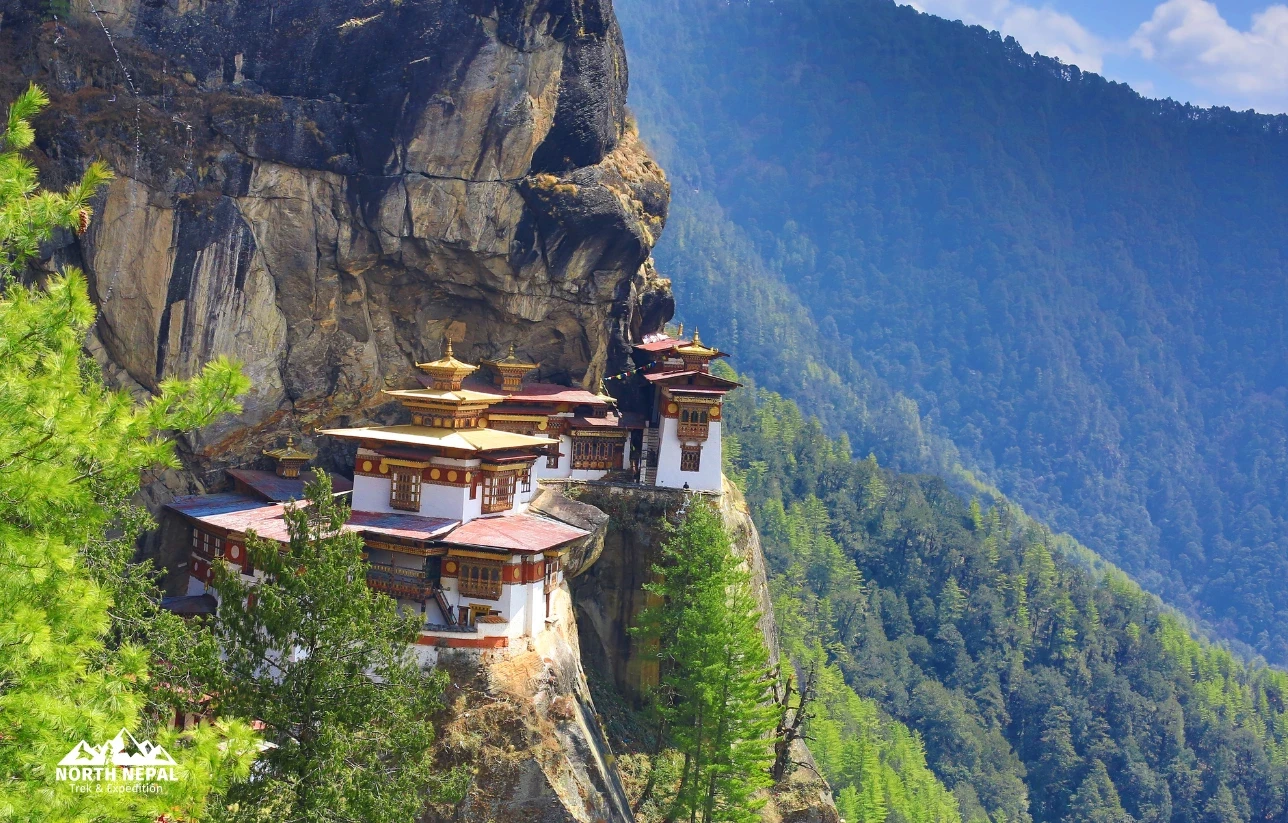
The time has come to visit one of the iconic and revered landmarks of the kingdom in this entire travel Bhutan tour. Taktsang Monastery. The monastery built on the cliff of the hill is truly a masterpiece. Trek to Taktsang Monastery starts with a lightweight breakfast.
Trekking to Taktsang Monastery will take about 5 hours. You will walk en route through dense coniferous forests. Beautiful Buddhist monasteries. Rotating Yapa-Yantra is a huge rotating cylindrical object along the way. Similarly, you can find local handmade items along the roadside. After a huff and puff walking on the steep, we will finally reach Taktsang Monastery.
Taktsang Monastery
This is a jaw-dropping sight to see this architectural marvel built on the cliff. Taktsang Monastery was built in 1646. This monastery is beautifully built with intricate designs on the woods and paintings. This monastery stands in the upper Paro with its contrasting and crisp golden color. Legends have it that Guru Padmasambhava came into this place by riding on the back of a Tigress and meditated there. That’s how this monastery got another name “Tiger’s Nest”.
Your exceptional travel Bhutan tours will come to an end. After a quick breakfast, our representative will guide you to the Paro airport. They will assist you with a necessary exit procedure. Hoping to come back, we will wrap up our Bhutan journey.
Bhutan's monsoon season is tapering off — roads and Paro Airport are operating normally. Book early to secure your preferred dates for the 8 Days tour.
Bhutan requires all foreign visitors to travel with a licensed local operator and hold a valid entry permit or visa at all times. We handle the complete paperwork process in advance, including passport verification, visa recommendation letters, and permit registration, so you can cross into Bhutan without delays or complications at the border.
While this is a cultural touring itinerary rather than a high-altitude trek, several stops such as Paro (2,200m) and the hike up to Tiger's Nest Monastery involve moderate elevation and uphill walking. Travelers with heart or respiratory conditions should consult a doctor before booking, and comfortable walking shoes are recommended for the Tiger's Nest hike.
Comprehensive travel insurance is required for entry into Bhutan and must remain valid for the full duration of your trip. Your policy should cover trip cancellation, medical emergencies, and evacuation. Please share your policy details with us before departure so our team can coordinate directly with your insurer if needed.
Secure the Bhutan Tours and Trekking | 8 Days for 2026/2027 before the seat gets fully booked.
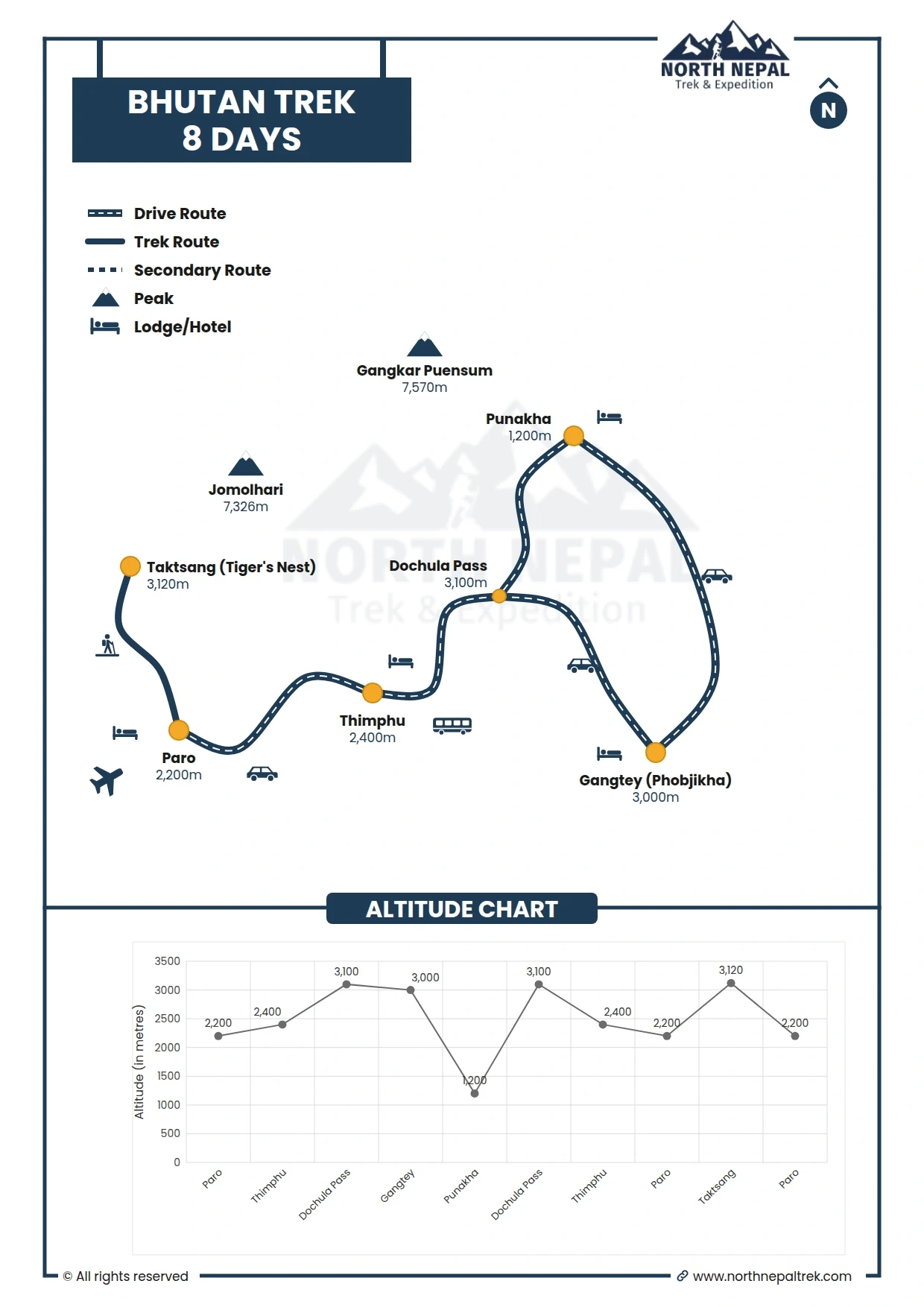
The Bhutan 7 Nights 8 Days Tour is a private cultural and sightseeing journey covering Paro, Thimphu, Gangtey Valley and Punakha. It combines Buddhist heritage, traditional architecture, Himalayan scenery, local culture and short hikes, including the trek to Taktshang Monastery, or Tiger’s Nest. The tour is graded Easy and reaches a maximum listed elevation of 3,120 meters.
Yes. The itinerary is designed as an easy-paced cultural tour rather than a demanding trekking trip. Most travel is by road, with sightseeing and shorter walks, while the Tiger’s Nest hike is the main physically demanding activity.
The itinerary includes visits to Thimphu Chorten, Tashichho Dzong, Zilukha Nunnery, Jungshi Paper Factory, Punakha Dzong, Khamsum Yulley Namgyal Chorten, Sangchhen Dorji Lhuendrup Lhakhang Nunnery, Chimi Lhakhang, Simtokha Dzong, Ta Dzong and Rinpung Dzong. You also have opportunities to explore local markets, handicrafts, villages and traditional Bhutanese life.
Yes, if your travel dates coincide with a festival. The tour highlights festivals such as Haa Summer Festival, Jambay Lhakhang Drup, Wangdue Phodrang Tshechu and Jakar Tshechu. Festival dates vary each year, so the experience depends on your travel dates.
Bring comfortable walking shoes, layered clothing, a warm jacket, rain protection, sunglasses, sunscreen and personal medication. Good footwear is particularly important for the Gangtey Natural Trail and Tiger’s Nest hike. If you're travelling in winter, add warmer layers because temperatures can become very cold at higher elevations.
The current page lists the tour as a 7 Night 8 Days private trip, with group-joining departures shown at USD 1,800 per person, reduced from USD 2,000 for the listed 2026 departures. Pricing can vary according to the departure arrangement and private-trip requirements.
The itinerary page does not provide a complete separate list of personal exclusions. Travellers should therefore budget separately for international airfare, personal purchases, drinks outside the included meals, tips, travel insurance and other services not specifically listed in the final package inclusions. Confirm the final inclusion and exclusion list before booking.
The main tour is listed as a Private Trip, while the page also shows scheduled group-joining departures for 2026. Private departures can be arranged for travellers who prefer their own dates or a customized programme.
Spring and autumn are the recommended seasons listed for this tour. Spring is particularly attractive for greenery and flowering landscapes, while autumn generally offers favourable conditions for mountain views and sightseeing. Winter is possible but requires warmer clothing, and summer can bring wetter conditions.
The overall tour is graded Easy, but the hike to Taktshang Monastery (Tiger’s Nest) is the most demanding activity. The itinerary states that the hike takes around 5 hours and involves steep sections through forest before reaching the monastery. A reasonable level of fitness and proper walking shoes are recommended.
The exact entry requirements depend on nationality and current Bhutanese immigration regulations. Before departure, travellers should have a valid passport and the required Bhutan entry authorization, with the necessary documentation arranged through the tour operator where applicable. Confirm nationality-specific requirements before booking.
The itinerary is primarily a road-based tour. After arriving at Paro, you travel to Thimphu, continue to Gangtey through Dochula Pass, then travel to Punakha and return to Paro. The Paro to Thimphu journey takes approximately one hour, while the Thimphu to Gangtey drive is around 6–7 hours.
The tour uses hotel accommodation throughout the itinerary. Breakfast, lunch and dinner are included, giving travellers opportunities to try local Bhutanese cuisine while also having regular meals during sightseeing days.
The itinerary does not guarantee Wi-Fi or mobile coverage at every hotel or destination. Connectivity can vary between Thimphu, Paro, Punakha, Gangtey and rural areas, so travellers who need reliable internet should confirm the arrangements with their hotel or tour operator before departure.