Upper Mustang Trek - 14 Days
The 14-Day Upper Mustang Trek starts from Kathmandu via Pokhara & Jomsom into the trans-Himalayan ra...
OVERVIEW & HIGHLIGHTS
The North Annapurna Base Camp Trek, also called the Maurice Herzog Trail, is a 5-day trek from Pokhara to 4,190 m (13,747 ft) below the north face of Annapurna I in Myagdi District. You drive to Humkhola (2,864 m), walk about 23 km and sleep in fixed tented camps. The grade is moderate. Beginners can do it with a well-planned itinerary and an experienced trekking guide. You need an ACAP permit and a licensed guide. Price: USD 650 solo, or USD 490 per person for 2 people, with lower rates for larger groups.
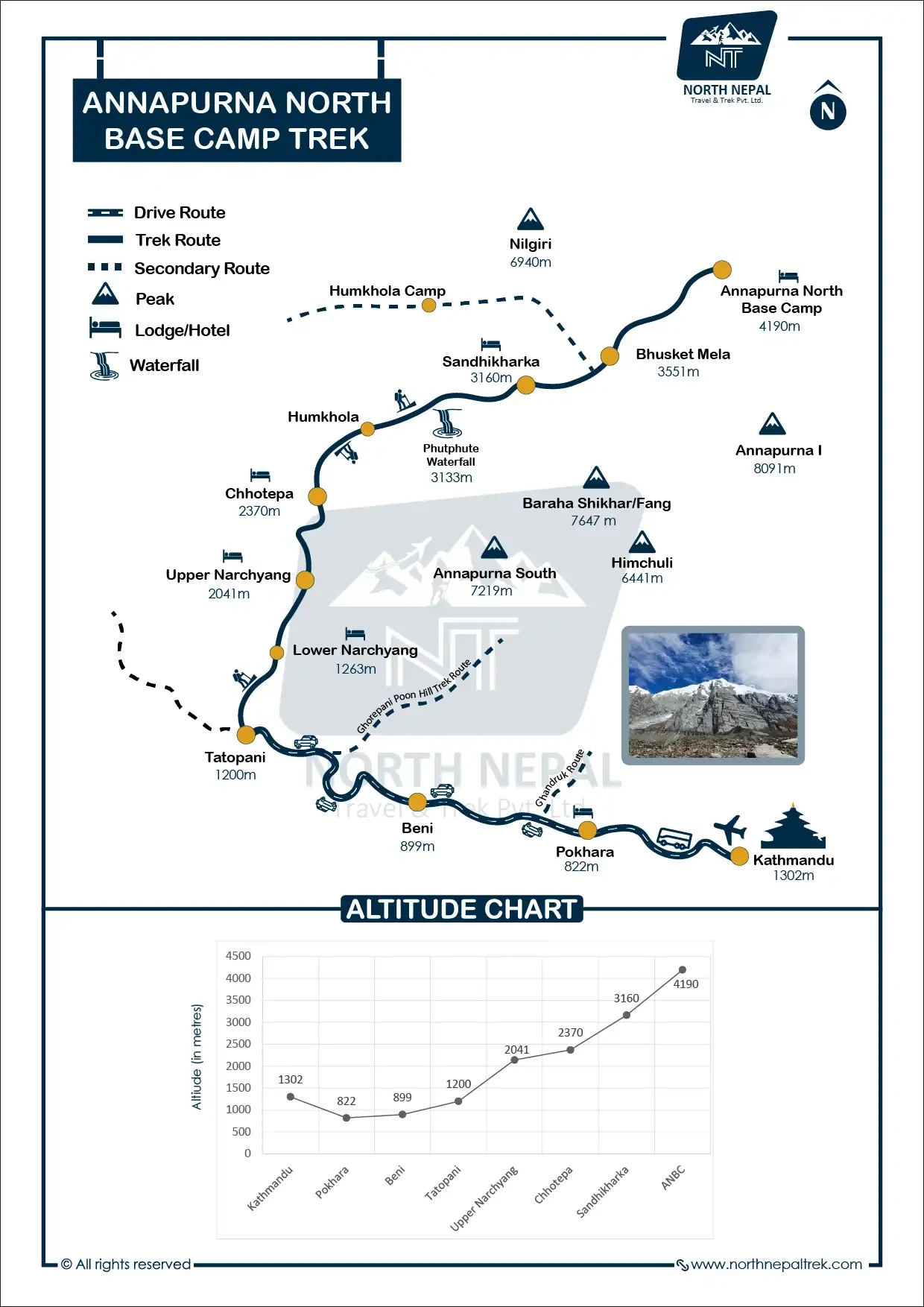
The 5-day North Annapurna Base Camp package starts in Pokhara with a 6–7 hour drive (about 115 km) to Humkhola (2,864 m / 9,396 ft), inside the Annapurna Conservation Area (ACAP). Narchyang Waterfall is on the lower Narchyang section of the drive. From Humkhola the trail climbs on stone-paved and rocky trail through rhododendron forest and past caves, via Phutphute, Sandikharka, Gupha Phat and Busket Mela. The route is also called the Maurice Herzog Trail. It was officially explored in 2019 and leads past the blue Panchakunda Lake (Narchyang Lake) to North Annapurna Base Camp at 4,190 m (13,747 ft), in Annapurna Rural Municipality, Myagdi District.
It's a short trek, but not an easy one. You sleep at 2,864 m on the first night and at 4,050 m by the third, some climbs are steep, and there are no proper teahouses. We grade it moderate. Beginners can do it, but only with a well-planned itinerary and an experienced guide. Base camp faces the north side of Annapurna I (8,091 m) with the Nilgiri peaks and Tilicho Peak alongside. Dhaulagiri (8,167 m) is in view from parts of the route.
The ACAP permit costs NPR 3,000 for foreign nationals, and a licensed guide is mandatory for this trek.
| Route segment | Time |
|---|---|
| Tatopani to Humkhola (jeep) | 2–2.5 hours |
| Humkhola to Phutphute | 2 hours |
| Phutphute to Sandikharka | 45 minutes |
| Sandikharka to Gupha Phat | 2 hours |
| Busket Mela to Sunkhola | 2 hours |
| Sunkhola to Panchakunda | 2 hours |
| Panchakunda to North Annapurna Base Camp | about 45 minutes |
The highest point, 4,190 m, is lower than the high point of the Mardi Himal Trek. The longest walking day is Day 4, at around 11 km.
The Annapurna North Base Camp Trek, often written as the North Annapurna Base Camp Trek or shortened to North ABC, is also known as the Maurice Herzog Trail. It's on the Myagdi side of Annapurna I, away from the main Annapurna Base Camp and Annapurna Circuit trails.
The Annapurna Rural Municipality (ARM) explored the route in 2019. Since then TAAN, ACAP, local communities and the Ministry of Tourism have been promoting it to trekking agencies and individual trekkers.
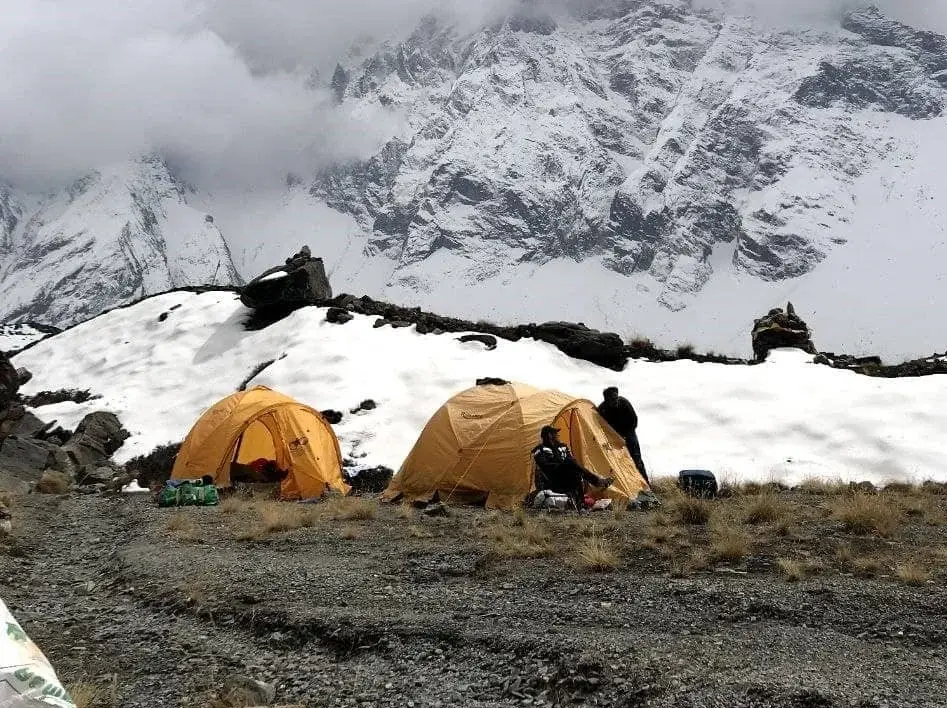
Note: This is still a camping trek. The trail has no proper teahouses, so you sleep in fixed tented camps at each overnight stop and eat simple meals such as dal bhat. You don't need to bring a tent, a stove or a cook.
Bibek Bhandari, Trekking Guide
North ABC trek route and pacing are drawn from 12+ years guiding the Annapurna region. Mohan founded North Nepal Trek in 2015; Jeewan has led over 80 Everest Base Camp treks since 2016.
After enjoying breakfast, we will start our second day of the North Annapurna Base Camp Trek. The altitude of Busket Mela is about 3,650 m | 11,975 ft, so we will trek slowly to minimize the risk of altitude sickness. After trekking for 2 hours, we reach Phutphutay Waterfall, where we stop for a break. We will walk further to Sandikharka, a shelter established midway on the trekking route. We enjoy our snacks and take some rest here.

Trekking further, after 1 hour, we reach another shelter called Gupha Phat. From here, we can see Tilicho Peak between the cliffs. Another hour of trekking from here takes us to Busket Mela. We reach Busket Mela after 6 hours of trekking. There is no electricity access from here, so we need power banks to charge our phones. Moreover, during the trek from Humkhola to Busket Mela, there is no phone signal. Busket Mela has two shelters within a short distance from the tented camp. There is also a river nearby that serves as a source of drinking water, so we use filtering tablets as soon as we reach there, so we can drink water much faster. We spend the night in the tented camp here. Overnight stay at Busket Mela.
The morning near the riverside will wake you with the soothing sound of flowing water. After having breakfast, we set off for the campsite. The trekking route from Busket Mela to the Panchakunda campsite (4,050 m) is all through rocky roads and imposing rock formations.
Photo: On the way to Busket Mela from the campsite
As we progress to a higher altitude, we rest, drink water, and then trek again. During our four hours of trekking, we will see many waterfalls and small streams throughout the route. Walking again, we can see the signboard indicating SunKhola ( a river named the River of Gold) due to the golden colors of the stones found there. Trekking further, we reach the Campsite, 4050 meters. The North Annapurna Base Camp, 4190 meters, is only about 45 minutes from here, but there are no shelters for camping, so we camp at the Campsite next to the Panchakunda Lake. We have dinner and spend the night in the tented camp beside the lake, our last camp.
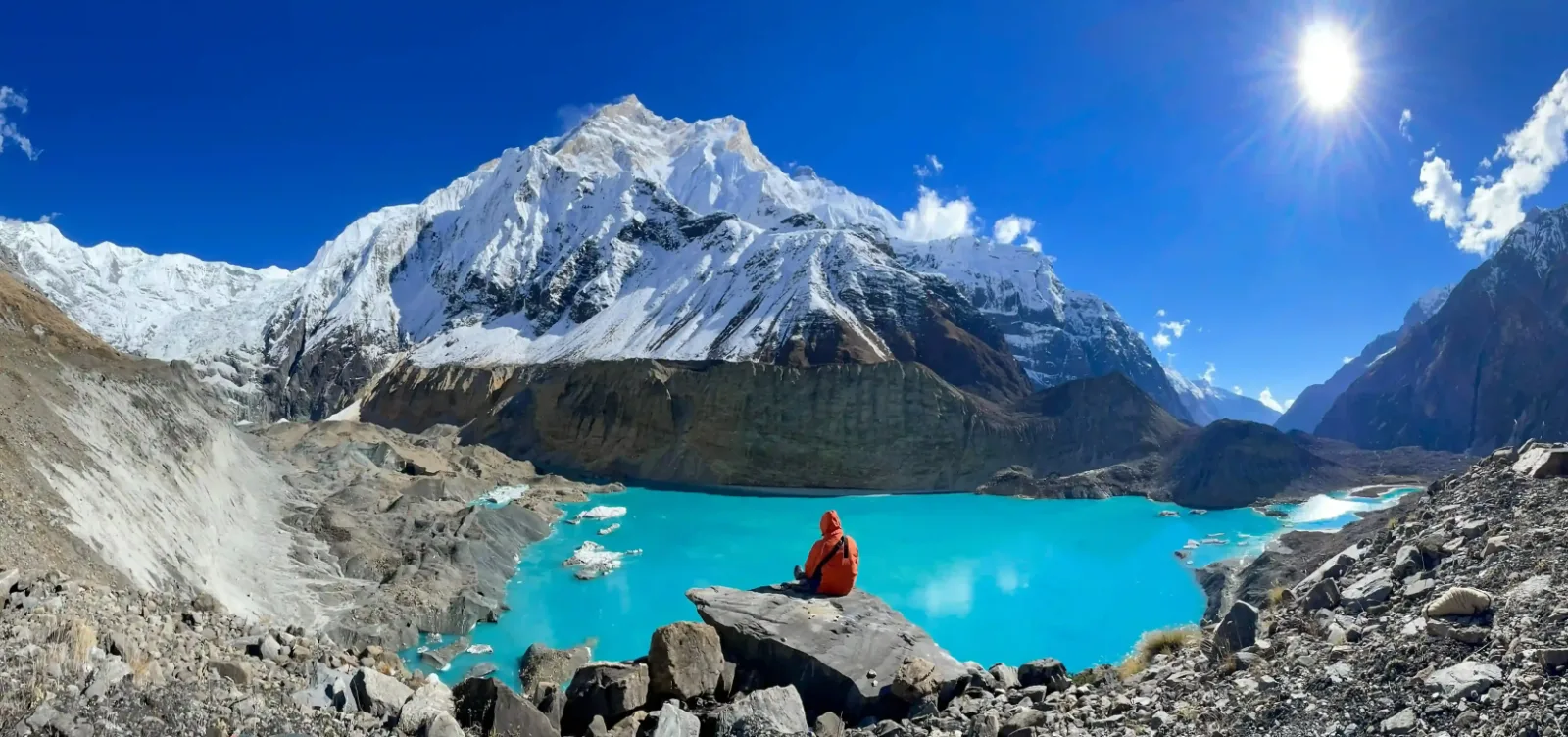
After having our breakfast, we will leave for North Annapurna Base Camp. The area is remote, and you often see wildlife here. Himalayan blue sheep are the most common ones found here. After trekking a short distance, you can see a Shiva temple here. There is a lake called Narchyang, also known as Pancha Kunda. It is a renowned lake among the Hindu and Buddhist pilgrims. The lake is turquoise blue.

From here it is about 45 minutes to base camp. North Annapurna Base Camp is at an elevation of 4,190 m (13,747 ft). From here, we can see the North Nilgiri (7061 m), Nilgiri Central (6940 m), Nilgiri South (6839 m), Tilicho peak (7134 m) Bharha Chuli (7647 m), Khangsar Kang (also called Roc Noir, 7485 m), and the Annapurna I (8091 m). After time at base camp, we trek back to Humkhola.
The trek back from base camp to Humkhola takes 5 - 6 hours. A jeep will be waiting for us at Humkhola, so after trekking along the same route, we drive to Tatopani. We will relax our bodies and soak in the nearby hot spring. Overnight stay at a hotel in Tatopani.
Today is the final day of our North Annapurna Base Camp trek. After breakfast, we can again hop in the hot waters of Tatopani. After that, we will then take a Jeep to Pokhara. After 4 hours of driving on the highway, we arrive at your hotel, marking the end of your North ABC trek. You can talk with us if you plan to go to Kathmandu or extend your trip to Jomsom or even to the Annapurna Base Camp Trek. We will assist you as a travel partner.
Mar 2026 • Friends
Namaste 🙏🏻😊
Thank you for the wonderful ABC North trip. You even took us to dinner last night — it was the best birthday I could ever have. Thank you so much for giving me such a beautiful experience and unforgettable memories.
Thank you so much, Zeewan, for making our trip so smooth and enjoyable. Thank you for always supporting us and giving us encouragement throughout the journey. You were not just our guide — you were truly our friend during this trip.”
I will always remember this, and Facebook and Instagram will remind me every year that I have been here.
Thank you very much.
धन्यवाद (Dhanyabad)🏔️😊🙏🏻


We did the North Annapurna Base Camp Trek and had a wonderful time! Our aim was to experience a trek a little bit off the beaten path and we got just that! Accommodation on the trek ist still quite basic (which we didn't mind), but there are a lot less people on the trek than on the classic trails and we enjoyed this original experience a lot. Nature on this trek ist stunning! Our guide Jeewan and our Porter Sumit took excellent care of us. We picked North Nepal Travel & Trek for the individually crafted itinerary. The trek was exceptionally well-organized. We will be back!
This itinerary gains height quickly and has no rest day: you sleep at Humkhola (2,864 m) on the first night, Busket Mela (3,650 m) on the second and the Panchakunda campsite (4,050 m) on the third, before reaching North Annapurna Base Camp (4,190 m) on Day 4. Guides conduct daily health assessments for early symptoms of Acute Mountain Sickness (AMS) and check oxygen levels with a pulse oximeter. If severe symptoms appear, standard protocol mandates immediate descent to lower elevations.
In cases of severe injury, acute altitude illness, or extreme weather conditions on remote wilderness trails, emergency helicopter evacuation is coordinated directly through local rescue services, adhering strictly to regional aviation regulations set by CAAN. Evacuations are initiated promptly upon assessment by your guide in direct communication with our Pokhara operations team and local emergency support network.
All trekkers must hold comprehensive travel insurance covering emergency medical treatment, high-altitude trekking and off-the-beaten-path wilderness hiking (up to 6,000 m), and emergency helicopter rescue/evacuation. Insurance details must be submitted prior to the departure of the trek to streamline emergency logistics if required.
Secure the North ABC Trek for 2026/2027 before the seat gets fully booked.
The North Annapurna Base Camp trek is a 5-day camping trek to the north face of Annapurna I (8,091 m), reaching base camp at 4,190 m (13,747 ft). It follows the Maurice Herzog Trail in Myagdi District and covers about 23 km on foot over three walking days. The trail climbs through rhododendron forest, past Phutphutay Waterfall and caves, to the sacred turquoise Panchakunda Lake, before reaching base camp with close-range views of the north wall.
The North Annapurna Base Camp trek is moderate and non-technical. Beginners can do it with a well-planned itinerary and an experienced trekking guide, but it gains height quickly: you sleep at 2,864 m on the first night and 4,050 m on the third. The main challenges are altitude, long days, and living simply in tented camps in a remote area. Some sections are stony or muddy from hydropower work, with a few steep stretches that may need rope support, and landslide-prone areas exist on the trail. Prepare with regular hiking carrying a loaded pack, and build your cardio three to four weeks out.
No. Under Nepal Tourism Board rules in force since 1 April 2023, foreign trekkers must trek with a licensed guide. It's also a practical need on this route: it's an off-the-beaten-track trail with limited infrastructure, three nights in tented camps, no phone signal on long stretches and no rescue facilities nearby. All our guides carry first-aid kits and know the route well.
The North Annapurna Base Camp area is known habitat for Himalayan blue sheep (bharal), which are commonly spotted on the upper slopes, and lies within snow leopard territory, though sightings are extremely rare. The dense rhododendron and oak forests lower down are home to a variety of bird species.
You fly or drive to Pokhara first, where you'll meet us at the North Nepal Trek office on 13th Street, Lakeside. From Pokhara, a 4WD jeep takes you on a 115 km drive to Humkhola (2,864 m), the trailhead, which takes about 6 to 7 hours on rough mountain roads. We use the meeting day to sort any remaining paperwork and buy any food or supplies you still need. We arrange all transport from Kathmandu onward.
Yes. You need the Annapurna Conservation Area Permit (ACAP): NPR 3,000 for foreign nationals and NPR 1,000 for SAARC nationals (the USD equivalent depends on the current Nepal exchange rate). The TIMS card system isn't currently active, so no TIMS card is needed, and no restricted area permit is required. We arrange the ACAP permit for you.
This is still a camping trek: there are no proper teahouses on the trail. You sleep in fixed tented camps at Humkhola, Busket Mela and the Panchakunda campsite, then in a hotel in Tatopani on the last night. A basic Dharamshala at Humkhola exists but isn't suitable for overnights. Meals are simple local trekking food, mainly dal bhat, so no cook needs to travel with the group, and you shouldn't expect the choice of busier trails. If you'd rather sleep on your own, a porter can carry a private tent for you. The 6-day route via Narchyang starts with a homestay and tea houses before the tented camps.
No reliable electricity or phone signal exists beyond the first day. From Busket Mela onward there is no power at all, and mobile network coverage drops out on the remote upper sections. Bring a fully charged power bank for your camera and phone, and a headlamp with spare batteries. This is part of the appeal of the trek: a few days genuinely off the grid, surrounded by mountains.
Because this is a camping trek in a remote area, your personal packing list matters more than on teahouse routes. Key items: a water and windproof warm jacket, a sleeping mat, trekking shorts and trousers, t-shirts and base layers, sturdy trekking shoes, high-energy food and chocolate, a filter water bottle, a power bank in a waterproof box, and personal toiletries. We provide a sleeping bag, and the fixed tented camps provide your tent and meals, so you don't need a tent, stove or cooking gear. See our full all-seasons packing guide (northnepaltrek.com/all-seasons-trek-packing-list) for more detail.
The fixed tented camps provide the tents and meals, so you don't need a kitchen or a cook. We provide a sleeping bag, plus crampons and trekking poles if conditions need them (returned after the trip), and a first-aid kit with a pulse oximeter. A porter carries sleeping bags and shared equipment, and can carry a private tent if you'd prefer to sleep on your own. You carry only your personal gear and daypack. Let us know if you have any gear questions before you arrive.
The North Annapurna Base Camp trek is priced per person on a sliding scale: USD 650 for one person, USD 490 each for two, USD 450 each for groups of 3 to 6, USD 420 each for 7 to 12, and USD 400 each for larger groups. The package covers the 4WD jeep transfer from Pokhara to the trailhead and back, a licensed guide, a porter for sleeping bags and shared equipment, the ACAP permit, tented camp accommodation, a sleeping bag, three meals a day on the trek, and basic first-aid supplies. Costs are higher than similar-length Annapurna treks because this route is remote and camping-based.
Beyond the package, budget for your Nepal visa, travel insurance with high-altitude helicopter evacuation cover, meals in Pokhara, any personal snacks or energy food you want to carry, and tips for your guide and porter. Because the trek is fully camping-based with meals included, on-trail extras are minimal compared to teahouse treks. Carry some Nepalese Rupees in cash for Pokhara shopping and any last-minute supplies.
Because this trek needs a jeep, a guide and camp arrangements in a remote area, we recommend booking at least three to four weeks ahead. Peak season (spring and autumn) fills faster. That said, we're based in Pokhara and can sometimes arrange shorter-notice departures. Send us your target dates and we'll tell you what's possible.
Our cancellation terms depend on timing, since we commit to transport, a guide, porters, food, and camping gear in advance. Deposits are applied against non-refundable costs, and the balance may be partly refundable or transferable depending on how far ahead you cancel. We put the exact written terms in front of you before you pay, with nothing hidden. Message us for the current schedule that applies to your dates.
Yes. North Nepal Trek is a government-registered adventure travel company based in Pokhara, Nepal, with a branch in Thamel, Kathmandu, and a member of the Trekking Agencies Association of Nepal (TAAN). The North Annapurna Base Camp trek is one of our specialist camping routes, guided by experienced local staff who know this remote trail well. Our approach is simple: come as a guest, leave as a friend.
Spring (March to May) and autumn (September to November) are the recommended seasons. Spring often has snow left on the higher sections, and autumn has clear skies but can get busier around the Dashain and Tihar holidays. The trail is open year-round when conditions allow, but during the monsoon (June to August) rain and landslide risk can affect the road to Humkhola and the trail, so check with us first. Expect a frozen Panchakunda Lake in winter, and always prepare for fast-changing weather at altitude.
Nights in camp at Busket Mela (3,650 m) and the Panchakunda campsite (4,050 m) regularly drop below freezing, and in winter or early spring they can get significantly colder. Daytime walking in sun can feel mild, but once the sun drops behind the mountains the temperature falls fast, especially at camp. This is why we include a sleeping bag rated for cold conditions and recommend a proper down jacket, warm layers, and a sleeping mat for insulation from the ground.
Yes, travel insurance is mandatory. Your policy must cover trekking up to 6,000 m, emergency medical treatment and helicopter evacuation. Rescue costs in Nepal are high, and the route is remote with no phone signal on long stretches, so proper cover is essential. Buy the policy in your home country before you travel, send us the details before the trek, and carry the emergency numbers with you.
This trek gains height quickly, with no rest day: you drive from Pokhara to Humkhola (2,864 m) in one day, sleep at Busket Mela (3,650 m) and the Panchakunda campsite (4,050 m), and reach base camp at 4,190 m on Day 4. Stay hydrated, walk at a steady pace, avoid alcohol, and tell your guide about any headache, nausea, or dizziness the moment it starts. Our guides carry a first-aid kit with a pulse oximeter and are trained in altitude sickness management. If symptoms worsen, the safest response is always descent, and your guide makes that call.
The trek is safe with proper preparation and a guide, but it's more remote and less supported than standard Annapurna routes. There are no teahouses, hospitals, or reliable phone signal above the first camp. The trail passes through some landslide-prone and hydropower-affected sections. That's why a licensed guide is mandatory, and why you need proper insurance and an honest look at your fitness before booking. Our guides know this route well and carry first-aid and communication equipment.
The drive from Pokhara to Humkhola (2,864 m), the trailhead, covers about 115 km and takes 6 to 7 hours by 4WD jeep on rough mountain roads. It's a long day in the vehicle, but the drive itself passes through dramatic river valleys and traditional villages, so it doubles as part of the experience. The return drive at the end of the trek follows the same route. We arrange the jeep and driver as part of the package.
The fastest option is a 25-minute flight from Kathmandu to Pokhara, which we recommend. The road journey takes considerably longer and the condition of the highway varies. Once in Pokhara, you'll meet us at the North Nepal Trek office on 13th Street, Lakeside, to finalize paperwork, meet your guide, and pick up any last supplies before the jeep drive to the trailhead the next morning. We can arrange either the flight or road transfer for you.