Gosaikunda Lake Trek: A Place of Religious Prominence

Gosaikunda Lake Trek: A Place of Religious Prominence
DESTINATION Nepal
MAX. ELEVATION 4380m
WALKING DISTANCE ~177 km
GRADE Moderate to Challenging
BEST SEASON March-May August-November
DURATION 7 Days
MEALS INCLUDED Breakfast/Lunch/Dinner
ACCOMMODATION Hotel, Lodge and Tea house

OVERVIEW & HIGHLIGHTS

Overview of the Gosaikunda Lake Trek

Gosaikunda Lake is a pilgrimage site for devotees of Lord Shiva located in the Langtang region. During Janai Purnima, the place is visited by thousands. Villages we pass during the trek are mostly formed by Tamang communities, predominantly influenced by Tibetan cultural practices.

Langtang Gosainkunda Lake trek is a part of Langtang National Park, in which our main destination is the freshwater lake of Gosainkunda. The trek involves walking through streams and suspension bridges as well as traversing rhododendron and pine forests. Moreover, we get a glimpse of the culture and lifestyle of the people living in Langtang Villages.

Why you will love the Gosaikunda Trek?

  • The trek to Gosaikunda Lake starts at Thulo Bharkhu, which is a couple of hours’ drive from Kathmandu. We ascend through rhododendron forests and reach Chisapani, where we spend our first night. Chisapani provides some splendid views of Langtang along with the Jugal Himal mountain range. We hike further through the cultural villages of Brahmins, Chettri, Newar, and Tamang.
  • After that, we tread along the trail to Magen Goth and then to Phedi. We then ascend to Lauribinayak via the Lauribinayak Pass (4165 m). The pass offers some excellent views of Langtang, Manaslu, and Ganesh Himal.
  • After hiking further, we reach Gosaikunda Lake. After exploring the lake, we will descend to Chandan Bari. From there, we descend further, crossing rhododendron forests, villages, terraces, and farmlands, before reaching Dhunche. We then take a 7-hour drive to Kathmandu from there.
  • Gosaikunda Lake Trek is best done in autumn and spring. It offers a combination of Glacial Lakes, rhododendron forests, snow peaks, and traditional settlements. It is one of the most satisfying treks in northern Nepal.
  • We provide the Gosaikunda Lake Trek with quality service and affordable prices. Additionally, we offer an experienced guide who will accompany you all the way.
Balaram Giri
Itinerary review by

Balaram Giri, Assistant Guide

Gosaikunda Lake Trek route and pacing are drawn from years guiding the Langtang region. Mohan founded North Nepal Trek in 2015; since then, Balaram Giri has led multiple treks through Langtang National Park up to the sacred Gosaikunda Lake.

Gosaikunda Lake Trek Itinerary

Toggle all
Day 1

Kathmandu to Dunche (2350m)

HIGHEST ALT. 2350m

We drive from Kathmandu early in the morning. We reach Dunche after 5 hours of driving, where we spend the night.

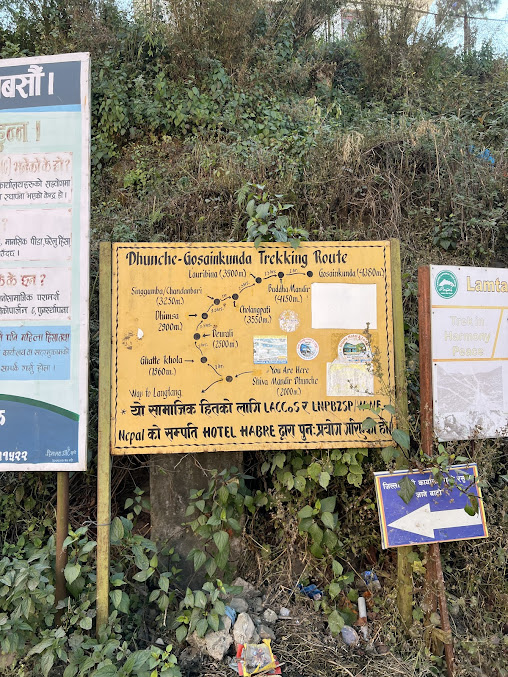
Dhunche; trek starting point of Gosaikunda trek in Langtang regionPhoto: Dhunche; trek starting point of Gosaikunda trek in Langtang region (source)

Day 2

Drive to Thulo Sybru & Trek to Thulo Bharkhu

HIGHEST ALT. 2200 m
DURATION 4-5 hours

We take a bus to Thulo Sybru and begin our hike towards Thulo Bharkhu. We ascend through stone stairs along a Tamang village. After taking a rest in the village, we continue our hike. After 6 hours, we reach the Thulo Bharkhu.

A  tea house in Thulo Bharkhu en route Gosaikunda Lake Trek.Photo: A  tea house in Thulo Bharkhu en route Gosaikunda Lake Trek.

Day 3

Thulo Bharkhu to Chandanbari (3250m)

HIGHEST ALT. 3250m
DURATION 5 hours
Distance
DISTANCE 15 km

We hike along rhododendron forests as we pass across Dursagang and Foprang Danda. We will enjoy some panoramic views of Langtang and Ganesh Himal. After walking for 5 hours, we reach Chandanbari, where we spend the night.

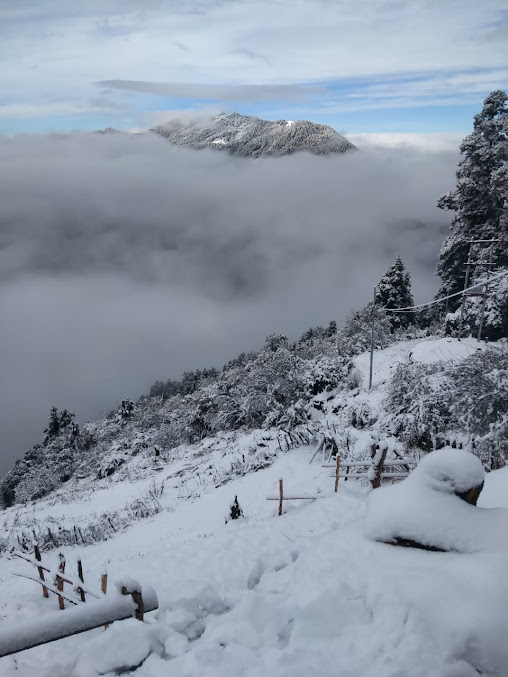
Chandanbari during snow seasonPhoto: Chandanbari during snow season

Day 4

Chandanbari to Gosaikunda (4380m)

HIGHEST ALT. 4,380m
DURATION 5 hours
Distance
DISTANCE ~ 9 km

We ascend further as we reach Lauribinayak. After hiking for about 5 hours, we encounter some Shiva temples and Buddhist chortens. These mark the arrival of Gosaikunda Lake. We will stay in a guesthouse nearby.

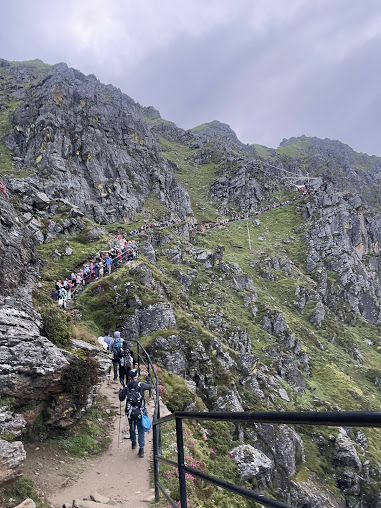
Trekkers & pilgrimage in the Gosaikunda lakePhoto: Trekkers & pilgrimage in the Gosaikunda lake

Day 5

Exploring Gosaikunda

HIGHEST ALT. 4380 m

We will explore the Gosaikunda area and also walk around to the other lakes nearby. Gosaikunda lake is a holy place where devotees take a bath to cleanse themselves spiritually.

Also, there are about 108 lakes altogether when both big and small lakes are combined. However, it is quite impossible to explore all the lakes in a day. So, we will visit some of the more important big lakes. The place itself is too packed during the trekking season. We will buy some souvenirs for our friends and family and spend the night in a tea house.

Day 6

Gosaikunda to Dunche (2350m)

HIGHEST ALT. 2350 m
DURATION 7 hours
Distance
DISTANCE ~16 km

We trace back our steps through Lauribinayak to Chandanbari. We descend for about 7 hours to reach Dunche.

Gosaikunda Lake from the other side.Photo: Gosaikunda Lake from the other side.

Day 7

Dunche to Kathmandu (1,400m)

DURATION 8 hours drive

We take an early morning bus from the village, passing along farmlands. We finally reach Kathmandu after about 8 hours of drive.

Kumari living goddess of Kathmandu. Photo: Kumari living goddess of Kathmandu. 

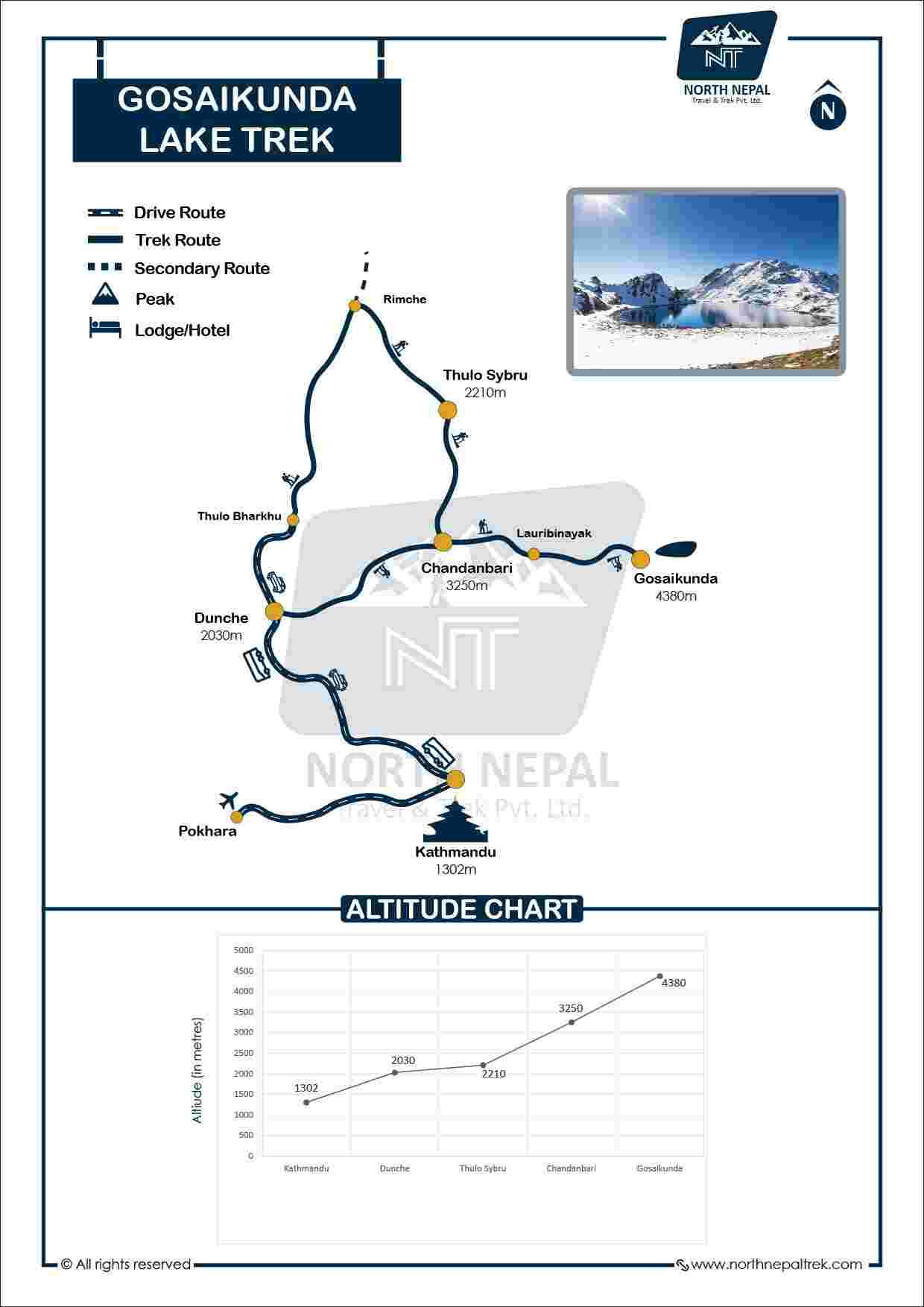
Gosaikunda Lake Trek Map and Altitude Graph

Gosaikunda Lake Trek Map and Altitude Graph

What's Included & Excluded

Included:

  • Local bus ticket from Kathmandu to Dunche to Thulo Syabrubesi.
  • Public bus ticket from Dunche to Kathmandu while returning
  • We provide 3 meals per day (Breakfast, Lunch, and Dinner) and Tea / Coffee twice daily. Please note that each meal is served as a single serving.
  • One English speaking guide including his accommodation, food, transportation, equipment, and salary.
  • 6 nights teahouse accommodation during the trek
  • Langtang National park permits for the trekking
  • Duffle bag & Sleeping Bag, if necessary
  • Purified drinking water (Ef-Chlor – water purification tablet)
  • All government taxes and service charges
  • International airfare and Nepal entry visa fee (You may easily issue the visa upon your arrival at Tribhuwan International Airport Kathmandu).
  • Meals whilst in Kathmandu.
  • Nepal Travel/medical insurance.
  • Items of a personal nature such as alcoholic drinks, cold drinks, laundry, and Tips.
  • Accommodation in Kathmandu. 
  • Expenses occurred due to unavoidable Events i.e. road wrecks, strike, flight delays, etc.
  • Anything not mentioned in the Included list.

Complete Guide to the Gosaikunda Lake Trek

Toggle all

Best Time to Trek to Gosaikunda Lake

Gosaikunda Lake Trek at a glance

  • Duration: 7 days, Kathmandu to Kathmandu
  • Highest point: Gosaikunda Lake, 4,380 m (14,370 ft)
  • Walking per day: 5–6 hours on average
  • Grade: Moderate to challenging, because of the steep climb and altitude
  • Best seasons: March–May and September–November
  • Route: Dhunche – Thulo Syabru – Thulo Bharkhu – Chandanbari – Gosaikunda – Dhunche
  • Accommodation: Teahouse lodges
  • Permit: Langtang National Park permit (included); a licensed guide is mandatory
  • Price: USD 460–700 per person, depending on group size

The best seasons for the Gosaikunda Lake Trek are spring (March to May) and autumn (September to November). Skies are usually clear, and the views of Langtang Lirung, Ganesh Himal and the Annapurna range from Laurebina and Chandanbari are at their best.

Spring (March to May)

Spring brings rhododendron forests in flower, green terraced farmland and warm days in the lower villages. Nights at Gosaikunda are still cold, and early spring can bring snow on the upper trail.

Autumn (September to November)

Autumn is the busiest season, with stable weather and the clearest mountain views. The Janai Purnima festival, usually in August, brings thousands of Hindu pilgrims to the lake, so lodges fill up around that full moon.

Winter and monsoon

In winter the lake freezes and heavy snow can make the upper trail difficult and some lodges close, so it is only for experienced, well-equipped trekkers. In the monsoon (June to August) the trail is wet, slippery and prone to landslides, and cloud often hides the peaks.
Permits and Guide for the Gosaikunda Lake Trek

The Gosaikunda Lake Trek needs the Langtang National Park entry permit. It costs NPR 3,000 for foreign nationals and NPR 1,500 for SAARC nationals, and it is included in our package. We arrange it before the trek from a copy of your passport, and it is checked at Dhunche on the drive in. The TIMS card is not currently required.

Do you need a guide?

Yes. Since 1 April 2023, foreign trekkers in Nepal's national parks, including Langtang National Park, must trek with a government-licensed guide arranged through a registered agency, and solo trekking without a guide is not allowed. It is also the safer choice: the climb from Chandanbari to Gosaikunda is steep and high, the weather near the lake can change quickly, and fog can hide the trail.

Our guides are local, licensed and experienced on this route. They carry a first-aid kit, know the villages and lodges well, and set a steady pace for the climb to 4,380 m.

Accommodation and Food on the Gosaikunda Trek

The Gosaikunda Lake Trek is a teahouse trek. Our package includes six nights in teahouse lodges on the trail. Lodges in Dhunche, Thulo Syabru and Chandanbari are comfortable family-run places; at Gosaikunda itself, lodges are basic and can be full during the Janai Purnima festival. Rooms are usually twin-share with blankets, and bathrooms are shared.

Hot showers and phone charging are available at most lodges for a small extra charge. A duffel bag and a sleeping bag are provided if you need them.

Meals

Three meals a day (breakfast, lunch and dinner) and tea or coffee twice a day are included. Dal bhat with free refills is the staple, and most lodges also serve noodles, fried rice, potatoes, soups, porridge and Tibetan bread. Chandanbari is known for its yak cheese, made at the small cheese factory in the village. Water purification tablets are included, so you do not need to buy bottled water.

History and Significance of Gosaikunda Lake

Gosaikunda is both a beautiful alpine lake and one of the holiest pilgrimage sites in Nepal, sacred to Hindus and Buddhists alike. According to Hindu mythology, Lord Shiva created the lake by thrusting his trident into the mountain to find water to cool his throat after swallowing poison during the churning of the ocean. Many pilgrims believe a stone in the lake is Shiva's head and that the lake's waters flow underground to the Kumbheshwar temple in Patan.

Janai Purnima festival

Every year on the full moon of Janai Purnima (usually in August), thousands of Hindu pilgrims and jhankri (shamans) walk up to the lake to bathe in its waters and renew their sacred thread. It is a remarkable time to visit, but the trail and lodges are very busy.

The lakes

Gosaikunda is the largest of a cluster of high lakes, traditionally said to number 108, including Bhairav Kunda and Saraswati Kunda. The lakes feed the Trishuli River and are usually frozen through the winter months. The area around the lakes is a protected Ramsar wetland inside Langtang National Park.

Route and Highlights of the Gosaikunda Lake Trek

The trek starts with a drive from Kathmandu to Dhunche, the headquarters of Rasuwa District, then climbs through Tamang villages and forests of oak, pine and rhododendron to Thulo Syabru and Chandanbari (Sing Gompa). From Chandanbari, the trail climbs steeply via Laurebina to Gosaikunda Lake at 4,380 m, with views of Langtang Lirung, Ganesh Himal, Manaslu and, on clear days, the Annapurna range.

Highlights

  • Sunrise over the Langtang and Ganesh Himal ranges from Laurebina
  • A full day at Gosaikunda to explore the lakes and the temple on the shore
  • Tamang villages, monasteries and the yak cheese of Chandanbari
  • Wildlife of Langtang National Park, including red panda, Himalayan tahr and many bird species

You return to Dhunche by the same trail and drive back to Kathmandu. The trek can also be extended over the Laurebina La (4,610 m) into Helambu, or combined with the Langtang Valley Trek.

What to Pack for the Gosaikunda Lake Trek

Gosaikunda sits at 4,380 m, and nights at the lake are below freezing for most of the year, so pack for cold as well as for warm forest trails.

  • Broken-in waterproof hiking boots and trekking socks
  • Base layers, a fleece, a warm down jacket and a waterproof shell
  • Warm hat, gloves and a buff
  • Headlamp, trekking poles, sunglasses and high-SPF sunscreen
  • Reusable water bottle (water purification tablets are included)
  • Microspikes in winter or early spring, if your guide advises them
  • Personal medication, snacks and some Nepali rupees in cash

A duffel bag and sleeping bag are provided if you need them. If you hire a porter, they carry 20–25 kg, usually shared between two trekkers. See our full packing list for more detail.

Trip Customization and Booking

Our Gosaikunda package is a standard guideline, and we can adapt it to your plans.

  • Shorten or extend the trek, or add a rest day at Gosaikunda
  • Cross the Laurebina La into Helambu, or combine with the Langtang Valley Trek
  • Upgrade to a private jeep instead of the local bus
  • Add a porter or extra nights in Kathmandu

The price changes with your group size and any extras, and we agree all changes with you before you book. A 20% deposit confirms your booking. Message us on WhatsApp or email [email protected].

How Difficult Is the Gosaikunda Lake Trek?

The Gosaikunda Lake Trek is graded moderate to challenging. It needs no technical climbing, but it gains a lot of height in a short time, from about 2,000 m at Dhunche to 4,380 m at the lake in three days.

What makes it challenging

  • Steep climb: the trail from Chandanbari (3,250 m) to Gosaikunda gains over 1,100 m in a day.
  • Altitude: you sleep at 4,380 m beside the lake, where headaches are common and nights are freezing.
  • Long descent: the return from Gosaikunda to Dhunche is long and hard on the knees.
  • Weather: fog, snow and cold can come quickly near the lake.

Preparation, safety and insurance

Train for 6 to 8 weeks with regular cardio and long hikes with a daypack. Your guide sets a steady pace, watches for signs of altitude sickness and turns back if symptoms get worse. Because the trek goes above 4,000 m, travel insurance covering trekking up to 6,000 m, emergency medical treatment and helicopter evacuation is required.

Why Trek With Us — Gosaikunda Lake Trek

North Nepal Travel & Trek is a locally owned trekking company founded in 2015, with its head office in Lakeside, Pokhara and a branch office in Thamel, Kathmandu, the starting point for the Gosaikunda trek. Our guides know the Tamang villages, the pilgrimage traditions and the significance of Janai Purnima along the route.

Licensed and registered

We are licensed by the Nepal Tourism Board (Licence No. 179), registered with the Government of Nepal (Company Reg. No. 162883/073) and a member of the Trekking Agencies' Association of Nepal (TAAN No. 2342). Every trek is led by a government-licensed, English-speaking guide.

What we handle for you

  • Bus tickets from Kathmandu to Dhunche and back (private jeep on request)
  • Your Langtang National Park permit
  • Six nights in teahouse lodges, three meals a day and tea or coffee twice a day
  • A duffel bag and sleeping bag if you need them, and water purification tablets
  • A licensed guide, with their accommodation, food, transport, equipment and salary covered

Our trips hold an average 4.9-star rating from past trekkers. Come as a guest, leave as a friend. Message us on WhatsApp to plan your Gosaikunda trek.

Live Trail Update of Gosaikunda Lake Trek: A Place of Religious Prominence Live

Last updated: 1 Week Ago

Updated: Balaram Giri

Trail Condition Clear, Busy & Dry
Weather Clear Skies, Cold Nights
Wifi/Network Patchy Above Gosaikunda
Teahouses Widely Available, Comfortable

Trekker Alerts

Best trekked from March to May or August to November; the lake can be frozen and the trail snow-covered in winter.

Reviews From The Trail

Hear it from those who've walked with us.


Safety Policy

Professional & Certified Guides

Every trek is accompanied by an experienced, licensed, English-speaking local guide trained in high-altitude wilderness survival, remote trail navigation, and first-aid response. Guides carry comprehensive medical kits equipped with essential high-altitude pharmaceuticals and pulse oximeters to monitor oxygen saturation levels daily during the ascent toward Gosaikunda Lake (4,380 m / 14,370 ft) and Laurebina La Pass (4,610 m / 15,125 ft).

High-Altitude Acclimatization & AMS Management

Itineraries are structured with careful elevation profiles and gradual altitude gains to ensure proper physiological preparation before reaching high-altitude points above 4,000 meters. Guides conduct rigorous daily health assessments for early symptoms of Acute Mountain Sickness (AMS). If severe symptoms appear, standard protocol mandates immediate descent to lower elevations.

Emergency Rescue Coordination

In cases of severe injury, acute altitude illness, or extreme weather conditions on remote mountain passes, emergency helicopter evacuation is coordinated directly through local rescue services. Evacuations are initiated promptly upon assessment by your guide in communication with our Kathmandu and Pokhara offices.

Mandatory Travel Insurance

All trekkers must hold comprehensive travel insurance covering emergency medical treatment, high-altitude trekking (up to 6,000 m), and emergency helicopter rescue/evacuation. Insurance details must be submitted prior to the departure of the trek to streamline emergency logistics if required.


Gosaikunda Lake Trek Departure Date for 2026/2027

Secure the Gosaikunda Lake Trek for 2026/2027 before the seat gets fully booked.


Terms, Conditions & Feasibility

  1. All bookings are made with North Nepal Travel & Trek Pvt. Ltd Registered Company Number 162883/073/074 (hereafter referred to as The Company) whose office is in Lakeside, Pokhara-6, Nepal.
  2. The term "trip" used in this website and booking conditions refers to all itineraries described on this website including those which might otherwise be know as walking, tours, trekking trips, sightseeing, climbing, mountaineering, expeditions, or holidays.
  3. We accept your last-minute booking as well, but full payment of the total tour cost should be made in advance if necessary or can be paid fully on arrival day. See More 

Frequently Asked Questions

Weather & Seasons

1. What is the best time to travel there?

March to May and October to December are considered to be the best season for trekking in this region. From March to May, the trails are covered with green lush vegetation and blooming Rhododendrons, the national flower of Nepal. Most of the lakes are frozen because of the heavy snowfall during this time so, we barely see any pilgrims and devotees. Likewise, from October to December, the weathers are usually clear so, we can see the panoramas of the Himalayas and spellbinding landscapes vividly. Gosaikunda is a heavenly place for both Hindus and Buddhists and because of that, the trails are likely to be crowded because of the pilgrims and devotees during these months.

2. What is the best time to do the Gosaikunda Trek?

March to May and October to December are the favourable trekking periods.

Spring brings lush vegetation and blooming rhododendrons. Autumn generally offers clearer Himalayan views. However, conditions around Gosaikunda can become very cold, and the lake may remain frozen for extended periods.

Accommodation & Food

1. What about food and accommodations?

Both pilgrims and trekkers can stay in a lodge with good facilities and good food. The visitors usually get an individual room except for some minor cases. Overall, the place has a good facility for food and accommodation.

2. What are accommodation and food like on the Gosaikunda Trek?

Trekkers and pilgrims can stay in local lodges along the route. Facilities and food are generally good, although standards vary between locations.

Accommodation may normally be shared depending on availability, particularly during busy pilgrimage periods.

Health & Safety

1. Is this trek possible with children?

Yes, this trek is possible with children. Since Gosaikunda is a religious place, lots of visitors opt to take children with them to worship. Most of the trails and paths are easily accessible to children but, extra care and caution are very vital in this expedition.

2. Is the Gosaikunda Trek difficult?

The trek is graded Moderate to Challenging, with a maximum elevation of approximately 4,380 m.

The main considerations are altitude, changing mountain weather and the physical demands of ascending to the lake. Trekkers should maintain a steady pace and allow sufficient time for altitude adjustment.

3. Is altitude sickness a concern on the Gosaikunda Trek?

Yes. At around 4,380 m, altitude sickness is a genuine consideration.

Trekkers should ascend gradually, stay hydrated, avoid pushing through significant symptoms and inform their guide immediately if they develop headache, nausea, dizziness, unusual fatigue or other symptoms associated with altitude illness.

Payments & Extra Costs

1. Can I pay homage to the temples and monasteries while trekking?

The Gosaikunda lake Trek revolves around the Gosaikunda lake which carries religious importance to both Hindus and Buddhists. So, pilgrims are commonly seen from August to October. All the trekkers have plenty of time to explore the lake and pay homage to their respective gods.

General Information

1. What is the Gosaikunda Trek?

The Gosaikunda Trek is a moderate-to-challenging Himalayan trek in Nepal's Langtang region, centred around Gosaikunda Lake, a sacred alpine lake revered by both Hindus and Buddhists. The route combines mountain scenery, rhododendron forests, high-altitude landscapes and important pilgrimage sites.

2. Is the Gosaikunda Trek suitable for children?

Children can do the Gosaikunda Trek, but it should not be treated as an easy family trek. The route reaches approximately 4,380 m, so altitude, cold weather and sustained uphill walking need to be taken seriously.

Children should be accompanied by adults, ascend at an appropriate pace and be monitored carefully for altitude-related symptoms.a

Cultural Insights

1. Can I pay homage to the temples and monasteries while trekking?

Yes. Gosaikunda is an important pilgrimage destination for both Hindus and Buddhists, and the trek provides time to visit religious sites around the lake and along the route.

Pilgrims traditionally travel to Gosaikunda during important religious periods, particularly around Janai Purnima, when the lake attracts large numbers of devotees.

Packing Gear & Rental

1. What should I pack for the Gosaikunda Trek?

Because the trek reaches approximately 4,380 m, pack for changing mountain conditions rather than treating it as a low-altitude hike.

Essential items should include warm layers, a waterproof jacket, comfortable trekking shoes, warm socks, gloves, a hat, sunglasses, sunscreen, a reusable water bottle, trekking poles and personal medication.

1. What extra expenses should I expect during the Gosaikunda Trek?

Personal drinks, snacks, tips, travel insurance and hotel nights outside the package are not included in the price. Budget for these separately.

Booking & Company Policies

1. Can the Gosaikunda Trek itinerary be customized?

Yes. Every trek can be customized based on the trekker’s requirements, including the number of days you have available. Tell us what you need and we will plan it with you.

Trekking Permits & Logistics

1. What permits are required for the Gosaikunda Trek?

You need Langtang National Park permit to enter.

Transportation

1. How do I get to the Gosaikunda Trek starting point?

Private jeep transfer is isncluded in a packages. You can also get a public bus from Kathmandu Buspark easily.

Wifi/Network and Communication

1. Is mobile network and Wi-Fi available on the Gosaikunda Trek?

Connectivity is not guaranteed throughout the trek, particularly at higher elevations.

Wildlife & Nature

1. What natural scenery can I see on the Gosaikunda Trek?

The route passes through lush vegetation, rhododendron forests, mountain landscapes and high-altitude lake surroundings.

Spring is particularly attractive for rhododendron blooms, while clearer autumn conditions can provide better Himalayan visibility.

PRIVATE TRIP

7 Days

USD 700 pp

We Offer Group Discount

No. of PersonsPrice per Person
1 PaxUSD 700
2 PaxesUSD 605
3 - 6 PaxesUSD 550
7 - 12 PaxesUSD 510
13 - 25 PaxesUSD 460
RECOGNISED · CERTIFIED · TRUSTED

We are associated with