Gosaikunda Lake Trek: A Place of Religious Prominence
Gosaikunda Lake is a pilgrimage site for devotees of Lord Shiva located in the Langtang region. Duri...
OVERVIEW & HIGHLIGHTS
Helambu Trek is all about exploring the natural splendour and well-preserved culture in the undisturbed and unadulterated environment of Langtang. Being the less-travelled trail, the Helambu region has been able to maintain its cultural uniqueness intact. An amazing short trekking experience near Kathmandu valley, the Helambu Trek offers a blend of nature and adventure. The route is famous for its natural beauty, stunning views, and intriguing cultures. In addition, it will take you to some untouched and unspoiled parts of central Nepal.
Niranjan Adhikari, Trekking Guide
Helambu Trek route and pacing are drawn from years guiding the Langtang region. Mohan founded North Nepal Trek in 2015; since then, Niranjan Adhikari has led multiple treks through Shivapuri National Park and the Tamang and Sherpa villages of Helambu.
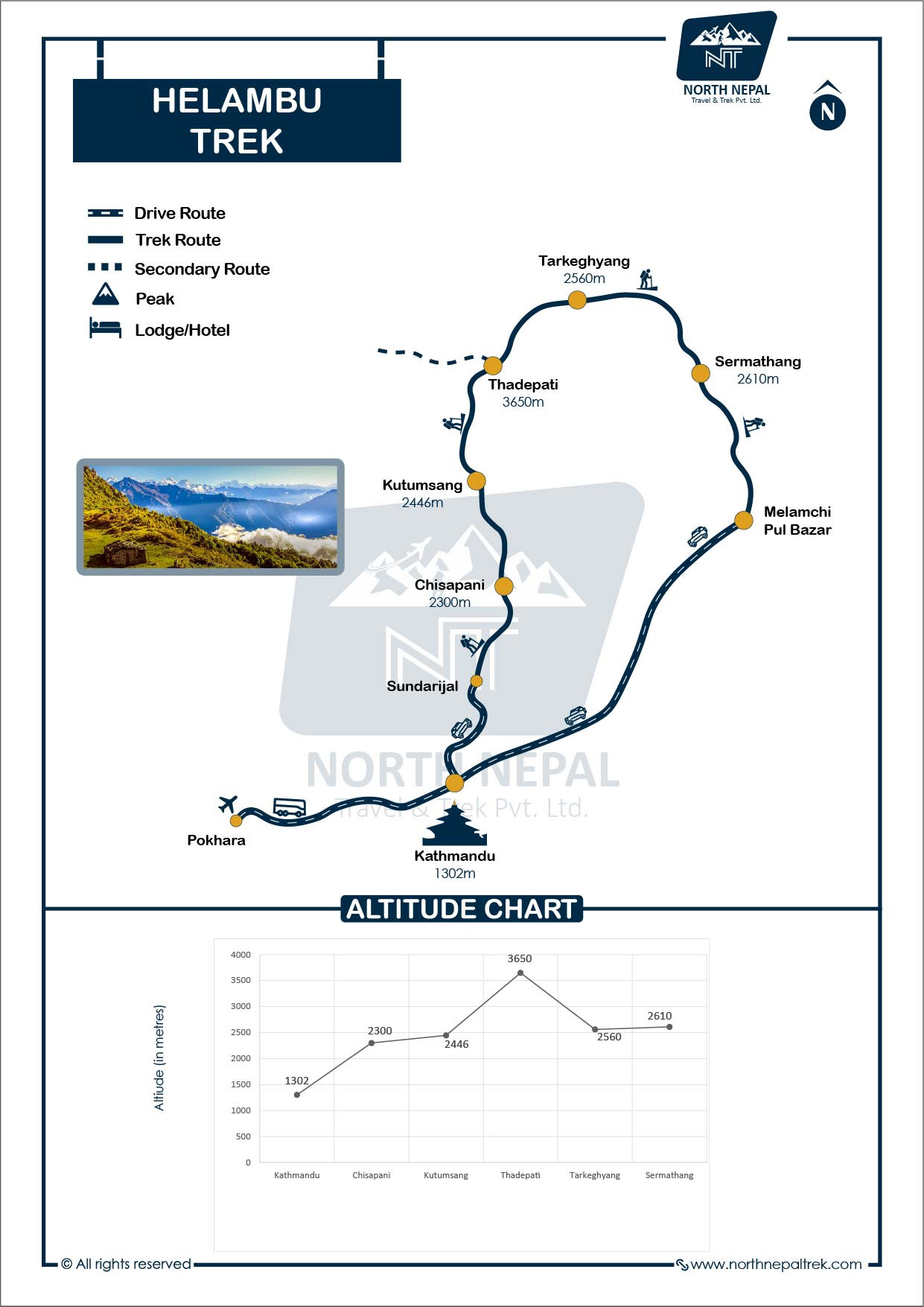
After having breakfast, we start our trek. We descend through fields and farmlands with a stunning view of Langtang Mountains. We also pass through settlements at Pathi Bhanjyang and Gul Bhanjyang before finally reaching Kutumsang.
Climbing above Kutumsang, we will hike along a steep trail surrounded by rhododendron forests. We climb to Yuri Danda which provides some gorgeous views of the Himalayas. Walking further, we arrive at Tharepati, where we spend the night.
We descend until we reach the Melamchi Khola. After crossing the river, we will hike uphill, passing through several Sherpa settlements. At the top, lies the village of Tarkeghyang. Most of the people here belong to the Helmu Caste. Hence, this village is also known as Helambu.
Photo: A monastery in Tarkeghyang.
It will be comparatively an easy walk as we traverse through the plain trail. The path passes through forests, waterfalls, as well as streams. We pass through the Sherpa village of Gangyul before reaching Sermathang.
Photo: Sermathang en route Helambu Trek.
We descend for about 3 hours to Melamchi Pul Bazaar which is mostly inhabited by the Sherpa. We then get on a bus that will take us back to Kathmandu in just 2 hours. We will go souvenir shopping in the evening.
Photo: Melamchi Pul Bazaar en route Helambu trek.
Best trekked from March to May or August to November, though its lower altitude keeps it walkable in more months than higher Himalayan routes.
While the Helambu Trek reaches a moderate maximum altitude of 3,650 m (11,975 ft) at Tharepati, our itineraries feature steady pacing across forested ridges, terraced hillsides, and mountain paths. Guides conduct daily health assessments for early symptoms of Acute Mountain Sickness (AMS). If severe symptoms appear, standard protocol mandates immediate descent to lower elevations.
In cases of severe injury, acute altitude illness, or extreme weather conditions on remote ridgelines, emergency helicopter evacuation is coordinated directly through local rescue services. Evacuations are initiated promptly upon assessment by your guide in communication with our Kathmandu and Pokhara offices.
All trekkers must hold comprehensive travel insurance covering emergency medical treatment, high-altitude trekking (up to 4,000 m), and emergency helicopter rescue/evacuation. Insurance details must be submitted prior to the departure of the trek to streamline emergency logistics if required.
Secure the Helambu Trek for 2026/2027 before the seat gets fully booked.
The Helambu Trek is a scenic 6-day trek near Kathmandu that combines Himalayan mountain views with the traditional cultures of the Sherpa, Tamang and Hyolmo communities. The route passes through traditional villages, rhododendron forests and Buddhist monasteries without reaching the extreme elevations found on longer Himalayan treks.
The Helambu Trek is graded Easy to Moderate. Most trekking days involve around 5 to 7 hours of walking on established village trails, forest paths and mountain ridges. It is suitable for beginners and trekkers with a reasonable level of fitness.
The highest point is Tharepati at approximately 3,650 m (11,975 ft). Although this is below 4,000 m, altitude can still affect some trekkers, so a steady pace and sensible acclimatization are important.
Yes. The Helambu Trek is one of the more accessible short Himalayan treks from Kathmandu. The walking days are moderate, the route uses established trails and accommodation is available in local teahouses and lodges.
The standard Helambu Trek takes 6 days. The itinerary can also be extended depending on your available time, including a combination with the Gosaikunda Trek.
The Helambu region is home to Sherpa, Tamang and Hyolmo communities. The trail passes through traditional villages, Buddhist monasteries and settlements where local customs and Himalayan Buddhist traditions remain an important part of daily life.
Bring comfortable trekking shoes, layered clothing, a waterproof jacket, fleece or warm insulation, gloves, a warm hat, sunglasses, sunscreen, a reusable water bottle, trekking poles and personal medication.
A small daypack is useful for carrying water, extra layers and personal items during the day's walk.
Personal expenses such as additional drinks, snacks, Wi-Fi, charging, hot showers, tips and other personal purchases may cost extra depending on the services available along the route.
Check the current package inclusion and exclusion list before departure so you know exactly what is covered.
Yes. The itinerary can be adjusted according to your available time, walking pace and travel interests. It can also be extended toward Gosaikunda if you want a longer Himalayan trekking experience.
The best seasons are spring (March to May) and autumn (September to November).
Spring brings blooming rhododendrons and pleasant temperatures, while autumn generally offers clearer mountain views and more stable weather. Winter trekking is also possible with appropriate preparation.
Altitude sickness is possible around Tharepati at 3,650 m, although the risk is lower than on higher Himalayan routes.
Walk at a comfortable pace, stay hydrated and tell your guide immediately if you develop symptoms such as persistent headache, nausea, dizziness or unusual fatigue. If symptoms worsen, you should not continue ascending.
Altitude sickness is possible around Tharepati at 3,650 m, although the risk is lower than on higher Himalayan routes.
Walk at a comfortable pace, stay hydrated and tell your guide immediately if you develop symptoms such as persistent headache, nausea, dizziness or unusual fatigue. If symptoms worsen, you should not continue ascending.
The Helambu Trek requires entry permits for Shivapuri Nagarjun National Park and Langtang National Park. When booking with North Nepal Travel & Trek, the necessary permits are arranged before the trek begins.
The Helambu trekking area is conveniently located near Kathmandu. Transportation from Kathmandu to the trailhead is arranged according to the selected itinerary, with the exact starting point depending on the route being used.
Teahouses serve a selection of Nepali and international trekking meals. Typical options can include dal bhat, noodles, rice dishes, soups, eggs, vegetables, Tibetan-style breads and hot drinks. Food choices vary between lodges and villages.
Mobile coverage is available in parts of the Helambu region, particularly around larger villages, but reception can become unreliable in more remote sections.
Some teahouses may offer Wi-Fi, although connection speeds vary. Carrying a power bank is recommended rather than relying on continuous electricity or internet access.
The trek passes through rhododendron forests, mountain ridges, traditional agricultural landscapes and Himalayan viewpoints. Spring brings colourful rhododendron blooms, while clear autumn mornings provide some of the best opportunities for mountain views.
From viewpoints such as Tharepati, you can see Langtang Lirung, Ganesh Himal, Dorje Lakpa, Jugal Himal and surrounding Himalayan peaks.