Dashain 2026 runs from Sunday 11 October to Sunday 25 October, and Dashain Tika falls on Wednesday 21 October. Tihar follows from Saturday 7 November to Bhai Tika on Wednesday 11 November. Government offices and banks close on 11 October and again from 17 to 23 October. Trekking carries on throughout. What gets difficult is roads, buses and anything involving a government counter.
Both festivals land squarely inside Nepal's autumn trekking season this year, which is later than usual. If you have booked the Everest Base Camp trek, the Annapurna Base Camp trek or the Manaslu Circuit trek for October or November, the festival dates fall inside your trip rather than neatly around it. In 2025 tika day was 2 October and most of the festival was finished before the main trekking crowds arrived. In 2026 it sits right in the middle of them.

I get asked the same question every autumn by people who have already booked: have I made a mistake booking these dates? No. But you do need to know what shifts, because nobody tells you until you're standing at a closed immigration counter on the 19th.
Dashain 2026 dates
Fifteen days, but only six of them are observances most people would notice. The government holiday block runs from Phulpati on Saturday 17 October through Friday 23 October.
|
Date
|
Day
|
Nepali date (2083 BS)
|
What it is
|
Public holiday
|
|
11 October
|
Sunday
|
Ashoj 25
|
Ghatasthapana, Dashain begins
|
Yes
|
|
17 October
|
Saturday
|
Ashoj 31
|
Phulpati
|
Yes, holiday block starts
|
|
18 October
|
Sunday
|
Kartik 1
|
Maha Ashtami
|
Yes
|
|
19 October
|
Monday
|
Kartik 2
|
No separate observance
|
Yes
|
|
20 October
|
Tuesday
|
Kartik 3
|
Maha Navami
|
Yes
|
|
21 October
|
Wednesday
|
Kartik 4
|
Vijaya Dashami, Dashain Tika
|
Yes
|
|
22 October
|
Thursday
|
Kartik 5
|
Papankusha Ekadashi
|
Yes
|
|
23 October
|
Friday
|
Kartik 6
|
Dwadashi, last day of holiday block
|
Yes
|
|
25 October
|
Sunday
|
Kartik 8
|
Kojagrat Purnima, Dashain ends
|
—
|
These come from the 2083 calendar published by the Nepal Panchang Nirnayak Bikas Samiti, the government-appointed committee that fixes Nepal's festival dates.
If you find a calendar that disagrees, trust the Nepali one. In 2026 the Ashtami tithi ends on the morning of Monday 19 October and Navami begins, so some international calendars print Maha Navami on the 19th. Nepal keeps Navami on Tuesday the 20th, and the government holiday list follows Nepal. The 19th is a holiday with nothing happening on it, which makes it one of the quietest days of the year in Kathmandu.
Tihar 2026 dates
|
Date
|
Day
|
Nepali date (2083 BS)
|
What it is
|
|
6 November
|
Friday
|
Kartik 20
|
Dhanteras, Tihar formally begins
|
|
7 November
|
Saturday
|
Kartik 21
|
Kaag Tihar, crows
|
|
8 November
|
Sunday
|
Kartik 22
|
Kukur Tihar (day) and Lakshmi Puja (evening)
|
|
9 November
|
Monday
|
Kartik 23
|
Gai Puja, cows
|
|
10 November
|
Tuesday
|
Kartik 24
|
Govardhan Puja, Goru Puja, Mha Puja. Nepal Sambat 1147 begins
|
|
11 November
|
Wednesday
|
Kartik 25
|
Bhai Tika
|
The government Tihar holiday runs from 8 to 12 November.

Two things are unusual this year. Kukur Tihar and Lakshmi Puja share Sunday 8 November, because the new moon begins that afternoon, which pushes Gai Puja onto its own day on the 9th. In most years those two sit together instead. And Indian calendars order the whole sequence differently, so you'll see websites printing Lakshmi Puja on the 9th or Bhai Dooj on the 10th. For anything happening inside Nepal, use the dates above.
What actually changes for a traveller
Nepal does not shut down. The thing that closes is the part of the country locals use: government counters, banks, neighbourhood shops, long-distance buses running to a normal timetable. Tourist infrastructure mostly keeps going, sometimes with half the usual staff.
The squeeze is sharpest from 15 to 23 October, and again around 8 to 12 November.
|
Service
|
What to expect
|
What to do
|
|
Immigration, permits, police
|
Closed 11 October and 17 to 23 October
|
Finish visa extensions and paperwork by Friday 16 October
|
|
Banks
|
Closed on holiday days. Thamel and Lakeside ATMs keep running
|
Draw cash before 17 October
|
|
Long-distance buses
|
Heavily booked outbound before Phulpati, inbound after Kojagrat Purnima
|
Book through your operator, don't plan to buy on the day
|
|
Domestic flights
|
Operating, but competing with peak trekking demand
|
Book early, keep a buffer day before your international flight
|
|
Tourist hotels and restaurants
|
Open in Thamel and Lakeside, slower service around tika
|
Nothing, just expect a wait
|
|
Local shops, tailors, small kitchens
|
Many close for several days around 21 October
|
Buy SIM cards, gear and anything you need before the 17th
|
|
Taxis
|
Noticeably fewer around tika day
|
Ask your hotel to arrange transfers in advance
|
|
Hospitals
|
Emergency services run normally
|
Travel insurance with evacuation cover, as always
|
The transport pressure is real and it is not a tourist problem, it is a scale problem. Around two million people leave the Kathmandu Valley for Dashain in a normal year, and most of them move within the same handful of days. You are not competing with other trekkers for a bus seat on 16 October. You are competing with half of Kathmandu.
This year there's an extra complication. The Kathmandu Post reported on 29 September that this monsoon's floods washed away bridges and damaged roads in several places, which delayed the opening of advance Dashain bus bookings. Road conditions in Nepal change week to week after a bad monsoon, so anything I wrote here about a specific route would be wrong by the time you read it. Ask your operator to confirm your route in the week you travel, not the month you book.
Trekking during Dashain and Tihar 2026
This is the part that matters if you have a trek booked, and it's the part most festival articles skip entirely.
The short version: the trails don't care. October is peak season, lodges on the Annapurna and Everest routes are open and busy, and the weather in the third week of October is usually the best of the year. Dashain doesn't touch any of that. What it touches is the three days at either end of your trek, and the people walking with you.
Your guide and porter want to be home on 21 October. Everyone does. This is the one day of the year when families who are scattered across Kathmandu, India, the Gulf and Malaysia are in the same room, and a guide who misses it misses it for the whole year. A decent operator plans the roster around this months ahead and tells you straight. A bad one quietly swaps your guide out on day six without explaining why.

Ask any operator you're considering, in writing: will my guide be with me on tika day, and if not, who replaces them and when do I meet them? The answer tells you a lot about the company.
" North Nepal Travel & Trek guides work through Dashain and Tihar, tika day included, and we pay them extra for every festival day they spend on the trail with you. Your trek runs on its planned dates, and the guide who gives up a day at home with family is paid properly for it, not at the ordinary daily rate. "
Getting to and from the trailhead is the real constraint. Jeeps and buses to trailheads are hard to book from roughly 14 to 17 October and again from 22 to 26 October, which are the outbound and return peaks. If your itinerary has you driving on those dates, arrange private transport through your operator rather than hoping.
Starting from Pokhara sidesteps most of this. Ghorepani Poon Hill, Mardi Himal and Annapurna Base Camp all start within a couple of hours' drive of Pokhara, so you never touch the long-distance bus rush out of Kathmandu. If your dates are fixed and they overlap the holiday block, a Pokhara-side trek is the easier trip this year. That's not a sales line, it's just geography.
Lukla and Jomsom flights are weather-dependent at the best of times. Holiday demand stacks on top of that. Keep at least one spare day at the end of your trek before an international departure, and ideally two.
Lodges stay open, with one caveat. Teahouses on the main routes run normally through October because that's their season. A few family-run lodges in lower villages close for a day or two around tika while the family celebrates. Your guide will know which ones and will plan around it.
And if you're on the trail on 21 October in a Gurung or Magar village, there's a reasonable chance the lodge family invites you in. Say yes. It's the best thing that can happen on an October trek and you can't book it.
Tika day, 21 October
What you'll notice first is the quiet. By late morning Kathmandu's main roads are close to empty, most neighbourhood shops have the shutters down, and the traffic noise that defines the city is just gone. Families walk between houses in new clothes with red rice on their foreheads and yellow grass behind their ears.
The grass is jamara, barley sown in the dark on Ghatasthapana ten days earlier, which is why it's pale yellow instead of green. The red is tika, a paste of rice, yoghurt and vermilion that elders press onto the foreheads of younger relatives along with a blessing and usually a small amount of cash. Parents and grandparents go first, then aunts, uncles and in-laws. Families spend the next four days driving between houses so that every elder blesses every younger relative, which is why the roads fill up again on the 24th and 25th.
Not everyone wears red. Some Gurung, Magar and Tamang families use white tika, rice and yoghurt without vermilion. Many Buddhist and Kirat households treat the whole thing as a public holiday rather than a religious festival, and in the high Buddhist valleys of Manang and upper Mustang you may not notice Dashain at all. It's one of Nepal's most widely observed festivals, not a universal one
"On tika day, Lakeside's hotels and tourist restaurants stay open, often short-staffed, while the small local shops in the back lanes close until the afternoon. From the balcony you see kites over the rooftops and families in new clothes, foreheads red with tika, walking between houses."
If a family offers you tika
If you're invited into a house, you'll be offered tika too, and refusing is awkward for everyone. Nobody expects you to know the ritual.
Bow your head slightly and let them place it. Say dhanyabad afterwards. Take food and money with your right hand or both hands together. Don't walk into the prayer room unless you're asked in. Ask before photographing people or the ritual. Take your shoes off at the door. The rice falls off through the day on its own, and washing your face in the evening is fine.
What time is tika?
The committee announces an auspicious minute, the saita, shortly before Dashain each year. As of today, 4 October, it hasn't been published for 2026. Any page quoting 11:53 AM is repeating last year's time.
In practice it barely matters for a visitor. The committee itself has said in past years that ordinary families don't need to wait for the saita because the whole day is auspicious, and the exact minute is mostly a state-ceremony concern. Most families give tika from mid-morning into the early afternoon. I'll add the official time here once it's announced.
The fifteen days, briefly
Days 1 to 6 (11 to 16 October). Ghatasthapana opens the festival: a water pot representing Durga is set up in the household prayer room and barley is sown around it. The next five days are private worship at home. Outside, this is when the markets go mad with festival shopping, and the 16th is the last full working day before everything closes.
Day 7, Phulpati (17 October). A bundle of sacred plants travels from Gorkha Durbar to Hanuman Dhoka in Kathmandu and is received with a procession. It's one of the few genuinely public events of Dashain, and it's worth seeing if you're in the city. The holiday block starts here and Kathmandu begins to empty.

Day 8, Maha Ashtami (18 October). The night of Kalratri, when Durga is worshipped in her fiercer forms. Many temples and households sacrifice goats, ducks or buffaloes, and the meat becomes the family feast. Plenty of families offer pumpkins, cucumbers or coconuts instead, and many don't sacrifice at all. If this bothers you, stay away from Durga and Kali temples on the mornings of the 18th and 20th. You won't come across it in tourist areas or on the trail.
Day 10, Maha Navami (20 October). Anything that earns a living gets blessed. Buses, taxis, trucks, motorbikes, sewing machines, factory tools. You'll see vehicles with marigold garlands and red tika smeared on the bonnet all day. Taleju Bhawani in Kathmandu Durbar Square traditionally opens to the public.
Day 15, Kojagrat Purnima (25 October). The full moon that closes Dashain. The name comes from a question, who is awake?, because Lakshmi is said to bless the houses where people stay up. It's also the last day to receive tika, so the highways are heavy with people heading back.
Tihar's five days
Tihar is lighter and far more public than Dashain. Dashain happens inside houses; Tihar happens on the street after dark, and it's the better of the two to witness as a visitor.
1. Kaag Tihar, 7 November
Rice left out on rooftops for crows, who are treated as Yama's messengers. Little to see beyond small offerings on walls.
2. Kukur & Lakshmi Puja, 8 November
Dogs get a marigold garland, a red tika and a proper meal. Pet dogs, street dogs, police dogs, all of them. It happens on every street in the country and it's the easiest Tihar day for a visitor to stumble into.

Lakshmi Puja, evening of 8 November
The main night, held on the darkest night of the month. Houses are cleaned, small painted footprints lead from the doorway to the prayer room so Lakshmi can find her way in, and every doorway gets oil lamps and strings of lights. After dark, groups of girls and women go house to house singing bhailo; boys and men sing deusi on the following nights. Hosts hand over money, fruit and sel roti. If you're in a town on this night, be outside.
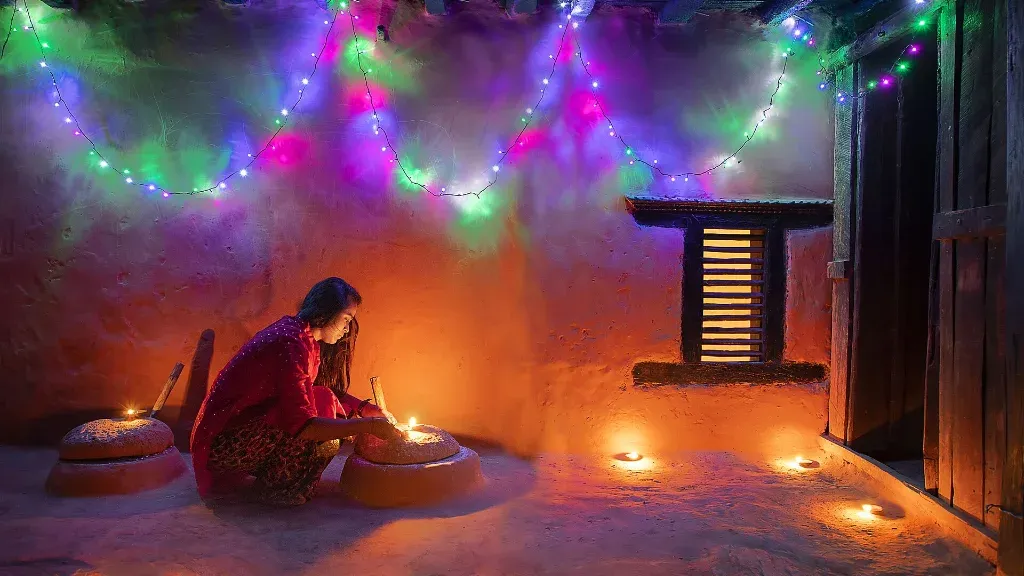
Lighting the oil lamps on Lakshmi Puja night. Photo: Mithunkunwar9, Wikimedia Commons, CC BY-SA 4.0. Cropped.
3. Gai Puja, 9 November
Cows fed, garlanded and marked with tika in the morning. Mostly a village and town-edge thing.
4. Govardhan Puja, Goru Puja & Mha Puja, 10 November.
Oxen honoured for their work in the fields, and Newar families perform Mha Puja, the worship of one's own body, with each family member sitting before a mandala. The same day is Nepal Sambat New Year, 1147 this year, with gatherings across the Kathmandu Valley.
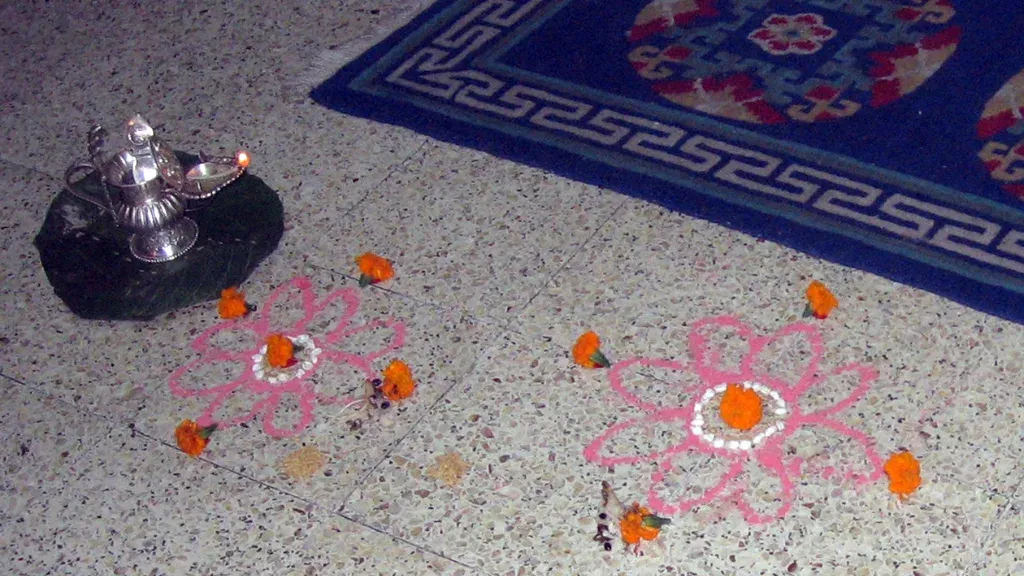
A Mha Puja mandala laid out for the Newar new year. Photo: Kamal Ratna Tuladhar, Wikimedia Commons, CC BY-SA 3.0. Cropped.
5. Bhai Tika, 11 November
Sisters bless their brothers with a seven-coloured tika, a garland of makhamali flowers and a circle of oil and water drawn around them. Brothers give tika and gifts back. The roads fill again with people visiting siblings.

Dashain or Tihar: which is better to be here for?
| |
Dashain
|
Tihar
|
|
2026 dates
|
11 to 25 October
|
7 to 11 November
|
|
Government holiday
|
11 October, 17 to 23 October
|
8 to 12 November
|
|
What it's about
|
Durga's victory over Mahishasura, blessings from elders
|
Yama's messengers and animals, Lakshmi, brothers and sisters
|
|
Atmosphere
|
Crowded markets, then empty streets. Kites and bamboo swings
|
Lit streets at night, singing groups, marigolds everywhere
|
|
For a visitor
|
Mostly happening indoors. You see the quiet, not the festival
|
Happening outdoors after dark. You can actually watch it
|
|
Travel impact
|
Heavier. Longer closure, bigger transport rush
|
Lighter, but still a travel rush
|
If you only have the choice of one, Tihar is the more rewarding festival to witness and the less disruptive to travel through. Dashain is more significant to Nepalis and less visible to outsiders.
The quiet window between them
The thirteen days from Kojagrat Purnima on 25 October to Kaag Tihar on 7 November are the most normal stretch of the autumn. Offices open, banks open, buses on normal timetables after the return rush has cleared, and prime trekking weather.
If your dates are flexible, two plans work well. Arrive around 26 or 27 October after the return rush, trek, and be back in Pokhara or Kathmandu for Lakshmi Puja on 8 November. Or come in early October, finish your trek before 17 October, and spend the holiday week somewhere you're happy to sit still.
Chhath follows straight after, from 13 to 16 November, with its main evening offering on Sunday 15 November, a public holiday. It is celebrated mainly in the Terai, so expect another wave of travel towards the southern plains that week. The section below explains what it is and where to see it.
Chhath in Madhesh: the festival after Tihar
Chhath is one of the most important festivals of the Terai, Nepal's southern plains, and above all of the Mithila community of Madhesh. In 2026 it runs from 13 to 16 November. Devotees fast and offer arghya to the setting sun and then the rising sun at ponds and rivers.
The main evening offering on Sunday 15 November is a public holiday across Nepal. The fast is hard: devotees, called vratis, go without food and even water through the main day, about 36 hours in all, and break it only after the dawn offering. They fast for the health, long life and prosperity of their families.
Janakpur, the capital of Madhesh Province, is the best place in Nepal to see Chhath. Ponds such as Gangasagar, Dhanushsagar and Ratnasagar are cleaned and decorated in the days after Tihar, and on the evening of the offering the banks fill with families carrying baskets of fruit, while devotees sing folk songs. Since 1990 Chhath has also spread to the hills, and today you will see devotees on the banks of the Bagmati in Kathmandu.
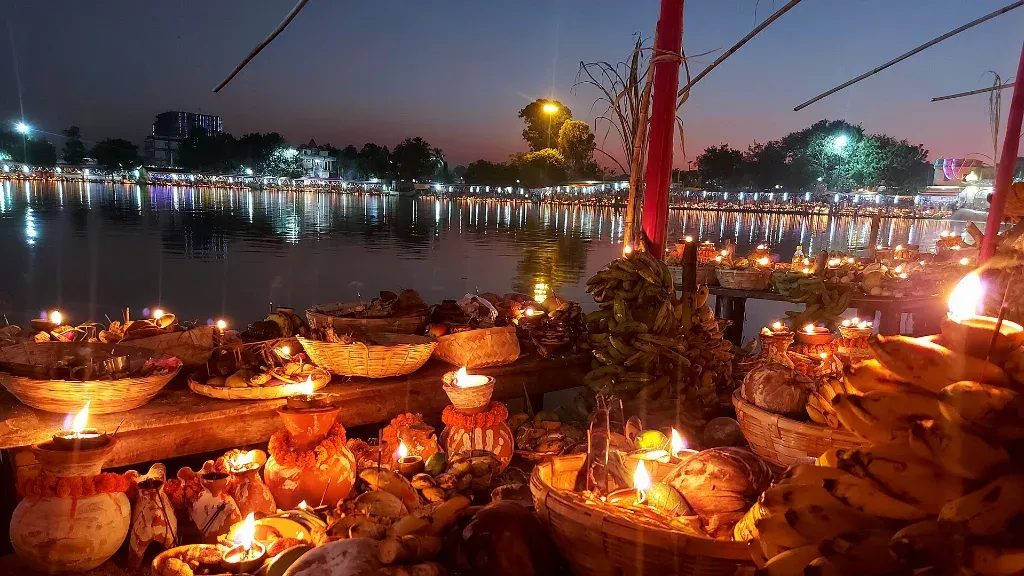
Chhath at Gangasagar pond in Janakpur. Photo: Tulsi Bhagat, Wikimedia Commons, CC BY-SA 4.0. Cropped.
Chhath food follows strict rules. For the four days devotees avoid meat, alcohol, onion, garlic and ordinary salt, and food is cooked only with rock salt. The offerings carried to the water include rice pudding and fruit, prepared with strict attention to purity.
Heads up
Chhath is a religious fast, not a show. Stand back from the water's edge, ask before photographing anyone, and never step over offerings laid out on the bank. The crowds at Gangasagar on the evening of the offering are huge, so keep your group together.
Why trek in Nepal during the festival season?
Because the weather, the harvest and the festivals all line up. Dashain, Tihar and Chhath come after the monsoon, when the air is usually clear and the paddy harvest is under way. Families are home, villages are decorated, and the trails stay open the whole time.
Autumn is Nepal's main trekking season for a reason. The monsoon has washed the dust out of the air, and October and November usually bring the clearest mountain views of the year. Our month-by-month guide to the best time to trek in Nepal covers the weather in detail.
The festival season is also harvest time. Kantipur reported on 17 October 2026 that farmers in Lumbini Province were rushing to bring in their paddy before the festivals arrived. By Tihar much of that work is done and people have more time to celebrate, which is why a village in Tihar week feels so different from one in the planting season.
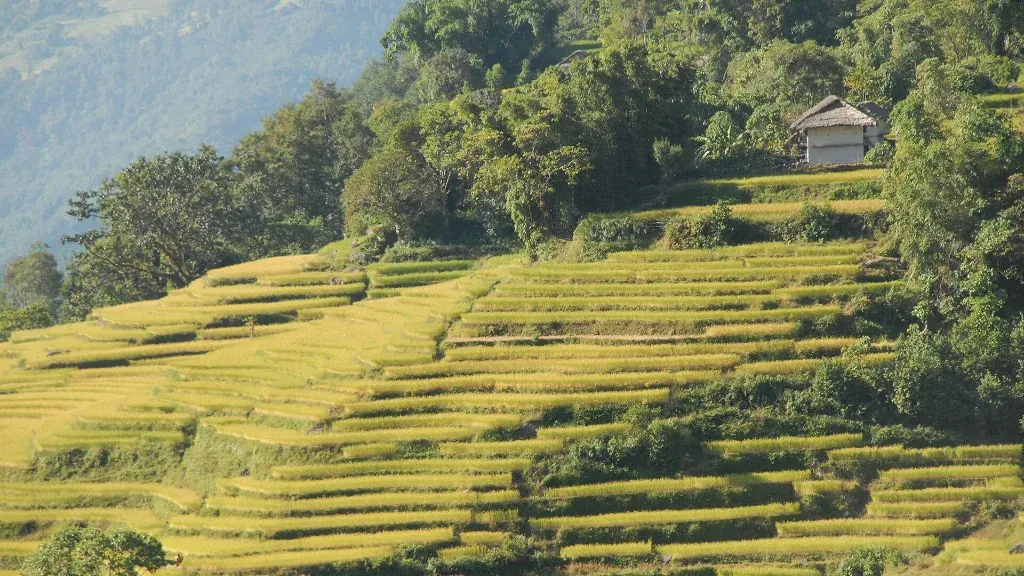
Ripe paddy on hill terraces in the Barun valley, eastern Nepal. Photo: Sergey Pashko, Wikimedia Commons, CC BY 3.0. Cropped.
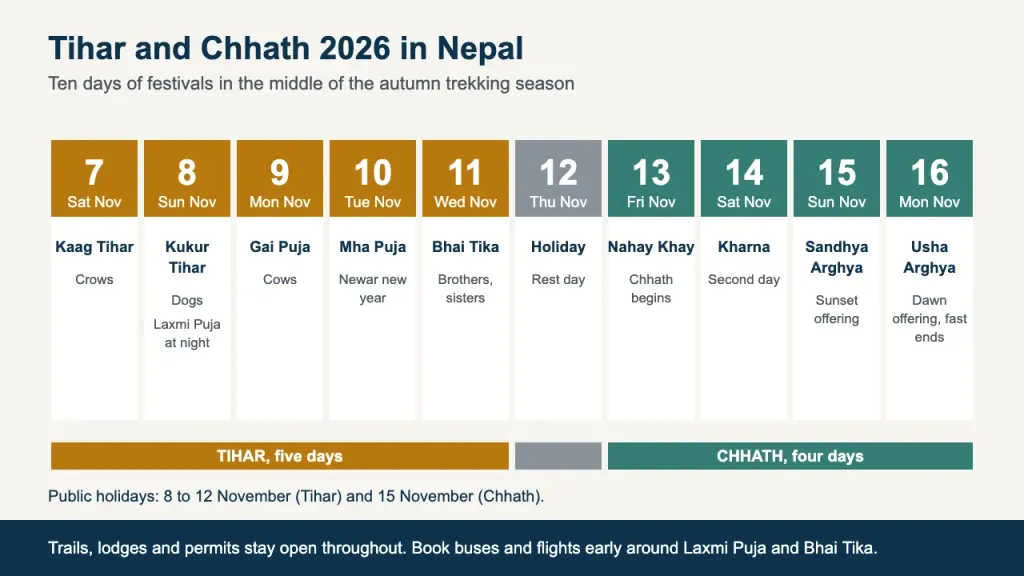
Tihar and Chhath 2026 at a glance. Graphic: North Nepal Travel & Trek.
What to eat during the festivals
Tihar food is sweet and fried. Sel roti, a ring of rice-flour batter fried in oil, is made in every household, along with sweets and fruit for the pujas and for Deusi-Bhailo singers. On a trek, ask the lodge if they are frying it. Many will offer you a piece, and it goes well with a cup of milk tea on a cold morning.
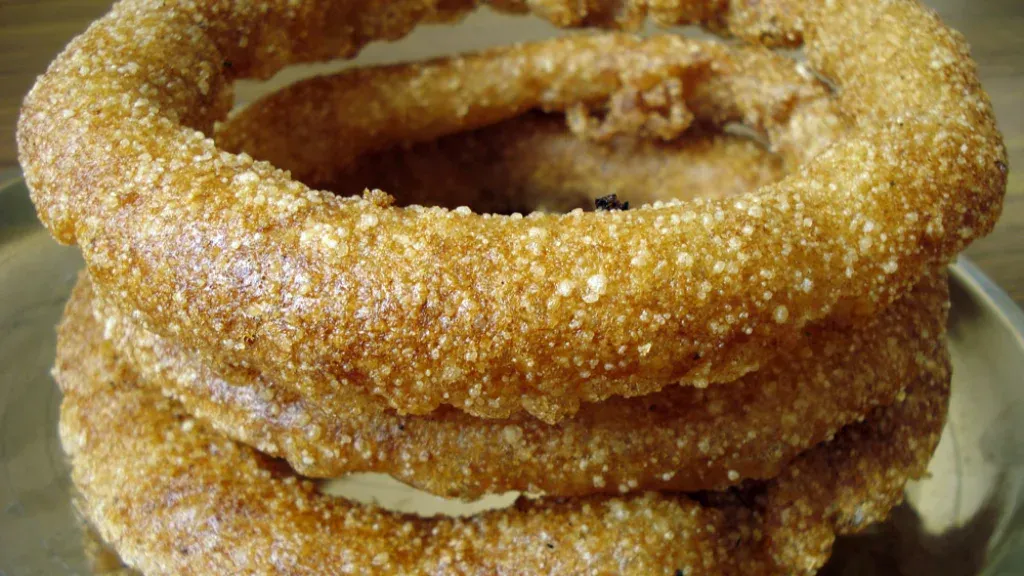
Sel roti, the fried rice-flour ring made in every Tihar kitchen. Photo: Swapnil Acharya, Wikimedia Commons, CC BY-SA 3.0. Cropped.
Where to trek in festival week
For a short trek in Tihar week I recommend the Ghorepani Poon Hill trek from Pokhara. It is four days and rated easy, it tops out at Poon Hill, 3,210 m (10,531 ft), and it passes hill villages where Tihar is celebrated at home rather than for visitors. Ghandruk, on the same route, is a large Gurung village with its own customs and food. Our guides work through the festivals, and we pay them extra for every festival day on the trail.
My advice
Keep a few small notes in your pocket in Tihar week. When Deusi or Bhailo singers reach your lodge, a small gift is part of the song, and your guide will tell you what is normal in that village.
Frequently Asked Questions (FAQ)
1. When is Dashain Tika 2026?
Wednesday 21 October 2026, which is Kartik 4 in the Nepali calendar. The auspicious time had not been announced as of 4 October 2026. Most families give tika from mid-morning into the early afternoon.
2. Can tourists travel in Nepal during Dashain?
Yes. Hotels, tourist restaurants, airports, tourist buses and trekking lodges all keep running. The difficulties are crowded buses and flights, closed government offices and banks from 17 to 23 October, and small local shops shutting around tika day. Book transport early and keep a buffer day before your flight home.
3. Can I trek during Dashain?
Yes, and October is the best trekking month of the year in Nepal. Trails and main-route teahouses are unaffected. The constraints are trailhead transport around 14 to 17 October and 22 to 26 October, and guide availability on tika day itself. Ask your operator directly about both.
4. Will my guide work on tika day?
Most guides want to be home with their families on 21 October. A well-run operator plans its roster around this and tells you in advance who will be with you. Ask before you book, and ask for the answer in writing.
5. Are banks and shops open during Dashain?
Tourist-area hotels, restaurants and shops stay open. Banks and government offices close on public holidays, which in 2026 are 11 October and 17 to 23 October. Many small family-run shops close for several days around 21 October. Draw cash before the 17th.
6. Is public transport running during Dashain?
Yes, but it's heavily booked. Around two million people leave the Kathmandu Valley each year, filling buses before Phulpati and again after Kojagrat Purnima. This year flood-damaged roads delayed advance bookings. Book tourist buses and domestic flights early through your operator.
7. When is Tihar 2026?
From Kaag Tihar on Saturday 7 November to Bhai Tika on Wednesday 11 November, with Dhanteras on Friday 6 November. Kukur Tihar and Lakshmi Puja both fall on Sunday 8 November. The government holiday runs 8 to 12 November.
8. Why do different websites give different Dashain and Tihar dates?
Two reasons. Indian panchangs order the Tihar days differently from the Nepali one, which is why some sites put Lakshmi Puja on 9 November. And in 2026 the Ashtami tithi ends on the morning of 19 October, so some international calendars print Maha Navami on the 19th when Nepal keeps it on the 20th. Use the Nepali committee calendar for anything happening in Nepal.
9. What should I do if someone offers me tika?
Accept it. Bow your head, let them place it, say dhanyabad, and take anything offered with your right hand or both hands. Ask before taking photographs, and don't enter the prayer room unless invited.
10. Is October or November better for trekking in Nepal in 2026?
Both are good. Late October after the 25th and the first week of November are the easiest stretch this year, because the weather is still settled and both festival travel rushes have cleared.
11. When is Chhath 2026?
Chhath 2026 runs from 13 to 16 November. The main evening offering to the setting sun is on Sunday 15 November, a public holiday in Nepal, and the festival ends with the dawn offering on 16 November.
12. Where is the best place to see Chhath in Nepal?
Janakpur, in Madhesh Province, around ponds such as Gangasagar and Dhanushsagar. You can also see Chhath on the banks of the Bagmati River in Kathmandu.
13. What food should I try during Tihar?
Sel roti, the fried ring of rice-flour bread made in every home for the festival. You will also be offered sweets and fruit, especially when Deusi and Bhailo singers visit.
Before you go
If you're planning an October or November trek, the simplest version is this: be where you want to be by Friday 16 October, stay put until Saturday 24th, draw your cash early, and don't plan to buy a bus ticket on the day between 14 and 26 October. If you're trekking, start before the holiday block or start from Pokhara.
Plan around it and the festivals stop being an obstacle. Tika from a lodge family in a Gurung village, kites over the hills in the afternoons, and every doorstep in the country lit up in November tends to be the part people remember, not the trek statistics.
If you want help fitting a trek around these dates, write to us in Pokhara and we'll tell you plainly which days to avoid and which are worth planning around. Come as a guest, leave as a friend.
Sources for the Chhath and festival-season sections: Government of Nepal, Ministry of Home Affairs, 2083 BS public holiday list (via Collegenp); The Kathmandu Post, Chhath festival begins (12 Nov 2018), Devotees worship rising Sun God to conclude Chhath (8 Nov 2024) and Janakpur gears up for Chhath celebrations (22 Oct 2025); Kantipur, Farmers rush to bring in the paddy harvest during the festive season (17 Oct 2026). All accessed 8 November 2026.
Author
Mohan Raj Bhandari
Founder/Managing director
A native of the Annapurna region, he brings over 17 years of firsthand experience leading treks across the mountains of Nepal. His deep local roots and proven guiding expertise make him a trusted authority on authentic Himalayan adventures.