On May 14, 15, and 16, 2026 (Thursday to Saturday), locals of Upper Mustang will gather in the courtyard of Lo Manthang's Royal Palace to celebrate the ancient festival called Tiji Festival. So, what is this ancient festival celebrated in a “forbidden kingdom” beyond the mountains of Nepal in the dry desert of Nepal?
When the spring winds blow across the Tibetan Plateau, a transformation happens in the Kingdom of Lo in Mustang region. Monks in crimson robes gather in the ancient walled city of Lo Manthang. Prayer flags flutter with the wind. Community people gather in the courtyard of the Royal Palace. And for three days, the world witnessed the ancient cultural celebrations of Upper Mustang; Tiji Festival in Spring.
Tiji Festival of Upper Mustang is a centuries-old Tibetan Buddhist celebration that brings together ancient mythology, spiritual devotion, and living cultural heritage in the Kingdom that is hidden between the dry land & snowy peak. If you've ever wondered what a genuine, unchanged religious festival looks like when it's been preserved for over 600 years, this is it.
In this guide, we'll explore everything you need to know about the Tiji Festival Mustang region, including what it is, when it happens, how to experience it, and its spiritual aspect.
What is the Tiji Festival? Understanding Upper Mustang's Holiest Celebration
The Tiji Festival, locally called Tenchi or Tempa Chirim (which translates to "Prayer for World Peace" in Tibetan), is far more than just a festival. It's a living, breathing connection to a pre-modern world that most of us only read about in history books.
At its core, the Upper Mustang festival is a three-day Tibetan Buddhist ritual that celebrates the mythological victory of good over evil. This is a complete spiritual and cultural re-enactment of ancient beliefs, conducted by monks who have studied these rituals for decades, wearing costumes and masks that have been passed down through generations, in a kingdom that has physically changed very little since the 15th century.
 Photo: Visiters indulging in the mask dance on the courtyard of Royal Palace during Tiji festival.
The Tiji Festival in Lo Manthang (the capital of Upper Mustang) involves masked dances, ritual prayers, ceremonial music, and performances that directly connect to Vajrayana Buddhism, the form of Buddhism practiced in Tibet and preserved in Nepal's remote Mustang region.
The masked dances, known as Tsa Cham, Nga Cham, and Rha Cham, aren't entertainment in the modern sense. They're spiritual practices designed to cleanse the community, protect against negative forces, and restore harmony to both the physical and spiritual worlds.
Tiji is not just a marketing gimmick for cultural exposure. It is a religious ceremony that is authentic and unchoreographed, where the monks and disciples immerse themselves in the rituals. The monks aren't aware of whether tourists are watching or not. The rituals would happen the same way if no one outside Upper Mustang ever knew they existed.
The History of the Tiji Festival: A 600-Year Journey Through Mustang's Spiritual Landscape
To understand the history of the Tiji Festival, you need to first understand that Upper Mustang is a place where Tibetan culture was preserved in amber in the Tibetan Plateau. After political changes in China, people migrated to the south of Tibet and chose their new home at Upper Mustang region of Nepal. People celebrated their centuries-old festival in Lo Manthang while they changed or disappeared elsewhere.
Origins in Mythology: The Legend of Dorje Jono
The Tiji Festival's spiritual foundation rests on an ancient Tibetan legend. According to local mythology, Dorje Jono (a reincarnation of Buddha) was born to a demon father named Ma Tam Ru Ta. He was an evil creature that fed on humans and caused chaos across the Kingdom. Rather than follow his father's evil path, Dorje Jono developed into a virtuous being who eventually battled his own father to save the Mustang kingdom from destruction and suffering.
.webp) Photo: Dorje Jono (a reincarnation of Buddha).
Photo: Dorje Jono (a reincarnation of Buddha).
This isn't a simple good-versus-evil narrative, though. The legend carries layers of meaning in Tibetan Buddhist philosophy. Dorje Jono's battle with his demon father represents the internal struggle that every Buddhist practitioner faces, the constant battle between ignorance and enlightenment, between selfish impulses and compassionate action. The festival's three-day reenactment of this victory serves as both a literal celebration and a spiritual reminder of this inner work.
The 15th Century Founding: When the Festival Took Its Modern Form
Historical records suggest that the Tiji Festival was formally established in the early 15th century by Lama Lowo Khenchen, a respected Buddhist teacher and member of Mustang's royal lineage. At that time, Upper Mustang's kingdom was dealing with various challenges, spiritual unrest, political instability, and the general human suffering that comes with uncertain times.
 Photo: Old image of Tiji festival captured after 1990 AD.
The festival was designed to serve multiple purposes at once:
- A spiritual ritual to invoke divine protection
- A unifying community event that brought people together
- A way to pass down Buddhist teachings to ordinary people (many of whom couldn't read the scriptures themselves)
- A mechanism for establishing the king's authority and connection to the divine
However, the festival as we know it today took its current form during the 17th century under King Samdrup Rabten, who collaborated with the renowned Sakya master Ngawang Kunga Sonam. Together, they integrated Vajrakila rituals, powerful practices in Vajrayana Buddhism designed to eliminate obstacles and negative energies, into the festival's structure. Ngawang Kunga Sonam performed special Vajrakila ceremonies that became the spiritual core of what we now call the Tiji Festival in Nepal.
Vajrakila: The Spiritual Technology Behind the Festival
To truly appreciate the Upper Mustang cultural festival, you need to know something about Vajrakila (also called Dorje Phurba). Vajrakila isn't a deity in the way Western religions might understand "deity." Rather, it's a concentrated form of enlightened activity, a manifestation of the Buddha's ability to cut through ignorance and transform negative forces.
Vajrakila practices were introduced to Tibet in the 8th century by Buddhist masters like Padmasambhava (also called Guru Rinpoche) and Vimalamitra. These weren't abstract spiritual concepts. They were practical techniques, codified in texts, taught by teachers to students, passed down through unbroken lineages for over 1,200 years.
 Photo: 8th century by Buddhist masters like Padmasambhava. (source)
When Ngawang Kunga Sonam integrated Vajrakila rituals into the Tiji Festival, he was essentially saying: "Let's use these powerful Buddhist practices to protect our community." The masked dances, the ritual movements, the special chants, they're all expressions of Vajrakila practice in action.
This is why the Tiji Festival feels so different from festival celebrations in other parts of the world. The participants aren't just remembering history or entertaining audiences. They're actively engaged in what they believe is spiritual work. A work that, in their worldview, has real consequences for their community and the wider world.
Six Centuries of Continuous Practice: An Unbroken Chain
What makes the Tiji Festival history even more remarkable is that this practice has continued almost without interruption for over 600 years. In an era of rapid globalization, cultural dilution, and the disappearance of traditional practices, the Tiji Festival has remained relatively unchanged.
 Photo: Monk & disciple performing dance in the traditional costumes in the Tiji festival.
Yes, the outside world has changed dramatically since 1420. Technology has transformed. Political systems have evolved. But when the Tiji Festival happens in Lo Manthang each May, the dances are essentially the same. The masks look nearly identical to those of centuries ago. The monks performing the rituals have studied the same texts and learned from the same teacher lineages.
This continuity is extraordinary. It means that if someone from the 17th century were transported to Lo Manthang today during the Tiji Festival, they would recognize almost everything happening around them. The costumes would be familiar. The rituals would follow the same sequence. The prayers would use the same words.
“Prayer for World Peace”
The Three-Day Celebration: Understanding Each Day of the Tiji Festival
The Tiji Festival is divided into three distinct days. Each day has specific spiritual significance and unique ritual components. Understanding what happens on each day helps you appreciate the depth of what you're witnessing.
Day 1 – Invocation of the Deity: Calling the Divine Protector
The first day of the Tiji Festival focuses on invocation, literally calling the protective deity (Vajrakila/Dorje Phurba) to be present and active. This day establishes the sacred container for the festival and sets intentions for the three days ahead.
 Photo: monks and disciple performing dance on the courtyard of Lo Manthang
What Happens:
- Early morning rituals in monasteries
- Opening ceremonies in the courtyard of the main monastery
- Monks in elaborate costumes and masks begin the first masked dance (Tsa Cham)
- Ritual music featuring traditional Tibetan instruments (dungchen horns, gyaling oboes, drums)
- Offerings are made to the deity (butter lamps, scarves, incense)
- The royal family participates in ceremonial roles
The Symbolism: The first day represents preparation and connection. Just as you might begin a meditation practice by settling your mind and calling attention to the present moment, the first day of the Tiji Festival is about invoking the spiritual forces that will work through the festival to benefit the community.
The costumes on this day are dramatic and colorful, reds, golds, blacks, and greens feature prominently. Some masks represent wrathful deities (fierce protectors), while others represent gentler, compassionate aspects of the divine. The variety of masks and costumes tells a story: diverse energies and forces, all being called together for a unified purpose.
Day 2 – The Battle Against Evil: The Central Drama
The second day of the Tiji Festival is the day of the great reenactment, the mythological battle between good and evil, between Dorje Jono and his demon father, Ma Tam Ru Ta.
What Happens:
- The courtyard becomes a ritual theater
- Masked dancers representing different celestial and demonic figures perform increasingly elaborate dances
- The narrative of Dorje Jono's victory unfolds through movement, music, and dramatic actions
- Younger monks, monks in animal masks, monks as celestial beings—each group has specific movements and meanings
- Ritual combat is performed (not with weapons, but through choreographed movement that symbolizes spiritual conflict)
- The crowd participates by watching intently and occasionally providing energy through presence and attention
The Symbolic Battle: From a Buddhist philosophical perspective, the battle on Day 2 isn't just about mythology. It represents several simultaneous concepts:
The internal battle that occurs in every person's mind when they face the choice between self-centered action and compassionate action. Dorje Jono's choice to overcome his demonic father (who represents ignorance and negative impulses) mirrors the spiritual work that Buddhists believe each person must do.
The cosmic battle between order and chaos. In Tibetan Buddhism, negative forces aren't external demons prowling the universe. They're manifestations of ignorance, confusion, and harmful patterns. By ritually demonstrating the victory over these patterns, the community is, in a sense, strengthening these patterns' defeat in the real world.
On this day, the Tiji Festival is most visually spectacular. If you're photographing or trying to capture what's happening, Day 2 is when the most dramatic moments occur. But don't get so caught up in the visual spectacle that you miss the underlying spiritual work—that would be like watching a symphony while ignoring the music.
Day 3 – Victory and Purification: Completing the Transformation
The third and final day brings closure, celebration, and purification. By Day 3, the victory has been achieved. Now the focus is on consolidating that victory, purifying the community, and extending the benefits outward.
 Photo: Tiji festival on the courtyard of Lo Manthang Royal Palace.
What Happens:
- Final ritual dances and ceremonies (Rha Cham, the "victory dance")
- Specific rituals designed to remove obstacles for the coming year
- Distribution of blessed substances (blessed grain, water, or other items that have been energized through the ritual process)
- Family gatherings and celebrations throughout Lo Manthang
- The royal family distributes blessing cords to community members
- Monks return to monasteries to perform concluding prayers
The Purification Element: Purification in Tibetan Buddhism doesn't mean judgment or punishment. It means clearing away obstacles, negativity, and obstacles to peace and flourishing. Through the three-day ritual, the entire community is believed to undergo this purification.
By Day 3, if you've been present for all three days, you often notice a palpable shift in the energy of Lo Manthang. People are lighter. There's more celebrating and less intensity. The work has been completed. The divine protection has been invoked. The community has collectively acted out the victory of positive forces.
Tiji Festival Dates 2026: When and How to Plan Your Journey
For 2026, the Tiji Festival in Upper Mustang is celebrated on May 14, 15, and 16, 2026 (Thursday to Saturday). You can witness this ancient festival in the Lo Manthang, Upper Mustang region. These dates are predictions based on current astronomical calculations.
Historical Pattern of Festival Dates
Looking at recent Tiji Festival dates:
- 2024: April 29 - May 1
- 2025: May 15-17
- 2026: May 14-16
The variation from year to year reflects how lunar calendars work; the lunar year is slightly shorter than the solar year, so festival dates gradually shift forward through the calendar, then jump backward in certain years to stay aligned with the seasons.
The Tibetan Lunar Calendar Connection
The Tibetan Buddhist lunar calendar determines the Tiji Festival dates. Specifically, the festival is celebrated on the 15th, 16th, and 17th days of the first month of the Tibetan year (called "Losar" month).
In the Gregorian calendar that most of us use, this typically translates to late April or May, with the exact dates shifting each year slightly.
Planning Ahead: Why Early Booking Matters
If you're asking "How to visit Tiji Festival Lo Manthang," the most important answer is: start planning early. Accommodations in Lo Manthang fill up months in advance during the festival season. Permits need to be arranged well ahead of time. Flights to Kathmandu should be booked early.
Most travelers should plan to contact us at least 4-6 months before their desired travel date. Those booking during peak season (which coincides with the Tiji Festival dates) should give even more notice.
Where is the Tiji Festival Celebrated? Understanding Lo Manthang & Upper Mustang
Tiji Festival is celebrated specifically in Lo Manthang, the ancient walled capital of the Upper Mustang region. But understanding the geography and context of this location transforms the experience from "visiting a festival" to "entering a preserved medieval kingdom."
Lo Manthang: A City Untouched by Modernity
Lo Manthang sits at approximately 3,840 m. (12,600 ft) on the Tibetan Plateau, in Nepal's Mustang district. The city is surrounded by a thick stone wall, just as it has been for centuries. Inside this wall, a maze of narrow streets connects traditional Tibetan architecture, flat-roofed stone houses that have sheltered the same families for generations.
 Photo: January Snow in Lo Manthang of Upper Mustang region.
There are no paved roads inside Lo Manthang. No motor vehicles drive through the narrow lanes (though you might see a motorcycle or two these days). The dominant sounds are monks chanting, wind through narrow streets, and the ever-present prayer wheels being spun by locals.
When the Tiji Festival in Lo Manthang begins, the entire community mobilizes. Monks from the region's monasteries converge on the central courtyard of Lo Manthang. Families set up viewing spots. The royal family participates in rituals and dances. For three days, this medieval courtyard becomes the center of religious observance for the entire Upper Mustang region.
Upper Mustang: The Broader Context
Lo Manthang is the capital, but the Tiji Festival in Upper Mustang extends beyond just the city. It still maintains a strong Tibetan cultural and linguistic identity.
The region consists of multiple towns and villages:
- Lo Manthang - the ancient walled capital
- Jomsom - the main hub and entry point (3-4 days trek from Lo Manthang)
- Marpha - a picturesque settlement known for apple orchards
- Kagbeni - a fortified village at the confluence of rivers
- Numerous smaller villages and monasteries scattered throughout the region
Accessing Upper Mustang: The Alternative Ways
The reason the Upper Mustang festival remains so authentic and unspoiled is partly that accessing it is genuinely difficult. There are no direct roads from the south. You have two main options:
Option 1: The Trek (Most Common) The Upper Mustang Trek typically takes 12-14 days. You'll trek from Jomsom through changing landscapes, gaining altitude gradually, and experiencing the region in depth. This is the experience most travelers choose because it allows genuine immersion in the landscape and culture.
Option 2: The Jeep Tour (Faster) The Upper Mustang Jeep Tour covers similar terrain but in a vehicle, reducing the trek to 8-10 days total. You still trek on foot for portions of the journey, but vehicle support makes the experience more comfortable. This option works well for those with limited time or lower fitness levels.
Both options require:
- A Restricted Area Permit (special permit required to enter Upper Mustang)
- Annapurna Conservation Area Project (ACAP) permit
- A registered Nepali guide (you cannot travel independently)
- At least 10 days total (including travel to/from Kathmandu)
Alternative: Lower Mustang
For travelers interested in festivals in Upper Mustang Nepal, but without the time or physical capacity for a full Upper Mustang trek, the Lower Mustang Trek offers an alternative. However, note that the Tiji Festival specifically happens in Lo Manthang (Upper Mustang), not in Lower Mustang.
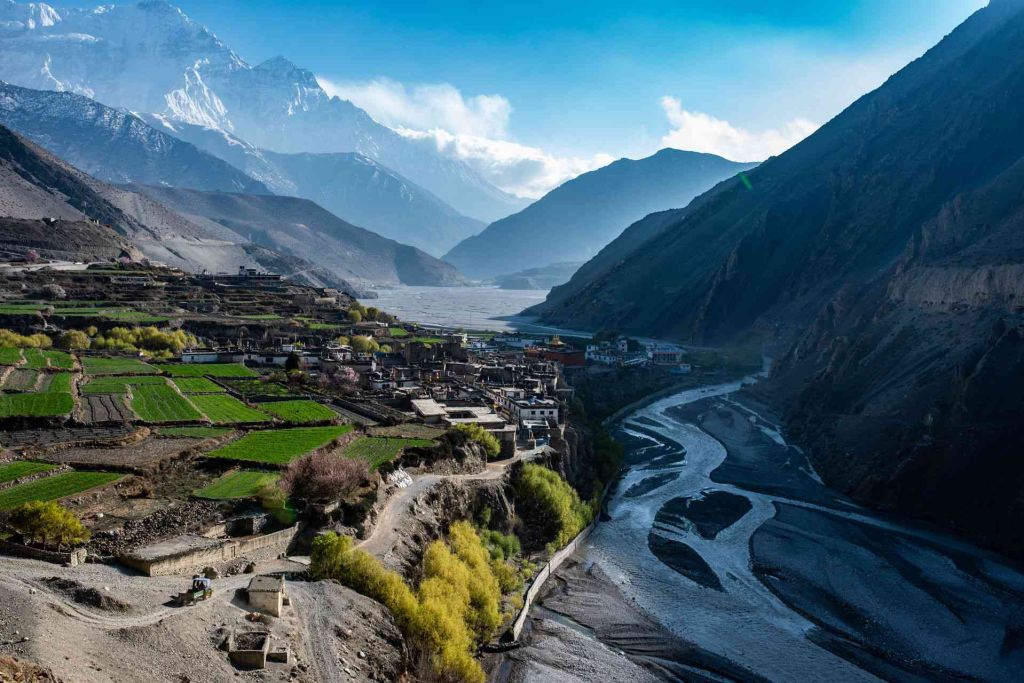 Photo: Lower Mustang region
Lower Mustang provides insight into Tibetan culture and the Mustang region generally, but if your primary goal is experiencing the Tiji Festival, you'll need to plan for Upper Mustang specifically.
Spiritual and Cultural Significance: Why the Tiji Festival Matters
To fully appreciate the Upper Mustang festival, you need to understand its spiritual context. This isn't a cultural performance designed for tourists. It's a sacred observance that carries genuine spiritual weight for participants.
Vajrayana Buddhism: The Spiritual Framework
The Tiji Festival is rooted in Vajrayana Buddhism, also called Tibetan Buddhism or Tantra Buddhism. This is a rich, complex system of Buddhist practice that emerged in Tibet and spread to Nepal, Bhutan, and Mongolia.
Key concepts to understand:
Enlightenment Through Transformation, Not Escape: Unlike some forms of Buddhism that emphasize withdrawing from worldly life, Vajrayana teaches that you can achieve enlightenment by transforming negative energies into positive forces. You don't escape from the world; you transform how you engage with it.
Deities as Expressions of Enlightened Activity: When the Tiji Festival involves rituals to Vajrakila/Dorje Phurba, they're not worshipping a deity in the theistic sense. They're invoking and embodying an enlightened quality—the ability to cut through obstacles and confusion.
The Three Bodies of the Buddha: Vajrayana teaches that Buddha-nature has multiple dimensions. By performing rituals with mudras (hand gestures), chanting mantras (sacred words), and visualizations, practitioners engage with these different dimensions simultaneously.
The Tiji Festival incorporates all these elements. The masked dances are mudras in motion. The chanting is a mantra practice. The entire three-day ceremony is a massive visualization practice shared by a community.
Community Purification and Protection
From the community perspective, the Tiji Festival in Upper Mustang serves specific practical functions:
- Spiritual Cleansing: Tibetan Buddhist philosophy teaches that negative actions and states of mind accumulate like dust in our consciousness and in the collective consciousness of communities. Just as we bathe our bodies to remove physical dirt, the community performs rituals to remove these accumulated negative imprints. The three-day festival is understood as a purification process that benefits not just individuals but the entire community. After the festival, the belief is that harmful influences have been reduced and positive forces strengthened.
- Protection for the Coming Year: Upper Mustang is a challenging environment with limited resources. The community faces real threats—crop failures, health crises, harsh winters, and isolation. The Tiji Festival ritual is performed annually to invoke protection and ensure the community's survival and flourishing.
- Renewal of Community Bonds: By gathering together, sharing in ritual, and collectively participating in the celebration, the community strengthens its social bonds. Older generations pass traditions to younger ones. Different families and groups coordinate and cooperate. The festival is both a spiritual practice and a social glue.
A Unique Cultural Experience for Travelers: What Visiting the Tiji Festival Really Feels Like
After all the history, spiritual context, and practical information, here's what you actually experience when you visit the Tiji Festival in Nepal:
The First Sight of Lo Manthang
Most travelers reach Lo Manthang after several days of trekking. You're exhausted, acclimatized, and saturated with the landscape. Then you crest a ridge, and suddenly the walled city appears below you, a medieval fortress city materially unchanged from centuries past.
Your first reaction is usually disbelief: "This place really exists? In the modern world?"
Walking through the main gate into Lo Manthang is like stepping backward in time. No phones are ringing, no car sounds, no electric lights (though some newer guesthouses have solar panels). The streets are narrow enough that you brush against walls as you walk. Prayer flags hang overhead. The smell of juniper incense drifts through courtyards.
Festival Days: The Intensity of Ritual
On festival days, the experience intensifies dramatically. You wake early, squeeze into a courtyard, or find a rooftop vantage point with other travelers and locals. The music starts—deep horns, high-pitched oboes, drums—sounds that seem to come from another world.
The masked dancers emerge, and your rational mind struggles to process what you're seeing. The costumes are intricate and often grotesque. Some masks represent peaceful deities—serene, beautiful, almost kind-looking. Others represent wrathful protectors—fierce, with bulging eyes, open mouths, expressions of fierce compassion.
The dances are hypnotic. They're not performed for an audience the way you might watch ballet. They're performed as ritual, as spiritual work. The dancers move with complete focus, sometimes accelerating to an almost trance-like state. Children in the crowd watch with intense attention. Elders watch as if observing something sacred. You find your own attention pulled into something larger than yourself.
There's music and visual spectacle, yes. But underneath that is a palpable sense of something real happening, genuine spiritual work being conducted by people who sincerely believe in what they're doing.
The Emotional Impact
Many travelers report that the Tiji Festival experience is emotionally powerful in unexpected ways. You might find yourself unexpectedly moved, sometimes to tears, by the beauty of the ceremony, the dedication of the monks, the sense of community participation, or the realization that you're witnessing something genuine and ancient.
This emotional response isn't engineered. It emerges from a genuine encounter with human culture at its most sincere.
Some travelers report a sense of privilege combined with humility: "I get to witness this extraordinary thing, but I'm also an outsider observing something sacred that isn't really for me."
Others report a sense of expanded perspective. These responses are common because the Tiji Festival isn't packaged as an emotional experience. It's just real, and real things affect us.
Best Time to Experience the Tiji Festival: Seasonal Planning and Travel Considerations
The best time to experience the Tiji Festival is Spring on the month of May. Why Not Other Seasons? Simple, the festival will only last for three days.
You need to consider weather, access, acclimatization, crowds, and practical logistics.
The Ideal Season: May (Spring)
The Tiji Festival occurs in May according to the Tibetan calendar. May is an optimal time to visit Upper Mustang for several reasons:
Weather Advantages:
- Spring weather in Upper Mustang is stable and predictable
- Temperatures range from 10-20°C (50-68°F) during the day
- Nights are cold (around 0-5°C or 32-41°F) but manageable with proper gear
- Clear skies mean excellent mountain views
- Wind is present but not extreme yet (the monsoon season's afternoon storms haven't started)
Festival-Specific Benefits:
- You're visiting specifically for the Tiji Festival dates, so planning is straightforward
- The spring landscape is beginning to show green in lower elevations
- Prayer flags are fresh and bright, creating stunning visual backdrops
- The entire community is energized and prepared for the celebration
Altitude Acclimatization:
- May offers milder conditions that make acclimatization easier than summer or autumn
- The gradual temperature increase from lower elevations to Upper Mustang helps your body adjust
- Most trekkers find that acclimatization headaches and symptoms are minimized in May
Late April Entry Strategy
Some experienced travelers arrive in Nepal in late April (10-14 days before the Tiji Festival), giving them time to trek to Upper Mustang slowly and acclimatize thoroughly. This strategy means:
- You arrive in Lo Manthang 4-5 days before the festival begins
- You have time to explore the city, meet locals, and settle in
- Your body is well-acclimatized by the time the intense ritual energy of the festival begins
- You can fully participate in pre-festival preparations
- This is actually the strategy we recommend for most first-time visitors to the Tiji Festival in Upper Mustang.
If you miss the Tiji Festival dates, consider planning to visit during the actual festival period rather than coming to Upper Mustang in the off-season.
Peak Season Reality Check
Here's what to know about visiting during Tiji Festival dates: Expect to share Lo Manthang with 200-400 other tourists and trekkers during the festival itself. This might seem like a lot in a "remote" location, but understand it in context:
- The tourists who visit are spread across multiple guesthouses
- During the festival, the entire community is engaged in ritual, not in catering to tourists
- You won't feel crowded during the actual ceremony
The key difference between festival season and off-season isn't whether you'll see other travelers. It's whether you'll see the actual festival. And if the Tiji Festival is your primary goal, this difference is everything.
Practical Planning: How to Visit the Tiji Festival Lo Manthang
Now that you understand what the Tiji Festival is and why it matters, here's how to actually make it happen.
The Tiji Festival Trek Options
Complete Experience: 13-14 Days Days 1-2: Fly Kathmandu to Pokhara, drive Pokhara to Jomsom Days 3-5: Trek from Jomsom toward Marpha and Kagbeni (acclimatization) Days 6-8: Trek from Kagbeni to Lo Manthang Days 9-11: Experience the Tiji Festival (Days 8-10 of festival) Days 12-13: Trek back down to Jomsom and drive Pokhara. Day 14: Fly back to Kathmandu
This is the recommended option. It gives you time to acclimatize, experience the entire festival, and recover afterward.
Faster Option: 10-11 Days Upper Mustang Jeep Tour covers similar terrain with vehicle support, reducing total journey time while still allowing festival participation.
Alternative for Trekkers: Combine with Lower Mustang Trek plus the Upper Mustang trip, creating a 14-16 day experience that deeply explores the entire Mustang region.
Permits and Logistics
You need a special Restricted Area Permit (RAP) and Annapurna Conservation Area Project (ACAP) permit. Find the details below:
- Restricted Area Permit: Upper Mustang requires a special Restricted Area Permit. The revised fee for RAP has been reduced to USD 50 per day from USD 500, which now makes Upper Mustang more accessible. We issue your permit for a hassle free journey.
- Annapurna Conservation Area Project permit: When you travel to Upper Mustang, you walk on the premises of the Annapurna Conservation Area. Therefore, an ACAP permit is required, which costs around NPR 3000 for non-SAARC nations and NPR 1000 for SAARC countries. This is also managed by us.
- Guide Requirement: You must trek with a registered Nepali guide. Independent travel in Upper Mustang is not permitted. This policy protects the region's culture and environment from unsustainable tourism impact.
What to Pack
Upper Mustang trekking requires standard mountainous region gear:
- Comfortable trekking boots (broken in before arrival)
- Layers: base layers, insulating layers, waterproof outer layer
- Warm hat, gloves, sun hat
- Sunscreen (SPF 50+) and sunglasses
- Water bottle and water purification method
- Day pack for daily treks
Altitude Acclimatization Timeline
Most travelers feel fine in Jomsom (2,720m). By Kagbeni (2,810m), you've started gaining elevation noticeably. The trek to Lo Manthang involves substantial climbing, but spread over multiple days allows gradual acclimatization.
Some mild altitude symptoms (headache, slight breathlessness with exertion) are normal. If you experience severe symptoms, descent is the treatment.
Spiritual Preparation: Getting Ready Inwardly for the Festival
Beyond physical preparation and logistical planning, many travelers ask whether they should prepare spiritually or mentally for the Tiji Festival.
You don't need to be Buddhist to appreciate the festival. You don't need to have meditated before or studied Buddhist philosophy. Many visitors come with minimal background and find the experience profound.
That said, some preparation can enrich your experience:
- Learn Basic Buddhist Concepts: Understanding karma (action and consequence), compassion as a spiritual practice, and the concept of mind transformation helps you understand what you're witnessing.
- Read About Tibetan Buddhism: Books like "The Snow Lion's Turquoise Mane" by Cynthia Prost or "Introduction to Tibetan Buddhism" by John Powers provide accessible entry points.
- Practice Mindfulness or Meditation: This isn't required, but meditation experience helps you appreciate the meditative aspects of ritual practice. Even 10 minutes daily of basic mindfulness meditation for a few weeks before your trip can shift how you observe the festival.
- Approach With Genuine Curiosity: The most important preparation is approaching the Tiji Festival with genuine curiosity and respect. Leave behind the desire to "get the perfect photos" or "check this off a list." Come with openness to being surprised, moved, or challenged by what you experience.
Next Steps: Planning Your Tiji Festival Journey
If the Tiji Festival in Upper Mustang has sparked your interest, here's how to move forward:
Step 1: Confirm Your Interest and Timeline
Do you definitely want to see the Tiji Festival, or are you interested in Upper Mustang trekking generally? This matters because it determines whether you need to plan specifically around Tiji Festival dates 2026 (or whichever year you're targeting).
Step 2: Decide Your Trek Duration and Style
Step 3: Book Early
Contact us at least 4-6 months before your desired travel date, especially if you're planning to visit during Tiji Festival season. Peak season accommodations and flights fill quickly.
Step 4: Prepare Physically and Mentally
Begin training now if your trip is several months away. Read about the region, learn basic Buddhist concepts, and approach the journey with genuine openness.
Step 5: Arrange Necessary Documentation
- Passport valid for 6+ months
- Nepal visa (obtained on arrival or in advance)
- Travel insurance (high-altitude trekking)
- RAP & ACAP permit (both handled by us)
Author
Mohan Raj Bhandari
Founder/Managing director
A native of the Annapurna region, he brings over 17 years of firsthand experience leading treks across the mountains of Nepal. His deep local roots and proven guiding expertise make him a trusted authority on authentic Himalayan adventures.
Field Notes, Monthly
Receive monthly trekking updates, seasonal trail conditions, permit changes, packing
advice, and exclusive travel planning tips from our local guides.