Kailash Mansarovar Yatra - 11 Days

Kailash Mansarovar Yatra - 11 Days
DESTINATION Tibet
MAX. ELEVATION 5,630 m|18,472 ft
WALKING DISTANCE n/a
GRADE Moderately Challenging
BEST SEASON May, June, September
DURATION 11 Days
MEALS INCLUDED Breakfast, Lunch, Dinner
ACCOMMODATION Hotels & Lodge

OVERVIEW & HIGHLIGHTS

Book 2026 Fixed Departure Dates Kailash Yatra from Kathmandu with North Nepal Trek

Why is the Kailash Yatra in 2026 special? 2026 is the Tibetan Year of the Horse (Rta Lo), when circuling Kailash carries 13x the spiritual merit. This is Mahakumbh of Kailash. Next comes only after 2038 AD.

This 11-day Kailash Mansarovar Yatra begins in Kathmandu with a drive north through Langtang National Park to the Nepal-Tibet border at Rasuwagadhi, crossing into Kyirong (Gyirong) for the first acclimatization night at 2,774m. The next day’s drive to Saga at 4,640m passes Lake Peiku Tso, the Qomolangma High Pass, and the Yarlung Tsangpo (Brahmaputra) river crossing. From Saga, it’s a long 450km drive west to Lake Mansarovar at 4,590m, where a full day is kept for prayers, a vehicle circumambulation of the lake, and rest before the Kora begins.

The 3-day Parikrama around Mount Kailash starts at Darchen, about 35 minutes by road from Mansarovar. Day one is a 12km trek to Dirapuk Monastery at 5,210m, with the north face of Kailash straight ahead. Day two crosses Dolma La Pass at 5,630m, the hardest morning of the journey, before dropping down to Zuthulphuk Monastery for the night. The third day closes the circuit back to Darchen. The return retraces through Saga, with a stop at Kiron waterfall on the road back to Kyirong, then a full day’s drive to Kathmandu. Kailash Yatra requires mandatory Tibet travel permits. Carry Chinese Yuan (RMB) for everything on the Tibet side — cash is the only option at guesthouses and rest stops along the plateau road.

Day Itinerary Trek Time Max. Elevation
1 Kathmandu to Gyirong (drive) n/a 2,774 m.
2 Acclimatization at Gyirong 3-4 hrs. 2,774 m.
3 Drive from Gyirong to Saga n/a 4,640 m.
4 Drive from Saga to Mansarovar n/a 4,590 m.
5 Drive Mansarovar to Darchen n/a 4,670 m.
6 Darchen to Dirapuk 6-7 hrs. 5,210 m.
7 Charansparsa and back to Dirapuk 5-6 hrs. 5,210 m.
8 Dirapuk to Zuthulpuk via Dolma La Pass 8-9 hrs. 5,630 m.
9 Short Trek and Drive to Saga 3-4 hrs. 4,640 m.
10 Drive Saga to Kyirong n/a 2,774 m.
11 Drive Kyirong to Kathmandu n/a 1,400 m.

Why Kailash Mansarovar Yatra from Nepal?

  • Mount Kailash, the sacred abode of Lord Shiva
  • Lake Mansarovar, a holy lake for ritual baths and prayers
  • Kora (Parikrama) is a spiritually enriching yet challenging trek encircling Mount Kailash.
  • Gauri Kund, a sacred pool on the Kailash Parikrama route
  • Dirapuk and Zuthulphuk Monasteries, ancient monasteries along the trek
  • Asthapad, believed to be the place where Lord Shiva meditated
  • Yam Dwar, the gateway to the Kailash Parikrama
  • Religious rituals and prayers are performed throughout the journey
  • Scenic landscapes with stunning views of the Himalayas and the Tibetan plateau
  • Cultural encounters, interactions with local Tibetans and pilgrims
  • Spiritual and personal growth as a transformative pilgrimage experience
Mohan Raj Bhandari
Itinerary review by

Mohan Raj Bhandari, Founder/Managing director

Since founding North Nepal Trek in 2015, the Kailash Mansarovar Yatra has been one of the most meaningful journeys we organize — there is nothing quite like standing at Darchen with Mount Kailash rising ahead of you. Mohan guided this pilgrimage across the Tibetan plateau through Kyirong, Saga, and Lake Mansarovar before leading the three-day Parikrama over Dolma La Pass at 5,630 meters. He has a strong command of the permit logistics and altitude pacing this journey demands, and pilgrims consistently tell us how much more confident they felt with him managing the crossing.

Kailash Mansarovar Yatra Itinerary

Toggle all
Day 1

Drive from Kathmandu (1400 m | 4,593 ft) - Gyirong (2774 m | 9101 ft):

HIGHEST ALT. 2774 m | 9101 ft

Early in the morning, at about 3:30 a.m./4:00 a.m., we drive from Kathmandu to Gyirong Border, which takes about 6-7 hours, covering 175 kilometers. We need to leave early because the Tibet immigration office opens from 10:15 am to 2 pm, and only during this duration the visitors can proceed for inspection and start their Tibet tour. Also, the Tibet time zone is 2 hrs 15 min ahead of the Nepali time zone, so we are leaving at 6:00 am in Tibet time. Gyirong is the gateway for Tibet tour from Nepal via road. 

After about 6 - 7 hours of driving, we stop at Nuwakot or Syabrubesi for breakfast and then leave for the Nepal-Tibet border. Most of the section of the drive is off-road, mountain road, where the possibility of roads being blocked instantly can not be ignored due to three major landslide-prone areas. So, you need to be aware of this beforehand and plan accordingly if such an unfortunate situation occurs. 

After registering at the Nepal Immigration office, we move towards the Nepal-Tibet border, where we leave our vehicles from Nepal and walk towards the Tibet/China immigration office. If you have heavy bags, then you can hire a porter to transfer your baggage to the Tibet immigration office and from the office to the parking zone. Our Tibetan guide will receive us upon arrival and take us to the Tibetan Immigration office. 

Here in the immigration office, we need to make a COVID-19 vaccination QR and take care of other visa formalities. The total time taken for the visa procedures can range from 2 - 3 hours, depending on how crowded the immigration office is, and only the Tibetan guide can take you to the visa office. 

After completing all visa formalities, our Tibetan guide will provide a brief session explaining the route and details of activities that we can do during our trip. We drive to Gyirong, which takes about an hour from the Nepal-China border. Gyirong is a small town in Tibet situated at an altitude of 2,774 m | 9,101 ft. Overnight stay at Gyirong.

Day 2

Acclimatization at Gyirong:

HIGHEST ALT. 2774 m | 9101 ft
DURATION 3 - 4 hrs

Gyirong is made up of "Gyi' and "rong", "Gyi" means Happy, and "rong" means Village, so Gyirong means happy Village. 

Gyirong is a perfect place for acclimatization, as we travel to Saga (4640m) the next day, so we need to prepare our body for the altitude. Gyirong hosts multiple Nepali restaurants and offers Indian delicacies. Gyirong also facilitates money exchange services if you don't have enough Yuan. During this free day, you can purchase any forgotten goods and prepare for the trip tomorrow. There are a lot of Nepali Shops as well, so it will be fine.

Moreover, we can make a short visit to the Ghepuk Cave; it has religious significance for Hindus and Buddhists and ancient significance for people from Nepal and Tibet. The 1st Buddhist master, Padma Shambhava, from India, arrived in Tibet and started teaching Buddhism to locals here, hence starting the religion of Buddhism. From the 8th Century, the masters/gurus from Tibet began traveling and teaching Buddhism all over Tibet. 

The cultural/ancient significance is also from the 7th Century. The then-king of Tibet, Songtsen Gampo, also known as Songzan Ganbu, married the princess of Nepal Bhrikuti in this cave. The bridal party returned to Nepal, while Bhrikuti went to Lhasa, where the separation of Bhrikuti and her parents took place. The cave was named Ghepuk in reference to this event, "Ghe" means separation, and "Puk" means cave.

Padma Sambhava is worshipped inside this cave with diyos, and you can witness rich Tibetan culture today. While returning, we can see a river flowing down a bridge, and the bridge is adorned with flags, showcasing rich Tibetan culture in every step of our Journey. Overnight stay at Gyirong.

Day 3

Drive from Gyirong to Saga 4640 m|15223 ft:

HIGHEST ALT. 4640 m | 15223 ft

After a full day of acclimatization the day before, we have our breakfast and drive to Saga.

The drive from Kyirung to Saga takes 4 hours, covering a total distance of 200 kilometers. During this drive, enjoy the massive Gyirung waterfall, take some pictures, and continue the Journey to Saga. Additionally, we can see the Chagasi Milerpa cave at an altitude of 4200 m, and It is believed that Milerpa mediated inside this cave for 9 whole years.

We also cover a high pass, named Qomolangma high pass, situated at an altitude of 5236 m | 17178 ft, which lies inside the Qomolangma National Nature Reserve. Qomolangma Monastery lies here in the high pass, which makes it one of the highest monasteries during this Kailash Mansarovar Yatra. During this pass, make sure to have extra warm clothes, hats, and scarves, as the winds here are continuous and very cold. Spin the mani bells and enjoy the views of hills, mountains, and a lake afar from the Qomolangma High Pass. The mountain peaks Gaurishankar, Shishapangma, and Langtang Himal can be seen from this pass. 

The drive from Qomolangma Pass to Saga takes about 2 hrs, and we have our lunch here at Saga. Overnight stay at Saga.

Day 4

Saga to Mansarovar (4590 m | 15060 ft):

Today is a long day of driving as we cover a total of 507 km, passing through towns and villages like Zhongba and Paryang. Even though the drive is long, the scenic views of glass lands, yak, and sheep herds are sure to entertain you. The whole drive takes about 7-8 hours from Saga to Paryang, covering 507 km. The roads are well built, so even the long Journey will not be that much tiresome.

We drive through the bridge above the Brahmaputra River and pass through many lakes like Khunmen Tso, Sibling, Karru Ongchen, and Peiku Tso Lake (4400 m). The drive is all along hills, as there is no vegetation and no trees. The whole duration is along the deserts; however, the scenes will satisfy you. Moreover, before the construction of black-topped roads, the drive duration was two days, but now we can drive from Saga to Mansarovar in a single day.

We stopped at Fayang for lunch, which is about 4 hour's drive from Saga. After having lunch and resting for a bit, we drive towards Mansarovar, which takes another 3-hour drive. As we reach Mansarovar, we can see Kailash Mountain, mostly the top and East face of Mount Kailash. As we reach Mansarovar, we can take a stroll around Mansarovar. As for overnight stays, we have two options for today. 

One option is on the shore of Lake Mansarovar, but it is a very basic tea house with 3 or 4 beds in one room and no toilet and bathrooms. There are toilet tents as a substitute for toilets. Another option is a good teahouse in a townside a bit far from Lake Mansarovar with more features than a basic tea house. You can choose any option that fits your needs, and we will prepare accordingly. 

In religious significance, it is believed that Shiva and Parvati bathe here in Mansarovar at midnight, and many wait for their arrival till midnight. While no one claims to see Shiva and Parvati, the reflection of the moon in the Mansarovar Lake makes it worth the wait for the devotees.

Day 5

Mansarovar to Darchen (4670 m | 15320 ft):

HIGHEST ALT. 4670 m | 15320 ft

Today is one of the most awaited days for devotees as we start bathing in Mansarovar, washing all of our sins. After bathing, we can start our worshipping in Mansarovar. After puja, we start our meditation on the shore of Mansarovar for 2 - 3 hours, taking all the positive energy and negating the negative thoughts and energy. Unlike normal places, the spirituality of Lake Mansarovar eases your mind and soul so you can meditate for hours. The holy name for meditation here in Mansarovar is Samadhi. 

After meditation, we can take a tour of Lake Mansarovar, with an eco bus that circles around the Lake. The tour can also be called Lake Mansarovar Parikrama; even if we forget about the religious and spiritual significance of Mansarovar, the tour of the Highest freshwater lake in the world is a sight to behold. Kailash Mountain surrounds Mansarovar on the right and by the Gurlamandhata Mountain on the left.

After a full-day exploration of Mansarovar, with meditation and puja, we drive towards Darchen, which takes only 45 mins, covering 45km. Overnight stay at Darchen.

Kailash Mansarovar Yatra can also be started from Hilsha, Nepal, and trek to Taklakot, Tibet. Overnight stay at Taklakot and then trek from Taklakot to Mansarover the next day. The overall itinerary of the Kailash Mansarovar Tour from Nepal can be reduced to 9 days, but this border is often closed by Tibet, so you need to make an inquiry with us and plan accordingly.  

Day 6

Darchen to Yamaduar (Short drive) and trek to DiraPuk (5210 m| 17093 ft)

HIGHEST ALT. 5210 m| 17093 ft
DURATION 6 - 7 hrs with 27188 walking steps
Distance
DISTANCE 13 km

Darchen serves as the base/ starting and ending point of the Kailash Parikrama/Kora. The Parikrama takes a total distance of 53 km, and we will start the trek after an eight-kilometer drive to Yamaduar from Darchen.  

If you wish to rent horses, helpers, porters, or yaks, you need to rent them from Yamaduar. The horses make the three days of trekking easy; however, if you wish to trek to Charansparsa, then you need to pay the price of a horse for 4 days, and horses can't go to Charansparsa.  

Note: Horses and yaks aren't included in the package, but we can manage them for you at Darchen. 

From Yamaduar, the total trekking time to reach DiraPuk is 13 km, which takes about 6 - 7 hrs with 27188 walking steps(calculated during Kailash Mansarovar Yatra via iPhone14).

This route will provide you with incredible views of both the west and north face of the magnificent Mount Kailash.

According to the natives here, DiraPuk was discovered by a female Yak. When the female yak placed her horn inside the cave, the yak herders noticed it, and the cave was found, hence named Dirapuk, "Dira" meaning horn of female yak, and "Puk" meaning cave. Overnight stay at Dirapuk Monastery, situated at an altitude of 5,210 m.

Day 7

Dirapuk to Charansparsa and back to Dirapuk:

After breakfast, we trek toward the north face of Mount Kailash for Charansparsa. Note that we can't take horses today, so we will be trekking for a total time of about 5 -6 hours. 

CharanSparsa means touching/reaching the feet of Mount Kailash from the North face, directly from Dirapuk Monastery. It is believed that during Charansparsa, you are directly touching the feet of Lord Shiva, so the blessing you receive today is sure to provide you Mokshya.

The milky white water from the top of Kailash forms the Indus River, while the Ganges are believed to originate from lord Shiva's Jatta(hair). 

The total time to trek to Charansparsa is 2 - 3 hrs, and we spend about 1 - 2 hrs in the base of Mount Kailash. Finally, trekking back takes about 1 -2 hours, so we can complete Charansparsa in a total of 6 - 7 hours with 13672 total footsteps.

Day 8

Trek from Dira Puk to ZuthulPuk via Dolma La Pass (5630 m | 18471 ft): 

HIGHEST ALT. 5630 m | 18,471 ft
DURATION 8 - 9 hours
Distance
DISTANCE 18 km

Today is the holiest day of 11 days, Kailash Mansarovar Yatra. We start the trek after having breakfast, and the trails are suitable, so you can ride the horses today. The total trekking time for today is about 8 - 9 hours.

The first section of the route is ascending all the way to Dolma La Pass 5630 m | 18,471 ft) for two hours. There are some stalls before you reach Dolma La Pass, where you can have tea and hot drinks, or from there, there are no stalls until ZuthulPuk.

After Dolma La Pass, the road descends for 1 hrs and then straightens for 2-3 hrs until we reach Zhutul Puk.

Day 9

End of Kailash Parikrama and drive to Saga:

DURATION 3 hrs
Distance
DISTANCE 8 km

After having our breakfast, we start our last day of the trek, a short distance of 8 km for about 3 hrs upto Gebu and short drive to darchen. Today marks the end of the Kailash Parikrama/Kora as we begin trekking to descend Darchen town. After that, we drive from Darchen to Saga. Overnight stay at Saga.

Day 10

Drive from Saga to Kyirong:

This is your final day in the Tibetan Plateau itself. The drive from Saga to Kyirong takes about 4 - 5 hrs. The picturesque Kiron waterfall lies in this route, so we can spend time clicking photos and mesmerizing here. After a short drive from Kiron waterfall to Kyirong, we spent the whole day resting and reflecting on our Journey to Kailash Mansarovar Trek. 

Day 11

Drive from Kyirong to Kathmandu: 

After the successful completion of the Kailash Mansarovar Yatra, we drive back to Nepal, filled with spiritual enlightenment with the help of meditation and the blessing of lord shiva.

Today is the final day of our Journey, as we leave the Tibet border after completing immigration formalities. The drive from Kyirong to Kathmandu takes about 6 - 7 hours along the greenery. The drive may even take more hours depending on the road conditions, as it is completely off-road from the Nepal Immigration Office. Our Journey ends at Kathmandu.

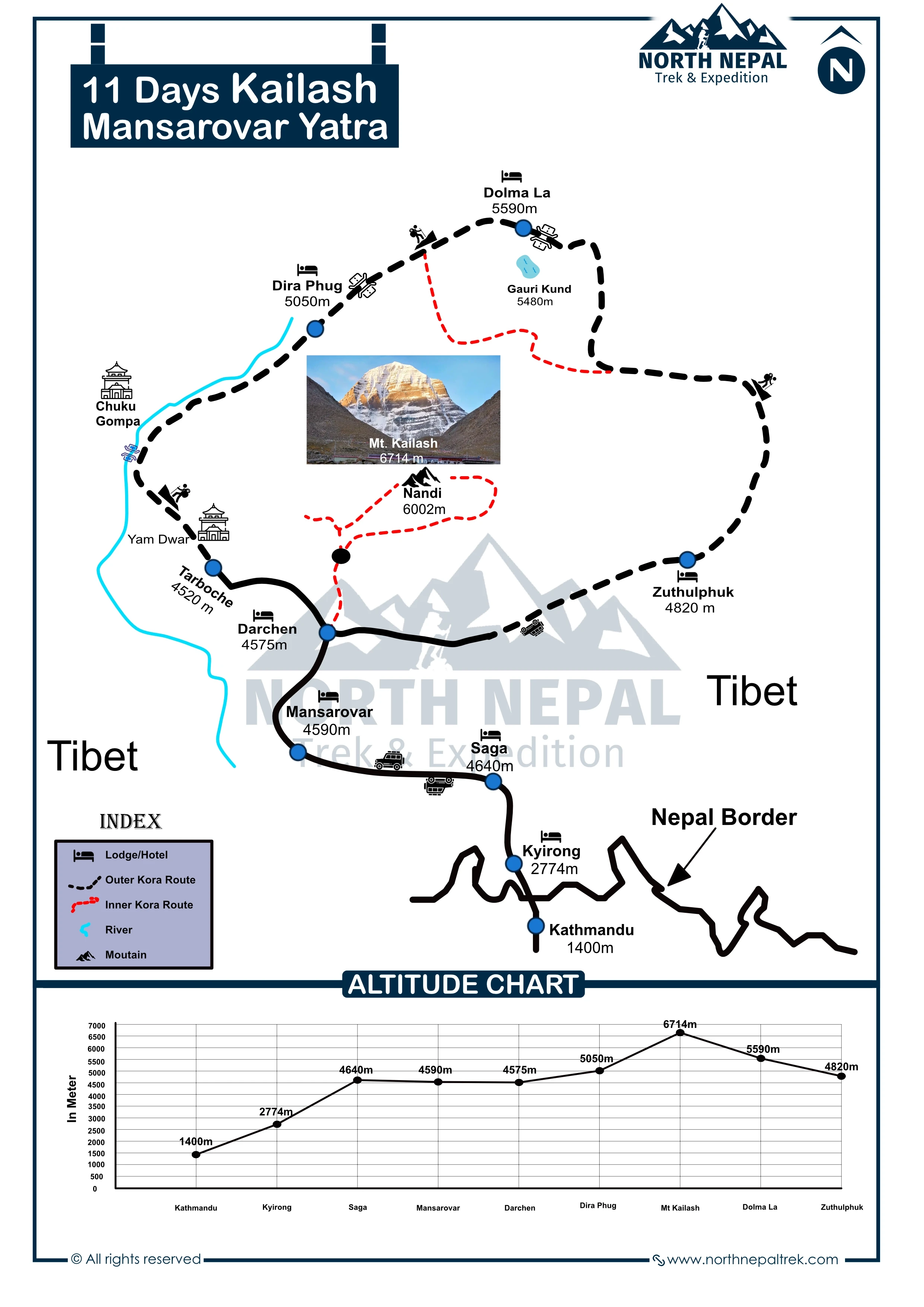
11 Days Kailash Mansarovar Yatra's Map and Elevation Graph

11 Days Kailash Mansarovar Yatra's Map and Elevation Graph

What's Included & Excluded

  • As per the itinerary, accommodation in Tibet: 
    • Hotel in Keyrong/Tibet - 3 Nights ( 2 Night before Parikrama and 1 Night after Parikrama) 
    • Hotel in Saga Tibet - 2 Nights Hotel/Tea House in Mansarovar Lake - 1 Night
    • Hotel in Darchen - 1 Night
    • Hotel in DiraPuk- 2 Night (Itinerary Based)
    • Hotel in ZuthulPuk - 1 Night
       
  • Fresh cooked vegetarian meal by our cook. Hot and cold drinking water. (Breakfast, Lunch, Dinner).
  • Tibet Travel permit and group Visa, Tibetan Guide, All Monastery, and Kailash entry permits.
  • Professional, reliable, friendly, and service-oriented Nepali leader fluent in English and Hindi, and English-speaking experienced Tibetan guide.
  • Jeep throughout the Kailash Mansarovar Yatra, in Nepal and Tibet.
  • Pulse Oximeter, first aid kit with high altitude sickness medicine.
  • Kailash Mansarovar Yatra and Dolma la pass Trek complete certificate.
  • Personal expenses for Nepal-Tibet.
  • Personal Travel insurance and Rescue Evacuation on the tour.
  • Tips and Gratuities for staffs.
  • Kailash Tour Rescue jeep in case needed if someone needs to go back earlier than group.
  • Extra cost incurred in case of Landslide or natural problem, or any other problem outside of our reach.
  • Extra days in Kathmandu.
  • Nepal visa or re-entry Nepal visa price. 
  • Yaks or porters in TIbet region (our guide will help you manage, or you can directly book with us for a bit of extra cost).
  • Any other charges such as photography, or extra purchases such as Bells, and Mala that are not mentioned in the What’s Included section.

Complete Guide to the Kailash Mansarovar Yatra

Toggle all

2026 Fixed Departure Dates & Full Moon Days

These are fixed dates for the 2026 Kailash Yatra applicable for Indians & Non-Resident Indian (USA, Canada, and Australia). Dates will not change unless there is political unrest between India and China, natural calamities, or other reasons that are beyond our control.

Arrival in KathmanduKathmandu Heritage WalkDeparture Date
25th April, 202626st April, 202627th April, 2026
06th May, 20267th May, 20268th May, 2026
25th May, 202626th May, 202627th May, 2026
4th June, 20265th June, 20266th June, 2026
9th June, 202610th June, 202611th June, 2026
16th June, 202617th June, 202618th June, 2026
23th June, 202624th June, 202625th June, 2026
08th July, 20269th July, 202610th July, 2026
23rd July, 202624th July, 202625th July, 2026
5th August, 20266th August, 20267th August, 2026
22nd August, 202623rd August, 202624th August, 2026
02nd September, 202603rd September, 202604th September, 2026
09th September, 202610th September, 202611th September, 2026
20th September, 202621st September, 202622nd September, 2026

Full Moon Days: May 1, May 31, June 29, July 29, August 28, Sept 26 2026

Mount Kailash & Mansarovar Lake Overview

The Kailash Mansarovar Yatra combines the Mount Kailash and Lake Mansarovar tour. This is one of the most sacred high-altitude pilgrimage journeys in the world. This yatra is done by Hinduism, Buddhism, Jainism, and the Bon religion. Kailash Yatra 2026 dates have already been published for Indians and non-Indians.

The Kailash Mansarovar tour from Nepal leads pilgrims and trekkers to Mount Kailash, Gaurikunda, and Lake Mansarovar. Each place reserves a different faith. Mt. Kailash is believed to be the divine abode of Lord Shiva. Gaurikunda is a sacred lake associated with the goddess Parvati, the wife of Shiva. “Gauri” is another name for Parvati, and “Kunda” means lake in the Sanskrit language. Lake Mansarovar is a freshwater lake located in western Tibet within the Tibet Autonomous Region of China. It is deeply revered as a holy lake by Hindus.

Linguistically, the name Kailash is believed to originate from the Sanskrit word “kelāsa”, meaning crystal, symbolizing purity and enlightenment. The elevation of Mt. Kailash is 6,638 meters (21,778 ft). However, it remains unclimbed by modern expeditions. Does it mean no one has climbed Mt. Kailash? The legend says that the Buddhist saint Milarepa has only climbed the peak. Milarepa, who was once known as a notorious murderer, turned into a spiritual monk.

While most visitors undertake the journey to Mount Kailash and Lake Mansarovar for spiritual and moksha (salvation), others are drawn by the Mount Kailash Trek and the opportunity to experience the Tibetan plateau culture, traditional monasteries, and rural life of remote western Tibet. The journey combines spirituality with cultural immersion. Travelers encounter Tibetan Buddhism and ancient monasteries along the route. Kailash Parikrama (also known as Kailash Kora) is a sacred 4-day circumambulation trek that begins and ends at Darchen, the base settlement of Mount Kailash. The most difficult section is Dolma La Pass at 5,630 m (18,471 ft) on the third day of the trek. The highest Himalayan pass in the trek. Then descend to Zuthulphuk Monastery, a sacred meditation site associated with Guru Rinpoche.

The shortest and easiest route for the Kailash Mansarovar Yatra is via Nepal. It starts and ends at Kathmandu with an overland journey to the Nepal-Tibet border (Gyirong / Kyirong), followed by scenic drives across the Tibetan plateau through settlements such as Saga and Darchen. The standard Kailash Mansarovar Tour itinerary lasts 9 to 11 days, though it can be extended with the Everest Base Camp at 5,200 m on the Tibet side.

The journey involves sustained travel above 4,500 meters, making altitude acclimatization, physical fitness, and proper planning essential. Due to its elevation, remoteness, and long travel days, the Kailash Mansarovar Tour is classified as a moderately to highly challenging pilgrimage, suitable for spiritual travelers and high-altitude trekkers.
Religious Significance of Mount Kailash & Mansarovar Lake

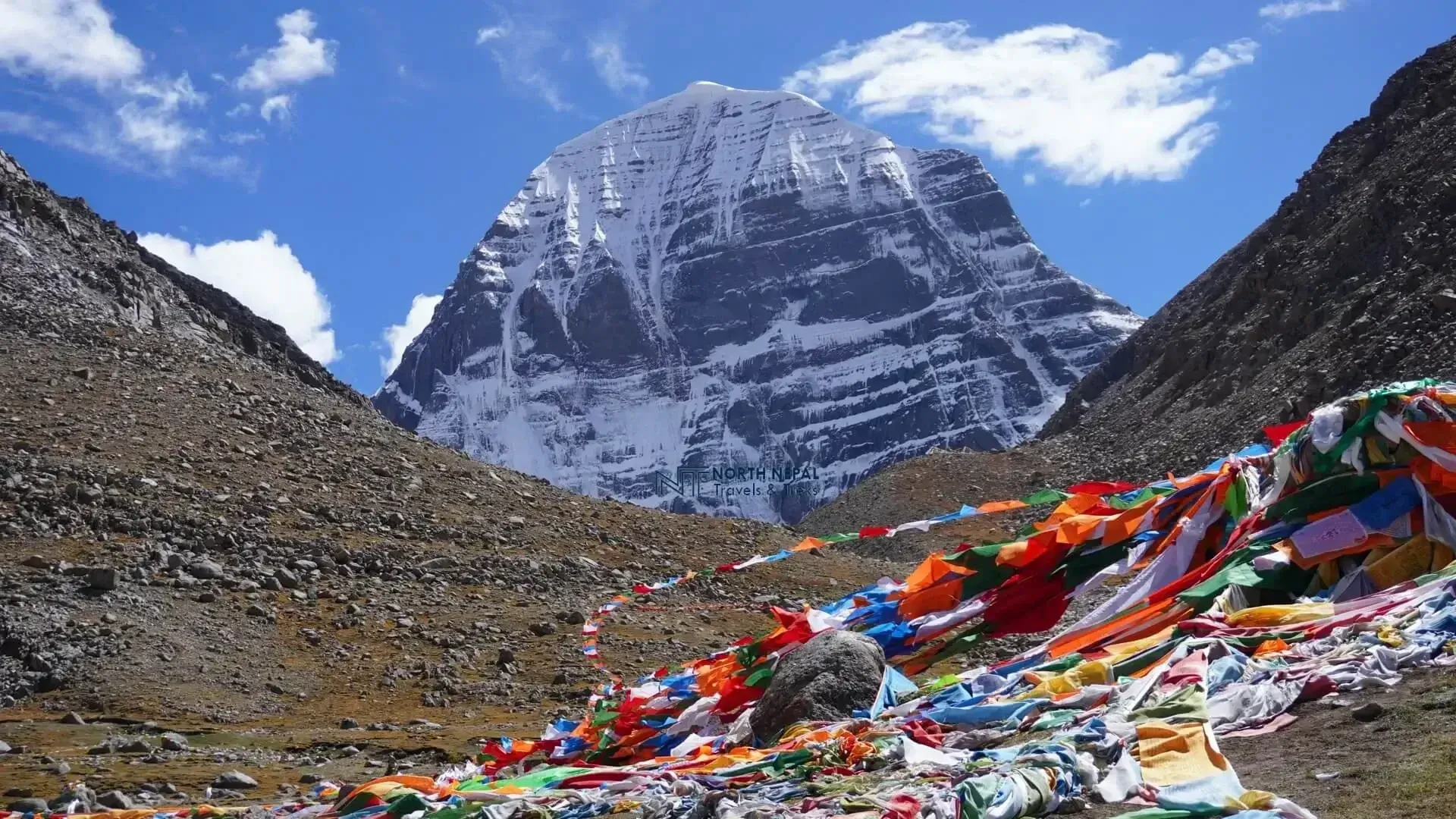
Mount Kailash is a revered destination for people of different religions, which is why not just Tibetans but tourists from all across the globe arrive for the Kailash Mansarovar Yatra. The major religions that hold religious significance for Mount Kailash are Hinduism, Buddhism, and Jainism.

In Hinduism, Mount Kailash is recognized as the abode of Lord Shiva. It is believed to be a pillar of the world as it lies in the center of the earth, and the presence of spiritual energy can be felt during every step of the Kailash Parikrama. Mount Kailash is so revered in the Hindu religion that most Hindus directly remember Lord Shiva rather than the Mountain itself while discussing Mount Kailash.

Moreover, it is also believed to be the gateway to Heaven; as described in the Mahabharata, the Pandava brothers, with their wife Draupadi, walked to the summit of Mount Kailash on their path to liberation. In Buddhism, Mount Kailash is known as Mount Meru and is central to Buddhist cosmology. Mount Kailash is believed to be the home of the Buddha Cakrasamvara, who is also known as Demchok and represents supreme bliss, a state of eternal happiness.

Moreover, according to the Buddhists, Milarepa has been to the top of the holy Mount Kailash and made it back successfully, which makes him the only person ever to summit Mount Kailash.

In Bon, Mount Kailash is believed to be the abode of Sky goddess Sipaimen, and followers of Jainism believe Rishabhdeva attained nirvana (Moksha) (translateable to liberation) at Mount Meru.

Kailash Parikrama (Kora) — The Sacred Circuit

The religious name for the circumambulation of Mt Kailash is known as Kailash Parikrama in Hindu, whereas the Buddhist/Tibetan word is Kailash Kora. The pilgrims of many religions believe that Kailash Parikrama/kora on foot provides a powerful sensation of spiritually beneficial practice that can bring various positive effects, such as the collection of meritorious karma, cleansing of one’s sins, and excellent fortune. Hindus, Jains, and Buddhists circumambulate Mount Kailash in a clockwise (right) direction, whereas Bonpos/Bon perform the circumambulation of Mount Kailash in an anti-clockwise (left) direction.

The Kailash Parikrama, or Kailash Kora, begins and ends at Darchen, at an altitude of 4,670m | 15,320 ft, covering a distance of 53 km (33 mil). The Kailash Parikrama takes a total of three days, taking you from Darchen to DiraPuk on the first day, followed by DiraPuk to Zuthul Puk and Zuthul Puk to Darchen, where the Parikrama ends.

Best Time for Kailash Mansarovar Yatra

The best time to visit Kailash Mansarovar is April, May, June, July, September, and October. The pilgrimage can be extended to the first or second week of October. Booking early helps you to reserve your spot in this sacred walk to the home of lord Shiva.

As the Kailash Mansarovar lies in a particularly remote and high-altitude region of Tibet, we need to be sure of the weather conditions before visiting Kailash Mansarovar. Kailash Mansarovar Yatra is featured in different seasons, leading to varied climates and temperatures, which directly influence the visitors/pilgrims on the Kailash Mansarovar Tour from Nepal.

However, the same can’t be said for the weather after the second week of October, as the cold temperature starts and snow begins accumulating in the paths, making it impossible for the Kailash Mansarovar Tour or Kailash Parikrama. Talking about months, the best season for Kailash Mansarovar is between May, June, July, August, and September, but the Kailash Mansarovar Yatra can be slightly extended till the second week of October.

Permits & Documents Requirement for Kailash Mansarovar Yatra

Kailash Yatra requires Chinese Visa (Tourist or Group Visa), Tibet Travel Permit (TTP), Military Permit, and Medial Fitness Certificate for this pilgrimage to Tibet region.

1. Permit Requirements for Non-Indians (Canada, USA, Europe)

Non-Resident Indians (NRIs) residing in Canada, the United States of America, and Europe have the same rules as Non-Indian visitors or trekkers. You need following permits:

a) Chinese Visa (Tourist or Group Visa): You have to have a valid Chinese tourist or group visa. The passport should be valid for at least 6 months.

b) Tibet Travel Permit (TTP): One must obtain a Tibet Travel Permit. These are easily handled by professionals and experienced travel agencies based in Pokhara and Kathmandu.

c) Military Permit: This is required for border zones while crossing Tibet from Nepal.

d) Medial Fitness Certificate: A medical fitness certificate is mandatory while travelling to Kailash Mansarovar. This ensures that you are medically fit in the high altitude of the Tibet region.

2. Permit Requirements for Indian Citizens

a) Kailash Mansarovar Yatra Government permit: You have to get the Kailash Yatra approval from the Government of India, which is issued by the Ministry of External Affairs (MEA). Individuals aged 18 to 70 years old can apply for the Yatra permit. Should have a valid passport with 6 months of validity.

b) Chinese Visa for Tibet: You require a valid Chinese visa before traveling. This is managed by professional travel agencies in Pokhara and Kathmandu. Since it might take a few days, it is always recommended to apply early.

c) Medical Certificate: An Indian pilgrimage should be mandatory to go through the medical procedure to obtain a medical certificate. This is a compulsory requirement for people going for the Kailash Mansarovar Kora. The person should have no serious health issues or breathing conditions. If found, s/he is not allowed to go to the Kailash Mansarovar.

3. Documents Required for the Visa Procedure

a) Valid passport with a validity of 6 months

b) At least 4 Passport-size photos

c) Application form for Yatra

d) Travel Insurance

e) Emergency Contact details

Important: All permits are included in our tour package. You do not need to apply separately. Permit processing takes 15–20 working days. Book at least 6 weeks before your departure date.

Why Trek With Us - Kailash Mansarovar Yatra - 11 Days

100% Locally Owned & Pokhara-Based

North Nepal Trek is a Nepali-owned company with deep experience running overland journeys across the Himalayas and onto the Tibetan plateau. That local grounding means faster logistics on the Nepal side of the border and a genuine understanding of what pilgrims need on a journey this demanding.

Officially Licensed & TAAN-Registered

We are a government-registered travel and trekking agency and an active member of the Trekking Agencies' Association of Nepal (TAAN). Every Tibet Travel Permit, Chinese visa arrangement, and military permit for the border zones is processed correctly and well in advance of your departure.

Kailash Route & Permit Expertise

The Kailash Mansarovar Yatra involves some of the most complex permit logistics of any journey we run — Chinese visas, Tibet Travel Permits, military permits, and medical fitness certificates, all with different requirements for Indian and non-Indian pilgrims. We've built our systems specifically around getting this right, every time, for every nationality.

Expert, Safety-Focused Guides

Our guides are experienced on the high Tibetan plateau, where much of the journey sits above 4,500 meters. They monitor altitude symptoms throughout the drive to Saga and Mansarovar and through the three-day Parikrama over Dolma La Pass at 5,630 meters, and know exactly when to slow the pace or arrange support.

Top-Rated Client Satisfaction

Our track record speaks for itself: thousands of trekkers and pilgrims have travelled with us across Nepal, Tibet, and Bhutan, and our reviews on TripAdvisor and Google consistently reflect the same thing pilgrims tell us directly — that they felt safe, well organized, and genuinely moved by reaching the sacred ground of Mount Kailash and Lake Mansarovar.

Live Trail Update of Kailash Mansarovar Yatra - 11 Days Live

Last updated: 1 Week Ago

Updated: Mohan Bhandari

Road Condition Open, Peak Season
Weather Mild Days, Cold Nights
Border Crossing Open at Kyirong/Rasuwagadhi
Permits Processing Normally

Trekker Alerts

The Kailash Mansarovar route is in full peak season — the Kyirong/Rasuwagadhi border is open, roads across the Tibetan plateau are clear, and permit processing is running normally. Days are mild but nights remain cold at altitude, so pack accordingly.

Reviews From The Trail

Hear it from those who've walked with us.


Safety Policy

Professional & Certified Guides

Every Kailash Mansarovar Yatra is led by an experienced, licensed guide familiar with the Tibetan plateau route, the border crossing at Kyirong, and the demands of sustained travel above 4,500 meters. Your guide manages permit logistics, monitors pilgrim health, and coordinates with local Tibetan support staff throughout the journey.

Altitude & Medical Fitness Requirements

The journey sustains travel above 4,500 meters for most of the itinerary, reaching 5,630 meters at Dolma La Pass during the Parikrama. A medical fitness certificate is mandatory for all pilgrims, confirming no serious cardiac, respiratory, or other high-altitude-restricted conditions. Guides monitor pilgrims for symptoms of altitude sickness throughout the drive to Saga and Mansarovar and during the three-day circuit around Mount Kailash, adjusting pace and rest as needed.

Emergency Rescue Coordination

The Tibetan plateau is remote, and emergency response takes longer here than in Nepal's more accessible trekking regions. In the event of a medical emergency, your guide coordinates with local Chinese authorities and our Kathmandu and Pokhara offices to arrange the fastest available evacuation, which may involve a combination of vehicle transport to the nearest medical facility and onward coordination from there.

Mandatory Travel Insurance

All pilgrims must hold comprehensive travel insurance covering emergency medical treatment at high altitude. Because helicopter evacuation options are limited on the Tibetan plateau, insurance covering ground and cross-border medical evacuation is strongly recommended alongside standard high-altitude coverage. Please submit your insurance details before departure.


Kailash Mansarovar Yatra Departure Date for 2026/2027

Secure the Kailash Mansarovar Yatra for 2026/2027 before the seat gets fully booked.


Terms, Conditions & Feasibility

  1. All bookings are made with North Nepal Travel & Trek Pvt. Ltd Registered Company Number 162883/073/074 (hereafter referred to as The Company) whose office is in Lakeside, Pokhara-6, Nepal.
  2. The term "trip" used in this website and booking conditions refers to all itineraries described on this website including those which might otherwise be known as walking, tours, trekking trips, sightseeing, climbing, mountaineering, expeditions, or holidays.
  3. We accept your last-minute booking as well, but full payment of the total tour cost should be made in advance if necessary or can be paid fully on arrival day. See More 

Frequently Asked Questions

Cultural Insights

1. What is the Kailash Mansarovar Yatra?

The Kailash Mansarovar Yatra is a pilgrimage to Mount Kailash (6,638 m) and Lake Mansarovar (4,590 m) in western Tibet. Mount Kailash is sacred to Hindus, Buddhists, Jains and followers of the Bon religion. For Hindus, it is associated with Lord Shiva; for Buddhists, with Demchok.

2. What is the Kailash Kora (Parikrama)?

The Kailash Kora is the 52 km circumambulation of Mount Kailash. Foreign pilgrims generally complete it over three days, beginning at Tarboche and passing through the high-altitude Dolma La Pass.

3. What is Dolma La Pass?

Dolma La is the highest point of the Kailash Kora. It has deep spiritual significance for pilgrims and is traditionally associated with leaving behind the past and beginning a new phase of life.

4. What is special about Lake Mansarovar?

Lake Mansarovar sits at 4,590 m and is one of the most important pilgrimage sites in the region. It is sacred in Hinduism and Buddhism, and many pilgrims perform rituals at its shore.

5. What is Lake Rakshastaal?

Rakshastaal is the saltwater lake located west of Lake Mansarovar. It has an important place in Hindu tradition and is traditionally associated with the demon king Ravana.

6. Can people of different religions join the Kailash Yatra?

Yes. Mount Kailash is sacred to Hinduism, Buddhism, Jainism and Bon. The pilgrimage is open to people from different religious and cultural backgrounds.

7. Can I attend the Kora during a full moon?

Yes. Some pilgrims prefer to align their Kora with an auspicious full moon, including Guru Purnima or Shravan Purnima. Departure dates can be planned around specific lunar dates where possible.

8. Can I photograph monasteries and local people?

Ask permission before photographing local people or monasteries. Inside monastery prayer halls, always confirm whether photography is permitted before taking pictures.

9. What mantras can pilgrims chant during the Kora?

Hindu pilgrims commonly chant "Om Namah Shivaya", while Buddhist pilgrims may chant "Om Mani Padme Hum." Pilgrims can follow their own religious traditions respectfully during the Kora.

10. Why is the Kailash Yatra in 2026 considered significant?

2026 is the Tibetan Year of the Horse, a year associated with special spiritual significance for circumambulating Mount Kailash.

Packing Gear & Rental

1. How should I prepare physically for the Kailash Kora?

You don't need to be an athlete, but you should build your walking endurance before departure. We recommend starting regular walking at least three months before the trip, gradually increasing the duration and including stair climbing to prepare for the high-altitude Kora.

1. What currency should I carry in Tibet?

Carry sufficient Chinese Yuan (CNY) for personal expenses. We recommend exchanging currency in Kathmandu before crossing the border because access to ATMs can be very limited in the Kailash region.

Payments & Extra Costs

2. What is included in the North Nepal Trek package?

The package includes the permits and services specified in the current itinerary, including the Tibet Travel Permit and Chinese Group Visa. The complete inclusion list should be checked in the booking package.

3. What is not included in the Kailash Mansarovar Yatra package?

International flights to Kathmandu are excluded from the package. Other exclusions should be confirmed against the current itinerary before booking.

Booking & Company Policies

1. Can I book a private or customized Kailash Yatra?

Yes. North Nepal Trek offers both fixed group departures and private/customized Yatras for families, couples and solo pilgrims. The itinerary can be planned around your preferred dates and requirements.

Weather & Seasons

1. When is the best time for the Kailash Mansarovar Yatra?

The Yatra season generally runs from May through September. Conditions vary by month, so the departure date should be selected according to road access, weather and the planned Kora schedule.

2. Which months should I avoid?

November through April is the period when the Kailash region is effectively closed for the Yatra because of severe cold and unreliable border access.

Health & Safety

1. Is altitude sickness a concern during the Kailash Yatra?

Yes. Altitude sickness is the main health concern, particularly because the Kora reaches up to 5,630 m. The itinerary includes acclimatization time before reaching the Kailash and Mansarovar region. Trekkers should maintain a steady pace, stay hydrated and report symptoms immediately.

2. How fit do I need to be for the Kailash Yatra?

You need a reasonable level of fitness rather than athletic ability. Regular walking and stair training before departure can help prepare for the Kora and its high-altitude sections.

3. Can older pilgrims do the Kailash Mansarovar Yatra?

Yes, age alone does not determine suitability. However, Indian pilgrims with heart conditions, high blood pressure or serious respiratory problems should consult their doctor before booking and disclose relevant health concerns to the trekking operator.

4. Is travel insurance mandatory?

Yes. Travel insurance covering emergency evacuation up to 6,000 m is mandatory. Valid insurance details must be provided before departure.

5. Is it safe to bathe in Lake Mansarovar?

The lake is glacier-fed and extremely cold. Pilgrims may perform a brief ritual dip, but a full swim is not recommended and not allowed. 

6. How much water should I drink during the Yatra?

Drink at least 3 litres of water per day. Hot boiled water is available for filling bottles in the morning and evening.

7. Do I need a doctor's certificate?

A doctor's certificate is required for Indian nationals.

General Information

1. Has anyone ever climbed Mount Kailash?

No. Climbing Mount Kailash is prohibited because of its profound religious significance. Pilgrims instead undertake the Kora around its base.

2. How long does the Kailash Mansarovar Yatra take?

The Tibet portion generally takes 9 to 11 days, while the complete journey including Kathmandu preparation days takes around 14 days in total.

3. Why do the Kailash Yatra from Nepal?

The Nepal route provides an overland approach through the Kyirong border, connecting Kathmandu with Tibet and continuing toward Saga, Lake Mansarovar and Darchen.

Trekking Permits & Logistics

1. What permits are required for the Kailash Mansarovar Yatra?

The required permits depend on nationality and the current Tibet entry regulations. We arrange the Tibet Travel Permit and Chinese Group Visa for the journey.

2. Can I use a Chinese individual tourist visa instead of a group visa?

No. The Kailash Mansarovar Yatra from Nepal runs on a Chinese Group Visa, which we arrange for you in Kathmandu. Individual tourist visas are not used for this journey.

3. How many people are required for a Chinese Group Visa?

A minimum of five people is required for the group visa. Solo travellers and couples can be merged with another departure group when applicable.

4. How early should I arrive in Kathmandu before departure?

We recommend arriving in Kathmandu at least four working days before departure for visa processing, with five days recommended to provide additional time for preparation.

Transportation

1. What is the route from Kathmandu to Kailash?

The overland route travels from Kathmandu through the Kyirong border crossing, continues into Tibet toward Kerung County and Saga, and then proceeds to Lake Mansarovar and Darchen.

2. What happens during the Kailash Kora?

The Kora is completed over three days. The first day travels from Darchen to Dirapuk, approximately 12 km and 5–6 hours. The remaining route continues through the high-altitude sections before returning to Darchen.

3. Can I hire a horse during the Kora?

Yes. Personal horses and helpers can be hired for suitable sections of the Kora. Horses cannot cross Dolma La Pass, so pilgrims must walk that section.

Accommodation & Food

1. Where do we stay during the Kailash Mansarovar Yatra?

Accommodation varies along the route. Kathmandu has comfortable hotels, while facilities become increasingly basic in the Kailash region.

2. What are toilet facilities like?

Toilets in the Kailash region are basic and often shared. Water availability can be limited, so carrying toilet paper and hand sanitizer is recommended.

3. What food is available during the Yatra?

Common meals include dal bhat, Tibetan thukpa, momos, rice dishes and eggs. Vegetarian food may not be consistently available throughout the journey, so dietary requirements should be discussed before departure.

Wifi/Network and Communication

1. Will I have internet or phone access during the Kailash Yatra?

Connectivity in Tibet is unreliable and restricted, particularly during the remote sections. Mobile service is unavailable on some of the remote one-day sections, so travellers should prepare for several periods without normal communication.

Wildlife & Nature

1. What are the main natural highlights of the Kailash Mansarovar Yatra?

The journey passes through the high-altitude landscapes of western Tibet, with Mount Kailash, Lake Mansarovar, Lake Rakshastaal and the surrounding Tibetan plateau forming its main natural highlights. The route combines stark high-altitude terrain with some of the most important sacred landscapes in the Himalaya.

PRIVATE TRIP

11 Days

USD 2800 pp

RECOGNISED · CERTIFIED · TRUSTED

We are associated with