Annapurna Sanctuary Trek - 9 Days

Home Trekking

Annapurna Region

Annapurna Sanctuary Trek - 9 Days
DESTINATION Nepal
MAX. ELEVATION 4130m
WALKING DISTANCE 5-6 hrs
GRADE Moderate
BEST SEASON March-May / August-November
DURATION 9 Days
MEALS INCLUDED Breakfast/Lunch/Dinner
ACCOMMODATION Hotel, Lodge and Teahouse

OVERVIEW & HIGHLIGHTS

Overview of Annapurna Sanctuary Trek

The Annapurna Sanctuary, also known as the ABC Poon Hill Trek, is a fantastic 9-day Annapurna balcony hike that gives us two amazing experiences in a single trip. It takes you through the beautiful Ulleri, Ghorepani, Tadapani, and Chhomrong villages & dense rhododendron forest to Annapurna base camp.

Annapurna Sanctuary Trek is an extension of the Annapurna Base Camp Trek with the inclusion of places like Ghorepani, Poonhill, and Ulleri, among others. ABC Poon Hill Trek offers us both the famous sunrise view from Poon Hill and the breathtaking Annapurna Base Camp.

Download the all-season packing checklist before you lace up your trekking boots for the Annapurna Sanctuary Trek.

Annapurna Sanctuary Trek Highlights

  • Experience trekking to not one but two base camps: Machhapuchare Base Camp (3,700 m | 12,140 ft) and Annapurna Base Camp (4,130 m | 13,550 ft).
  • Enjoy stunning mountain scenery with panoramic views of over 15 peaks from Poon Hill (3,210 m), including four 8000m giants: Dhaulagiri I, Annapurna I, Manaslu, and Annapurna II.
  • Trek through a diverse range of landscapes, from lush rhododendron forests and terraced rice fields to alpine meadows and glacial moraines.
  • Witness the traditional way of life and rich culture of the Gurung and other local communities in villages like Ulleri, Ghandruk, and Chhomrong.
  • Relax and rejuvenate in the natural hot springs at Jhinu Danda, a popular spot for trekkers to soothe their muscles.
  • Enjoy homestay options in villages like Chhomrong, Sinuwa, and Ghandruk, living like a typical Nepali.
  • Witness various birds and wildlife during your trek through the forests.
  • Witness breathtaking sunrises over the Annapurna massif from both Poon Hill and Annapurna Base Camp.
  • Create unforgettable memories of your Himalayan adventure in Nepal that will last a lifetime.
Jeewan Tamang
Itinerary review by

Jeewan Tamang, Trekking Guide / Mountain Climber / Trail Runner

Annapurna Sanctuary Trek route and pacing are drawn from 12+ years guiding the Annapurna region. Mohan founded North Nepal Trek in 2015; Jeewan has led over 20 Annapurna Sanctuary treks since 2016.

Annapurna Sanctuary Trek's Itinerary

Toggle all
Day 1

Drive to Nayapul and trek to Ulleri (2080m)

HIGHEST ALT. 2080m
DURATION 1.5 Hours
Distance
DISTANCE 12 km

We start our trip to Ulleri from Pokhara after breakfast early in the morning. We drive for about an hour to Nayapul in a car. At Nayapul, we check our trekking permits at the checkpost. Then we begin our first day of the Annapurna Sanctuary Trek.

Trekkers from North Nepal Trek resting at ulleri restpoint (Chautara) during Annapurna Sanctuary Trek
Photo: Trekkers resting near Ulleri

We'll pass through the village of Birethanti (1000m) and, we can witness natural waterfalls and bamboo forests. The trail goes through Sudame village and goes up to Hile (1510m) before we reach Tikhedhunga.

At Tikhedhunga, we cross a big suspension bridge over the river and climb - a stone staircase with more than 3,300 steps. This climb takes us to Ulleri, a Magar village at an altitude of 2080 m. On the way up, you'll see great views of green hills, flowing rivers, and small villages.

The whole trek from Nayapul to Ulleri takes about 4-5 hours, covering 12 km. Overnight stay at Ulleri, in a tea house and you can see beautiful mountains even from your room.

Day 2

Ulleri to Ghorepani (2775m)

HIGHEST ALT. 2775m
DURATION 4-5 hours
Distance
DISTANCE 8 km

We start our trek to Ghorepani from our tea house in Ulleri after breakfast early in the morning. The trail goes up gently through dense rhododendron forest and grass pastures and we can see great views all around on the second day of our Annapurna Sanctuary Trek.

View from Ghorepani during Annapurna Sanctuary Trek captured by North Nepal Trek,
Photo: View from Ghorepani

We trek next to a small natural stream and then into thick forests full of oak and rhododendron trees. This part of the Annapurna Base Camp Poon Hill Trek is great for witnessing wild birds and animals, and the forest air feels fresh and nice cooling us during the trek.

On our way, we cross two clear streams and then trek up a small hill to reach Nangathanti village (2460m). We stop here for lunch and rest a bit.

If we're trekking in winter, this trail might have snowfall, to make the ABC Poonhill trek more exciting. After lunch, we trek uphill for about an hour to reach Ghorepani, situated at an elevation of 2750 m after covering 8km and trekking for 5-6 hours.

When we get to Ghorepani, we check into a tea house and you can relax and get ready for tomorrow's early trek. The views of the Dhaulagiri mountains from here are amazing. We spend the night in Ghorepani.

Day 3

Ghorepani Hike to Poon Hill and trek to Tadapani (2540m)

HIGHEST ALT. 2540m
DURATION 6-7 hours
Distance
DISTANCE 13 km

We start our day very early, before the sunrise. On the third day of the Annapurna Sanctuary Trek, we trek up to the famous Poon Hill viewpoint at 3210 meters. This uphill trek takes about 45 minutes after covering 1.5 km. From Poon Hill, you can see one of the best panoramic views in the whole Annapurna region.

View from Poonhill in the morning captured by North Nepal Trek
Photo: Sunrise View from Poonhill

As the sun rises, you’ll be dazzled by the golden rays of the morning light reflecting off the Annapurna, Fishtail, and Dhaulagiri peaks. And guess what? You’ll also get to see over 15 other stunning mountain peaks, including Annapurna, Dhaulagiri, Nilgiri Himal, Mardi Himal, and Machhapuchhre (Fishtail Mountain). It’s the perfect spot for some epic photos during our Annapurna Base Camp Poon Hill Trek.

After enjoying the sunrise, we trek back down to Ghorepani for breakfast at our tea house. After breakfast, we start our trek to Tadapani. First, we trek up a bit to Deurali Pass, from here, we get to see another great view of the Annapurna and Dhaulagiri mountain range.

From Deurali Pass, we trek down through a thick forest filled with rhododendrons, and the trees are filled with moss, and we might see different kinds of birds. The trek through the forest is very peaceful and calming.

As we get close to Tadapani, we might witness a beautiful sunset over the mountains nearby, and we reach Tadapani, at an altitude of 2,630 m after trekking for 5 - 6 km, covering 9.7 km.  Overnight stay at Tadapani.

Day 4

Tadapani to Chhomrong

HIGHEST ALT. 2040m
DURATION 5-6 hours
Distance
DISTANCE 10 km

We start our trek from Tadapani to Chhomrong after breakfast early in the morning. On the fourth day of the Annapurna Sanctuary Trek, we trek for about 5- 6 hours and cover approx.10 km from Tadapani to Chhomrong.

Trekker from North Nepal enjoying the view of Tadapani
Photo: View from Tadapani

On our way, we trek through pretty villages like Chuile, Kimrong, Ghurjung, and Taulung. The trail goes through thick forests full of rhododendron trees, the Kimrong River, and across fields on hillsides, and we can witness rural views and feel the fresh mountain air.

We'll cross a big suspension bridge over Kimrong Khola. There might be a sign that says "Please stop and wait while mules are walking over the bridge". From the bridge, you can see great views of the valley and river below.

After the bridge, we trek up some steep stairs to Chhomrong village. This climb is demanding but worth it. Chhomrong is a beautiful Gurung village with many cozy lodges. From Chhomrong, you can see amazing views of big mountains and the Annapurna South & Hiunchuli is right above the village, and across the valley, you can see the famous Fishtail Mountain (Machhapuchhre). We'll spend the night at Chhomrong ending the fourth day of our ABC Poonhill trek.

Day 5

Chhomrong to Dovan

HIGHEST ALT. 2540m
DURATION 5-6 hours
Distance
DISTANCE 11 km

We start our trek from Chhomrong early in the morning after breakfast. First, we trek down a stone staircase to Chhomrong Khola (river), following a steep path, but the mountain views and the rural area views of this part are worth it. After crossing the river, we trek up to Upper Sinuwa. This climb is tough, so we'll take it slow. As we go up, we'll see amazing views of huge mountains with various greenery of plants and trees, and we might spot wild animals too!

village route on the way to chhomrong captured by North Nepal Trek during Annapurna Sanctuary Trek.Photo: Way to Chhomrong

Past Sinuwa, we trek into thick forests filled with ferns, oak trees, bamboo, and rhododendrons everywhere. Along the route, sometimes the trees are so thick that it's dark even in the day, making us feel like we're in a magical forest!

We keep trekking towards the Himalayan Hotel the whole way. We can see great views of Annapurna and Machhapuchhre, waiting for us to reach their base.

Next, we trek up to Kuldighar, also known as a Bamboo (2,470 meters), a bit of a hard part, but the mountain and greenery views from here are worth it. After Kuldi, we go down a steep trail into a forest full of bamboo and rhododendrons. This part can be slippery, so we'll be careful.

Finally, at the end of the fifth day of our Annapurna Sanctuary trek, we reach Dovan village at an altitude of 2,600 after trekking for 5 - 6 hours covering a total of 11 km. As we're getting closer to Annapurna Base Camp, the air is getting thinner, so we will need to rest more. Nonetheless, the views are getting even better. Overnight in Dovan, in a tea house.

Day 6

Dovan to Machhapuchhre Base Camp

HIGHEST ALT. 3,700 m
DURATION 6-7 hours
Distance
DISTANCE 9 km

We start our trek from Dovan early in the morning after breakfast. On the sixth day of our Dovan to MBC trek, we'll trek about 9 km to Machhapuchhre Base Camp, in about 4-5 hours.

Trekkers from North Nepal Trek pointing the Annapurna Peak from the Macchapuchre base camp during the Poonhill ABC trekPhoto: Near MBC

As we leave Dovan, we can see huge mountains all around us, after just starting the trek. We trek next to the Modi Khola River, and as the trail goes up slowly, we move from thick forests to more open areas.

After some time, we reach the Himalaya and  Hinku Cave, a cave with a big rock that hangs over the trail. It's a great place to rest, have a quick snack, and enjoy the beautiful surrounding views.

We keep trekking uphill and reach Deurali, a small village at about 3,230 meters. Here, we'll stop for lunch at a tea house. After lunch, we trek through a light forest with lots of mountain trees and might witness wild animals like deer.

As we get closer to Machhapuchhre Base Camp, the trail gets rockier and the air gets thinner, and we will see fewer trees but huge mountains upfront.

We ended our day at Machhapuchhre Base Camp (3,700 m). From here, we can see Machhapuchhre (the Fishtail Mountain) up close and we’ll be treated to breathtaking panoramic views of the iconic Machhapuchhre (Fishtail) mountain and the Annapurna Massif. We'll stay the night here, and prepare for our big trek to Annapurna Base Camp tomorrow.

Day 7

Machhapuchhre Base Camp Trek to Annapurna Base Camp

HIGHEST ALT. 4,130 m
DURATION 2 hours
Distance
DISTANCE 3 km

We start our trek to Annapurna Base Camp from MBC early in the morning after breakfast. The seventh day of the Annapurna Sanctuary Trek trek is short but exciting - covering only about 3 km but takes around 1.5 - 2 hours depending on our pace.

Annapurna Base camp filled with player flag and snow covered view captured by North Nepal trek during Poonhill ABC trek.
Photo: Annapurna Base Camp

As we leave MBC, we can see huge mountains all around us in the early morning light. It's one of the sights you will forever remember during our Annapurna Sanctuary Trek.

The trail from MBC to ABC is rocky with few grassy areas, small streams all over, and a glacier on the right of the trail. If we're trekking in winter, we can witness the snowfall too. The path goes up slowly, so it won’t be challenging, but we need to drink plenty of water and rest frequently. As we trek towards the Annapurna Base Camp, we can see more and more of the Annapurna mountain range.

We'll witness a lot of big peaks like Annapurna I, Annapurna South, and Hiunchuli. This part of the trek shows us how big the Annapurna Sanctuary really is - it's a high place surrounded by huge mountains.

After about 2-3 hours, we reach Annapurna Base Camp at 4,130 m high, and the view here is amazing - as we are surrounded by mountains from all sides. The 360 view of the mountains will make you forget all the fatigueness in your body while trekking all these days.

After we rest a bit, we can walk around ABC. There are many spots to see great views of the mountains and the sunsets and sunrises here are really special - the mountains turn golden in the light.

Today is the big day on our Annapurna Base Camp Poon Hill Trek, as we've made it to ABC! We'll spend the night here, enjoying the incredible mountain views and getting ready for our trek back down tomorrow.

Day 8

Annapurna Base Camp to Bamboo (2,340 m)

HIGHEST ALT. 4,130 m
DURATION 6-7 hours
Distance
DISTANCE 16 km

We start our day at ABC very early to see the sunrise. The morning light on Annapurna and the other big mountains is just amazing, and it's a great way to begin our trek down during the Annapurna Sanctuary Trek.

Group of trekkers from North Nepal Trek walking in the forest covered path captured on their way to Bamboo from ABC during Annapurna Base Camp Trek.Photo: ABC to Bamboo

After enjoying the views and having breakfast, we start our trek down to Bamboo. We'll trek down but it's a long trek, but most of it is flat or downhill.

We follow the same trail we trekked to visit the Annapurna Base Camp. We pass through the forests and descend about 1,700 m. The trail goes along the Modi Khola River, and it excites us on our long walk. We'll take breaks to rest and enjoy the views, as this is it for the ABC Poonhill trek for now. 

After a full day of trekking for 6-7 hours covering 16 km, we reach Bamboo, it is a settlement at 2,345 m high. Bamboo is in a beautiful forest area, with its quiet surroundings perfect for rest after our big day of trekking. The tea houses here are run by friendly local people and we'll stay the night here.

Day 9

Bamboo to Jhinu Dada hotspring & Drive back to Pokhara

HIGHEST ALT. 1780m
DURATION 5 hours
Distance
DISTANCE 8.5 km

We start our trek from Bamboo to Jhinu Danda after breakfast early in the morning. The final day of the Annapurna Sanctuary trek is about 8.5 km and takes 5 to 7 hours depending on our pace.

Suspension bridge on the way to Jhinu Danda filled with greenery in the frame captured by north nepal trek.com
Photo: On the way to Jhinu Danda

First, we trek up a steep path and then the trail gets a bit easier with some flat parts until we reach Upper Sinuwa. From here, we go down many stone steps to the Chhomrong Khola River and after crossing the river, we trek up the famous thousand-stone steps to Chhomrong village.

From Chhomrong, we trek down to Jhinu Danda and this part of the trail goes through thick forests with bamboo, rhododendrons, and oak trees. When we reach Jhinu Danda, we can relax in the famous natural hot springs. These warm waters feel great after all our trekking and help soothe our tired muscles.

After enjoying the hot springs, we trek a short distance to Matque. Here, we board a jeep for our drive back to Pokhara. The drive from Matque to Pokhara takes about 2 to 3 hours. The journey starts with a bumpy ride on narrow mountain roads, passing through forests, terraced fields, and small villages. As we descend, the rugged terrain gives way to rolling hills and valleys. Upon reaching Pokhara, you'll be welcomed by the serene Phewa Lake making it a perfect place to relax after your trek.

We arrive in Pokhara in the evening, marking the end of our Annapurna Base Camp Poon Hill Trek. This last day of our ABC Poonhill trek gives us a mix of hiking, relaxation in hot springs, and a drive back to Pokhara.

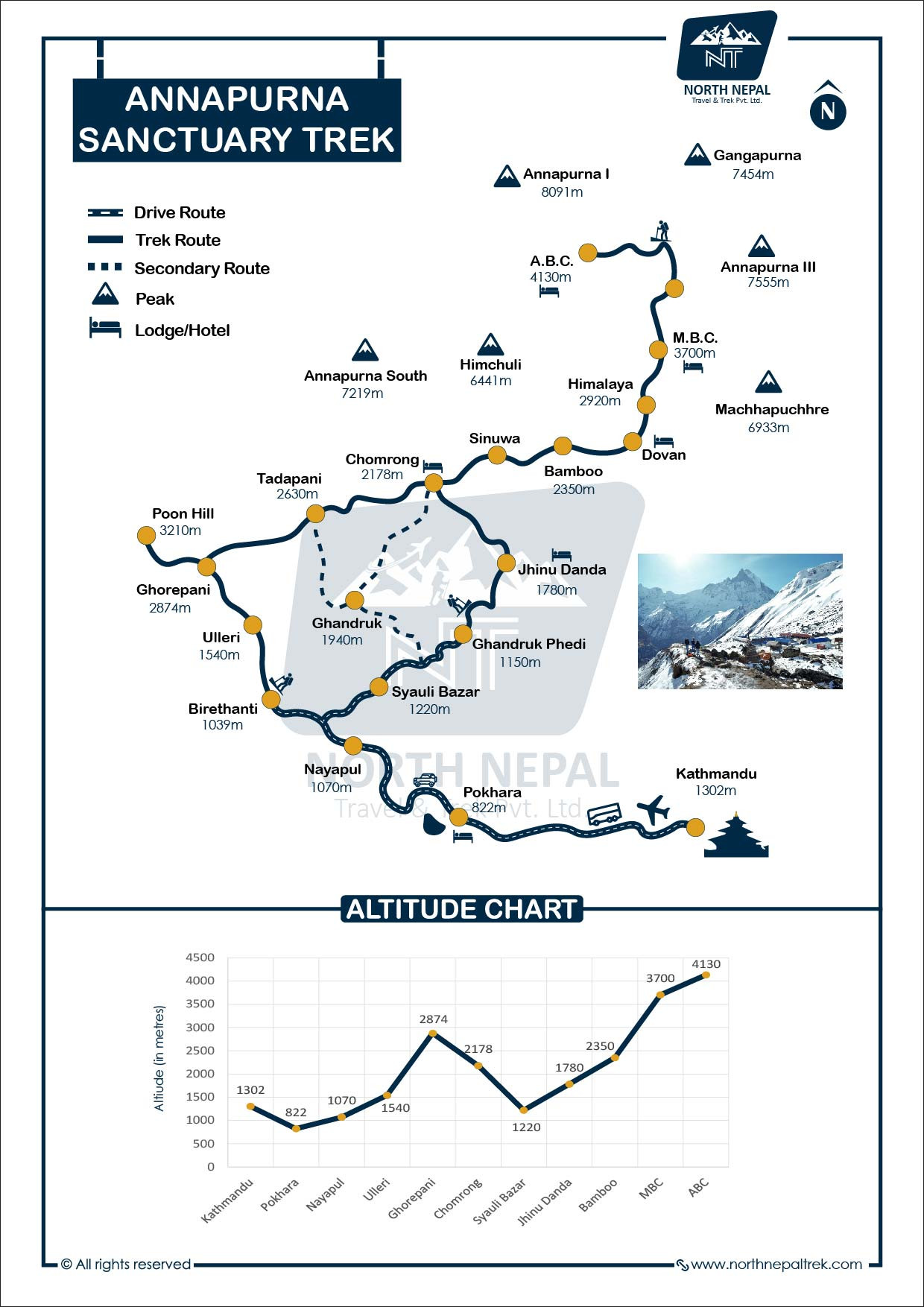
Annapurna Sanctuary Trek Map and Altitude Graph

Annapurna Sanctuary Trek Map and Altitude Graph

WHAT'S INCLUDED & EXCLUDED

  • Teahouse accommodation during the trek.
  • We provide 3 meals per day (Breakfast, Lunch, and Dinner) & Tea twice daily. Please note that each meal is served as a single serving.
  • Transport before & after the trek. ( Pokhara to Nayapool ) & ( Jhinudanda to Pokhara )
  • Professional English-speaking, Eco Trained trekking guide his food, accommodation, salary, insurance, equipment, medicine, transportation etc.
  • Sleeping Bag and Trekking sticks  (If needed & to be returned after trip completion).
  • All necessary paperwork and trekking permits (ACAP).
  • Medical kit (carried by your trek leader).
  • All government and local taxes.
  • Trek achievement certficates after the completion of the trek.
  • Other transportation except Included in the section.
  • Hotel accommodation in Kathmandu and Pokhara.
  • Porter/supporter to carry your stuffs
  • Lunch and Dinner in Kathmandu and Pokhara
  • International flights fare.
  • Travel and rescue insurance.
  • Personal expenses (phone calls, laundry, bar bills, battery recharge, extra porters, bottle or boiled water, shower, etc.).
  • Tips & Gratitudes for Guide & Porter
  • Additional costs or delays caused by management out of control like landscape,  bad weather conditions, in case of itinerary modification with a view to a safety concern, illness,  change of government policy, political instability raises strike, moment etc.
  • Any others expenses which are not mentioned in including section.

Note:

You can include porter ( carries upto 20 kg ), with an extra cost of $ 25 per day.

Essential Guide to the Annapurna Sanctuary Trek

Toggle all

Annapurna Sanctuary Trek Difficulty Level and Elevation

This trek is considered moderate, with significant elevation changes and varying terrain. It requires good physical fitness and mental preparation.

For beginners, this can be quite challenging. Walking from an elevation of 822m through hills and forests, then reaching an elevation of 4,130m can be tough. This requires a proper rest day for inexperienced trekkers.

The route passes through multiple climate zones, from subtropical lowlands to alpine environments, with temperatures and conditions changing accordingly.

Key points:

  1. Difficulty: Moderate to challenging
  2. Elevation range: 1,070m to 4,130m
  3. Total elevation gain: Over 3,000m
  4. Key challenges: Steep ascents/descents, high altitude, varied terrain
  5. Weather: Varies from warm lowlands to near freezing at ABC

Driving Distance and Total Duration for Annapurna Sanctuary Trek

The trek includes short drives at the beginning and end, bookending the hiking experience. The majority of the 9-day itinerary is spent on foot, with ample time allocated for acclimatization, rest, and enjoying the surroundings.

Key points:

  1. Pokhara to Nayapul: 40 km (1 hour)
  2. Matque to Pokhara: 45 km (2-3 hours)
  3. Total program duration: 9 days
  4. 7 full trekking days

Annapurna Sanctuary Trek Route, Distance and Duration

Annapurna Sanctuary Trek Route

This trek offers a diverse journey through the Annapurna region, blending cultural experiences with stunning mountain landscapes of both Poon Hill and ABC. This circular route takes trekkers from lush forests and terraced fields to high-altitude terrain, showcasing the varied ecosystems of the Himalayas. The trek includes iconic viewpoints like Poon Hill and culminates at Annapurna Base Camp, surrounded by towering peaks. Along the way, trekkers experience traditional Nepali villages, rhododendron forests, and the dramatic scenery of the Annapurna Sanctuary.

Annapurna Sanctuary Trek Route Key points

  1. Starts in Pokhara, drive to Nayapul
  2. Ascends through villages to Ghorepani
  3. Poon Hill Sunrise viewpoint
  4. Enters Annapurna Sanctuary
  5. Reaches Annapurna Base Camp
  6. Returns via different routes with hot springs

ABC Poonhill Trek Total Trekking Distance

The ABC Poonhill trek covers a substantial distance over varied terrain, challenging trekkers with both distance and elevation gain. Daily distances vary based on the day's objectives and the terrain's difficulty, with some days focused on altitude acclimatization and others on covering greater distances.

Key points for ABC Sanctuary Trek

  1. Total distance: 70-75 km (43-47 miles)
  2. Duration: 9 days
  3. Average daily distance: 8-10 km
  4. Longest day: ~15 km (ABC to Bamboo)

Trekking Distance and Duration Table for Annapurna Sanctuary Trek:

Annapurna Sanctuary (ABC & Poon Hill) Trek – Daily Distance and Duration Outline

Day

Itinerary

Distance(km)

Trek Duration(hrs)

1

Pokhara - Nayapul (Drive)
Nayapul - Ulleri

42 km
12 km

1 hrs
4 - 5 hrs

2

Ulleri - Ghorepani

8 km 

5 - 6 hrs

3

Ghorepani - Poonhill
Ghorepani - Tadapani

1.5 km
9.7 km

45 minutes
5 - 6 hrs

4

Tadapani - Chhomrong

7.6 km

5 - 6 hrs 

5

Chhomrong - Dovan

11 km

5 - 6 hrs

6

Dovan - MBC

9 km

4 - 5 hrs

7

MBC - ABC

3 km

1.5 - 2 hrs

8

ABC - Bamboo

16 km

6 -7 hrs

9

Bamboo - Jhinu Danda
Jhinu Danda - Pokhara (Drive)

8.5 km
48 (by Jeep)

5 - 7 hrs
2 - 3 hrs

Best Time for the Annapurna Sanctuary Trek

Spring and Autumn are best time to travel Annapurna sanctuary. These two season offers suitable climate for hikers, beautiful natures, highest possibiity of mountain views, and exposure of Nepal Cultures. 

Spring Season (March to May)

Spring offers an excellent trekking experience on the ABC Poon Hill route. The weather is mild and stable, with clear skies providing spectacular mountain views. The trail comes alive with blooming rhododendrons, adding vibrant colors to the landscape. Daytime temperatures are comfortable for trekking, while nights remain cool.

  1. Peak season with optimal weather conditions
  2. Rhododendron forests in full bloom (March-April)
  3. Clear mountain views, ideal for photography
  4. Moderate temperatures: 10-20°C (50-68°F) during the day
  5. Required gear: Light to medium layers, rain jacket

Autumn Season (September to November)

Autumn is the most popular season for the ABC Poon Hill trek. Post-monsoon weather brings stable conditions with clear, crisp air. The skies are typically cloudless, offering unobstructed views of the Annapurna range. The comfortable temperatures and dry conditions make for ideal trekking.

  1. Prime trekking season with the best weather
  2. Exceptional visibility for mountain views
  3. Stable and dry conditions
  4. Comfortable temperatures: 15-20°C (59-68°F) during the day
  5. Required gear: Warm layers for evenings, sun protection

Winter Season (December to February)

Winter brings colder temperatures and the possibility of snow, especially at higher altitudes. While challenging, winter treks offer a unique, serene experience with fewer crowds. Clear days provide crisp mountain views but prepare for very cold nights.

  1. Cold temperatures, especially at night
  2. Possibility of snow on the trail, especially near ABC
  3. Fewer trekkers, more solitude
  4. Daytime temperatures: 5-15°C (41-59°F), much colder at night
  5. Required gear: Warm insulation layers, quality sleeping bag, winter boots

Summer/Monsoon Season (June to August)

The monsoon season is the least favorable time for the ABC Poon Hill trek. Heavy rains can make trails slippery and obscure mountain views. However, the landscape is lush and green, and there are significantly fewer trekkers.

  1. Frequent rainfall and possible trail disruptions
  2. Lush green landscapes, but often cloudy views
  3. Higher risk of leeches and insects
  4. Warm and humid: 20-25°C (68-77°F), cooler at higher altitudes
  5. Required gear: Waterproof clothing, good boots, insect repellent

Why Annapurna Sanctuary Trek North Nepal

When you trek deep into the Annapurna Sanctuary, the natural amphitheatre of peaks encircling Base Camp at 4,130 metres, your safety depends entirely on who leads the way. Here is why trekkers choose North Nepal Travel & Trek:

100% Locally Owned & Pokhara-Based

We are proudly based right here in Pokhara, the gateway to the Annapurna Sanctuary. Booking with us keeps your investment local, directly supporting the mountain communities we visit.

Officially Licensed & TAAN-Registered

We are a fully government-registered trekking agency and an active member of the Trekking Agencies' Association of Nepal (TAAN), ensuring full legal compliance, financial security, and the highest safety standards.

Years of Route Expertise

We have spent over a decade safely operating treks into the Sanctuary, mastering the Modi Khola gorge, its avalanche-prone sections, and fast-changing high-altitude weather.

Expert Local Leadership

Your expedition is personally led by our expert guide, a government-certified, English-speaking local leader who knows every step of the trail and the Gurung heritage of Chhomrong and Ghandruk.

Top-Rated Client Satisfaction

Backed by a 4.9/5 rating across global review platforms, our travelers consistently rate our safety, local hospitality, and personalized service among the best in the Annapurna region.

Sustainable Tourism

Commitment to eco-friendly practices and supporting local communities along the trekking routes.

Altitude Sickness, Safety and Insurance for Annapurna Sanctuary Trek

Tips to avoid altitude sickness

Altitude sickness can affect anyone, regardless of fitness level. Prevention is key:

  1. "Climb high, sleep low" principle: Trek to a higher altitude during the day, but descend slightly to sleep
  2. Acclimatization days are crucial; don't skip them
  3. Recognize early symptoms: headache, dizziness, loss of appetite
  4. Descend immediately: If symptoms persist
  5. Carry medicines: consider carrying portable oxygen or Diamox (after consulting a doctor)

Annapurna Sanctuary Trek Insurance

Proper insurance is not just a precaution; it's a necessity for high-altitude trekking. Ensure your policy covers following:

  1. High-altitude trekking up to at least 4,130m
  2. Emergency evacuation, including helicopter rescue
  3. Medical expenses in Nepal
  4. Trip cancellation and gear loss
  5. Alway read the fine print and understand your coverage limits.

Packing List & Trekking Equipment for Annapurna Sanctuary Trek

Annapurna Sanctuary Trek combines both Poonhill and Annapurna Base Camp, so you need to pack accordingly.

Check out the detailed packing list for the list. Carry headlight with you, as you will be traveling early morning during the PoonHill sunrise.

Remember to pack accordingly for 10 - 12 days for the Annapurna Sanctuary Trek. No need to worry, North Nepal Trek will make sure you have everything packed for the journey. 

Accommodation and Food on the trails

You sleep in teahouse lodges every night of the Annapurna Sanctuary Trek and eat three cooked meals a day, all included in your package. Eight nights run from Ulleri at 2,080 m up to Annapurna Base Camp at 4,130 m, then back down to Bamboo. Rooms are simple, clean and usually twin-share, and every lodge provides blankets. Meals come from a fixed local menu that lodges across the Annapurna Conservation Area agree on each season.

Where You Sleep Each Night on the Trail

You stay in eight teahouse villages on this 9-day route, and comfort drops steadily as you climb. Lodges below Chhomrong have concrete walls, attached bathrooms and Wi-Fi. Above Chhomrong the buildings turn to plywood and stone, and facilities become shared. Machhapuchhre Base Camp and Annapurna Base Camp are the most basic nights of the trek.

Night Village Altitude Room standard Attached bathroom
1 Ulleri 2,080 m Comfortable lodge Usually yes
2 Ghorepani 2,750 m Comfortable lodge Many lodges
3 Tadapani 2,630 m Simple lodge Some lodges
4 Chhomrong 2,040 m Comfortable lodge Yes
5 Dovan 2,600 m Basic teahouse hared/Private
6 Machhapuchhre Base Camp 3,700 m Basic teahouse hared/Private
7 Annapurna Base Camp 4,130 m Basic teahouse hared/Private
8 Bamboo 2,345 m Basic teahouse Shared/Private


What a Teahouse Room Is Really Like

A standard teahouse room on the Annapurna Sanctuary Trek has two single beds, a foam mattress, a pillow and thick blankets. Walls are often plywood, so sound carries between rooms. There is a light and, lower down the trail, a power socket. Bring earplugs and a head torch and you will sleep well.

Bedrooms are not heated anywhere on this trek. The dining hall is the warm room in every lodge, heated by a stove or a kerosene heater in the evening. At Machhapuchhre Base Camp and Annapurna Base Camp, night temperatures drop below freezing from November to March. This is why we recommend a sleeping bag on top of the blankets, and we include one in your package if you need it.

Do You Get Your Own Room?

Most trekkers get a private twin room on this route, because the Annapurna Sanctuary is one of Nepal's best-served trails. In peak weeks during October, November and April, lodges at Deurali, Machhapuchhre Base Camp and Annapurna Base Camp fill early. Your guide radios or phones ahead each morning to hold beds for your group. On the busiest nights you may share a room with another trekker of the same sex.

What You Eat on the Annapurna Sanctuary Trek

Teahouse menus on this route carry 20 to 40 dishes, and the Nepali and Tibetan items are the ones worth ordering. Every lodge cooks the same core list, so you can plan your day around what you know is good. Portions are large because the menu is built for people who walk eight hours a day. Below is the menu you will see from Ulleri all the way to Annapurna Base Camp.

Meal What to order
Breakfast Tibetan bread with honey, chapati, porridge with apple, boiled or fried eggs, pancakes
Lunch Dal Bhat (lentils, rice and vegetables), momos, thukpa or fried noodles, fried rice
Dinner Dal Bhat, vegetable curry, Sherpa stew, pasta, garlic soup
Drinks Black tea, milk tea, masala tea, ginger lemon honey, hot chocolate

Your package includes breakfast, lunch and dinner every day on the trail, plus two servings of tea daily. Single portions are covered. Soft drinks, beer, bottled water and second helpings of non-Dal Bhat dishes are not.


Why We Recommend Dal Bhat Over Western Dishes

Order Dal Bhat and Nepali food rather than pizza, steak or lasagne — the local dishes are fresher, safer and better fuel for trekking. Every ingredient on the trail arrives by mule or on a porter's back, so imported items sit in storage longer. Lodge cooks make Dal Bhat several hundred times a week and Western dishes a handful of times. The gap in quality shows up quickly.

Dal Bhat is also the best value meal on the mountain. It arrives as rice, lentil soup, seasonal vegetable curry, pickle and often a papad, and most lodges refill the rice, dal and vegetables for free. That gives you roughly 800 to 1,000 calories of slow-release carbohydrate and plant protein in one sitting. Our guides eat it twice a day, every day, for exactly this reason.

We also ask you to avoid meat from Deurali upward. There is no refrigeration above 3,000 m, and any meat served there has been carried uncooled for two or more days. A stomach upset at 4,130 m can end a trek that was otherwise going well.


Food, Altitude and Safety Above 3,000 m

Eat and drink more than you feel like above Deurali, because altitude suppresses appetite and thirst at exactly the point your body needs both. Aim for three to four litres of fluid a day and finish every meal even when you are not hungry. Garlic soup appears on every menu on this trail and genuinely helps with acclimatisation. Tell your guide straight away if you cannot eat or keep food down.

Skip alcohol from Deurali onward. Beer and spirits are sold at Machhapuchhre Base Camp and Annapurna Base Camp, but alcohol dehydrates you, disturbs sleep and masks the early signs of altitude sickness. Save the celebration for the hot springs at Jhinu Danda on the last day. Your guide will tell you the same thing.


Drinking Water on the Trail

Single-use plastic water bottles are banned inside the Annapurna Sanctuary, so bring a refillable bottle and a way to treat water. Every lodge sells boiled water by the litre, and prices rise with altitude. Chlorine tablets, a SteriPen or a filter bottle all work well and cost less over nine days. Your package includes a bottle for storing hot water overnight, which doubles as a bed warmer at Base Camp.


What You Pay For Yourself on the Trail

Everything below is a personal cost, not part of your package, and there are no ATMs after Pokhara. Carry Nepali rupees in small notes for the whole trek. The figures below reflect the 2026 season and rise as you gain altitude.

Extra Typical cost
Hot shower NPR 100–400 (gas below Chhomrong, bucket higher up)
Charging a phone or camera NPR 100–300 per device
Wi-Fi NPR 200–300, reliable only up to Chhomrong
Boiled water NPR 80–400 per litre
Beer or soft drink NPR 400–900
Tips for guide and porter Your judgement, end of trek

We suggest budgeting NPR 1,500 to 2,500 per day for these extras. Wi-Fi and mobile signal fade above Chhomrong and are effectively gone at Machhapuchhre Base Camp and Annapurna Base Camp. Treat those two nights as offline and tell people at home in advance.

Permit requirements for Annapurna Sanctuary Trek

For the Annapurna Sacntuary you need only Annapurna Conservation Area Project (ACAP) permit. These permits support conservation efforts in the Annapurna region.

  1. ACAP: NPR 3000 per person (USD 30 - USD changes based on current exchange rate)

Where to Get Permits and Documents Needed

North Nepal Trek will issue your ACAP permit online within a minute. If you wish to get a permit through physically visit:

  1. Nepal Tourism Board in Damside, Pokhara
  2. Nepal Tourism Board in Bhrikutimandap, Kathmandu

What documents should you carry for the permit? Bring your passport and a passport-size photo as a hard copy. These days, even a soft copy is used, so no need to carry them physically for the permit.

Is Trekkers' Information Management System (TIMS) still required?

TIMS is not active or used at the moment. Don't be fooled when any trek agency asks for the TIMS fee. Yes, TIMS was active around 3 years ago. Trekkers had to fill them manually on a physical card. We will update as soon as there’s any changes in the system.

Live Trail Update of Annapurna Sanctuary Trek - 9 Days Live

Last updated: 2 Days ago

Updated: Jeewan Tamang

Trail Condition Good
Weather Sunny Day
Wifi/Network Weak
Teahouses Mostly open

Trekker Alerts

  1. Afternoon clouds affecting Pokhara flights
  2. Water filters recommended
  3. ATM unavailable past Pokhara
Reviews From The Trail

Hear it from those who've walked with us.

★★★★★

Trek with North Nepal Travels & Treks

I was trekking in March 2020. with North Nepal Travels & Treks. Our trekking route is Poon Hill and ABC. Everything was perfectly organized and my guide Shiva Bhandari was very knowledgeable. He talked a lot about local customs and culture. Next time I will choose them again.

M
Michał D
Nepal · Annapurna Sanctuary Trek - 9 Days · Jan 2023
★★★★★


Amazing experience

Oct 2024 • Couples

We spent 9 days on the amazing Annapurna Sanctuary trek with our brilliant guide Gobinda. We always felt as though we were in safe hands and enjoyed every aspect of our hike.

T
Tom P
Nepal · Annapurna Sanctuary Trek - 9 Days · Nov 2024
★★★★★

ABC via Poon Hill

Dec 2024 • Friends

Just returned from a 9 day trek to ABC via Poon Hill with a couple of my friends and could not recommend the trek enough. Zeewan, our guide was incredible. He was so knowledgeable about the Annapurna sanctuary region and went above and beyond to keep us safe and well looked after. We had an absolute blast. Cannot wait to see Zeewan summit Annapurna 💪

G
Georgia C
Nepal · Annapurna Sanctuary Trek - 9 Days · Aug 2026

Safety Policy

Professional & Certified Guides

Every trek is accompanied by an experienced, licensed, English-speaking local guide trained in high-altitude wilderness survival, remote navigation, and first-aid response. Guides carry comprehensive medical kits equipped with essential high-altitude pharmaceuticals and pulse oximeters to monitor oxygen saturation levels daily during the ascent toward Machhapuchhre Base Camp (3,700 m) and Annapurna Base Camp (4,130 m).

High-Altitude Acclimatization & AMS Management

Itineraries are structured with careful elevation profiles and gradual ascents through the Modi Khola valley, incorporating key rest stages in places like Deurali and MBC to ensure proper physiological adjustment. Guides conduct rigorous daily health assessments for early symptoms of Acute Mountain Sickness (AMS). If severe symptoms appear, standard protocol mandates immediate descent to lower elevations.

Emergency Rescue Coordination

In cases of severe injury, acute altitude illness, or unexpected weather disruptions along mountain paths, emergency helicopter evacuation is coordinated directly through local rescue services, adhering strictly to regional aviation regulations set by CAAN. Evacuations are initiated promptly upon assessment by your guide in direct communication with our Pokhara operations team and local emergency support network.

Mandatory Travel Insurance

All trekkers must hold comprehensive travel insurance covering emergency medical treatment, high-altitude trekking up to 4,500 m, and emergency helicopter rescue/evacuation. Insurance details must be submitted prior to the departure of the trek to streamline emergency logistics if required.


Annapurna Sanctuary Trek's Departure Date for 2026/2027

Secure the Annapurna Sanctuary Trek's for 2026/2027 before the seat gets fully booked.


Terms, Conditions & Feasibility

  1. All bookings are made with North Nepal Travel & Trek Pvt. Ltd Registered Company Number 162883/073/074 (hereafter referred to as The Company) whose office is in Lakeside, Pokhara-6, Nepal.
  2. The term "trip" used in this website and booking conditions refers to all itineraries described on this website including those which might otherwise be known as walking, tours, trekking trips, sightseeing, climbing, mountaineering, expeditions, or holidays.
  3. We accept your last-minute booking as well, but full payment of the total tour cost should be made in advance if necessary or can be paid fully on arrival day. See More

Frequently Asked Questions

General Information

1. What is the Annapurna Sanctuary trek?

The Annapurna Sanctuary trek is a classic 9-day route that combines the Ghorepani Poon Hill sunrise with a deep trek into the Annapurna glacial amphitheater, reaching Annapurna Base Camp at 4,130m. The 'Sanctuary' is a natural amphitheater surrounded by Annapurna I, Annapurna South, Hiunchuli, and the sacred Machhapuchhre (Fishtail), revered by the local Gurung communities. It covers about 115 km through rhododendron forests, Gurung villages, and high-altitude terrain. It's the extended version of the standard ABC trek with the Poon Hill sunrise added on.

2. How does the Annapurna Sanctuary trek differ from the 7-day Annapurna Base Camp trek?

The 7-day Annapurna Base Camp trek goes straight to base camp and back. The 9-day Annapurna Sanctuary trek adds the Ghorepani Poon Hill section at the start, giving you the famous 360-degree sunrise view of Dhaulagiri, the Annapurnas, and Machhapuchhre before continuing into the sanctuary. If you have the extra two days, the Sanctuary version is the fuller experience. Both reach the same base camp at 4,130m.

3. How difficult is the Annapurna Sanctuary trek?

The Annapurna Sanctuary trek is rated moderate to strenuous. Most of the trail is manageable with steady fitness, but the route is longer than the standard ABC trek at 115 km over 9 days, with significant elevation gain and loss each day. The section through the Deurali avalanche zone deserves respect, and the final climb to base camp at 4,130m is the most demanding part. Beginners can complete it with proper pacing and a good guide. Tell us about your fitness and we'll advise honestly.

4. Is the Annapurna Sanctuary trek possible with children or older adults?

Yes, with the right preparation. The trek reaches 4,130m at base camp, so altitude sickness is a real consideration even though the ascent is gradual. Children and older adults can manage it with a slower pace, an attentive guide, and the 9-day itinerary that builds in enough acclimatization. The rhododendron forests and Gurung villages on the early days are especially rewarding for families. Tell us the ages in your group and we'll advise on whether the pace and distance suit everyone.

5. Can I combine the Annapurna Sanctuary trek with other routes?

The Annapurna Sanctuary trek already combines Poon Hill and ABC into one itinerary, so it's a natural extension of both. Beyond that, you can add the Mardi Himal trek or the Khopra Ridge trek if you have more days. Each adds a different angle on the Annapurna range. Tell us your available time and we'll suggest whether an add-on works or whether the 9-day Sanctuary trek is already the right fit.

Trekking Permits & Logistics

1. What permits do I need for the Annapurna Sanctuary trek?

The Annapurna Sanctuary trek requires Annapurna Conservation Area Permit (ACAP), which costs NPR 3,000 (about USD 25). Officials check both at entry points along the route. Bring passport photos and copies. Both permits are included in our package and we arrange them for you.

2. Do I need a guide for the Annapurna Sanctuary trek?

Yes. Since April 2023, a licensed guide is mandatory for trekking in the Annapurna Conservation Area. On the Sanctuary trek specifically, a guide matters at the Deurali section, which crosses an avalanche-prone zone and is best navigated early morning with someone who knows the conditions. Guides also secure teahouse rooms in the busy sections around Chhomrong and Ghorepani during peak season. All North Nepal Trek guides are government-licensed and carry first-aid supplies including a pulse oximeter.

3. Where does the Annapurna Sanctuary trek start?

The trek starts from Pokhara. A private jeep takes you to the Ghorepani trailhead, and the route loops through Poon Hill, Tadapani, and Chhomrong before climbing into the sanctuary. At the end, you return to Pokhara by jeep from the final trail point. If you're coming from Kathmandu, we arrange either a 25-minute flight or road transfer to Pokhara. We handle all transport as part of the package.

Accommodation & Food

1. What food and accommodation can I expect on the Annapurna Sanctuary trek?

Teahouses are available throughout the Annapurna Sanctuary trek, so you sleep indoors every night. Lower down around Ghorepani and Chhomrong, the lodges are well-established with varied menus, private rooms, and hot showers. Higher up toward Machhapuchhre Base Camp and Annapurna Base Camp, rooms are simpler, menus shorter, and facilities more basic. The dining staple is dal bhat with free refills, plus noodles, pasta, soups, momos, and eggs. Lodges can get crowded during peak season, especially around Poon Hill.

2. Can the Annapurna Sanctuary trek accommodate vegetarian or special diets?

Yes. Vegetarian food is the default at higher teahouses, where there's no reliable refrigeration for meat, and every lodge serves dal bhat, fried rice, noodles, pasta, and vegetable curries. If you're vegan, gluten-free, or have specific allergies, let us know before the trek and we'll brief your guide so the teahouses can prepare suitable meals. The variety is better lower down and narrows as you climb, so setting expectations helps.

Packing Gear & Rental

1. What should I pack for the Annapurna Sanctuary trek?

Pack warm layers, an insulated down jacket, a waterproof shell, fleece, thermal base layers, gloves, a warm hat, sturdy broken-in trekking boots, sunglasses, sunscreen, a headlamp, and a sleeping bag rated for freezing temperatures for the higher camps. Trekking poles are strongly recommended for the steep stone staircases between Chhomrong and the sanctuary. We provide a sleeping bag and poles if you need them. See our all-seasons packing guide for the full breakdown.

2. Can I rent trekking gear in Kathmandu or Pokhara for the Annapurna Sanctuary trek?

Yes. Thamel in Kathmandu and Lakeside in Pokhara both have gear shops renting and selling sleeping bags, down jackets, trekking poles, and duffel bags, with genuine brands and affordable local alternatives available. Renting bulky items like a cold-rated sleeping bag makes sense if you rarely trek. For personal-fit items such as boots, gloves, and base layers, bring your own. We can point you to reliable shops and advise what to rent versus bring from home.

Payments & Extra Costs

1. How much does the Annapurna Sanctuary trek cost?

The Annapurna Sanctuary trek is priced at around USD 700 per person at the standard rate, with a group discount of about USD 550 per person for groups of 3 to 6. The package includes ACAP permits, a licensed guide, teahouse accommodation, all meals (breakfast, lunch, and dinner), and private jeep transport from Pokhara to the trailhead and back. Message us with your group size and dates for a firm, itemized quote.

2. What extra costs should I budget beyond the Annapurna Sanctuary trek package?

Beyond the package, budget for your Nepal visa, travel insurance with high-altitude helicopter cover, meals in Pokhara or Kathmandu, and on-trail extras like hot showers, device charging, Wi-Fi, bottled or boiled water, and snacks, all of which cost more at higher elevations. Tips for your guide and porter are customary in Nepal. A rough guide is USD 15 to 25 per day for personal extras on the trail. We're happy to give you a realistic day-by-day estimate.

Booking & Company Policies

1. How far in advance should I book the Annapurna Sanctuary trek?

For spring and autumn, the peak seasons are two to three months ahead, mainly to secure teahouse rooms around Poon Hill and Chhomrong, which fill fast on this popular route. Off-season departures are sometimes possible with shorter notice. Booking early also gives you time to train and arrange proper insurance. Send us your target dates and we'll tell you honestly what's available.

2. What is the cancellation policy for the Annapurna Sanctuary trek?

Our cancellation terms depend on how far ahead you cancel, since we commit to guides, permits, transport, and teahouse bookings in advance. Deposits are applied against non-refundable costs, and the remaining balance may be partly refundable or transferable to a future trek depending on timing. We put the exact written terms in front of you before you pay, with nothing hidden. Message us for the current schedule that applies to your dates.

3. Is North Nepal Trek a registered and licensed trekking company?

Yes. North Nepal Trek is a government-registered adventure travel company based in Pokhara, Nepal, with a branch in Thamel, Kathmandu, and a member of the Trekking Agencies Association of Nepal (TAAN). The Annapurna Sanctuary trek is one of our most popular packages, guided by experienced local staff who know the route and the teahouse owners personally. Come as a guest, leave as a friend.

Weather & Seasons

1. When is the best time for the Annapurna Sanctuary trek?

The best seasons are spring (March to May) and autumn (September to November). Spring brings blooming rhododendrons, clear mornings, and occasional snowfall higher up, which makes the sanctuary especially dramatic. Autumn has the driest, clearest skies, with the best mountain visibility from Poon Hill, though trails are busier. Late summer (August to September) also works and offers lush green landscapes with fewer crowds, at the cost of some rain lower down. October through December is the driest, clearest window of all.

2. How cold does the Annapurna Sanctuary trek get?

Nights at Machhapuchhre Base Camp (3,700m) and Annapurna Base Camp (4,130m) regularly drop below freezing, and the pre-dawn Poon Hill sunrise hike at the start of the trek can also be cold and windy. Lower elevations around Ghorepani and Chhomrong are milder. In winter the higher camps get seriously cold and snow can cover the trail. A sleeping bag rated for freezing temperatures and proper layering are non-negotiable. We time each day's start for the safest, most comfortable conditions.

Health & Safety

1. Is the Annapurna Sanctuary trek safe?

The Annapurna Sanctuary trek is safe for the vast majority of the route. The one section trekkers ask about is Deurali, which passes through an avalanche-prone zone. The risk there is real but manageable: we cross early in the morning when the slope is most stable, with a guide who monitors conditions. Altitude sickness is the other concern at 4,130m, and our itinerary builds in enough acclimatization. Your guide carries a first-aid kit and pulse oximeter and watches for symptoms throughout.

2. Do I need travel insurance for the Annapurna Sanctuary trek?

Yes, travel insurance is essential. Your policy must cover trekking at altitude plus emergency helicopter evacuation and medical treatment. Because the Annapurna Sanctuary trek reaches 4,130m, a policy covering evacuation up to 5,000m is sufficient. Many standard travel policies exclude high-altitude activity, so check the fine print. Buy the policy in your home country before you travel and carry the emergency contact numbers on the trail.

3. How do I avoid altitude sickness on the Annapurna Sanctuary trek?

The 9-day Annapurna Sanctuary itinerary builds in a gradual ascent profile that helps your body adjust, and the Poon Hill section at the start works as an early acclimatization stage before you climb higher into the sanctuary. Stay hydrated, walk at a steady pace, avoid alcohol, and tell your guide about any headache or nausea early. Our guides monitor you with a pulse oximeter and adjust the pace as needed. The altitude at base camp (4,130m) is real and deserves respect even on a well-paced trek.

Transportation

1. How do I get to the start of the Annapurna Sanctuary trek?

The trek starts from Pokhara, where a private jeep drives you to the Ghorepani trailhead. If you're coming from Kathmandu, we arrange either a 25-minute flight or road transfer to Pokhara. On the return, a jeep picks you up from the final trail point and drives you back to Pokhara. All transport is included in the package and we confirm pickup times and locations in advance.

2. Is airport pickup in Kathmandu included with the Annapurna Sanctuary trek?

Yes. Every North Nepal Trek package includes a private airport pickup and hotel transfer when you land in Kathmandu, and a drop-off when you depart. A guide or company representative meets you in the arrivals hall holding a North Nepal Trek sign. Just send us your flight details once they're booked and we handle the rest.

PRIVATE TRIP

9 Days

Price Start from USD 750

USD 700 pp pp

We Offer Group Discount

No. of PersonsPrice per Person
1 Pax US$ $ 700
2 Paxes US$ $ 610
3 - 6 Paxes US$ $ 550
7 - 12Paxes US$ $ 525
13 - 25 Paxes US$ $ 500
RECOGNISED · CERTIFIED · TRUSTED

We are associated with