Upper Mustang Trek - 14 Days
The 14-Day Upper Mustang Trek starts from Kathmandu via Pokhara & Jomsom into the trans-Himalaya...
OVERVIEW & HIGHLIGHTS
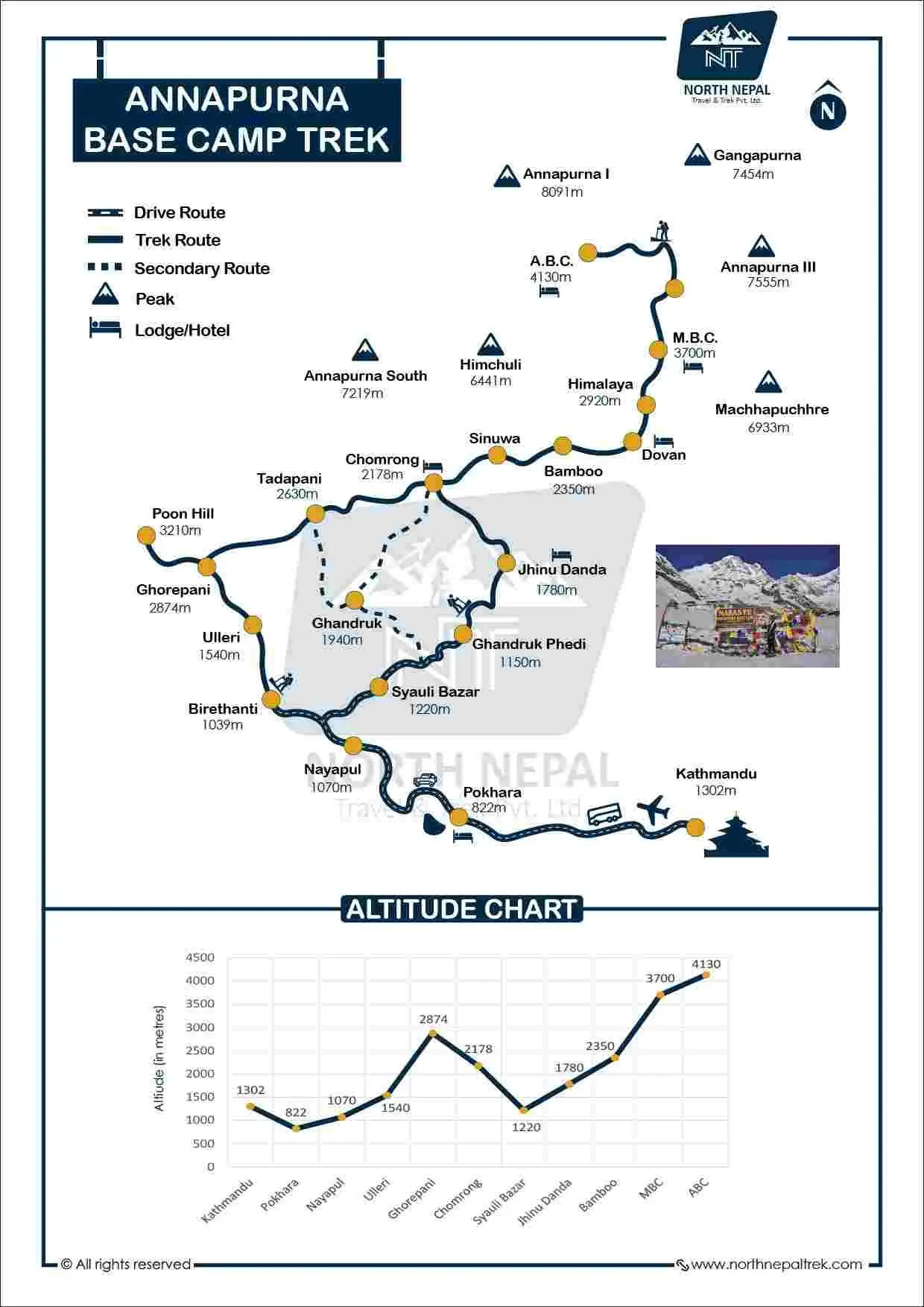
The Annapurna Base Camp trek is a 7-day teahouse trek from Pokhara to 4,130 m (13,550 ft), inside a ring of peaks led by Annapurna I (8,091 m), the world's 10th-highest mountain. The route starts at Jhinu Danda and climbs the Modi Khola valley via Chhomrong, Dovan and Machhapuchhre Base Camp. The grade is moderate, with no technical climbing.
Most of the trail is stone steps, through Gurung and Magar villages, terraced fields and then rhododendron and bamboo forest. Above Deurali, the valley narrows between Hiunchuli and Machhapuchhre and opens into the Annapurna Sanctuary. The descent takes two days, with a night beside the Jhinu Danda hot springs before the jeep back to Pokhara.
Every trekker needs an ACAP permit (NPR 3,000 for foreign nationals) and a government-licensed guide, and both are included in the package. Prices start at USD 350 per person for groups of 15 or more and USD 550 for a solo trekker. Jeep transfers, twin-share teahouse rooms and three meals a day are also included.
 (1).webp)
Infographic: ABC 7 Days trek package information (days, itinerary, distance, etc).
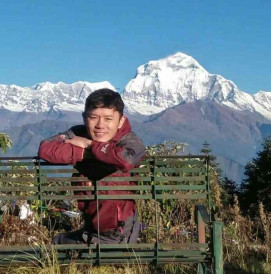
Gopal Yonjan, Trekking Guide / Tour Guide
Annapurna Base Camp Trek route and pacing are drawn from years guiding the Annapurna region. Mohan founded North Nepal Trek in 2015; since then, Gopal Yonjan has led multiple treks through Chhomrong, Machhapuchhre Base Camp, and Annapurna Base Camp.
Day 2 is 8.6 km to Dovan and takes 5 to 7 hours, with a steep drop and climb early on. Ten minutes of steps lead to the ACAP check post above Chhomrong, where permits are checked again. The trail then descends for about an hour to the Chhomrong Khola bridge and climbs straight back up to Upper Sinuwa.
Photo: Blooming Rhododendrons forest between Upper Sinuwa and Bamboo
After Upper Sinuwa the path levels out through forest and past small waterfalls, and Machhapuchhre appears between the trees. Lunch is at Bamboo, then about 2 more hours through bamboo thickets and over rocky slopes lead to Dovan (2,520 m / 8,268 ft). Dovan is a small cluster of lodges in the forest rather than a village.
Day 3 is the longest and hardest day of the trek: 13 km, 6 to 7 hours and a gain of about 1,180 m. It starts early. Between Dovan and Himalaya, a small temple called Pujinam Baraha Mandir faces a waterfall that covers the whole cliff face. The tea stop is at Himalaya (2,920 m / 9,580 ft).
Photo: Hazy trail of Dovan en route ABC trek
From Himalaya the trail climbs past Hinku Cave, an overhang that shepherds once used for shelter, to Deurali (3,230 m / 10,597 ft) for lunch. The stretch around Hinku Cave and Deurali is the main avalanche-prone section of the trek after heavy snow. Above Deurali the trees give way to grass and rock, and the valley starts to narrow.
About 2.5 hours after lunch, the valley narrows between Hiunchuli and Machhapuchhre and you reach Machhapuchhre Base Camp (3,700 m / 12,140 ft). Tonight's sleeping altitude is 1,180 m higher than last night, more than the usual acclimatisation guidance. Altitude symptoms often show up at night. If you wake with a headache or nausea, tell your guide straight away.
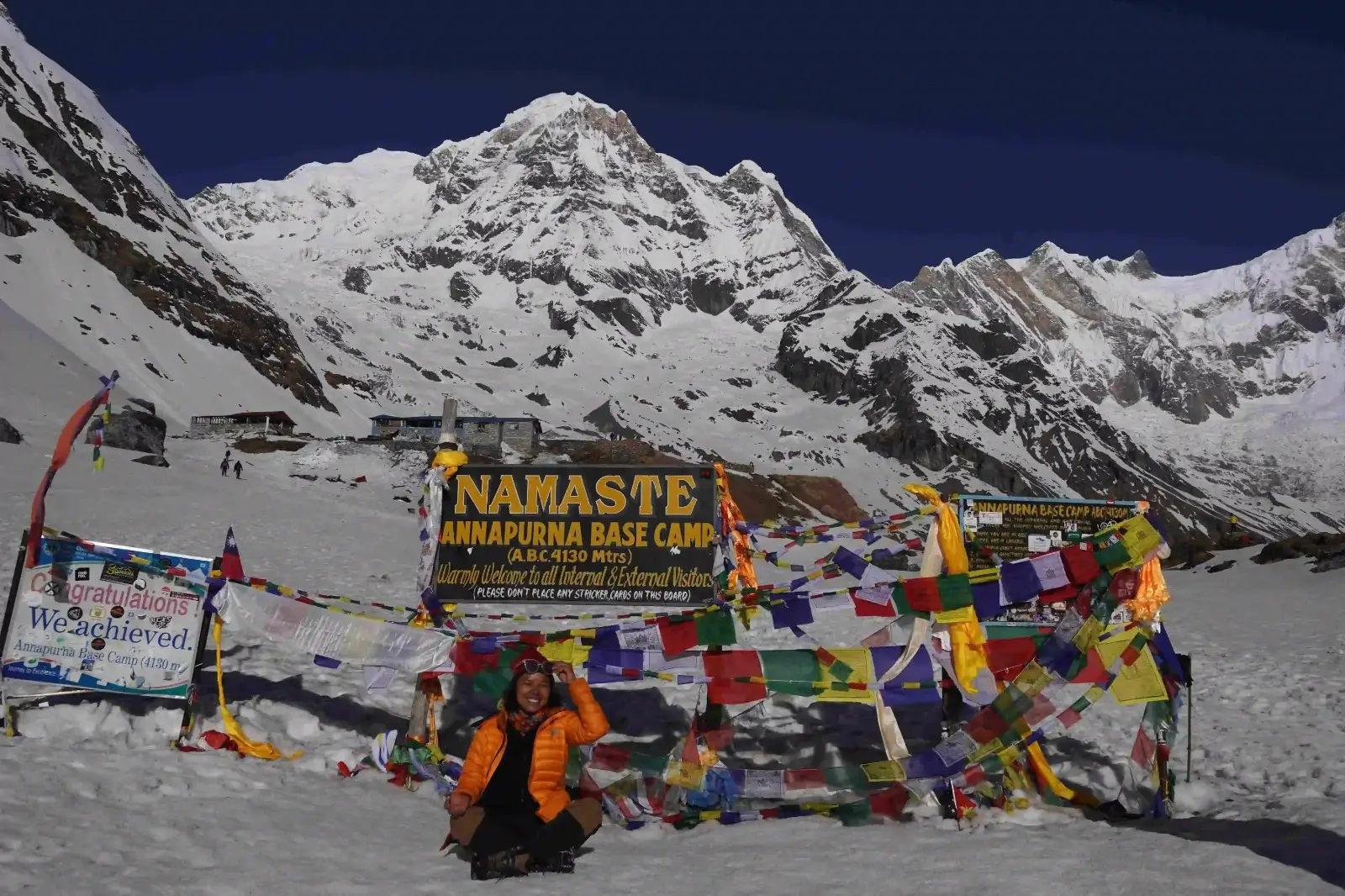
Day 4 is a short morning: 2.9 km from MBC to Annapurna Base Camp (4,130 m / 13,550 ft), taking 2 to 2.5 hours. The rocky path is often under snow in spring and climbs gently across the moraine with Annapurna I straight ahead. The rest of the day is free at base camp, with the whole Sanctuary around you.

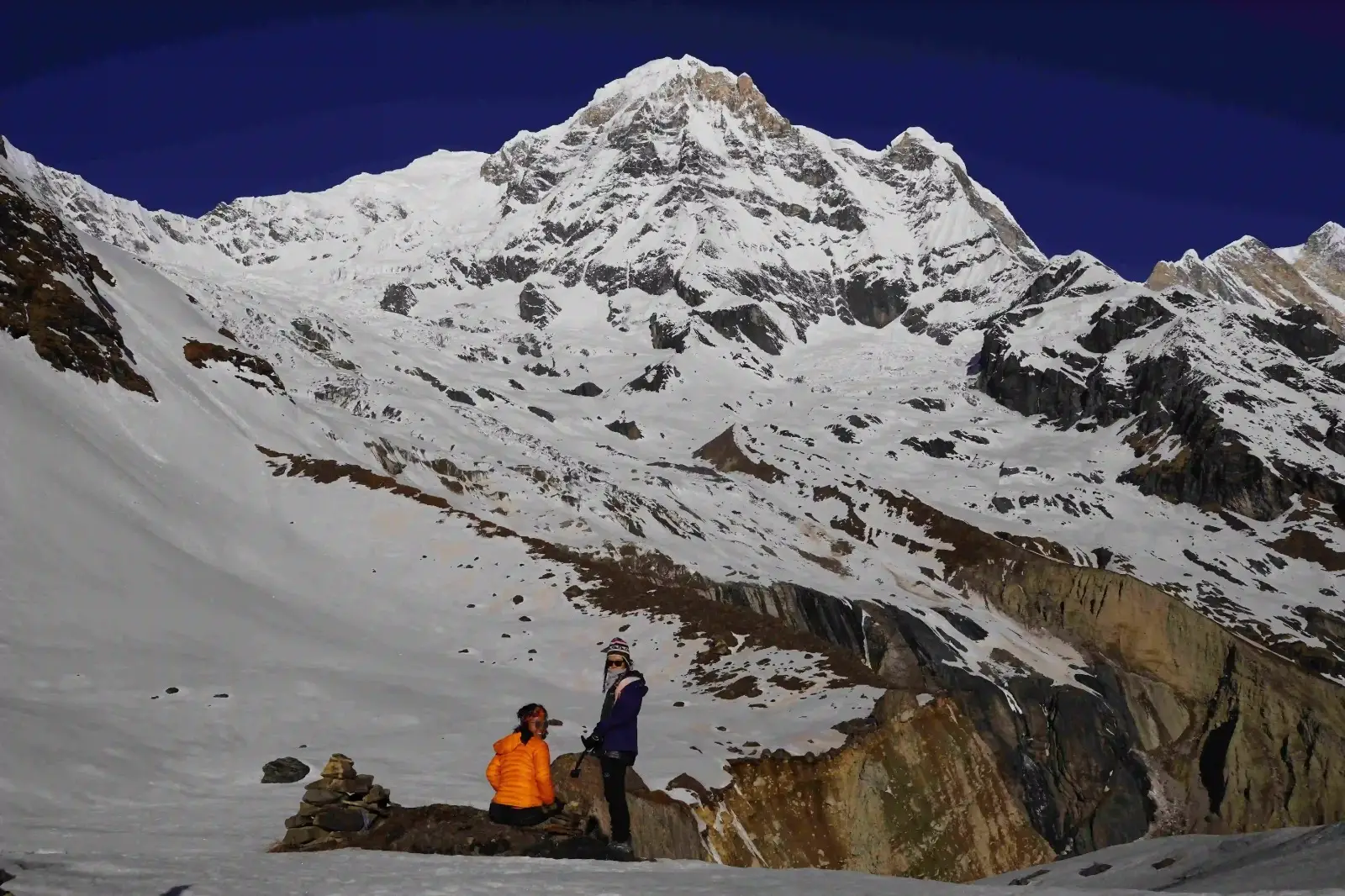
The ring of peaks includes Annapurna I (8,091 m / 26,545 ft), Annapurna South (7,219 m / 23,684 ft), Gangapurna (7,455 m / 24,459 ft), Machhapuchhre (6,993 m / 22,943 ft) and Hiunchuli (6,441 m / 21,132 ft). The full list is in the peak tables further down. Temperatures drop fast once the sun goes behind the peaks.
There is also a memorial to Park Young-Seok, a famous South Korean mountaineer who went missing on the south face of Annapurna I in October 2011.
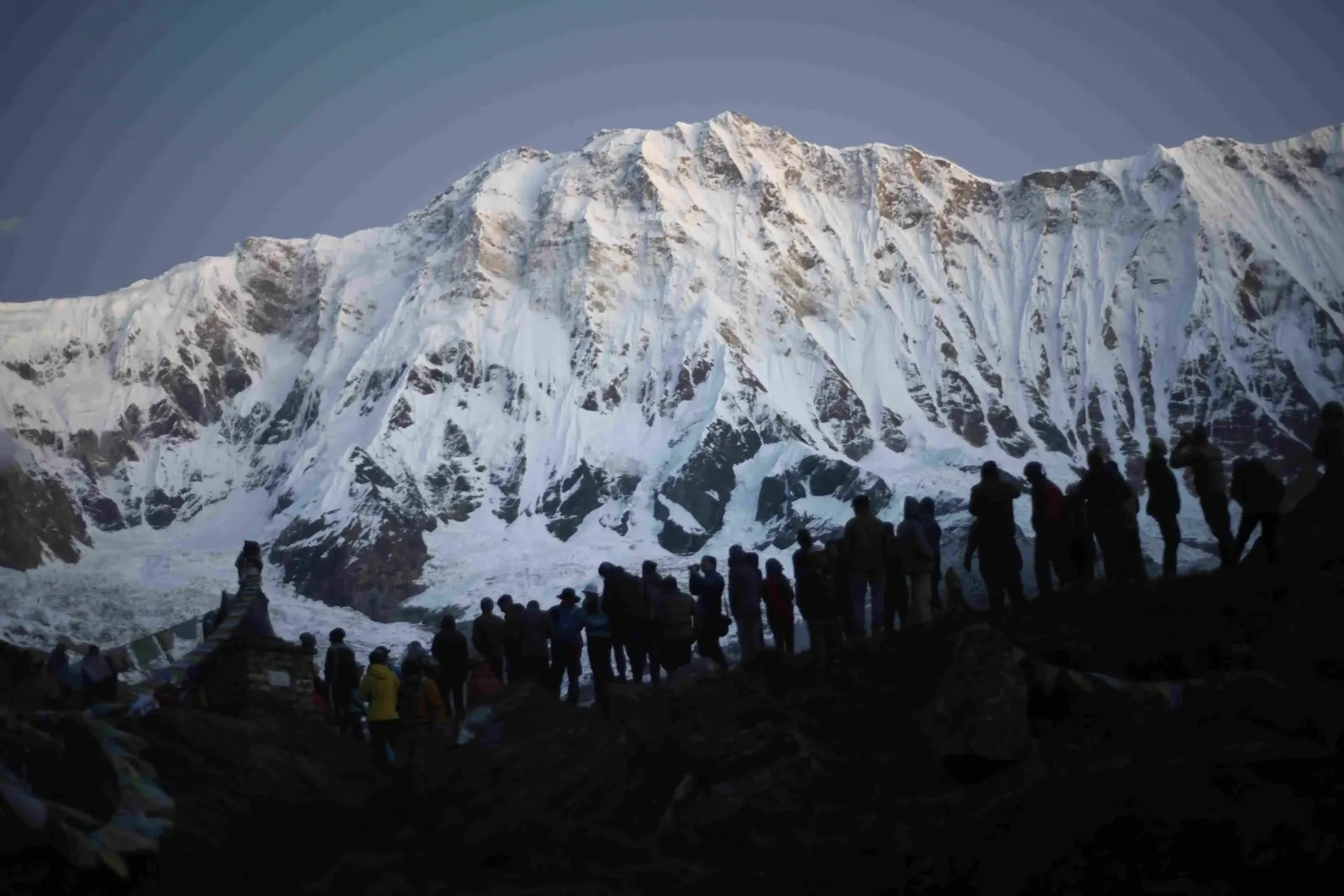
Day 5 starts before dawn, because sunrise at ABC lights the top of Annapurna I first and then spreads down the rest of the ring. After breakfast the trail goes back down through MBC, Deurali and Himalaya to Dovan (2,520 m / 8,268 ft). It is mostly downhill and takes about 6 hours, and your legs will feel the descent.
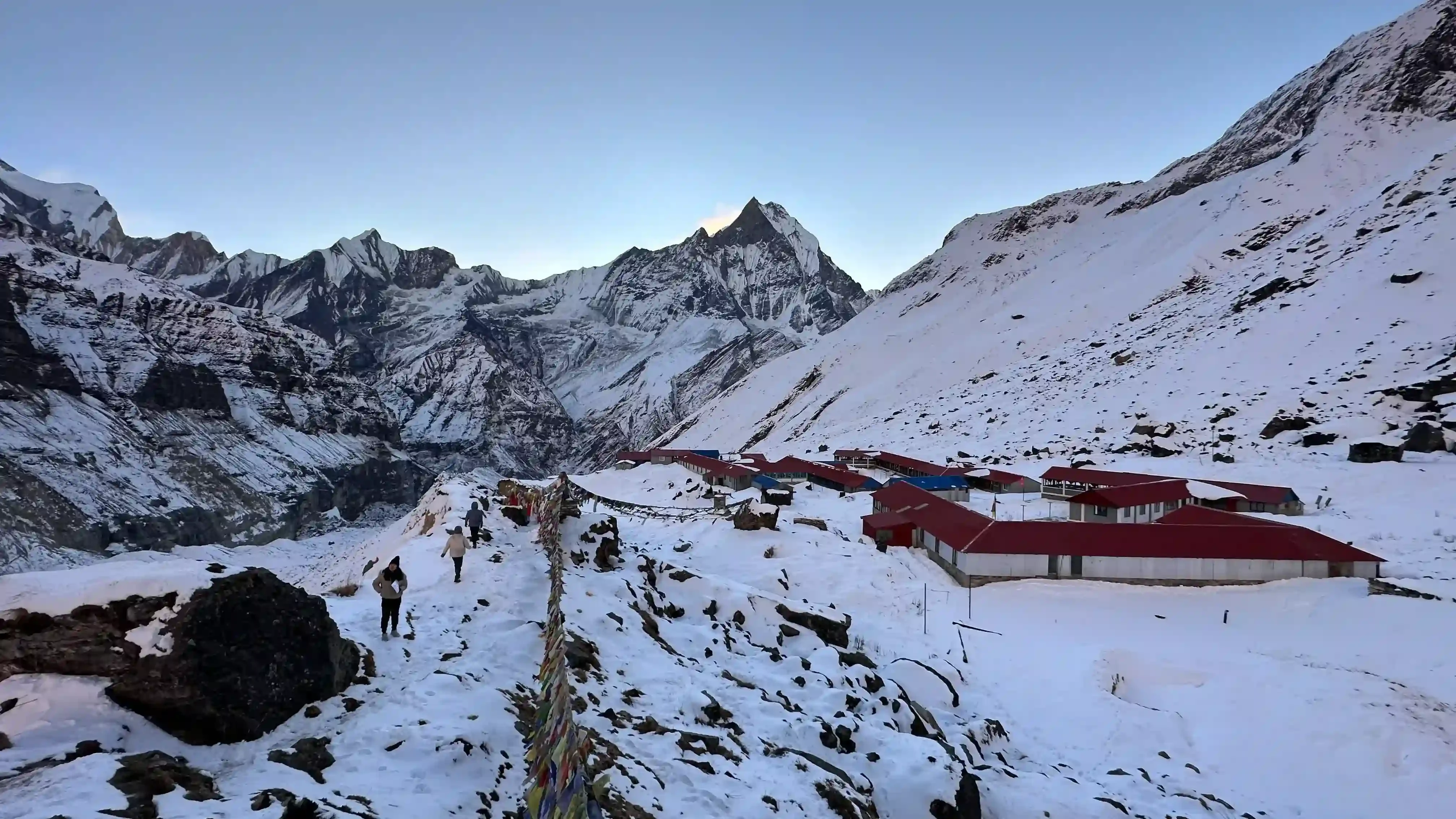
Photo: Annapurna Base Camp and teahouses encompassed by Annapurna ranges and other peaks
Day 6 drops through Bamboo, with a few short climbs, to Sinuwa for lunch. From Sinuwa the trail goes down to the Chhomrong Khola bridge and then climbs steeply back up into Chhomrong, the last real climb of the trek. From Chhomrong, stone stairs run all the way down to Jhinu Danda (1,780 m / 5,840 ft).
Photo: Suspension Bridge of Jhinu Danda.
The hot springs sit beside the Modi Khola, down a steep path below the village. After six days of stone steps, an hour in warm water does more for tired legs than anything else on the trip. The night is spent in a Jhinu Danda lodge, a short climb back up from the pools.
Day 7 begins with an optional soak, then a 4.4 km walk of about 2 hours down to Siwai. Anyone who would rather skip the walk can take the jeep from Jhinu Danda. From Siwai the jeep takes about 2.5 hours to Pokhara, mostly on paved road, and permits are checked again at Birethanti on the way out.
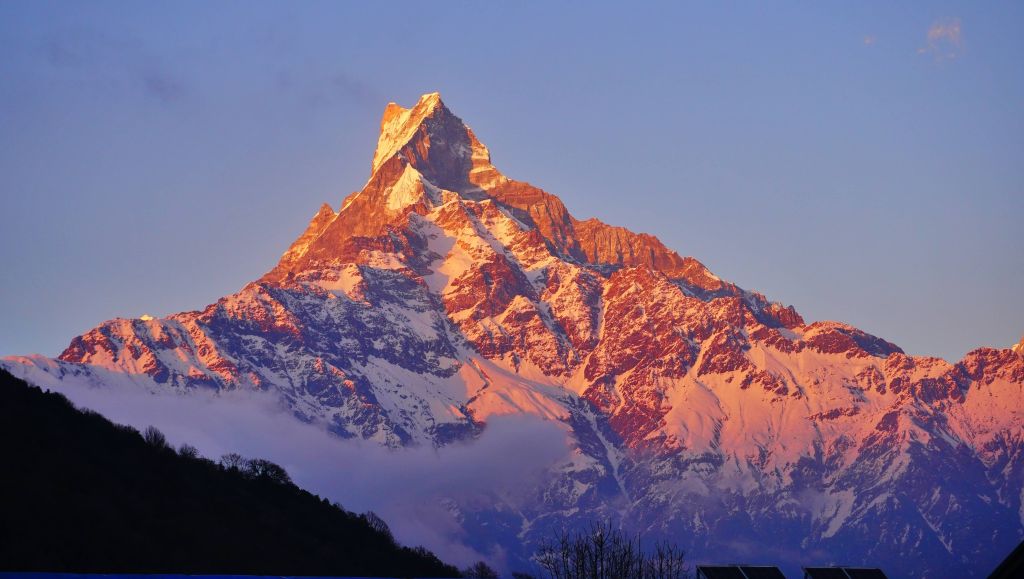
Photo: Fewa Lake with the view of Machhapuchre mountain and other peaks in Pokhara.
Note:
Best Season: March-May and September-November offer the clearest views of the Annapurna Sanctuary – the monsoon (June-August) brings leeches and cloud cover, while winter (Dec-Feb) can bring snow at higher elevations.
Amazing host - Mohan, Awesome guide - Bipin and very supportive porter Basanta - provided great support to us in our 7 day trek to Annapurna Base Camp. From booking the rooms in Kathmandu to booking to and fro flight from Pokhara to Kathmandu and everything during the trek was arranged very nicely. Bipin and Basanta made sure we were well taken care of during the entire duration of the trek to Annapurna base camp.
Always smiling and putting the needs of customer before their own.
Five stars to North Nepal Treks.
We went to Pokhara in November 2019 for a visit and decided to book a trip to ABC with North Nepal Travels & Treks. Our guide was Neeraj, who was very thoughtful and took care of all our needs. He was knowledgeable of the surrounding mountains and Nepali traditions. The porter was also very helpful and nice. Both of them were very friendly so that 6 days of trekking with them were very enjoyable. Thank you so much for the memorable trip.
Highly recommend to all friends!
I had the most amazing experience with my siblings, recently completing the ABC trek. The trek was organized by Mohan Raj Bhandari if North Nepal Tours. We had a wonderful team of sherpas and a guide who ensured that we were comfortable and enjoyed our trek. Mohan personally co-ordinated and made us feel at home both during the Trek and our stay at Pokhara. Mohan has been very patient and professional in handling and responding to all our queries before and during the trek. Grateful for making our experience a memorable one.
I am 59 and have some arthritis, I have always wanted to do a trek in the Himalayas. I did a lot of research and Niraj Adhikari from North Nepal Travel & Trek put together a trek to Annapurna Base Camp that covered all my requirements, I completed this trek on 22 September 2023. Niraj made sure that everything I wanted to do was included but also made sure that I would be able to achieve my goals and was not overstretched.
Niraj looked after all my requirements from being picked up at Kathmandu and Pokhara airports, hotel accommodation before and after the trek (at the same prices if I had done it myself), and of course the trek, the experience was personal, and he was in touch throughout to make sure I was ok. My guide was the most amazing person, Divas Gurung.
He was experienced and aware of my restrictions, we did a 7-day trek very easily, and at my pace, I was never rushed, and I always felt safe. It was the most amazing experience; Divas gave me a brilliant commentary of the area and the local people that made my trek very special. The tea houses and the food were better that expected.
I would not go past North Nepal Travel & Trek, they made sure my trek was exceptional and Divas is the best guide you could hope for! He also takes great photos and tells interesting local stories. If you want to do a trek that is safe and well organised with a brilliant guide, contact Niraj at North Nepal Travel & Trek. I am already planning my next trek with Niraj and Divas.
Sep 2023 • Couples
We recently did the Annapurna Base Camp trek with North Nepal Travels & Treks. Their services were really good before, during and after the trekking. They sent us all the information needed and answered the doubts we had. In the end, the team asked us what we enjoyed and what we didn’t.
The trek lasted 7 days with accommodation and meals included. Our guide, Buddhiman, took care of us and told us many recommendations. For instance, what to eat or not to eat in the mountains and which places to see. He also knew what to do in certain moments thanks to his great experience. As well, he was flexible on where to sleep according to our rhythm and with what we needed.
Overall, it was a nice experience and we had amazing views of the Annapurna region.
My experience with North Nepal Travel was exceptional. Their services were not only reasonably priced but also of outstanding quality. Niranjan, our guide, was particularly remarkable. His deep knowledge of the trek routes instilled confidence in us throughout our journey. His patience in addressing our queries was commendable.
During our short hike through the Australian Base Camp, Niranjan was not just a guide but a storyteller, enlightening us about the local people, culture, and villages. His encouragement was a constant source of motivation.
His advice and recommendations were invaluable, influencing us to modify our itinerary to make the most of our time in Pokhara.
I wholeheartedly recommend North Nepal Travel for anyone looking to explore the Pokhara region. Their trustworthiness, authenticity, and exceptional service quality set them apart. Niranjan's guidance has inspired us to undertake more challenging treks, and we eagerly anticipate returning to explore more of Pokhara's stunning landscapes.
A heartfelt thanks to Niranjan for his invaluable assistance and for making our trip unforgettable.
We are so lucky to have picked North Nepal Travel and Treks for our trekking holiday in Nepal. The services provided surpassed our expectations in every way. Mohan was prompt to answer all our pre- trek enquiries, he created a flexible itinerary which really maximized our trekking experience, sorted out all our transportation (domestic flights, airport transfers, jeep to and from trail), provided a wealth of information and good advice for our entire time in Nepal.
The trek itself was amazing. Our fantastic guide Zeewan pointed out all the little wonderful things we would have missed on our own, always looking after our safety and wellbeing. He is fun, inspirational and a great photographer (we have so many beautiful photos!). The trek was at our pace and each day we arrived at a tea house to a room with the best views. We never had to wait for our meals even though the kitchen is so busy at peak season.
Zeewan brought us hot coffee while waiting for sunrise at ABC in the freezing cold. He took us on a local trail through millet farms with the most stunning views where we never met any other tourist and even happily ran down and up hundreds of steps to get us some fresh bananas. We have so many wonderful memories to cherish, thanks to this passionate and professional team at North Nepal. We look forward to come back to Nepal for another adventure with you.
Oct 2024 • Couples
We had an amazing experience from our first contact with Mohan (the boss) North Nepal travels and Treks. Mohan was great with communications, caring, and he even took us out to dinner after the trek and coming to see us at our hotel before leaving Pokara that everything is ok.
We had absolutely fantastic time ABC 9 days hike with our guide Raj Rai and Porter Balaram . They went above and beyond to look after us, making sure all our needs are met. Our guide Raj is always available ( Thanks Raj for getting my water bottle from bushy steep slope (clumsy me) and knowledgeable with all our questions, always making sure we get the best room in all of our mountain lodges. Our Porter Balaram, who never failed to smile, always cheerful, entertain us all the time.
Highly recommended North Nepal travels and Treks if you plan to have your trekking in Nepal.
The Annapurna base camp (7-day ABC): April 18- 24, 2025
Before our journey began, trekking in Nepal especially the Annapurna base camp (ABC) had been around among friends/ colleagues since years back. Due to some circumstances, this year meant to be it, well, some of us believed so. 😁 Followed to a few researches, we found the North Nepal Travels & Treks on Facebook with number of positive reviews and available itinerary suitable for our group….. We then decided to book our very first trek a 7-day ABC with NNT&T.
💚Emmy, Pooja, Yao -> Let’s goooooo ABC!!
It was a true rewarding and well-supported adventure. Hats off to the NNT&T team/ our guide Gopal Tamang Dhai (Mr.)! ⭐️✨💯
Our overall trekking journey was well-organized and enjoyable which offered a good balance of challenge~ scenic beauty and touch of local cultures, providing a memorable outdoor experience. “This trek is a symphony of changing ecosystems, cultures, and emotions. From the warm, forested trails of the lowlands to the stark, snowy amphitheater of the Annapurna Sanctuary, it’s an unforgettable adventure that showcases the raw beauty and diversity of Nepal.”
During the trek, each of us felt the challenge over changes of environment differently. However, we managed through as they were mild symptoms. We noted that trekking at high altitudes (often above 3,000 meters) can be tough. Acclimatization is critical to avoid altitude sickness, and thin air makes even short hikes strenuous… fortunately, we felt well-prepared through consistent communication with our guide Gopal. Safety protocols were well explained and maintained. We loved the support and care through some little tip for thin air environment practices such breathing techniques. Moreover, our guide managed group dynamics well, keeping morale high and adjusting plans when necessary.
Furthermore, one of the most enriching parts of the trek was exposure to local culture. Any interactions with villagers, traditional meals, and the chance to witness local customs added a deep layer of authenticity to the journey. Our guide was knowledgeable, professional, and approachable who provided clear information about the trail, environment, and local culture, which greatly enriched the experience.
So, thank you once again for an incredible experience in the Himalayas, NNT&T family! We look forward to having our upcoming adventures with you again soon.
For anyone out there, if you are looking around for your very first trek or perhaps second or third one in Nepal, why don’t check “The North Nepal Travels & Treks” out, and there your guide Gopal Tamang Dhai (Mr.) for an unforgettable adventure and immersive nature experience.
Apr 2025 • Couples
North Nepal Travel & Trek is the perfect partner.
The trek from Kande to Annapurna Base Camp (ABC) is a breathtaking experience. You walk through lush forests, charming villages and past impressive mountain landscapes. Every day offers new views, from the green hills to the snowy peaks of Annapurna and Machhapuchhre. The route is challenging but doable for those who are in reasonable condition. The atmosphere in the lodges is warm and welcoming. Highlight: the sunrise at ABC, with 360° views of majestic mountains. An unforgettable trip full of nature, culture and satisfaction. Overall an unforgettable experience!
The biggest altitude jump on this itinerary is Day 3, from Dovan to Machhapuchhre Base Camp (3,700 m), before Annapurna Base Camp (4,130 m / 13,550 ft) on Day 4. Guides conduct daily health assessments for symptoms of Acute Mountain Sickness (AMS). If severe symptoms appear, standard protocol mandates immediate descent to lower elevations.
In cases of severe injury, acute altitude illness, or extreme weather conditions on the mountain sanctuary, emergency helicopter evacuation is coordinated directly through local rescue services. Evacuations are initiated promptly upon assessment by your guide in communication with our Pokhara and Kathmandu offices.
All trekkers must hold comprehensive travel insurance covering emergency medical treatment, high-altitude trekking (up to 4,500 m), and emergency helicopter rescue/evacuation. Insurance details must be submitted prior to the departure of the trek to streamline emergency logistics if required.
Secure the Annapurna Base Camp Trek for 2026/2027 before the seat gets fully booked.
Yes, ABC combines easily with other treks in the Annapurna region. Common combinations are Ghorepani Poon Hill, Ghandruk Village, Mardi Himal and Khopra Ridge. Adding Poon Hill turns it into the 9-day Annapurna Sanctuary Trek. The Annapurna Circuit is the one route it doesn't link with directly.
ABC is easier than both. Everest Base Camp reaches 5,364 m (17,598 ft) and takes 12 to 14 days. The Annapurna Circuit crosses the Thorong La at about 5,416 m. ABC tops out at 4,130 m in 7 days, though its stone steps are hard on the legs.
The standard itinerary takes 7 days from Pokhara. The 5-day Short Annapurna Base Camp Trek gains height quickly and suits experienced hikers who can walk 7 to 8 hours a day. Adding Ghorepani Poon Hill makes the 9-day Annapurna Sanctuary Trek. Allow extra time for travel between Kathmandu and Pokhara.
Daily walking distances on the 7-day itinerary range from about 2 km (1.2 miles) on Day 1 to 13 km (8.1 miles) on Days 3, 5 and 6. Each day's distance is in the itinerary. The jeep ride to and from Pokhara comes on top. Starting from Nayapul or Kande adds more walking and at least one extra day.
The hot springs are at Jhinu Danda (1,780 m / 5,840 ft), beside the Modi Khola, down a steep path below the village. On this itinerary the night of Day 6 is spent at Jhinu Danda. That allows a soak after the long descent and another on the morning of Day 7, before the walk out to Siwai.
Annapurna Base Camp is at 4,130 m (13,550 ft). The night before, trekkers sleep at Machhapuchhre Base Camp, 3,700 m (12,140 ft). From Pokhara (about 822 m), the net gain is roughly 3,300 m. The real climbing total is higher, because the trail drops to river crossings and climbs back out.
Your clothing should be based on the ongoing season. For example, winter requires more warmth so you need to dress accordingly, with warm down jackets, thick gloves, beanies, etc. while summer requires you to wear breathable clothes that are preferably thin. Autumn is similar to summer so, you can wear the same type of clothing but it can be a little chilly during dusk and dawn so bring a jacket with you.
Lastly, for spring, you need to dress as you would in winter. This is because of the snowfall that happens during this season.
Yes, a sleeping bag is absolutely necessary for this trek, especially during the months of winter, spring, and autumn. The tea houses will provide you with blankets but they may not be enough to block the cold.
The essentials are layered clothing with a warm down jacket, waterproofs, broken-in boots, a sleeping bag rated to about -10°C, a headlamp and a power bank. A sleeping bag and trekking poles are included if needed, to return after the trek. Down jackets can be rented in Pokhara. The full list is on the trekking gear list for Nepal.
Yes, we offer sleeping bags and down jackets on rent to tackle the cold temp of Mt Annapurna. Similar to other Himalayan treks, the Annapurna Himalayan trek hits trekkers with snow and cold winds at higher elevations.
A porter is an optional extra on this package and carries the main luggage, usually one duffel bag shared between two trekkers. The daypack only needs to hold about 5 kg: water, snacks, layers, sunscreen and a camera. Extra luggage can be stored at the office in Pokhara while you trek.
A light daypack capable of carrying a maximum load of 5 kg is more than enough as you will just be carrying your water bottle, snacks, some energy bars, and your gadgets. For more travel information please go through our “Trek Preparation And Packing” section.
Yes, we will store all your goods at our office store. This Annapurna Base Camp trekking does not require much gear so it’s understandable that you will leave some of your belongings with us.
Yes, you have to carry your gear yourselves unless you hire a porter. Our porters will take care of it for you. During the Annapurna trekking, you will have to use your trekking poles and when it’s not needed, our porter will carry it.
The 7-day ABC trek costs USD 550 for one person, USD 480 each for two, USD 450 each for 3 to 6 and USD 400 each for 7 to 14. Groups of 15 to 25 pay USD 350 each. The price includes jeep transfers, a licensed guide, the ACAP permit, teahouse rooms and three meals a day.
Tipping is not compulsory, but guides and porters expect it. Most groups tip on the last evening of the trek. A common approach is to hand the tip over in person with a thank-you note. Tips are usually shared out separately for the guide and the porter.
A return helicopter flight to Annapurna Base Camp is priced per person, and the per-person rate is lower for a group of 4 to 5 than for 2 people or fewer. Current prices and flight times are on the Annapurna Base Camp Helicopter Tour page. Quotes for specific dates are available from the team.
Once the payment is received, the team in Pokhara starts arranging permits, lodges and transport. You get the final details before arrival, and your physical training can begin. The trek starts on the scheduled date, or you can arrive in Pokhara a day or two earlier. Last-minute bookings are also accepted.
October is the best time for this trek as it features stable weather, lovely mild temperatures, and clear skies. However, since it is the best time, it can get a little crowded.
October and November give the clearest views and the most stable weather, though October is the busiest month. March to May is next best, with rhododendrons in flower and more afternoon cloud. June to August is monsoon, with rain, leeches and hidden peaks. January and February bring snow above Deurali.
Yes, children and older trekkers do complete this trek, but altitude sickness at 4,130 m can affect anyone regardless of age or fitness. Children can be slower to say they feel unwell, so the pace stays easy and guides check everyone's oxygen level daily. A doctor's check before booking is wise. Contact the team to plan a family trek.
One of the best treks in the Annapurna Region, the Annapurna Base Camp trek is a moderate trek with fewer challenges. This moderate trek takes you to the base camp of the world’s 10th-highest peak, Mt. Annapurna (8091m/26,545ft). So, this moderate trek can easily be completed with good health and determination, even beginners can complete this trek safely.
Yes, with a licensed guide and a sensible pace, the ABC trek is safe. The two real risks are altitude sickness above 3,000 m and avalanches around Hinku Cave and Deurali after heavy snow. Guides check oxygen levels daily at altitude. The avalanche-prone section is crossed early in the morning, and guides turn back if conditions aren't safe.
Start training 6 to 8 weeks before the trek. Build up to walks of 5 to 6 hours with a daypack, and add stair climbing or steep hills twice a week. The descents on stone steps are as tiring as the climbs. Anyone with a heart, lung or joint condition should check with a doctor first.
Yes, the ABC trek suits fit beginners. There is no technical climbing, but you walk 5 to 7 hours a day for six days, mostly on stone steps. If you can walk 5 to 6 hours on hilly ground and climb stairs for 20 to 30 minutes without stopping, you're ready. A porter helps a lot on a first trek.
Yes, the Everest Base Camp trek is the more challenging of the two. Annapurna Base Camp tops out at 4,130 m, while Everest Base Camp is at 5,364 m, and the EBC trek usually takes 12 to 14 days.
A certain physical fitness is required to trek the Annapurna region, make sure that you do not have any major issue trekking for 5 to 6 hours daily. If you have any heart, lung, or leg conditions, make sure that you consult with your doctor first.
Travel insurance must cover trekking up to 4,500 m, emergency medical treatment and helicopter evacuation. Check the altitude limit in the policy wording before buying, because many standard policies stop at 3,000 m or 4,000 m. Insurance details must be sent to the team before the trek starts, so an evacuation can be arranged quickly if needed.
Only the Annapurna Conservation Area Permit (ACAP) is needed. It costs NPR 3,000 for foreign nationals and NPR 1,000 for SAARC nationals, is single-entry, and costs double if bought at a checkpoint. Children under 10 do not need a permit, and the TIMS card system isn't currently active on this route. The ACAP permit is included in the package.
No, a licensed guide is required. Since April 2023, foreign trekkers in Nepal's national parks and conservation areas, including the Annapurna Conservation Area, must trek with a government-licensed guide arranged through a registered agency. Every ABC package on this page includes a licensed, English-speaking guide for all 7 days.
The trek starts in Pokhara. From Kathmandu, Pokhara is about 25 minutes by air, which is quicker and easier than the long bus ride on a rough road. A jeep then drives from Pokhara to Jhinu Danda in about 3 hours. Most trekkers arrive in Pokhara the day before the trek starts.
It depends on the route you choose, the shortest you can do is 5 days while the standard length is 7 days. If you want to extend it further, you can combe the Ghorepani Poon hill trek making it the Annapurna Sanctuary Trek. This one takes 10 days to complete.
Teahouses line the whole route, and rooms are generally twin or triple sharing with basic beds. Lower villages like Chhomrong have attached bathrooms and hot showers, while higher lodges have shared toilets and bucket hot water for a fee. Menus include dal bhat with refills, noodles, pasta, pizza and Tibetan bread. Vegetarian food is easy to find everywhere.
Vegetarian options are the go-to in the highlands of Nepal as there is no proper refrigeration of meat. There are plenty of vegetarian dishes available at every eatery, you can order spaghetti, pizza, pasta, Tibetan bread, Dal Bhat, Noodles, etc.