Island Peak Climbing
Assorted under the trekking peaks by Nepal Mountaineering Association (NMA), the island peak is the...
OVERVIEW & HIGHLIGHTS
Classified as a climbing peak by Nepal Mountain Association (NMA), Mera peak stands at 6476 m altitude and is categorized under the 'top 5' climbing peaks of Nepal. Also, it is the highest climbing peak in Nepal. What distinguishes it from others is that it offers an expansive soul-stirring view of 5 of the tallest mountains in the world such as Mt. Everest, Mt.Kanchanjunga, Mt. Lhotse, Mt. Cho Oyu, and Mt. Makalu.
The peak lies in the Hinku valley of the Khumbu region so it follows the trails of Everest Base Camp Trek in the beginning. The mountain has three main summits Mera North (6476 m), Mera Central (6461 m), and Mera South (6065 m).
Not only that, the trails follow the remote valleys, villages, and glacial lakes. The trekking routes are filled with lush vegetation and green forests, Rhododendrons. Moreover, the summits are relatively easy and can be easily conquered with minimal prior knowledge of climbing and training.
This peak was brought to light when the legendary climbers Tenzing Norgay Sherpa and Edmund Hillary ascended the peak as a training routine before ascending the world’s highest peak Mount Everest. After that, the peak began gaining popularity among amateur climbers. The majority of the climbers opt to surmount the trekking peaks partitioned by the NMA as training before going for other high-altitude mountains.
With a golden opportunity to explore the Khumbu region, Sherpa settlements, lush vegetation, Gompas and monasteries, this peak is favoured among climbers and trekkers as they will get an experience of climbing as well as trekking. It is like striking two birds with one stone.
Phunjo Jhangmu Lama, Lady Expedition Guide
Since founding North Nepal Trek in 2015, Mohan Raj Bhandari has kept a close eye on the Mera Peak Climb, and Phunjo shares firsthand insight from personally leading this trek, so you know exactly what to expect before you go.
On our second day, we leave very early after having breakfast. The starting part of the trails is relatively easy but gets harder later as we have to climb uphill to reach the Zwatra-La pass at an altitude of 4610 meters. The view from the top is something to behold as the spellbinding views of the Himalayas welcome us.
After that, we descend downhill to reach Thuli Kharka. En route, we will see many yaks and unique landscapes. The scenery perceived amid the paths will be carved in our memory. Finally, we halted for an overnight stay at a tea house in Thuli Kharka.
After an early breakfast, we will walk downhill for 3 hours to reach Thulodhunga. We will have lunch and continue our journey towards Kothe along the shore of the Hinku river. We will spend the night in Kothe.
As usual, we will start our expedition after morning breakfast. We will continue the walk along the ridge of the Hinku river until we reach Gondishung. Here, we halt for our lunch. The locals often use this place to graze the herd of cattle during the summer season. After our lunch, we walked further toward Thangnak, where we stayed overnight.
En route, we will pass through an ancient monastery called Lungsumgba Gompa. The name of the Mera Peak is sculpted, and natives say that the Gompa is around 200 years old.
Like any other day, we start our journey after a quick breakfast. In the beginning, we walk uphill to reach Ding Kharka. The views and landscapes along the path are something to behold. The hypnotizing views of Mt.Charpate and many other peaks will take our breath away. Similarly, from Ding Kharka, our uphill climb starts as we head towards Khare, situated at an altitude of 5095 meters.
We will take a rest at Khare for acclimatization. As we are reaching 5000 m above altitude, it is of utmost significance to adjust our body and heart at high altitudes. Moreover, we prepare ourselves physically and mentally to mount the Mera Peak. First, we explore the small town and take some advice and suggestions from the local Sherpas regarding climbing.
After that, our guides will brief us about the usage of gear and tools and even train us. In order to soar up to the Mera Peak, our health should be the prime focus. After the briefing, we will spend the night in a Lodge.
After an early breakfast, we ascend towards the High Camp. We will glimpse the astounding Mera Peak along the way, added by some alpine glaciers. For the first time on our journey, we will be embraced by a mind-boggling view of the five tallest mountains in the world Mt. Everest (8848 m), Mt.Kanchenjunga (8586 m), Mt. Lhotse (8516 m), Mt.Makalu (8485 m), and Mt.Cho Oyu (8188 m). This is the distinctive trait of this expedition.
Enjoying and encompassing the unforgettable views along the way, we further hike towards the Mera Peak base camp, sitting at an altitude of 5800 m. From this day onwards, our night will be spent in a tent. We will get an opportunity to gaze at the alluring sunset views.
Today is the summit day we have been waiting and toiling our sweat for as we ascend to the top of the highest trekking peak in Nepal, Mera Peak.
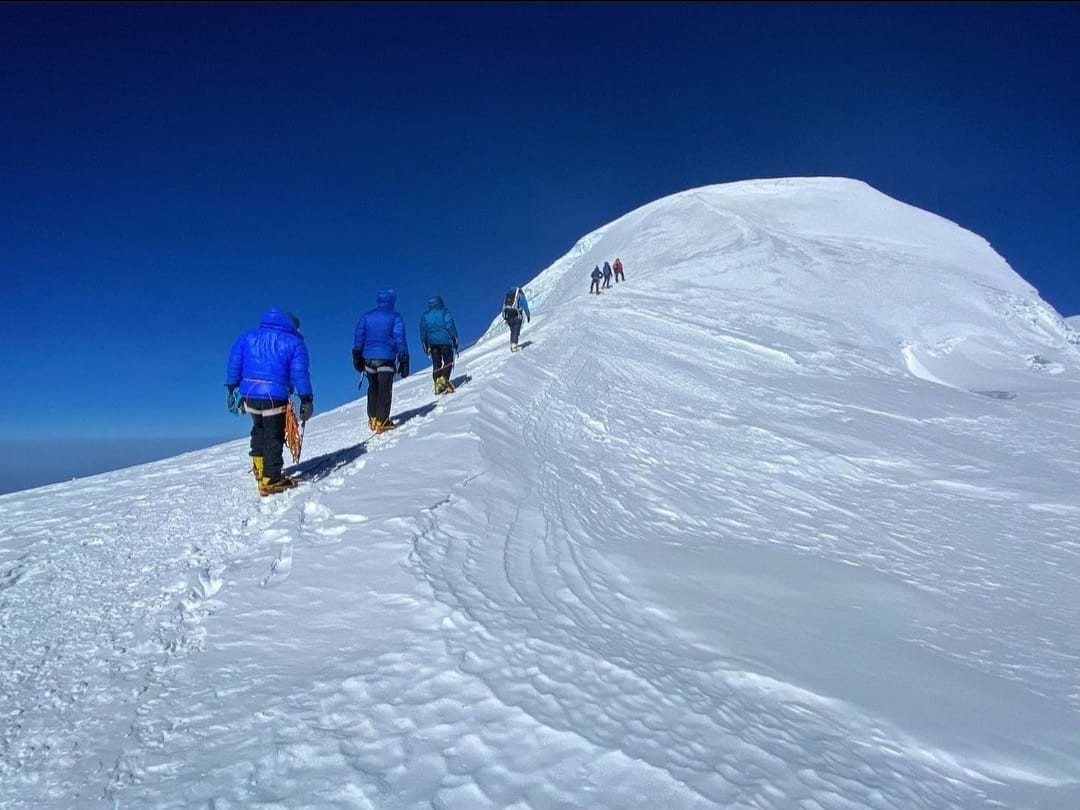
After a very early breakfast, around 2 in the morning, we ready ourselves and gears for the climb. The climb is non-technical and steep in some places only. We do not have to use the ropes frequently. Before the sunlight hits the peak, we must soar to the top.
After the climb to Mera Peak (6461 m), we will be welcomed by grand and Majestic views of the high Himalayas. The view is something that words aren't enough. The eyes keep gawking at the exquisite views of the 5 tallest mountains in the world, along with other equally appealing peaks. This is when an individual will feel all their struggle and difficulties vindicated along the way is worth every penny.
With a proud heart and heavy feelings, we descend towards Mera Base Camp and further towards Khare. We will spend the night here.
As on any typical day, we trace our way back toward Kothe along the same route after breakfast. The achievement demands a grand celebration, so we may savour the local delicacies and even drink locally-produced alcohol.
After having breakfast, we continue our return journey toward Thuli Kharka. The views and landscapes are the same. We will leave behind a couple of Chortens along the way and stay overnight in Thuli Kharka.
After an early breakfast, we head back to Lukla village through the Zwatra-La pass set at an altitude of 4600 m. We will get to see amazing mind-blowing views of some of the highest peaks of the Everest region such as Cho Oyu, Kongde Peak, Number Himal, Kusum Khangru, etc. We will spend our night in Lukla Village.
After a heartwarming trek and climbing to the beautiful Himalayas, we will catch an early flight to Kathmandu from Lukla. It is just a 35-minute flight, so we have copious amounts of spare time. We may choose to explore the Kathmandu Valley as it has a handful of attractions prepared for visitors.
Spring (Mar-May) and Autumn (Sep-Nov) are the best seasons to climb Mera Peak - book early to secure your permit and guide.
The climb spends around three days above 5,000 m, so the risk of Acute Mountain Sickness (AMS) is real. Our itinerary is built with proper acclimatization days, and our guides monitor every climber closely and will adjust or turn back the ascent if symptoms appear.
As an NMA trekking peak, Mera requires the use of crampons, an ice axe, and basic mountaineering technique. We provide a pre-climb briefing and hands-on training at Khare before the summit push, and prior high-altitude trekking experience (such as Everest Base Camp) is strongly recommended.
Travel insurance covering high-altitude climbing and emergency helicopter evacuation up to at least 6,500 m is mandatory for the Mera Peak climb. Please arrange your policy before departure and share the details with us so we can act quickly in case of an emergency.
Secure the Mera Peak Climb for 2026/2027 before the seat gets fully booked.
Mera Peak is a 6,476 m climbing peak in Nepal’s Khumbu region, reached through the remote Hinku and Hongu valleys. The North Nepal Travel & Trek itinerary is an 11-night, 12-day challenging expedition combining high-altitude trekking with a guided peak climb. The route passes through forests, Sherpa settlements and alpine terrain before reaching Mera High Camp and the summit.
Mera Peak is graded Challenging. Although the summit route is described as non-technical in normal conditions, climbers need previous high-altitude trekking experience, basic mountaineering training and the ability to use equipment such as crampons and an ice axe. The itinerary also includes several days above 5,000 m, making acclimatization particularly important.
You don't necessarily need extensive mountaineering experience, but prior high-altitude trekking experience is strongly recommended. The company specifically recommends experience at elevations such as Everest Base Camp, together with basic training in climbing techniques and the use of climbing equipment.
The approach to Mera Peak passes through Sherpa villages, Buddhist chortens and monasteries in the Khumbu region. One notable stop is Lungsumgba Gompa near Gondishung, where the Mera Peak name is carved and which local accounts describe as around 200 years old. The route offers a chance to experience Sherpa mountain culture alongside the climbing expedition.
Personal climbing equipment includes climbing boots, crampons, ice axe, jumar, harness, carabiners, figure-eight device and tape sling. These personal climbing items are excluded from the package, so you should arrange them before the expedition. North Nepal Travel & Trek provides trekking equipment such as a down sleeping bag and duffel bag, along with tents and climbing-camp equipment.
The listed price starts at USD 1,999 per person for a solo booking. Group rates decrease with group size:
|
Group size |
Price per person |
|
1 person |
USD 1,999 |
|
2 people |
USD 1,950 |
|
3–6 people |
USD 1,900 |
|
7–12 people |
USD 1,800 |
|
13–25 people |
USD 1,650 |
The package states that government charges, service charges and VAT are included in the listed price.
Personal climbing gear, travel and evacuation insurance, tips, Wi-Fi, hot showers, device charging, bottled or boiled water, snacks, personal laundry and expenses arising from unforeseen circumstances are excluded. The package also lists a USD 500 NMA garbage deposit, refundable under the stated conditions.
Yes. The listed Mera Peak package is a Private Trip, with discounted per-person rates for larger groups. The expedition also includes an experienced government-registered English-speaking guide, cook and assistant climbing guide according to group size.
The recommended climbing seasons are March to May and September to November. Spring and autumn generally provide the most suitable combination of weather and temperature. Winter summit attempts are considerably harder because of severe cold, so current mountain conditions should always be assessed before departure.
Yes. Altitude is one of the main challenges. The itinerary spends around three days above 5,000 m, with the summit at 6,476 m. An acclimatization day at Khare (5,095 m) is built into the itinerary, and guides provide climbing-equipment training and health briefings before the summit attempt.
Travel insurance and evacuation insurance are strongly recommended and are listed as exclusions from the package. For a climb reaching 6,476 m, your policy should specifically cover high-altitude mountaineering and emergency evacuation rather than relying on a standard travel policy.
The package includes the required Mera Peak climbing permit, Sagarmatha National Park permit, Local Area Permit and TIMS, together with the necessary government and local documentation. The climbing permit varies by season, with the page listing USD 250 in spring, USD 125 in autumn and USD 70 in winter.
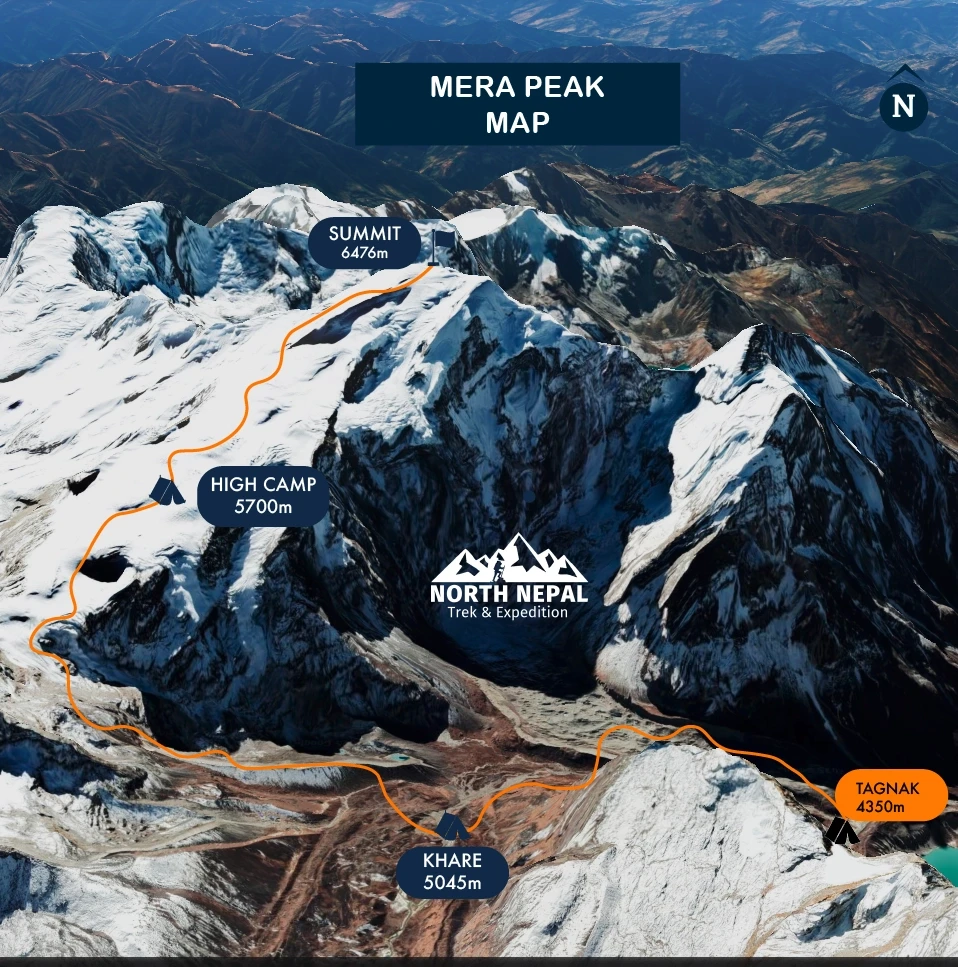
The expedition begins with a flight from Kathmandu to Lukla, taking approximately 35 minutes. From Lukla, you trek through Chutanga, cross Zwatra-La and continue into the Hinku Valley toward Kothe, Thangnak and Khare. The return journey follows the trekking route back to Lukla, followed by a flight to Kathmandu.
Accommodation changes as you gain altitude. Lower sections use tea houses and lodges, including Chutanga, Thuli Kharka, Kothe, Thangnak and Khare. From the high-altitude section onward, you stay in tents, with the expedition team providing camping, kitchen and dining equipment.
Breakfast, lunch and dinner are provided throughout the trek and climbing period, with tea or coffee included with meals. The expedition team also carries and prepares food during the camping section. Additional hot drinks, bottled drinks, snacks and desserts are not included.
Connectivity becomes increasingly limited as you move into the remote Hinku and Hongu valleys and higher camps. Wi-Fi and electronic device charging are excluded from the package, and should not be treated as guaranteed services at high altitude. It's sensible to prepare for periods without reliable internet or mobile connectivity.
One of the major attractions is the exceptionally wide Himalayan panorama from the upper route and summit. On clear days, the itinerary highlights views of Mount Everest, Kanchenjunga, Lhotse, Makalu and Cho Oyu, along with other peaks including Charpate, Kongde Peak, Number Himal and Kusum Khanguru.