
Gosaikunda Lake Trek: A Place of Religious Prominence
Gosaikunda Lake is a pilgrimage site for devotees of Lord Shiva located in the Langtang region. Duri...
OVERVIEW & HIGHLIGHTS
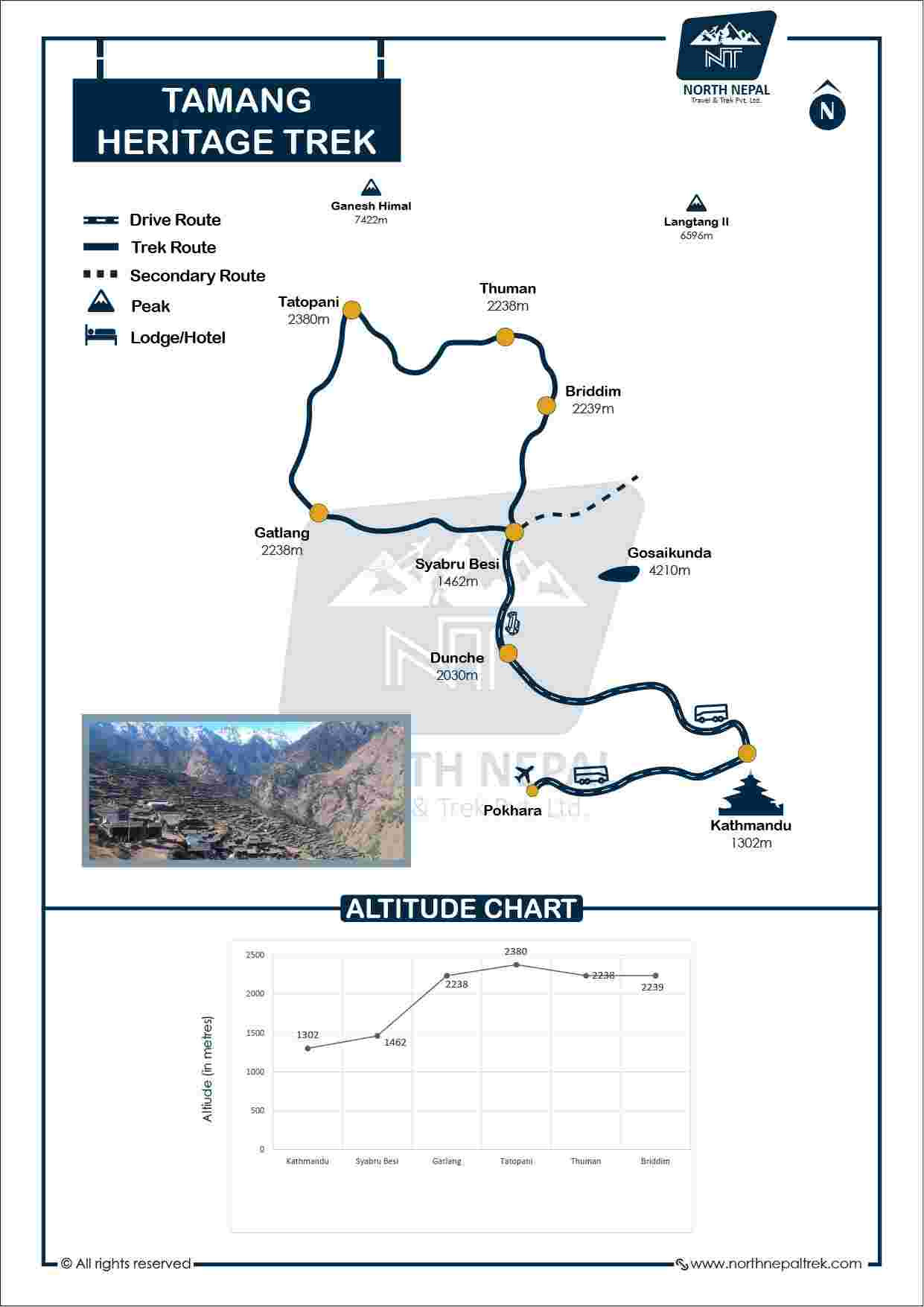
The Tamang Heritage Trek is a newly discovered trail in Nepal. It is a cultural trek through vibrant Tamang villages in Langtang with beautiful panoramic views of Ganesh Himal, Jugal Himal, and the Langtang range, which lies in the northern part of Kathmandu near Langtang National Park. In Nepal, this trek is the perfect way to enjoy your life with awesome memories. The Tamang Heritage Trek is an expedition that takes you to some of the most culturally rich areas of northern Nepal. Most importantly, it offers you a peek into the lifestyle and traditions of the Tamang community living in the Langtang region. Moreover, you’ll witness some breathtaking scenery of terraced farmlands, verdant Rhododendron forests, and snow-capped mountains of the Langtang Himalayas. Furthermore, this trek can be combined with the Langtang, making it a Tamang Heritage and Langtang Valley Trek.
We begin our trek from SyabruBesi which is also the initiation point for the Langtang trek as well as Gosaikunda Trek. However, we will be heading in a different direction. We will ascend for about an hour and a half to reach the top of a hill.
Photo: Phurpu Danda on the way to Gatlang.
Here, we will enjoy some fantastic views of the Gosaikunda range and Ganesh Himal, along with the Goljang Valley. After descending the Goljang valley, we will hike further for about 3 hours to reach Gatlang.
We begin by descending the Thangbuchet River. Then, we cross a bridge and start climbing. After a total of 7 hours hike, we will reach the village of Tatopani. Tatopani means ‘hot water’ which is due to the natural hot springs around the village. We will take a hot bath in the springs and spend the night in a lodge nearby.
Photo: Tatopani Village Rasuwa.
We will ascend to the high grassland of Nagthali Danda which provides some excellent views of the Himalayas. From the top, we ascend down to the village of Thuman, where we spend the night.
Photo: Reflection of Lamjung Himal on Nagkund-Nagthali Dada.
We walk along a plain land for a while then start descending downhill. We have reached quite close to Tibet as it’s merely 3 hour's walk away. We will walk for 5 hours total to reach Briddim.
Photo: Briddim villlage.
Syabrubesi is merely a 3- hour walk from Briddim. Upon reaching Syabrubesi, we will explore the area for the rest of the day.
Photo: Syabrubesi; trek starting point of the trek.
We begin early in the morning for the seven-hour drive to Kathmandu.

Best trekked from March to May or August to November for clear mountain views and comfortable trekking temperatures.
While the Tamang Heritage Trail Trek reaches moderate maximum altitudes (typically up to 3,300 m at Nagthali Gyang), our itineraries feature steady pacing across varied mountain paths, suspension bridges, and stone staircases. Guides conduct daily health assessments for early symptoms of Acute Mountain Sickness (AMS). If severe symptoms appear, standard protocol mandates immediate descent to lower elevations.
In cases of severe injury, acute altitude illness, or extreme weather conditions on remote ridgelines, emergency helicopter evacuation is coordinated directly through local rescue services. Evacuations are initiated promptly upon assessment by your guide in communication with our Kathmandu and Pokhara offices.
All trekkers must hold comprehensive travel insurance covering emergency medical treatment, high-altitude trekking (up to 4,000 m), and emergency helicopter rescue/evacuation. Insurance details must be submitted prior to the departure of the trek to streamline emergency logistics if required.
Secure the Tamang Heritage Trail Trek for 2026/2027 before the seat gets fully booked.
The Tamang Heritage Trail Trek is a short cultural trek in the Langtang region of Nepal, north of Kathmandu. The route passes through traditional Tamang villages, forested hills, Buddhist monasteries and community homestays, offering a closer look at local life alongside Himalayan mountain scenery.
Yes, the route is considered one of the more accessible cultural treks in the Langtang region. However, it still involves several hours of walking each day, uneven trails and uphill sections. Children and older trekkers should travel at a comfortable pace with appropriate guidance and preparation.
The Tamang Heritage Trail passes through communities where Tamang language, Buddhist traditions, village customs and traditional architecture remain an important part of daily life.
The route also provides opportunities to visit monasteries and gompas and, depending on the village and season, observe local cultural practices and celebrations.
Yes. Community homestays are one of the defining features of the Tamang Heritage Trail. Staying with local families gives trekkers an opportunity to experience traditional hospitality, locally prepared food and everyday village life rather than simply passing through the settlements.
Pack comfortable trekking shoes, layered clothing, a waterproof jacket, warm layers for cool evenings, a reusable water bottle, sunglasses, sunscreen, a headlamp, personal medication and basic toiletries.
The right clothing also depends on the season. Winter requires warmer layers, while spring and monsoon conditions call for reliable rain protection.
Personal expenses can include snacks, drinks, hot showers, charging, Wi-Fi where available, tips and other purchases not covered by the trekking package.
Check the current package inclusions and exclusions before departure so you have a clear idea of what is already covered.
The risk is lower than on high-altitude treks such as Everest Base Camp or Annapurna Base Camp, but altitude should still be taken seriously as the trail reaches higher elevations.
Walk at a steady pace, stay hydrated and tell your guide if you experience persistent headache, nausea, dizziness or unusual fatigue.
The Tamang Heritage Trail requires the Langtang National Park entry permit.
The trail is accessed by road from Kathmandu toward the Langtang region. The exact starting and ending points depend on the selected itinerary.
Road conditions can vary, particularly during and after the monsoon, so the final transfer schedule should be confirmed before departure.
Accommodation is primarily through community homestays and local lodges. Homestays are an important part of the experience, allowing trekkers to stay with local families and experience village life more directly.
During the main trekking seasons, some homestays can become busy and room sharing may be necessary.
Meals are prepared locally and commonly include traditional Nepali dishes and local Tamang cuisine. Community homestays provide an opportunity to eat freshly prepared food using locally available ingredients.
Mobile connectivity varies between villages and can become unreliable in more remote sections. Some lodges or homestays may provide Wi-Fi, but it should not be treated as guaranteed throughout the trek.
Carry a power bank and keep important travel information available offline.
The trail passes through rhododendron forests, green hills, terraced landscapes and Himalayan mountain scenery. Spring is particularly attractive when rhododendrons are in bloom.
The route also provides a quieter alternative to some of the busier Langtang trekking corridors, with the landscape changing from forested lower hills to more open mountain terrain as you gain elevation.