Upper Dolpo Trek Permits 2026: Fees, Rules and How to Get Them
Published Oct 29, 2026 Updated Oct 29, 2026 10 min read
Quick answer
To trek Upper Dolpo you need three permits: the Upper Dolpo restricted-area permit (USD 500 for 10 days, then USD 50 a day), the Lower Dolpo permit and the Shey Phoksundo park fee. A registered agency must apply.
Three permits, one agency, one licensed guide. The official fees, the March 2026 rule change, where the permits are checked, and why the fee you read online may be wrong.
Every Upper Dolpo enquiry I answer has a permit question in it. Can I get it myself? Can I go alone? Is it really USD 50 a day now? Some of the rules changed in 2026, and some of what's written online changed with them when it shouldn't have. This guide sets out what the Department of Immigration and the Nepal Tourism Board publish as of 29 October 2026, how my office gets the permits for you, and where on the trail someone will ask to see them. It is the permit reference for our Upper Dolpo Trek; the companion guides cover cost, difficulty and the best time to go.
Key facts
Permits needed3: Upper Dolpo restricted area, Lower Dolpo restricted area, Shey Phoksundo National Park
Issued byDepartment of Immigration (both restricted-area permits); park fee paid in Kathmandu or at the park entry point
Upper Dolpo feeUSD 500 per person for the first 10 days, then USD 50 per person per day
Lower Dolpo feeUSD 20 per person per week, then USD 5 per person per day
Park feeNPR 3,000 per foreign visitor per entry; under 10s free
Who appliesA registered Nepali trekking agency, online
Solo trekkersAllowed since 22 March 2026, with a licensed guide
TIMS cardNot active at the moment; nothing to buy
Which permits do you need for the Upper Dolpo trek?
The Upper Dolpo trek needs three permits: the Upper Dolpo restricted-area permit, the Lower Dolpo restricted-area permit and the Shey Phoksundo National Park entry permit. The TIMS card is not active at the moment, so there is no fourth document to buy.
Two of the three Upper Dolpo permits are restricted-area permits from the Department of Immigration, because Dolpa district is split into two restricted zones. The government defines the zones by ward, not by village name. The Upper Dolpa zone covers wards 4 to 6 of Dolpo Buddha Rural Municipality, wards 1 to 7 of Shey Phoksundo Rural Municipality and wards 1 to 6 of Chharka Tangsong Rural Municipality. Lower Dolpa covers most of the rest of the district, including Thuli Bheri Municipality, where the Juphal airstrip and the district headquarters at Dunai sit. Our 24-day Upper Dolpo route spends time in both zones, so it needs both permits.
The third Upper Dolpo permit is the entry permit for Shey Phoksundo National Park, Nepal's largest national park at 3,555 km². It is charged per entry, in rupees.
USD 20 a week, then USD 5 a day after the first week
Shey Phoksundo National Park
Paid at the Tourist Service Center, Kathmandu, or at the entry point
NPR 3,000 (foreigners); NPR 1,500 (SAARC); under 10s free
The Upper Dolpo restricted-area fees are set in US dollars, but the government collects them through Nepali payment channels, so your agency pays the rupee equivalent on your behalf. The park fee is set in rupees, and its dollar value moves with the Nepal Rastra Bank exchange rate. If an Upper Dolpo quote still lists a TIMS card, ask the operator to take it off. What the permits add to the trip price is worked through in our Upper Dolpo trek cost guide.
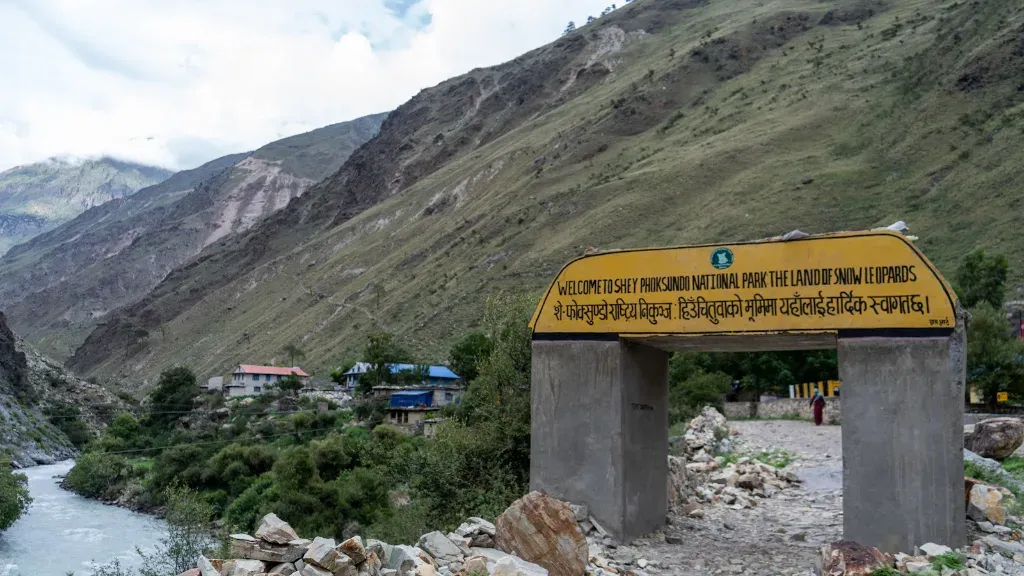
The welcome gate of Shey Phoksundo National Park, the land of snow leopards, on the trail beside the river. Photo: North Nepal Travel & Trek.
How do you get an Upper Dolpo permit?
You get an Upper Dolpo permit through a registered Nepali trekking agency, which applies online to the Department of Immigration on your behalf. You cannot apply yourself, and the same agency must provide your licensed guide.
The paper Upper Dolpo permit is gone. The Department of Immigration moved restricted-area applications online on 23 February 2024, and trekkers no longer have to stand in the immigration office in Kathmandu. Payment goes through Nepali channels such as mobile banking, Connect IPS, eSewa and Khalti, which is one more reason the agency handles it rather than you.
Since 22 March 2026 an Upper Dolpo permit application can go in using your Nepal visa application number, the submission ID you get when you apply for the visa from home. Before that, the agency had to wait for the visa itself. In practice this means my office can lock in your permits well before you fly, rather than in a rush during your first days in Kathmandu.
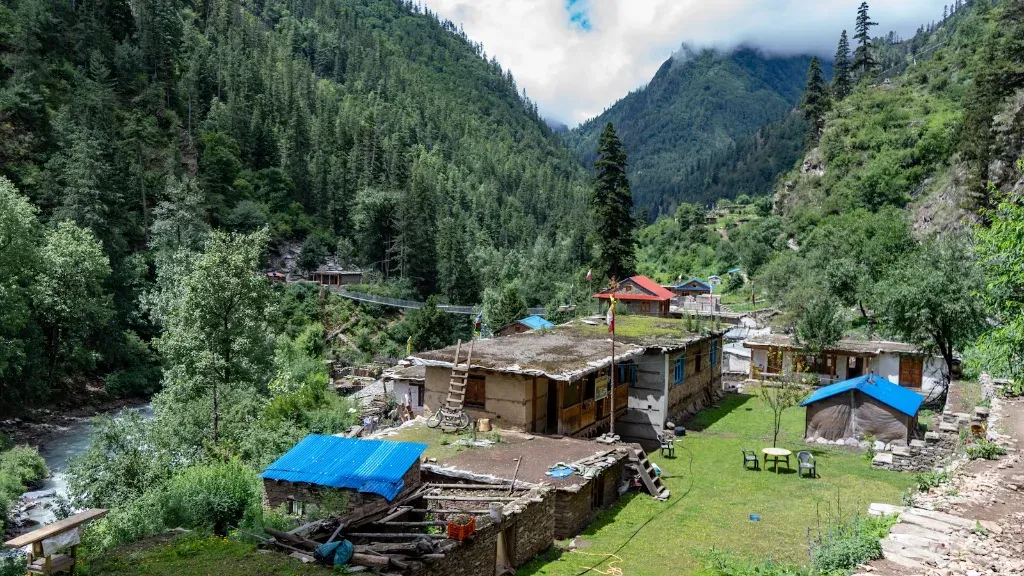
Flat-roofed stone houses in a pine-forested valley of Dolpa. Photo: North Nepal Travel & Trek.
What do you need to send for an Upper Dolpo permit?
For an Upper Dolpo permit, North Nepal Travel & Trek needs your passport details, your Nepal visa details or visa submission ID, and your exact trek dates. We handle every step of the application, payment and park fee from there.
Because we handle the whole permit process, the details have to be right before we apply. The permit covers the dates we apply for, so if you add days in Kathmandu before the trek or change your flights, tell us before the application goes in, not after.
You send: a clear scan of your passport information page, your visa details or visa submission ID, and your trek dates.
We arrange: the Upper Dolpo and Lower Dolpo restricted-area permits, the Shey Phoksundo park fee and your licensed guide.
You carry: nothing official. Your guide holds the originals; keep phone photos of each permit and your passport.
Can you trek Upper Dolpo solo?
Yes, since 22 March 2026 a single trekker can hold an Upper Dolpo permit. You still cannot walk alone. You must apply through a registered agency and trek with a licensed guide, and one guide can lead no more than seven trekkers.
Before March 2026, restricted-area permits for Upper Dolpo were issued only to groups, so a solo trekker had to find a partner. The Department of Immigration changed that after complaints from the Trekking Agencies' Association of Nepal (TAAN) and others. The same notice made the agency fully responsible for emergency rescue and capped groups at seven trekkers per guide. Our guide to trekking Nepal's restricted areas solo covers the notice in detail.
My honest view on Upper Dolpo solo: the permit was never the hard part. Above Phoksundo Lake our route is tents all the way, so a solo trekker still travels with a guide, a cook and porters or pack animals carrying the camp. Going solo is now legal and simpler on paper. It is not cheaper per head, because one person carries the whole cost of the crew. The Upper Dolpo difficulty guide explains what those camping nights ask of you.
Where are Upper Dolpo permits checked?
On our Upper Dolpo route, permits are checked at the Shey Phoksundo National Park post at Suligad and again at Ringmo, the village on the shore of Phoksundo Lake. Your guide carries the originals for the whole trek.
Suligad, where the Shey Phoksundo National Park office sits, comes on the walk in from Dunai and is where the park permit is checked. Ringmo, at Phoksundo Lake, 3,600 m (11,811 ft), is the last village before the Upper Dolpo route climbs towards the high passes, and permits are checked again there.
Keep a photo of each Upper Dolpo permit and the information page of your passport on your phone. If the group splits for any reason, or a document gets wet at a river crossing, a clear photo makes the conversation at a checkpost much shorter.
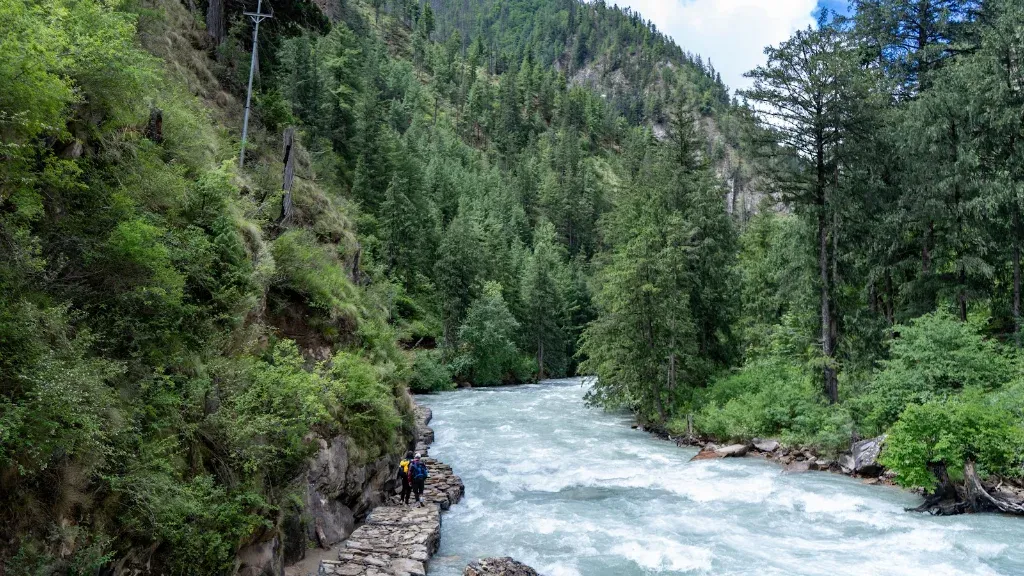
Trekkers on a stone-paved section of the trail beside a fast river through pine forest in Dolpa. Photo: North Nepal Travel & Trek.
Is the Upper Dolpo permit USD 50 a day now?
No. As of 29 October 2026, the Department of Immigration still charges USD 500 for the first 10 days in Upper Dolpo, then USD 50 a day. The flat USD 50-a-day rate applies to Upper Mustang, not Upper Dolpo.
The confusion has a clear source. On 18 November 2025 the Council of Ministers set the Upper Mustang permit at USD 50 per person per day, amending the Immigration Rules. TAAN welcomed it and asked the government to change the Upper Dolpa rule the same way, so that trekkers pay only for the days they actually spend there. That second change has not happened. The Department of Immigration still lists Upper Dolpa at USD 500 for the first 10 days.
Several trekking websites now quote Upper Dolpo at USD 50 a day with no minimum. If a quote is built on that number, it will be short on any trip that spends fewer than ten days in the zone. Check the official table, or ask your operator which figure they used. I would rather tell you the higher number now than send you an extra invoice later.
Can Upper Dolpo permits be suspended?
Yes. The Department of Immigration can stop issuing restricted-area permits, including Upper Dolpo permits, for safety reasons. It did so for 29 to 31 October 2026, when heavy snow and avalanches were forecast for the high hills and Himalaya.
The notice came on Tuesday 27 October 2026, after the National Disaster Risk Reduction and Management Authority warned tourists to avoid high-hill and Himalayan areas for those three days. No new restricted-area permits for the high hills and Himalaya would be issued for that period, and trekkers already inside were asked to stay in safe places and not trek. This is the kind of thing that can land in the middle of a 24-day trip.
Heads up
A permit pause, a snowstorm or a grounded flight at Juphal can each cost days, and on Upper Dolpo the days keep counting on your restricted-area permit. Keep spare days between the end of the trek and your flight home, and check that your travel insurance covers trip delay as well as helicopter rescue to 5,350 m (17,552 ft), the height of Nangda La. Our best time to trek Upper Dolpo guide explains when snow is most likely.
Frequently asked questions
You need three: the Upper Dolpo restricted-area permit and the Lower Dolpo restricted-area permit, both from the Department of Immigration, and the Shey Phoksundo National Park entry permit. The TIMS card is not active at the moment.
The Upper Dolpo restricted-area permit costs USD 500 per person for the first 10 days and USD 50 per person for each day after that, according to the Department of Immigration as of 29 October 2026. The Lower Dolpo permit and the park fee are extra.
No. Upper Dolpo permits are issued only through a registered Nepali trekking agency, which applies online to the Department of Immigration. The agency must also provide a licensed guide for your trek.
Your agency needs your passport details, your Nepal visa details or visa submission ID, and your trek dates. With North Nepal Travel & Trek, we handle the application, payment and park fee from there.
You can hold an Upper Dolpo permit as a single trekker since 22 March 2026, but you must still trek with a licensed guide arranged by a registered agency. A guide may lead up to seven trekkers.
Not as a flat rate. Upper Mustang moved to USD 50 a day in November 2025. Upper Dolpo still charges USD 500 for the first 10 days, then USD 50 a day, according to the Department of Immigration.
Foreign visitors pay NPR 3,000 per entry to Shey Phoksundo National Park, according to the Nepal Tourism Board. SAARC nationals pay NPR 1,500, and children under 10 enter free.
On our route, Upper Dolpo permits are checked at the Shey Phoksundo National Park post at Suligad and at Ringmo by Phoksundo Lake. Your guide carries the originals; keep photos of them on your phone.
The full route, departure dates and group prices are on our Upper Dolpo Trek page, or message me on WhatsApp with your dates.
A native of the Annapurna region, he brings over 17 years of firsthand experience leading treks across the mountains of Nepal. His deep local roots and proven guiding expertise make him a trusted authority on authentic Himalayan adventures.