How Hard Is the Upper Dolpo Trek? The Passes, the Altitude and the Nights in a Tent
Published Oct 28, 2026 Updated Oct 28, 2026 10 min read
Quick answer
The Upper Dolpo trek is Challenging. Our 24-day loop crosses three passes above 5,000 m, tops out at Nangda La (5,350 m), and spends 16 nights in tents. Altitude and remoteness, more than daily distance, make it hard.
Three passes above 5,000 metres, a fortnight under canvas and an airstrip days away. What makes Upper Dolpo one of the harder treks in Nepal, and who it suits.
If you are asking how hard Upper Dolpo is, you have probably walked a teahouse trek already and want to know whether this is the next step up or a different kind of trek altogether. It is a bit of both. The daily walking on our itinerary is mostly five to seven hours. What changes is everything around it: how high you sleep, how far you are from help, and what a night at 4,000 m feels like when there is no lodge to walk into.
I grade Upper Dolpo as Challenging, and the reason is the passes. This page goes through where the hard days fall on our itinerary, how the altitude climbs, and how the trek compares with the routes you may already know.
Key facts
GradeChallenging, because of the high passes
Itinerary24 days, Kathmandu to Kathmandu, starting and finishing at Juphal airstrip, 2,475 m (8,120 ft)
Highest pointNangda La, 5,350 m (17,552 ft)
Passes above 5,000 mNangda La 5,350 m, Shey La 5,100 m (16,732 ft), Choila North 5,040 m (16,535 ft)
Highest nightNangdala High Camp, 4,717 m (15,476 ft)
WalkingMostly 5 to 7 hours a day; the longest day is 7 to 8 hours
Nights in tents16 of 23
How hard is the Upper Dolpo trek, really?
The Upper Dolpo trek is harder than the popular teahouse treks, but not because the days are long. Most walking days on our itinerary are five to seven hours. The difficulty comes from sustained altitude, three passes above 5,000 m, two weeks of camping and a long way between you and any road.
That distinction matters when you judge whether the trek is for you. A trekker who can walk six hours a day for a week at sea level has the legs for Upper Dolpo. The question is how that same trekker copes with sleeping close to or above 4,000 m night after night, eating what the kitchen tent can carry, and accepting that a bad day cannot be fixed by catching a jeep.
I grade it Challenging because of the passes, not the distances. The effort on any single day is manageable. It is three high passes and the cold nights between them that wear people down.
Where are the hardest days on the Upper Dolpo trek?
The hardest days on the Upper Dolpo trek are the climb to the high camp below Nangda La, the crossing of Nangda La itself, Shey La the day after, and Choila North a week later. Each is short enough on paper; each is done at an altitude where every step costs more than it looks.
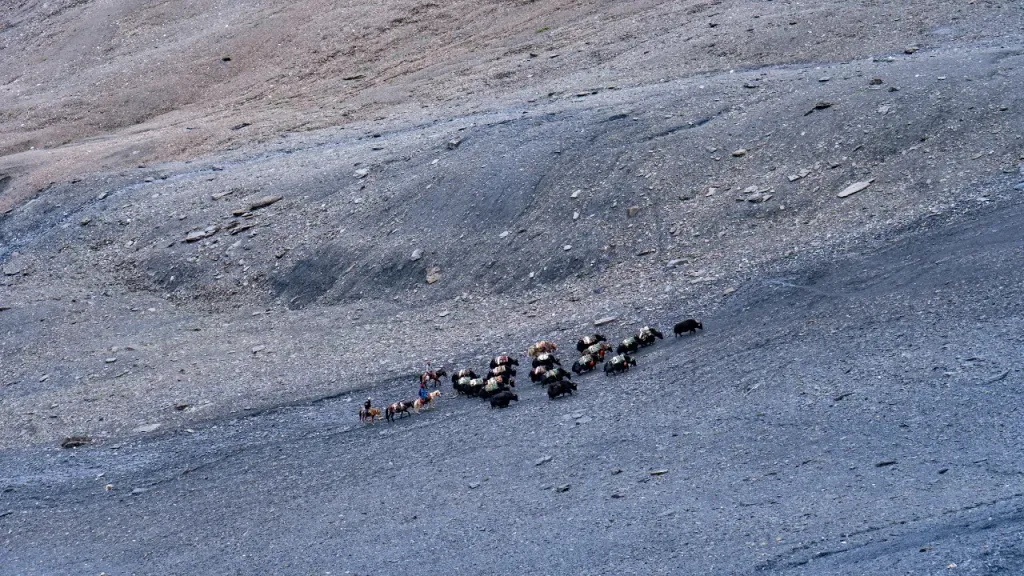
A yak caravan crosses loose scree on the high route in Upper Dolpo. Photo: North Nepal Travel & Trek.
Day 9, Sallaghari to Nangdala High Camp. About 11 km and five to six hours, but you finish 1,087 m higher than you slept, at 4,717 m (15,476 ft). This is the biggest single gain in sleeping altitude on the trek, and I say more about it in the next section.
Day 10, over Nangda La to Shey Gompa. About 12 km and five to six hours. From the high camp it is a climb of roughly 630 m to the top of the trek at 5,350 m (17,552 ft), then down to Shey Gompa at 4,343 m (14,249 ft).
Day 11, over Shey La to Namgung Gompa. Six to seven hours, over the second pass at 5,100 m (16,732 ft), with no rest day in between. Two passes on consecutive days is where tired legs show.
Day 18, over Choila North to Tokyu. About 17 km in roughly four hours, crossing 5,040 m (16,535 ft). By then you have slept above 3,700 m for nine nights, and on our itinerary it is the shortest of the three pass days.
Day 20, Dho Tarap to Naworpani. The longest walking day at seven to eight hours, ending 469 m lower than it starts. It is not high, but a long day losing height at the end of three weeks finds out every weak knee in the group.
How does the Upper Dolpo trek handle the altitude?
From Day 10 to Day 19 the Upper Dolpo trek sleeps between 3,770 m and 4,360 m, and there are two rest days built in: one at Phoksundo Lake (3,600 m) on Day 7 and one at Saldang (3,770 m) on Day 13. The exception is the climb to the high camp on Day 9.
Day
Where you sleep
Sleeping altitude
Change
5
Chunuwar
3,000 m (9,843 ft)
+313 m
6
Phoksundo Lake
3,600 m (11,811 ft)
+600 m
7
Phoksundo Lake, rest day
3,600 m (11,811 ft)
0
8
Sallaghari
3,630 m (11,909 ft)
+30 m
9
Nangdala High Camp
4,717 m (15,476 ft)
+1,087 m
10
Shey Gompa, over Nangda La
4,343 m (14,249 ft)
−374 m
11
Namgung Gompa, over Shey La
4,360 m (14,304 ft)
+17 m
12
Saldang
3,770 m (12,369 ft)
−590 m
13
Saldang, rest day
3,770 m (12,369 ft)
0
14–17
Komash, Shimen, Tinje, Yak Kharka
3,850 to 4,110 m
small rises and falls
18
Tokyu, over Choila North
4,240 m (13,911 ft)
+222 m
For comparison, the Wilderness Medical Society's guidance, as published by the US Centers for Disease Control and Prevention, is to raise your sleeping altitude by no more than 500 m a night once above 3,000 m, and to add an extra night for every 1,000 m gained. Most of the Upper Dolpo itinerary sits comfortably inside that. Day 9 does not: it more than doubles it.
I would rather you read that here than discover it on the trail. The two nights at Phoksundo Lake before it give you a base to climb from, but Day 9 is still the night your body is tested hardest. The same CDC guidance is blunt about what happens next: never go up to sleep higher while you have symptoms of altitude illness, and if symptoms get worse, descent is the treatment.
Heads up
Tell your guide about a headache at the high camp the moment it starts, not the next morning at the foot of the pass. Headache is the main symptom of acute mountain sickness, often with nausea, dizziness, tiredness or loss of appetite. On Upper Dolpo, the decision to go over Nangda La or go back down is made that evening, and it is much easier to make with the full picture.
Why does camping make Upper Dolpo harder than a teahouse trek?
Camping makes Upper Dolpo harder because there is no warm lodge at the end of the day. On our itinerary, 16 of the 23 nights are in tents, from Phoksundo Lake on Day 6 until Lashicap on Day 21, and above Phoksundo there is nowhere reliable to buy a meal or dry out kit.
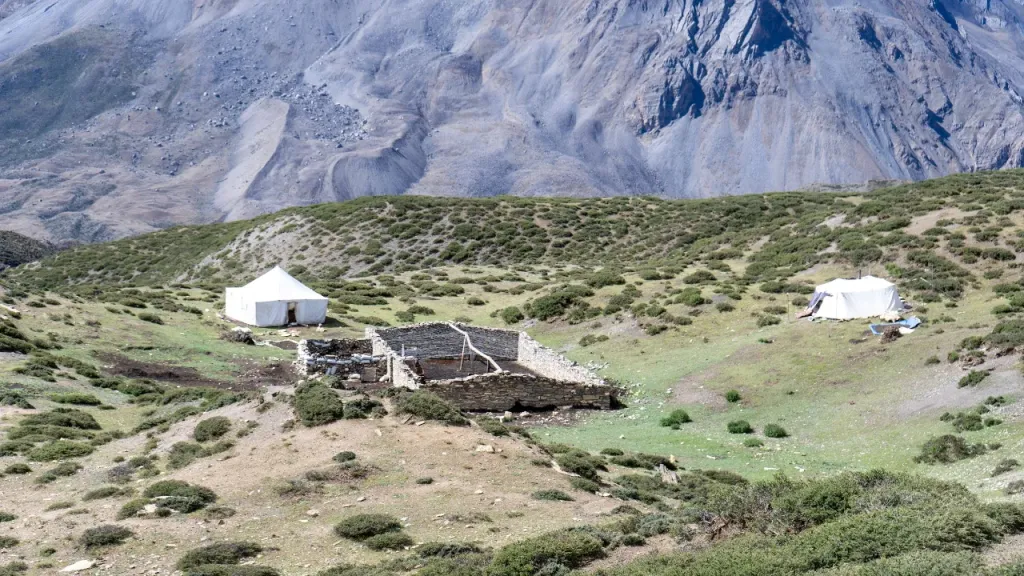
Tents beside a stone enclosure on a high pasture in Upper Dolpo. Photo: North Nepal Travel & Trek.
In practice that changes your evenings more than your days. You eat in a dining tent, you sleep in a tent at altitudes where nights are cold even in the main seasons, and anything wet stays wet until the sun reaches the tent. A cook and kitchen crew carry the food and fuel for the whole group, so meals are hot and regular, but the comfort is the comfort you bring: a sleeping bag rated for the cold, a down jacket, and the discipline to keep your layers dry.
Remoteness is the other half of it. From the high section, the Juphal airstrip is days away on foot. If something goes seriously wrong, the realistic way out is a helicopter, and only when the weather allows one to fly. That is why your travel insurance has to cover helicopter rescue to at least 5,350 m (17,552 ft).
Is Upper Dolpo harder than Everest Base Camp or the Manaslu Circuit?
Upper Dolpo is harder than Everest Base Camp and the Manaslu Circuit overall, even though Everest Base Camp goes higher. It is twice as long, crosses three passes above 5,000 m instead of one or none, and trades teahouses for tents. The figures below are from our own itineraries.
Upper Dolpo
Manaslu Circuit
Everest Base Camp
Days, Kathmandu to Kathmandu
24
11
12
Highest point
Nangda La, 5,350 m (17,552 ft)
Larkya La, 5,106 m (16,752 ft)
Kala Patthar, 5,644 m (18,517 ft)
Passes above 5,000 m
3
1
None (the route is in and out)
Nights
16 in tents
Teahouses
Teahouses and lodges
Our grade
Challenging
Strenuous
Moderate to challenging
The single hardest day on our Manaslu Circuit, the 10 to 11 hour crossing of Larkya La, is longer than any day on Upper Dolpo. That is why we grade Manaslu Strenuous. Upper Dolpo asks for less on any one day and more over three weeks. If you finished Everest Base Camp comfortably and enjoyed the high days rather than enduring them, you have the right base. If the days above 5,000 m on that trek were a struggle, do another high teahouse trek first.
Who should trek Upper Dolpo, and how should you train?
Upper Dolpo suits trekkers who have already been above 5,000 m, who are comfortable walking six hours a day for days in a row, and who can enjoy two weeks without a hot shower. It is not a first trek in Nepal.
Fitness helps you enjoy the trek; it is no guarantee against altitude illness. The useful preparation is steady endurance: long walks with a loaded pack, on hills, on consecutive days, in the boots you will wear. Our 16-week Himalayan training plan builds exactly that.
If three weeks and three high passes is more than you want, our Lower Dolpo trek covers the southern side of the same region.
Frequently asked questions
We grade the Upper Dolpo trek Challenging. It crosses three passes above 5,000 m, reaches 5,350 m at Nangda La and spends 16 of 23 nights in tents. Daily walking is mostly five to seven hours.
The highest point of our Upper Dolpo trek is Nangda La at 5,350 m (17,552 ft), crossed on Day 10 between the high camp and Shey Gompa.
Most walking days on the Upper Dolpo trek are five to seven hours. The longest is seven to eight hours, from Dho Tarap to Naworpani on Day 20.
Upper Dolpo is not a good first trek. It suits people who have already trekked above 5,000 m and know how their body handles altitude. A high teahouse trek is a better first step.
Overall, yes. Everest Base Camp goes higher, but Upper Dolpo is twice as long, crosses three passes above 5,000 m, and is a camping trek far from roads and lodges.
You stop climbing. CDC guidance is never to sleep higher with symptoms, and to descend if they worsen. On the high section of Upper Dolpo, serious cases need a helicopter, so insurance must cover rescue to 5,350 m.
The full Upper Dolpo route, dates and prices are on our Upper Dolpo Trek page, or message me on WhatsApp with your dates.
A native of the Annapurna region, he brings over 17 years of firsthand experience leading treks across the mountains of Nepal. His deep local roots and proven guiding expertise make him a trusted authority on authentic Himalayan adventures.