Travel Insurance for Trekking in Nepal: What Your Policy Must Cover
Published Jul 17, 2026 Updated Oct 27, 2026 10 min read
Quick answer
For trekking in Nepal you need a policy that names trekking, covers you above the highest point of your route, and includes helicopter evacuation, emergency medical treatment and repatriation. For Everest Base Camp or the Annapurna Circuit that means cover to at least 6,000 m. Ordinary holiday insurance usually stops far lower.
Most people who message us already have a policy. The problem is rarely that they skipped insurance; it is that they bought a holiday policy built for a beach and assumed it stretches to Lobuche. This guide shows what to look for in the wording, matched to the routes we run, and what happens if you actually need a helicopter. Read it before you pay the premium, not after.
Key facts
Is it required by law?Not for ordinary teahouse trekking, but we require it on every trek
Altitude limitAbove your route's highest point; 6,000 m covers all classic treks
Must be namedHelicopter evacuation and mountain rescue
Medical coverEmergency treatment plus repatriation home
Not trekkingClimbing peaks such as Island Peak or Mera Peak needs mountaineering cover
Buy itWhen you pay your first non-refundable deposit
Before a rescueYour insurer's emergency line should give a payment guarantee
Why trekking insurance matters in Nepal
Three things make Nepal different from a walking holiday in Europe. You will be days from a road at high altitude, where the safe answer to serious altitude sickness or a broken leg is often a helicopter. Evacuated trekkers are almost always taken to private hospitals in Kathmandu, which expect payment or an insurer's guarantee. And the flights into the mountains, Lukla above all, stop in bad weather, which costs you days and money.
Helicopter rescue in Nepal is run by private operators. When your guide calls one, the operator needs to know who will pay before it flies. Usually that is your insurer, through a guarantee of payment; otherwise it is your credit card. A single evacuation costs several thousand US dollars, and a medical flight home costs far more.
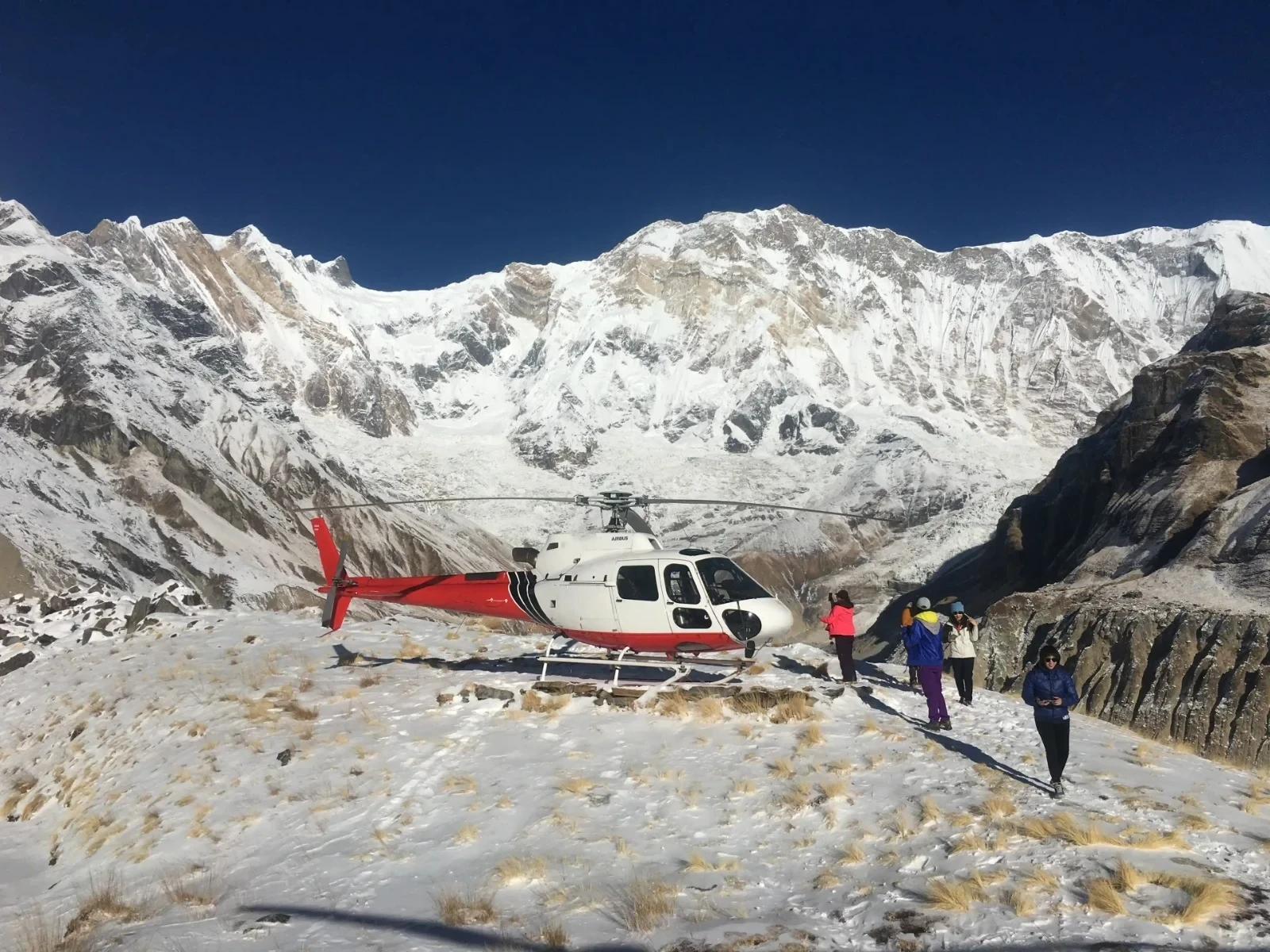
A helicopter at Annapurna Base Camp, 4,130 m (13,550 ft). In bad weather, no helicopter flies. Photo: North Nepal Travel & Trek.
The altitude limit: match it to your route
This is the clause that catches more Nepal trekkers than any other. Many standard policies cover walking only to a few thousand metres, and some exclude trekking entirely. Find the altitude limit in your policy schedule and compare it with the highest point of your route, including side trips.
Leave a margin. Itineraries change with weather, and a side trip or viewpoint can take you higher than the trek's name suggests: on the Everest Base Camp trek the highest point is not base camp but Kala Patthar, 5,644 m (18,517 ft). A policy to 6,000 m covers every classic teahouse trek in Nepal.
Heads up
If the policy says "trekking" but gives no altitude, ask the insurer in writing and keep the reply. Vague wording gets read against you when you claim, not in your favour.
What a Nepal trekking policy must include
Cover
What to look for
Emergency medical
Hospital treatment in Nepal and the medical flight home; prefer an insurer that pays hospitals directly
Helicopter evacuation
Named in the wording as helicopter, mountain rescue or air evacuation, not just "emergency transport"
Altitude
A stated limit above your route's highest point
Cancellation and curtailment
At least the total of what you cannot get back: flights, trek, permits, domestic flights
Travel delay
Help with extra nights when Lukla or mountain flights are grounded
Baggage
Check the single-item limit, not just the total; a good down jacket or camera may be over it
Personal liability
Standard on most policies; check the adventure exclusion does not cancel it
Repatriation is where the big numbers are. A medical flight from Kathmandu to Europe, North America or Australia can cost more than the trek, the flights and the policy put together, so do not buy a policy with a low medical limit to save a few pounds or dollars.
Helicopter evacuation: how it works in practice
Descent is the first treatment for altitude sickness, and a good guide will walk you down before anyone reaches for the phone. A helicopter is for when walking down is not possible or not fast enough: HAPE or HACE, a fracture far from a road, severe dehydration, or a cardiac problem.
The sequence matters. Your guide or our office calls your insurer's 24-hour assistance line, the insurer confirms cover and issues a guarantee of payment to the helicopter company, and the helicopter flies when the weather allows. A rescue the insurer approved in advance is far more likely to be paid smoothly; one that was not will be scrutinised and may be refused.
That scrutiny has a history. In March 2026 Nepali prosecutors, acting on a Central Investigation Bureau investigation, charged 32 people from trekking agencies, helicopter companies and hospitals over fake rescues that allegedly cost insurers at least USD 19.69 million, including charter flights billed as rescues and trekkers pushed into airlifts for minor illness. If anyone on the trail pushes you towards a helicopter you do not think you need, call your insurer yourself.
Helicopters do not fly into cloud. There are days when the answer is no however ill you are, which is one more reason to turn round early rather than gamble on a lift.
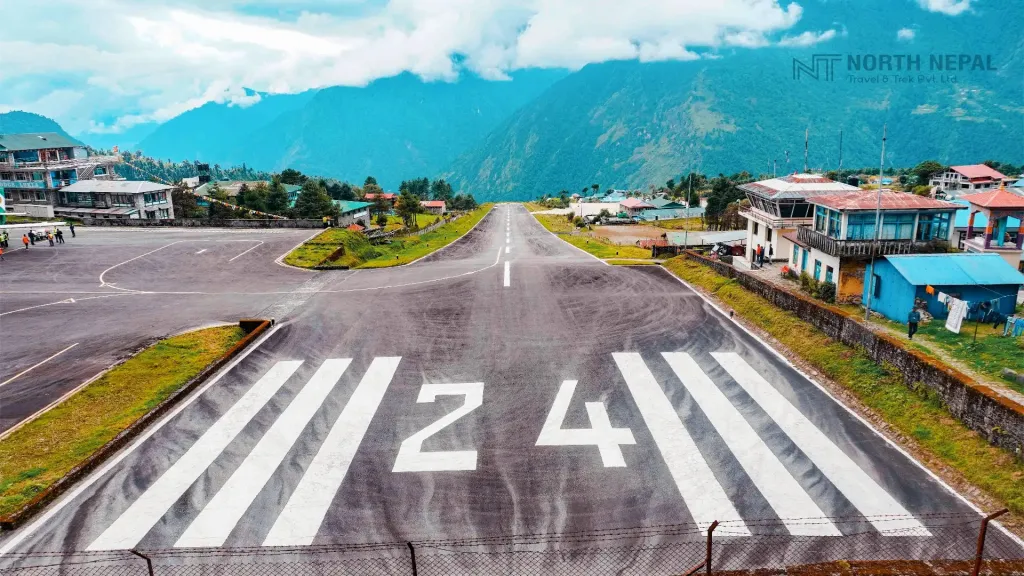
The runway at Lukla. When cloud closes it, trekkers wait for days, and travel-delay cover earns its keep. Photo: North Nepal Travel & Trek.
Cancellation and delays: the Lukla factor
Flights to Lukla for the Everest region only run in good visibility, and in recent autumns rain and fog have grounded them for days at a time. When that happens you either wait or pay for a seat on a helicopter. Travel-delay and missed-departure cover pays for some of it; read what it pays for and for how long.
Cancellation cover protects money you have already spent, so it only works if the policy started before you spent it. Permits, domestic flights and deposits are often non-refundable once booked. Our best time to trek guide shows when flight delays are most likely.
Exclusions that void Nepal claims
Exclusion
How it catches trekkers
Mountaineering
Ropes, crampons on technical ground, ice axes or a peak permit turn a trek into a climb. Island Peak and Mera Peak need mountaineering cover
Other activities
Paragliding, rafting and canyoning in Pokhara are often excluded; declare them if you plan them
Pre-existing conditions
Undeclared asthma, high blood pressure, heart or lung problems or diabetes can void the whole claim
Alcohol and drugs
Any incident where they contributed is excluded. Cannabis remains illegal under Nepal's national law
Permits and rules
Trekking in a restricted area without the right permit, or against an official travel warning, can void cover
Age
Some insurers lower altitude limits or refuse adventure cover for older travellers
Declare medical conditions. A stable, managed condition usually costs only a modest extra premium, and altitude has a way of exposing conditions that are quiet at sea level. If you have a heart or lung history, see your doctor before you book; that letter also supports a claim later.
Restricted areas such as Manaslu, Nar Phu and Upper Mustang need a restricted-area permit and a licensed guide, and solo trekkers have been able to get these permits through a trekking agency since March 2026, with a licensed guide still required. We arrange all permits as part of the trek; the details are in our Nepal trekking permits guide.
Choosing a provider
I will not tell you which insurer to buy from: policies change and your nationality, age and route all matter. Trekkers we look after commonly use World Nomads, True Traveller and Austrian Alpine Club membership (strong on rescue, but with a modest medical limit and no cover for summits over 6,000 m, so many add a medical policy), and UK trekkers also look at the BMC and Snowcard. Some trekkers add an evacuation membership such as Global Rescue on top of a normal medical policy.
Compare three policies on the same five lines: altitude limit, medical limit, helicopter evacuation named or not, the evacuation limit or excess, and any exclusions that mention Nepal or remote regions. Use the policy wording, not the sales page or the comparison site. Search the PDF for "altitude", "helicopter" and "mountaineering".
Some policies limit evacuation cover in very remote areas. If your trek goes somewhere unusual, such as Upper Dolpo, Kanchenjunga or Humla, ask the insurer in writing before you buy.
Before you go and if something happens
When
What to do
Done?
When you pay your first deposit
Buy the policy, so cancellation cover starts
☐
Before booking
Check the altitude limit and helicopter wording against your route
☐
Before departure
Send your policy number and emergency line to your trekking agency
☐
Before the trek
Print a one-page summary with the policy number, 24-hour number and altitude limit; give a copy to your guide
☐
In Kathmandu
Check the emergency number connects from a Nepali SIM
☐
If something happens
Call the insurer before the flight where at all possible; keep every invoice, the diagnosis and the discharge summary
☐
Buying after you arrive in Nepal is possible with a few insurers, but nothing that has already happened or already been paid for is covered, and there may be a waiting period before cover starts. Buy at home.
For a claim, the insurer will want a doctor's diagnosis, the helicopter invoice showing the route and date, your hospital discharge summary and a statement from your guide or agency. Write down the timeline while it is fresh: date, time, altitude, symptoms and when the decision to evacuate was made. Claims usually take weeks, so keep your claim reference on every email.
Frequently asked questions
Not by law for ordinary teahouse trekking, but helicopter companies will not fly without a guarantee of payment, and reputable operators, including us, require proof of cover with altitude and evacuation before departure.
At least the 5,644 m (18,517 ft) of Kala Patthar, the highest point of the trek. Buy cover to 6,000 m to leave a margin.
Only if it covers trekking above the Thorong La pass, 5,416 m (17,769 ft). Buy cover to 6,000 m, which also covers the Tilicho Lake side trip at 4,919 m (16,138 ft).
Usually not. Look for helicopter evacuation or mountain rescue named in the policy wording. Generic "emergency transport" wording is not enough.
Usually not. Climbing a peak with ropes, crampons and a climbing permit counts as mountaineering, which needs separate cover.
A few insurers sell to travellers already abroad, but nothing that has already happened or been paid for is covered, and a waiting period may apply. Buy before you leave home.
Your insurer, if your policy covers it and they issue a guarantee of payment to the helicopter company. Without that, you pay, usually by card, and claim back if you can.
Not sure your policy covers your route? Send it to us with your trek, and we will tell you honestly. See our treks or message Mohan on WhatsApp (+977 985 601 6904).
A native of the Annapurna region, he brings over 17 years of firsthand experience leading treks across the mountains of Nepal. His deep local roots and proven guiding expertise make him a trusted authority on authentic Himalayan adventures.