Best Time to Trek Upper Dolpo: An Airstrip, Three Passes and a Harvest
Published Oct 28, 2026 Updated Oct 28, 2026 11 min read
Quick answer
The best time to trek Upper Dolpo is mid-May to early July or mid-September to November. The plateau's weather matters less than the flights into Juphal and the snow on Nangda La (5,350 m).
Upper Dolpo is one of the driest corners of Nepal, yet it has one of the shortest trekking seasons. What actually decides when you can go, and why the calendar is set below and above the plateau, not on it.
Most season advice for Nepal is written for Everest and Annapurna: trek in spring or autumn, stay away in the monsoon. Upper Dolpo breaks that rule in both directions. The plateau sits in the rain shadow behind the Dhaulagiri and Kanjiroba ranges, and the northern slopes of Shey Phoksundo National Park get less than 500 mm of rain a year, according to the park authority. On paper it is a summer trek. In practice its season is shorter than Everest's, because the weather that decides it happens at the airstrip and on the passes.
I give our clients two windows for the 24-day Upper Dolpo trek: mid-May to early July, and mid-September to November. This page explains what opens and closes each one: the flights into Juphal, the snow on the passes, and, in late spring, the yarsagumba harvest that can leave whole villages locked up for a month.
Key facts
Best windowsMid-May to early July; mid-September to November
Wettest monthsJuly to September
Annual rainUnder 500 mm on the northern slopes; about 1,500 mm in the Suli Gad valley to the south
GatewayJuphal airstrip, 2,475 m (8,120 ft), by air from Nepalgunj
Highest pointNangda La, 5,350 m (17,552 ft), Day 10 of 24
WinterFrequent snowfall above 2,500 m (8,202 ft)
When is the best time to trek Upper Dolpo?
The best time to trek Upper Dolpo is mid-May to early July or mid-September to November. Those months give the best odds that Juphal flights run and the three high passes are clear of deep snow.
Two things decide the Upper Dolpo season, and neither is the weather on the plateau itself. The first is access. The trek begins and ends with a flight between Nepalgunj and Juphal, and the monsoon grounds that flight more than any other season does. The second is the passes. Our route crosses three above 5,000 m, and the first heavy snow of winter can close them.
Because the trek is 24 days long, the windows are really about start dates. In spring, a start from Kathmandu in the second half of May or early June has you home by early July. In autumn, the window runs from mid-September to November, and an earlier start leaves more room on the passes before winter snow sets in.
Main risk
My view
Mid-May to early July
The monsoon arriving in the lower valleys at the end of the window; busy pastures during the yarsagumba harvest
Recommended
July and August
Monsoon rain on the walk in and out; Juphal flights stopped for days or weeks
Possible on the plateau, with caution and advice
Mid-September to November
Snow on the passes, more likely the later you go
Recommended
December to April
Frequent snow above 2,500 m, freezing nights, Juphal closed by snow
Not for a camping group
Why do the Juphal flights decide the Upper Dolpo season?
The Upper Dolpo trek starts and ends at Juphal airstrip, 2,475 m (8,120 ft), reached by air from Nepalgunj. When rain or snow stops those flights, the weather on the plateau stops mattering. The monsoon is when it happens most.
The record is consistent. In July 2016 the Civil Aviation Authority of Nepal stopped Nepalgunj to Dolpa flights for about a week because of the intensity of the monsoon, leaving passengers stranded, The Kathmandu Post reported. In 2023 it was worse. Rain and bad weather kept planes out of Juphal for 26 days, until flights resumed in mid-August, and within a week incessant rain had stopped them again.
Snow does the same at the other end of the year. In February 2019 snowfall shut Juphal airport, and the aviation authority's local office expected it to stay closed for three days.
This is why I don't plan Upper Dolpo around the plateau's rainfall figures. A dry plateau is no help while you sit in Nepalgunj waiting for a plane. Whatever month you choose, keep spare days between the end of the trek and your flight home. The itinerary can change with the weather, and on Upper Dolpo it sometimes does. What those days cost is covered in our Upper Dolpo trek cost guide.
How late in the autumn can you trek Upper Dolpo?
Our Upper Dolpo autumn window runs to the end of November, but snow on the passes grows likelier late in the season. The route crosses three passes above 5,000 m, the highest Nangda La at 5,350 m (17,552 ft).
Early winter snow is the risk, and it can come before November. In 2025, snow began falling across Upper Dolpa on the night of 27 October, and by the next day nine inches had built up in the Dolpo Buddha, Shey Phoksundo and Chharka Tangsong rural municipalities, Kantipur reported. Tourists stopped and waited in the villages. Two weeks later, five police officers walking from Naumdo towards Dunai by way of Dho were flown out from Dho by helicopter after nearly 36 hours in deep snow.
The park authority describes Dolpo's winters as severe, with frequent snowfall above 2,500 m and temperatures below freezing above 3,000 m through much of the winter. On our itinerary, Nangda La is Day 10, Shey La (5,100 m) Day 11 and Choila North (5,040 m) Day 18. Count forward from your start date. Leave Kathmandu on 15 October and you cross Choila North on 1 November. That works in a normal year, but it leaves less room if the snow comes early.
Heads up
Snow late in the autumn window can hold a camping group in place for days or force a change of route over the passes. If your dates fall late in the autumn window, keep more spare days at the end, and make sure your travel insurance covers helicopter rescue to at least 5,350 m. When the guide says the pass waits until tomorrow, it waits.
What is Upper Dolpo like from mid-May to early July?
Late spring on the Upper Dolpo trek brings long days and the busiest weeks on the high pastures. It is yarsagumba season, when many families from upper Dolpa leave their villages to harvest the fungus above 3,000 m.
Yarsagumba is a caterpillar fungus, and for many households in Dolpa the harvest pays for the whole year. It is picked before the monsoon, between May and June. In 2025 the pastures in Shey Phoksundo National Park officially opened on 18 May, and about 10,000 people entered Dolpa's pastures that season, The Kathmandu Post reported. Parents lock their houses and take the whole family up to the pastures, and schools empty for the month the harvest lasts.
For a trekker this cuts both ways. The hillsides are busy, and some of the villages you pass may be quiet, their houses shut until the harvest ends. You also see Dolpo making its living now, which an autumn trek doesn't show you.
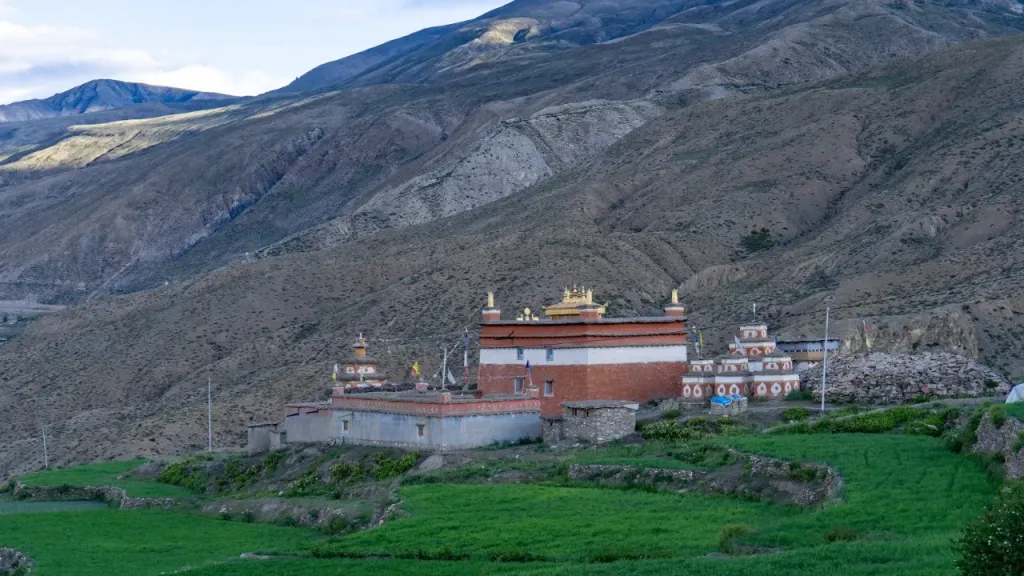
Green fields below a gompa in Upper Dolpo. Photo: North Nepal Travel & Trek.
The spring window closes in early July because the monsoon reaches the valleys at each end of the trek, and the flight record above shows what follows.
What is Upper Dolpo like from mid-September to November?
Autumn on the Upper Dolpo trek begins as the monsoon leaves the lower valleys and ends when winter snow starts to threaten the passes. It is the busier of the two windows, though busy in Dolpo means very few people.
Busy is relative here. In the five years to October 2025, 1,825 foreigners entered Shey Phoksundo National Park, The Kathmandu Post reported. That figure covers every foreign visitor to the park, including those who go no further than Phoksundo Lake. Spread across 3,555 km², Nepal's largest national park, it is very few people in any season.
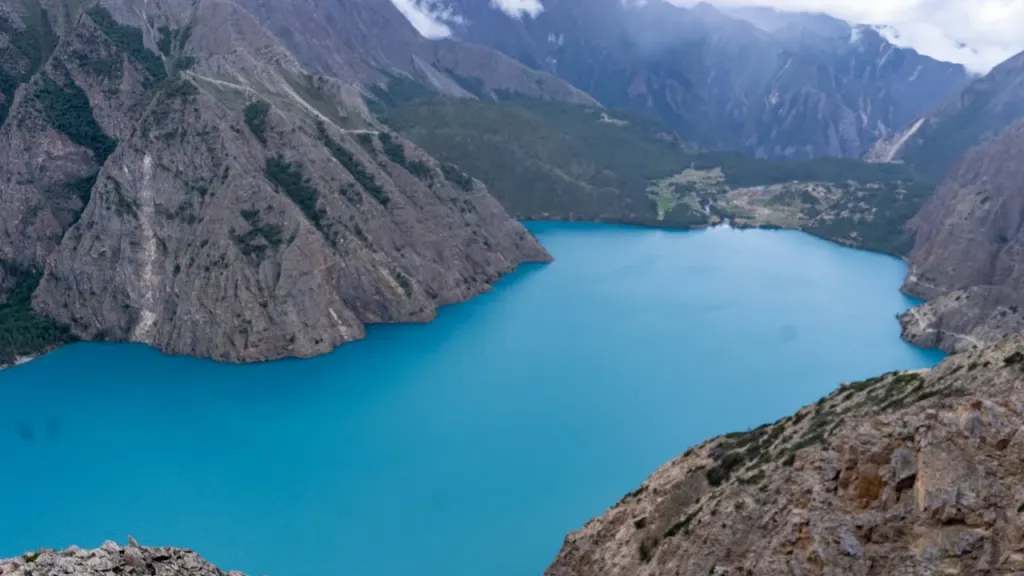
Phoksundo Lake, Nepal's deepest lake, in Shey Phoksundo National Park. Photo: North Nepal Travel & Trek.
The autumn nights get colder as October and November go on, and on a camping trek you feel that in a tent, not a lodge. Our guide to how hard the Upper Dolpo trek is covers what 16 nights under canvas ask of you. If you can choose your dates, start early in the window. Late starts are what put the passes at risk.
Can you trek Upper Dolpo in the monsoon?
Yes, on the plateau. Upper Dolpo lies in a rain shadow, but the monsoon still soaks the Himalayan valleys you walk through to reach it and grounds the Juphal flights. Plan a summer trek only with your operator's advice.
The rainfall figures explain the appeal. The park authority records less than 500 mm of rain a year on the northern slopes of Shey Phoksundo National Park, against 1,500 mm in the Suli Gad valley in the south, because the Dhaulagiri and Kanjiroba ranges block most of the monsoon. Most of what does fall comes between July and September.
The catch is that the Upper Dolpo trek doesn't start on the plateau. Our route flies into Juphal, walks down to Dunai at 2,140 m (7,021 ft) and follows the Suli Gad north to Phoksundo Lake, and the last days come back down the Thuli Bheri valley. Those are the monsoon days: wet trails, high rivers and the risk of landslides. The flight at each end is the least reliable link of all.
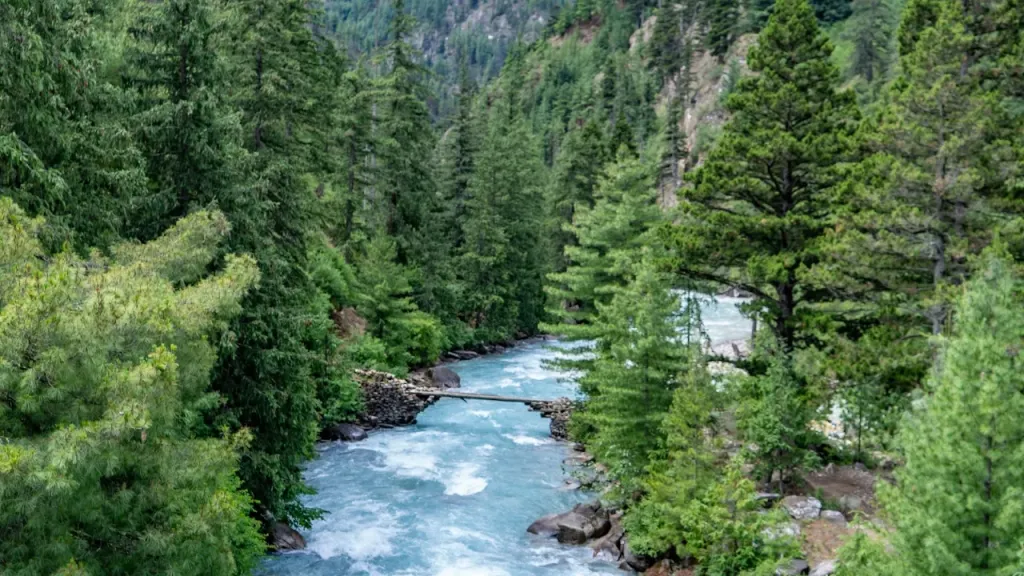
A river through conifer forest in the lower valleys of Dolpa, which take far more of the monsoon than the plateau. Photo: North Nepal Travel & Trek.
So my answer for July and August is: possible in the upper region, with caution. Before you book a summer trek, talk to your trekking agency about your dates, how many spare days you can carry and what happens if Juphal closes. If you want a summer trek with fewer of these risks, start with our guide to monsoon treks in Nepal.
Why don't we trek Upper Dolpo in winter or early spring?
From December to April, snow and cold close Upper Dolpo to a camping group. The park authority records frequent snowfall above 2,500 m in winter, and our itinerary sleeps at 3,600 m or higher for fourteen nights.
Fourteen nights in tents at that height, with temperatures below freezing above 3,000 m for much of the winter, is a different undertaking from a teahouse trek in the cold months. The airstrip doesn't help either: the February 2019 closure at Juphal was caused by snow.
Many Nepal season guides, including our own month-by-month guide to trekking in Nepal, list March and April as spring trekking months, and for teahouse routes they are. For a camping trek over three passes above 5,000 m, we start the Upper Dolpo season in mid-May.
Frequently asked questions
There is no single best month. The two windows for the Upper Dolpo trek are mid-May to early July and mid-September to November. In autumn, an earlier start leaves more room on the passes before winter snow.
On the plateau, yes, because Upper Dolpo lies in a rain shadow. But monsoon rain falls on the valleys at both ends of the trek, and Juphal flights can stop for weeks, as they did for 26 days in 2023. Take advice before booking.
Yes. The Dhaulagiri and Kanjiroba ranges block most of the monsoon. The northern slopes of Shey Phoksundo National Park get under 500 mm of rain a year, against about 1,500 mm in the Suli Gad valley to the south.
It can. In late October 2025, nine inches of snow fell across Upper Dolpa in two days, and tourists waited in the villages. Snow on the Upper Dolpo passes is more likely the later you go, so keep spare days if your trek runs into November.
Weather is the main risk to Juphal flights. Monsoon rain stopped them for about a week in July 2016 and for 26 days in 2023, and snow closed the airport in February 2019. Keep spare days at the end of your trip.
Not as a camping trek. From December to April, Shey Phoksundo National Park sees frequent snowfall above 2,500 m and freezing temperatures above 3,000 m, and the Upper Dolpo route crosses three passes above 5,000 m.
The yarsagumba harvest in Dolpa runs from mid- to late May into June and lasts about a month. In 2025 the pastures in Shey Phoksundo National Park opened on 18 May; the 2026 season was set to open in the final week of May.
The full Upper Dolpo route, dates and prices are on our Upper Dolpo Trek page, or message me on WhatsApp with the month you have in mind.
A native of the Annapurna region, he brings over 17 years of firsthand experience leading treks across the mountains of Nepal. His deep local roots and proven guiding expertise make him a trusted authority on authentic Himalayan adventures.