Upper Dolpo Trek Cost 2027: What You Pay, and Where the Money Goes
Published Oct 28, 2026 Updated Oct 28, 2026 10 min read
Quick answer
Upper Dolpo trek cost is driven by three things: a restricted-area permit of USD 500 per person for 10 days plus USD 50 a day after, four flights via Nepalgunj and Juphal, and a full camping crew.
A permit charged by the day, two flights each way, and a kitchen carried in on foot. A Pokhara operator's account of the most expensive trek on his list, and why the price is what it is.
In the five years to October 2025, 1,825 foreigners paid to enter Shey Phoksundo National Park, according to figures reported by The Kathmandu Post. That is the whole foreign footfall of a park of 3,555 square kilometres, the gateway to Upper Dolpo, across five trekking seasons. Part of the reason is distance. Part of it is price.
I run North Nepal Travel & Trek from Pokhara, and Upper Dolpo is the trek where clients go quiet when they see the price. I understand why. So instead of a brochure figure, this is the arithmetic: what each part of the price pays for, what happens to the cost when the mountains change the plan, and the costs nobody puts on the quote. Our current price and departure dates are on the Upper Dolpo Trek page.
Key facts
Itinerary24 days, Kathmandu to Kathmandu; days can change with weather
Start and finishJuphal airstrip, Dolpa, 2,475 m (8,120 ft)
Highest pointNangda La, 5,350 m (17,552 ft)
NightsLodges at either end, tents on the high section
The current price for our Upper Dolpo trek, with group rates and departure dates, is on the Upper Dolpo Trek package page. It covers the domestic flights, every permit, a licensed guide, porters, a cook and kitchen crew, tents and three meals a day from the airstrip back to the airstrip.
I keep the price in one place on purpose. Permit fees, flight fares and the exchange rate all move between seasons, and a number copied into an article goes stale long before anyone notices. What doesn't change is how the price is built, and that is what the rest of this page explains.
The per-person price also moves with the size of the group, more on Upper Dolpo than on any teahouse trek, because so much of the cost is shared kit and shared people. One trekker pays for a whole kitchen. Ten trekkers split it.
Where does the money in an Upper Dolpo trek go?
Three lines make up most of the Upper Dolpo price: a government permit charged by the day, two flights each way, and a camping crew. Everything else is the ordinary cost of a long trek: hotels, guide wages, food.
The permit. Upper Dolpo is a restricted area, and the Department of Immigration charges for every day you spend inside it. On a teahouse trek the permits are a rounding error. Here they are a line you notice.
The flights. Dolpa has a road now, but it is a long, rough drive, so our itinerary flies. You fly Kathmandu to Nepalgunj on the plains, sleep the night in the heat, and take a small plane the next morning up to the airstrip at Juphal. On the way home both flights usually connect in a single day. Four sectors, booked and paid for whether or not the weather cooperates.
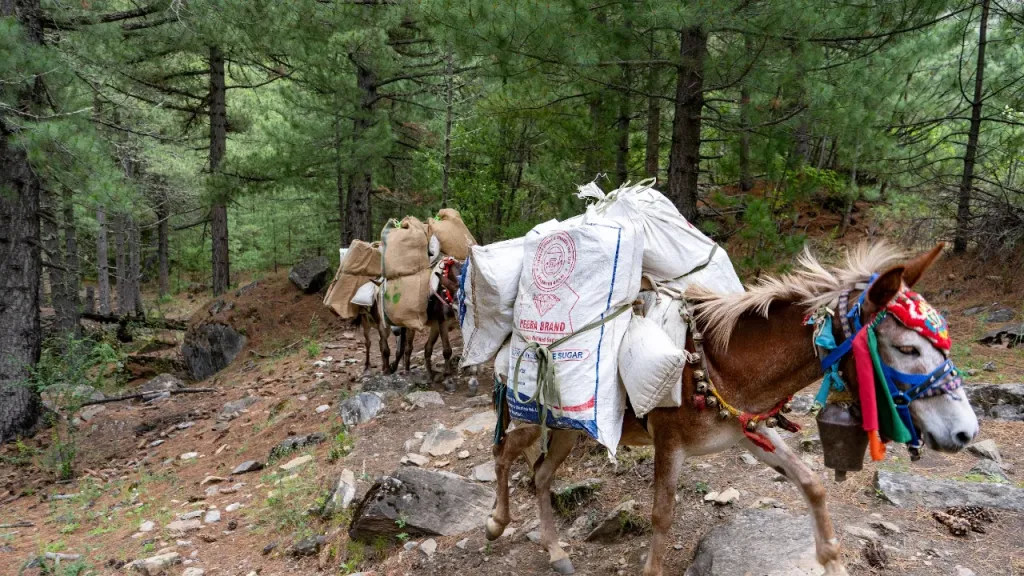
Pack animals carry supplies through the pine forest in Dolpa. Photo: North Nepal Travel & Trek.
The kitchen. Above Phoksundo Lake the itinerary is tents all the way, with nowhere reliable to buy a meal. A cook, his kitchen team and the porters carry tents, food and fuel for the whole group for the length of the high section. When a client asks what they're paying for, this is my honest answer: you are paying people to carry a small village over a 5,350 m pass so that you can eat a hot meal on the other side.
How much is the Upper Dolpo permit?
The Upper Dolpo restricted-area permit costs USD 500 per person for the first 10 days, then USD 50 per person for each day after, according to the Department of Immigration. You pay for days inside the restricted zone, not for the length of the whole trip. The zone covers Shey Phoksundo Rural Municipality wards 1 to 7, Dolpo Buddha wards 4 to 6 and Chharka Tangsong wards 1 to 6. How the permits are issued, and who may apply, is covered in our Nepal trekking permits guide.
Days inside Upper Dolpo
Permit per person
Up to 10
USD 500
12
USD 600
14
USD 700
16
USD 800
18
USD 900
20
USD 1,000
Only part of an Upper Dolpo trek falls inside the zone, and how many days depends on the route and on what the weather does to the plan. The detail worth knowing is that the first USD 500 buys ten days whether you use them or not, so a short stay inside the zone doesn't make the permit any cheaper. Where the price does climb is when an itinerary, or a delay, keeps you inside past day ten. If one quote sits several hundred dollars below the rest, ask how many permit days it includes.
Two smaller fees sit on top. The Lower Dolpo restricted-area permit is USD 20 per person per week, then USD 5 a day beyond the first week. Shey Phoksundo National Park charges foreigners NPR 3,000 at the gate, according to the Department of National Parks and Wildlife Conservation. That fee is set in rupees, so its dollar value moves with the Nepal Rastra Bank exchange rate.
You won't pay for a TIMS card. TIMS is not active at the moment, and an operator who bills you for one is charging for paper you'll never be asked to show.
What happens to the cost when the Upper Dolpo itinerary changes?
The Upper Dolpo itinerary can change once you're on it. Snow on a pass, a flight that can't land at Juphal, a landslide on the trail or an unwell trekker can add a day or reroute a section, and on Upper Dolpo an extra day costs more than it does on a teahouse trek.
Our 24 days is the plan, not a promise the mountains have signed. I say that to every Upper Dolpo client before they book, because the people who enjoy this trek most are the ones who arrive expecting the plan to bend.
Being prepared comes down to three things. Leave spare days between the end of the trek and your flight home, so a late plane out of Juphal costs you a hotel night rather than a missed connection. Buy insurance that covers trip delay as well as rescue. And ask before you book how extra days are handled. With us, whether an extra day is charged, and how, depends on the circumstances: what held the group, where, and for how long. The guide, the crew and the camp keep costing money every day the group waits, and a delay that keeps you in the Upper Dolpo zone past day ten adds USD 50 a day to the permit.
What isn't included in the Upper Dolpo price?
Your international flights, Nepal visa, travel insurance, tips and anything you buy for yourself sit outside the Upper Dolpo package price. None of them is large on its own, but together they are the difference between the quote and what leaves your bank account.
Cost
What to know
Nepal visa
The fee depends on length of stay. Buy one that covers the trip plus spare days for flight delays.
The plane to Juphal is small, and it doesn't fly when cloud closes the valley. When it can't go, there's another night in Nepalgunj, another set of meals, another morning at the airport, and the guest usually pays for them. Budget for them, and check that your insurance covers trip delay before you rely on it.
How much cash should you carry on the Upper Dolpo trek?
Carry every rupee you'll need for tips, drinks and small purchases before you leave Kathmandu or Nepalgunj. Dunai has an ATM, but it isn't one you can rely on: if it's empty or offline the day you pass, there is no second chance. Don't count on paying by card anywhere on the trail, and once the group walks out of Dunai there is nowhere to draw money until you're back.
Frequently asked questions
The current price of our 24-day Upper Dolpo trek is on the Upper Dolpo Trek package page. It includes domestic flights, permits, a licensed guide, porters, camping crew and meals on the trek. The Upper Dolpo permit alone is USD 500 for 10 days, then USD 50 a day.
The Upper Dolpo restricted-area permit is USD 500 per person for the first 10 days and USD 50 per person for each day after that. What you pay depends on how many days your itinerary keeps you inside the zone.
Upper Dolpo costs more because the permit is charged by the day, our itinerary flies in and out via Nepalgunj and Juphal, and there are no lodges on the high section, so a cook and porters carry the group's food, fuel and tents.
Usually, yes. Upper Dolpo and Upper Mustang both charge restricted-area permit fees, but Upper Dolpo is longer, our itinerary flies in and out, and it has no lodges on the high section.
No. TIMS is not active at the moment, so you should not be charged a TIMS fee for the Upper Dolpo trek.
Yes. Weather, cancelled Juphal flights or landslides can add days to the Upper Dolpo trek or change its route. Leave spare days before your flight home and ask your operator how extra days are charged.
No. Tips for the guide, porters and kitchen crew are not included in the Upper Dolpo price. They are not mandatory, but they are expected according to the service you receive.
The full route, departure dates and group prices are on our Upper Dolpo Trek page, or message me on WhatsApp with your dates.
Department of Immigration, Nepal, Trekking route and permit fee, https://immigration.gov.np/trekking-route-and-permit-fee, accessed 28 Oct 2026. Upper Dolpa USD 500 per person for the first 10 days, USD 50 per person per day beyond; Lower Dolpa USD 20 per person per week, USD 5 per day beyond one week.
A native of the Annapurna region, he brings over 17 years of firsthand experience leading treks across the mountains of Nepal. His deep local roots and proven guiding expertise make him a trusted authority on authentic Himalayan adventures.