Upper Dolpo Trek Packing List: What to Bring for 16 Nights in a Tent
Published Oct 29, 2026 Updated Nov 15, 2026 9 min read
Quick answer
Pack for camping, not teahouses. Bring a sleeping bag rated to −20°C comfort, a down jacket, layers for three passes above 5,000 m and a way to treat water, and keep your porter duffel to about 10–12 kg.
No lodge to warm up in, nothing to buy above Phoksundo Lake, and three passes above 5,000 m. A camping packing list for the Upper Dolpo trek, built around the 10–12 kg your porter carries for you.
Most packing lists for Nepal assume a lodge every night: a dining room with a stove, a shop selling chocolate and batteries, somewhere to dry your socks. Upper Dolpo has none of that for most of the trek. On our 24-day route you sleep in tents for 16 of 23 nights, and above Phoksundo Lake the only things you can rely on are what you brought and what our crew carries. This list is what I tell every Upper Dolpo client to pack, and what I tell them to leave behind. It goes with our guides to how hard the trek is, when to go and the permits you need.
Key facts
Nights in tents16 of 23, from Phoksundo Lake (Day 6) to Lashicap (Day 21)
Highest campNangdala High Camp, 4,717 m (15,476 ft), Day 9
Highest pointNangda La, 5,350 m (17,552 ft), Day 10
Porter allowance20–25 kg per porter, one porter for two trekkers
Your duffelAbout 10–12 kg
We can lendA down jacket and sleeping bag, if you need them
Not on the trailShops above Phoksundo Lake, reliable charging, a reliable ATM
What makes packing for the Upper Dolpo trek different?
Packing for the Upper Dolpo trek is different because it is a camping trek. You sleep in tents for 16 nights, there are no shops above Phoksundo Lake, and the park bans firewood, so your clothes and sleeping bag are your only heating.
On a teahouse trek, a forgotten hat costs you a few hundred rupees at the next lodge. On the Upper Dolpo trek it costs you a cold head for two weeks. Our cook, kitchen crew and porters carry the tents, the food, the fuel and the dining tent, so you never carry camp equipment yourself. What you do carry, or hand to your porter, is everything personal: clothes, sleeping bag, toiletries, medicines, snacks and batteries.
Shey Phoksundo National Park makes the cold more personal. The park prohibits firewood and campfires, and its own advice to visitors is to cook with kerosene or gas and bring enough warm clothing. After dinner there is no fire to sit around. There is the dining tent, your down jacket and your sleeping bag.
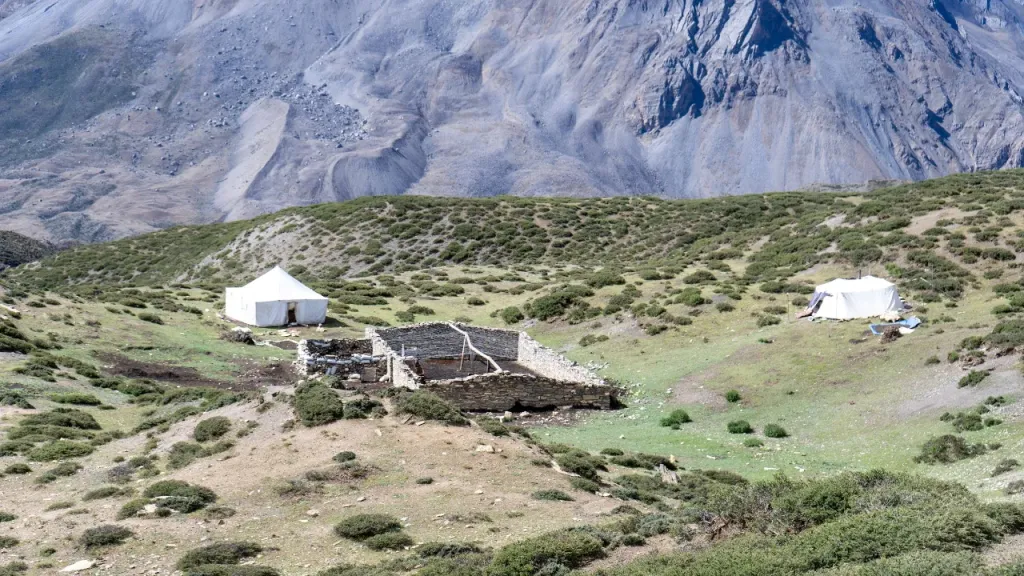
Two tents beside a stone enclosure on a high pasture in Upper Dolpo. Photo: North Nepal Travel & Trek.
How much can you bring on the Upper Dolpo trek?
On our Upper Dolpo trek one porter carries 20–25 kg for two trekkers, so your duffel should weigh about 10–12 kg. You carry your own daypack. The small plane into Juphal also has a strict baggage limit, which we confirm with your ticket.
Eleven kilos sounds tight for 24 days, and it is meant to be. The trick is to pack for the coldest night, not for every day. You will wear the same trekking trousers for a week at a time and nobody will mind. What matters is that the warm layers, the sleeping bag and the spare socks are all in the duffel and all dry.
Anything you won't use on the trek stays in Kathmandu: city clothes, the laptop, the second pair of shoes. If you are flying home soon after the trek, pack that bag before you leave for Nepalgunj so the last morning in Kathmandu isn't a scramble.
What sleeping gear do you need for Upper Dolpo?
For the Upper Dolpo trek, bring a sleeping bag rated to −20°C comfort, not −20°C limit, plus a liner. Your highest camp is Nangdala High Camp at 4,717 m (15,476 ft), and nights in the tents are cold even in the main seasons.
The comfort rating is the one to read. A bag sold as "−20°C" often means the limit at which you survive, not the temperature at which you sleep. If your own bag is lighter than that, we can lend you a sleeping bag and a down jacket for the trek; tell us when you book, so we can match the size.
A liner adds warmth and keeps the bag cleaner over 16 nights. An inflatable pillow weighs almost nothing and makes a bigger difference to your sleep than people expect. Sleep in a dry base layer and a warm hat, never in the clothes you walked in.
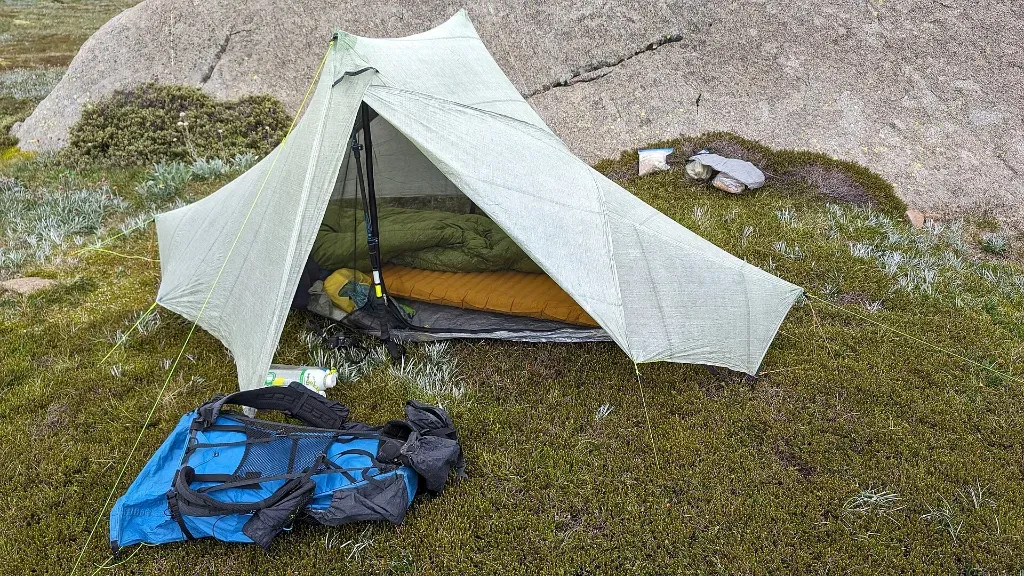
A sleeping bag and mat set up inside a trekking tent, with the pack left outside. Photo: Steve Bittinger, CC BY 2.0, via Wikimedia Commons.
What clothing do you need for the Upper Dolpo passes?
For the Upper Dolpo passes, you need layers you can add and remove all day: a base layer, a fleece, a down jacket and a wind and waterproof shell. Nangda La, Shey La and Choila North are all above 5,000 m, and the wind on top is the coldest part of the day.
Base layers: two sets of merino or synthetic, top and bottom. One to walk in, one kept dry for camp and sleep.
Mid layer: a fleece or light insulated jacket for walking in the cold mornings.
Down jacket: a warm, hooded one for camp evenings and the passes. We can lend one if you don't own one.
Shell: a waterproof and windproof jacket and trousers.
Trekking trousers: two pairs, plus warm trousers for camp.
Hands and head: liner gloves, insulated gloves, a warm hat, a sun hat and a buff.
Feet: broken-in waterproof boots, camp shoes, and five or six pairs of trekking socks, with one thick pair kept only for sleeping.
Boots are the one thing I won't let a client compromise on. Walk 50 km in them before you arrive. A blister on Day 4 is still with you on Nangda La on Day 10.
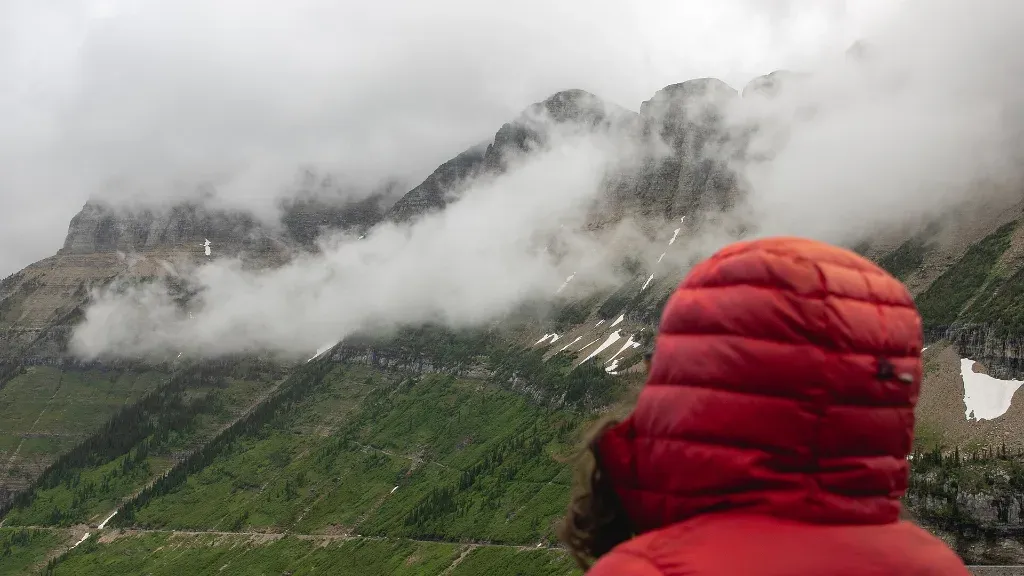
A hooded down jacket, the layer you live in at camp and on the passes. Photo: Glacier National Park (NPS), public domain, via Wikimedia Commons.
What goes in your daypack on the Upper Dolpo trek?
Your Upper Dolpo daypack holds what you need between camps: water, a warm layer, a shell, sunglasses, sun cream, snacks and a head torch. The porters and pack animals usually walk at their own pace, so you won't see your duffel until camp.
A 30 to 35 litre pack with a rain cover.
Two litres of water capacity: bottles or a bottle and a bladder.
Your fleece or down jacket, and your shell, even on a sunny morning.
Glacier-grade sunglasses (category 4), high-SPF sun cream and lip balm.
Snacks you actually want to eat at altitude.
A head torch with spare batteries.
Trekking poles. On the scree below the passes they are not optional.
Phone photos of your passport and permits.
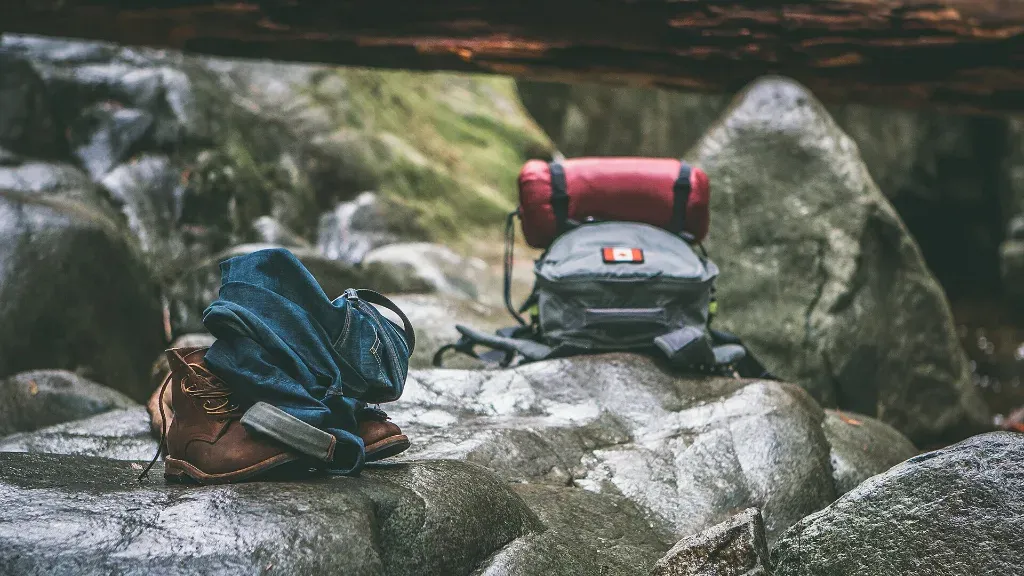
A daypack, boots and a pack with its sleeping bag strapped on. Photo: Andrew Ly, CC0, via Wikimedia Commons.
How do you treat drinking water on the Upper Dolpo trek?
On the Upper Dolpo trek, treat every drop of stream or tap water. The US Centers for Disease Control and Prevention calls boiling the best option: a rolling boil for 1 minute, or 3 minutes above 6,500 ft (about 1,980 m).
At camp, boiled water from the kitchen is the simplest way to fill your bottles. Between camps you need your own method. The CDC's advice is that most portable filters remove parasites but not viruses, and that chemicals such as chlorine dioxide kill viruses and bacteria but may not kill every parasite, so filter first and then disinfect. Bring tablets as a backup even if you carry a filter.
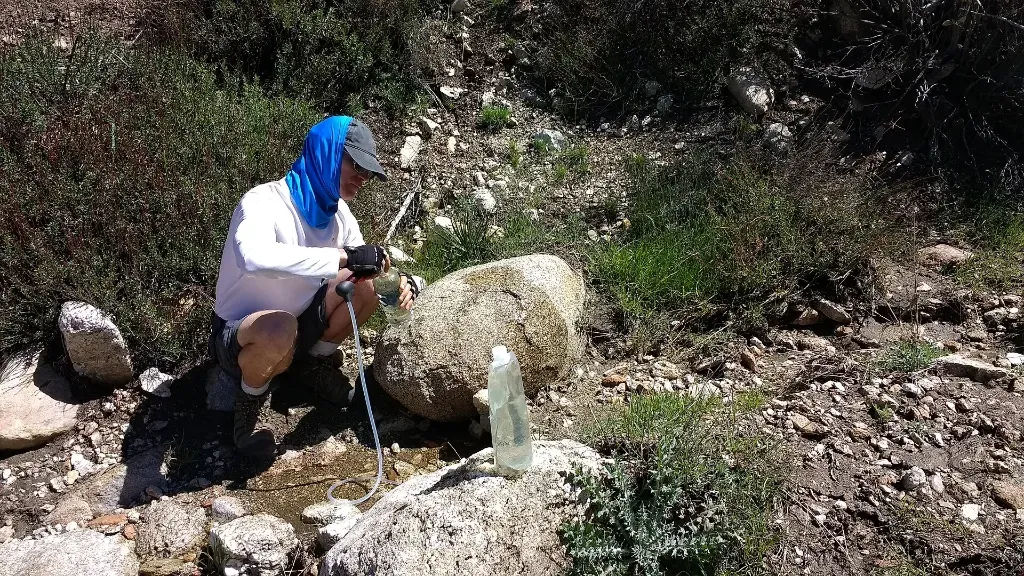
A hiker filtering stream water into a bottle. Filter first, then disinfect. Photo: Chris Hunkeler, CC BY-SA 2.0, via Wikimedia Commons.
Don't plan on buying bottled water. Shey Phoksundo National Park asks visitors to carry out plastic bottles, batteries and other non-biodegradable rubbish, so a refillable bottle is the right choice for the trail as well as the easiest.
What about charging, money and snacks on the Upper Dolpo trek?
On the Upper Dolpo trek, carry your own power, your own cash and your own snacks. There is no reliable charging on the high section, the ATM in Dunai can't be counted on, and above Phoksundo Lake there is nowhere to buy anything.
A 20,000 mAh power bank is the minimum for a phone and a camera over three weeks; a small folding solar panel helps if you take a lot of photos. Where charging and hot showers do exist lower down, they cost extra.
Bring all the cash you need for tips, drinks and small purchases from Kathmandu or Nepalgunj. Snacks are the other thing people underestimate. Appetite drops at altitude, and the chocolate or nuts you like at home become the thing you are glad you packed on Day 15.
Heads up
Cold drains batteries fast. A phone at 80% in the evening can be dead by morning in a tent at 4,000 m. Sleep with your phone, power bank and camera batteries inside your sleeping bag, and carry used batteries out with you: the park asks every visitor to take them home.
Frequently asked questions
Pack for a camping trek: a sleeping bag rated to −20°C comfort, a down jacket, warm layers and a windproof shell for passes above 5,000 m, broken-in boots, water treatment, a power bank and your own snacks.
On our Upper Dolpo trek one porter carries 20–25 kg for two trekkers, so your duffel should be about 10–12 kg. You carry your own daypack, and the small plane to Juphal has a strict baggage limit.
You need a bag rated to −20°C comfort. If you don't own one, North Nepal Travel & Trek can lend you a sleeping bag and a down jacket for the Upper Dolpo trek. Tell us when you book.
Not above Phoksundo Lake. Buy or rent what you are missing in Kathmandu or Pokhara before you fly to Nepalgunj, and pack enough snacks for the whole camping section.
Boil it, or filter and then disinfect it. The CDC recommends boiling for 3 minutes above 6,500 ft. At camp the kitchen boils water; between camps carry a filter and tablets.
Not reliably. There is no dependable charging on the high section of the Upper Dolpo trek, so carry a 20,000 mAh power bank and keep it warm in your sleeping bag at night.
Department of National Parks and Wildlife Conservation, Shey Phoksundo National Park (2019), https://dnpwc.gov.np/media/publication/Sey_phoksundo-_2019.pdf, accessed 29 Oct 2026. Firewood prohibited; no campfires, cook with kerosene or gas and take sufficient warm clothing; carry out batteries, plastic bags and bottles.
A native of the Annapurna region, he brings over 17 years of firsthand experience leading treks across the mountains of Nepal. His deep local roots and proven guiding expertise make him a trusted authority on authentic Himalayan adventures.