Mount Everest Climbing Gear: The Full Kit List, Costs and Nepal's Rules
Published Oct 26, 2026 Updated Oct 26, 2026 13 min read
Quick answer
To climb Mount Everest you need insulated 8,000 m boots, a one-piece down suit, crampons, a harness with a jumar and safety leashes for the fixed ropes, an oxygen mask and regulator, and a sleeping bag rated to about −29 °C (−20 °F). Bought new at list price, the personal kit costs at least USD 21,000.
Most Everest gear lists online are the same list reshuffled, with no prices and no sense of which items actually decide a climb. This one is built from the published kit and costs of climbers who have done it, and from what we see every season when our clients rent and fit climbing gear for Island Peak, Lobuche East and Mera. I have not stood on the summit of Everest myself, so where a number matters I tell you whose number it is.
Key facts
Summit height8,848.86 m (29,032 ft)
BootsInsulated 8,000 m boots, about USD 1,200
Down suitOne-piece, over USD 2,000
Sleeping bagRated to about −29 °C (−20 °F), at least USD 1,000
OxygenAbout USD 650 a bottle; at least five per climber
Personal kit from nothingAt least USD 21,000 at list price (Alan Arnette, 2026)
Nepal permit, springUSD 15,000 per foreign climber (from 1 September 2025)
What gear do you need to climb Mount Everest?
Think of it as a system for three problems: cold, terrain and thin air. Clothing and boots deal with the cold, metal hardware connects you to the fixed ropes, and the oxygen set keeps you working above about 8,000 m (26,247 ft). The kit changes as you climb, so it helps to see it by section of the route.
Section of the route
What you are dealing with
Gear that matters most
Base Camp, 5,364 m (17,598 ft)
Six to eight weeks of living in the cold
Warm sleeping bag, thick sleeping mat, down jacket, camp boots
Khumbu Icefall to Camp 1, 6,065 m (19,898 ft)
Ladders over crevasses, fixed ropes, ice
8,000 m boots, crampons, harness, jumar, two safety leashes, helmet
Western Cwm, Camp 2, 6,400 m (20,997 ft)
Strong sun reflected off snow, then cold nights
Light layers, glacier glasses, sun cover, warm bag
Lhotse Face, Camp 3, 7,200 m (23,622 ft)
Steep blue ice on fixed ropes
Crampons that fit your boots exactly, jumar, mitts that work with it
South Col, Camp 4, 7,920 m (25,984 ft), to the summit
Extreme cold, wind and thin air
Down suit, down mitts, goggles, oxygen mask and regulator
Group gear such as tents at the high camps, stoves, fixed ropes and the oxygen bottles themselves is normally supplied by the expedition, which is why your personal list is shorter than it first looks. Check exactly what your operator includes before you buy anything.
Clothing: layers, the down suit and your hands
Clothing works in three layers: a base layer next to the skin that moves sweat away, a warm middle layer of fleece or light down, and an outer layer that blocks wind. Alan Arnette, who has climbed Everest and writes the most detailed independent reports on the mountain, describes exactly this base, warmth and protection system.
The one-piece down suit is the big item. It is worn for the summit push, where the summit averages about −26 °C (−15 °F) even in May. Arnette uses a Mountain Hardwear Absolute Zero suit and calls it "almost too warm", which is what you want at 3 am above the South Col. Lower down, the Western Cwm can be hot in sunshine, so a light shell and sun hat matter as much as down.
Hands are where people lose fingers. On summit day Arnette wears big down mitts over a thick fleece liner glove, and carries a spare pair of down mitts for emergencies. Lower on the mountain he uses lighter leather gloves, which let you handle carabiners and ropes. Add a warm hat, a balaclava or face cover, glacier glasses for daytime and goggles for wind.
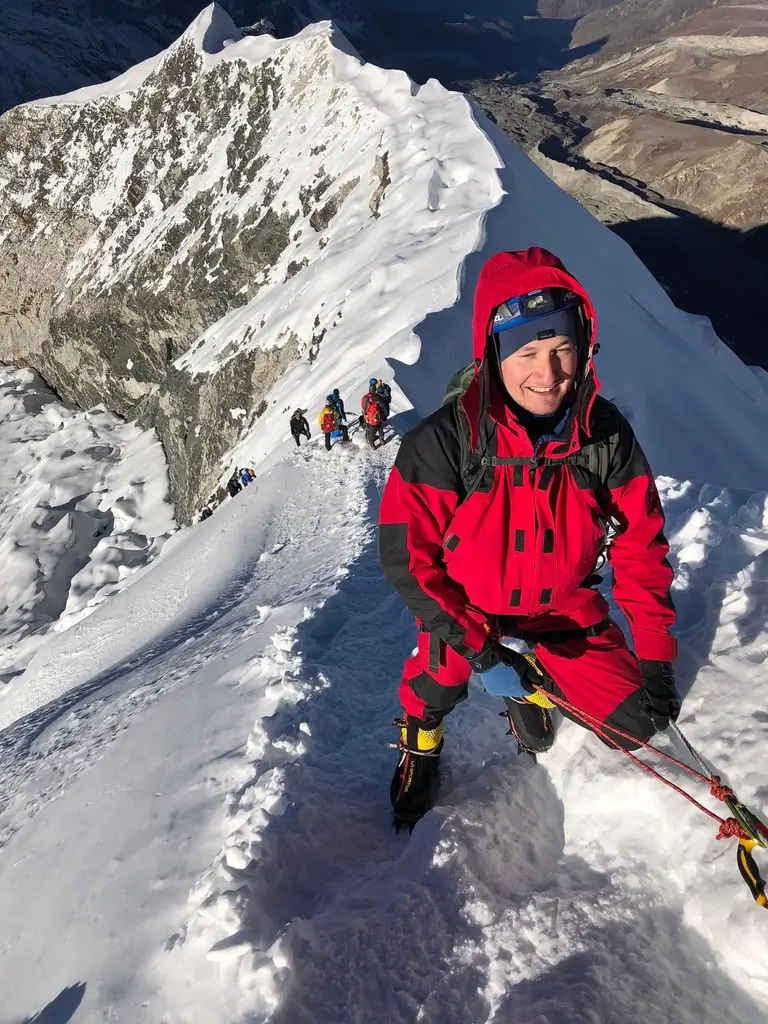
A climber on our Island Peak trip, 6,189 m (20,305 ft), in a full insulated suit. Everest uses the same system, only warmer. Photo: North Nepal Travel & Trek.
Boots, crampons and the hardware for the fixed ropes
Boots come second only to sleep on Arnette's list of what matters most. He uses La Sportiva Olympus Mons and names Zamberlan, Lowa and Scarpa as other good makes, and his advice is blunt: "Wrong boots will destroy your climb." Feet swell at altitude, so fit the boots with the socks you will actually wear, and train in them.
Crampons must be rigid steel twelve-point crampons that fit those boots exactly. A crampon coming off on the Lhotse Face is an emergency. Arnette has used Black Diamond Sabertooth and Grivel G14.
On the south side you do not rope up to other climbers. A rope-fixing team lays fixed lines up the route each season, and you clip into them. Your personal hardware is a harness, a jumar (a handled clamp that slides up the rope and grips under load), two safety leashes with locking carabiners so you stay clipped in while passing each anchor, a belay or rappel device such as a figure 8 for coming down, a helmet, and an ice axe for balance. The jumar has to work with your mitts on; Arnette notes that very bulky mitts may not fit it.
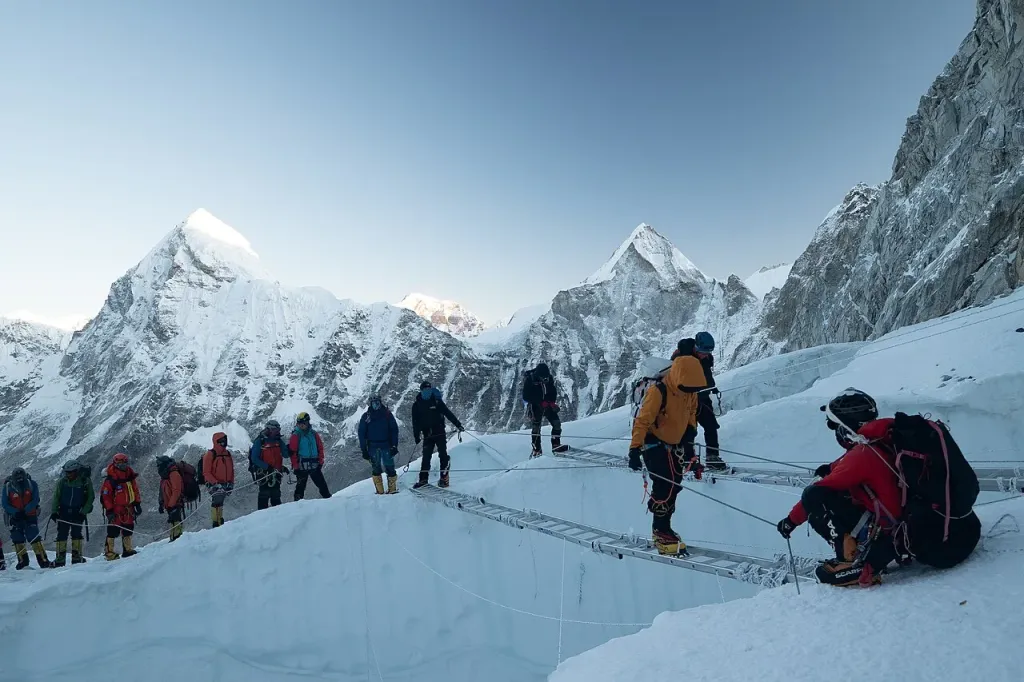
Crossing ladders in the Khumbu Icefall, May 2026. Crampons on metal rungs and a clip to the rope on both sides. Photo: AngeliSherpa, Wikimedia Commons, CC BY-SA 4.0.
Oxygen: mask, regulator and bottles
An oxygen set has three parts: the bottle, the regulator that sets the flow, and the mask. Arnette prices the mask at about USD 550, the regulator at about USD 550, and bottles at about USD 650 each, with a minimum of five bottles per climber, about USD 3,250.
How long a bottle lasts depends on the flow. A Poisk bottle gives about 6 hours at 2 litres per minute. Russell Brice, who ran Himex expeditions for many years, used 4 litres per minute on summit days and said the mask "seems to work perfectly" at that flow. On the earlier acclimatisation climbs, climbers normally sleep one night at Camp 3, 7,200 m (23,622 ft), without oxygen.
Most expeditions supply the bottles and carry them up to the high camps, so you rarely buy oxygen yourself. What you should do is practise with the mask and regulator before the summit push: how to change a bottle, how to read the flow, and how to clear ice from the mask with mitts on.
Sleeping gear, packs and food
Sleep is where people save weight and regret it. Arnette uses two sleeping bags rated to −20 °F (about −29 °C), one for base camp and one for the high camps, and found a 0 °F (−18 °C) bag marginal up high. He also warns against relying on bags and mats supplied by an outfitter, which are often old and flattened. A thick mat at base camp and a light inflatable mat higher up keep the cold ground away.
For the summit push you carry a small pack: water in an insulated bottle, snacks you can eat with cold hands, spare mitts, goggles and a headlamp. The expedition's kitchen and stoves melt snow for water at the high camps.
Heads up
The most common gear mistake we see on trekking peaks is the same one that ruins Everest climbs: boots and crampons that were never tried together. Fit both in Kathmandu or at home, walk in them, and check the crampons stay on before you leave. The second is power. Batteries and phones die in the cold, so keep them inside your suit and sleeping bag.
What Nepal now requires you to carry
Nepal requires each Everest climber to carry at least one GPS tracker or RECCO reflector, a small chip that helps rescuers find a person with a detector. ABC News, reporting in April 2025, said the rule followed the record death toll of 2023. Explorersweb notes that most technical jackets and high-altitude down suits, and some boots, already have a RECCO reflector built in, and that in practice no one checks every climber.
Climbers must also bring their own waste off the mountain in sealed bags, known as wag bags or poo bags, under a rule from the local Khumbu authorities. And on 8,000 m peaks, Nepal requires one guide for every two climbers.
A rule you may have read about, that you must first climb a 7,000 m peak in Nepal, is not law yet. The Tourism Bill containing it passed the upper house and went to committee in the House of Representatives in July 2026; the ministry wanted it in force for spring 2027. Later that month 58 lawmakers filed 263 amendments; one asks that Everest permits go only to climbers who have climbed a 7,000 m peak and two 8,000 m peaks in Nepal. Explorersweb expects the final law to differ significantly and thinks it is unlikely to be enforced by spring 2027. Check its status with your operator before you book.
How much does Everest gear cost, and should you rent or buy?
Arnette's 2026 cost report puts personal gear, meaning the down suit, boots, sleeping bags and the rest of your own kit, at at least USD 21,000 if you buy everything new at list price. The main items look like this.
Item
Typical cost (USD)
Rent or buy?
8,000 m boots
About 1,200
Buy and break in
One-piece down suit
Over 2,000
Buy, or rent in Kathmandu if it fits well
Sleeping bag, −29 °C (−20 °F)
At least 1,000
Buy; don't rely on old outfitter bags
Oxygen mask and regulator
About 550 each
Usually supplied by the expedition
Oxygen bottles
About 650 each, at least 5
Usually supplied by the expedition
Crampons, harness, jumar, carabiners
Not given in the report
Buy for Everest; renting is normal for a trekking peak
The gear is a fraction of the total. Arnette's 2026 medians on the Nepal side are USD 45,250 with a Nepalese operator, USD 54,000 with an international operator and a Sherpa guide, and USD 76,000 with an international guide. Nepal's permit for a foreign climber rose on 1 September 2025 to USD 15,000 in spring, USD 7,500 in autumn and USD 3,750 in winter and the monsoon.
For a trekking peak the answer is different. On our Island Peak, Lobuche East and Mera Peak climbs, climbing gear is not included in the package price, so clients bring their own or rent boots, crampons, harness and jumar in Kathmandu or Pokhara. Our Pokhara gear rental guide covers the shops.
Practise first: trekking peaks and the trek to base camp
The skills behind this gear are learnable, but they need to be automatic before Everest: walking in crampons, moving up a fixed rope with a jumar, clipping past anchors, and abseiling down. The trekking peaks in the Everest region are where most people learn them. Lobuche East, 6,119 m (20,075 ft), Island Peak, 6,189 m (20,305 ft), and Mera Peak, 6,476 m (21,247 ft), all use the same boots, crampons, harness and jumar. They are not 7,000 m peaks, so they would not meet the proposed rule, but they show you how your body and your gear handle the cold.
If you only want to see the mountain, you need none of this kit. The Everest Base Camp Trek reaches Kala Patthar, 5,644 m (18,517 ft), in good trekking boots and a down jacket. The Gokyo Lake Trek climbs Gokyo Ri, 5,357 m (17,575 ft), the Everest Three Passes Trek crosses three passes above 5,300 m, and the Pikey Peak Trek is a five-day trek with views of Everest from 4,065 m (13,337 ft).
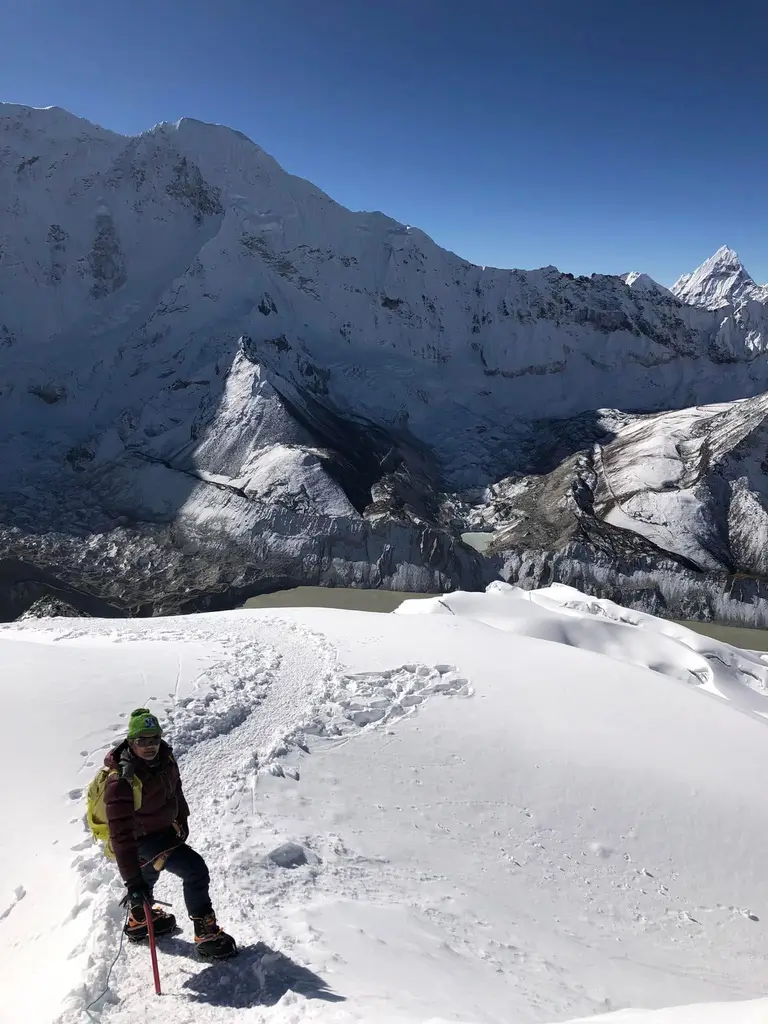
On Island Peak. The best place to learn your crampons and jumar is a 6,000 m peak, not Everest. Photo: North Nepal Travel & Trek.
Frequently asked questions
Insulated 8,000 m boots, a one-piece down suit, rigid steel crampons, a harness, a jumar, two safety leashes with locking carabiners, a rappel device, a helmet, an ice axe, down mitts with liner gloves, glacier glasses and goggles, an oxygen mask and regulator, and a sleeping bag rated to about −29 °C (−20 °F).
Alan Arnette's 2026 report puts personal gear at at least USD 21,000 if you buy everything new at list price. Boots cost about USD 1,200, a down suit over USD 2,000 and a sleeping bag at least USD 1,000. Oxygen bottles cost about USD 650 each, but the expedition usually supplies them.
Insulated 8,000 m mountaineering boots that take rigid crampons. Arnette uses La Sportiva Olympus Mons and also names Zamberlan, Lowa and Scarpa. Fit them with the socks you will climb in, because feet swell at altitude.
Almost every climber uses it. A Poisk bottle lasts about 6 hours at 2 litres per minute, and some expeditions use 4 litres per minute on summit day. Very few people have climbed Everest without bottled oxygen.
Tents, stoves, fixed ropes and oxygen are normally supplied by the expedition. Down suits and hardware can be rented in Kathmandu, but for Everest buy your own boots and sleeping bag, because fit and condition matter too much to leave to chance.
A RECCO reflector or GPS tracker for rescue, and bags to bring their waste off the mountain. Nepal also requires one guide for every two climbers on 8,000 m peaks.
Not by law, as of October 2026. The rule is in the Tourism Bill, which was still in committee with hundreds of amendments filed, some asking for stricter experience rules. It may not apply by spring 2027. Check the current status before you book.
No. The trek to base camp and Kala Patthar, 5,644 m (18,517 ft), needs trekking boots, warm layers, a down jacket and a sleeping bag, but no crampons, harness or oxygen.
Błażejczyk K., Havenith G., Szymczak R. K., "Simulations of the human heat balance during Mount Everest summit attempts in spring and winter", International Journal of Biometeorology 68, 2024 (summit −26 °C in May): https://link.springer.com/article/10.1007/s00484-023-02594-1
A native of the Annapurna region, he brings over 17 years of firsthand experience leading treks across the mountains of Nepal. His deep local roots and proven guiding expertise make him a trusted authority on authentic Himalayan adventures.