The Everest Expedition Timeline: Sixty Days, Week by Week
Published Oct 19, 2026 Updated Oct 19, 2026 16 min read
Quick answer
A standard Everest expedition from Nepal takes about 60 days, home to home. That covers one to three days in Kathmandu, seven to ten days trekking to base camp, three to four weeks of acclimatisation rotations, a wait for the May weather window, about a week for the summit push and a few days to get out.
We don't run Everest expeditions. We guide treks in the Khumbu, so every spring our guides walk the same trail as the expedition teams, sleep in the same lodges at Namche Bazaar and Dingboche, and watch the tents go up at base camp. This post follows an expedition through its calendar, week by week, and explains why each block of days is there. At the end I've matched each part of that calendar to the Everest-region treks you can do in 5 to 17 days.
Key facts
Typical lengthAbout 60 days, home to home
Kathmandu1 to 3 days for permits and gear checks
Trek to base camp7 to 10 days from Lukla
Acclimatisation rotations3 to 4 weeks
Summit pushAbout a week, base camp and back
Summit windowMid to late May; in 2026, about 80% of summits came between 17 and 26 May
First ascent, 195380 days from Kathmandu to the summit
What does a 60-day Everest expedition look like?
On the south side, a 60-day expedition breaks into six blocks: Kathmandu, the trek in, three to four weeks of rotations, the weather wait, the summit push and the trip home. The blocks add up to about 42 to 53 days on paper; the rest is a buffer for weather and illness.
Alan Arnette, who has climbed Everest and has reported on every season for years, advises booking 60 days home to home. His own breakdown of a south-side trip looks like this:
Block
Days
Where
Travel to Kathmandu
Up to 3
Home to Nepal
Trek to base camp
7 to 10
Lukla, 2,846 m (9,337 ft), to base camp, 5,364 m (17,598 ft)
Rotations
20 to 28
Base camp to Camps 1, 2 and 3
Summit attempt
About 7
Base camp to the summit, 8,848.86 m (29,032 ft), and back
Back to Kathmandu
About 3
Base camp to Kathmandu
Travel home
About 2
Nepal to home
Himalayan Database figures tell the same story from the other end: expeditions spend about 40 days on average after they reach base camp. Arnette's own sample schedule is longer still, landing in Kathmandu at the end of March and flying home in the first week of June, which leaves spare days for weather.
Here is how that looks week by week. Real teams shuffle these weeks around the weather, but the order rarely changes, and week 9 is often only a few days.
1
Week 1: Kathmandu and the flight to Lukla
Permits, briefings, gear checks, then the first days on the trail to Namche Bazaar.
2
Week 2: the trek to base camp
Acclimatisation days in Namche and Dingboche, then Lobuche, Gorak Shep and base camp.
3
Week 3: base camp and the first rotation
The puja ceremony, icefall training, then the first trip up to Camp 1 and often Camp 2.
4
Week 4: recovery
Rest at base camp or lower down the valley.
5
Week 5: the second rotation
Camp 2 as a working base, then a night at about 7,000 m, at Camp 3 on the Lhotse Face.
6
Week 6: recovery and the forecast watch
Some teams add a third rotation; most rest and watch the weather.
7
Week 7: the weather wait
Teams wait for the jet-stream winds to ease and the ropes to reach the summit.
8
Week 8: the summit push
About a week from base camp to the summit and back.
9
Week 9: down and out
Pack up base camp, walk or fly out to Lukla, fly to Kathmandu.
None of this starts on day one. Most climbers spend a year or more training and building up through smaller peaks before they book, which I've covered in how hard it is to climb Mount Everest.
Week 1: what happens in Kathmandu?
Expedition teams spend one to three days in Kathmandu. They meet the team, check every climber's gear against a list, buy what's missing in Thamel and collect the climbing permit, then fly to Lukla to start walking.
The permit is the one fixed cost no operator can discount. Nepal's royalty for Everest's normal route in spring is USD 15,000 per foreign climber, in force since 1 September 2025. The operator settles the rest of the paperwork, including national park entry, local municipality fees and the garbage deposit.
These days also matter for the team itself. People who will share a tent at 7,000 m meet for the first time over dal bhat in a hotel restaurant. A good expedition leader watches those first meals as closely as the gear checks.
Week 2: how long is the trek to Everest Base Camp?
The walk from Lukla to base camp takes expedition teams seven to ten days. It's the same trail our trekkers use, through Phakding, Namche Bazaar, Tengboche, Dingboche, Lobuche and Gorak Shep, and the slow pace is the first block of acclimatisation, not a warm-up.
From Lukla the trail drops to Phakding, 2,610 m (8,563 ft), and climbs the next day to Namche Bazaar, 3,440 m (11,286 ft). After a rest day there it goes on to Tengboche, 3,867 m (12,687 ft), with its monastery, and up to Dingboche, 4,410 m (14,469 ft), for a second rest day. Then come Lobuche, 4,940 m (16,207 ft), Gorak Shep, 5,164 m (16,942 ft), and the last stretch along the Khumbu Glacier to base camp.
Namche Bazaar, the main Sherpa town on the trail. Expedition teams and trekkers both spend an extra night here to acclimatise.
The pace comes from the body, not from tradition. The CDC repeats the Wilderness Medical Society guideline that above 3,000 m (9,843 ft) you should raise your sleeping altitude by no more than about 500 m (1,640 ft) a night, with a rest day every three to four days. A fit person could walk this trail much faster; nobody who wants to reach the summit does.
Many teams also use the walk to get higher. On rest days at Dingboche, groups often climb Nangkartshang Peak, 5,083 m (16,677 ft), and come back down to sleep. Some expeditions take their clients up Lobuche East, 6,119 m (20,075 ft), before they reach base camp. Arnette reckons that adds about a week, but it lets the body get used to about 6,000 m without the Khumbu Icefall.
If you trek to base camp in spring, this is the part of the expedition you share. Our Everest Base Camp Trek follows the same villages, with an acclimatisation day at Namche Bazaar, and reaches base camp on day 8. The difference comes at Gorak Shep: the climbers keep going, and you turn round for home.
Weeks 3 to 6: what are acclimatisation rotations on Everest?
A rotation is a round trip from base camp to a higher camp: climb up, sleep high for one or more nights, then come down to base camp to recover. On the south side, teams usually spend three to four weeks on two rotations, the second reaching about 7,000 m.
Before anyone climbs, the Sherpa teams hold a puja at base camp, a Buddhist ceremony asking the mountain for safe passage. Many Nepali climbing staff prefer not to enter the icefall before it has been held. Teams then practise ladder crossings and rope work on the ice near camp before the real thing.
The first rotation
Climbers leave base camp in the dark to cross the Khumbu Icefall before the sun loosens the ice, and climb to Camp 1, 6,065 m (19,898 ft), at the top of it. Most spend a night or two there or carry on to Camp 2, 6,400 m (20,997 ft), in the Western Cwm, then return to base camp. This is also when climbers learn the route through the icefall, its ladders and its timing.
The second rotation
Teams go back up to Camp 2 and use it as a working base, then climb the Lhotse Face on fixed ropes to Camp 3, 7,200 m (23,622 ft). Arnette's advice for climbers who will use bottled oxygen on summit day is to spend a night at about 7,000 m before the summit push, which on the south side means Camp 3. It's usually the hardest night of the expedition before the summit itself.
Crampon work on steep ice on Lobuche East, 6,119 m (20,075 ft). Expedition climbers practise the same skills before their first trip through the icefall.
Between rotations
Recovery days are part of the plan, not free time. Climbers eat as much as they can, sleep, dry their gear and check their oxygen masks. Some teams walk down to Pheriche or Dingboche, where the thicker air brings back appetite and sleep. If weather or illness gets in the way, a team may add a third rotation; some cut to one rotation to Camp 2.
Behind every client rotation, the Nepali guides and porters carry tents, fuel, food and oxygen up to stock the high camps. They cross the icefall many more times in a season than any client, and they carry most of its risk. If you're comparing operators, ask how those staff are paid and insured.
Week 7: why do Everest climbers wait for a weather window?
For most of the year, jet-stream winds blow across Everest's summit far too hard to climb. In May, as the monsoon builds, they usually ease for a few days, so by early May teams have done their rotations and are waiting for a forecast and for the fixed ropes to reach the summit.
The spring of 2026 shows how the calendar really runs. A serac blocked the route through the Khumbu Icefall for about two weeks, and it only reopened on 28 April, which squeezed everyone's rotations. The rope-fixing team reached the summit on 13 May. After that, about 80% of the season's summits came between 17 and 26 May, and 274 climbers reached the top on 20 May alone.
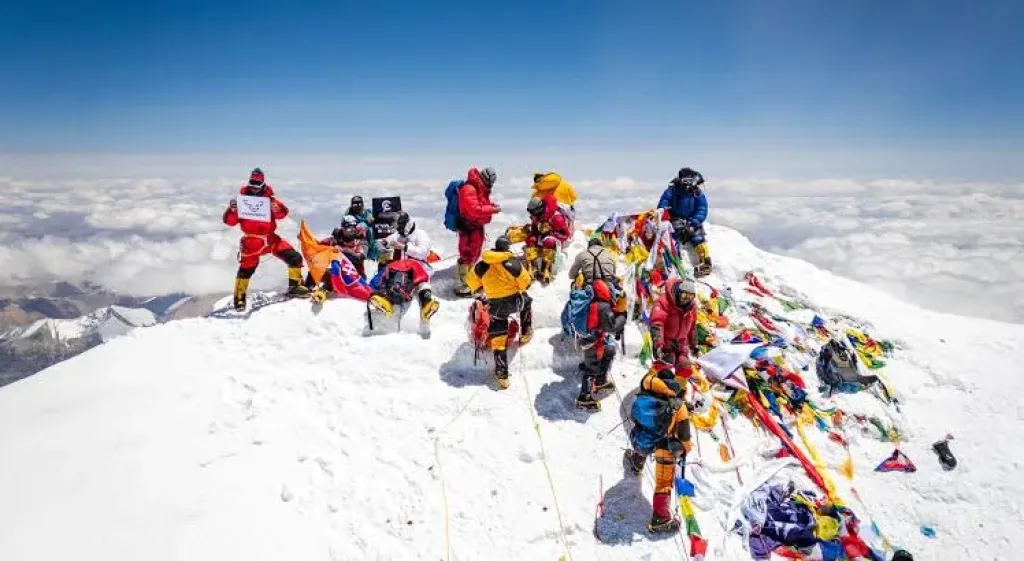
A busy summit morning on Everest. When a weather window opens, most teams try to use the same few days.
That's the problem with a short window: when every team reads the same forecast, they all go for the same days, and queues form on the ridge. Patient leaders often wait for a second window, even with a slightly worse forecast, to avoid the crowd. Ask any operator how they chose the summit day in their last three seasons.
Week 8: how long is the Everest summit push?
The summit push takes about a week from base camp and back. Climbers move up through Camps 2 and 3 to the South Col, leave for the summit late in the evening, and spend 9 to 18 hours on the round trip from the South Col to the top and back.
A typical plan on the south side looks like this:
Day
Climb
Sleep
Day 1
Through the icefall and the Western Cwm
Camp 2, 6,400 m (20,997 ft); some teams stop at Camp 1
Day 2
Rest
Camp 2
Day 3
Up the Lhotse Face; many climbers start bottled oxygen around here
Camp 3, 7,200 m (23,622 ft)
Day 4
To the South Col; rest, eat, drink, then leave late in the evening
A few hours at Camp 4, 7,920 m (25,984 ft)
Day 5
Summit, 8,848.86 m (29,032 ft), and back down
South Col
Day 6
Down the Lhotse Face
Camp 2
Day 7
Through the icefall for the last time
Base camp
Summit night is timed so climbers reach the top in the morning and get down before the afternoon weather. When Arnette summited in 2011, he left the South Col at 9:20 pm, stood on top at about 5 am, and was back at the South Col about 11 hours after leaving.
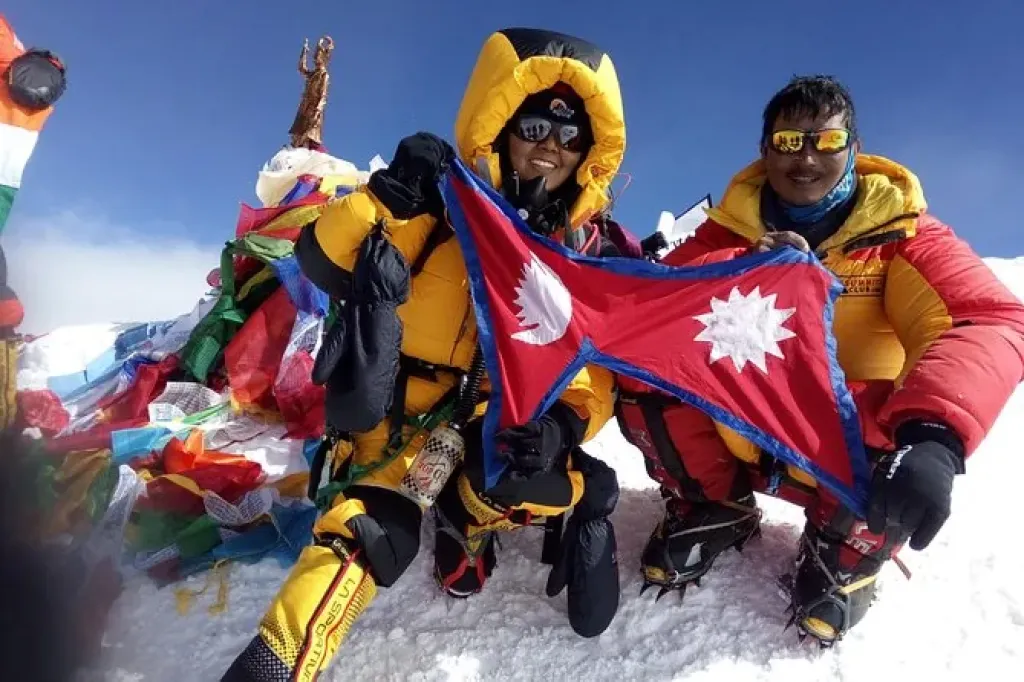
Two climbers with the flag of Nepal on the summit of Everest, 8,848.86 m (29,032 ft).
The turnaround time
Every serious team sets a turnaround time before summit night: whoever hasn't reached the top by then goes down anyway. It's the hardest rule on the mountain to keep, after two months and tens of thousands of dollars, with the summit an hour away. It's also the rule that brings people home. Ask an operator who makes that call, and whether they've ever turned a team round.
Week 9: how do climbers get home from Everest?
After the summit, most climbers are back at base camp within two days. Teams then pack up base camp and leave quickly; many climbers now fly out by helicopter, while others walk down to Lukla in a few days and fly to Kathmandu.
Base camp comes down almost as fast as it went up. Camps are stripped, rubbish is carried out against the garbage deposit, and the yak trains take the loads back down the valley. By the time the monsoon arrives in June, the moraine where a few hundred people lived for two months is nearly empty again.
Most climbers come home noticeably thinner and tired for weeks. Five to six weeks at or above base camp wears the body down even with good food, which is one more reason expeditions don't stay on the mountain longer than they need to. If you want to understand what that altitude does at trekking height, read what happens to your body at Everest Base Camp.
How do faster and slower Everest timelines differ?
The 60-day plan is the standard, but not the only one. Speed expeditions cut the trip to a few weeks by acclimatising at home; the north side runs a similar calendar from Tibet; and climbers without bottled oxygen need longer, not shorter.
Speed expeditions
Climbers sleep in altitude tents at home for weeks before they leave, then use generous bottled oxygen, and often helicopters for logistics, to cut the time in Nepal to two to four weeks. They cost USD 100,000 or more, and the days they save come out of the safety margin: less room for illness, a slow-adapting body or a late weather window.
The north side
From Tibet, teams drive to base camp at about 5,200 m (17,060 ft) instead of trekking, which takes about five days from Lhasa, and then spend about three weeks on rotations. China kept the north side closed to foreign teams in spring 2026, and as of late August no expedition was known to have an autumn permit.
Without bottled oxygen
A very small number of climbers go without supplemental oxygen. Arnette's advice is that they reach 8,000 m during acclimatisation, before the summit attempt, so their rotations go higher and the whole trip usually takes longer.
Everest and Lhotse together
Some climbers add Lhotse, 8,516 m (27,940 ft), which shares the route through the icefall and the Western Cwm and up the Lhotse Face. They use one set of rotations for both peaks, which usually adds days to the end of the trip rather than weeks.
How long did the first ascent of Everest take?
The 1953 British expedition took 80 days from Kathmandu to the summit. Its first party left Kathmandu on 10 March, reached Tengboche on 26 March, and Tenzing Norgay and Edmund Hillary stood on top at 11:30 am on 29 May.
There was no airstrip at Lukla, so the expedition walked in from the Kathmandu Valley with hundreds of porters, which took 16 days just to reach Tengboche. Our trekkers get there a few days after landing at Lukla. Flights, helicopters, better forecasts and fixed ropes have taken weeks off the logistics.
What hasn't shrunk is the acclimatisation. After reaching Tengboche, the 1953 team spent about three weeks acclimatising, from 26 March to 17 April, before the main climb. Today's teams spend three to four weeks on rotations. The body still needs the same time to adapt; speed expeditions just move part of it to a tent at home.
Which Everest-region trek fits into your own calendar?
You don't need 60 days to see Everest. Our Everest-region treks run from 5 to 17 days, and each one shows you a different part of the expedition's world, from a distant view of the summit to three passes above 5,300 m.
Base camp plus the Kongma La, Cho La and Renjo La passes: the closest a trekker gets to an expedition's rhythm
If you only have a week
The Pikey Peak Trek is the one I'd pick. It stays below 4,100 m, so altitude is far less of a worry, and the sunrise from the top shows Everest among a long line of peaks. Be ready for long drives on the first and last days.
If you want Everest without the crowds
The Gokyo Lake Trek leaves the main trail above Namche and climbs a parallel valley to the Gokyo lakes. From Gokyo Ri you look across the Ngozumpa Glacier to Everest, Lhotse, Makalu and Cho Oyu, and in May you share the view with far fewer people than at Kala Patthar.
If you want to stand where the climbers start
The Everest Base Camp Trek is the classic for a reason. In late April and early May you walk into base camp when the expedition tents are up and the season is in full swing, and you climb Kala Patthar for the view of the summit that base camp itself doesn't give you.
If you want the long version
The Everest Three Passes Trek crosses Kongma La, 5,535 m (18,159 ft), Cho La, 5,420 m (17,782 ft), and Renjo La, 5,360 m (17,585 ft), and visits base camp and Gokyo on the way. It's 17 days of long, high days, and only for trekkers who have already been to altitude and know how their body reacts.
Heads up
In April and May the trail above Namche is busy with yak trains and porters carrying expedition loads. When animals pass, always step to the hill side of the trail, never the drop side, and wait until the whole train has gone by. Expedition camps at base camp are private; don't walk into them unless you're invited.
Frequently asked questions
A standard Everest expedition from Nepal takes about 60 days, home to home. The core is three to four weeks of acclimatisation rotations from base camp; Himalayan Database figures show expeditions spend about 40 days on average after reaching base camp.
About a week from base camp and back. Climbers move up through Camps 2 and 3 to the South Col at 7,920 m (25,984 ft), leave late in the evening, and spend 9 to 18 hours on the round trip to the summit before descending to base camp over two more days.
A rotation is a round trip from base camp to a higher camp: climb up, sleep there, then come back down to recover. Most south-side teams do two rotations over three to four weeks, the second reaching Camp 3, 7,200 m (23,622 ft), on the Lhotse Face.
Late April to mid-May. By then the expedition tents are up at base camp and teams are on their rotations. In 2026, the icefall route reopened on 28 April and the fixed ropes reached the summit on 13 May.
Yes. Speed expeditions pre-acclimatise in altitude tents at home, then use generous bottled oxygen, and often helicopters for logistics, to cut the time in Nepal to two to four weeks. They cost USD 100,000 or more and leave less margin for illness or bad weather.
The 1953 British expedition left Kathmandu on 10 March and Tenzing Norgay and Edmund Hillary reached the summit on 29 May: 80 days. With no airstrip at Lukla, the team walked in, taking 16 days to reach Tengboche.
The 5-day Pikey Peak Trek. It reaches 4,065 m (13,337 ft), gives a distant view of Everest and its neighbours, and avoids the high-altitude nights of the base camp trail. For the base camp itself, allow 12 days.
A native of the Annapurna region, he brings over 17 years of firsthand experience leading treks across the mountains of Nepal. His deep local roots and proven guiding expertise make him a trusted authority on authentic Himalayan adventures.