How Hard Is It to Climb Mount Everest? Time and Challenges by the Numbers
Published Oct 19, 2026 Updated Oct 19, 2026 16 min read
Quick answer
Climbing Mount Everest takes about two months and costs most climbers USD 40,000 to 80,000. The climbing itself is technically moderate; altitude, cold, wind and crowds make it hard. In 2024, 68% of Everest climbers reached the summit.
We don't run Everest expeditions. We guide treks to Everest Base Camp and climbs of 6,000 m peaks such as Island Peak, so every spring our guides share the trail and the lodges with expedition teams on their way up. This post sets out what the climb asks of a person, stage by stage, using the most recent figures I could verify.
Key facts
Summit height8,848.86 m (29,032 ft)
Typical expeditionAbout two months, Kathmandu to Kathmandu
Typical cost (2026)USD 40,000 to 80,000
Nepal climbing royalty (spring)USD 15,000 per foreign climber
Summit rate68% in 2024
Death rate, 2000 to 20240.77 per 100 climbers above base camp
Main climbing seasonMay
Why does an Everest climb take two months?
A standard commercial Everest expedition takes about two months from arriving in Kathmandu to flying home. Most of that time goes on acclimatisation, not climbing. Speed expeditions that pre-acclimatise at home cut it to two to four weeks.
The two months break into blocks. There are a few days in Kathmandu for permits and gear checks, then the walk in to base camp on the same trail our trekkers use, through Namche Bazaar and Dingboche. After that come several weeks of rotations: climbing to the higher camps, sleeping there, and dropping back to base camp to recover. Then teams wait for a weather window, make the summit push over several days, and walk out. I've set out each block in detail in our Everest expedition timeline, week by week.
The length is set by the body, not by tradition. The CDC repeats the Wilderness Medical Society guideline that above 3,000 m (9,843 ft) you should raise your sleeping altitude by no more than about 500 m (1,640 ft) a night. On Everest the camps are much further apart than that, so climbers go up, come down, rest and go up again until their bodies have adapted enough for the summit push.
Speed expeditions cost USD 100,000 or more. The days they save come out of your safety margin: less room for illness, bad weather or a body that adapts slowly. The preparation before any of this, from training to warm-up climbs, usually takes a year or more.
What are the hardest sections of the Everest climb?
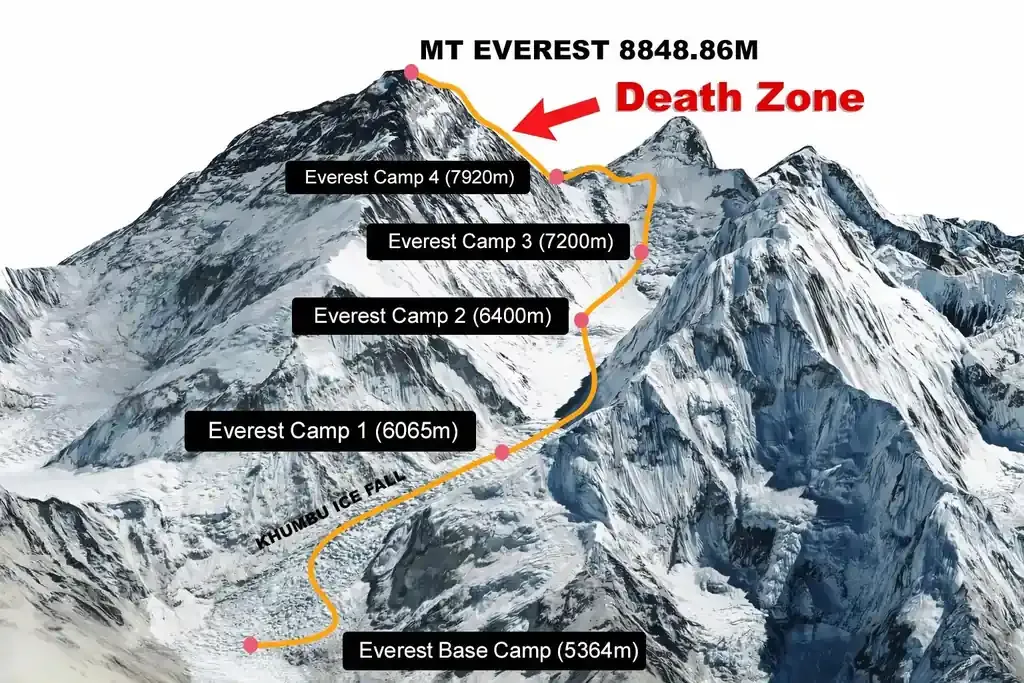
From Nepal, the route climbs the Khumbu Icefall, the Western Cwm and the Lhotse Face to the South Col, then follows the Southeast Ridge to the summit. Each section is hard in a different way.
Point on the route
Height
Main challenge
Everest Base Camp
5,364 m (17,598 ft)
Weeks of living at altitude
Camp 1, top of the Khumbu Icefall
6,065 m (19,898 ft)
Moving ice, ladders over crevasses
Camp 2, Western Cwm
6,400 m (20,997 ft)
Hidden crevasses, strong reflected sun
Camp 3, Lhotse Face
7,200 m (23,622 ft)
Steep hard ice on fixed ropes
Camp 4, South Col
7,920 m (25,984 ft)
Wind, cold, start of the death zone
Summit
8,848.86 m (29,032 ft)
A night-time push in very thin air
The South Col route from Everest Base Camp to the summit, with the four high camps. Image: North Nepal Travel & Trek.
The Khumbu Icefall
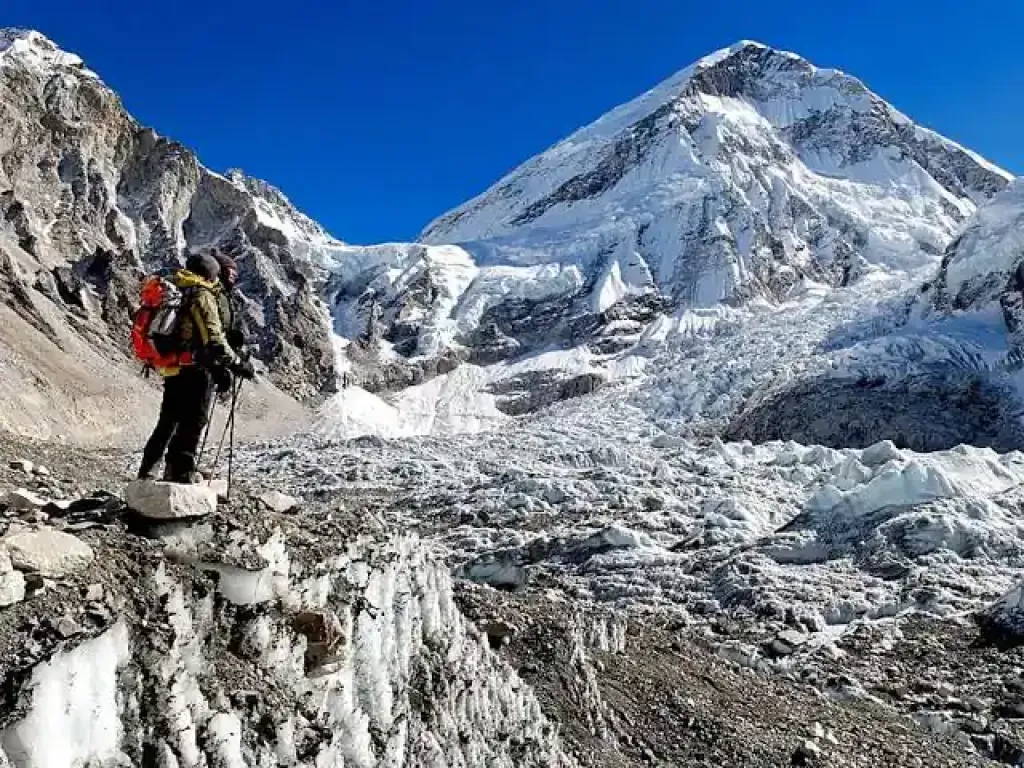
Just above base camp, the Khumbu Glacier breaks up as it drops over a steep step into towers of ice and deep crevasses. The glacier keeps moving, so the route changes through the season. A specialist team of Nepali climbers, the Icefall Doctors, fixes ropes and aluminium ladders through it each spring. In 2026 a serac blocked the route for about two weeks, and it only reopened on 28 April.
Skill helps less in the icefall than anywhere else on the mountain, because the main danger is ice falling from above. Climbers cross early, before the sun loosens it, and keep moving. The Nepali guides and porters who carry loads cross it far more often than their clients, and they carry most of its risk. In 2014 an avalanche in the icefall killed 16 Nepali mountain workers.
A trekker looking up at the Khumbu Icefall from the moraine near Everest Base Camp. Photo: North Nepal Travel & Trek.
The Western Cwm
Above the icefall the route enters the Western Cwm, a long glacier valley between Everest, Lhotse and Nuptse. The walking is easier, but crevasses hide under the snow, so climbers stay roped up. On still afternoons the snow walls reflect the sun and the valley gets surprisingly hot, which is why teams move early. Camp 1 sits at its lower end and Camp 2 near its head.
The Lhotse Face
From Camp 2 the route climbs the Lhotse Face, a long wall of hard blue ice. Climbers clip into fixed ropes and pull themselves up with a mechanical ascender for hours, kicking in with crampons. Camp 3 is a set of tents on ledges cut into the face, and most climbers start using bottled oxygen around here.
The death zone and summit ridge
From the South Col upward, roughly above 8,000 m, the body can no longer adapt and gets weaker by the hour. Teams usually leave Camp 4 late in the evening and climb through the night. When Alan Arnette summited in 2011, he left the South Col at 9:20 pm and stood on top at about 5 am, then needed about three hours to get back down to the col. The ridge passes the Balcony and the South Summit before the final snow slope, with long drops on both sides.
What does Everest's altitude do to the body?
At Everest Base Camp air pressure is about half of sea level, so each breath carries roughly half the oxygen. Near the summit it is far less, and above about 8,000 m climbers depend on bottled oxygen.
The Caudwell Xtreme Everest research team took blood from four climbers at about 8,400 m (27,559 ft), just below the summit. The average oxygen level in their arteries was 3.28 kPa. A normal reading is 12 to 14 kPa, and hospital patients below 8 kPa are treated as critically ill. Those climbers were walking and making decisions at levels doctors would treat as an emergency at sea level.
Lower down, the same changes that our trekkers feel on the way to base camp keep building: broken sleep, little appetite, a dry cough and weight loss over the weeks. The CDC treats high-altitude pulmonary oedema (fluid in the lungs) and cerebral oedema (swelling of the brain) as emergencies that need descent. Frostbite is a risk on every summit night. If you want the body-by-body version at trekking height, read what happens to your body at Everest Base Camp.
Bottled oxygen makes the biggest single difference to who reaches the top. Between 2000 and 2024, 80% of Everest expedition members who used bottled oxygen reached the summit, against 15% of those who climbed without it, according to Himalayan Database figures. It also adds a new risk: a frozen regulator or an empty bottle high on the ridge becomes an emergency straight away.
Why does the weather decide when you can climb Everest?
For most of the year, jet-stream winds blow across Everest's summit far too hard to climb. In May, as the monsoon builds, they usually ease for a few days, and nearly every summit happens then.
Expedition leaders pay specialist forecasters to predict those windows, and better forecasting is one reason the death rate has fallen. But good forecasts also send every team up on the same days. In 2026, the rope-fixing team reached the summit on 13 May, and about 80% of the season's summits came between 17 and 26 May.
A forecast is a probability, not a promise. Storms can build quickly in the afternoon, which is part of what turned the 1996 season into one of the worst on record, when eight climbers died in one storm. Good teams build spare days into the plan so they can wait for a better window rather than force a poor one.
Why are crowds a challenge on Everest?
When weather windows are short, hundreds of climbers try for the summit on the same few days, and queues form on the narrow ridge. Standing still above 8,000 m burns oxygen and body heat.
The 2019 photograph of a long line of climbers near the summit showed the problem to the world. It has not gone away. Spring 2026 was the busiest season on record, with 1,008 summits on the Nepal side, and 274 climbers reached the top on 20 May alone.
Experienced leaders now often choose a less popular summit day on purpose, even if the forecast is slightly worse, to avoid the queue. If you're comparing operators, ask how they decide the summit day and how they handle crowding.
How much does it cost to climb Everest, and who carries the risk?
Most Everest climbers pay USD 40,000 to 80,000 in 2026, including Nepal's USD 15,000 spring royalty. The Nepali guides who fix the ropes and carry the loads take on more risk than the paying clients.
The price buys the support that makes the modern success rate possible: fixed ropes to the summit, oxygen stocked at the high camps, forecasting, cooks and doctors at base camp, and usually a Nepali guide climbing beside each client. Cheaper packages usually carry less oxygen and fewer staff, which leaves less margin when something goes wrong. Our post on how many people have climbed Mount Everest breaks the 2026 prices down by type of operator.
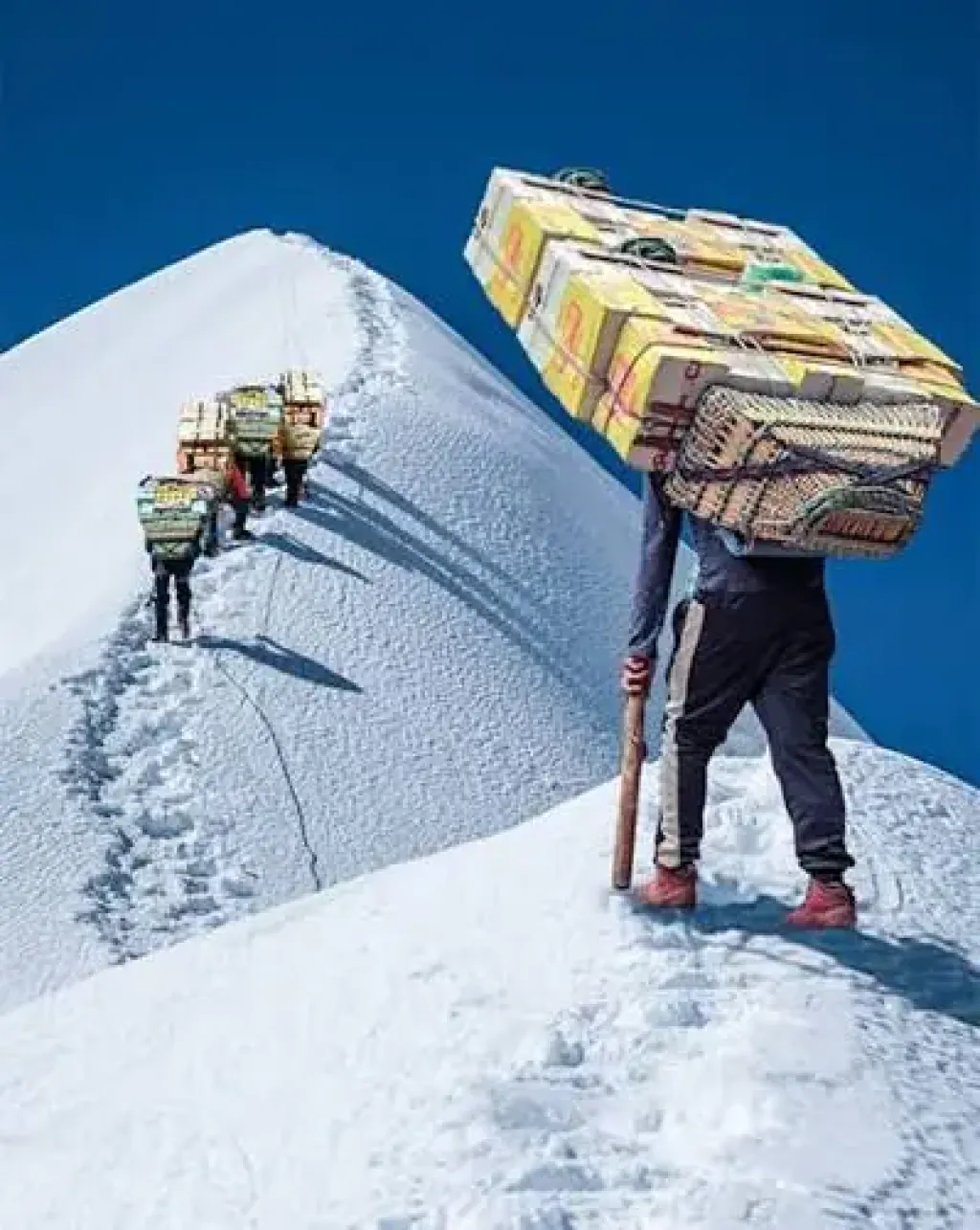
The workforce reaches the top more often than the customers. Of the 13,737 Everest ascents recorded to December 2025, 7,081 were made by hired climbers, mostly Sherpa and other Nepali guides. They also cross the icefall many more times in a season than any client, carrying tents, food and oxygen to the camps. A decent operator pays, insures and equips its staff properly, and it's fair to ask about that before you book.
Porters carrying loads up a snow ridge. On Everest, Nepali guides and porters carry most of the weight. Photo: North Nepal Travel & Trek.
How do you prepare for climbing Everest?
Preparation for Everest takes a year or more. Most climbers build up through a trek to Everest Base Camp, a 6,000 m peak and then a 7,000 or 8,000 m expedition, while training for long days with a heavy pack.
The usual ladder starts with trekking peaks such as Island Peak, 6,189 m (20,305 ft), or Lobuche East, 6,119 m (20,075 ft), both in the Khumbu. These teach crampon work, fixed ropes and how your own body handles real altitude, where a mistake is easier to recover from. Climbers then usually take on an 8,000 m peak such as Manaslu before Everest. Nepal may soon make this formal: a Tourism Bill passed by the National Assembly in February 2026 would require Everest applicants to have climbed a 7,000 m (22,966 ft) peak in Nepal first, but as of July 2026 it was still in a parliamentary committee and not yet law.
Fitness takes months to build. Long uphill days with a pack, back-to-back training days and strength work matter more than speed. Our 16-week Himalayan training plan is a good base for a trekking peak; Everest needs much more on top of it.
Choosing an operator
Before you sign, ask these questions and compare the answers in writing:
How many Nepali guides climb with each client, and how many bottles of oxygen does each client have, including spares?
Who makes the turnaround call on summit day, and have they ever turned a team around?
How are the Nepali staff paid and insured?
How many seasons has this team worked on Everest?
Can you speak to past clients, including some who didn't summit?
The last part of preparation is deciding your turnaround rules before you leave base camp. On summit day there will be a moment, a queue, a slow pace or a failing regulator, when going on and turning back both look reasonable. Climbers who decided in advance make that call better than those who decide on the ridge.
Is the north side of Everest easier?
The north side from Tibet has no Khumbu Icefall, and you can drive to base camp. But it is colder and windier, and summit day stays high for longer. Neither side is easy.
On the north side, vehicles reach base camp at about 5,200 m (17,060 ft), near Rongbuk Monastery. From there the route follows the North Col and the Northeast Ridge, crossing rock steps high on the ridge. A climber in trouble high on the north ridge has a long, exposed way down.
China controls access closely. It kept the north side closed to foreign teams in spring 2026, and as of late August it was still closed with no autumn permits issued; outfitters expect it to reopen in spring 2027. When it is open, the Tibet-side permit costs about USD 15,800 to 18,000 per person for teams of four or more. Far fewer people climb from the north, which is one reason fewer deaths are recorded there: 110 on the Tibet side against 229 on the Nepal side, to December 2025. Our Kailash Mansarovar and Everest Base Camp tour visits the north base camp without any climbing; ask us about the current Tibet permit situation before you plan it.
How has climbing Everest changed since the 1920s?
Everest has become more achievable with each generation. Fixed ropes, bottled oxygen, better forecasting and professional Nepali guiding have raised the summit rate and cut the death rate, while making the mountain far more crowded.
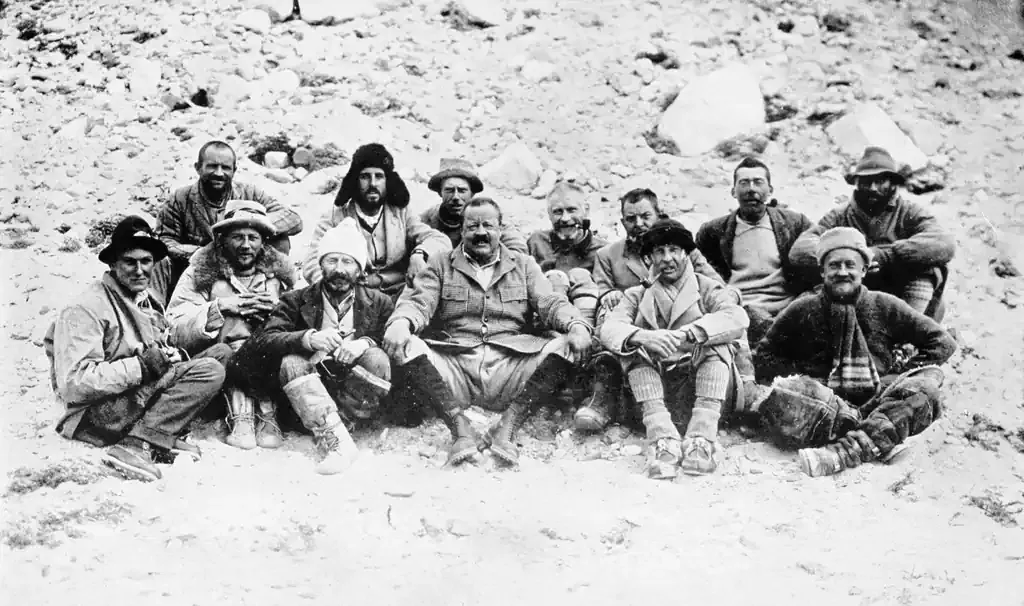
The British expeditions of the 1920s approached from Tibet in tweed and wool. In 1924, Edward Norton climbed above 8,500 m without bottled oxygen, and George Mallory and Andrew Irvine disappeared high on the north ridge. Tenzing Norgay and Edmund Hillary made the first ascent on 29 May 1953 by the South Col route. Reinhold Messner and Peter Habeler showed in 1978 that Everest could be climbed without bottled oxygen, and commercial guiding grew from the 1990s.
Members of an early British Everest expedition in the 1920s. Photo: public domain.
The numbers show how much has changed. Between 1990 and 2005, only about 30% of first-time expedition members reached the top; in 2024 the summit rate was 68%. The death rate fell from 1.80 for every 100 climbers above base camp before 2000 to 0.77 between 2000 and 2024. Each improvement also made the mountain look possible to more people, which is how we got the queues.
So how hard is Everest, really?
Technically, the standard routes on Everest are moderate. Physically and mentally, it is one of the hardest things a person can choose to do: two months of fatigue, then a night-long push in very thin air.
The modern figures say that good preparation and support work: about two in three climbers now reach the summit, and the death rate is less than half what it was before 2000. Everest rewards a climber who is well prepared, well supported and honest about turning around, and it is unforgiving of everyone else.
If what you want is to stand under the mountain rather than on top of it, the trek to Everest Base Camp follows the expedition approach, with the same villages, lodges and views, in about two weeks and with no climbing skills. Altitude is still the real challenge on the trek, so the itinerary matters more than your fitness.
Heads up
You can't see the summit of Everest from base camp, because Nuptse blocks the view. For the classic close view, our groups climb Kala Patthar, 5,644 m (18,517 ft), above Gorak Shep before sunrise. It's cold and steep, and it's the moment most guests remember.
Frequently asked questions
Most of an Everest expedition is spent letting the body adapt. Climbers make several rotations up to the higher camps and back to base camp, then wait for the jet-stream winds to ease, which is why a standard trip lasts about two months.
The standard routes from Nepal and Tibet are technically moderate: steep snow and ice on fixed ropes, ladders over crevasses and short rock steps. The difficulty comes from altitude, cold, wind and weeks of fatigue, which is why preparation and support matter more than rock-climbing skill.
The death zone is the part of Everest above about 8,000 m, where the air is too thin for the body to adapt and it gets weaker by the hour. On the Nepal side it starts around the South Col, and climbers spend the whole summit night there, nearly all using bottled oxygen.
Between 1990 and 2005, only about 30% of first-time expedition members reached the top of Everest; in 2024 the summit rate was 68%, according to the Himalayan Database. Bottled oxygen, fixed ropes, better forecasting and strong Nepali guiding explain most of the improvement.
Not usually. When the north side is open, the Tibet-side permit costs about USD 15,800 to 18,000 per person for teams of four or more, against Nepal's USD 15,000 spring royalty. China kept the north side closed to foreign teams in spring 2026, and as of late August no autumn permits had been issued.
Most climbers build up through a 6,000 m peak such as Island Peak or Lobuche East and then a 7,000 or 8,000 m expedition, learning crampon work, fixed ropes and oxygen systems. A Nepal Tourism Bill would require a 7,000 m Nepali peak first, but as of July 2026 it was not yet law.
Nearly all Everest summits happen in May, when the jet-stream winds ease for a few days before the monsoon. In 2026, about 80% of the season's summits came between 17 and 26 May. Autumn and winter ascents are rare.
No. The trek to Everest Base Camp at 5,364 m (17,598 ft) follows a walking trail with no ropes or ladders. The challenge is altitude, so a licensed guide and an itinerary with a proper rest day matter more than climbing skill or fitness.
Huey RB, Salisbury R, Wang JL, Mao M, "Effects of age and gender on success and death of mountaineers on Mount Everest", Biology Letters, 2007: https://pmc.ncbi.nlm.nih.gov/articles/PMC2391200
A native of the Annapurna region, he brings over 17 years of firsthand experience leading treks across the mountains of Nepal. His deep local roots and proven guiding expertise make him a trusted authority on authentic Himalayan adventures.