How Cold Is Mount Everest? Summit, Camp and Base Camp Temperatures
Published Oct 26, 2026 Updated Oct 26, 2026 7 min read
Quick answer
In May, the main climbing month, Everest's summit averages about −26 °C (−15 °F), with winds near 58 km/h. In winter it is near −40 °C (−40 °F). The base camp weather station averages below freezing over a year.
Everest's cold gets exaggerated in both directions. Some websites quote −60 °C as if it were normal; others make base camp sound like a ski resort. Since 2019 a line of weather stations has measured the mountain from 3,810 m (12,500 ft) upwards, reaching 8,810 m (28,904 ft) in 2022, so we no longer have to guess. These are the measured and modelled figures, and what they mean for climbers on the summit and for our trekkers at base camp.
Key facts
Summit, May averageAbout −26 °C (−15 °F), wind about 58 km/h (36 mph)
Summit, winterAbout −40 °C (−40 °F), with much stronger wind
Balcony, 8,430 m (27,657 ft)−45 °C to −1 °C (−49 °F to 30 °F), May 2019 to January 2020
South Col, 7,945 m (26,066 ft)−29.7 °C (−21 °F) in February, −12.2 °C (10 °F) in July, monthly means
Base Camp station, 5,315 m (17,438 ft)−3.1 °C (26 °F) mean over the year
Phortse, 3,810 m (12,500 ft)4.1 °C (39 °F) mean over the year
Cooling with heightAbout 6 to 6.5 °C for every 1,000 m (3,281 ft)
How cold is the summit of Mount Everest?
In May, when almost everyone climbs, the summit averages about −26 °C (−15 °F), with an average wind of about 16 m/s, around 58 km/h (36 mph). That is the figure from a 2021 analysis of summit weather by Robert Szymczak and colleagues, quoted in their 2024 study of climbers' heat balance.
Winter is far harsher. The same research team put the summit air at about −40 °C (−40 °F) during winter summit attempts, with mid-winter winds averaging around 41 m/s, about 148 km/h (92 mph). Their model estimated that a climber forced to spend a night in the open without a tent would lose about 4 °C of body temperature in May, but about 14 °C in December.
Wind turns cold into danger. On 9 May 2022, while a team installed the highest weather station on Earth at 8,810 m (28,904 ft), the wind was 64 km/h (40 mph) and the wind chill about −40 °C (−40 °F), even though it was the climbing season.
How cold is it at each camp on Everest?
The National Geographic and Rolex Perpetual Planet weather stations have measured the mountain at six heights. A study of their data, published in October 2026, gives these figures for the stations from Phortse up to the South Col.
Station
Height
Measured temperature
Phortse
3,810 m (12,500 ft)
4.1 °C (39 °F) mean over the year
Base Camp
5,315 m (17,438 ft)
−3.1 °C (26 °F) mean over the year
Camp II
6,464 m (21,207 ft)
−10.2 °C (14 °F) mean over the year
South Col
7,945 m (26,066 ft)
−12.2 °C (10 °F) in July to −29.7 °C (−21 °F) in February, monthly means
Balcony
8,430 m (27,657 ft)
−23 °C (−9 °F) mean, from −45 °C to −1 °C, May 2019 to January 2020
The Balcony figures come from a separate study by Szymczak and Krzysztof Błażejczyk. That station ran for only about eight months before strong winds knocked it over in January 2020, so its numbers cover a shorter period than the others.
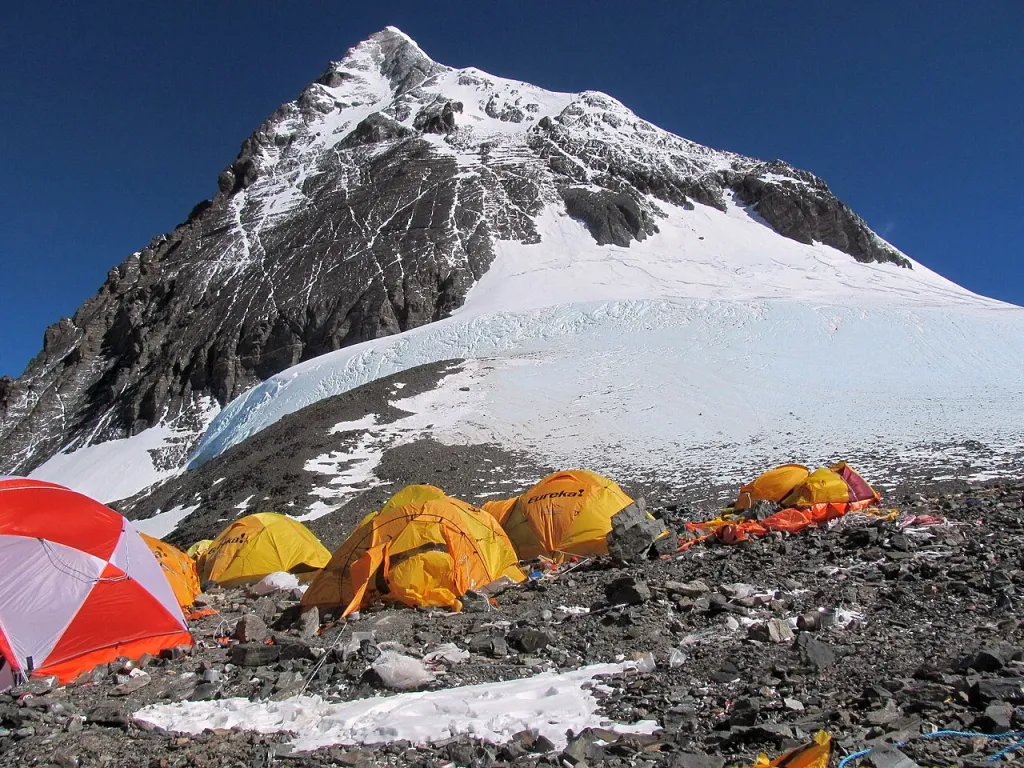
Tents at the South Col, about 7,900 m (25,919 ft), below Everest's summit pyramid. The South Col station averages −29.7 °C in February. Photo: Tirthakanji, Wikimedia Commons, CC BY-SA 3.0.
Why is Everest so cold?
Height first. Air cools by about 6 to 6.5 °C for every 1,000 m (3,281 ft) you climb, and the stations on Everest show about that rate. The summit is roughly 3,500 m (11,483 ft) above base camp, so it is over 20 °C colder before the wind is counted. The air is also thin, with about a third of the pressure at sea level, so it holds and carries less heat.
Wind second. In winter the jet stream sits over the summit, and the wind strips heat from anything in it. The white plume you often see blowing off Everest's summit from Kala Patthar is snow carried by that wind.
The plume off Everest's summit is snow blown by high-altitude wind. Photo: North Nepal Travel & Trek.
Why do climbers go in May?
Because the wind drops. In late spring the jet stream moves north before the monsoon, and for a few days at a time the summit winds fall low enough to climb. The temperature is still about −26 °C (−15 °F), but with less wind a climber can keep warm.
Błażejczyk, Havenith and Szymczak found that with the right clothing and pace, climbers in May can stay in heat balance above 8,000 m (26,247 ft). In winter they could not: the body kept losing heat, and the model put survival for an unsheltered night at about 9 hours. Winter ascents of Everest are rare.
Below freezing at night in every trekking season. The weather station at base camp, 5,315 m (17,438 ft), averages −3.1 °C (26 °F) over the whole year, and nights are much colder than days. The lodges at Lobuche and Gorak Shep have no heating in the bedrooms; the only warm room is the dining room, around the stove in the evening.
Our 12-day Everest Base Camp Trek provides a sleeping bag and a duffel bag, and we send every trekker a full packing list. Bring a proper down jacket, warm gloves and a hat, and layers you can add and remove as the sun comes and goes.
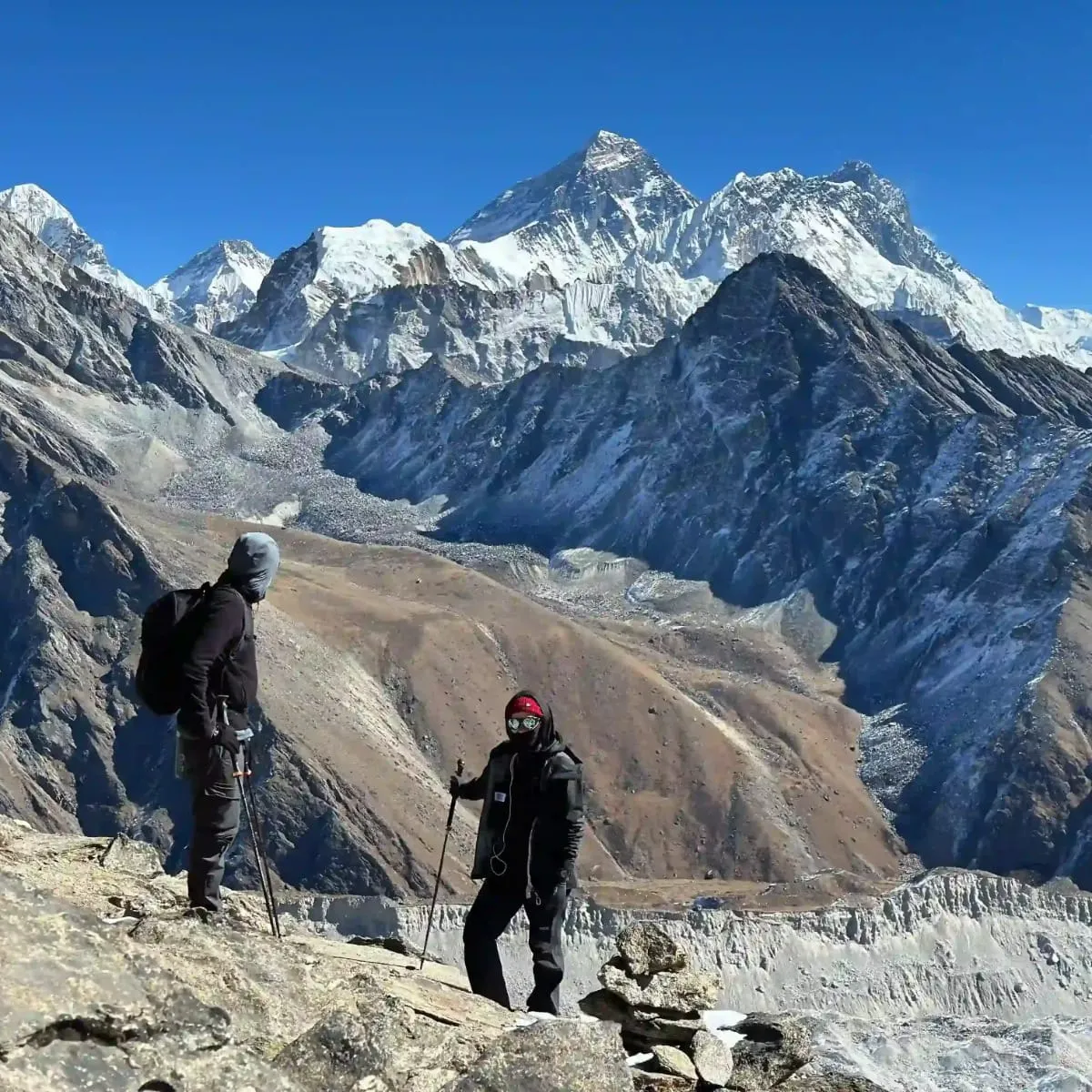
Our trekkers in down jackets near Kala Patthar. Above 5,000 m you wear them every morning and evening. Photo: North Nepal Travel & Trek.
Heads up
The coldest moment of the trek is the pre-dawn climb of Kala Patthar from Gorak Shep, and the cold is what catches people out. Water bottles freeze and phone and camera batteries die. Sleep with your water bottle and batteries inside your sleeping bag, and put your down jacket on before you leave the lodge, not halfway up.
Frequently asked questions
In May, the main climbing month, about −26 °C (−15 °F) on average, with winds around 58 km/h (36 mph). In winter the summit air is about −40 °C (−40 °F), with mid-winter winds averaging around 148 km/h (92 mph).
The Balcony station at 8,430 m (27,657 ft) recorded a low of −45 °C (−49 °F) between May 2019 and January 2020. Higher up, and in mid-winter, it is colder still.
On the upper mountain, yes. The South Col station's warmest monthly mean is −12.2 °C (10 °F) in July. Lower down, the base camp station averages −3.1 °C (26 °F) over the year, with days above freezing in spring and autumn.
Because the wind drops. In late spring the jet stream moves north before the monsoon, giving a few calm days at the summit. The air is still about −26 °C (−15 °F), but with less wind, climbers can stay warm enough to keep going.
Below freezing in every trekking season. The base camp weather station at 5,315 m (17,438 ft) averages −3.1 °C (26 °F) across the year, and nights are much colder than days, especially from December to February.
It can be extreme. On 9 May 2022, in the climbing season, a team at 8,810 m (28,904 ft) measured winds of 64 km/h (40 mph) and a wind chill of about −40 °C (−40 °F).
Błażejczyk K., Havenith G., Szymczak R. K., "Simulations of the human heat balance during Mount Everest summit attempts in spring and winter", International Journal of Biometeorology, 2024: https://link.springer.com/article/10.1007/s00484-023-02594-1
A native of the Annapurna region, he brings over 17 years of firsthand experience leading treks across the mountains of Nepal. His deep local roots and proven guiding expertise make him a trusted authority on authentic Himalayan adventures.