Upper Dolpo Culture: Bon, Shey Gompa and the Villages on the Trek
Published Oct 29, 2026 Updated Oct 29, 2026 11 min read
Quick answer
Upper Dolpo is one of the few places where Bon, Tibet's pre-Buddhist religion, and Tibetan Buddhism still share the same valleys. On our 24-day trek you meet Bon at Ringmo, Buddhism at Shey Gompa, and both in Dho Tarap.
A Bon village on a turquoise lake, a monastery under a mountain of quartz, and chortens you walk around in opposite directions depending on who built them. The living culture of the Upper Dolpo trek, in the order you meet it.
I send people to Upper Dolpo for the passes, and most of them come home talking about the gompas. The Upper Dolpo trek crosses Nangda La at 5,350 m (17,552 ft), but the days that stay with clients are the ones spent in Ringmo, Shey and Saldang, where the religion and the way of life are still Tibetan and still working. This guide follows that culture in the order you meet it on our 24-day route, with the itinerary days, and sits alongside our guides to how hard the trek is, when to go and the permits you need.
Key facts
FaithsBon and Tibetan Buddhism, often in neighbouring villages
Bon on our routeRingmo and the Tshowa gompa at Phoksundo Lake, 3,600 m (11,811 ft), Days 6–7
Sacred centreShey Gompa, 4,343 m (14,249 ft), Days 10–11
Crystal Mountain5,565 m (18,258 ft), circled on a kora every year
Shey festivalEvery 12 years in the Dragon year; last held 2024, next due 2036
Other gompa stopsNamgung (Day 11), Saldang and Yangjer (Days 12–13), Dho Tarap (Day 19)
Walking directionClockwise at Buddhist sites, anticlockwise at Bon sites
Why is Upper Dolpo's culture different from the rest of Nepal?
Upper Dolpo's culture is Tibetan in language, dress and faith, and it has stayed that way because the region was so hard to reach. Bon and Tibetan Buddhism are both still practised here, often a day's walk apart.
The people of Upper Dolpo call themselves Dolpo-pa. Families grow barley and buckwheat in a short summer, graze yaks on the high pastures, and for centuries carried grain north to Tibet to trade for salt. Houses are flat-roofed and built of stone, with animals on the ground floor and the kitchen and bedrooms above, the layout Ratan Lal Biswas described at Ringmo in the 1995 Himalayan Journal.
What I want clients to understand before they go is that none of this is put on for visitors. The gompas on the Upper Dolpo trek are working monasteries, the chortens are prayed at, and the mani walls are still being added to. You are walking through someone's religious landscape, not past a heritage display, and the trek is better when you treat it that way.
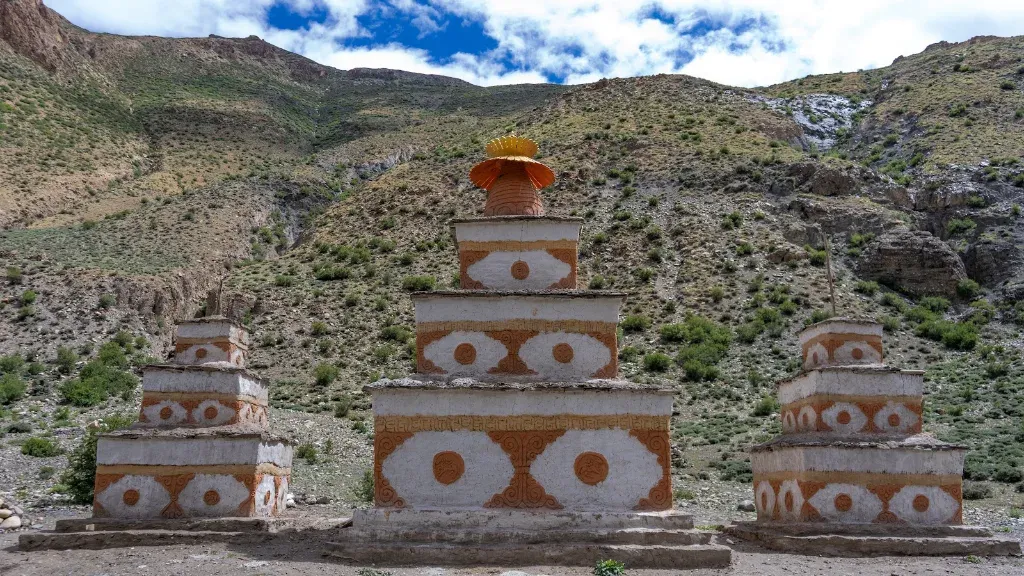
Three painted chortens on a hillside in Upper Dolpo. Photo: North Nepal Travel & Trek.
What is Bon, and where do you meet it on the Upper Dolpo trek?
Bon is the religion Tibet followed before Buddhism arrived, and on our route you meet it first at Ringmo village and the Tshowa gompa beside Phoksundo Lake, 3,600 m (11,811 ft), on Days 6 and 7.
Bon and Buddhism have borrowed so much from each other over the centuries that, to a visitor, a Bon gompa looks familiar: prayer flags, butter lamps, painted walls. The difference you will notice is direction. Bon practitioners walk around chortens, mani walls and temples anticlockwise, the opposite of Buddhists, and their swastika turns the other way too.
Day 7 on our itinerary is a rest day at Phoksundo Lake, and it is the best cultural day of the first week. Walk up into Ringmo, then along the shore to Tshowa, and ask your guide to find the caretaker so you can see the prayer hall. Bon starts even earlier on the Upper Dolpo trek: the evening walk on Day 3 from Dunai, 2,140 m (7,021 ft), goes up to a Bon gompa above the town.
Why is Shey Gompa Upper Dolpo's sacred centre?
Shey Gompa, 4,343 m (14,249 ft), is the Crystal Monastery under the Crystal Mountain, Upper Dolpo's sacred centre. We reach it on Day 10 over Nangda La and leave on Day 11 over Shey La, 5,100 m (16,732 ft).
The founding story, as Shey Phoksundo Rural Municipality tells it, begins with Drikung Kyobpa Jigten Gonpo, the master behind the Drikung Kagyu school, sending his disciple Druptop Senge Yeshe (the municipality spells it Shinge Yeshe) to Shey. Yeshe subdued the fierce spirit of the mountain and made it the abode of the deity Chakrasamvara, and since then it has been the pure Crystal Mountain. Three old monasteries stand around it: Shey Sumdho, Tsakhang and Gonmoche.
The Crystal Mountain rises to 5,565 m (18,258 ft), according to the municipality, and its rock is laced with quartz and marine fossils. Dolpo-pa walk a kora around it every year; the Himalayan Journal put the circuit at about 16 km. Every 12 years, in the Tibetan Year of the Dragon, Shey holds a much larger festival. The municipality counted the 2024 festival as the 67th, so the next one should fall in 2036.
Shey also has a place in travel writing. In 1973 Peter Matthiessen walked here with the biologist George Schaller, who had come to study blue sheep, and the book that came out of it, The Snow Leopard, won the US National Book Award. If you read one book before the Upper Dolpo trek, make it that one.
One honest limit: our itinerary gives you the afternoon of Day 10 and the morning of Day 11 at Shey. That's enough for the gompa and the walk up to Tsakhang, but not for the full kora. If the kora matters to you, ask us about adding a day at Shey; it lengthens the trek, and the restricted-area permit with it.
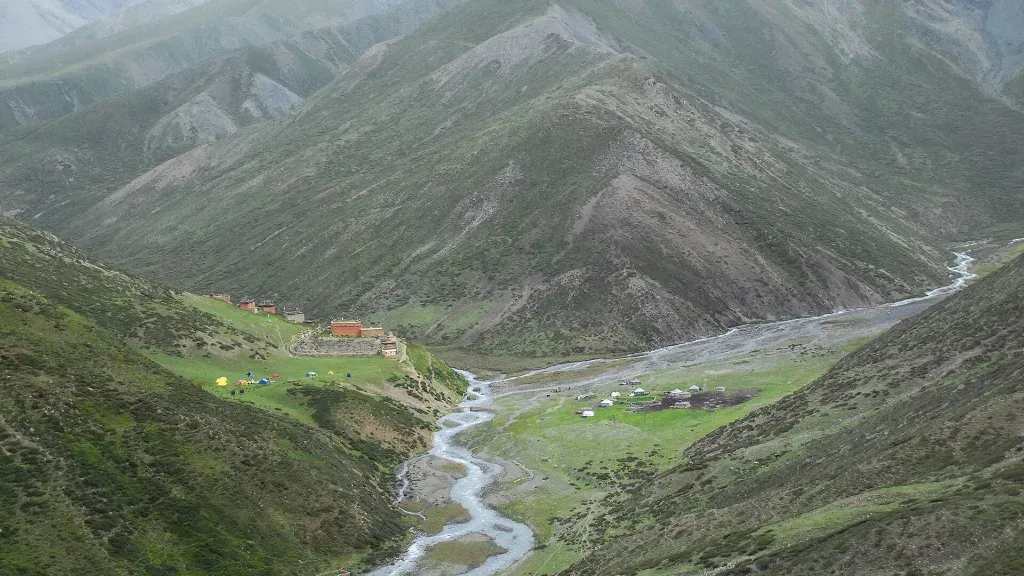
Shey Gompa above its valley, the stop on Days 10 and 11 of our route. Photo: Sergey Pashko, CC BY 3.0, via Wikimedia Commons.
What will you see at Namgung, Saldang and Yangjer?
After Shey, the Upper Dolpo trek stops at Namgung Gompa, 4,360 m (14,304 ft), on Day 11, then Saldang, 3,770 m (12,369 ft), on Days 12 and 13, with a rest-day hike up to Yangjer Gompa, 4,590 m (15,059 ft).
Namgung Gompa is the first monastery after the Shey La crossing, and the Himalayan Journal recorded it as belonging to the Karma Kagyu school. The morning of Day 12 starts with the climb up to it before the walk down the Namga Khola to Saldang.
Saldang is the largest village of inner Dolpo, spread along a hillside above its fields. On a 1993 trek, reported in the 1995 Himalayan Journal, Biswas counted about 80 houses and nearly 600 people across its five settlements, on the old trade route north to Tibet. On our route, Saldang is also where you finally get a full rest, because Day 13 is an acclimatisation day.
The rest-day hike goes up to Yangjer Gompa, often described as the wealthiest gompa in Dolpo. It's a climb of about 820 m from Saldang, so treat it as part of your acclimatisation. I'd go, though. It's the one gompa visit on the trek where you have the whole day for it.
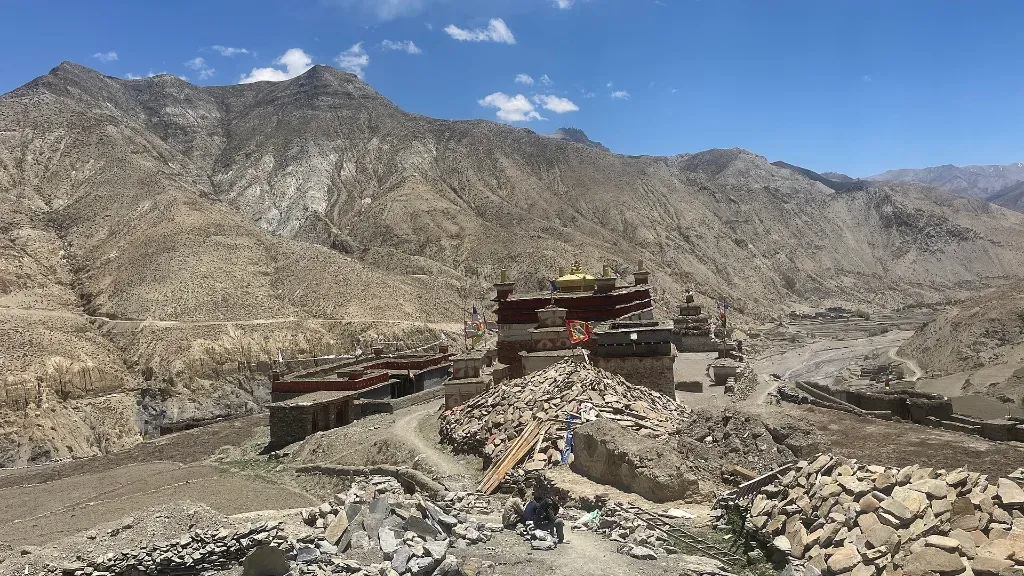
Samye Tsoling Gonpa, the monastery at Saldang. Photo: Lamatimal, CC0, via Wikimedia Commons.
How did salt and yaks shape life in Upper Dolpo?
For centuries Upper Dolpo lived on barter: grain carried north to Tibet, and salt and wool carried back on yak and sheep caravans. That trade built the villages, the trails and the rhythm of the year the trek follows.
The Himalayan Journal described Dolpo traders exchanging tsampa and grain for Tibetan salt and wool with Tibetan nomads, at border markets such as Kato. After 1959 the trade with Tibet nearly stopped and only partly recovered. On our route, the trail beyond Phoksundo Lake on Day 8 follows one of these old salt-trading paths between Dolpo and Tibet.
To see that world before you go, watch Himalaya (1999), Éric Valli's film about a yak salt caravan. It was shot in Dolpo with local villagers in most roles, and it was nominated for the Oscar for best foreign-language film. On the Upper Dolpo trek you will still pass yak trains carrying loads between villages, and they always have right of way on a narrow trail.
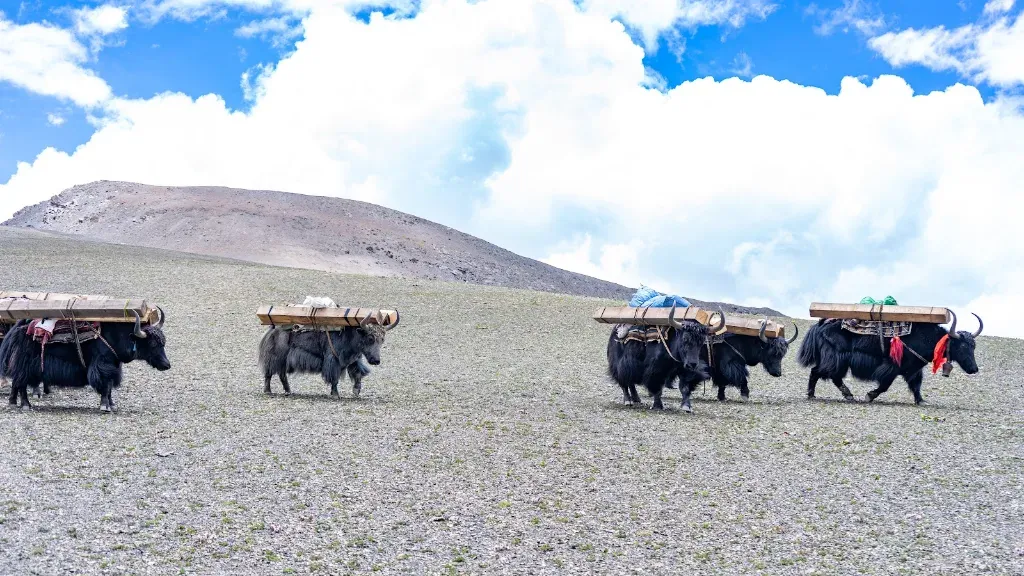
A yak caravan carrying loads across a high plateau in Upper Dolpo. Photo: North Nepal Travel & Trek.
What makes Dho Tarap different?
Dho Tarap, 3,944 m (12,940 ft), is where Bon and Buddhist families live side by side in one valley. We reach it on Day 19, the day after the Choila North crossing, and the short walk leaves the afternoon free.
When the 1995 Himalayan Journal described the Tarap valley, it counted about 10 villages along some 20 km of the Tarap Chu, with gompas and chortens of both traditions. Around Dho the fields grow wheat, buckwheat, barley and potatoes, and the village is a cluster of chortens and monasteries among them.
Day 19 is only about two hours' walk from Tokyu, and that's why I like it. It's the one afternoon late in the trek when you can sit in a village instead of passing through it. Watch which way people walk around the chortens; in Tarap you can see both directions. Two days later, on the way to Lashicap, the trail passes Chhedul Gompa.
How should you behave at gompas and chortens in Upper Dolpo?
Walk clockwise around Buddhist chortens, mani walls and gompas and anticlockwise around Bon ones. Ask before you photograph people or the inside of a prayer hall, and leave a small offering when a gompa is opened for you.
If you aren't sure which tradition a site belongs to, follow what the locals do or ask your guide. Shey Phoksundo National Park's own advice to visitors is simply to respect cultural and religious sites, and on the Upper Dolpo trek that comes down to a few habits:
Keep chortens and mani walls on your right at Buddhist sites, and on your left at Bon sites.
Take off your shoes and hat before you enter a prayer hall.
Don't touch altars, statues or thangka paintings, and don't point your feet at them when you sit.
Ask before photographing monks, villagers or the inside of a gompa. Some halls don't allow photos at all.
Never sit on, step over or take a carved mani stone.
Put a small note in the donation box or on the altar when a caretaker opens a gompa for you.
Cover your shoulders and knees in villages and monasteries.
Heads up
Many gompas on the Upper Dolpo route are locked when the caretaker is out in the fields or the lama is away, and there's no timetable. Don't plan a day around getting inside one. Your guide will ask in the village, but some doors simply stay shut, and that's part of visiting a working monastery.
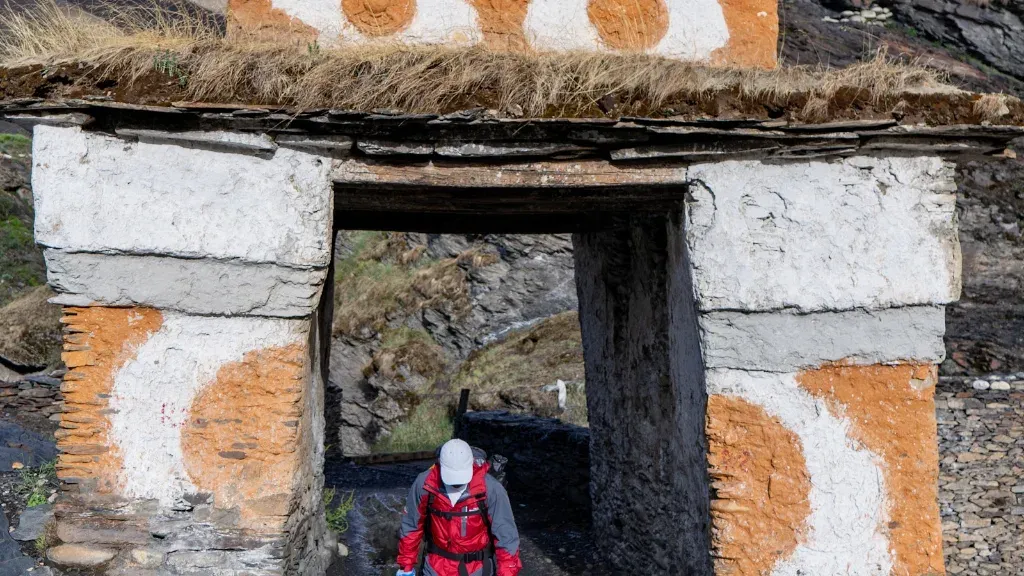
Walking through a kani, a gateway chorten, on the trail in Upper Dolpo. Photo: North Nepal Travel & Trek.
Frequently asked questions
Both Bon, Tibet's pre-Buddhist religion, and Tibetan Buddhism. On our Upper Dolpo trek, Ringmo and the Tshowa gompa at Phoksundo Lake are Bon, Shey Gompa follows the Kagyu tradition, and Dho Tarap has families of both.
The Crystal Mountain is the sacred peak above Shey Gompa, 5,565 m (18,258 ft) according to Shey Phoksundo Rural Municipality. Its rock is laced with quartz and fossils, and Dolpo-pa walk a kora around it every year.
The Shey festival is held every 12 years, in the Tibetan Year of the Dragon. The last one was in 2024, so the next should fall in 2036. Smaller festivals happen in Upper Dolpo every year.
Clockwise at Buddhist chortens, mani walls and gompas, keeping them on your right. At Bon sites such as Ringmo and Tshowa, walk anticlockwise. If in doubt, follow the locals.
Usually, if the caretaker or lama is in the village. Your guide will ask for you. Take off your shoes, ask before taking photos, and leave a small offering. Some gompas stay locked.
Day 7 at Phoksundo Lake for the Bon villages, Days 10 and 11 at Shey Gompa, Day 13 at Saldang with the Yangjer hike, and the short Day 19 into Dho Tarap.
The full route, with every gompa day, is on our Upper Dolpo Trek page. If you want the same Tibetan culture with lodges instead of tents, look at our Upper Mustang Trek, or message me on WhatsApp with your questions.
A native of the Annapurna region, he brings over 17 years of firsthand experience leading treks across the mountains of Nepal. His deep local roots and proven guiding expertise make him a trusted authority on authentic Himalayan adventures.