Thorong La Altitude Sickness: How to Cross the Pass Safely
Published Nov 1, 2026 Updated Nov 15, 2026 11 min read
Quick answer
Thorong La is 5,416 m (17,769 ft), and most altitude trouble on the Annapurna Circuit shows up in the three nights before it. Take the Manang rest day, sleep at Thorong Phedi, and turn back if a headache gets worse.
Thorong La is the highest point most of our guests will ever stand on, and it is the day people ask me about before they book. The pass itself is rarely the problem. The problem is arriving at Thorong Phedi with a headache you have been ignoring since Yak Kharka. This post is about those last three nights and the pass morning. For the basics of altitude sickness itself, start with our guide to altitude sickness in Nepal. Nothing here is medical advice; anything about medicines is a conversation for your doctor.
Key facts
Pass heightThorong La, 5,416 m (17,769 ft)
Last night beforeThorong Phedi, 4,540 m (14,895 ft)
Pass dayAbout 16 km, 8 to 9 hours
Climb on pass day876 m (2,874 ft) up, 1,654 m (5,427 ft) down
Rest dayManang, 3,519 m (11,545 ft), with a hike to Ice Lake
DirectionEast to west, Manang side to Muktinath
Insurance we ask forCover up to 6,000 m, with helicopter rescue
Why does altitude sickness catch people at Thorong La?
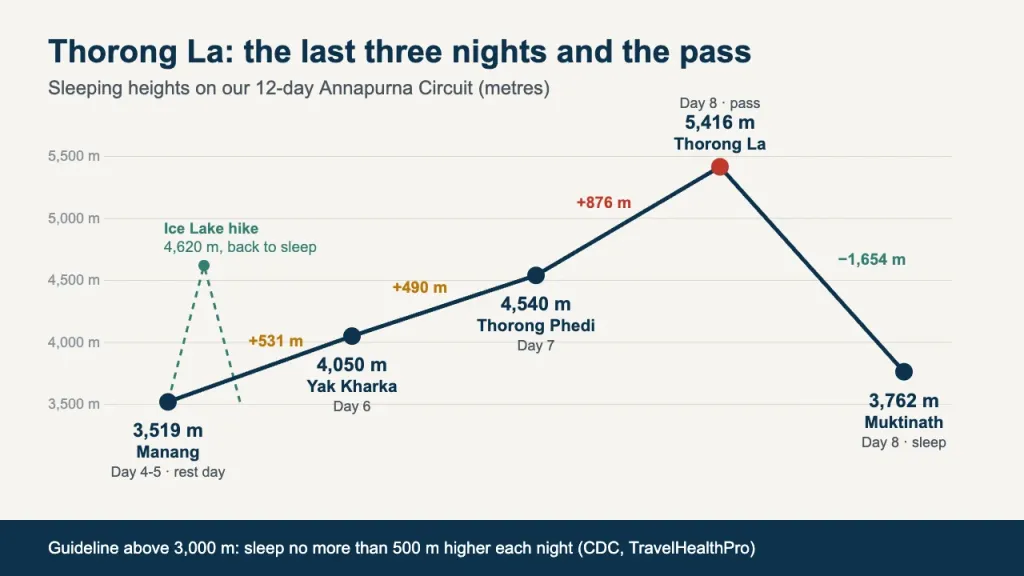
Because the Annapurna Circuit saves its biggest height gains for the end. After Manang you sleep about 1,000 m (3,281 ft) higher in two nights, then climb another 876 m (2,874 ft) to the pass. Altitude sickness usually starts above about 2,500 m (8,202 ft), and every night from Chame onward sits above that line.
The first week of the Annapurna Circuit climbs slowly up the Marsyangdi valley, and most people feel fine. The picture changes after the Manang rest day. On our 12-day itinerary, guests sleep at Manang, 3,519 m (11,545 ft), then Yak Kharka, 4,050 m (13,287 ft), then Thorong Phedi, 4,540 m (14,895 ft). The next morning they climb to Thorong La, 5,416 m (17,769 ft), and walk all the way down to Muktinath, 3,762 m (12,343 ft).
That pass day is about 16 km and 8 to 9 hours on our itinerary. It is long, cold and starts in the dark. Altitude sickness symptoms usually begin 2 to 12 hours after arriving at a new height, the US Centers for Disease Control and Prevention (CDC) says, which is why the night at Thorong Phedi tells you so much about the morning.
Sleeping heights on our 12-day Annapurna Circuit, and the pass day. Graphic: North Nepal Travel & Trek.
Why does the Manang rest day matter so much?
The Manang rest day is the most important day on the whole Annapurna Circuit. It gives your body time to adjust before the two big nights, and the hike to Ice Lake lets you climb high and sleep low. Skip it and Thorong La gets much harder.
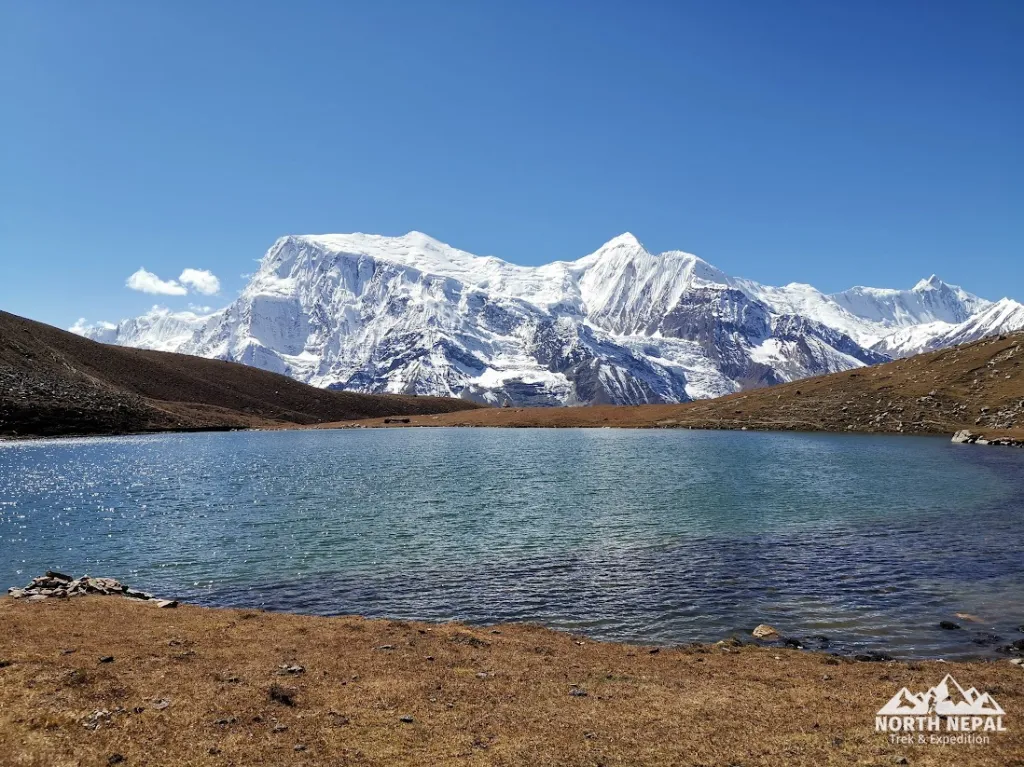
On our 12-day Annapurna Circuit the rest day is Day 5 at Manang. Guests hike up to Ice Lake, 4,620 m (15,157 ft), which is higher than Thorong Phedi, and then come back down to sleep at Manang. The CDC says day trips to higher ground with a return to sleep lower are much easier on the body than sleeping high. That is exactly what Ice Lake does.
The Himalayan Rescue Association (HRA) has run an aid post in the Manang area since November 1981, and in Manang village itself since 1985. It treats about a thousand patients a year, most of them local Nepali people, and gives talks on altitude sickness to trekkers and trekking staff. If the aid post is open when you pass through, go to the talk. It is the best hour you will spend on the trek.
Ice Lake, 4,620 m (15,157 ft), the acclimatisation hike from Manang. Photo: North Nepal Travel & Trek.
My advice
Do not let anyone talk you out of the Manang rest day to save time. If you are short on days, shorten the walk out after Muktinath, not the rest day. Ask us how.
Are Yak Kharka and Thorong Phedi too big a jump?
They are right at the limit, and the first one is slightly over it, which is why we never shorten them. From Manang to Yak Kharka you sleep 531 m (1,742 ft) higher, and from Yak Kharka to Thorong Phedi 490 m (1,608 ft) higher. The usual guideline above 3,000 m is no more than 500 m (1,640 ft) a night.
That 500 m guideline for sleeping height comes from both the CDC and the UK's TravelHealthPro, and TravelHealthPro also advises a rest day every three or four days. The Annapurna Circuit sits on or just over that line for two nights running. This is why the Manang rest day before them matters, and why we do not let anyone push on from Yak Kharka to Phedi and on to High Camp in one go.
The walking itself is short. Manang to Yak Kharka is about 9.4 km and Yak Kharka to Thorong Phedi about 8.5 km on our itinerary. Arrive early, drink, eat a proper lunch, and take a short walk above the lodge in the afternoon before coming back down to sleep.
If someone in your group is slow to adjust, an extra night at Yak Kharka costs one day and makes the pass far more pleasant. Tell us when you book and we will build it into a custom itinerary, or your guide can add it on the trail.
Should you sleep at Thorong Phedi or High Camp?
Sleep at Thorong Phedi unless your whole group is clearly well. High Camp, at about 4,880 m (16,010 ft), shortens the pass morning by roughly an hour, but it adds 340 m (1,115 ft) to your sleeping height and is colder, with fewer ways down in the dark.
Our 12-day itinerary sleeps at Thorong Phedi, 4,540 m (14,895 ft). From there it is about an hour up a steep slope to High Camp, then the long climb to the pass. Some trekkers prefer to sleep at High Camp to get a head start. I understand the appeal, but for most people it is the wrong trade.
Sleeping at High Camp means a jump of 830 m (2,723 ft) in sleeping height from Yak Kharka in one day, well past the 500 m guideline. And if someone wakes at High Camp with a bad headache or vomiting, the only sensible move is down that steep slope to Phedi, in the dark and the cold. At Phedi you are already lower, and the way down to Yak Kharka is easier.
Thorong High Camp, about 4,880 m (16,010 ft). Photo: Sergey Ashmarin, Wikimedia Commons, CC BY-SA 3.0, cropped.
How do you decide on the morning of the pass?
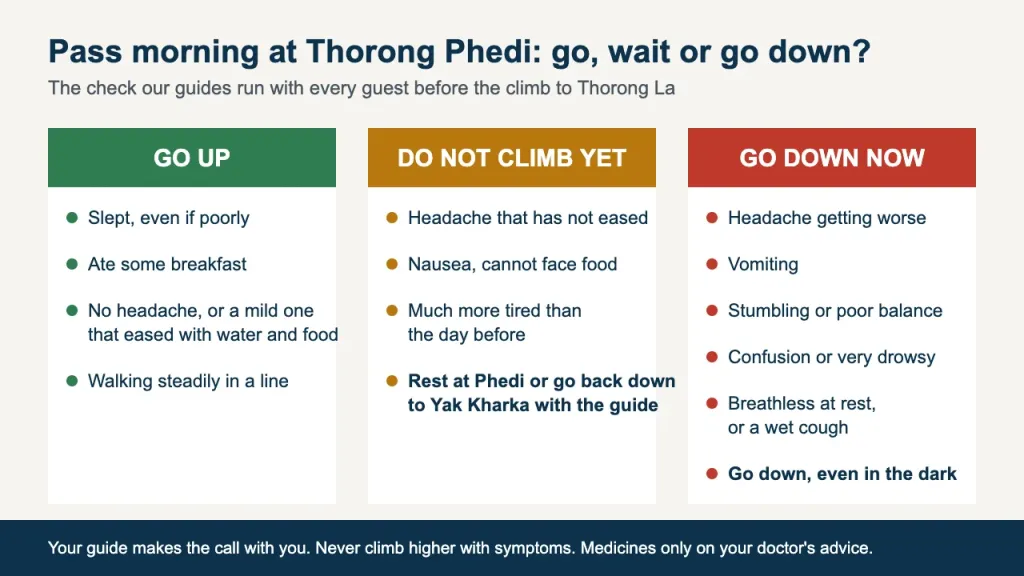
Your guide checks everyone before leaving Thorong Phedi, and you have to be honest. A mild headache that eases with water and breakfast is common. A headache that is getting worse, vomiting, unsteady walking, confusion or breathlessness at rest means you do not go up.
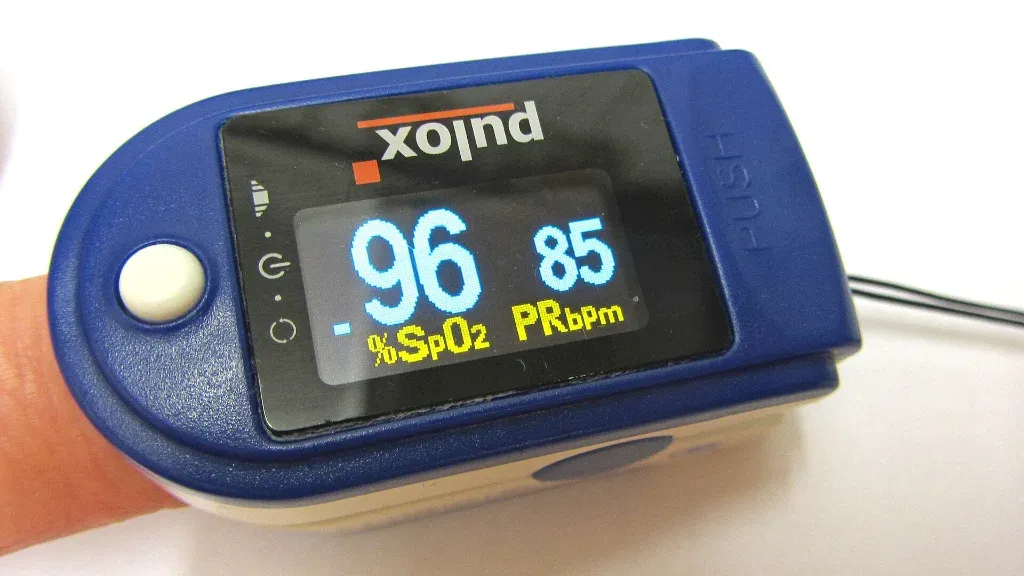
Our guides carry a first-aid kit and a pulse oximeter and run a daily health check from Manang onward. The oximeter is useful, but it does not decide on its own. The CDC notes that oxygen readings are usually normal for the altitude, or only slightly low, even in people who have acute mountain sickness. How you feel and how you walk matter more than the number on the screen.
A finger pulse oximeter like the ones our guides carry. Photo: Stefan Bellini, Wikimedia Commons, CC0.
Signs that mean you do not climb
A headache that is getting worse, or does not ease with water, food and rest
Vomiting, or being unable to eat breakfast
Stumbling or poor balance, the "drunk walk" doctors call ataxia
Confusion, unusual sleepiness or acting out of character
Breathlessness while resting, or a wet cough
The last three are signs of the serious forms, HACE and HAPE, and mean going down straight away, whatever the time. Weather is the other reason to wait. In late September 2026 Manang district closed the high route for three days ahead of a storm, and many trekkers turned back from the pass. Our Annapurna Circuit trail update covers what happened.
The pass-morning check our guides run at Thorong Phedi. Graphic: North Nepal Travel & Trek.
Heads up
Pass morning starts in the dark, by headlamp, and it is the coldest part of the trek, often well below freezing. Your appetite will be poor at 4 am. Eat anyway, and fill your bottles the night before so they are ready.
What happens if someone gets sick near the pass?
They go down. Below the pass that means back towards Yak Kharka and Manang. Once over the top, the long descent to Muktinath is itself the treatment. If walking down is not possible, we call a helicopter through local rescue services, weather permitting.
Going down is the most effective treatment for altitude sickness. The CDC says acute mountain sickness improves quickly with a descent of 300 m (984 ft) or more. At Thorong Phedi that means walking back towards Yak Kharka, with the guide carrying the person's pack. Horses are often available at Phedi for anyone too tired or unwell to walk well, and they can also carry people up towards the pass on the east side.
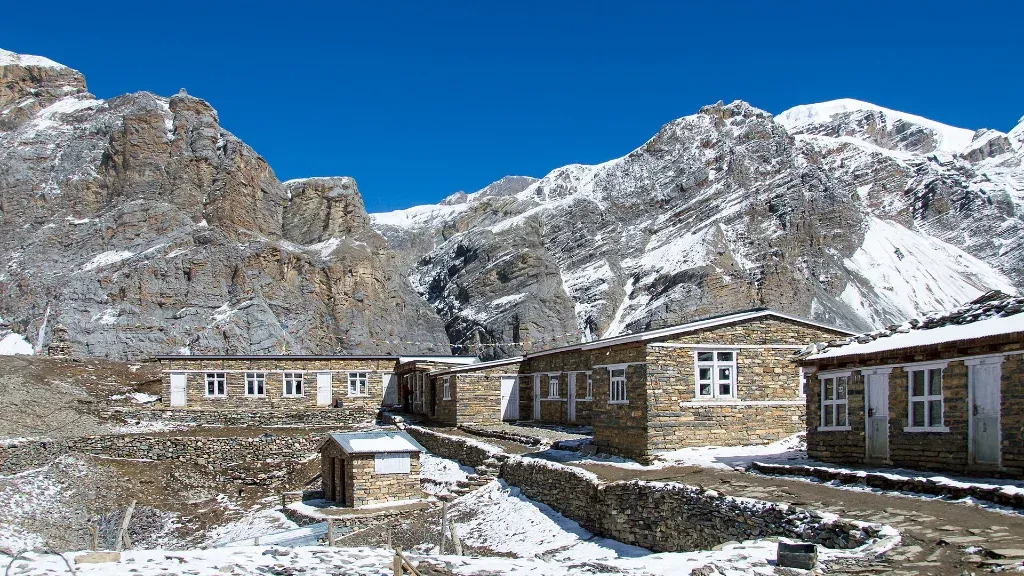
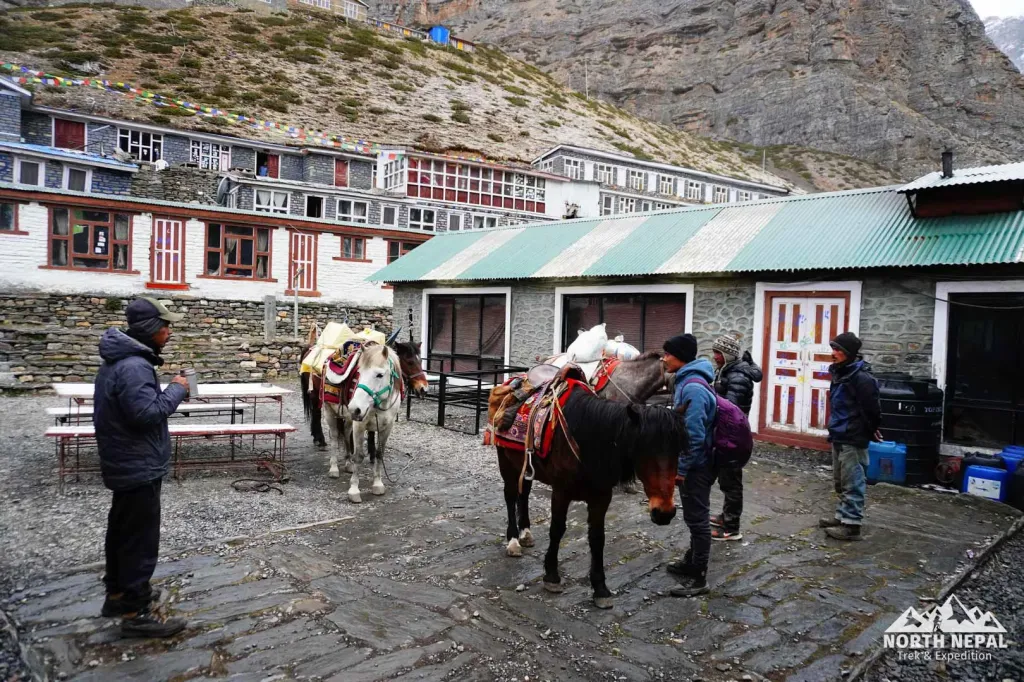
Thorong Phedi, 4,540 m (14,895 ft), the last night before the pass. Photo: North Nepal Travel & Trek.
Do not count on a doctor at Phedi. The HRA ran a satellite clinic at Thorong Phedi for a few seasons from 2007, but it says the clinic is no longer operating. The nearest HRA aid post is back at Manang. Helicopter evacuation is coordinated by your guide with our Pokhara and Kathmandu offices and needs flying weather, so it is never instant.
Medicines have a place, but only on a doctor's advice. The ones you will hear about are acetazolamide (Diamox), dexamethasone and nifedipine. Talk to your doctor before the trip about whether any of them is right for you, and never use them as a reason to keep climbing with symptoms. The UK's TravelHealthPro says preventive medicine is not a substitute for a gradual ascent.
All of this is why we ask every Annapurna Circuit guest for insurance that covers trekking up to 6,000 m and helicopter rescue. Our guide to travel insurance for trekking in Nepal explains what to look for.
Why do we cross Thorong La from east to west?
Because crossing from Muktinath means climbing 1,654 m (5,427 ft) in a single day from 3,762 m. Crossing from the Manang side spreads the height over three nights first. That is the safer direction, and it is the one every one of our Annapurna Circuit itineraries uses.
There are few places to sleep high on the Muktinath side to break the climb the way Yak Kharka and Phedi do on the east. Starting from Muktinath turns the pass into a very long, steep day with no chance to adjust. Coming from Manang, the climb is shorter and the descent does the work for you.
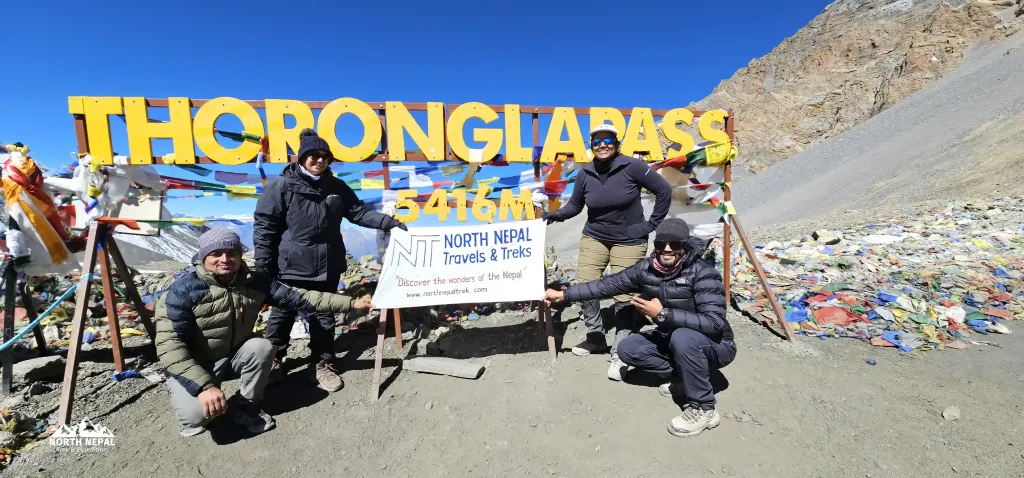
One of our guests with their guide on Thorong La, 5,416 m (17,769 ft). Photo: North Nepal Travel & Trek.
Our guide Jeewan has led more than 20 Annapurna Circuit treks since 2016. Fitness does not protect you, so tell your guide early about any headache, even a small one at Yak Kharka. A family who crossed with us in June 2019 wrote in their review that their youngest rode a horse to the top while the rest walked, and they all reached Muktinath that evening. A good pass day is honest, unhurried and flexible.
Thorong La is 5,416 m (17,769 ft). It is the highest point on the Annapurna Circuit and one of the highest trekking passes in the world. On our itinerary you sleep at Thorong Phedi, 4,540 m (14,895 ft), the night before.
Yes. Fitness does not protect you from altitude sickness. How you have reacted to altitude before is a better guide, the CDC says. Fit trekkers often walk too fast and climb too quickly, which makes things worse.
For most people, Thorong Phedi. High Camp, about 4,880 m (16,010 ft), shortens the pass morning but adds 340 m (1,115 ft) to your sleeping height, which is a big jump after Yak Kharka, and the way down at night is steep.
No. The Himalayan Rescue Association ran a satellite clinic at Thorong Phedi for a few seasons, but it says the clinic is no longer operating. The nearest HRA aid post is at Manang. Your guide carries a first-aid kit and a pulse oximeter.
That is a question for your doctor, not your trekking company. Acetazolamide (Diamox) is the medicine most often discussed for altitude sickness, but a slow ascent with a proper rest day at Manang comes first.
We ask for cover up to 6,000 m that includes emergency medical treatment and helicopter rescue. Check the altitude limit in your policy wording, not just the summary.
Tell your guide straight away. A mild headache may mean resting another day at Phedi or Yak Kharka. Worsening symptoms, vomiting, trouble walking, confusion or breathlessness at rest mean going down, not up.
A native of the Annapurna region, he brings over 17 years of firsthand experience leading treks across the mountains of Nepal. His deep local roots and proven guiding expertise make him a trusted authority on authentic Himalayan adventures.