Altitude Sickness in Nepal: Symptoms, Prevention and What to Do on a Trek
Published Oct 30, 2026 Updated Oct 30, 2026 8 min read
Quick answer
Altitude sickness can start above about 2,500 m, and most Nepal treks go far higher. Climb slowly, take your rest days, tell your guide about any headache, and never sleep higher with symptoms. If they get worse, go down.
Most of our guests reach heights they have never slept at before. What altitude sickness is, the warning signs of the serious kinds, how our itineraries are built to prevent it, and what happens on the trail if it strikes.
Our guests walk to Namche, Manang, Samagaun and Thorong La. Altitude sickness is the one health risk all of those treks share. This is the plain guide I wish every guest read before booking. It is not medical advice, and anything about medicines is a conversation for your doctor.
Key facts
Risk startsAbove about 2,500 m (8,202 ft)
Safe ascentAbove 3,000 m, sleep no more than about 500 m higher each night
Rest daysOne every three to four days at the same height
The three conditionsAMS (common), HACE and HAPE (rare and life-threatening)
The rule that matters mostNever sleep higher while you have symptoms
The most effective treatmentGoing down
InsuranceMust cover your highest altitude and helicopter evacuation
What is altitude sickness, and when does it start?
Altitude sickness is what happens when you climb faster than your body can adjust to thinner air. The common form, acute mountain sickness (AMS), usually begins above about 2,500 m (8,202 ft), according to the UK's national travel health service.
The main sign of AMS is a headache, usually with at least one of these: loss of appetite, nausea, dizziness or unusual tiredness. Symptoms tend to start 2 to 12 hours after arriving at a new height, and they usually clear within 12 to 48 hours if you don't climb any higher, the US Centers for Disease Control and Prevention (CDC) says.
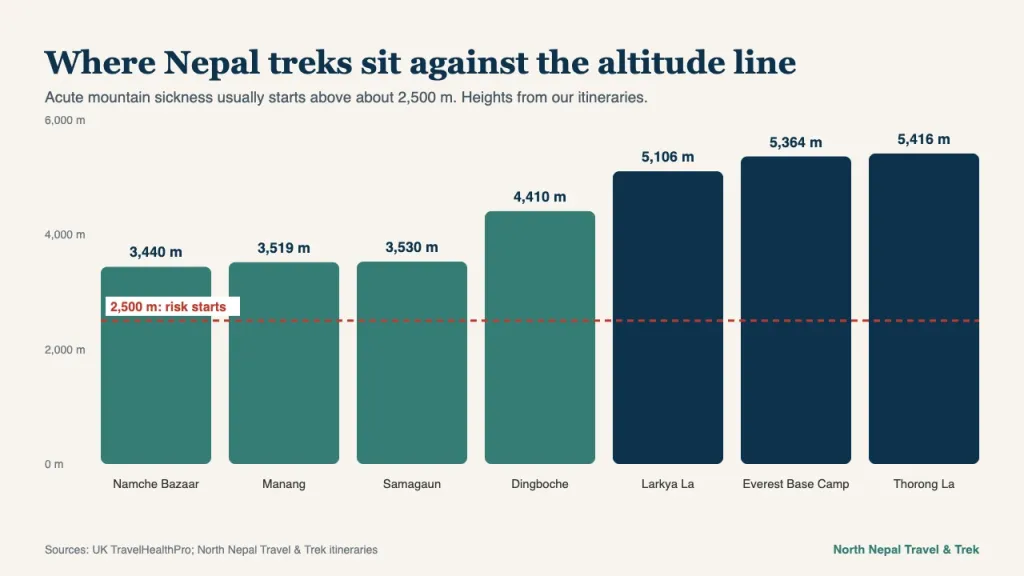
Almost every trek we run goes well past that 2,500 m line. Namche Bazaar sits at 3,440 m (11,286 ft), Manang at 3,519 m (11,545 ft), Samagaun on the Manaslu Circuit at 3,530 m (11,581 ft) and Dingboche at 4,410 m (14,469 ft). The high points are higher still: Everest Base Camp at 5,364 m (17,598 ft), Larkya La at 5,106 m (16,752 ft) and Thorong La at 5,416 m (17,769 ft).
Every one of these places on our itineraries sits above the 2,500 m line where altitude sickness usually starts. Graphic: North Nepal Travel & Trek.
What are HAPE and HACE, and how do you spot them?
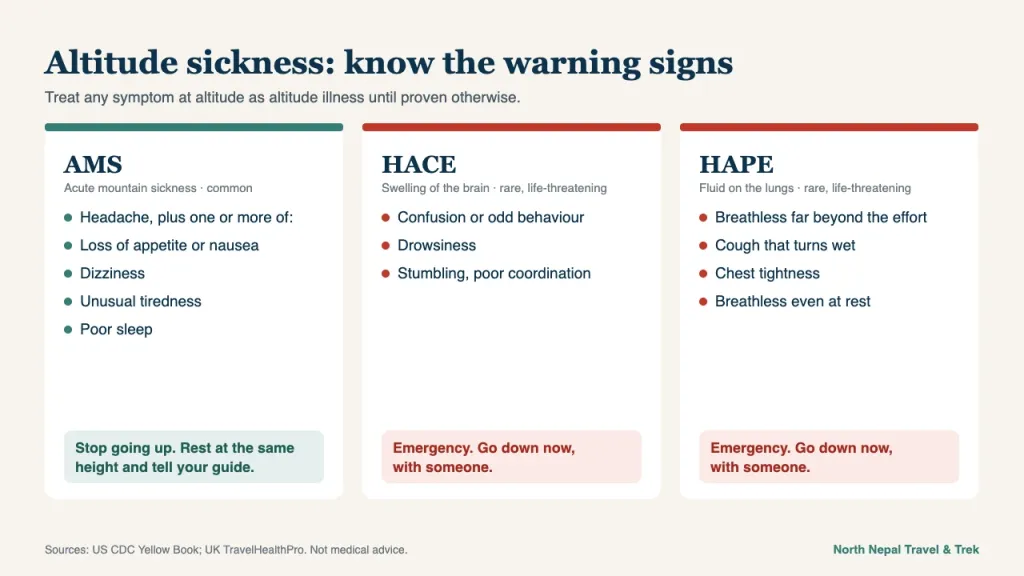
HAPE and HACE are the rare, serious forms of altitude sickness, and both can kill. HAPE is fluid on the lungs; HACE is swelling of the brain. Either one means going down straight away.
HACE warning signs: confusion, drowsiness, odd behaviour, and losing coordination, such as stumbling or swaying on your feet.
HAPE warning signs: breathlessness far beyond what the climb explains, a cough that turns wet, chest tightness, then breathlessness even at rest, sometimes with blood-tinged spit.
The warning signs of AMS, HACE and HAPE, and what to do about each. Graphic: North Nepal Travel & Trek.
HAPE affects up to 1 in 100 travellers above 4,300 m (14,108 ft), the CDC says, and without treatment or descent, HACE can lead to coma within 12 to 24 hours of losing coordination. That is why the medical advice is clear: treat any symptom at altitude as altitude illness until proven otherwise, and never leave an ill person alone.
Heads up
Breathless while sitting still, or confused and unsteady on your feet: that is not a bad day, it is an emergency. Tell your guide at once, even in the middle of the night. On our treks the guide will start the descent straight away.
Who gets altitude sickness?
Anyone can. Fitness and training do not protect you from altitude sickness, and men and women are affected about equally, according to the CDC. The biggest factors are how high you sleep, how fast you got there, and whether you have had altitude illness before.
Children are as likely to get it as adults, and people over 50 are at slightly lower risk, the CDC says. If you have a heart or lung condition, sleep apnoea or another long-term illness, see a doctor who knows high-altitude medicine well before you book.
Fit trekkers often feel tempted to walk faster than the itinerary needs. Don't. The pace your guide sets on the way up is the pace your body can adjust to, and arriving first at the lodge earns you nothing.
How do you prevent altitude sickness on a Nepal trek?
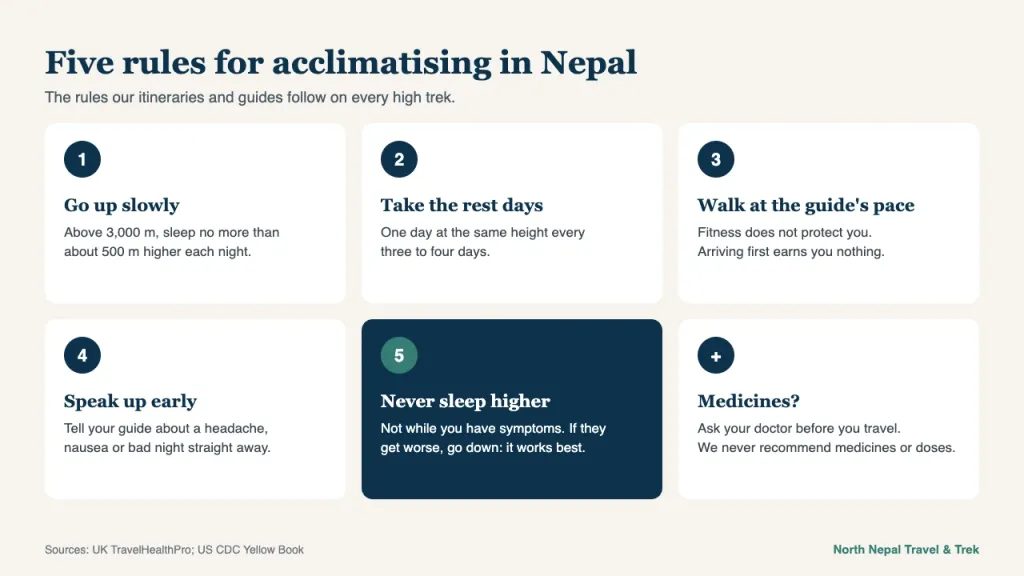
Go up slowly. Above 3,000 m, raise the height you sleep at by no more than about 500 m a night, and take a rest day at the same height every three to four days, the UK travel health service advises. Our itineraries are built around that rule.
On our 12-day Everest Base Camp trek the acclimatisation day is at Namche Bazaar, with a hike up to the Everest View Hotel, 3,962 m (12,999 ft), before sleeping back down in Namche. On the Annapurna Circuit the rest day is at Manang, with a hike to Ice Lake, 4,620 m (15,157 ft). The Manaslu Circuit pauses at Samagaun, and the Upper Dolpo trek rests at Phoksundo Lake and Saldang.
The rest is everyday discipline, and our guides will remind you of it every day:
Walk slowly, even when you feel strong.
Drink plenty of treated or boiled water.
Skip alcohol for at least your first two days at high altitude, and never use alcohol or opiate painkillers to help you sleep at altitude. Ask your doctor before taking any sleeping tablet.
Tell your guide about a headache, nausea or bad night as soon as it starts. Our guides check every guest's health every day.
Don't sleep higher while you still have symptoms.
The acclimatisation rules our itineraries and guides follow. Graphic: North Nepal Travel & Trek.
What medicines are used for altitude sickness?
The medicine most often used to prevent and treat AMS is acetazolamide, sold as Diamox. Doctors also use dexamethasone for severe AMS and HACE, and nifedipine for HAPE. Never take any of them without your doctor's advice.
We are a trekking company, not a clinic, so we never recommend medicines or doses. Talk to your doctor or a travel clinic before you leave, tell them the highest altitude on your itinerary, and take their advice on whether you need anything, how to use it, and its side effects. Your doctor may suggest trying it at home before you travel to check for side effects.
Remember that no tablet replaces a slow ascent. The UK travel health service is clear that medicines are not a substitute for climbing gradually.
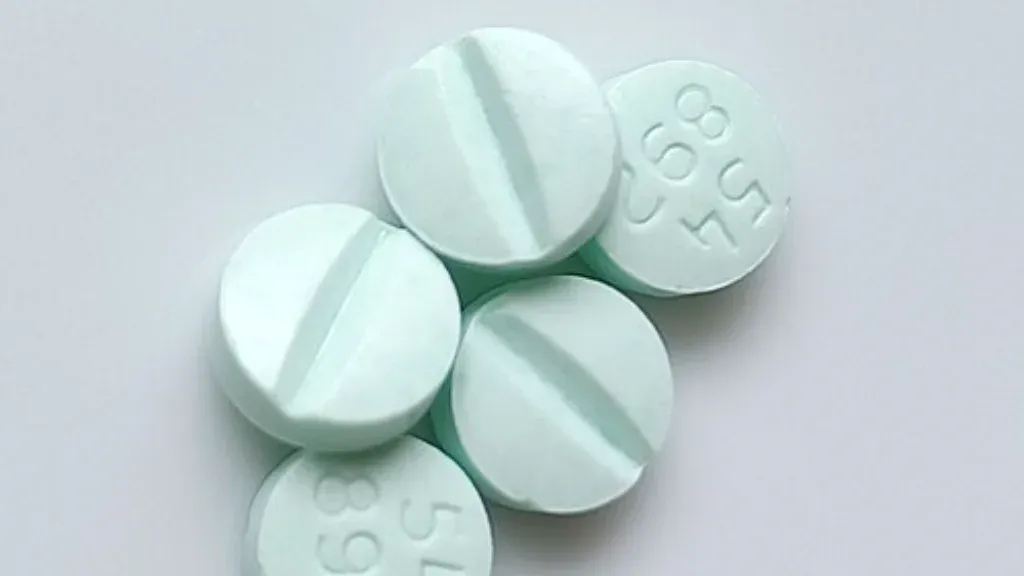
Dexamethasone tablets. Altitude medicines should only be used on a doctor's advice. Photo: Mx. Granger, CC0, via Wikimedia Commons, cropped.
What should you do if you get altitude sickness on the trail?
Stop climbing. With mild AMS, rest at the same height until the symptoms clear. If they get worse, or there is any sign of HACE or HAPE, go down, usually 300 to 1,000 m and further for HAPE, until you feel better. Descent is the most effective treatment.
On our treks the guide makes that call with you. Our protocol is simple: if severe symptoms appear, the guide starts the descent immediately. If going down on foot isn't possible, because of the person's condition, the weather or the terrain, the guide calls our Kathmandu and Pokhara offices, and we arrange a helicopter evacuation through local rescue services under Civil Aviation Authority of Nepal rules.
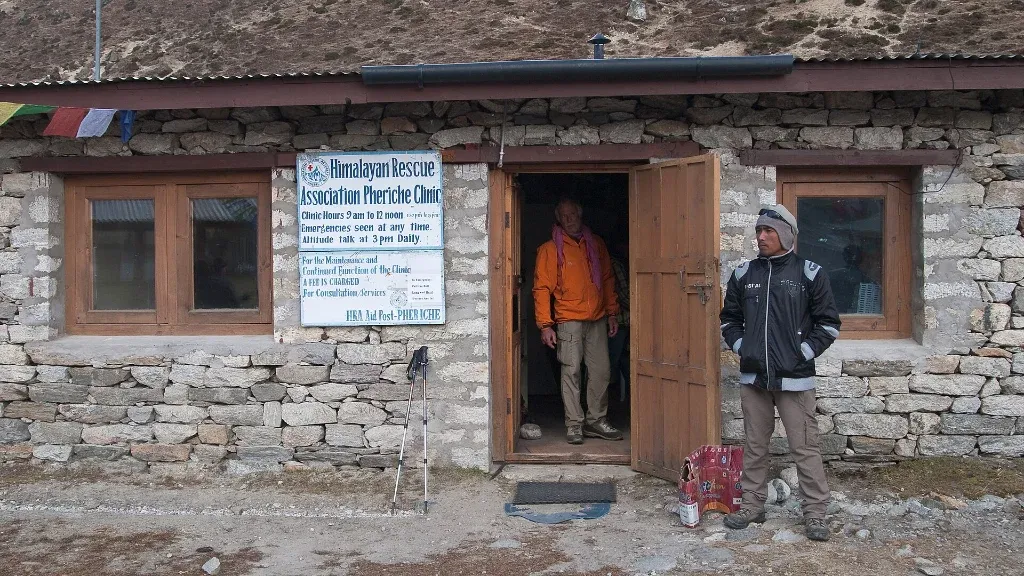
Medical help is closer than people think on the busiest routes. The Himalayan Rescue Association runs aid posts at Manang, where it has treated trekkers since 1981 and gives talks on altitude sickness, and at Pheriche in the Everest region, plus a clinic at Everest Base Camp. Supplemental oxygen and portable pressure bags are also used when descent has to wait.
The Himalayan Rescue Association aid post at Pheriche, in the Everest region. Photo: Vyacheslav Argenberg, CC BY 4.0, via Wikimedia Commons, cropped.
Do you need travel insurance for altitude?
Yes. Your policy must name the highest altitude you will reach and include emergency helicopter evacuation, the UK travel health service says. We ask every guest to send us their policy details before the trek starts.
Our minimums depend on the route: cover up to 6,000 m for the Everest Base Camp trek, up to 6,000 m for the Annapurna Circuit, and up to 6,000 m for the Manaslu Circuit. Our guide to travel insurance for trekking in Nepal explains what else to check before you buy.
Frequently asked questions
Acute mountain sickness usually starts above about 2,500 m (8,202 ft), though some people feel it lower. Most Nepal treks sleep well above that height.
Mild acute mountain sickness usually clears within 12 to 48 hours if you rest and don't climb higher. If it gets worse, the answer is to go down.
No. Fitness and training do not protect you from altitude sickness. A slow ascent and rest days do.
Talk to your doctor. Acetazolamide (Diamox) is widely used to prevent altitude sickness, but only a doctor can tell you whether you need it and how to use it. We never recommend medicines or doses.
Yes. Mardi Himal reaches 4,500 m (14,764 ft) and Annapurna Base Camp 4,130 m (13,550 ft), both well above where altitude sickness starts. Short treks still need a steady pace and an honest word to your guide about symptoms.
Yes. Children are as likely to get altitude sickness as adults, and young children may not be able to tell you how they feel, so watch them closely and talk to your doctor before you go.
Not sure which trek suits your first time at altitude? Start with our Everest altitude preparation guide, then message me on WhatsApp and I'll talk you through the itinerary day by day.
C. Armstrong, Acute Altitude Illness: Updated Prevention and Treatment Guidelines from the Wilderness Medical Society, American Family Physician 101(8), 2020, https://www.aafp.org/afp/2020/0415/p505.html, accessed 30 Oct 2026.
A native of the Annapurna region, he brings over 17 years of firsthand experience leading treks across the mountains of Nepal. His deep local roots and proven guiding expertise make him a trusted authority on authentic Himalayan adventures.