Shey Phoksundo National Park: A Guide for Upper Dolpo Trekkers
Published Oct 29, 2026 Updated Oct 29, 2026 7 min read
Quick answer
Shey Phoksundo National Park is Nepal's largest national park, 3,555 km² of Dolpo set aside in 1984. The Upper Dolpo trek enters it on Day 4, and you need its NPR 3,000 entry permit as well as your restricted-area permits.
Snow leopard country, a turquoise lake, an eleventh-century monastery and more than 9,000 people living inside its boundary. What Nepal's biggest national park protects, which rules apply to you, and where the Upper Dolpo trek enters it.
Most people book the Upper Dolpo trek for Phoksundo Lake and Shey Gompa without realising both sit inside a single national park, and a very big one. Shey Phoksundo National Park sets the rules you trek by, from where you camp to what you can't burn, and its staff check your permit on the way in. This guide covers the park itself; for the lake, see our guide to Phoksundo Lake, and for the full permit process, our Upper Dolpo permit guide.
Key facts
Established1984
Area3,555 km², Nepal's largest national park
Buffer zone1,349 km², declared in 1998
Park officeSuligad, Dolpa, on the Day 4 trail
Altitude2,130 m to 6,883 m
Key wildlifeSnow leopard, blue sheep, Tibetan wolf, musk deer
Entry feeNPR 3,000 for foreigners, NPR 1,500 for SAARC nationals, under 10s free
What is Shey Phoksundo National Park?
Shey Phoksundo National Park is Nepal's largest national park. It was established in 1984, covers 3,555 km² of Dolpa and Mugu districts in Karnali Province, and protects the trans-Himalayan country of Dolpo, including Phoksundo Lake.
Shey Phoksundo National Park runs from 2,130 m at Ankhe, its lowest point, to 6,883 m, according to the park. Around it lies a buffer zone of 1,349 km², declared in 1998. The park office is at Suligad in Dolpa, and its visitor centre is at Palam.
What makes it unusual is how little of it is forest. Less than 5% of the park is forested, the park says; most of it is high, dry, open land in the rain shadow north of the Himalaya, much closer in feel to the Tibetan plateau than to the green valleys most people picture when they think of Nepal.
Where does the Upper Dolpo trek enter the park?
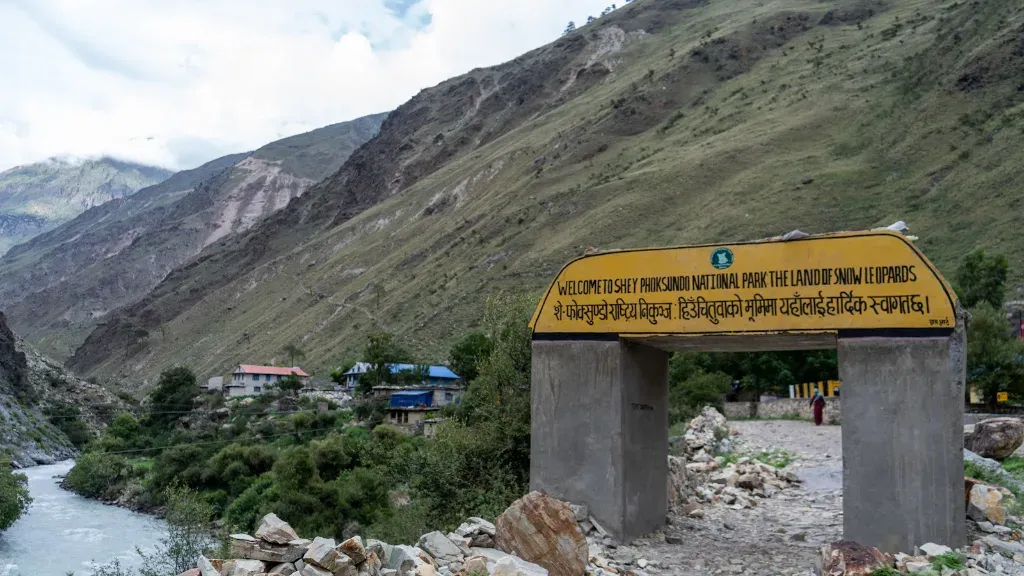
On our route you enter Shey Phoksundo National Park on Day 4, between Dunai and Chhekpa, where park staff check your entry permit. From there the trek passes the park's best-known sites, Phoksundo Lake and Shey Gompa.
The park lists Phoksundo Lake and Shey Gumba among its main attractions, and both are on our itinerary: the lake on Days 6 to 8 and Shey Gompa on Days 10 and 11. The park office at Suligad is on the approach, so the Day 4 check is usually the first time you show the park permit.
Keep the park permit with you for the whole trek. Park staff may ask to see it, and it is valid for a single entry only, so if you leave the park and re-enter, you need a new one.
The park gate on the trail beside the river. Photo: North Nepal Travel & Trek.
What wildlife lives in Shey Phoksundo National Park?
Shey Phoksundo National Park protects snow leopard, blue sheep, Tibetan wolf, musk deer, Himalayan tahr, goral and Himalayan black bear, among others. The park has recorded more than 200 bird species, 29 butterflies and six reptiles.
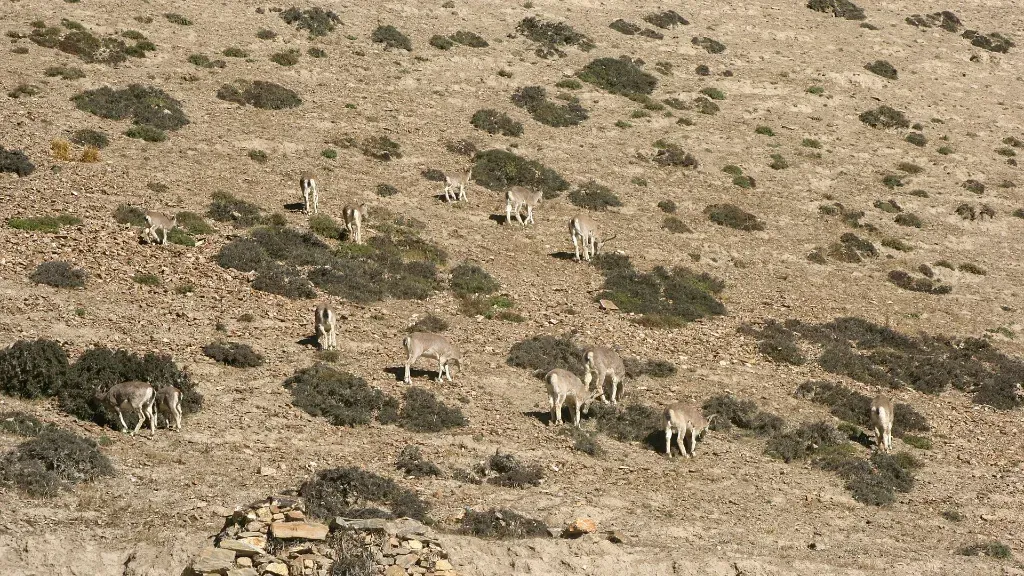
Blue sheep are the large wild animal you're most likely to see, often in herds on the slopes above the trail, and a main prey of the snow leopard. Blue sheep are also what drew the biologist George Schaller to Shey in 1973, the trip Peter Matthiessen wrote about in The Snow Leopard. A sighting of the cat itself is rare, and I'd never promise one.
The park also lists the butterfly Paralasa nepalaica, which it describes as the highest-flying butterfly in the world, and 286 plant species of ethnobotanical importance. I always tell guests to bring binoculars.
Blue sheep, or bharal, grazing in the hills of Mustang, Nepal. Photo: Sharadgurung7711, CC BY-SA 4.0, via Wikimedia Commons, cropped.
Who lives inside Shey Phoksundo National Park?
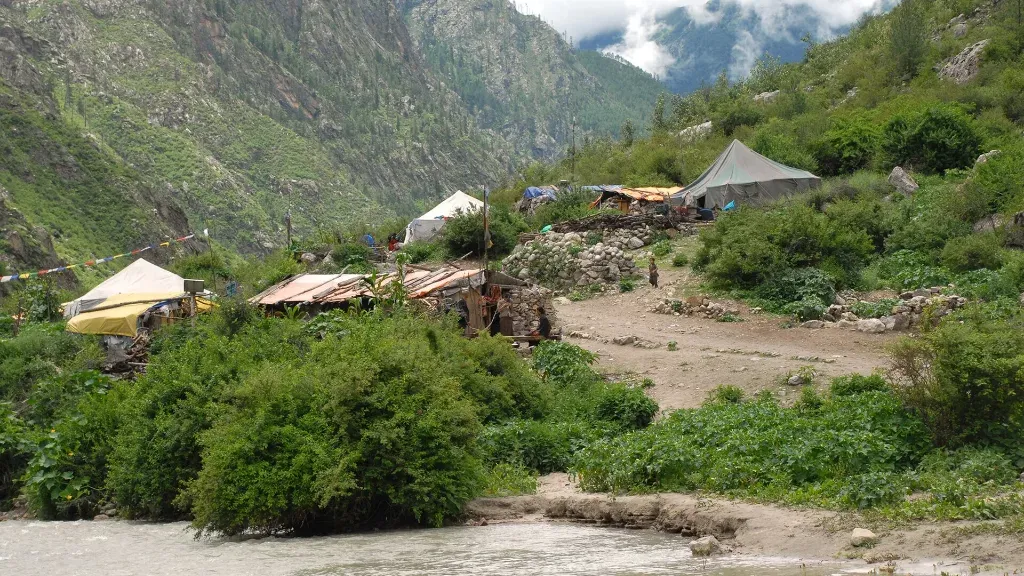
More than 9,000 people live inside Shey Phoksundo National Park, in some of the highest villages in the world, according to the park. Most practise Bon, the park says, and live by farming, herding and trade with Tibet.
The park is not a wilderness emptied of people. It protects villages, monasteries and old trade routes as well as wildlife, and the park counts Shey Gompa, from the 11th century, and Thashung Gompa, built about 900 years ago, among its cultural heritage. Salt caravans to and from Tibet were part of the local economy for centuries.
For trekkers, that means the rules below apply in places where people live, graze animals and pray. Our guide to Upper Dolpo culture covers the villages and gompas on the route in detail.
A summer camp used by caravans inside Shey Phoksundo National Park. Photo: Sergey Pashko, CC BY 3.0, via Wikimedia Commons, cropped.
What are the rules in Shey Phoksundo National Park?
Shey Phoksundo National Park bans firewood and plastic bags, limits camping to designated sites, and asks visitors to carry out non-biodegradable waste. You also may not walk inside the park between sunset and sunrise.
These are the park's own rules, as published by the Department of National Parks and Wildlife Conservation. On our Upper Dolpo trek the crew handles camping and cooking within these rules; the list below is what they mean on the trail:
No firewood. The use of firewood is strictly prohibited, so the kitchen cooks on gas or kerosene.
No polythene or plastic bags in the park.
Camp only at designated camping areas.
Carry out batteries, plastic bottles and other non-biodegradable rubbish.
Don't remove or damage plants or animals. Take only photographs.
Respect cultural and religious sites.
Keep your entry permit with you; it is single-entry, non-refundable and non-transferable.
Heads up
The rule people miss is the one about time: the park says no one should walk inside it between sunset and sunrise. On a long day that is a real constraint, so we plan every stage to reach camp before dark. Plan your photography stops with that in mind.
How much is the Shey Phoksundo National Park permit?
The Shey Phoksundo National Park entry permit costs NPR 3,000 per person per entry for foreign visitors, NPR 1,500 for SAARC nationals, and is free for children under 10, according to the Nepal Tourism Board.
On our Upper Dolpo trek the park permit is included, and we arrange it with the Upper Dolpo and Lower Dolpo restricted-area permits before you arrive. Because the fee is set in rupees, its dollar value moves with the exchange rate. The restricted-area permits are the larger cost; our Upper Dolpo permit guide explains all three.
Frequently asked questions
Shey Phoksundo National Park covers 3,555 km², which makes it Nepal's largest national park. It also has a buffer zone of 1,349 km², declared in 1998.
Shey Phoksundo National Park was established in 1984. Its park office is at Suligad in Dolpa, on the trail our Upper Dolpo trek follows on Day 4.
The park protects snow leopards, but sightings are rare. Blue sheep, a main prey of the snow leopard, are far more common and are often seen in herds on the slopes above the trail.
No. The park strictly prohibits the use of firewood, so there are no campfires. Our kitchen crew cooks on gas or kerosene for the whole trek.
No. The park's rules say no one should walk inside the park between sunset and sunrise, so treks are planned to reach camp before dark.
Our Upper Dolpo Trek crosses the park from Day 4, with the park permit included. Message me on WhatsApp if you want to know more.
A native of the Annapurna region, he brings over 17 years of firsthand experience leading treks across the mountains of Nepal. His deep local roots and proven guiding expertise make him a trusted authority on authentic Himalayan adventures.