How Many People Have Climbed Mount Everest? 2026 Figures
Published Oct 16, 2026 Updated Oct 18, 2026 12 min read
Quick answer
Through December 2025, 7,563 different people had reached the summit of Mount Everest, making 13,737 ascents between them, according to the Himalayan Database. Spring 2026 then added a record 1,008 summits, Nepal's Department of Tourism reports.
Two numbers answer this question, and the gap between them is the interesting part. I've pulled the latest figures together from the Himalayan Database, Nepal's Department of Tourism and the 2026 season reports, and every source is listed at the end. If you're really asking because you want to see Everest yourself, skip to the last section: you don't need a climbing permit for that.
Key facts
Different people on the summit (to Dec 2025)7,563
Total ascents (to Dec 2025)13,737
Summits in spring 20261,008 (a record)
Everest permits issued, spring 2026495
Most summits by one person32, Kami Rita Sherpa (17 May 2026)
Deaths on Everest (to Dec 2025)339
Summit height8,848.86 m (29,032 ft)
Nepal climbing royalty (spring)USD 15,000 per foreign climber
How many people have climbed Mount Everest?
Through December 2025, 7,563 people had stood on top of Mount Everest, and between them they made 13,737 ascents. The totals differ because many climbers, mostly Nepali guides, summit again and again as part of their job.
Of those 13,737 Everest ascents, 7,081 were made by hired climbers: the Sherpa and other Nepali guides who fix the ropes, carry the loads and climb beside clients. The other 6,656 were made by expedition members, the people who paid to be there. On Everest, the workforce reaches the top more often than the customers.
Kami Rita Sherpa from Thame shows the pattern better than any table. He first summited in 1994 and reached the top for the 32nd time at 10:12 am on 17 May 2026, aged 56, leading a team for 14 Peaks Expedition. In the same season Lhakpa Sherpa made her 11th ascent, the record for a woman.
The Himalayan Database had not published its 2026 totals when this was written. Adding the 1,008 spring 2026 summits to the 13,737 already recorded takes the all-time count of Everest ascents past 14,700. The number of different people will rise by less, because some of the 2026 summiters were guides who were already counted.
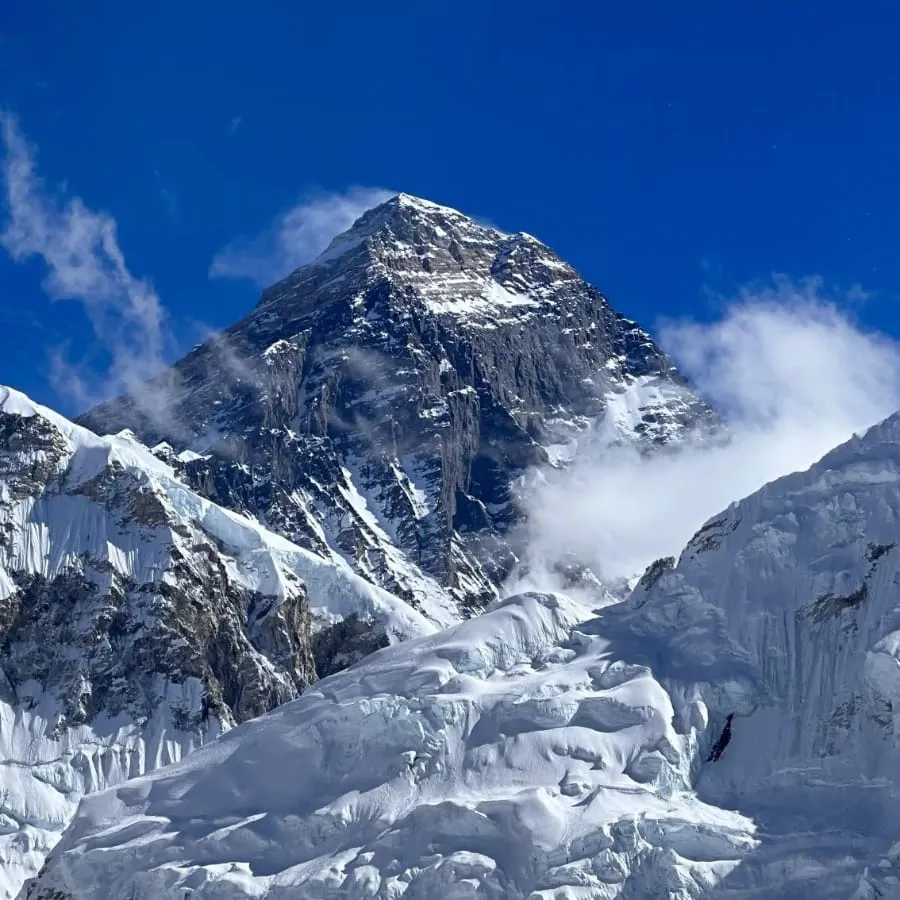
Snow and ice above the glacier near Everest Base Camp. Photo: North Nepal Travel & Trek.
How busy was the 2026 Everest season?
Spring 2026 was the busiest Everest season on record. Nepal issued 495 Everest permits, and the Department of Tourism's base camp field office counted 1,008 successful summits, against a previous record of about 900.
The crowd was squeezed into a few days. The Khumbu Icefall route reopened on 28 April after a serac had blocked it for about two weeks, the rope-fixing team reached the summit on 13 May, and 274 climbers reached the top on 20 May alone, a single-day record for the Nepal side. About 80% of the season's summits came between 17 and 26 May.
Everest permit holders came from 55 countries in 2026. China sent the most climbers (109), followed by the United States (77), India (61) and the United Kingdom (32). Everest royalties earned Nepal's government around Rs 1.08 billion for the season.
How many people have died on Everest?
Through December 2025, 339 people had died on Mount Everest: 229 on the Nepal side and 110 on the Tibet side. Measured against the number of climbers, the Everest death rate has fallen by more than half since 2000.
Across the mountain's whole history, the Himalayan Database puts the death rate at about 1.06 for every 100 climbers who went above base camp. The trend tells you more than the average. Before 2000 the rate was 1.80; from 2000 to 2024 it was 0.77. I'd put most of that drop down to better weather forecasting, fixed ropes all the way to the top, and more bottled oxygen carried higher.
Everest season
Deaths on Everest
2023
18
2024
8
2025
5
Spring 2026 (as of 4 June 2026)
5, including one on the approach to base camp
One bad season doesn't make Everest more dangerous, and one quiet season doesn't make it safe. Weather and crowding on particular summit days move the yearly figure far more than any long-term change, so watch the rate over ten years rather than one season's headlines.
Falls and avalanches cause the largest share of Everest deaths, followed by altitude illness and exhaustion.
Who climbs Everest today?
Today's Everest climber is older than the stereotype and comes from a wider spread of countries. Women are a growing minority, and the research finds they summit and survive at the same rates as men.
Age
A Himalayan Database study by Huey and colleagues (Biology Letters, 2007) found that between 1953 and 1989, 18.7% of Everest climbers were 40 or older and 0.3% were 60 or older. By 2000 to 2005, those shares had grown to 45.6% and 3.6%. Climbers over 40 had lower odds of reaching the summit, and climbers over 60 had higher odds of dying, especially on the way down.
Women
In the same study, women made up about 10% of Everest climbers in 2000 to 2005, up from under 5% before 1990. Men and women died at almost identical rates: 1.62% and 1.63%. By December 2024, 883 different women had reached the summit.
Nationality
Nepali climbers make the most ascents because guiding is their work. Among paying members, the United States leads with 1,078 summits through 2024, followed by China (683), India (605) and the United Kingdom (560).
What are the odds of reaching the summit?
In 2024, the Himalayan Database recorded a 68% summit rate on Everest. Between 1990 and 2005, only about 30% of first-time expedition members reached the top. In the data, bottled oxygen makes the biggest difference.
Between 2000 and 2024, 80% of Everest expedition members who used bottled oxygen reached the summit, against 15% of those who climbed without it. Across every year since 1922, the Himalayan Database puts overall summit success at about 43%.
Nepal may soon require more experience before an Everest permit. A Tourism Bill passed by the National Assembly in February 2026 would require Everest applicants to have climbed a 7,000 m (22,966 ft) peak in Nepal first. As of July 2026 the bill was still in a House of Representatives committee with 263 amendments filed, so it is not law yet. The ministry wants it in force for spring 2027.
If you want to find out how your body handles real altitude before committing to Everest, a 6,000-metre trekking peak such as Island Peak climbing in the Khumbu is the usual next step after base camp.
How long does it take to climb Everest?
A standard commercial Everest expedition takes about two months, Kathmandu to Kathmandu. Speed expeditions that pre-acclimatise at home cut this to two to four weeks.
1
Kathmandu
Permits, gear checks and team briefings.
2
Walk in to base camp
The same trail trekkers use, through Namche Bazaar and Dingboche. Our 12-day trek reaches base camp on day 8, with a rest day at Namche; climbers usually take it slower.
3
Acclimatisation rotations
Several weeks of climbing to the higher camps, sleeping there, and dropping back to base camp to recover.
4
Summit window
Teams wait for the jet-stream winds to ease. In 2026, the ropes reached the summit on 13 May and about 80% of summits came between 17 and 26 May.
5
Descent and out
Back to base camp, then a trek or helicopter out to Lukla and a flight to Kathmandu.
Speed expeditions on Everest cost USD 100,000 or more, and one premium three-week package was priced at USD 230,000 for 2026. The days saved come out of your safety margin: less room for illness, bad weather, or a body that adapts slowly. I'd only consider one with a proven altitude record of your own.
How much does it cost to climb Everest in 2026?
Most Everest climbers pay between USD 40,000 and 80,000 in 2026. Nepal's spring climbing royalty alone is USD 15,000 per foreign climber, up from USD 11,000 before September 2025.
Median 2026 price
Nepal (south side)
Tibet (north side)
Nepali operator
USD 45,250
USD 47,000
International operator, Sherpa guide
USD 54,000
Not offered
International operator, international guide
USD 76,000
USD 90,800
The royalty is charged in US dollars to foreign climbers. Nepali climbers pay Rs 150,000, and Nepali mountain guides are exempt. On the Tibet side, when it is open, the permit runs about USD 15,800 to 18,000 per person for teams of four or more; as of August 2026, China had kept the north side closed to foreign teams for both 2026 seasons. The Kathmandu Post put the average spend for a foreign climber in 2026 at over Rs 6 million. There's more on Nepal's 2025 climbing fee changes in our earlier post.
Which routes do climbers take up Everest?
Almost every Everest ascent follows one of two routes: the South Col and Southeast Ridge from Nepal, or the North Col and Northeast Ridge from Tibet. The other faces of the mountain see very few climbers.
From Nepal
The South Col route climbs the Khumbu Icefall above base camp, crosses the Western Cwm, and follows the Southeast Ridge to the top. Tenzing Norgay and Edmund Hillary made the first ascent this way on 29 May 1953, and it carries most of the traffic today. Its signature hazard is the icefall, where towers of ice can collapse without warning.
From Tibet
The North Col route starts from the Rongbuk valley and follows the Northeast Ridge. It has no icefall, but it is colder and windier, and summit day stays high on the ridge for a long time. George Mallory and Andrew Irvine disappeared on this side in 1924. China controls access tightly: as of August 2026 the north side was closed to foreign climbing teams for both 2026 seasons. Our Kailash Mansarovar and Everest Base Camp tour from Tibet visits the north base camp without any climbing; ask us about the current Tibet permit situation.
The other faces
The Southwest Face, the rock wall above the Western Cwm, was first climbed in 1975 by Chris Bonington's British expedition. The East, or Kangshung, Face rises above a remote valley in Tibet and has no commercial route.
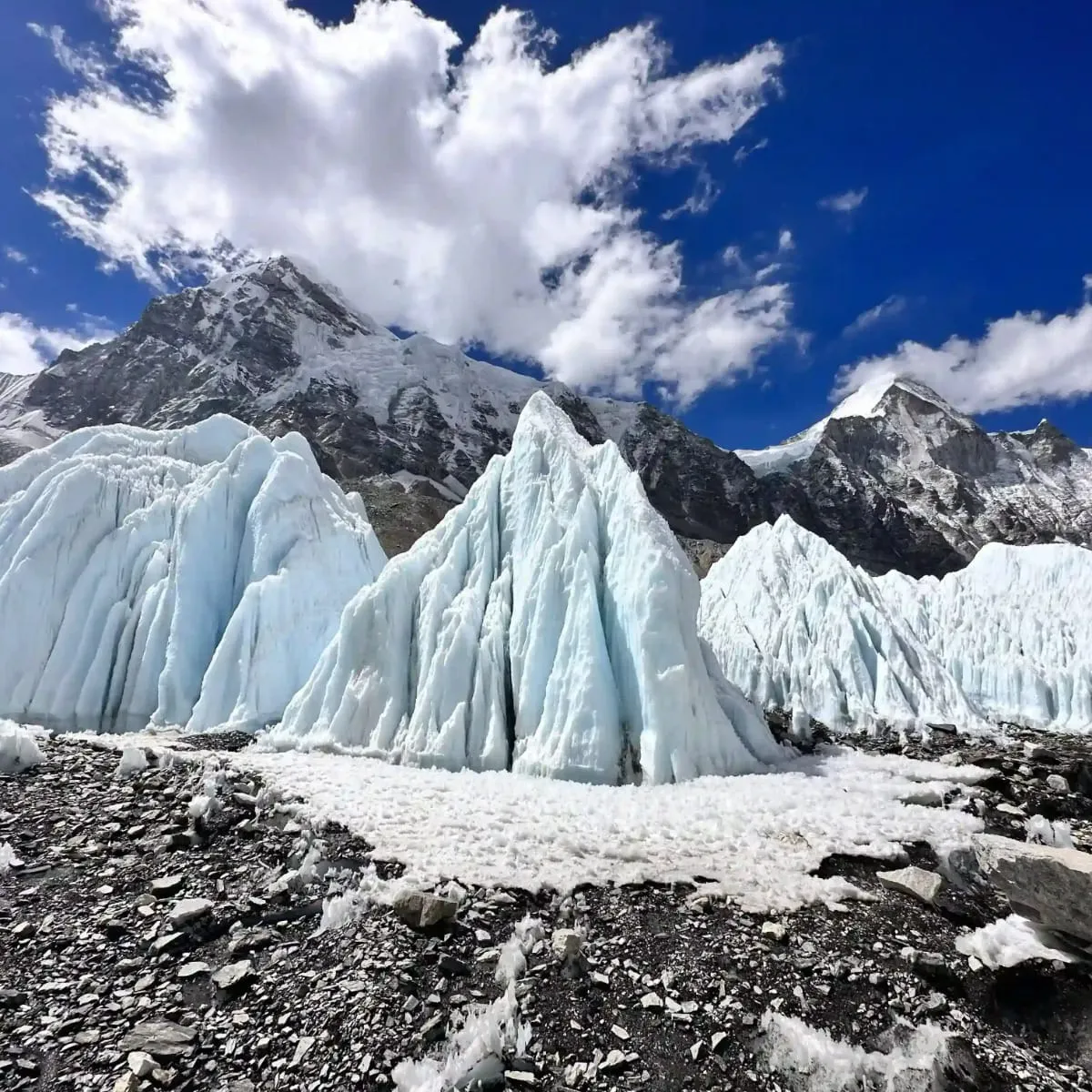
Ice seracs on the glacier near Everest Base Camp. Photo: North Nepal Travel & Trek.
What do the numbers mean if you're trekking to base camp?
You don't need to climb to see Everest up close. The trek to Everest Base Camp at 5,364 m (17,598 ft) needs no climbing skills, but altitude is the real risk, so the itinerary matters more than your fitness.
Altitude sickness is common on the Everest Base Camp trail. In a study of 550 trekkers at Pheriche in autumn 1996, 29.8% had acute mountain sickness, and each extra night spent between Lukla and Pheriche cut the risk by 18.7%. The CDC Yellow Book repeats the Wilderness Medical Society guideline: above 3,000 m (9,843 ft), raise your sleeping altitude by no more than 500 m (1,640 ft) a night, and add an extra night for every 1,000 m (3,281 ft) gained.
Heads up
On our groups, the first altitude headache usually shows up at Dingboche, 4,410 m (14,469 ft). Tell your guide straight away. Our rule is that nobody goes higher with symptoms of AMS, and your guide judges each trekker individually. Our 12-day itinerary has one rest day, at Namche Bazaar, and on two days above Namche it gains a little more than the 500 m guideline. That's why I'd add a second night at Dingboche if you know you acclimatise slowly.
For the classic close view of the summit, the climb to Kala Patthar, 5,644 m (18,517 ft), above Gorak Shep is the high point of the trek. On our 12-day Everest Base Camp trek itinerary that's day 9, the morning after base camp.
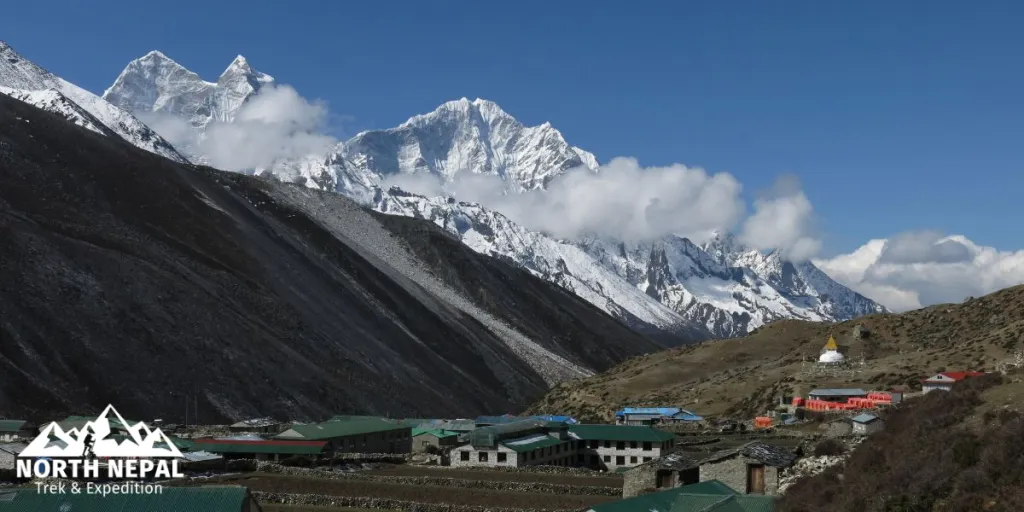
Lodges at Dingboche, where the first altitude headaches often start. Photo: North Nepal Travel & Trek.
Frequently asked questions
Through December 2025, 7,563 different people had reached the summit of Mount Everest, making 13,737 ascents, according to the Himalayan Database. Spring 2026 added a record 1,008 summits, which takes the total number of ascents past 14,700 once the database is updated.
Through December 2025, 339 people had died on Mount Everest, 229 on the Nepal side and 110 on the Tibet side. Five more deaths were reported in spring 2026 as of 4 June 2026, one of them on the approach to base camp. Falls and avalanches cause the most deaths, followed by altitude illness and exhaustion.
Across Everest's whole history, the Himalayan Database puts the death rate at about 1.06 for every 100 climbers who went above base camp. The modern rate is lower: 0.77 from 2000 to 2024, down from 1.80 before 2000.
A standard commercial Everest expedition takes about two months from Kathmandu and back. Most of that time goes on acclimatisation rotations from base camp. Speed expeditions cut it to two to four weeks at USD 100,000 or more.
Most Everest climbers pay USD 40,000 to 80,000 in 2026. Median prices on the Nepal side run from USD 45,250 with a Nepali operator to USD 76,000 with an international guide. Nepal's spring royalty is USD 15,000 per foreign climber.
Kami Rita Sherpa from Thame holds the record with 32 Everest summits, the latest on 17 May 2026. Lhakpa Sherpa holds the women's record with 11 summits.
Tenzing Norgay and Edmund Hillary made the first ascent of Mount Everest on 29 May 1953, by the South Col route from Nepal. Junko Tabei became the first woman on the summit in 1975, and Reinhold Messner and Peter Habeler made the first ascent without bottled oxygen in 1978.
Yes. The trek to Everest Base Camp at 5,364 m (17,598 ft) needs no climbing skills, and the hike up Kala Patthar, 5,644 m (18,517 ft), gives one of the best close views of the summit. A licensed guide and a sensible acclimatisation plan matter more than fitness.
Huey RB, Salisbury R, Wang JL, Mao M, "Effects of age and gender on success and death of mountaineers on Mount Everest", Biology Letters, 2007: https://pmc.ncbi.nlm.nih.gov/articles/PMC2391200
Basnyat B, Lemaster J, Litch JA, "Everest or bust: a cross sectional, epidemiological study of acute mountain sickness at 4243 meters in the Himalayas" (data collected autumn 1996): https://ndm.medsci.ox.ac.uk/publications/536941
A native of the Annapurna region, he brings over 17 years of firsthand experience leading treks across the mountains of Nepal. His deep local roots and proven guiding expertise make him a trusted authority on authentic Himalayan adventures.