The Everest Base Camp trek is not technically dangerous. There are no ropes, no fixed lines and no climbing. The real danger is altitude: you sleep as high as 5,164 m (16,942 ft) at Gorak Shep, and almost every serious illness on this trail comes from going up too fast or ignoring early symptoms.
Deaths are rare, but they do happen. A study of trekkers evacuated to Kathmandu put altitude-illness deaths across Nepal at about 7.7 per 100,000 trekkers, and found that Everest-region trekkers were more likely to need evacuation than trekkers elsewhere, because the Khumbu route climbs higher and faster than most. The good news is that most of what goes wrong up there is preventable.
| EBC safety at a glance |
| Everest Base Camp |
5,364 m (17,598 ft) |
| Highest night |
Gorak Shep, 5,164 m (16,942 ft) |
| Highest point |
Kala Patthar, 5,644 m (18,519 ft) |
| Main risk |
Altitude illness: AMS, HAPE, HACE |
| Other risks |
Lukla flight delays, cold, yak traffic, rockfall on the moraine, stomach bugs |
| Technical climbing |
None |
| Permits (foreigners) |
Sagarmatha National Park NPR 3,000 + Khumbu Pasang Lhamu Rural Municipality NPR 3,000 |
| Starting price |
From USD 1,500 per person (Everest Base Camp Trek) |
The real risk is altitude, not the trail
For this year's storms in the Khumbu and the full trip plan, see our Everest Base Camp trek planning guide.
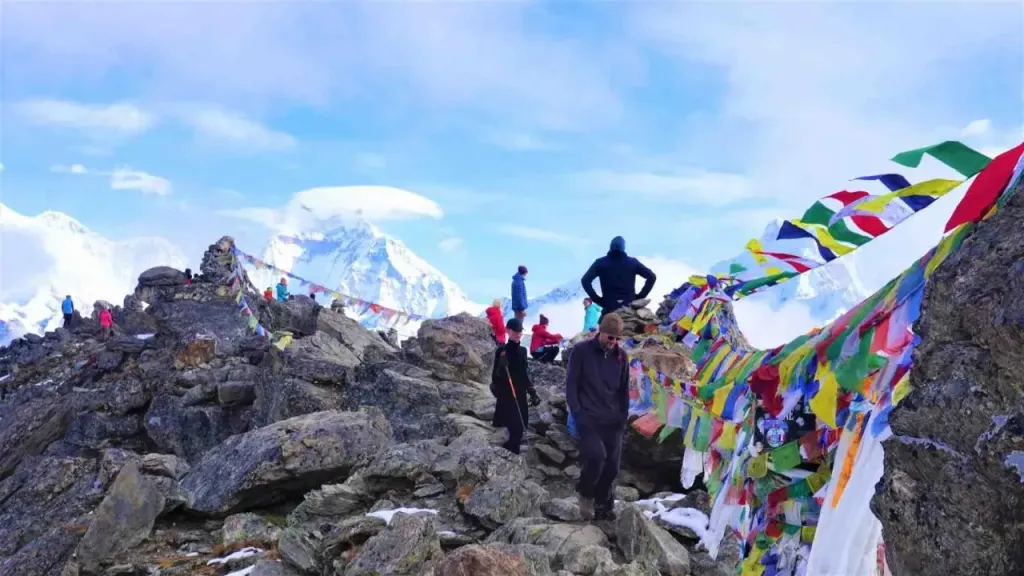 Above 4,000 m the pace that matters is the one you sleep at, not the one you walk at. Photo: North Nepal Travel & Trek.
At Everest Base Camp each breath carries roughly half the oxygen it would at sea level. The air is still about 21% oxygen. There is simply less air pressure pushing it into your lungs. Your body can adapt to that, but only if you give it time.
How much time matters more than how fit you are. In a 1996 survey of 550 trekkers at Pheriche, below Dingboche, 29.8% had acute mountain sickness. The same study found that each extra night spent between Lukla and Pheriche cut the risk of AMS by about 19%. That is the whole case for a slow itinerary in one number.
We see it every season. The trekkers who get into trouble are rarely the least fit. They are the ones who walk Namche to Tengboche at their home pace, skip the rest day, or keep quiet about a headache because they are afraid of being sent down.
How high you sleep, night by night
This is our standard 12-day Everest Base Camp itinerary. What counts is the altitude you sleep at, not the highest point you reach during the day.
| Night |
Where you sleep |
Gain |
| 2 |
Phakding, 2,610 m (8,563 ft) |
Down from Lukla, 2,860 m (9,383 ft) |
| 3–4 |
Namche Bazaar, 3,440 m (11,286 ft) |
+830 m, then a rest day |
| 5 |
Tengboche, 3,867 m (12,687 ft) |
+427 m |
| 6 |
Dingboche, 4,410 m (14,469 ft) |
+543 m |
| 7 |
Lobuche, 4,940 m (16,207 ft) |
+530 m |
| 8 |
Gorak Shep, 5,164 m (16,942 ft) |
+224 m |
The CDC's 2026 travel-health guidance says that once you are above 3,000 m (9,843 ft) you should raise your sleeping altitude by no more than 500 m (1,640 ft) a day, and add an extra night for every 1,000 m (3,281 ft) you gain.
Here is the honest part. Like most 12-day itineraries on the market, ours runs slightly over that line on two nights, and there is no rest day between Namche and Gorak Shep. Most healthy trekkers manage it. If you have never slept above 4,000 m, or you have had altitude sickness before, ask us to add a second night at Dingboche — we run that version on request. You spend that day walking up Nangkartshang, around 5,083 m (16,677 ft), and sleep back down in the village.
For the full medical background, training plan and Diamox guidance, read our Everest Base Camp altitude preparation guide.
Warning signs: the three conditions to know
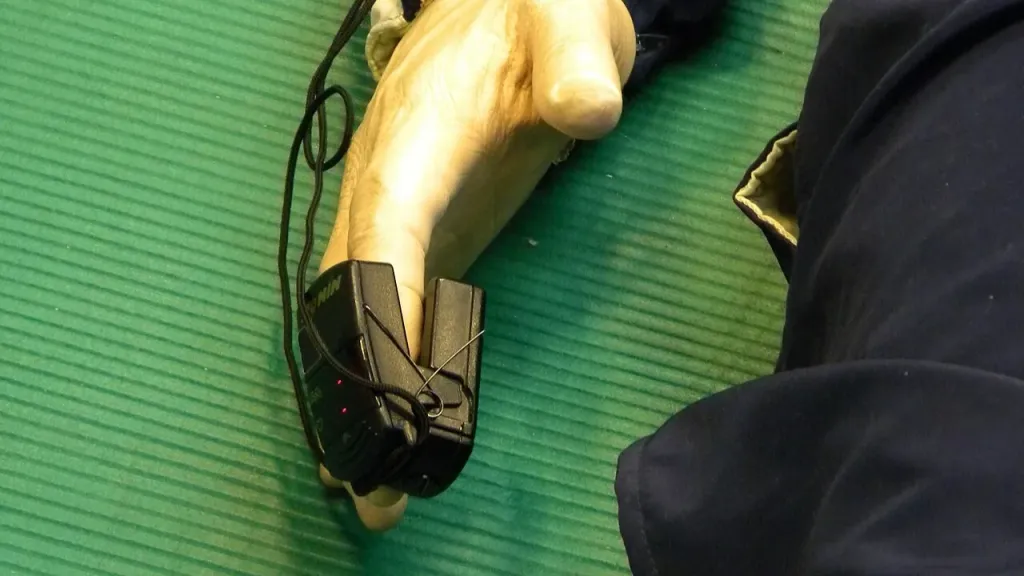 Our guides check oxygen saturation and pulse every evening. A single low reading is not the alarm; a falling trend with symptoms is. Photo: Pöllö, Wikimedia Commons, CC BY 3.0.
Altitude illness comes in three forms. The first is common and usually mild. The other two can kill within hours if nobody acts.
Acute mountain sickness (AMS)
Signs: a headache plus nausea, dizziness, unusual tiredness or very broken sleep.
What to do: stop going up. Rest at the same altitude, drink, eat, take paracetamol or ibuprofen. If it gets worse, go down.
High-altitude pulmonary edema (HAPE)
Signs: breathless at rest, not just on the climb; a wet cough; a gurgling or rattling chest; extreme weakness. It often shows up at night.
What to do: go down immediately, even in the dark. HAPE is the most common cause of death from altitude illness.
High-altitude cerebral edema (HACE)
Signs: confusion, odd behaviour, a severe headache that painkillers don't touch, and above all loss of balance.
What to do: go down immediately. Our guides use a simple test: walk heel-to-toe along a straight line. If you stagger like you've been drinking, you are descending.
The treatment for all three is the same: lose altitude. The Wilderness Medical Society names a descent of roughly 300–1,000 m (1,000–3,300 ft) as the most important treatment, with oxygen if it is available.
What our guides do every day
Every North Nepal Travel & Trek guide carries a first-aid kit and a pulse oximeter. Each evening they check your oxygen saturation and pulse, and they ask the questions people tend to dodge: did you finish your dinner, how did you sleep, is the headache new? A low reading on its own isn't an emergency. A falling trend plus symptoms is.
The one rule we don't bend: nobody sleeps higher with symptoms. An extra night in Dingboche costs you a day. Pushing on to Lobuche with a worsening headache can cost you the trek, a helicopter, or worse.
Two myths worth dropping. Forcing down huge amounts of water does not prevent altitude sickness; the Wilderness Medical Society says overhydration doesn't work and can lower your blood sodium dangerously. Drink to thirst, check that your urine is pale, and keep going. And acetazolamide (Diamox) helps you acclimatise, but it doesn't make a fast itinerary safe. The usual preventive adult dose is 125 mg every 12 hours, started the day before you climb. Get it from your own doctor before you travel, not from a pharmacy counter in Thamel.
The other risks on the trail
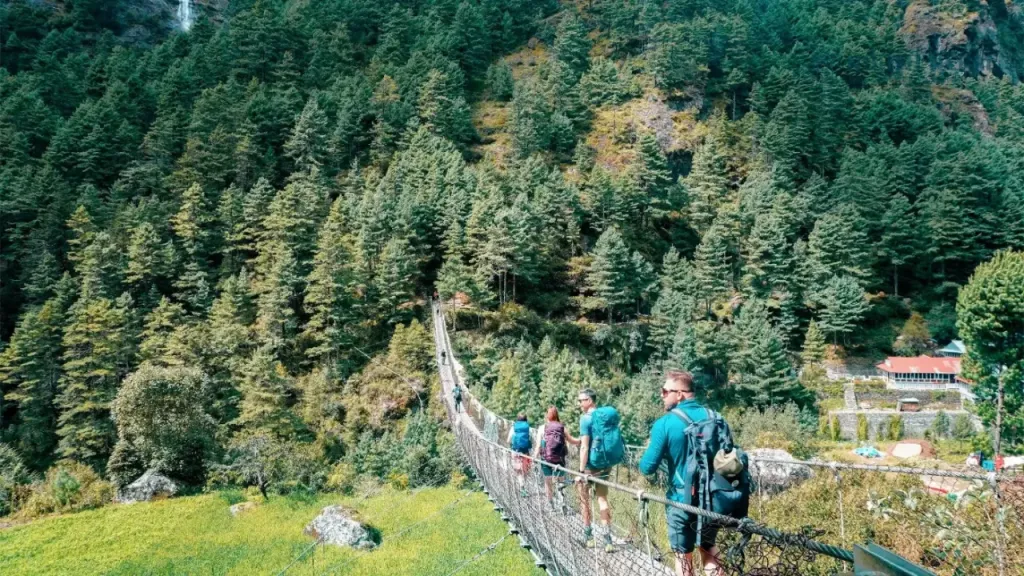 The bridges over the Dudh Koshi are solid. The risk is meeting an animal train halfway across. Photo: North Nepal Travel & Trek.
Altitude is the big one. These are the smaller ones that catch people out.
Lukla flights
In spring and autumn most Lukla flights leave from Manthali airport in Ramechhap, not Kathmandu, which means a pre-dawn drive of around four hours before you fly. The planes only fly in clear weather, so delays and cancellations are normal, at both ends of the trek. Keep at least one spare day between your return to Kathmandu and your international flight home. Helicopter transfers exist as a paid backup when planes are grounded.
Yaks, dzopkyo and porters
Between Lukla and Namche you share the trail with yak and dzopkyo trains carrying loads that stick out sideways. When you hear the bells, step to the uphill side of the path and wait. Never stand on the drop side.
Suspension bridges
The steel bridges over the Dudh Koshi are solid. The risk is congestion: don't step onto a bridge when an animal train is coming the other way.
Rockfall on the moraine
The last stretch from Gorak Shep to Base Camp crosses loose glacier moraine that shifts every season. Follow your guide's line, don't stop under steep loose slopes, and move quickly through the sections they point out.
Cold
Rooms above Dingboche are unheated, and only the dining room has a stove. Nights at Base Camp can drop to anywhere from −3°C to −20°C depending on the month. Cold makes acclimatising harder, so layer up early. Our package includes a bottle you can fill with hot water and take to bed. Use it.
Stomach bugs and the Khumbu cough
Most trekkers who feel rough in the Khumbu are fighting a stomach bug or a cough, not altitude. Treat all water (we supply purification tablets), wash your hands before every meal, and skip meat above Namche. A buff over your mouth on dusty sections helps with the dry Khumbu cough.
Sun and snow glare
The sun is fierce above the tree line, even on cloudy days. Bring category 3 or 4 sunglasses, high-SPF sunscreen and lip balm. Snow blindness is painful and completely avoidable.
Weather and season
Spring (March to May) and autumn (late September to November) give the most stable weather and the most reliable flights. Winter treks are possible but very cold. In the monsoon (June to early September), flights to Lukla are frequently cancelled and the views are mostly cloud.
Who should think twice
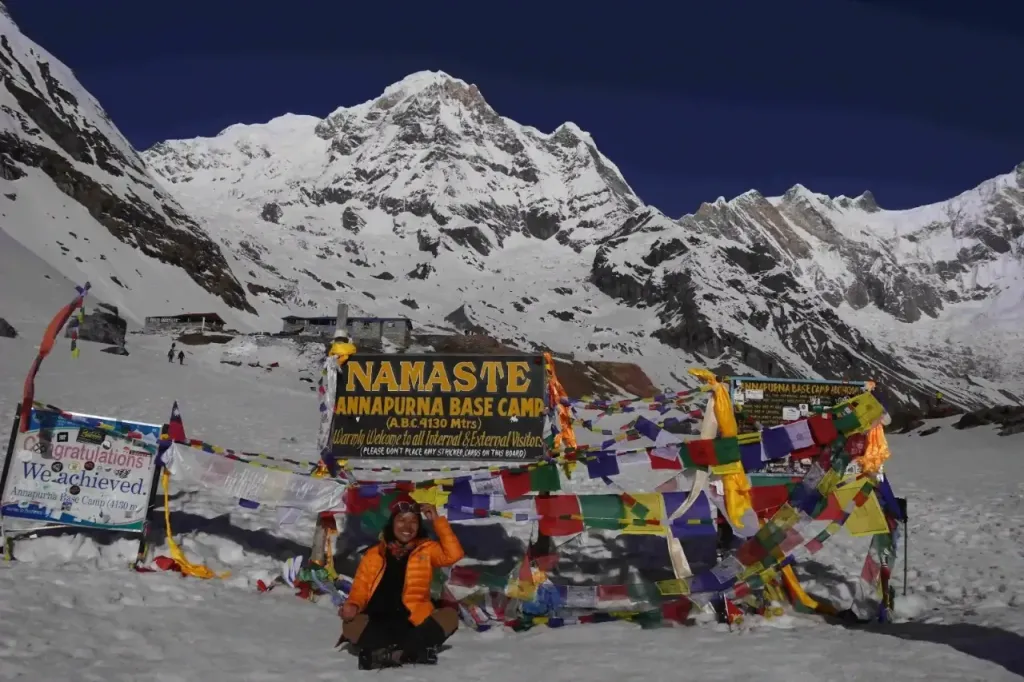 Annapurna Base Camp tops out more than 1,000 m lower than Gorak Shep, which makes it a realistic alternative if sleeping high is not safe for you. Photo: North Nepal Travel & Trek.
Age alone isn't a barrier, but it is worth taking seriously: one Kathmandu clinic study found that trekkers evacuated for altitude illness were older on average than other trekkers (44 against 39). Get a medical check that specifically mentions sleeping above 5,000 m if any of these apply to you:
- heart or lung disease, or uncontrolled high blood pressure
- previous HAPE or HACE
- pregnancy
- a chest infection or bad cold in the days before you fly to Lukla
If sleeping at altitude isn't safe for you, there are other ways to see the Himalaya:
Our Everest region treks page lists every Khumbu route we run, so you can compare how high each one sleeps before you choose.
Guides, insurance and rescue
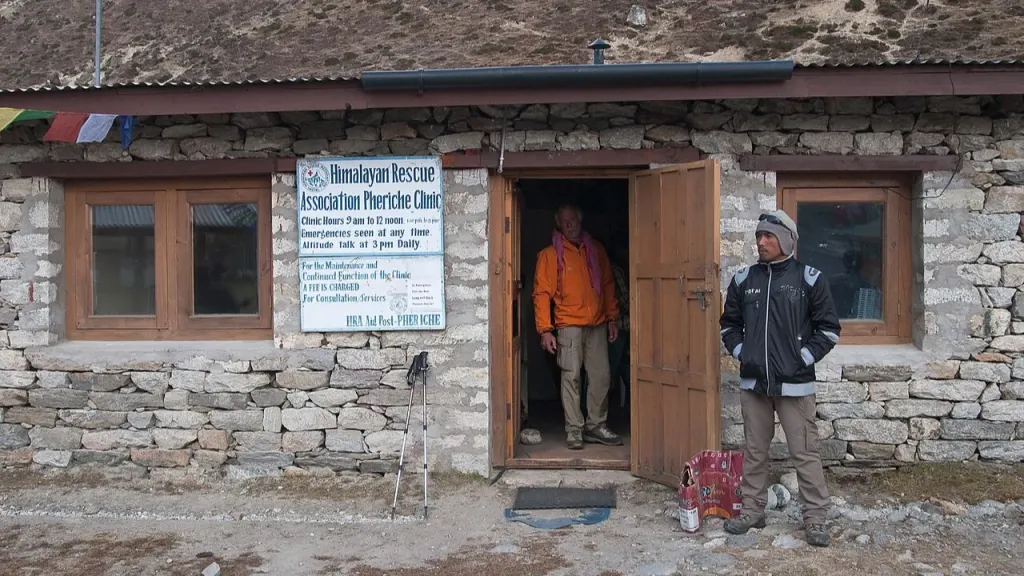 The HRA aid post at Pheriche runs through the main seasons and is the first place a sick trekker is taken. Photo: Vyacheslav Argenberg, Wikimedia Commons, CC BY 4.0.
Do you need a guide for Everest Base Camp?
Yes, on paper. The Nepal Tourism Board has required trekkers to hire a licensed guide since April 2023, and that requirement still stands. In the Everest region it is not enforced locally: the Khumbu Pasang Lhamu Rural Municipality, which runs the area, said it would not enforce the rule, and independent trekkers have continued to pass the Monjo checkpoint. Enforcement can change without much notice, so check the current position with us before you travel.
Legal or not, the case for a guide on this route is about altitude. A guide notices you leaving food on your plate two nights running, reads the oximeter trend, and has already made the 2 a.m. decision in Lobuche before. A trekker with early HACE will insist they are fine. Someone else has to make the call.
Insurance
Your policy must cover trekking up to 6,000 m and helicopter evacuation. Some standard travel policies stop at 3,000 m or exclude trekking altogether, so read the wording before you pay. Carry the policy number and emergency phone number on paper, not just on a phone that may be flat.
What happens if something goes wrong
If a guest needs evacuation, the guide contacts our Kathmandu and Pokhara offices and we coordinate a helicopter with a local rescue operator, subject to weather and aviation rules. The Himalayan Rescue Association also runs an aid post in Pheriche during the main seasons.
What it looked like for one of our guests
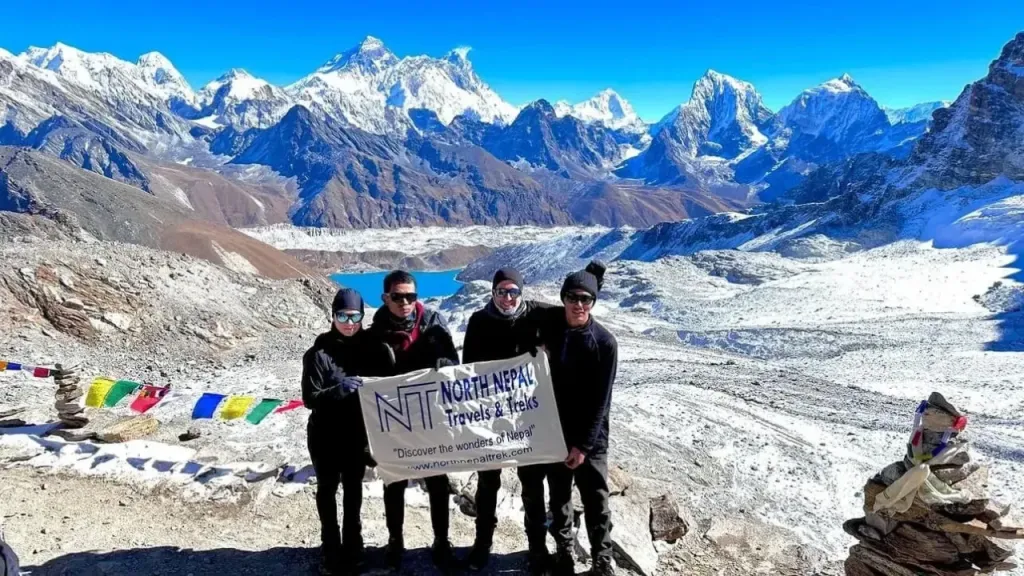 Our guests at Everest Base Camp, 5,364 m. Getting people here in good shape is the whole job. Photo: North Nepal Travel & Trek.
In March 2026 a solo trekker walked a 14-day Everest Base Camp trek with our guide Gopal and porter Aidhen. She got altitude sickness on the way up. In her TripAdvisor review she describes Gopal making sure she rested properly in the teahouses and ate enough to get her strength back, and waiting for her on the harder sections instead of hurrying her. That is what managing altitude looks like in practice: nothing dramatic, just someone paying attention every day.
How to make the EBC trek safer: a checklist
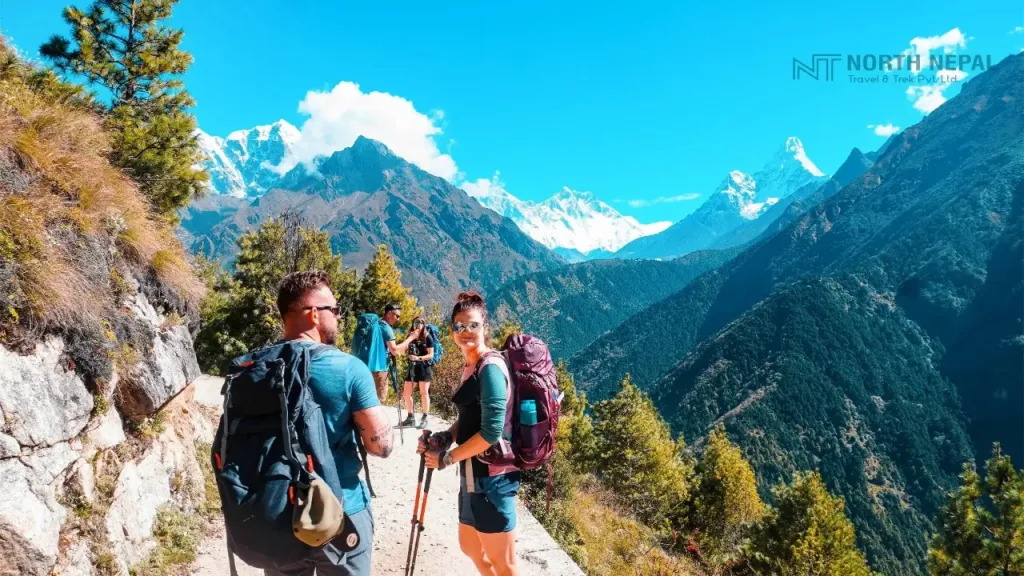 Twelve days Lukla to Lukla, thirteen if altitude is new to you. The itinerary does more for your safety than your fitness does. Photo: North Nepal Travel & Trek.
- Book at least 12 days Lukla to Lukla, and 13 if you're new to altitude.
- Train for 12 weeks: long back-to-back hikes and loaded stair climbs.
- Walk slower than feels natural from Namche upward.
- Never sleep higher with symptoms. Tell your guide about every headache.
- Skip alcohol above Namche and avoid sleeping pills.
- Drink to thirst and treat all water.
- Buy insurance that covers 6,000 m and helicopter rescue.
- Leave a spare day after Lukla for flight delays.
Frequently asked questions
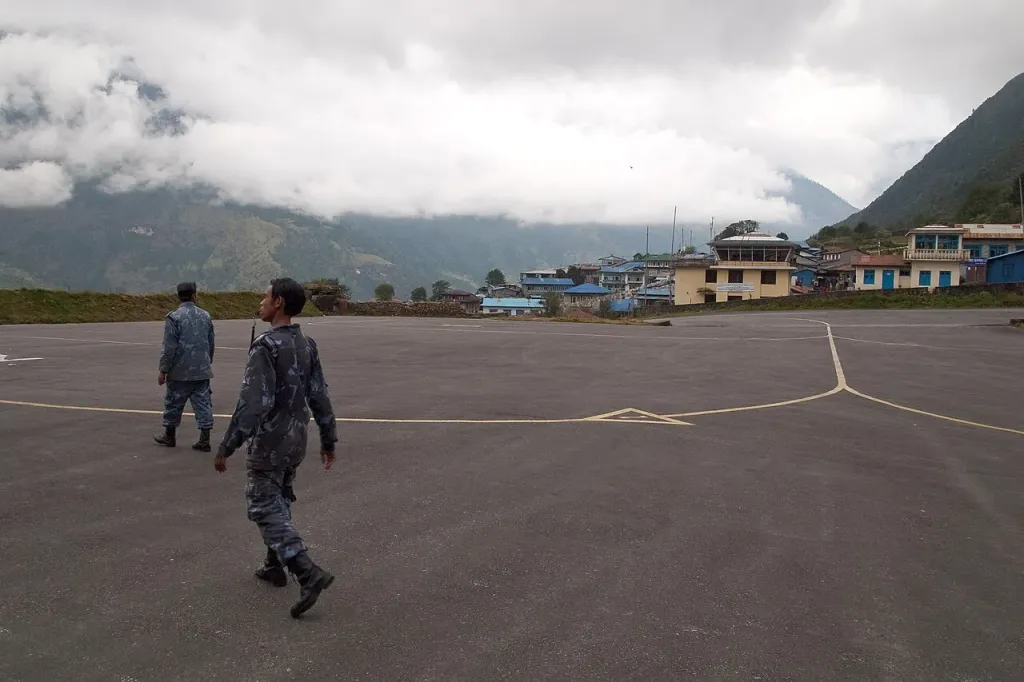 Lukla’s runway is short and sloped, and flights only go in clear weather. Build a spare day in at both ends. Photo: Vyacheslav Argenberg, Wikimedia Commons, CC BY 4.0.
Is the Everest Base Camp trek dangerous for beginners?
No, as long as you go slowly. The trail is non-technical and first-time trekkers finish it every season. Beginners mainly need 12 weeks of training, an itinerary of at least 12 days, and a guide who checks for altitude sickness every day.
How many people die on the Everest Base Camp trek each year?
There are no official figures for the EBC trek itself. Medical research puts altitude-illness deaths across all of Nepal's trekking at about 7.7 per 100,000 trekkers. Most serious altitude cases follow early symptoms that were ignored, which is why daily checks matter.
Is Lukla airport dangerous?
Lukla's runway is short and sloped, and flights only operate in clear weather, which is why delays and cancellations are common. Flying with experienced mountain pilots on a clear morning is routine. Build at least one spare day into your trip for weather.
Can you get altitude sickness in Namche Bazaar?
Yes. Namche Bazaar sits at 3,440 m (11,286 ft), and altitude sickness can start anywhere above about 2,500 m (8,202 ft). That is why every sensible itinerary spends two nights there before going higher.
Is Everest Base Camp higher than Kilimanjaro?
No. Kilimanjaro's summit, Uhuru Peak, is 5,895 m (19,341 ft), higher than Everest Base Camp at 5,364 m (17,598 ft). But you sleep higher on the EBC trek: Gorak Shep is 5,164 m (16,942 ft), while Kilimanjaro's main high camp, Barafu, is 4,673 m (15,331 ft).
Do you need oxygen for the Everest Base Camp trek?
No. Trekkers don't use bottled oxygen on the EBC trek. Oxygen is an emergency treatment for severe altitude illness while descending, not something you need to reach Base Camp.
What is the safest time to trek to Everest Base Camp?
October and November, then March to May. These months have the most stable weather and the most reliable Lukla flights. Winter is very cold above Dingboche, and the monsoon (June to early September) brings frequent flight cancellations.
Author
Mohan Raj Bhandari
Founder/Managing director
A native of the Annapurna region, he brings over 17 years of firsthand experience leading treks across the mountains of Nepal. His deep local roots and proven guiding expertise make him a trusted authority on authentic Himalayan adventures.