Everest Base Camp Trek Cost 2026: Every Dollar, Honestly Broken Down
Published Jun 25, 2025 Updated Oct 26, 2026 11 min read
Quick answer
A guided 12-day Everest Base Camp trek with a local operator costs about USD 1,000 to 1,500 per person in 2026, depending on group size. On top of that, budget around USD 500 to 700 for your visa, insurance, tips and trail extras. Trekking independently costs roughly USD 1,000 to 1,300 before a guide.
Quotes for the same twelve days to Everest Base Camp range across thousands of dollars, and the cheapest offer is rarely the cheapest trek by the time you are home. As an operator, I would rather show you the whole ledger: the fixed costs everyone pays, the choices that move the price, what our own package includes and leaves out, and the costs that only appear when the weather turns. Where a figure comes from a government or a published source, I say so; where it comes from what we see on the trail, I say that too.
Key facts
Sagarmatha National Park feeNPR 3,000 (about USD 19)
Khumbu municipality feeNPR 3,000 since July 2024 (NPR 2,000 for SAARC and Chinese nationals)
Lukla flightAbout USD 240 each way for foreigners (August 2026 fares)
Nepal visaUSD 30 for 15 days, USD 50 for 30 days
GuideUSD 40 a day on our treks
PorterUSD 20 to 25 a day, carrying 20 to 25 kg
Our 12-day packageFrom USD 1,500 per person; USD 1,000 each for 7 or more
How much does the Everest Base Camp trek cost in 2026?
This page is the money side of the trek. For the itinerary, season, permits and this year's conditions in one place, see our Everest Base Camp trek planning guide.
Three realistic budgets, all from Kathmandu back to Kathmandu, for a 12-day trek, and all excluding your international flights.
Style
Typical cost per person (USD)
What it gets you
Independent
About 1,000 to 1,300, before a guide
Permits, Lukla flights, teahouse rooms and your own meals; you carry your own pack and organise everything
Local operator package
About 1,000 to 1,500 (ours, by group size), plus 500 to 700 in extras
Permits, flights, a licensed guide, porters, rooms and three meals a day
Premium or international operator
Several thousand
Smaller groups, the best lodges where they exist, home-country booking, sometimes a helicopter return
The extras that no package includes are your visa (USD 50 for 30 days), travel insurance with helicopter evacuation, tips for the crew, and personal spending on the trail: drinks, hot showers, charging and Wi-Fi. That is where the USD 500 to 700 goes.
The numbers are worth checking against the route's fixed costs. Permits and Lukla flights alone come to roughly USD 525, so a quote far below USD 1,000 for a guided trek has to save money somewhere, usually on staff wages, meals or insurance.
Fixed costs: permits, flights and your visa
Two permits are needed and neither is expensive. The Sagarmatha National Park entry fee is NPR 3,000 for foreigners (NPR 1,500 for SAARC nationals), checked at the Monjo gate after Phakding. The Khumbu Pasang Lhamu Rural Municipality fee is collected on the trail, usually at Lukla. It started at NPR 2,000 in 2017, and from the 2024/25 fiscal year, which began in July 2024, the municipality raised it to NPR 3,000 for most foreigners; SAARC and Chinese nationals still pay NPR 2,000. At the October 2026 exchange rate of about NPR 155 to the dollar, the two together come to under USD 40. There is no TIMS card for the Everest region and no separate "Everest Base Camp permit".
The Lukla flight is the biggest single fixed cost. In August 2026 Tara Air was charging USD 243 from Kathmandu to Lukla and USD 242 back, so budget about USD 485 return. In the busy seasons many Lukla flights leave from Manthali airport at Ramechhap instead of Kathmandu, which means a drive of four to five hours in the early morning. Our package covers both the flights and the drive.
Nepal's tourist visa on arrival costs USD 30 for 15 days, USD 50 for 30 days and USD 125 for 90 days. Take the 30-day visa: weather delays at Lukla can eat a 15-day plan.
Fixed cost
2026 figure
Source
Sagarmatha National Park
NPR 3,000 (about USD 19)
National park brochure
Khumbu municipality fee
NPR 3,000 (about USD 19)
Himal Press, July 2024
Lukla flights, return
About USD 485
Tara Air fares reported August 2026
Visa, 30 days
USD 50
Embassy of Nepal
Guides, porters and Nepal's guide rule
Our licensed trekking guides cost USD 40 a day, and that covers the guide's own food, lodging, salary and insurance. A porter costs USD 20 to 25 a day and carries 20 to 25 kg, which is usually the duffels of two trekkers. Over 12 days a guide adds about USD 480 to an independent budget, and a shared porter about USD 120 to 150 each. Add those to the independent budget above and going alone with a hired guide costs more than most local packages, which is why a package is usually the better deal if you want a guide.
The Everest region is the main exception to Nepal's 2023 rule requiring foreign trekkers to hire a licensed guide. The Khumbu Pasang Lhamu Rural Municipality decided to keep allowing independent trekkers, so you can legally walk to base camp on your own. I still recommend a guide on this route, because the guide is the one who paces your acclimatisation, notices your symptoms in the evening and sorts out the flight chaos when Lukla closes in cloud.
Tipping is not compulsory, but in Nepal it is expected for good service. Hand it over at the end of the trek, separately to the guide and the porter.
Our trekkers near Kala Patthar. On this route the guide decides when you go up and when you rest. Photo: North Nepal Travel & Trek.
Teahouses, food and daily extras
If you trek independently, rooms are cheap and food is not. Teahouse rooms cost a few dollars a night low down and rise towards Lobuche and Gorak Shep, but lodges price rooms low because they expect you to eat where you sleep. Order dinner elsewhere and the room price can jump. What we see trekkers spend on food is about USD 25 to 35 a day low on the route and USD 35 to 45 higher up, because everything above Namche comes up on a porter's back or a yak.
Bottled water becomes expensive high up, and three or four litres a day from bottles adds up and leaves plastic behind. Carry purification tablets or a filter bottle and refill with boiled or filtered water from the lodges. Our package includes purification tablets.
Above Namche, charging, hot showers and Wi-Fi are paid for separately, and prices rise with altitude. On a package trek we suggest USD 10 to 20 a day for these extras and for drinks and snacks. A large power bank and a phone on airplane mode cut that sharply.
Heads up
Cash is the trail currency. The only ATMs are in Lukla and Namche, and they are not reliable, so change your whole trail budget into Nepali rupees in Kathmandu and carry it split between two places. Bring small notes: a 1,000-rupee note at 7 am in a small lodge is hard to change.
What our 12-day package includes, and what it doesn't
Our 12-day Everest Base Camp Trek starts from USD 1,500 per person for one trekker, and the price drops as the group grows: USD 1,300 each for two, USD 1,200 for three, USD 1,100 for four to six, and USD 1,000 for seven to twenty.
Included
Not included
Lukla flights, including the Manthali (Ramechhap) drive when flights leave from there
International flights and the Nepal visa
Both permits: Sagarmatha National Park and Khumbu municipality
Travel insurance with high-altitude helicopter rescue
A licensed English-speaking guide, with his food, lodging, salary and insurance
Drinks, including bottled water, and snacks
Porters for your bags
Wi-Fi, hot showers and charging on the trail
Three meals a day and tea twice a day
Tips for the guide and porters
Ground transport in private vehicles, including airport transfers
Personal trekking gear
Trekking poles, duffel bag and crampons if needed; purification tablets; first-aid kit with oximeter
Extra costs from bad weather, flight cancellations or illness
When you compare quotes, check five things line by line: whether the Lukla flights are named, whether meals are three full meals or a capped allowance, whether the guide's and porter's wages, food and insurance are covered, how many trekkers share each guide, and who pays for extra nights when Lukla closes. Ask any operator those questions, including us.
The costs that only appear when things go wrong
Weather is the big one. Lukla flights are cancelled in both directions every season, and every stranded day costs a night's lodging and meals. Build one or two buffer days into your plans and keep a few hundred dollars aside for them. When planes are grounded for days, a shared helicopter seat is sometimes the only way out, and it costs several times the plane fare.
Insurance is not optional. It must cover trekking to at least 6,000 m and helicopter evacuation, because a rescue flight from the upper valley is expensive and a standard travel policy excludes both. Check the altitude limit, check the evacuation clause, and give a copy of the policy to your guide in Kathmandu.
Savings that work: trekking in the shoulder weeks, sharing a porter, carrying water purification, eating dal bhat (refills are free), and booking directly with a Nepali operator. Savings that backfire: skipping insurance, cutting acclimatisation days to save two nights' lodging, hiring an unlicensed "guide" at the airstrip, and leaving no buffer days for the weather.
How season changes the price
The busiest months, October, November, April and early May, have the firmest prices and the most Lukla flights moved to Manthali. Lodges fill up, so nothing is discounted. The shoulder weeks, early March, late May, late September and early December, are the value window: quieter trails, more flexible lodges and more flights from Kathmandu itself.
Winter and the monsoon cost less on the trail, but with real trade-offs: deep cold from December to February, and cloud, rain and more flight cancellations from June to mid-September. Our guide to the best time to trek in Nepal goes through the months.
Other Everest-region treks, compared by price
If the full base camp trek is more than you need, or less, these are our other Everest-region treks and their starting prices per person.
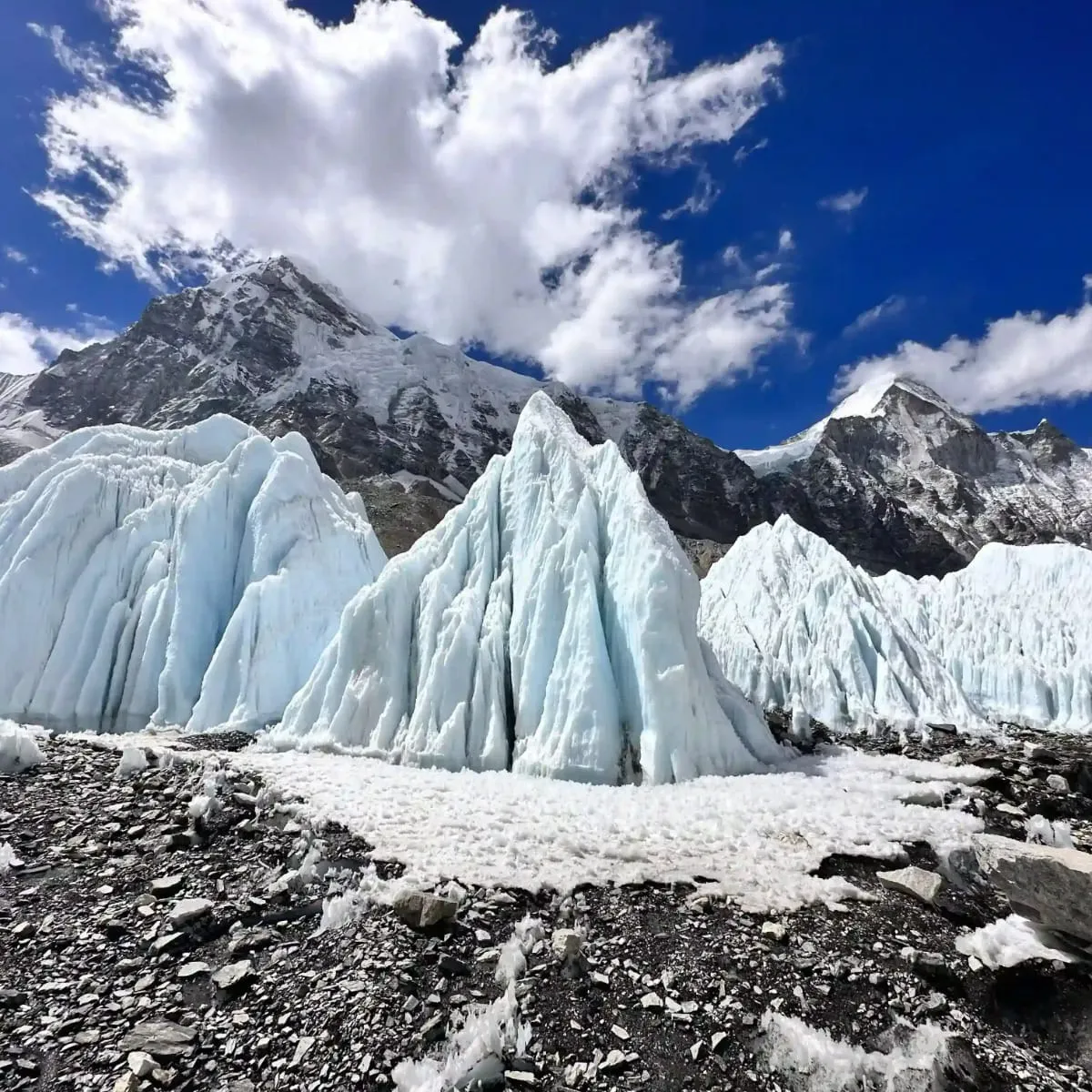
The Khumbu Icefall seen from Everest Base Camp, 5,364 m (17,598 ft). Photo: North Nepal Travel & Trek.
Frequently asked questions
With a local operator, about USD 1,000 to 1,500 per person for 12 days, depending on group size, plus around USD 500 to 700 for your visa, insurance, tips and trail extras. Independent trekkers spend roughly USD 1,000 to 1,300 before hiring a guide.
Two fees: the Sagarmatha National Park entry fee of NPR 3,000 for foreigners, and the Khumbu Pasang Lhamu Rural Municipality fee of NPR 3,000 since July 2024 (NPR 2,000 for SAARC and Chinese nationals). Together that is under USD 40. No TIMS card is needed in the Everest region.
About USD 240 each way for foreigners. In August 2026 Tara Air charged USD 243 from Kathmandu to Lukla and USD 242 back. In busy seasons many flights leave from Manthali (Ramechhap), four to five hours' drive from Kathmandu.
Not by law. The Everest region is the main exception to Nepal's 2023 guide rule, because the Khumbu municipality still allows independent trekkers. We still recommend a guide for acclimatisation, safety and help when flights are cancelled.
On our treks a licensed guide is USD 40 a day and a porter USD 20 to 25 a day, carrying 20 to 25 kg. Those rates include their food, lodging and insurance. Tips are not compulsory but are expected for good service.
On a package with meals included, about USD 10 to 20 a day for drinks, snacks, hot showers, charging and Wi-Fi. Independent trekkers need much more for rooms and meals. Carry it in Nepali rupees, because the only ATMs, in Lukla and Namche, are unreliable.
Lukla flights, both permits, a licensed guide, porters, three meals a day, ground transport and airport transfers, trekking poles, a duffel bag, purification tablets and a first-aid kit with an oximeter. It excludes international flights, visa, insurance, drinks, tips and trail extras.
North Nepal Travel & Trek, Everest Base Camp, Gokyo Lake, Everest Three Passes and Pikey Peak package pages (prices, inclusions), accessed 26 October 2026
A native of the Annapurna region, he brings over 17 years of firsthand experience leading treks across the mountains of Nepal. His deep local roots and proven guiding expertise make him a trusted authority on authentic Himalayan adventures.