Who Climbs Everest? The Demographics Behind 7,563 Summiteers
Published Oct 19, 2026 Updated Oct 20, 2026 10 min read
Quick answer
Most ascents of Everest are made by hired climbers, mostly Nepali professionals: they made 7,081 of the 13,737 ascents recorded to the end of 2025. The paying climbers are mostly over 40, about one in seven was a woman in 2006 to 2019 (one in five of spring 2026 permit holders), and in 2026 they came from 56 countries, led by China, the United States and India.
We don't run Everest expeditions. We guide treks in the Khumbu, so every spring our guides share the trail, the lodges and the yak traffic with the people in this article. Ask most visitors to picture an Everest climber and they describe a young Western man. The records say that picture is decades out of date. I've pulled together the Himalayan Database, the studies built on it and the reporting from the 2026 season to show who actually climbs Everest.
Key facts
People who have summited7,563, to December 2025
Total ascents13,737, to December 2025
Ascents by hired climbers7,081 (52%), mostly Nepali guides and staff
Paying climbers aged 40 or over54% in 2006 to 2019
Women among paying climbers14.6% in 2006 to 2019
Spring 2026 permits495 from 56 countries, 105 of them women
Most ascentsKami Rita Sherpa, 32 (17 May 2026)
Why are there more Everest ascents than people?
Everest had 13,737 ascents by 7,563 people to the end of 2025, because many climbers go back again and again. Almost all of the repeat ascents belong to hired guides and high-altitude staff, mostly Nepali, who made 7,081 of the total, or 52%.
That makes the most common person on the summit not a paying client but a working guide. On 17 May 2026 Kami Rita Sherpa reached the top for the 32nd time, a record, and Pasang Dawa Sherpa reached his 30th the same season. Behind them are many more Nepali climbers with ten or twenty summits, for whom the death zone is part of the job.
The work carries risk as well as records. Hired climbers account for about 130 of the 339 deaths recorded on Everest to the end of 2025. They cross the Khumbu Icefall many more times in a season than any client, carrying tents, food and oxygen to the high camps, and in 2014 an avalanche there killed 16 Nepali mountain workers.
Part of the reason is history and part is biology. British expeditions hired Sherpa climbers from the 1920s, and the work passed down through families. Studies have also found variants of the EPAS1 gene, common in Tibetans and Sherpas, that are linked to how the body copes with low oxygen. Today "Sherpa" is used on expeditions as a job title as well as a community name, and teams include climbers from many Nepali communities.
If you want the full count of summits, deaths and costs, our post on how many people have climbed Mount Everest has the 2026 figures. This one is about the people behind them.
How old are Everest climbers?
Everest climbers have got much older. In the records studied by Raymond Huey's team, which leave out hired guides and staff, the share of paying climbers aged 40 or over rose from 18% before 1990 to 54% in 2006 to 2019, and the share aged 60 or over rose from 0.1% to 4.6%.
Period (paying climbers)
Aged 40 or over
Aged 60 or over
Women
1953 to 1989
18.0%
0.1%
4.5%
1990 to 2005
38.7%
2.2%
9.1%
2006 to 2019
54.1%
4.6%
14.6%
Money and time are a large part of it. A guided climb costs most people USD 40,000 to 80,000 and needs about two months away from work, which suits people in their forties and fifties far better than people in their twenties.
Age does change the odds. In 2006 to 2019, success fell by about 1.1% for every year after 40. Climbers over 59 reached the summit 33.3% of the time against 63.7% for younger climbers, and their death rate was 4.1% against 0.9%. Among those who reached the top, climbers over 59 died on the descent far more often: 10.5% against 1.1%.
The records stretch the range at both ends. Yuichiro Miura of Japan became the oldest person to summit Everest in 2013, at 80. Jordan Romero of the United States climbed it at 13 in 2010, from the Tibet side. That record is unlikely to fall: Nepal sets a minimum age of 16, and in 2010 China set limits of 18 to 60 for the north side.
Good teams don't turn older clients away. They give them longer schedules, stricter medical checks and closer watching on the descent, which is exactly where the numbers say the risk is.
How many women climb Everest?
Women made up 14.6% of paying (non-hired) Everest climbers in 2006 to 2019, up from 9.1% in 1990 to 2005, and in spring 2026 women held 105 of the 495 Everest permits. Women summit and die at about the same rates as men.
The history is short. Junko Tabei of Japan became the first woman on top on 16 May 1975, twelve days after an avalanche hit her team's camp at 6,300 m (20,669 ft). Phanthog, a Tibetan climber, followed from the north side later the same month. Pasang Lhamu Sherpa became the first Nepali woman to summit on 22 April 1993 and died on the descent; she is a national hero in Nepal.
The modern record belongs to Lhakpa Sherpa, who in 2000 became the first Nepali woman to summit and come back down alive. On 17 May 2026 she reached the top for the 11th time, the most of any woman.
The research is clear. Huey's 2007 study found death rates of 1.62% for men and 1.63% for women, and the 2020 follow-up found no meaningful difference between the sexes in recent years, for success or for deaths. What decides the outcome at 8,000 m is preparation, acclimatisation and judgement.
Which countries do Everest climbers come from?
Nepal leads by far, because its guides summit every season. Among paying climbers in spring 2026, China held the most Everest permits, followed by the United States, India and the United Kingdom, from 56 countries in all.
Country
Everest permits, spring 2026
China
109
United States
77
India
61
United Kingdom
32
All 56 countries
495
The 495 figure counts foreign climbers' permits, so the Nepali guides who climbed beside them don't appear in the table. Over the mountain's history, hired climbers, mostly Nepali, have made more ascents than all the paying clients put together.
The north side tells a different story. China kept Tibet closed to foreign teams in spring 2026, so only Chinese climbers were on that side. Alan Arnette reported 28 Chinese climbers supported by 60 Chinese and Tibetan climbers, and 25 of the 28 reached the summit.
How much experience do Everest climbers have?
Less than you might expect. In 2006 to 2018, 30.7% of first-time Everest climbers had attempted another peak in Nepal first, down from 37.7% in 1990 to 2005. Those with that experience reached the summit more often: 67.6% against 61.5%.
Experience made no clear difference to death rates in Huey's data, which says a lot about how much the fixed ropes, oxygen and Nepali guides now carry. Nepali officials still see inexperienced climbers as a safety problem, which is the reason given for a proposed new rule.
Nepal may make experience a rule. A Tourism Bill passed by the National Assembly in February 2026 would require Everest applicants to have climbed a 7,000 m (22,966 ft) peak in Nepal first, but as of July 2026 it was still in a parliamentary committee and not yet law.
Trekkers and their guide under the peaks of the Khumbu. Most Everest climbers first find out how their body handles altitude on treks and smaller peaks like these.
The usual path starts with a trek, then a 6,000 m peak such as Lobuche East, 6,119 m (20,075 ft), then a 7,000 or 8,000 m expedition. How you feel at 6,000 m tells you more about your Everest chances than any fitness test at home.
Can disabled climbers climb Everest?
Yes. Tom Whittaker became the first disabled person to climb Everest in 1998, and climbers with prosthetic legs, blindness and amputations have followed. Nepal briefly banned blind and double-amputee climbers in 2017, but its Supreme Court overturned the ban in 2018.
The list is short. Erik Weihenmayer became the first blind person to summit on 25 May 2001. Mark Inglis of New Zealand was the first double amputee to summit, in 2006. Arunima Sinha of India, who lost a leg, reached the top in 2013.
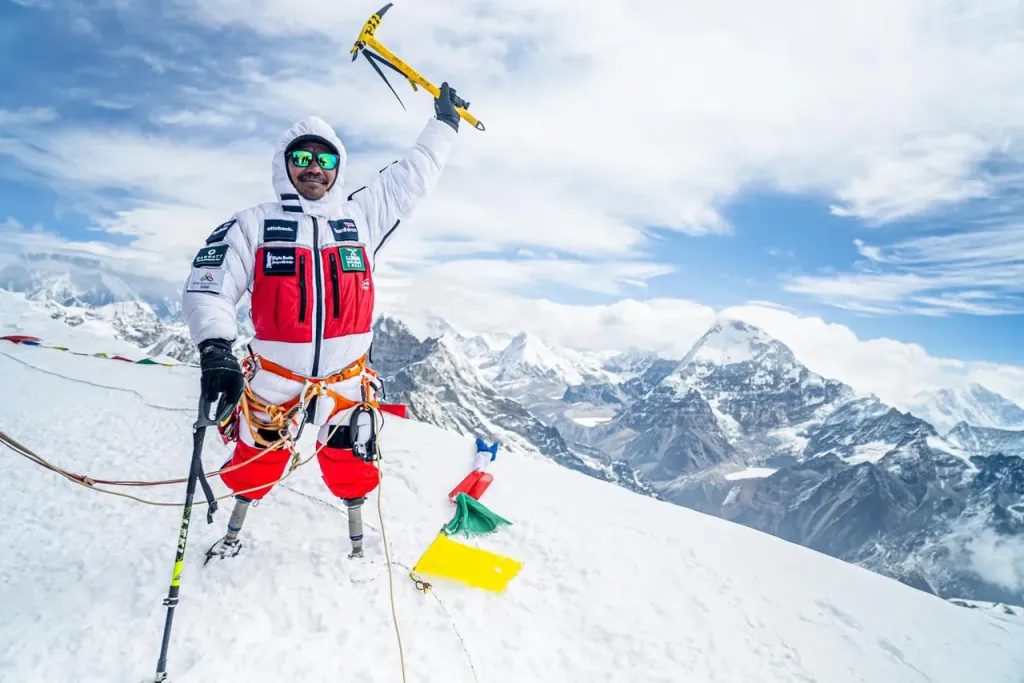
A climber on two prosthetic legs on a high Himalayan summit. Nepal's ban on double-amputee climbers was overturned in 2018.
Hari Budha Magar, a Nepali former Gurkha soldier who lost both legs above the knee, campaigned against the 2017 ban. On 19 May 2023 he became the first double above-knee amputee to summit Everest, and in January 2026 he finished the Seven Summits. Each of these climbs needed its own team, equipment and planning.
Who walks to Everest Base Camp instead?
Far more people walk to the foot of Everest than climb it. In the 11 months to mid-2024, Sagarmatha National Park, the park around Everest, counted 48,402 foreign visitors, against a few hundred climbing permits a year. The trekkers are a much wider mix of ages, budgets and backgrounds.
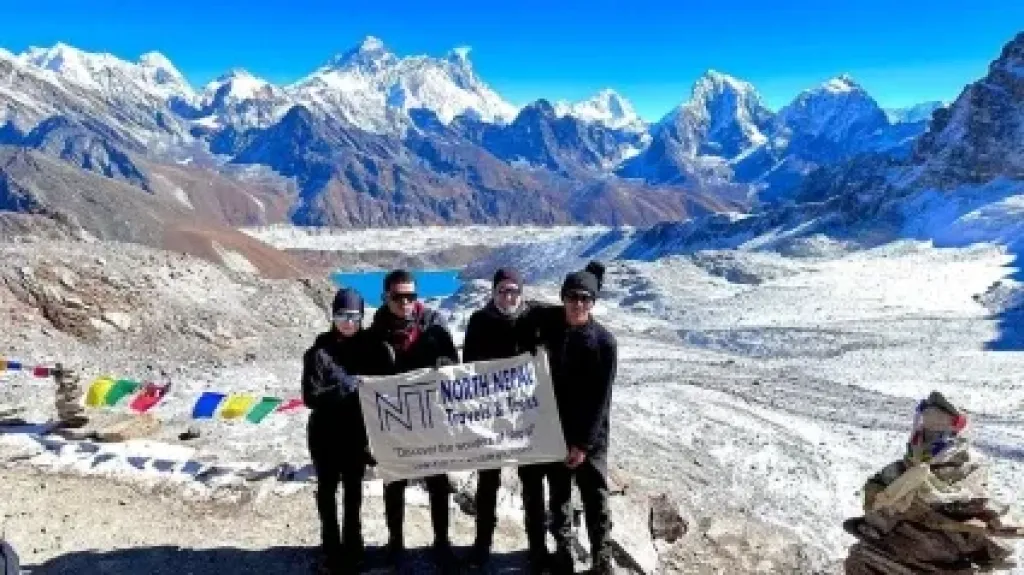
Our trekkers with a North Nepal Travel & Trek banner on a viewpoint above the Khumbu Glacier.
The base camp trail asks for fitness, about two weeks and patience with altitude, not a climbing record. Which trek suits you depends more on your time and your experience of altitude than on your age.
On the trail, pace matters more than age. Our guides often see the fittest trekkers struggle most at altitude, because they walk too fast in the first days. Let your guide set the pace from the first day, especially on the climb to Namche Bazaar, even when it feels too slow.
Frequently asked questions
Huey's study doesn't give an average, but it shows that 54% of paying, non-hired Everest climbers in 2006 to 2019 were 40 or older, up from 18% before 1990. About 4.6% were 60 or older.
Women made up 14.6% of paying (non-hired) Everest climbers in 2006 to 2019, up from 9.1% in 1990 to 2005. In spring 2026, 105 of the 495 Everest permits went to women. Men and women summit and die at about the same rates.
Nepal, by a wide margin, because its guides and high-altitude staff summit every season; hired climbers, mostly Nepali, made 7,081 of the 13,737 ascents to the end of 2025. Among paying climbers in spring 2026, China held the most permits, followed by the United States and India.
Nepal sets a minimum age of 16, with no upper limit. In 2010 China set limits of 18 to 60 for the north side. The youngest person to summit was Jordan Romero, at 13 in 2010, and the oldest was Yuichiro Miura, at 80 in 2013.
Lhakpa Sherpa of Nepal, with 11 ascents after her climb on 17 May 2026. In 2000 she became the first Nepali woman to summit Everest and return alive. The overall record belongs to Kami Rita Sherpa, with 32 ascents.
Yes. Tom Whittaker was the first disabled climber to summit, in 1998, Erik Weihenmayer the first blind climber in 2001, and Hari Budha Magar the first double above-knee amputee in 2023. Nepal's 2017 ban on blind and double-amputee climbers was overturned by its Supreme Court in 2018.
No. The trek to Everest Base Camp, 5,364 m (17,598 ft), follows a walking trail with no ropes or ladders. You need good fitness, about two weeks and a licensed guide, and an itinerary with proper acclimatisation matters more than your age.
Huey RB, Carroll C, Salisbury R, Wang JL, "Mountaineers on Mount Everest: Effects of age, sex, experience, and crowding on rates of success and death", PLOS ONE, 2020: https://pmc.ncbi.nlm.nih.gov/articles/PMC7449495
Huey RB, Salisbury R, Wang JL, Mao M, "Effects of age and gender on success and death of mountaineers on Mount Everest", Biology Letters, 2007: https://pmc.ncbi.nlm.nih.gov/articles/PMC2391200
Wikipedia, biographies of Junko Tabei, Phanthog, Pasang Lhamu Sherpa, Lhakpa Sherpa, Yuichiro Miura, Jordan Romero, Erik Weihenmayer, Mark Inglis, Arunima Sinha, Hari Budha Magar and Tom Whittaker (historical dates only; accessed 19 October 2026): https://en.wikipedia.org/wiki/Junko_Tabei
A native of the Annapurna region, he brings over 17 years of firsthand experience leading treks across the mountains of Nepal. His deep local roots and proven guiding expertise make him a trusted authority on authentic Himalayan adventures.