Upper Mustang Trek - 14 Days
The 14-Day Upper Mustang Trek starts from Kathmandu via Pokhara & Jomsom into the trans-Himalayan ra...
OVERVIEW & HIGHLIGHTS
Located at 4,130 m, the Annapurna Base Camp stands as one of the globe's most sought-after mountain destinations. In this Ultimate 13‑Day Annapurna Base Camp Trek, you'll embark on a thrilling journey into the heart of the Himalayas — following a well-structured 13‑Day ABC trekking itinerary that blends nature, culture, and adventure into an unforgettable Nepalese experience.
Download all season packing checklist for necessary preparation for Annapurna Base Camp trek for 13 days.
Among the most popular trekking destinations in the world. Rarely, any adventure enthusiast has not heard about the base camp trek Nepal. It is a thrilling adventure on the trail of the Himalayas.
Balaram Giri, Assistant Guide
Since founding North Nepal Trek in 2015, Mohan Raj Bhandari has kept a close eye on the Annapurna Base Camp Trek (13 Days), and Balaram Giri shares firsthand insight from personally leading this trek, so you know exactly what to expect before you go.
Arriving at Pokhara. Meeting with the representative of North Nepal Travel & Trek and further planning. Self or guided exploration around the Lake and streets of Pokhara in the evening. Overnight stay at Hotel. You can choose between flight and road transport on this trek. Both modes of transport will give you different life experiences.
via Flight:
It takes you 25 minutes to reach Pokhara International Airport from Kathmandu. Aerial view of mountain peaks, hilly landscapes, and Pokhara city is a quick and luxurious way to experience Nepal.
via Road:
Traveling Pokhara by road takes you about 8 hours. It’s a longer route driving Prithvi Highway and Pokhara Baglung Highway from Muglin. 13 days Annapurna Trek package on the road provides you with fleeting moments of local people and landscape from up close.
You will drive for an hour along the scenic Pokhara - Baglung highway to reach Birethanti; your initial point for trekking to Annapurna Base Camp. Located at 1,100 meters (3,609 ft) Birethanti is a beautiful settlement on the confluence of two river bodies. One is Modi River while another is a Bhurungdi Khola. 
You will take the left side of the route for ABC. 5.4 miles (8.7 km) of the trek route is an easy walk along the Bhurungdi Khola. After crossing a suspension bridge, You will proceed for permit check at ACAP Checkpost the trek to Ulleri is an uphill walk. You will climb an inclined hill until you reach Ulleri. Overnight stay at Ulleri teahouse. ( passing Hile, Sudame
After early breakfast, you will trek to Ghorepani from Ulleri. The trek is 5-6 hours covering 8 km distance. The trail takes you through dense rhododendron forest and grass pastures on the 4th day of our Annapurna Base Camp Trek.
This subtropical forest turns extremely beautiful in the spring season. Blooming of Rhododendron flowers ornate the forest. You might witness wildlife on the trail as well. Walking past Nangathanti village (2460m), you reach Ghorepani. Overnight stay at the teahouse of Ghorepani.
You will take an early morning trek to Poon Hill for a magical sunrise. You will reach Poon Hill Viewpoint in an hour from your teahouse. Located at an altitude of (3,210 m/10,531 ft), it offers you spectacular views of magical sunrise, sunset, and Annapurna South peak (7,219 meters).
You will take a route towards Tadapani. Trail section consists of a ridge, winding trails, and gradual uphill and downhill across the narrow hills. Walking for 6 to 7 hours, you will reach Tadapani. Situated at an altitude of 2,610 meters (8,563 ft), you will get a pleasing view of peaks and lush green forest. It is a neighboring district to beautiful Ghandruk village. Overnight stay at the teahouse of Tadapani.
Your itinerary follows a steep descent trek towards Sinuwa. Trekking for 6 to 7 hours, you will reach Sinuwa. The route consists of a winding downhill and uphill. Crossing two streams that flow between the hills takes you to your destination.
En route, you will walk through temperate forests abundant with Oks, evergreen Himalayan Bamboo, and epiphyte plants. Generally, the atmosphere is damp with the possibility of wildlife like Himalayan sheep. You will stay in the teahouse of Sinuwa at an height of (2,340 m/7,677 ft).
This point onward, your trek to Annapurna Base Camp starts along the rivers that originate from the Himalayan mountain ranges below the hills. Alongside this ABC trail, you will see the trail to Mardi Base Camp on the ridge to your right. Trekking for 6 to 7 hours, you will reach the teahouse at Deurali, your night stay on the 7th day of the trek.
En route, you will walk past resting points like Dovan. You can also see Tomrong Waterfall, Bahubali Waterfall, and Himalayas Waterfall. It is situated at a height of 3,230 meters. No worries, our expert Mountain guide is always there to guide you.
On the 13th day package of ABC trek, you will start with early breakfast. The walk begins on a rugged trail with the exotic topography of the mountains. You can see the dry landslides, the snow, the sharp rocks, and the cold air passing through your skin. The more you ascend, the grandeur it becomes.
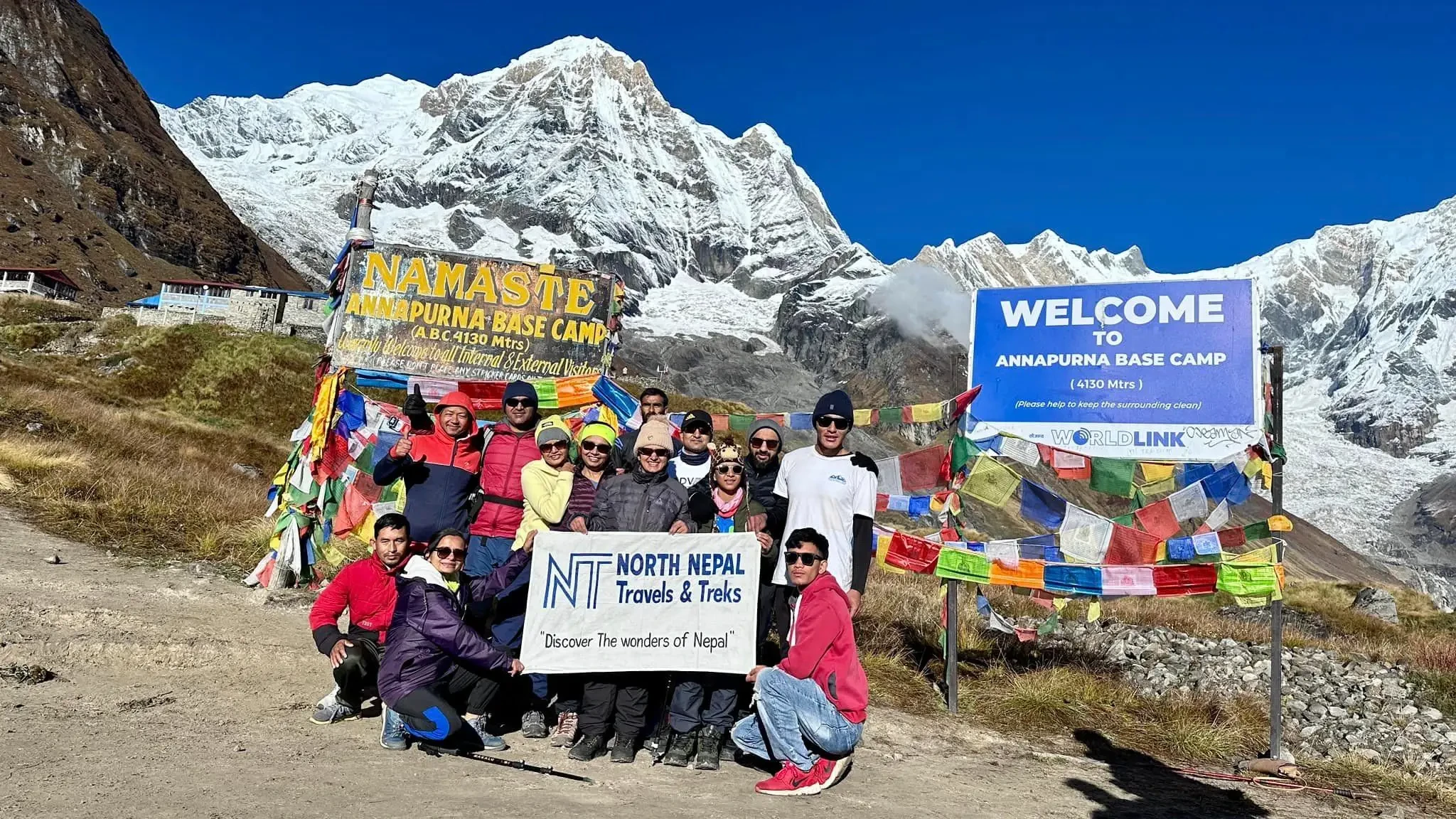
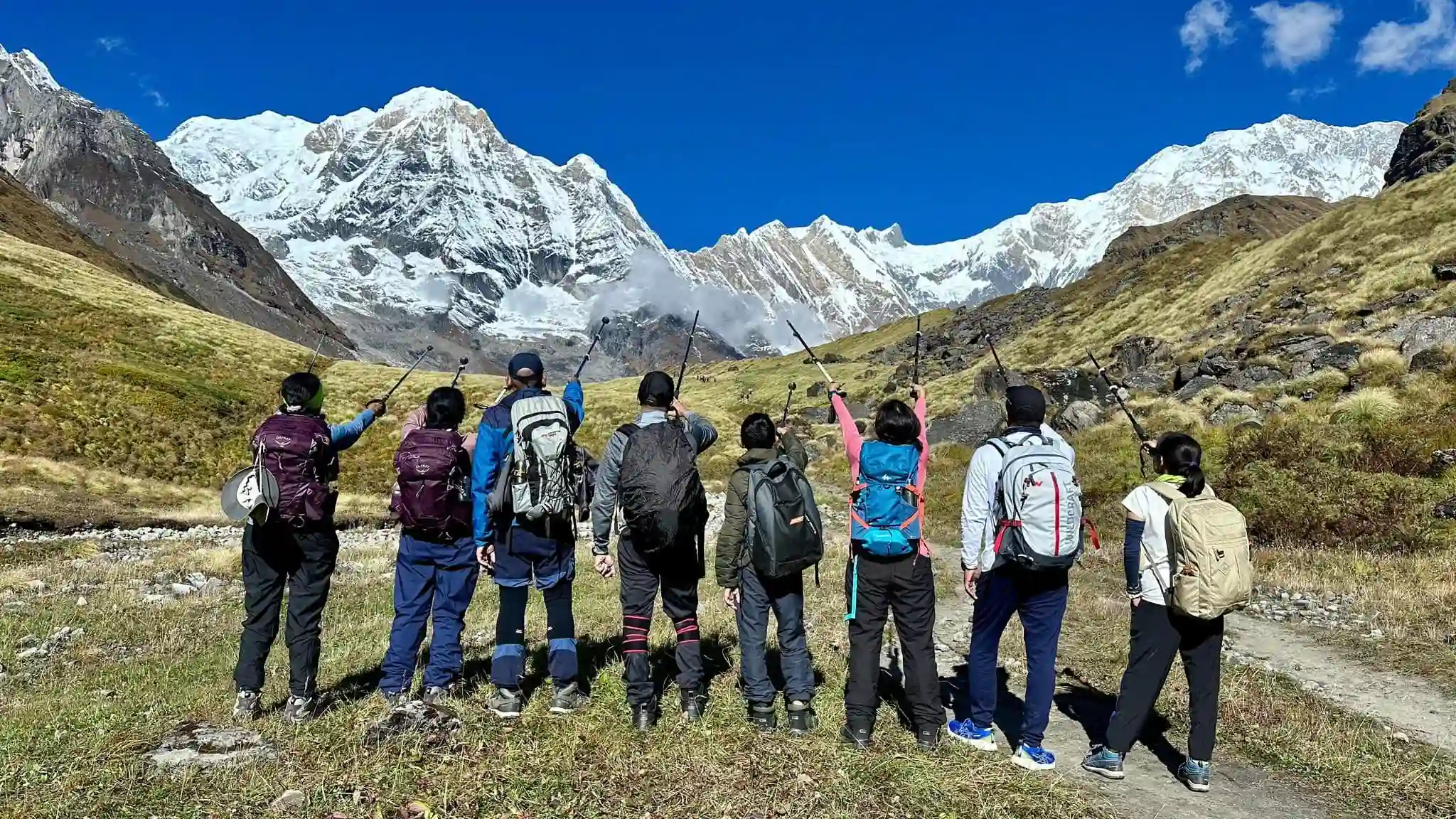
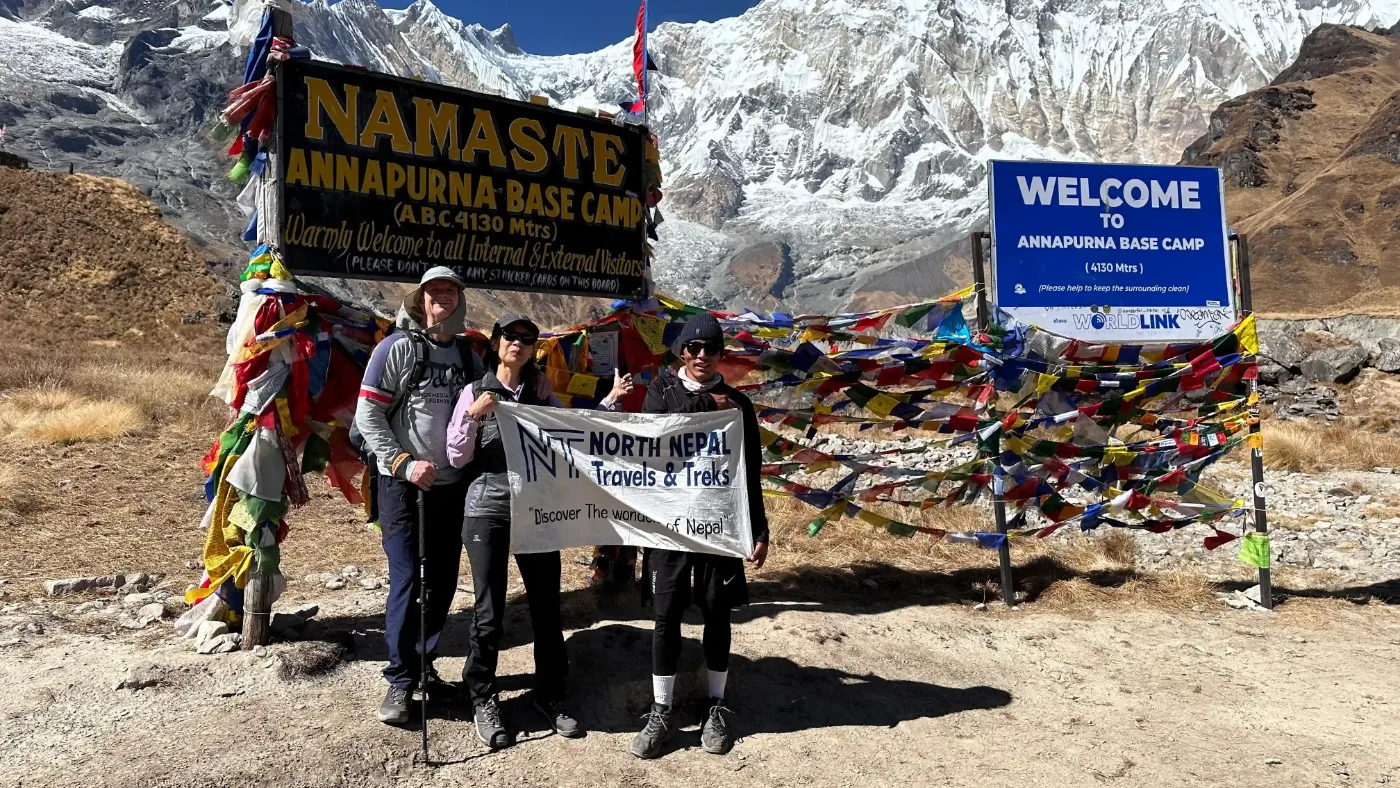
Trekking for 5-6 hours past the Machhapuchhre Base Camp on the rugged trail of mountains, you will reach Annapurna Base Camp Trek. Situated at an altitude of 4,130 meters (13,550 ft) above sea level, you feel like the world is yours. Surrounded by the glimmering snow and panoramic view of Annapurna South, Himchuli, Tharpu Chuli, and Gangapurna, this is a lifetime experience. Imagine in close proximity to the mountains and blue sky above you. This feels like the world beneath you.
ABC is all yours. Splash snowball on your friends. Take a number of pictures for your social media. Scream like never before. Collect as much as the memory of Annapurna Base Camp before you leave for home. And overnight stay in the teahouse of cold ABC.
You will leave the base camp after an early breakfast with hot tea or coffee. After bidding farewell, you will start trekking down to Bamboo. Returning back follows the same trail of the Annapurna Base Camp trek.
You will slowly lose the elevation. After trekking for 6-7 hours continuously, you will reach Bamboo. It is located at an altitude of (2,310 m/7,579 ft) on the deep gorge with few teahouses. Overnight stay at Bamboo.
After early morning breakfast at the teahouse of Bamboo, you will trek towards Jhinu (1,780 m/5,839 ft). It will take around 4 to 5 hours to walk to reach Jhinu. You will descend from Sinuwa and ascend through the beautiful Chhomorong village again, descend down the gorge towards Jhinu.
Landscapes get wider, unlike the higher altitude of ABC trek. You will witness higher trees and more vegetation down below. Oxygen level increases. The trail gets easier to walk. Precisely saying life gets easier. The natural hot spring in Jhinu makes it a popular stop for trekkers. Bathing in a natural hot spring is a relaxing experience after a strenuous walk.
This is the shortest trek in the entire Annapurna Base Camp Trek. You will walk for 2-3 hours up to Syauli Bazar. It is located at an altitude of 1,170 meters. Trek is quite easy below Ghandruk Village. You will walk through lush green forests and winding trails along the Modi River.
After reaching Syauli Bazar, you will drive back to Pokhara in 2-4 hours on a scenic highway of Hemja. Reaching Pokhara, you will rest. In the evening you will wander the streets of Pokhara and the vibrant lakeside.
You reach Kathmandu either by taking a Tourist bus or by flight following the same route. Reaching Kathmandu, you will tour around the important landmarks of the capital. You will visit UNESCO World Heritage Sites like Pashupatinath Temple, Boudhanath Stupa, Patan Durbar Square, and Basantapur Durbar Square with a local tour guide in a private jeep. Overnight stay at Hotel.
Your 13 days Annapurna Base Camp Trek package comes to an end after boarding the flight from Tribhuvan International Airport, Kathmandu. A representative from North Nepal Travel & Trek will assist you with the necessary exit and bid you farewell.
Autumn Trail Alert: Expect winding forest and stone-staircase trails with clear skies and cold nights on the Annapurna Base Camp Trek this season. Signal grows patchy above Deurali, and comfortable teahouses line the entire 13-day route.
The Annapurna base camp (ABC); A 7-day Journey from Sub-Tropical to Alpine Wonder
Before our journey began, trekking in Nepal especially the Annapurna base camp (ABC) had been around among friends/ colleagues since years back. Due to some circumstances, this year meant to be it, well, some of us believed so. 😁 Followed to a few researches, we found the North Nepal Travels & Treks on Facebook with number of positive reviews and available itinerary suitable for our group….. We then decided to book our very first trek a 7-day ABC with NNT&T.
💚Emmy, Pooja, Yao -> Let’s goooooo ABC!!
It was a true rewarding and well-supported adventure. Hats off to the NNT&T team/ our guide Gopal Tamang Dhai (Mr.)! ⭐️✨💯
Our overall trekking journey was well-organized and enjoyable which offered a good balance of challenge~ scenic beauty and touch of local cultures, providing a memorable outdoor experience. “This trek is a symphony of changing ecosystems, cultures, and emotions. From the warm, forested trails of the lowlands to the stark, snowy amphitheater of the Annapurna Sanctuary, it’s an unforgettable adventure that showcases the raw beauty and diversity of Nepal.”
During the trek, each of us felt the challenge over changes of environment differently. However, we managed through as they were mild symptoms. We noted that trekking at high altitudes (often above 3,000 meters) can be tough. Acclimatization is critical to avoid altitude sickness, and thin air makes even short hikes strenuous… fortunately, we felt well-prepared through consistent communication with our guide Gopal. Safety protocols were well explained and maintained. We loved the support and care through some little tip for thin air environment practices such breathing techniques. Moreover, our guide managed group dynamics well, keeping morale high and adjusting plans when necessary.
Furthermore, one of the most enriching parts of the trek was exposure to local culture. Any interactions with villagers, traditional meals, and the chance to witness local customs added a deep layer of authenticity to the journey. Our guide was knowledgeable, professional, and approachable who provided clear information about the trail, environment, and local culture, which greatly enriched the experience.
So, thank you once again for an incredible experience in the Himalayas, NNT&T family! We look forward to having our upcoming adventures with you again soon.
For anyone out there, if you are looking around for your very first trek or perhaps second or third one in Nepal, why don’t check “The North Nepal Travels & Treks” out, and there your guide Gopal Tamang Dhai (Mr.) for an unforgettable adventure and immersive nature experience.
Impressive tour from jungle to snow, culminating in the sunrise at ABC.
North Nepal Travel & Trek is the perfect partner.
The trek from Kande to Annapurna Base Camp (ABC) is a breathtaking experience. You walk through lush forests, charming villages and past impressive mountain landscapes. Every day offers new views, from the green hills to the snowy peaks of Annapurna and Machhapuchhre. The route is challenging but doable for those who are in reasonable condition. The atmosphere in the lodges is warm and welcoming. Highlight: the sunrise at ABC, with 360° views of majestic mountains. An unforgettable trip full of nature, culture and satisfaction. Overall an unforgettable experience!
Dec 2024 • Friends
Just returned from a 9 day trek to ABC via Poon Hill with a couple of my friends and could not recommend the trek enough. Zeewan, our guide was incredible. He was so knowledgeable about the Annapurna sanctuary region and went above and beyond to keep us safe and well looked after. We had an absolute blast. Cannot wait to see Zeewan summit Annapurna 💪
Itineraries are structured with gradual elevation gains to ensure proper acclimatization before reaching high-altitude points like Annapurna Base Camp. Guides conduct daily health assessments for symptoms of Acute Mountain Sickness (AMS). If severe symptoms appear, standard protocol mandates immediate descent to lower elevations.
In cases of severe injury, acute altitude illness, or extreme weather conditions on the mountain sanctuary, emergency helicopter evacuation is coordinated directly through local rescue services. Evacuations are initiated promptly upon assessment by your guide in communication with our Pokhara and Kathmandu offices.
All trekkers must hold comprehensive travel insurance covering emergency medical treatment, high-altitude trekking (up to 4,500 m), and emergency helicopter rescue/evacuation. Insurance details must be submitted prior to the departure of the trek to streamline emergency logistics if required.
Secure the Annapurna Base Camp Trek (13 Days) for 2026/2027 before the seat gets fully booked.
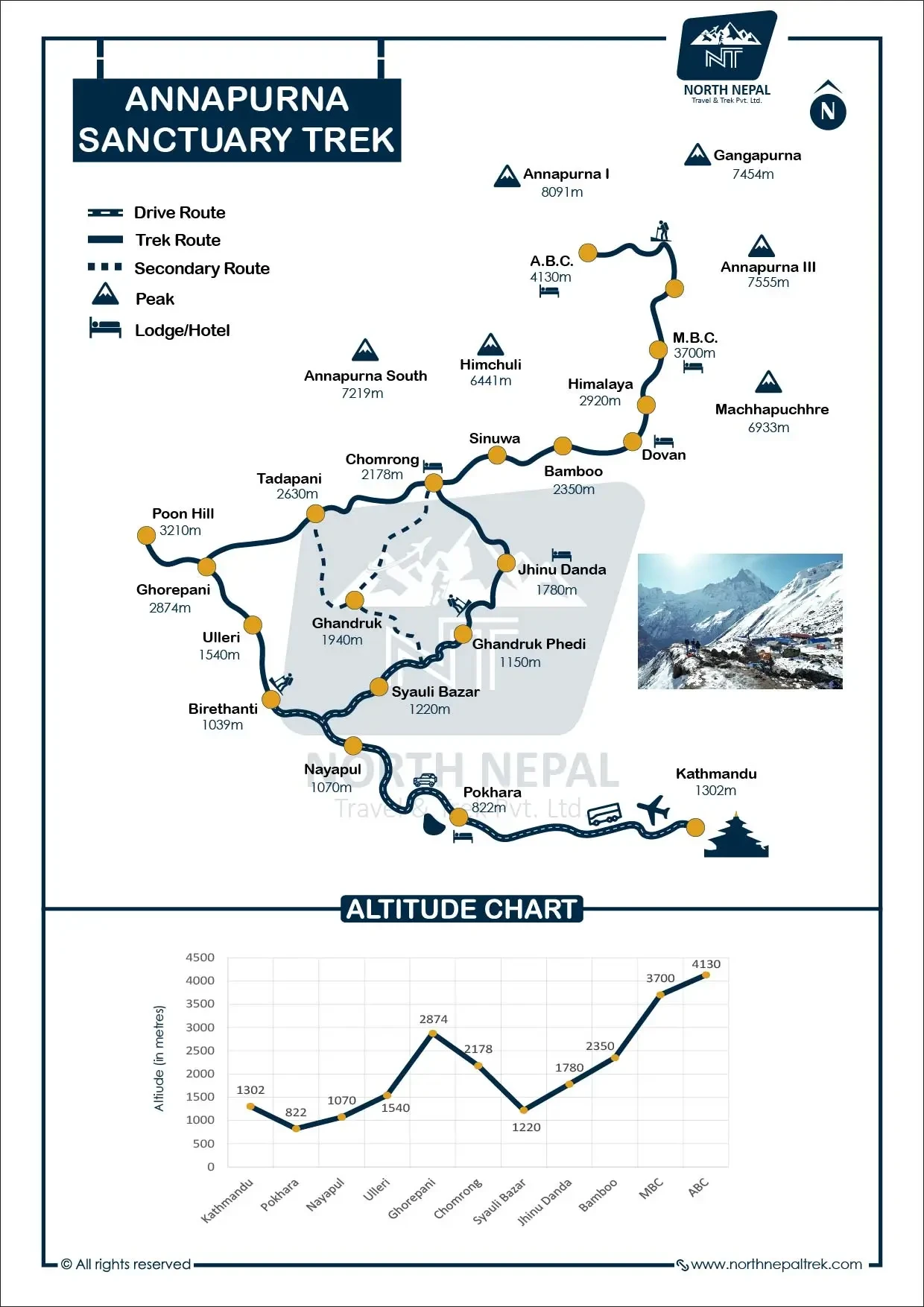
The Annapurna Base Camp Trek - 13 Days is a classic lodge-to-lodge trekking route into the heart of the Annapurna Sanctuary. The trail runs from Birethanti through Ulleri and Ghorepani, over Poon Hill, and on through Tadapani, Sinuwa, and Deurali before reaching Annapurna Base Camp itself at 4,130 m. The return route descends through Bamboo and Jhinu Danda to Syauli Bazar, from where you drive back to Pokhara and onward to Kathmandu.
This trek is graded moderately challenging. There's no technical climbing involved, but you'll face long walking days, steep stone staircases (especially around Ulleri and Ghorepani), and a gradual but real gain in altitude up to 4,130 m. A reasonable level of fitness and some prior hiking experience are recommended, and the 13-day pacing gives your body time to acclimatize comfortably along the way.
The highest point of the trek is Annapurna Base Camp itself, at 4,130 m (13,550 ft), tucked directly beneath Annapurna I, Machhapuchhre, and Hiunchuli. The 13-day itinerary is paced with gradual elevation gain through Ghorepani, Sinuwa, and Deurali so your body has time to acclimatize before you reach this altitude.
Yes. This 13-day itinerary already routes you over Poon Hill for its famous sunrise view of the Annapurna and Dhaulagiri ranges, and many trekkers choose to combine it with a separate Mardi Himal Base Camp extension for even more dramatic close-up mountain views. Let us know when booking and we'll help you build a combined itinerary. You can also read more about the Poon Hill Trek from Pokhara on its own.
This route delivers some of the most dramatic close-up mountain scenery in the Annapurna region. You'll see Annapurna I (8,091 m, the 10th tallest mountain on Earth), Machhapuchhre (the sacred "Fishtail" peak), Hiunchuli, Tharpu Chuli, Singu Chuli, and South Annapurna, with views opening up progressively as you climb from Chhomrong into the Annapurna Sanctuary itself.
The route climbs gradually and deliberately: from Birethanti up to Ulleri and Ghorepani, over to Tadapani, down and up again to Sinuwa, on to Deurali, and finally up to Annapurna Base Camp at 4,130 m. The return trip descends through Bamboo and Jhinu Danda to Syauli Bazar. This up-and-down profile isn't a shortcut - it's exactly what allows your body to acclimatize safely, which is why the trek is spread across 13 days rather than compressed into a shorter, riskier itinerary.
Two permits are required for this route: the Annapurna Conservation Area Permit (ACAP) and the Trekkers' Information Management System (TIMS) card. We arrange both permits for you as part of your booking, so all you need to bring are a few passport-sized photos and your passport details.
Yes. Every trek includes a licensed, English-speaking local guide trained in eco-tourism, wilderness navigation, and first-aid response. Your guide carries a comprehensive medical kit with pulse oximeters to monitor your oxygen levels daily as you climb toward Annapurna Base Camp, and handles permits, teahouse arrangements, and route decisions throughout the trip.
The trek passes through the Annapurna Conservation Area (ACA), which protects a remarkable range of ecological zones as you climb from subtropical forest up to alpine terrain. Lower down you'll walk through Schima and oak forest with ferns underfoot; mid-altitude you'll pass rhododendron and maple groves that bloom brilliantly in spring; higher still, the forest thins into dwarf juniper. Wildlife in the conservation area includes the Himalayan black bear, the colorful Blood Pheasant, and several rare frog species, though sightings on the trail itself are uncommon. You can read more in our Annapurna Sanctuary Trek guide.
The trail passes through Gurung and Magar villages, along with Brahmin and Chhetri communities lower down, giving the route a genuine "living museum" feel. Villages like Chhomrong and Ghorepani retain their traditional stone-and-slate architecture and terraced farming, and you'll have plenty of chances to chat with locals, visit tea houses run by the same families for generations, and see how these communities have adapted their livelihoods around trekking tourism.
Spring (March-May) and autumn (September-November) are the two prime seasons, offering the clearest mountain views, stable weather, and comfortable daytime trekking temperatures, with spring also bringing rhododendron blooms along the trail. Summer/monsoon (June-August) brings heavy rain, leeches, and clouded views, so it's generally avoided. Winter (December-February) is possible with clear skies, but nights turn very cold and higher sections can see snowfall.
This is a lodge-to-lodge (teahouse) trek. You'll stay in family-run teahouses along the entire 13-day route, with comfortable twin-share rooms lower down and simpler, more basic rooms as you climb higher toward Annapurna Base Camp. Most teahouses offer hot showers (sometimes for a small extra charge at higher elevations) and blankets, though we still recommend bringing a good sleeping bag.
Teahouses along the route serve full menus with a mix of Nepali and Western dishes: dal bhat (rice, lentil soup, and vegetable curry), noodles, momos, fried rice, soups, pasta, pancakes, and porridge. Dal bhat is the trekker's staple for a reason - it's filling, freshly cooked, and traditionally served with unlimited refills, which makes it ideal fuel for long walking days.
Yes. For trekkers short on time or looking for a more comfortable option, we offer Annapurna Base Camp Heli Landing Tours that let you fly in and land directly at (or near) base camp, skipping some or all of the walking. See our ABC Heli Tour options and helicopter tour pricing for details, and get in touch and we can help you decide which version - full trek, partial heli-assist, or full heli tour - best fits your time and budget.
Pack in layers: a good down jacket, fleece, and waterproof/windproof shell for the top; comfortable trekking trousers and thermal base layers for the bottom. Sturdy, well broken-in trekking boots are essential, along with a warm sleeping bag (rated to at least -10°C), sun hat, gloves, sunglasses, headlamp, and a basic first-aid kit with any personal medication. We send every trekker a detailed packing checklist before departure, and gear can also be rented locally in Pokhara or Kathmandu if you'd rather not fly with everything.
Yes, comprehensive travel insurance is mandatory. It must cover emergency medical treatment, high-altitude trekking up to at least 4,500 m, and emergency helicopter rescue/evacuation. Please send us your insurance details before departure so we can act quickly on your behalf if an evacuation is ever needed.
Most teahouses lower down the trail offer wifi, usually for a small fee. Coverage becomes patchy once you climb above Deurali, so don't count on a reliable connection in the final stretch up to Annapurna Base Camp. Nepali SIM cards (NTC or Ntell) generally get better signal than wifi in the mid-altitude villages, but expect to be mostly offline for the highest 1-2 days of the trek.