Upper Mustang Trek - 14 Days
The 14-Day Upper Mustang Trek starts from Kathmandu via Pokhara & Jomsom into the trans-Himalayan ra...
OVERVIEW & HIGHLIGHTS
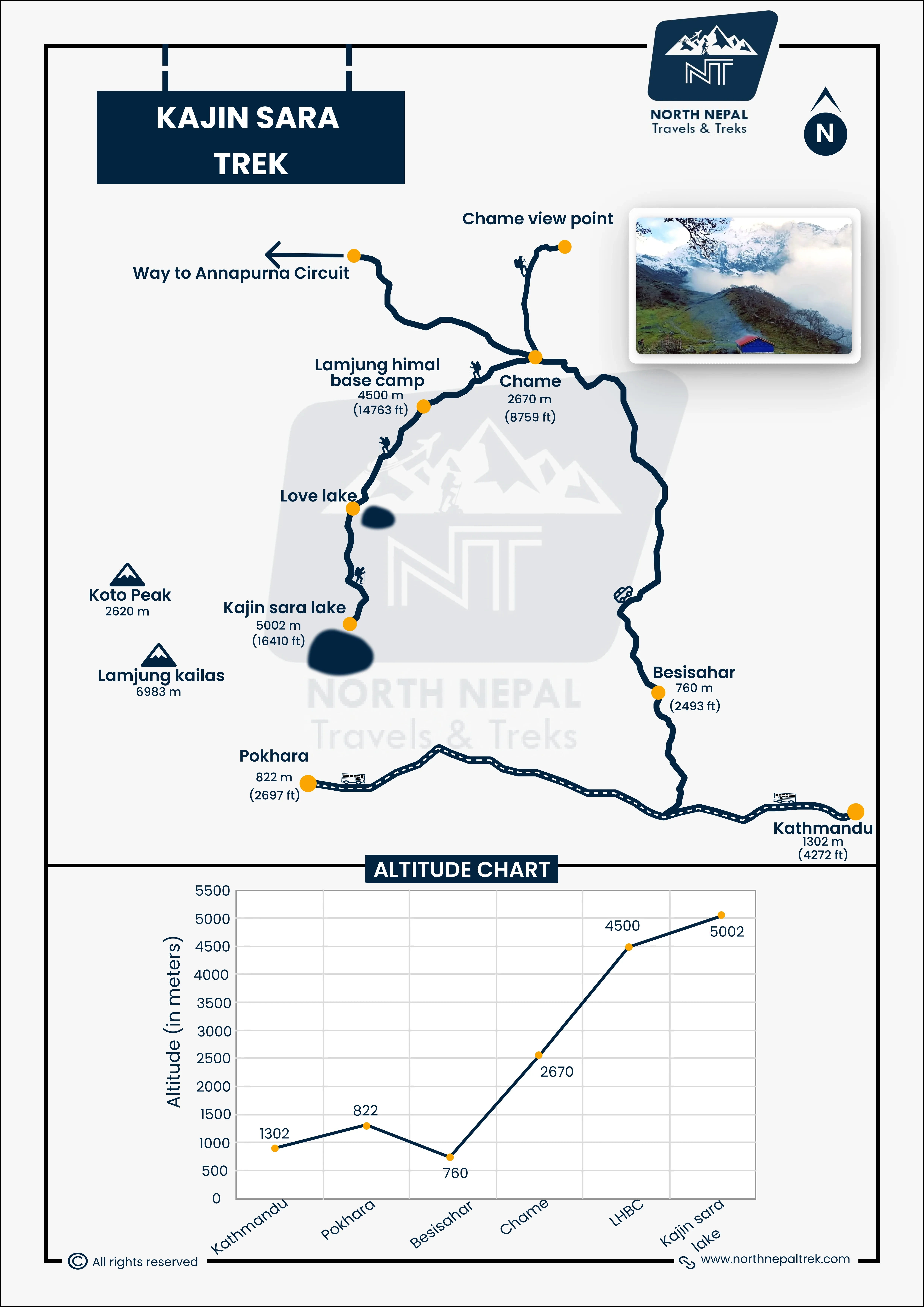
The Kajin Sara Trek is an exhilarating and challenging adventure through the breathtaking landscapes in the Manang district of Nepal. Starting from Pokhara, the journey kicks off with a scenic 4-hour bus ride to Beshishar, followed by a 7-hour jeep ride to Chame on the first day. The drive offers mesmerizing views of the Marsyangdi River, cliffs with waterfalls, and the Marsyandi River's hydropower. In Chame, trekkers can enjoy the beauty of the Marsyangdi River up close and even hike to Chame Viewpoint for panoramic views. The second day involves trekking to Lamjung Himal Base Camp, passing through lush pine forests, and encountering challenging terrain. The route presents both old and new paths, with the new paths being easier but longer. Yaks and local shepherds add to the unique experience and can help obtain more insights into the region. Trekkers spend the night in a shelter at Lamjung Himal Base Camp.
On the third day of the Kajin Sara Trek, hikers start trekking on a more challenging section with no clean drinking water sources. The trail is rocky and all the way ascending, leading to Dharamshala (Shelter). The trek continues with breathtaking cliff views and eventually reaches Love Lake, known for its heart-shaped formation. Trekkers overnight at the shelter near Love Lake inside the Dharmasala camping. The fourth day is the highlight of the journey, with a trek to Kajin Sara Lake, Nepal's highest lake at 5002 meters. The lake offers a mesmerizing sight surrounded by rocks and snowy peaks, making it feel like a different world altogether. After exploring Kajin Sara Lake, the trekkers retrace their steps to Love Lake and Lamjung Himal Base Camp. The final day includes a 3-hour trek to Chame and a drive back to Pokhara, concluding this unforgettable adventure filled with natural beauty and challenging terrain.
Milan Tamang, Assistant Trekking Guide
Since founding North Nepal Trek in 2015, Mohan Raj Bhandari has kept a close eye on the Kajin Sara Trek, and Milan Tamang shares firsthand insight from personally leading this trek, so you know exactly what to expect before you go.
From Pokhara:
After breakfast, we start our 1st day of the Kajin Sara Lake trek early and drive to Prithiv Chowk Bus Park from Lakeside at 6:45. There are only 1 or 2 buses for Beshisahar and they are available in the morning. After 15 minutes of driving, we will reach Prithvi Chowk Bus Park. We take our bus toward Beshisahar, a scenic bus ride from PrithivChowk to Besisahar takes about 4 hours.
From Kathmandu:
We take an early bus to Besisahar from Balaju bus park at 7: 00 am. The drive is filled with scenic mountain views and the Trishuli River. The scenic drive takes about 5 hr 30 min covering a total distance of 180 km via Prithvi Highway.
After reaching Beshishar we have our Lunch and take a Jeep toward Chame Village. The scenic view of the Marsyangdi River, the cliffs with waterfalls along with a drive-through tunnel, and the hydropower of Marsyandi River make this drive more memorable. The drive from Beshishar to Chame takes about 6:30 - 7 hours, as the drive is off-road and bumpy.
We will reach Chame at about 4-5 pm, so after reaching Chame, we enjoy the view of Marsyangdi River up close and the greenery that surrounds Chame. We can hike to Chame Viewpoint which takes about 20 - 25 mins if you walk at your normal pace. Overnight stay at Chame.
After our breakfast at Chame, we trek towards Lamjung Himal Base Camp. The very starting point of the trek is a short motor route. The motor route ends as soon as we step on the trail to the Lamjung Himal Base Camp. The second day of the Kajin Sara Lake trek takes you along the forest path filled with pine trees.
The path is straight at first and then ascending all the way up to Lamjung Himal Base Camp. There are many sections of two different paths that lead to the same point during this section of the trek, the new path and the old path. Most of the old path is replaced because it is too difficult while some were lost during landslides, and some are lost as the trails are less traveled.
Additionally, the new paths are the easier ones, and one could get lost during this section of the trek without the assistance of the guide. Moreover, there are no water taps, lodges, or hotels during this section of the trek so you need to carry water yourself.
After about 2 - 2:30 hours of trekking, we can see a signboard of Lamjung Himal Base Camp, and again there are two ways that take you to the Lamjung Himal Base Camp. The easier but longer trail takes 2 hrs:30 min, and the path is straight and ascending to the Lamjung Himal Base Camp but is comparatively easier to the shortcut route.
The shortcut route takes about 1hrs:30 min, but the trek is all the way ascending up to the Lamjung Himal Base Camp. Furthermore, the last section of this route is the most challenging part of the Kajin Sara Lake trek as the trail is not completely made and we walk on the steep uphill path with no footholds. The steep uphill ascents and slippery trail along with rocky steps make this section really challenging.
We will be taking porters with us to carry our luggage and food as there are no lodges after Chame during the overall Kajin Sara Lake Trek. We can see Yaks after this section and there is a shelter here for trekkers which can be used for free of cost even for foreign trekkers. There are some Yak sheds just above the Shelter and we can also meet the local Shepards during this trail. After we have our dinner, Overnight stay at a shelter in Lamjung Himal Base Camp.
We start the third day of the Kajin Sara Lake a bit early as we have to cover a longer distance today. There are no clean drinking water sources during this section, a river is there so you must carry a water bag and purification tablets. After 15 to 20 mins of trekking on the straight path, we reach the end of the easy trail and there are two ways, one of them takes you to love the lake and another takes you to the Shed for Yaks and shelter for Shepards.
This section of the trek is also confusing, as the trail towards Lamjung Himal takes you to the shed and shelter, however, the path that goes the opposite of Lamjung Himal leads you to Love Lake. The section ascends all the way up with rocky trails and huge rocks along the way. After 3 hours of hiking, we will reach Dharamshala (Shelter).
We can meet some shepherds along the way, and we trek some straight paths and then downwards, to the river where we will prepare for our Lunch. The trail is rocky and after we have our lunch here we trek towards huge cliffs. There are no clear trails during this section so many get lost and return during this section, so you need an experienced local guide.
We ascend at first and descend and go around the cliffs and then ascend to the top of the cliffs. The 360 views from here are truly mesmerizing. You can see the Lamjung and Koto Peak playing with the clouds, really up close. We trek along the rocky trail all the way to Love Lake. The lake is named so due to its shape like a heart, and we head towards the shelter after exploring the lake. We have our dinner and Overnight stay at the shelter.
The Kajin Sara Lake at an altitude of 5002 m, was discovered in 2019 and is currently Nepal’s highest lake, replacing Tilicho Lake as the highest lake in Nepal. The trail from Love Lake to Kajin Sara is through rocky paths and snows during the seasons of Winter and Spring. After the descending and roundabout path on the rocky trails, we reach Kajin Sara Lake after 1:30 hrs of trekking.
The Kajin Sara Lake is surrounded by rocks on the side of trekkers and a snowy paradise on the other. It feels like we arrive at a different world as soon we reach here.
The backdrop view of Lamjung and Koto Peak, and the pristine waters of Kajin Sara will surely mesmerize you, placing a special memory on your heart and mind. After exploring the Kajin Sara Lake, we return to Love Lake and have our lunch at the shelter.Now we follow the same trail we took during the previous days of the Kajin Sara Lake Trek. We reach the Lamjung Himal Base Camp after 4-5 hours of trekking.
Overnight stay at Lamjung Himal Base Camp after dinner.
The fifth and last day of the Kajin Sara Lake Trek starts after having our breakfast, we trek towards Chame. Trekking along the forests covered with Pine trees takes 3 hours for us to reach Chame as the descending and straight paths don’t take much time. We have our lunch and rest at Chame and then drive towards Besisahar. We then take a Jeep and drive back to Pokhara, with enough memories and trekking experience till the next time.
Photo: View from love lake en route Kajin Sara Trek- An adventure to Nepal's highest Lake
Autumn Trail Alert: Expect steep, rocky ascents and clear skies with cold nights on the Kajin Sara Trek this season. Signal ends past Chame, and this route is camping-only with no teahouses along the way.
Itineraries are structured with careful elevation profiles to ensure proper acclimatization before reaching high-altitude points like Dharamshala and Kajin Sara Lake (5,002 m). Guides conduct rigorous daily health assessments for early symptoms of Acute Mountain Sickness (AMS). If severe symptoms appear, standard protocol mandates immediate descent to lower elevations.
In cases of severe injury, acute altitude illness, or extreme weather conditions, emergency helicopter evacuation is coordinated directly through local rescue services. Evacuations are initiated promptly upon assessment by your guide in communication with our Pokhara and Kathmandu offices.
All trekkers must hold comprehensive travel insurance covering emergency medical treatment, high-altitude trekking and camping (up to 5,500 m), and emergency helicopter rescue/evacuation. Insurance details must be submitted prior to the departure of the trek to streamline emergency logistics if required.
Secure the Kajin Sara Trek for 2026/2027 before the seat gets fully booked.
The Kajin Sara Trek is a 6-day remote camping trek in the Manang District of Nepal, starting and ending in Pokhara. The route begins with a long drive to Chame on the Annapurna Circuit, then leaves the circuit entirely and heads into uninhabited high-altitude terrain — pine forests, rocky cliffs, and glacial ground that most trekkers in Nepal never see. The destination is Kajin Sara Lake at 5,002 m, Nepal's highest lake, first properly documented in 2019. It sits in an alpine bowl above Love Lake and has no lodge infrastructure whatsoever.
Kajin Sara Lake sits at 5,002 m in the Manang District and is Nepal's highest lake — a title it took from Tilicho Lake when it was first properly documented in 2019. The lake is in a rocky high-altitude basin ringed by snow-covered peaks including Lamjung Himal and Koto Peak. Very few trekkers have been here. There are no lodges, no teahouses, no infrastructure of any kind. You reach it on foot with a camping setup, and that's the only way in. If you want a lake destination in Nepal that genuinely hasn't been packaged and sold to death yet, this is it.
Love Lake is a glacial lake at around 4,600 m, reached on Day 4 — one day before Kajin Sara. It gets its name from the heart-shaped outline it forms when viewed from above. The shelter near the lake is your overnight camp before the final push to Kajin Sara on Day 5. On the way back down, you pass through Love Lake again and camp there before descending to Lamjung Himal Base Camp. It's both one of the more visually striking spots on the trek and the practical launching point for the highest day.
Day 1 is arrival in Kathmandu. Day 2 is a 4-hour bus ride from Kathmandu to Besisahar, then a 7-hour jeep ride to Chame (2,670 m) — it's a long travel day, so factor that in. Day 3 is the trek from Chame to Lamjung Himal Base Camp through pine forest, 5 to 8 hours and approximately 18 km. Day 4 goes from Lamjung Himal Base Camp to Love Lake, 6 to 7 hours. Day 5 is summit day: Love Lake up to Kajin Sara Lake (5,002 m) and back down to Lamjung Himal Base Camp, 4 to 5 hours of actual walking but at serious altitude. Day 6 is a 3 to 4-hour descent to Chame and the drive back to Pokhara.
The first two travel days follow the Annapurna Circuit corridor — the drive from Besisahar to Chame goes up the Marsyangdi River valley along the same road that Circuit trekkers walk. Chame is a stop on the Circuit. From the higher sections of the Kajin Sara trail, you get wide views of Lamjung Himal, Koto Peak, and other peaks along the Circuit. But the Kajin Sara route branches off the Circuit at Chame and doesn't rejoin it — it's a standalone out-and-back to the lake, not a loop.
Tilicho Lake sits at 4,919 m on the Annapurna Circuit. Kajin Sara Lake sits at 5,002 m and took the title of Nepal's highest lake from Tilicho when it was documented in 2019 — a difference of 83 m. The practical difference between the two treks is more significant than the altitude gap. Tilicho is reached via the Annapurna Circuit with teahouse accommodation the whole way, which makes it accessible to moderate trekkers. Kajin Sara has no lodges above Chame, harder navigation, and requires a camping setup throughout. If Tilicho felt comfortable, Kajin Sara is the logical next step up in difficulty and remoteness.
It's rated Challenging, and that rating is accurate. Above Chame there are no lodges, no taps, and trail sections that split or disappear entirely due to landslides. The ascent from Lamjung Himal Base Camp to Love Lake is steep rocky terrain with no clear footholds in sections. The trail to Kajin Sara itself is rocky and snow-covered in spring. Multiple trekkers have turned back or got lost without a guide — this isn't a theoretical risk, it's well-documented. Going without an experienced local guide on this route is a genuinely bad idea.
No. The altitude alone (5,002 m) would put this outside the beginner range, but the other factors compound it significantly: mandatory camping throughout, no lodge infrastructure above Chame, limited drinking water sources, confusing trail sections, and steep rocky terrain on summit day. You need at least one prior trek above 4,000 m under your belt and real comfort camping in cold conditions. If Nepal trekking is new to you, do the Annapurna Base Camp Trek or the Mardi Himal Trek first, then come back for this one.
The highest point is Kajin Sara Lake at 5,002 m (16,411 ft), reached on Day 5. You can push slightly higher on the ridge above the lake the same day. Lamjung Himal Base Camp — where you sleep on Days 3 and 5 — sits at approximately 3,800 to 4,000 m. Love Lake and the overnight shelter beside it are at around 4,600 m, which is the highest point you sleep at before summit day.
Two documents are needed. The Annapurna Conservation Area Permit (ACAP) costs NPR 3,000 for foreign nationals and NPR 1,000 to 1,500 for SAARC nationals. You may also need a TIMS Card. No restricted area permit is required — the route stays within the ACAP open zone. Both permits are handled by North Nepal Trek as part of the package, so there's no separate permit office visit before the trek.
Not legally, since this is an ACAP open zone. Practically, yes — treat it as mandatory. The trail splits frequently, old paths disappear after landslides, and new ones are poorly marked at best. The section after the Dharamshala shelter on the approach to Love Lake has no discernible trail at all. A lot of trekkers turn back at this point without a guide, and that's on a route with no connectivity and no one else around. Navigation errors at 4,500 m in a remote uninhabited zone are a real safety issue, not a hypothetical one. Every North Nepal Trek package includes a professional English-speaking guide.
Kathmandu is a 3-star hotel. Chame has lodge accommodation. After that, everything is tents. From Day 3 onward — Lamjung Himal Base Camp, the shelter near Love Lake, and back — you sleep in tents. Free government shelters exist at both camps, but the team uses them for cooking and storage rather than sleeping. There are no teahouses, lodges, or guesthouses anywhere between Chame and the lake. This is a full camping trek and it stays that way until you return to Chame on Day 6.
Chame has lodges with a full menu. Above Chame, there is nothing — no shops, no teahouses, nothing. All food for the camping section comes from what the team carries out of Chame. North Nepal Trek brings porters and a camp cook who prepare all meals from Day 3 onward. Clean drinking water is unavailable above Lamjung Himal Base Camp. Carry water purification tablets and a water bag — there's a river en route but you need to treat the water before drinking it. This is not a section where you want to improvise.
A sleeping bag rated to at least -10°C is non-negotiable for nights above 4,000 m. Beyond that: a down jacket, waterproof outer layers, thermal base layers, warm gloves, and a balaclava. Trekking poles are worth bringing for the steep rocky ascents and descents on Days 4 and 5. Pack water purification tablets, a headlamp with spare batteries, blister care, ibuprofen, and altitude medication — talk to your doctor about Diamox before you travel. The agency supplies tents, but bring your own sleeping bag liner. Your personal daypack is yours to carry throughout; porters handle the group gear.
October and November are the most reliable months — post-monsoon air, clear skies, dry trails, and stable weather at altitude. Spring (mid-February to May) is the second window: rhododendron blooms at lower elevation, clear mornings, and snow on the upper slopes that gives summit day a mountaineering feel. Avoid June through August — monsoon rains make camping dangerous and the trail slippery above Chame. December through early February brings extreme cold and water shortage at the high camps, which adds complications you don't need on an already demanding route.
Package prices start from USD 690 per person (listed originally at USD 850). The package covers camping meals throughout the trek, tents, local bus from Pokhara to Besisahar and return, jeep from Besisahar to Chame and back, a licensed English-speaking guide, porters, and the ACAP permit. International flights, Nepal visa, personal gear, and travel insurance are not included. Travel insurance covering trekking above 5,000 m and helicopter evacuation is mandatory for this trek — not optional, not a formality.