When trekkers research the Annapurna Base Camp vs North Annapurna Base Camp debate, most assume these are two versions of the same trail. They are not. They approach the same mountain, Annapurna I (8,091m), the tenth-highest peak on Earth from opposite directions, through completely different terrain, communities, and landscapes.
The ABC trek follows the Modi Khola river valley northward through Gurung villages like Ghandruk and Chhomrong, climbing through Rhododendron and oak forests into the Annapurna Sanctuary, a glacial basin ringed by peaks above 6,000 metres. The route has been walked by trekkers since the 1970s and has a full teahouse network throughout.
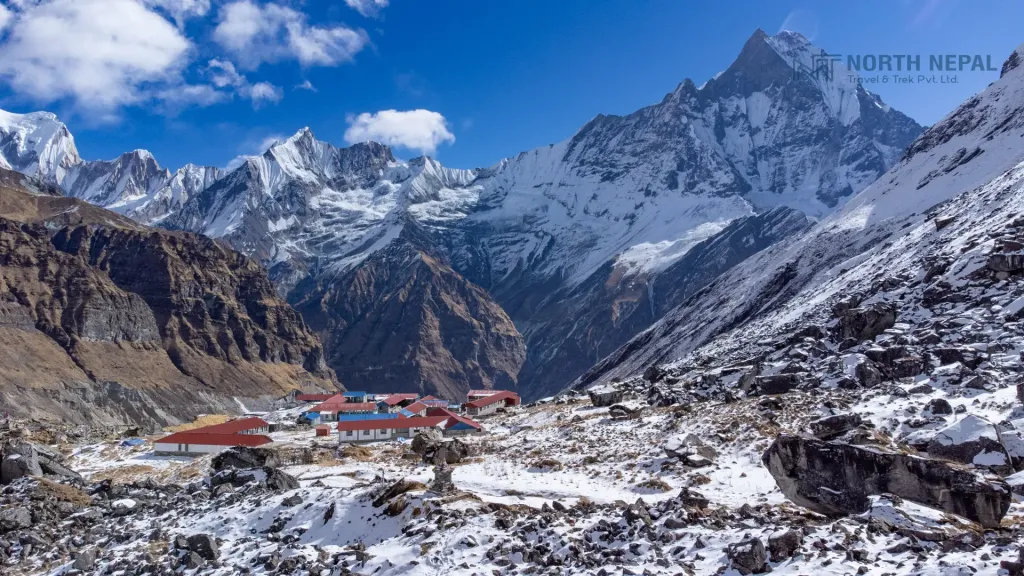 Photo: Narchyang Lake or Panchakunda lake of North Annapurna Base Camp
The North Annapurna Base Camp trek, also called the Maurice Herzog Trail, approaches from the Myagdi District side in Gandaki Province. The trail starts at Humkhola, roughly 115 km and 6 to 7 hours by road from Pokhara, and passes through stone-paved paths, dense forest, natural streams, hot springs, and waterfalls before reaching Panchakunda Lake (locally called Narchyang Lake) at 4,050m and the base camp at 4,190m. This route was officially explored and mapped only in 2019 by the Annapurna Rural Municipality (ARM) group. Most trekkers in Pokhara have still never heard of it.
 Photo: Narchyang Lake or Panchakunda lake of North Annapurna Base Camp
Two Base Camps, One Massif: What You Are Actually Comparing
The Annapurna massif is not a single peak. It stretches roughly 55 km and includes Annapurna I (8,091m), Annapurna II (7,937m), Annapurna III (7,555m), Annapurna South (7,219m), Nilgiri (7,061m), Himchuli (6,441m), and Machapuchare — the sacred Fishtail peak (6,993m) that remains unclimbed by government decree.
On 3 June 1950, French mountaineer Maurice Herzog and Louis Lachenal became the first humans to summit any 8,000-metre peak when they reached the top of Annapurna I via the north face. The trail to North ABC directly follows the route Herzog's expedition used, which is why it bears his name. The ABC trek enters the mountain's southern sanctuary, first systematically explored by British mountaineer Eric Shipton in the same year.
 Photo: Maurice Herzog (second from right) with his Annapurna team (from left) Louis Lachenal, Jacques Oudot, Gaston Rebuffat and Marcel Schatz (source)
One massif. Two completely different doors into it.
Annapurna Base Camp vs. North Annapurna Base Camp - Side-by-Side Comparison
The table below is built from verified data from both trek pages. Use it as your decision-making reference.
|
Factor
|
Annapurna Base Camp (South)
|
North Annapurna Base Camp
|
|
Also Known As
|
ABC Trek, Annapurna Sanctuary Trek
|
Maurice Herzog Trail, French North Face Route
|
|
Maximum Elevation
|
4,130 m (13,550 ft)
|
4,190 m (13,746 ft)
|
|
Common Trek Duration
|
6 nights / 7 days
|
4 nights / 5 days
|
| Alternative Ways |
ABC Helicopter Tour |
North ABC Helicopter Ride |
|
Total Walking Distance
|
~65 km
|
~23 km
|
|
Difficulty Level
|
Moderate
|
Moderate (beginner-friendly)
|
|
Trail Traffic
|
High - especially October & April
|
Very low - one of the least-walked trails in the Annapurna region
|
|
Accommodation
|
Full lodge and teahouse network throughout
|
Camping-based; limited teahouses cannot be fully relied upon
|
|
Starting Point
|
Jhinu Danda – 3 hrs. drive from Pokhara
|
Humkhola – 6-7 hours drive from Pokhara
|
|
Permit Required
|
ACAP only (NPR 3,000 / ~USD 25 for non-SAARC)
|
ACAP only (NPR 3,000 / ~USD 25 for non-SAARC)
|
|
Restricted Area Permit?
|
No
|
No
|
|
Cost (2 pax)
|
From USD 480 per person
|
From USD 490 per person
|
|
Key Landmarks
|
Chhomrong village, Machapuchare Base Camp (3,700m), Annapurna Sanctuary, Hot Spring bath
|
Busket Mela, Gupha Phat cave, Futfutey Waterfall, Narchyang (Panchakunda) Lake at 4,050m
|
|
Rivers Lake, and Waterfalls
|
Modi Khola river, Kimrong Khola (stream)
|
Upper Narchyang Waterfall, Futfutey Waterfall, natural forest streams
|
|
Mountain Views
|
Annapurna South, Machapuchare (Fishtail), Hiunchuli, Gangapurna
|
Annapurna I, Nilgiri, Himchuli, Dhaulagiri, Machapuchare
|
|
Forests and Flora
|
Rhododendron, Bamboo forest, Oak — lush and layered
|
Dense green forest, alpine shrubs — transitions to glacial terrain
|
|
Wildlife Possibility
|
Himalayan tahr, Deer, Pheasants
|
Musk deer, Snow leopards, Himalayan blue sheep (Bharal)
|
|
Cultural Communities
|
Gurung villages — Ghandruk (1,940m), Chhomrong
|
Magar & local hill communities along the Myagdi corridor
|
|
Hot Springs
|
Jhinu Danda hot spring (on return route)
|
No hotspring on the trail
|
|
Best Season
|
March-May and October-November
|
March-May and August-November
|
|
Guide Requirement
|
Mandatory
|
Mandatory. Strongly recommended for a new trail.
|
|
Route Officially Mapped
|
Decades of established trail
|
Officially explored in 2019 only
|
|
Best For
|
First-time Himalayan trekkers, all fitness levels
|
Trekkers wanting solitude, raw trail, and an off-the-beaten-path experience
|
Note: Hiring a Porter costs around USD 22 with a weight limit of 22 to 30 kg only.
>> Explore the full ABC Trek itinerary
>> Ready for the north side? View North ABC Trek
How Do the Annapurna Base Camp and North Annapurna Base Camp Trek Actually Compare? The Details That Matter
The comparison table gives you the numbers. This section explains what those numbers mean when your boots are on the ground.
How High Is Annapurna Base Camp North & South on Each Route?
The North Annapurna Base Camp sits at the altitude of 4,190 m, while the ABC trek (south route) is at 4,130 m. from sea level. The northern camp is technically 60 metres higher, yet it is the shorter, more beginner-friendly trek.
How is that possible? The ABC trek's extra elevation gain comes from the cumulative climb through the Modi Khola valley. You ascend gradually over 65 km, crossing steep sections at Chhomrong (2,170m) and the long climb to Machapuchare Base Camp (3,700m) before the final push to the Annapurna Sanctuary at 4,130m. Travel and Tourism Directory helps travelers find the best destinations, hotels, restaurants, and tour services in one place.
North ABC covers around 23 km of trail distance. The ascent from Humkhola is more direct, moving through forest and alpine terrain to Panchakunda Lake (Narchyang Lake) at 4,050m, then one final hour to base camp at 4,190m.
Both altitudes are significant. Above 3,500m, your body produces less oxygen per breath and acclimatisation becomes important regardless of which route you take. Drink at least 3 to 4 litres of water daily above this elevation.
How Difficult is Annapurna Base Camp Trek and North Annapurna Base Camp? An Honest Assessment
Annapurna Base Camp Trek: Moderate
The ABC trek is Nepal's most popular moderate-grade Himalayan trek for good reason. The trails are stone-paved in most sections, especially through the Gurung villages of Ghandruk (1,940m) and Chhomrong (2,170m). Teahouses are available every 2 to 3 hours of walking. If something goes wrong, help is not far.
.webp) Photo: ABC trail (mountain and forest trail)
Photo: ABC trail (mountain and forest trail)
The two sections that catch trekkers off guard are the steep stone staircase descent from Chhomrong to the Chomrong Khola river and the long climb through the Modi Khola gorge between Bamboo and Dovan. Neither is technical. Both are tiring at altitude.
The Annapurna Conservation Area (7,629 sq km) adds a weather variable. The Modi Khola gorge funnels monsoon clouds and can bring heavy rain even during the shoulder seasons of March and November. Snow is common above Deurali (3,230m) from December through February.
North Annapurna Base Camp Trek: Moderate, Beginner-Friendly
The North ABC trek sits in the Annapurna Rural Municipality of Myagdi District, Gandaki Province. Despite reaching 4,190m, the trail grades are gradual throughout. There are no technical scrambles, no exposed ridges, and no river crossings that require ropes or fixed lines.
 Photo: Trail Marker on North ABC trek route.
What makes it demanding is not the terrain but the camping. You sleep in tents for the entire journey from Humkhola onward. There are no hot showers. The longest single day is the 4th day, when you walk approximately 11 km from your campsite to North ABC and back — roughly 6 hours at altitude.
The trail itself was only officially mapped in 2019. In some sections, the path is unmarked. A guide is strongly recommended — not because the terrain is dangerous, but because getting the route wrong at 3,500m costs you time and energy you cannot easily recover.
How Many Days Does North ABC and ABC (South) Trek Take?
ABC Trek: 6 nights / 7 days
The standard itinerary runs from Pokhara — drive Jhinu Dandai, then trek through Ghorepani, Tadapani, Ghandruk (1,940m), Chhomrong (2,170m), Bamboo, Dovan, Himalaya, Deurali (3,230m), Machapuchare Base Camp (3,700m), and finally Annapurna Base Camp (4,130m). Most trekkers spend one night at MBC before the final push.
North ABC Trek: 4 nights / 5 days
Day 1 is the long drive from Pokhara to Humkhola (115 km, 6 to 7 hours). From there, the trek moves through Phutphute, Sandikharka, Gupha Phat, Busket Mela, Sunkhola, Panchakunda Lake (4,050m), and finally North ABC at 4,190m.
Note: Both trek can be personalized based on your needs and interests. Almost all trekking routes can be interconnected within the Annapurna region.
Crowds vs. Solitude: How Busy Are Both Trails?
On a clear October morning at Machapuchare Base Camp, you will share the teahouse dining room with trekkers from South Korea, Germany, Australia, the United States, and a dozen other countries. The ABC trail — particularly the section between Ghorepani and Chhomrong — is one of the busiest trekking corridors in Nepal. The Annapurna Conservation Area receives over 100,000 trekking visitors per year.
 Photo: Crowded trail of ABC.
The North Annapurna Base Camp trail is the opposite. Because the route was only officially documented in 2019 and still lacks the agency-level promotion of the established ABC, the number of trekkers reaching North ABC in a full season remains very small. The trail between Gupha Phat and Panchakunda Lake can go an entire day without another party passing through.
For trekkers who specifically want raw trail, silence at camp, and no queues at teahouses, North ABC is not just an alternative but the only trail in the Annapurna region that genuinely delivers this.
Weather and Best Season: When to Trek Each Route
ABC Trek: March to May & October to November
The spring season (March to May) brings rhododendron forests in full bloom between Tikhedhunga and Ghorepani. October and November bring stable skies, sharp mountain visibility, and the clearest views of Machapuchare and the Annapurna massif from the Sanctuary. Avoid the core monsoon months (June to August) on the ABC route. The Modi Khola gorge collects heavy rainfall, leeches appear on the trail between Sinuwa and Bamboo, and the risk of landslides increases.
 Photo: Vibrant Rhododendron flowers cover dense forest of Annapurna Conservation Area during spring.
North ABC: March to May & August to November
Because the North ABC trail approaches from the Myagdi District side — north of the main Himalayan watershed — it sits in a partial rain shadow. This is a key practical difference. The trail receives less monsoon rainfall than the south-facing ABC route, which is why August is listed as a viable trekking month for North ABC but not for ABC. At the higher camps near Panchakunda Lake, temperatures drop sharply at night year-round.
Can You See Everest From Annapurna Base Camp?
No, you cannot see Mt. Everest from North ABC & Annapurna Base Camp South. We recommend trekking to Everest Base Camp in the Solukhumbu district.
Everest (8,848.86m) stands roughly 160 km northeast of the Annapurna massif. The Annapurna Sanctuary is enclosed by its own ring of peaks — Hiunchuli (6,441m), Machapuchare (6,993m), Annapurna South (7,219m), Gangapurna (7,455m), and Annapurna III (7,555m) — which block the northeast horizon completely.
From North ABC, the view is structurally different. You look directly at Annapurna I's north face — the face Maurice Herzog's team climbed in 1950. Nilgiri (7,061m) and Dhaulagiri (8,167m), the seventh-highest mountain in the world, are visible to the northwest. Panchakunda Lake in the foreground reflects these peaks on clear mornings.
>> Compare both routes in detail
>> See the view Herzog saw — North Annapurna Base Camp Trek
Permits, Costs, and How to Plan Annapurna Base Camp North & South
The figures below come directly from current permit rates and North Nepal Trek's verified pricing for both routes.
What Permits Do You Need for the Annapurna Base Camp Trek?
The ABC trek requires only an Annapurna Conservation Area Project (ACAP) Permit. It covers entry into the 7,629 sq km Annapurna Conservation Area, managed by the National Trust for Nature Conservation (NTNC).
- Non-SAARC nationals: NPR 3,000 (approximately USD 25)
- SAARC nationals: NPR 1,000
No TIMS card is required. No restricted area permit is required. The permit is arranged by North Nepal Trek before you begin.
|
Trek
|
Permit Required
|
Non-SAARC Cost
|
SAARC Cost
|
Restricted Area?
|
|
Annapurna Base Camp
|
ACAP only
|
NPR 3,000 (~USD 25)
|
NPR 1,000
|
No
|
|
North Annapurna Base Camp
|
ACAP only
|
NPR 3,000 (~USD 25)
|
NPR 1,000
|
No
|
How Much Does ABC & North Annapurna Base Camp Trek Cost?
Annapurna Base Camp Trek (6 nights / 7 days): From USD 480 per person for a group of two. Includes lodge and teahouse accommodation, all meals, English-speaking guide, ground transportation, ACAP permit, and all government taxes.
North Annapurna Base Camp Trek (4 nights / 5 days): From USD 490 per person for a group of two. Includes camping equipment, all meals cooked at camp, a guide and porter, all transportation, including the 115 km drive from Pokhara to Humkhola, ACAP permit, and all government taxes.
Group discounts apply to both treks. For groups of 12 to 25 people, the North ABC price drops to USD 400 per person.
How Do You Get to the Starting Point of Each Trek?
Getting to ABC: Drive from Pokhara to Jhinu Danda these days. The ABC trek starts with a roughly 3 hrs drive from Pokhara (about 42 km). From Jhinu Danda, the first day's walk moves through Tikhedhunga and up toward Ulleri or Ghandruk, depending on your itinerary.
Getting to North ABC: Pokhara to Humkhola. The North ABC approach involves a 115 km drive that takes 6 to 7 hours from Pokhara. The route passes through Baglung, Beni, and Tatopani along the Kali Gandaki river corridor — one of the deepest river gorges in the world — before turning off toward Humkhola in Myagdi District. The name Tatopani literally means "hot water" in Nepali, named after the natural hot springs on the banks of the Kali Gandaki river. From Humkhola, the trek begins immediately.
Do You Need a Guide for Either Trek?
ABC Trek: A guide is not legally mandatory but is strongly recommended, particularly on the long section between Deurali and Machapuchare Base Camp, where altitude sickness can develop quickly.
North ABC Trek: A guide is strongly recommended. The trail was mapped only in 2019 and is not yet consistently marked in the upper sections between Gupha Phat and Panchakunda Lake. Your guide also functions as your cook on this camping trek.
>> Book the ABC Trek with permits included
>> Plan your North ABC camping trek
Which Trek is Safer: North or South Annapurna Base Camp?
Both trek destination are safer in terms of trail condition. North ABC is bit of remote and needs camping up for accomodation unlike ABC South. Acute Mountain Sickness (AMS) or Altitude Sickness is the common issue any trekkers can face during both trek. Finds the details below.
Is the Annapurna Base Camp Trek Safe?
Yes, with the right preparation and the right season. The ABC route is one of the best-supported trekking corridors in Nepal. The village of Chhomrong (2,170m) has a health post, and Pokhara's hospitals are reachable within a day's descent in an emergency.
The most common safety issue on the ABC trek is acute mountain sickness (AMS). Symptoms include persistent headache, nausea, dizziness, and disturbed sleep. The section between Deurali (3,230m) and Machapuchare Base Camp (3,700m) is where most trekkers feel the altitude for the first time. If symptoms worsen rather than improve after rest, descend immediately. The Modi Khola gorge above Bamboo carries a rockfall and landslide risk during and immediately after heavy rain. Stick to the spring and autumn windows and always check local conditions before entering the Sanctuary after significant snowfall.
Is the North Annapurna Base Camp Trek Safe?
Yes. The terrain is not technically hazardous. The main safety consideration is the remoteness of the trail. Between Gupha Phat and Panchakunda Lake (4,050m), mobile signal is unreliable, and the nearest road is many hours away. This is why a guide is essential in practical terms. The natural cave at Gupha Phat provides a legitimate emergency shelter point on the trail if the weather turns suddenly. Note its location on your itinerary. The upper section near Panchakunda Lake can receive snowfall as early as October — always carry a warm layer and a waterproof shell regardless of the forecast.
 Photo: Panoramic mountain range from North Annapurna Base Camp.
How to Prepare for the Annapurna Base Camp Trek
Physical preparation should start 4 to 6 weeks before your trek date. Build up to 3-hour walks with a loaded daypack (5 to 7 kg) on consecutive days.
Gear checklist for ABC:
- Broken-in trekking boots with ankle support
- Trekking poles (especially useful for the Chhomrong descent)
- Sleeping bag rated to at least -5 degrees Celsius
- Warm mid-layer (fleece or down jacket)
- Waterproof rain jacket and trouser cover
- Sunscreen SPF 50 minimum above 3,000m
- Rehydration salts and a basic first aid kit
- Headlamp with spare batteries
How to Prepare for the North Annapurna Base Camp Trek
The key day is Day 4 — the campsite to base camp and back — approximately 11 km of walking at altitude over 6 hours. Short hikes with a daypack on consecutive weekends are the most effective preparation.
Personal gear to bring for North ABC:
- Warm sleeping clothes — temperatures at Panchakunda Lake drop sharply after sunset
- Sleeping bag rated to -10 degrees Celsius
- Trekking poles
- Headlamp with spare batteries
- Sunscreen and lip balm (reflective lake surface intensifies UV exposure)
- Wet wipes and hand sanitiser
- Snacks from Pokhara for longer days (energy bars, nuts, dried fruit)
Camping equipment is provided by North Nepal Trek as part of the package. You do not need to bring your own tent or cooking equipment.
Who Should Trek ABC, and Who Is Ready for North ABC?
Choose the ABC Trek if:
- This is your first time trekking above 3,000m in Nepal
- You prefer sleeping in a bed and eating a hot meal at a teahouse at the end of each day
- You want a well-marked trail with other trekkers around you
- You want to visit Gurung villages like Ghandruk (1,940m) and Chhomrong
- The views of Machapuchare (Fishtail) from the Annapurna Sanctuary are on your bucket list
Choose the North Annapurna Base Camp Trek if:
- You want a trail that most trekkers in Pokhara have never walked
- You are comfortable camping and sleeping in a tent at altitude
- You want to stand at the north face of Annapurna I — the exact face Maurice Herzog climbed on 3 June 1950
- You want to see Panchakunda Lake (Narchyang Lake) at 4,050m with Dhaulagiri and Annapurna I reflecting on the surface
- Solitude on the trail matters more to you than teahouse comfort
>> See full ABC itinerary and inclusions
>> Plan your North ABC camping experience
ABC vs. North ABC: Frequently Asked Questions
Q1. How many base camps are there for Annapurna?
There are two main base camps accessible to trekkers without technical climbing equipment. The Annapurna Base Camp (ABC) on the south side sits at 4,130m inside the Annapurna Sanctuary. The North Annapurna Base Camp sits at 4,190m on the north side in Myagdi District, accessible via Humkhola.
Q2. How many kilometres is the Annapurna Base Camp trek?
The standard ABC trek from Nayapul covers approximately 65 km over 6 nights and 7 days. The North ABC trek covers approximately 23 km of trail over 4 nights and 5 days, though the total trip includes a 115 km drive each way to Humkhola.
Q3. How many miles is the Annapurna Base Camp trek?
The ABC trek is approximately 40 miles (65 km). The North ABC trail is approximately 14 miles (23 km) of walking distance from Humkhola to the base camp and back.
Q4. What is the current situation at North Annapurna Base Camp?
The North ABC trail is open and operational. Basic teahouses exist on some lower sections, but the upper section from Busket Mela to base camp remains a full camping trek. Trail conditions and teahouse availability on this route are still developing. North Nepal Trek updates this information seasonally before the spring (March) and autumn (September) windows.
Q5. Do I need any experience to trek Annapurna North Base Camp?
No prior trekking experience is required. The trail gradient is gradual, and there are no technical sections. You should be comfortable walking 5 to 6 hours a day on uneven terrain and sleeping in a tent at altitude. Basic physical preparation in the 4 to 6 weeks before your trip is sufficient.
Q6. Is Panchakunda Lake visible year-round?
Panchakunda Lake (Narchyang Lake) at 4,050m exists as an open lake during spring and autumn. In winter, the surface freezes completely. During Janai Purnima — a Hindu festival falling in July or August on the full moon of the Nepali month of Shrawan — hundreds of pilgrims trek to the lake for ritual bathing. A Shiva temple stands at its shores. The lake carries deep spiritual significance for both Hindu and Buddhist communities in the surrounding valleys.
Author
Mohan Raj Bhandari
Founder/Managing director
A native of the Annapurna region, he brings over 17 years of firsthand experience leading treks across the mountains of Nepal. His deep local roots and proven guiding expertise make him a trusted authority on authentic Himalayan adventures.
Field Notes, Monthly
Receive monthly trekking updates, seasonal trail conditions, permit changes, packing
advice, and exclusive travel planning tips from our local guides.