Upper Mustang Tiji Festival Tour – 12 Days, 2026

Home Trekking

Annapurna Region

Upper Mustang Tiji Festival Tour – 12 Days, 2026
DESTINATION Nepal
MAX. ELEVATION 3,840 m.
WALKING DISTANCE
GRADE Easy (no trekking required)
BEST SEASON May (festival-fixed)
DURATION 12 Days
MEALS INCLUDED Breakfast, Lunch & Dinner
ACCOMMODATION Hotels & Lodge

OVERVIEW & HIGHLIGHTS

Tiji Festival 2026 Overview

Tiji Festival 2026 Itinerary: 14, 15 & 16 May 2026 (Thursday–Saturday)

Tiji Festival 2026 is officially scheduled for Thursday 14 May, Friday 15 May, and Saturday 16 May 2026, with all three days of Cham masked dances held in the Royal Palace courtyard inside the walled city of Lo Manthang, Upper Mustang.

Date Tibetan Cham Name Theme
9 May 2026 Arrival Welcome to the City of Temple
10 May 2026 UNESCO World Heritage Sites Cultural & Architecture
11 May 2026 Kathmandu to Kalopani Scenic ride
12 May 2026 Kalopani to Kagbeni Gateway to Upper Mustang
13 May 2026 Kagbeni to Lo Manthang Day before Tiji Celebration
14 May 2026 Tiji Festival Day 1 Invocation of the Deity
15 May 2026 Tiji Festival Day 2 The Battle Against Evil
16 May 2026 Tiji Festival Day 3 Victory & Demon Effigy Burning
17 May 2026 Lo Manthang to Pokhara Relaxing at Fewa Lake
18 May 2026 Pokhara Explore Pokhara
19 May 2026 Pokhara to Kathmandu Back to City chaos
20 May 2026 Departure Farewell

Tiji Festival dates are fixed each year by the lamas of Choede Monastery using the Tibetan lunar calendar. The festival always falls in the third Tibetan month — typically mid to late May — and always runs for three consecutive days. Once the dates are announced, they do not change. Our 12-day jeep itinerary is built backwards from these three days, so you arrive in Lo Manthang with one day to acclimatize before Day 1 of the festival.

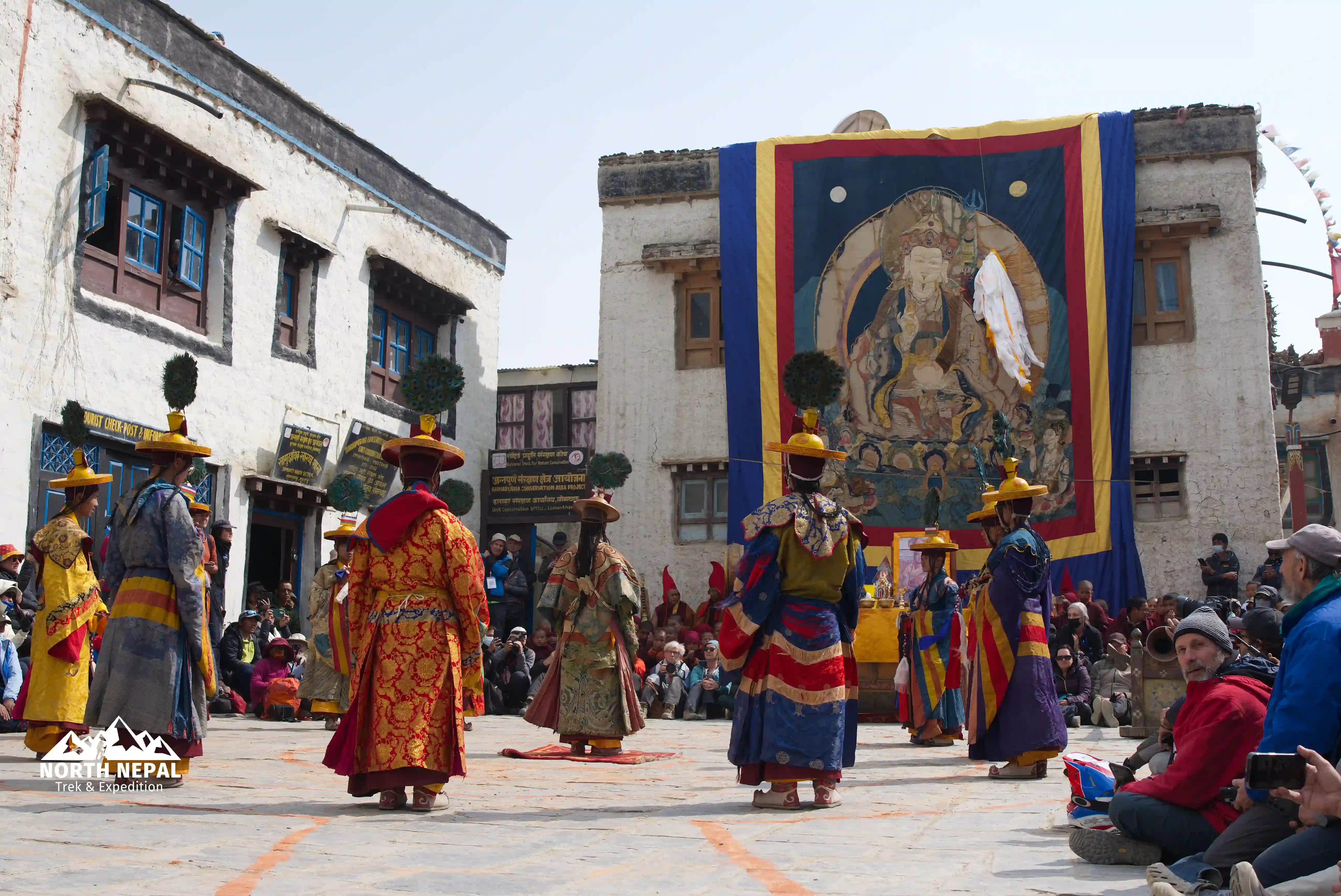
Mask Dance at Lo Manthang during Tiji festival

Already Confirmed: Tiji Festival 2027 Tentative Dates

Tiji Festival 2027 is provisionally scheduled for 1, 2, and 3 June 2027 (Tuesday–Thursday). Dates are confirmed by Choede Monastery in early 2027. We open 2027 bookings from August 2026.

Tiji Trip Highlights

  • Three full days at Tiji Festival 2026 (14, 15, 16 May) inside the walls of Lo Manthang at 3,840m. in the Royal Palace courtyard.
  • Suitable for time-poor travellers, families with teenagers, and anyone who has skipped this region because of the trekking commitment.
  • Visit Muktinath temple at 3,710 m on a dedicated day after Lo Manthang — one of the eight Svayam Vyakta Kshetras (self-manifested Vishnu shrines) and a Guru Rinpoche site, with 108 sacred water spouts and the natural-gas eternal flame.
  • Explore the Thakali heartland of Marpha — apple capital of Nepal, whitewashed stone houses, and the community-owned Marpha Distillery.
  • Drive along the Kali Gandaki gorge — the deepest river canyon on earth, between Dhaulagiri (8,167 m) and Annapurna I (8,091 m).
  • Explore three major monasteries inside Lo Manthang: Jampa Lhakhang (15th century), Thubchen Gompa, and Choede Gompa (Sakya lineage, the official Tiji venue)
  • Updated 2026 permits handled in-house: USD 50/day RAP and ACAP NPR 3,000.
  • UNESCO World heriatge exploration in Kathmandu; Kathmandu & Patan Durbar Squares, Pashupatinath, and Bouddhanath.

Upper Mustang Tiji Festival Tour Itinerary

Toggle all
Day 1

Arrival and transfer to hotel

HIGHEST ALT. 1,324 m.

Tribhuvan International Airport sits in the Kathmandu Valley basin at 1,324 m. The drive from arrivals to Thamel takes 30–45 minutes depending on traffic — expect a noisy, slightly chaotic first impression of Nepal. Our representative meets you at the gate with a marigold garland and handles transfer in a private vehicle.

Check-in is at a 3-star hotel in Thamel — the trekkers' quarter where most outdoor shops, money-changers, and restaurants are concentrated. Use the afternoon to recover from the flight, swap currency, and pick up any last-minute gear. Evening pre-trip briefing covers the full Tiji schedule, festival etiquette inside Choede Gompa, and the day-by-day permit checks ahead. Welcome dinner at a Newari restaurant in Lazimpat or Thamel.

Day 2

Explore UNESCO World Heritage Sites Across Kathmandu Valley

HIGHEST ALT. 1,324 m.

The Kathmandu Valley holds seven UNESCO World Heritage Sites. We cover four of the most significant in a single guided day: Kathmandu Durbar Square (the Malla-era royal complex with the Kumari living-goddess house), Patan Durbar Square across the Bagmati (the most architecturally intact of the three Durbar Squares), Pashupatinath (the largest Hindu temple in Nepal, on the Bagmati River, where open-air cremations happen on the ghats throughout the day), and Bouddhanath. Pashupatinath is a working pilgrimage site, not a museum; non-Hindus cannot enter the inner sanctum but watch the rituals from the eastern bank.

Late afternoon transfer to Bouddhanath — one of the largest stupas in the world and the spiritual heart of Tibetan Buddhism in Nepal. The kora (clockwise circumambulation) around the stupa at sunset, with monks chanting and butter lamps being lit, is the best preparation possible for the rituals you will witness in Lo Manthang. Return to Thamel for dinner and pack an overnight bag for the long jeep drive ahead.

Day 3

Flight from Kathmandu to Pokhara & drive Kalopani

FLIGHT 25 min.
HIGHEST ALT. 2,530 m

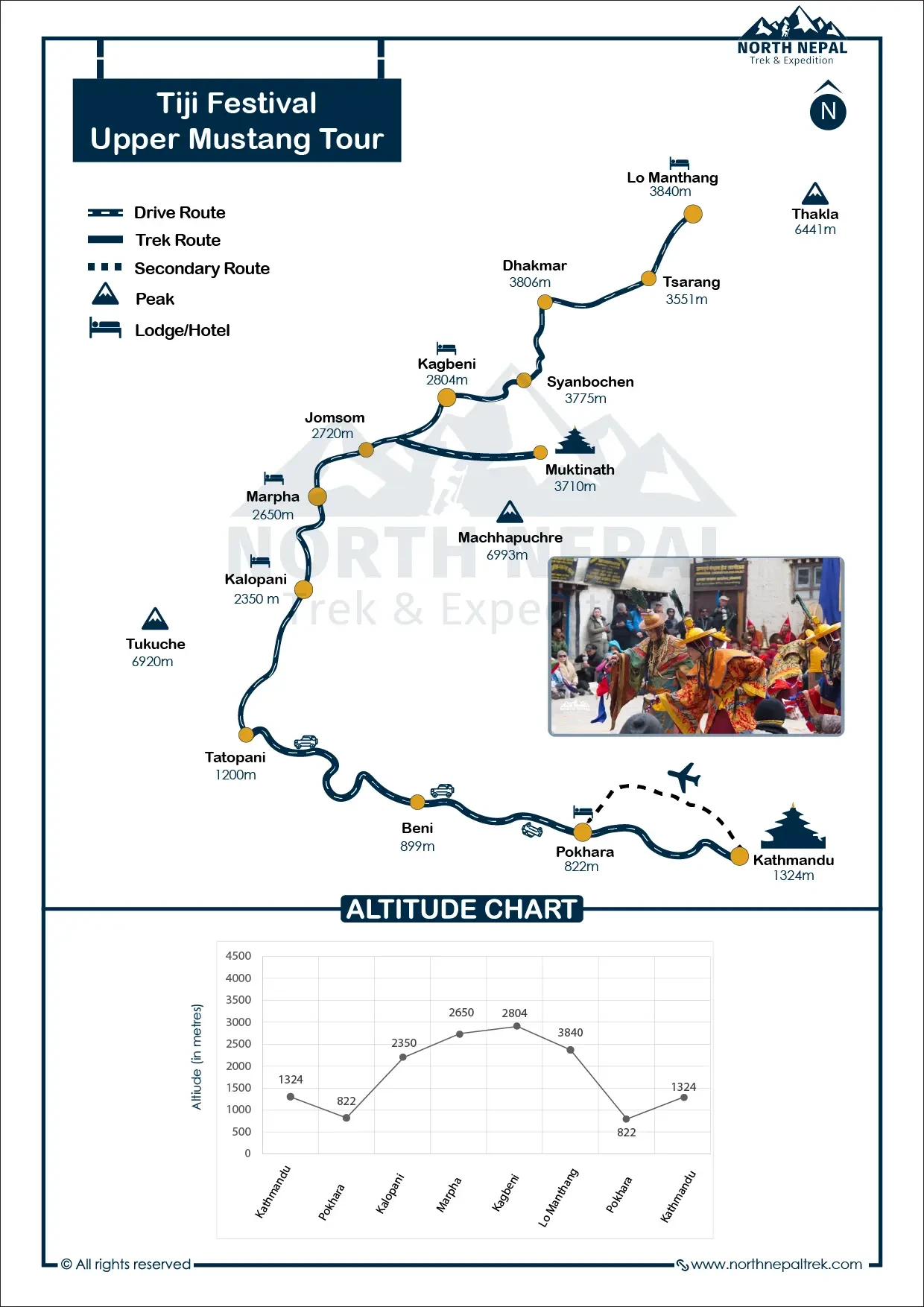
Day start with a fine breakfast and a 25-minute flight to Pokhara, the tourism capital of Nepal. Afterwards, a drive to Kalopani in the Lower Mustang region of Nepal. Jeeps climb north up the Kali Gandaki gorge via Beni and Tatopani.

The road is paved most of the way to Beni and becomes rougher as the canyon narrows. Expect steady jeep travel through terraced rice paddies, then Pine and Rhododendron forest, then the tight Kali Gandaki canyon walls.

Kalopani sits at 2,530 m on a forested shelf opposite the Dhaulagiri massif. The village is small — three or four guest houses, a single street, and apple orchards on the slopes above. On a clear evening, Dhaulagiri I (8,167 m) and Annapurna I (8,091 m) are both visible from the lodge garden, less than 35 km apart across the world's deepest canyon. Cold nights this high — pack a fleece for dinner. Local distilled apple brandy is the regional pour.

Day 4

Explore Marpha, Dhumba Lake & Muktinath, Overnight in Kagbeni

HIGHEST ALT. 2,804 m.

Short morning drive from Kalopani through Tukuche to Marpha (2,670 m) — the apple capital of Nepal and the most architecturally preserved Thakali village in the country. Whitewashed stone houses, slate roofs, narrow flagstone alleys, and the 17th-century Marpha Gompa above the village. Walk the main lane, sample apple brandy and dried apricots at the community-owned Marpha Distillery, and visit the gompa before lunch.

Early afternoon drive to Jomsom (2,720 m, 30 min) and stop at Dhumba Lake (Dhumpa Tal) — a small turquoise lake at 2,830 m below the south face of Nilgiri (7,061 m), considered sacred by both the Bon and Tibetan Buddhist communities. From Dhumba, a short driving detour leads to Thini gau, the oldest of the Panch Gau — the Five Villages of Lower Mustang, made up of Thini, Syang, Marpha, Chimang, and Tukuche.

Did you know? Thini was historically the most powerful of the five and is the only one that once held its own local king. The 17th-century Thini Gompa sits above the village; the prayer wheels in the main lane still turn on the original water-driven mechanism.

After this, our Tiji Festival itinerary takes you to Muktinath, a sacred temple revered by both the Hindu & Buddhist faiths, with 108 spring spouts.

Continue 12 km north to Kagbeni (2,804 m) — the gateway to Upper Mustang and the first checkpoint where your RAP is inspected. The village sits at the confluence of the Jhong Khola and the Kali Gandaki and is dominated by the 15th-century Kag Chode Thupten Samphel Ling, locally known as the Red Monastery. Walk the village before dinner to see the whitewashed mud-brick houses, the famous "Yak Donald's" signpost, and the police check-post.
Day 5

Drive Kagbeni to Lo Manthang

HIGHEST ALT. 3,840 m.

Morning permit check at the Kagbeni police post, then enter the restricted area. The road climbs through Chele, Samar, and Syangboche, crosses the Yamda La (3,985 m) and the Nyi La (4,010 m) — the two highest points on the route — then descends past the Ghami mani wall to a lunch stop. Ghami's mani wall is the longest in Nepal at roughly 305 m, carved from end to end with Tibetan prayer stones. Final leg is via Tsarang and the Lo La pass into Lo Manthang. The first sight of the white-walled city across the dusty plateau is the scenic high point of the entire trip.

Lo Manthang sits at 3,840 m, surrounded by a 6 m mud-brick wall built around 1380 by King Ame Pal. Inside the wall are roughly 180 households, four major monasteries, and the five-storey Royal Palace where the Tiji dances will be performed. The town is a tentative UNESCO World Heritage site under the name "Medieval Earthen Walled City of Lo Manthang." Light dinner at the lodge, early bed — altitude requires conservative behaviour on arrival night. Drink water, skip alcohol, and tell your guide if you develop a headache.

Day 6

Tiji Festival Day 1: Watch Tro-wa Chham — Invocation of the Deity

HIGHEST ALT. 3,840 m

Day 1 of Tiji 2026 falls on Thursday 14 May. Festival timing is set by the lamas of Choede Gompa and announced by long horn (dungchen) blasts from the palace roof, usually around 9:30–10:00 AM. A giant thangka of Padmasambhava and the protector deity Dorje Jono is unfurled on the palace's south wall. Monks in brocaded silk robes and carved wooden masks perform the slow opening dances — the Tro-wa Chham, or Harassing of the Demon — which summon protective deities and purify the courtyard for the rituals to come.

Spectators sit cross-legged on the dust around the courtyard or watch from the rooftops opposite. The dances run in slow cycles with breaks for tea — total viewing time is around 5–6 hours but you can come and go. Stay seated when the masked dancers move, do not stand directly in front of the thangka, and photography is permitted but flash is not.

Late afternoon free time to walk the city wall (a 30-minute circuit), visit Jampa Lhakhang to see the 108 gold-and-gemstone mandalas painted on its walls, or rest at the lodge. Most guest houses serve communal Tibetan dinner during festival week.

Day 7

Tiji Festival Day 2: Watch Nga Chham — The Battle Against Evil

HIGHEST ALT. 3,840 m.

Day 2 (Friday 15 May 2026) is the most theatrical of the three. The Cham dances depict the birth of Dorje Jono and his fierce confrontation with the demon Ma Tam Ru Ta, who is said to have caused drought, famine, and strange livestock diseases until subdued. Masked dancers represent guardian deities, lions, tigers, and wrathful protectors. Movements are faster and more dramatic than Day 1.

Mid-afternoon, the senior monks lead a procession of chanting clergy in a circumambulation of the entire Lo Manthang city wall — a purification rite in which the demonic energy is symbolically driven out of the settlement. Spectators are welcome to follow at the back of the procession.

If you have energy after the dances, an optional 1-hour walk leads to Thubchen Gompa just inside the western wall, built in the late 15th century and home to a large gold-and-copper statue of Sakyamuni Buddha. Choprang Gompa, where the Tiji masks are stored between festivals, is also walkable in 30 minutes.

Day 8

Tiji Festival Day 3: Watch Rha Chham — Victory & Demon Effigy Burning

HIGHEST ALT. 3,840 m.

Day 3 (Saturday 16 May 2026) is the climactic day of Tiji. The lead dancer — the Tsowo, who has completed three months of solitary tantric retreat to spiritually embody Dorje Jono — receives the torma effigy of the demon. The torma is a ritual figure built from tsampa (roasted barley flour) collected from every household in Lo Manthang, dyed red with butter and dough.

Mid-afternoon, the Tsowo and the masked attendants carry the torma in procession out of the eastern gate of the city, into the open ground below the wall. There the effigy is dismembered, scattered, and burned — the ritual destruction of the demon's negative energy. Monks throw blessed tsampa into the air, and spectators receive small portions of the consecrated grain and red protective threads tied around the wrist.

After the ceremony ends, return to the lodge for a farewell dinner with your guide and the lodge family. This is the last night in Lo Manthang. Pack early — the southbound drive starts after breakfast.

Day 9

Drive Lo Manthang to Pokhara

HIGHEST ALT. 3,840 m.

As the sacred Tiji festival ends, we drive to Pokhara. The drive retraces the route through Tsarang, Ghami, Syangboche, and Chele to Kagbeni, then continues along the Kali Gandaki to Jomsom, Marpha, Tatopani, and Beni, and finally to Pokhara. The Kagbeni exit checkpoint inspects your RAP one final time.

Total descent of just over 3,000 m in a single day — drink water, the air thickens noticeably below Tatopani.

Pokhara at 822 m feels tropical after Mustang. Check in at a lakeside hotel near Phewa Tal in the late afternoon or evening. A long hot shower, laundry service, and a sit-down dinner at one of the lakeside restaurants — the temperature swing alone makes Pokhara feel like a different country from where you woke up.

Day 10

Pokhara Exploration Full Day

HIGHEST ALT. 822 m.

This day is all about exploring the beautiful city of Pokhara. Walk around the Fewa Lake. Visit Tal Barahi temple in the middle of the lake by boating, a short walk to the Peace Pagoda or Pumdikot for a mountain view, or simply rest with a drink and a paperback. The day is yours.

Day 11

Flight from Pokhara to Kathmandu

FLIGHT 25 min.
HIGHEST ALT. 1,324 m.

Morning 25-minute Pokhara–Kathmandu flight. On a clear day, the right-hand window gives unbroken views of the Annapurna and Manaslu ranges. Transfer to your Thamel hotel by private vehicle.

The afternoon is yours. Most clients use it for last-minute souvenir shopping in Thamel — singing bowls, Tibetan thangkas, and Pashmina shawls. Other options include a short visit to Swayambhunath (the Monkey Temple) for valley views, a relaxing massage at one of the spas in Lazimpat, or a coffee at one of the old courtyard cafés.

Day 12

Departure

HIGHEST ALT. 1,324 m.

Private vehicle transfer to Tribhuvan International Airport. Our team handles checkout from the hotel and drops you at the international departures gate. Trip ends.

If you want to extend your stay – Chitwan jungle safari (3 days), Bandipur cultural side-trip (2 days), or helicopter tour to Everest Base Camp (around 4 hrs both ways from Kathmandu) — we can add it as a custom extension. Just ask before you book.

Tiji Festival Upper Mustang Tour

Tiji Festival Upper Mustang Tour

WHAT'S INCLUDED & EXCLUDED

  • Airport pickup & drop in Kathmandu in a private vehicle, plus all internal transfers
  • 2 nights' 3-star hotel accommodation in Kathmandu
  • 1 night 3-star lakeside hotel in Pokhara
  • Full Kathmandu Valley UNESCO sightseeing tour with private licensed cultural guide and entry fees (Kathmandu Durbar Square, Patan Durbar Square, Pashupatinath, Bouddhanath)
  • Private 4WD jeep with an experienced driver
  • Upper Mustang Restricted Area Permit (RAP) — 5 days inside the restricted zone at USD 50 per person per day = approximately USD 250 per person, included
  • Annapurna Conservation Area Permit (ACAP) — NPR 3,000 per person, included
  • Licensed English-speaking cultural guide for the full 12 days, with all guide expenses (food, accommodation, insurance, salary, equipment)
  • All meals on tour days (breakfast, lunch, dinner) at lodges along the Mustang and Muktinath route, with seasonal fruit and Tibetan-style hot drinks
  • Accommodation at Kalopani, Kagbeni, Lo Manthang (3 nights during festival), and Muktinath
  • First-aid kit, pulse oximeter, and basic altitude medication carried by the guide
  • Welcome dinner in Kathmandu at a Newari restaurant
  • Farewell dinner in Kathmandu at a traditional Nepali cultural restaurant
  • All applicable government taxes and VAT
  • North Nepal Travel & Trek service charges and trip coordination from our Pokhara office
  • International flights to and from Nepal
  • Nepal entry visa fee (USD 30 for 15-day on-arrival visa, USD 50 for 30 days, USD 125 for 90 days)
  • Travel and high-altitude medical insurance — mandatory and must cover helicopter evacuation up to 4,000 m
  • Lunches and dinners in Kathmandu and Pokhara except where specified in inclusions
  • Personal clothing and gear
  • Hot showers, laundry, charging, and Wi-Fi at lodges in Mustang (typically NPR 200–500 per service)
  • Bottled or boiled drinking water on the route — we recommend a SteriPen or LifeStraw to reduce plastic
  • Alcoholic, cold, and aerated drinks at any meal
  • Personal expenses (phone calls, snacks, souvenirs, shopping)
  • Emergency helicopter evacuation costs — billed first to the client and reimbursed by your insurance
  • Tips for guide and driver — customary USD 10–15 per day for the guide and USD 7–10 per day for the driver
  • Any expense caused by delays beyond the operator's control (flight cancellations, road closures, landslides, political disruptions)
  • Any service or item not explicitly listed under "Cost Includes"

Complete Guide to the Upper Mustang Tiji Festival Tour

Toggle all

Tour Difficulty: Easy Because the Route Is Driven, Not Trekked

This trip is rated Easy because the route is driven by a private 4WD jeep, not walked. Total walking time across the 12 days is around 6–10 hours, broken into short cultural sections at Marpha (1 hr), Thini gau (1 hr), Lo Manthang city wall and monastery walks (4–5 hrs across the festival days), and Muktinath (the 30-minute uphill walk to the temple). The main physical challenge is altitude — Lo Manthang sits at 3,840 m, and the Yamda La and Nyi La passes both clear 3,985 m. Reasonable general fitness and no underlying heart or lung condition are required, but you do not need to be a trained trekker.

Packing the luggage and stuff in the Jeep
Photo: Packing the luggage and stuff in the Jeep.

Permit Costs Updated for 2026: USD 50/Day RAP + NPR 3,000 ACAP

As of late 2025, the Upper Mustang Restricted Area Permit (RAP) is USD 50 per person per day, replacing the previous USD 500-for-10-days block. For this 12-day itinerary, you spend approximately 5 days inside the restricted zone (Day 5 entry at Kagbeni through Day 9 exit back at Kagbeni) — so RAP cost is approximately USD 250 per person. ACAP is NPR 3,000 (approx. USD 25). Both permits are arranged in advance by our Pokhara office; you do not need to apply yourself. Full details on our Upper Mustang fee update page.

Solo Travellers Are Welcome After the March 2026 Rule Change

As of 23 March 2026, solo foreign travellers may obtain a RAP without a second person, provided they book through a registered Nepali agency and are accompanied by a licensed guide. We handle this in-house for solo bookings on this package. See our solo trekking restricted area guide for the full breakdown of the rule change and what it means for independent travellers.

Accommodation Standard: 3-Star Hotels in Cities, Family Guest Houses on Route

Kathmandu and Pokhara use 3-star hotels with attached bathrooms, hot showers, and reliable Wi-Fi. On the Mustang and Muktinath route, you stay in luxury accommodation — clean rooms, twin-bed configuration, mostly shared toilets, communal dining rooms heated by dung-fuelled stoves. Lo Manthang has upgraded guest houses (some with attached bathrooms), but every bed is in demand during Tiji — pre-booking three months ahead is the only reliable way to secure a room inside the walled city. Single-supplement upgrades are available on request.

Accommodation at Muktinath
Photo: Accommodation at Muktinath.

Food on the Mustang Route: Dal Bhat, Thukpa, Momos & Apple Brandy

Standard menu across the Kali Gandaki and Upper Mustang lodges: dal bhat (lentils, rice, vegetable curry, pickle — the staple), Tibetan thukpa noodle soup, steamed and fried momos, tsampa (roasted barley flour porridge), yak cheese, buckwheat pancakes, fresh and dried apples (regional specialty), and local apple brandy. Vegetarian, vegan, and gluten-free options are available with advance notice. Prices in Mustang run 30–50% higher than in the Annapurna foothills — supplies arrive by jeep or mule from Jomsom.

Breakfast in Upper Mustang
Photo: Breakfast in Upper Mustang.

No ATMs Beyond Jomsom: Carry Enough Nepali Rupees for the Whole Trip

Carry sufficient Nepali rupees in cash for the entire Mustang and Muktinath section — budget approximately NPR 5,000–8,000 per person for incidentals (charging, hot showers, drinks, souvenirs, tips). USD and EUR notes are accepted in Lo Manthang at unfavourable rates. Your guide will help with the calculation before you leave Pokhara.

Best Time to Book: At Least 4 Months Ahead for May 2026

This package only runs in May because Tiji is fixed to that month. May weather in Upper Mustang is dry, with daytime temperatures of 15–20 °C and night temperatures dropping near or below freezing at 3,840 m. Skies are typically clear, mountain visibility is at its peak (the rain shadow effect keeps Upper Mustang under 250 mm precipitation per year), and the wild apricot and apple blossom in Kagbeni and lower Mustang is at its strongest in early-to-mid May. Lo Manthang accommodation sells out by January for May departures — book by January 2026 at the latest.

Tiji festival at Lo Manthang of Upper Mustang
Photo: Tiji festival at Lo Manthang of Upper Mustang.

Insurance Is Mandatory: Must Cover Helicopter Evacuation to 4,000 m

Travel insurance with high-altitude medical coverage and helicopter evacuation up to 4,000 m is mandatory. Standard travel insurance often excludes altitudes above 2,500 m — verify your policy in writing before you fly to Nepal. World Nomads, IMG, Allianz, and SafetyWing all offer policies that cover this trip. Bring a printed copy of your policy and the 24-hour emergency number; we will keep a duplicate at our office.

Why Trek With Us - Upper Mustang Tiji Festival Tour – 12 Days, 2026

100% Locally Owned & Pokhara-Based

We are proudly based right here in Pokhara—the key staging ground for all Mustang expeditions. Booking directly with us keeps your investment local, supports regional Himalayan communities, and guarantees immediate on-the-ground coordination.

Officially Licensed & TAAN-Registered

Upper Mustang is a restricted trans-Himalayan region requiring specialized permits and strict compliance. As a fully government-registered trekking agency and active member of the Trekking Agencies' Association of Nepal (TAAN), we handle all restricted area documentation smoothly and legally.

Decades of Remote Trans-Himalayan Expertise

Navigating the arid landscapes, high desert passes, and rugged trails north of the Annapurna and Dhaulagiri ranges requires seasoned logistical planning. We bring over a decade of deep field experience managing remote Jeep and trekking itineraries in Mustang.

Expert Cultural & Historical Leadership

Your journey is led by certified, English-speaking local guides who are deeply fluent in the history of the Sakya lineage, Tibetan Buddhist traditions, and the local Lo-Pa culture. They ensure you secure prime viewing spots for the masked rituals and understand the profound story of Dorje Jono.

Top-Rated Client Satisfaction

Backed by a 4.9/5 rating across global review platforms, our travelers consistently praise our expert pacing through high-altitude terrain, comfortable teahouse selections, and deeply respectful, personalized hospitality.

Live Trail Update of Upper Mustang Tiji Festival Tour – 12 Days, 2026 Live

Last updated: 1 Week Ago

Updated: Basanta Timilsina

Road Condition Open, Monsoon Season
Weather Rain Shadow, Mostly Dry
Wifi/Network Patchy in Lo Manthang
Hotels Quiet, Off-Season

Trekker Alerts

Upper Mustang road to Lo Manthang is open and driveable (monsoon season, dry rain-shadow climate) as of August 2026. Network coverage is patchy beyond Jomsom. Note: the Tiji Festival is a fixed annual May event — the next celebration is May 2027, so festival-dated departures are limited to that window.

Reviews From The Trail

Hear it from those who've walked with us.


Safety Policy

Professional & Certified Guides

Every journey is accompanied by a licensed, English-speaking local guide trained in high-altitude overland logistics, cultural interpretation, and first-aid response. Guides carry comprehensive medical kits equipped with essential pharmaceuticals and pulse oximeters to monitor oxygen levels daily during the drive and cultural tours reaching maximum elevations up to 4,200 m.

High-Altitude & Overland Health Management

While our Tiji Festival jeep tour focuses on cultural immersion and overland exploration rather than strenuous trekking, the route reaches significant elevations across arid, windy terrain. Itineraries are structured with gradual altitude gains to ensure proper acclimatization. Guides conduct daily health assessments for symptoms of Acute Mountain Sickness (AMS). If severe symptoms appear, standard protocol mandates immediate descent to lower elevations.

Emergency Rescue Coordination & Restricted Area Clearance

Because Upper Mustang is a government-restricted border region, emergency helicopter evacuation and rescue operations require strict official authorization and coordination with local security and border authorities. In cases of severe injury or acute altitude illness, our Kathmandu and Pokhara offices instantly coordinate with local rescue services and relevant authorities to secure clearance and execute emergency evacuations where permitted.

Mandatory Travel Insurance

All travelers must hold comprehensive travel insurance covering emergency medical treatment, high-altitude travel (up to 4,500 m), and emergency helicopter rescue/evacuation. Insurance details and restricted area permit documentation must be submitted prior to departure to ensure seamless emergency coordination if required.


Upper Mustang Tiji Festival Tour Departure Date for 2026/2027

Secure the Upper Mustang Tiji Festival Tour for 2026/2027 before the seat gets fully booked.


Terms, Conditions & Feasibility

  1. All bookings are made with North Nepal Travel & Trek Pvt. Ltd Registered Company Number 162883/073/074 (hereafter referred to as The Company) whose office is in Lakeside, Pokhara-6, Nepal.
  2. The term "trip" used in this website and booking conditions refers to all itineraries described on this website including those which might otherwise be know as walking, tours, trekking trips, sightseeing, climbing, mountaineering, expeditions, or holidays.
  3. We accept your last-minute booking as well, but full payment of the total tour cost should be made in advance if necessary or can be paid fully on arrival day. See More 

PRIVATE TRIP

12 Days

Price Start from USD 1900

USD 1500 pp

We Offer Group Discount

No. of PersonsPrice per Person
2 US$ 1700
3-5 US$ 1600
6-20 US$ 1500
RECOGNISED · CERTIFIED · TRUSTED

We are associated with