Upper Mustang Trek - 14 Days
The 14-Day Upper Mustang Trek starts from Kathmandu via Pokhara & Jomsom into the trans-Himalayan ra...
OVERVIEW & HIGHLIGHTS
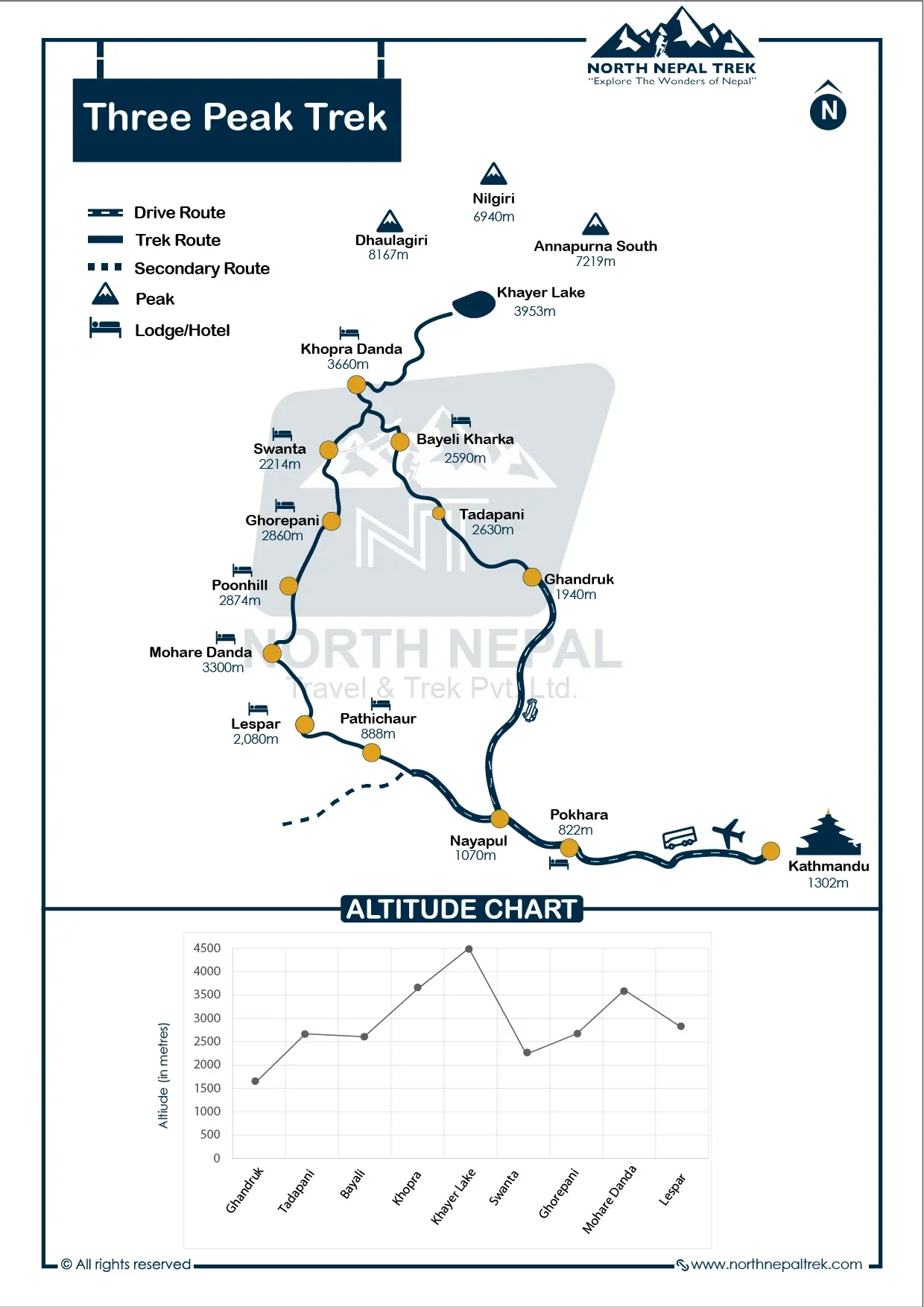
Our unique Three Peak Trek combines Mohare Danda, Khopra Ridge, and Poon Hill into one incredible circuit. It connects classic routes with isolated ridges, giving you the best of both worlds. This route is perfect for travelers seeking magical sunrises, sunsets, and wide mountain views. While Poon Hill is famous, Mohare Danda and Khopra Ridge serve as hidden gems of the Annapurna region.
Download our all-season packing checklist before you tighten your trekking boots for the Three Peak Trek in the Annapurna region.
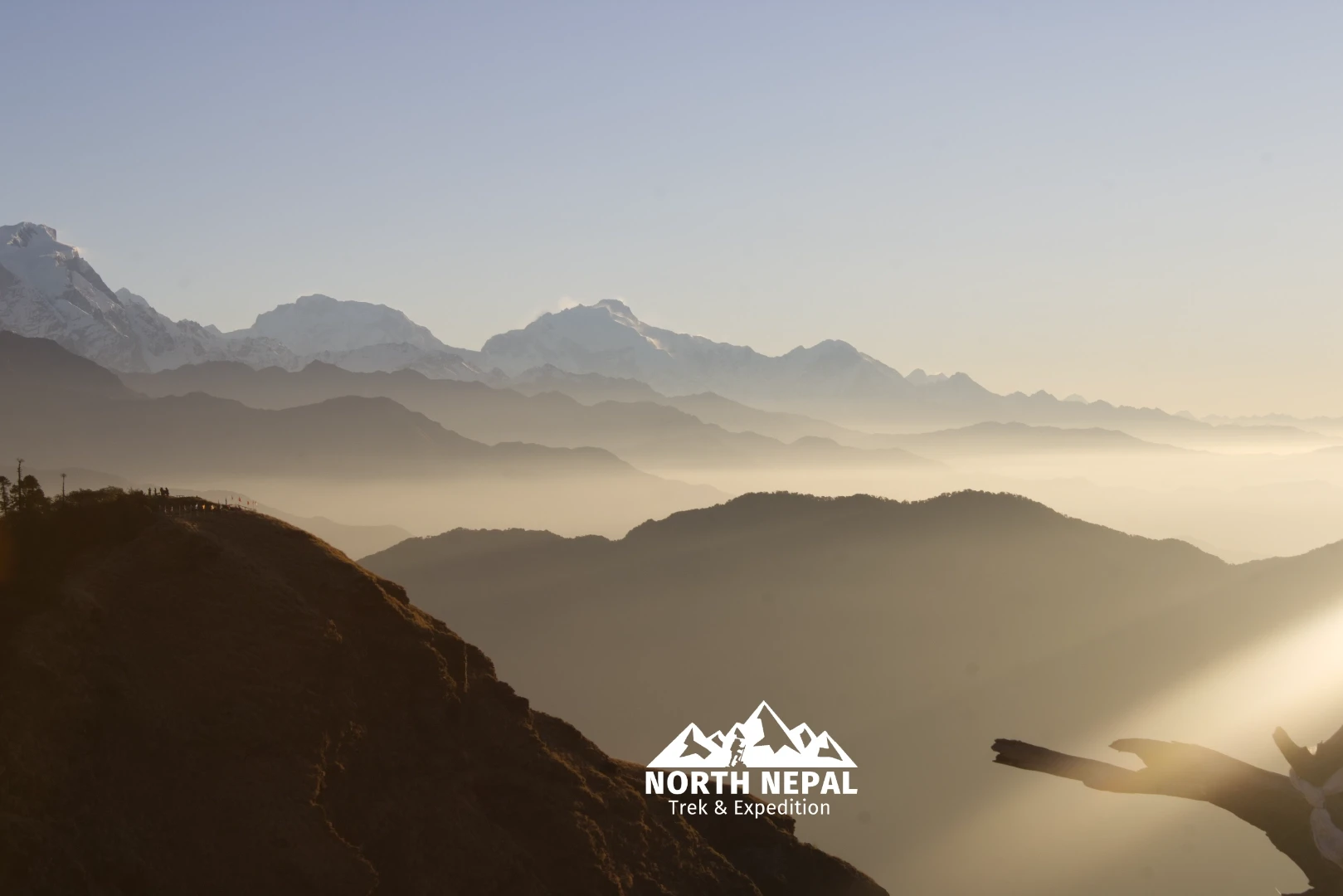
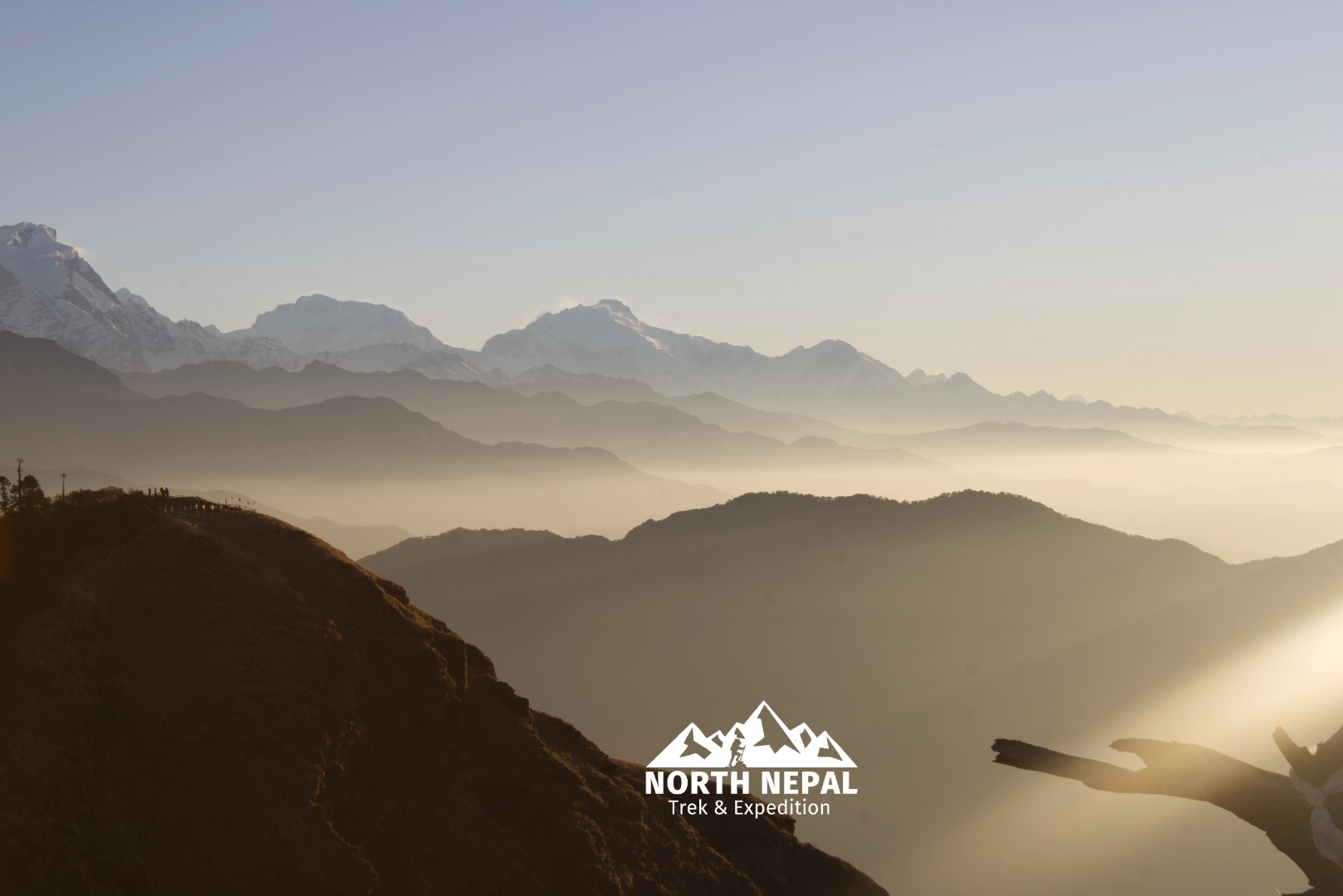
The journey takes you along off-the-beaten tracks and iconic ridges with magnificent views of snow-capped mountains like Annapurna South, Dhaulagiri, Machhapuchhre (Fishtail), and Nilgiri. From Khopra Ridge, you can witness an extraordinary 360° panorama where almost all peaks of the Annapurna and Dhaulagiri ranges are visible. The trek also leads you to the holy waters of Khayer Lake (4,660 m), a sacred site sitting high beneath Annapurna South. This blend of high-altitude adventure and panoramic beauty makes every step rewarding.
Moreover, the trail winds through Magar and Gurung villages like Swanta and Lespar, offering a warm cultural experience. You will walk through forests trails that burst into pink and red colors during spring. The lower forests are alive with wildlife, including gibbons, deer, and colorful Himalayan pheasants. The mix of terrace fields and wild ridges adds nature's touch along the entire trail.
Rajendra Rai, Trekking Guide
Three Peak Trek route and pacing are drawn from years guiding the Annapurna region. Mohan founded North Nepal Trek in 2015; since then, Rajendra Rai has led multiple treks through Mohare Danda, Khopra Ridge, and Poon Hill.
The third day of the Three Peak Trek takes you from Tadapani onto a higher ridge, mixing forest trails with cliffside sections that feel more adventurous. The toughest part is the hard ascent around Isharu, where the climb gets steep and steady. The effort pays off with big ridge views and a stronger sense of being deep in the Annapurna region.
After the climb, the trail towards Bayali is easier. This is a peaceful hike through the forest of Bayali. Bayali is peaceful and remote, with open hills and a cool mountain atmosphere. It’s a shorter day but intense, marked by demanding ascents and rewarding Himalayan scenery.
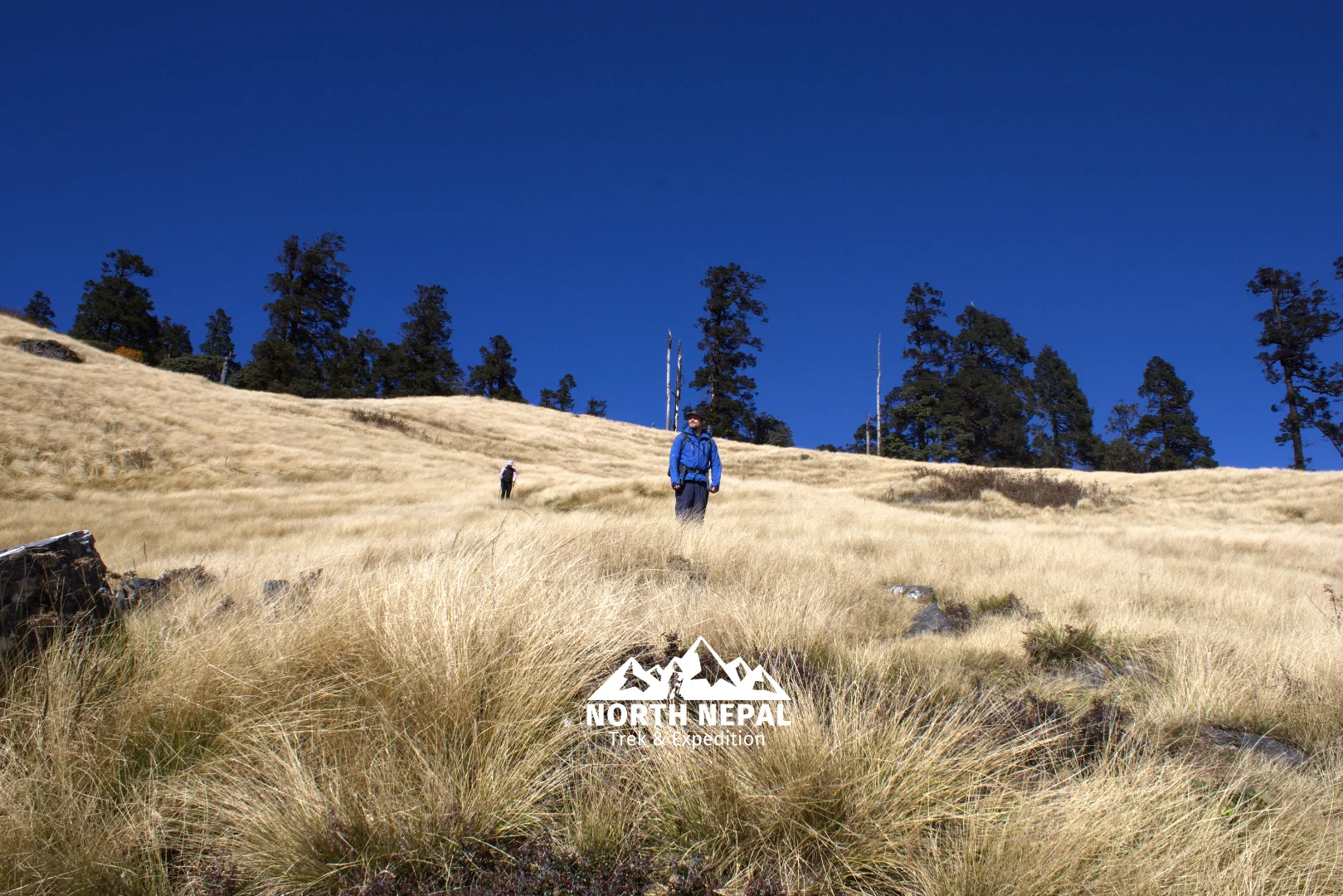
You will trek through the most iconic sections of the Three Peak Trek - Khopra Ridge Trek. The trail from Bayali to Khopra Ridge starts deep inside the forest, following narrow paths and a few cliffside sections where the views drop sharply into the valley. There are no teahouses until Chistibung, so the morning feels quiet and untouched. You descend through rhododendron trees, bushes, and birdsong until you reach the small lodge area of Chistibung for lunch.
From there, the route turns into a steep uphill climb that takes about 2 to 2.5 hours. It’s a tough push, but the trail slowly opens to bigger views as you approach Khopra Ridge. Reaching the Khopra after a tough climb is a reward. The moment a wide panoramic view of the Annapurna and Dhaulagiri ranges opens up, you will forget your tiring day walk in a second.
The day starts with a magical sunrise, one of the best moments of the Three Peak Trek. This is also the hardest section, with a 6–7 hour walk toward Khayer Lake. The trail climbs steadily to the viewpoint, slightly steep but doable with a slow pace. After that, the path turns into long stretches of stone steps leading into a wide, sacred high-mountain zone.
Between Khopra and Khayer Lake, the landscape is filled with small monuments, ridges, and quiet valleys considered holy by local communities. Along the way, you pass Khopra Viewpoint, Khyer Khola, Baraha Lake, a small hidden waterfall, and finally the turquoise Khyer Lake sitting beside the Khyer Baraha Temple.
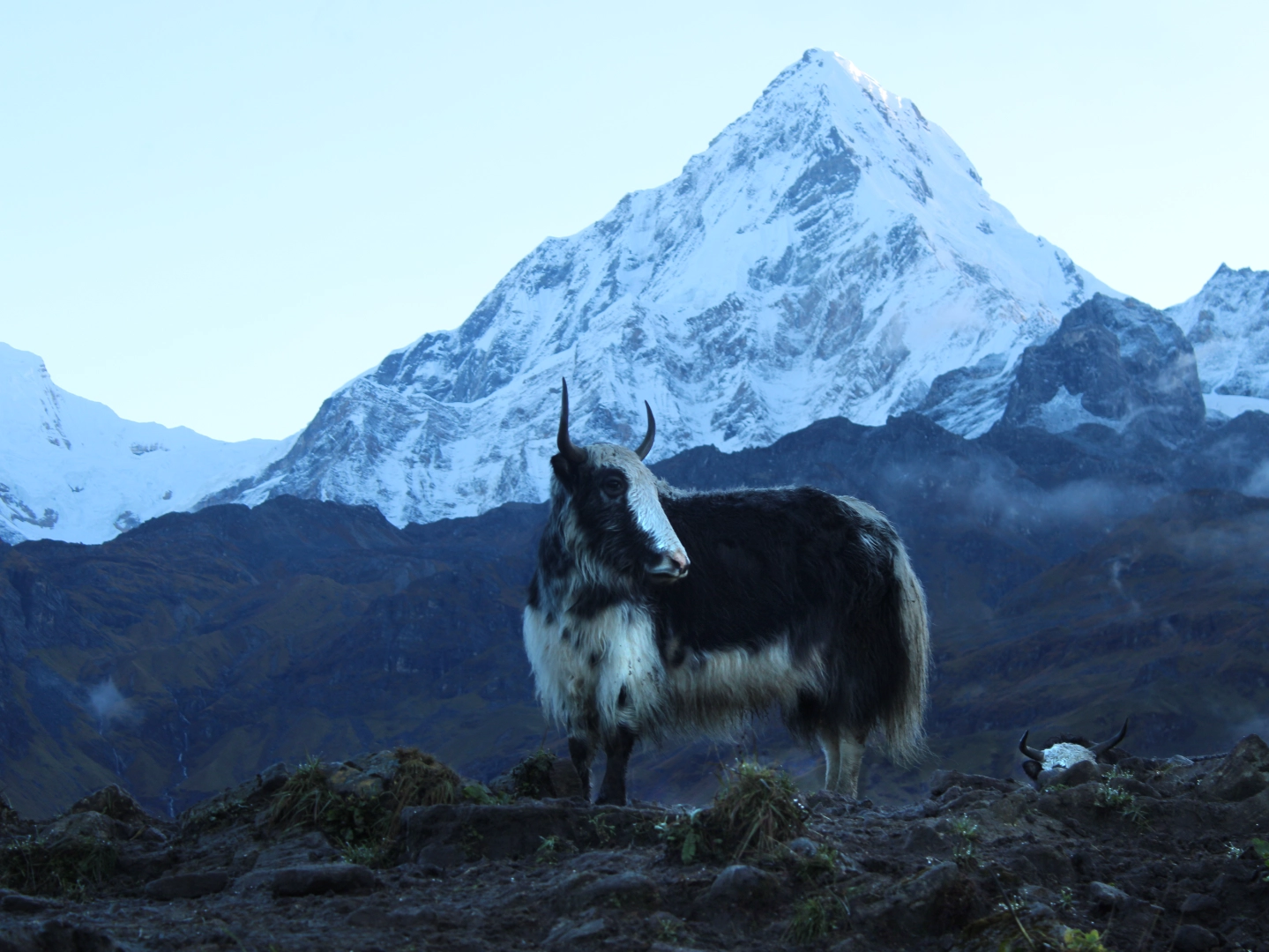
The area is full of life: yak herds, sheep, shepherds moving through the hills, and even the rare chance of spotting a snow leopard or a Himalayan black bear. It’s a long, demanding day, but the mix of sacred landscape, wildlife, and high-altitude beauty makes it one of the most unforgettable parts of the trek.
You leave Khopra and trek towards Swanta village to a lower altitude. The first section descends to a small local hydropower station, where the local hydro powers the Swanta. From there, the path becomes easier and flows gently toward Swanta, a traditional Magar village about 10 km away. The whole walk takes around 4 to 5 hours.
Swanta is known for its strong Magar culture, terraced fields, and warm village atmosphere. It’s one of the region's largest agricultural communities, famous for wild-honey hunting and a simple farm life. The lower forests around the village are alive with wildlife, birds moving through the trees, gibbons calling in the distance, and sometimes deer or foxes crossing the trail.
Reaching Swanta feels peaceful after the tough climbs of the previous days. It’s a great place to slow down, explore short side hikes, and enjoy the cultural side of the Three Peak Trek.
The walk from Swanta to Ghorepani takes around 5 hrs and stays mostly moderate, with a mix of stone-paved paths, forest trails, and wide terrace fields. The day begins gently as you cross a suspension bridge and move toward Chitre, following part of the old salt trading route that once connected mountain communities.
After Chitre, the trail turns uphill through a dense Rhododendron forest, one of the most colorful sections of the Three Peak Trek in spring. The climb is steady but shaded, and small openings in the trees reveal views of Dhaulagiri and the Annapurna range.
Reaching Ghorepani feels lively again, with blue-roofed lodges, fresh mountain air, and the sense of being close to the famous ridge above Poon Hill. It’s a scenic day that blends culture, forest, and classic Himalayan landscapes.
The most popular Poon Hill and Mohare Danda, both known for the world's most magical sunrises and mountain views. The day starts early with a 45-minute climb to Poon Hill, the classic sunrise viewpoint of the Annapurna region. Watching the first light hit the peaks is the perfect motivation before heading onto the ridge trail, a route often called the “Ridge Trek” because most of the walk follows open hilltops with huge panoramas.
From Poonhill, the trail continues gently across the ridge toward Mohare Danda, taking about 3 to 4 hours in total. The path is peaceful, with rolling hills, cool wind, and constant views of Dhaulagiri and the Annapurna range stretching across the horizon.
Mohare Danda offers one of the widest 360° viewpoints in the lower Himalayas, making the end of the day feel special. There’s also an optional short side hike to Kokhe Danda for anyone who wants an extra lookout.
A short but unforgettable day, filled with sunrise moments and ridge-top scenery.
The trail from Mohare Danda to Lespar Village is an easy 6 to 7 hrs descent, dropping from the open ridge into a deep, green forest. The path is shaded and quiet, with scattered openings that reveal distant mountain views and small villages tucked into the hillsides.
As you move lower, you’ll likely pass buffalo herds grazing along the trail, a reminder that this part of the Three Peak Trek connects closely with everyday village life. Lespar Village itself is peaceful and welcoming, known for its simple homestays and warm local atmosphere.
Staying here gives you a close look at traditional lifestyles, local food, and the slower rhythm of rural Nepal, an ideal way to end a long journey through the mountains.
The final day of the Three Peak Trek begins with a gentle 3 to 4 walk from Lespar Village down to Patichaur. The trail passes through several small villages, giving you one last look at rural life in the lower Annapurna region. The path is easy and relaxed, with friendly locals, terraced fields, and warm valley air replacing the high-mountain cold.
From Patichaur, a 2-hour drive takes you back to Pokhara. The road slowly opens to familiar views of the city, lakes, and hills, marking the end of the trek. It’s a smooth return from peaceful mountain trails to the comfort of Pokhara.
Best Season: Spring and Autumn give the clearest sunrise and sunset views from Mohare Danda, Khopra Ridge, and Poon Hill – the three key viewpoints on this circuit.
Itineraries are structured with gradual elevation gains to ensure proper acclimatization before reaching high-altitude points like Khayer Lake (4,660 m). Guides conduct daily health assessments for symptoms of Acute Mountain Sickness (AMS). If severe symptoms appear, standard protocol mandates immediate descent to lower elevations.
In cases of severe injury, acute altitude illness, or extreme weather conditions on remote ridgelines, emergency helicopter evacuation is coordinated directly through local rescue services. Evacuations are initiated promptly upon assessment by your guide in communication with our Pokhara and Kathmandu offices.
All trekkers must hold comprehensive travel insurance covering emergency medical treatment, high-altitude trekking (up to 5,000 m), and emergency helicopter rescue/evacuation. Insurance details must be submitted prior to the departure of the trek to streamline emergency logistics if required.
Secure the Three Peak Trek for 2026/2027 before the seat gets fully booked.
The combined Three Peak trek (Mohare Danda, Poon Hill, Khopra Ridge) usually takes about 7–9 days. For example, the Mohare Danda section is ~50.8 km over 4 days. One itinerary shows the full route as 8 days (9 nights).
You’ll see dozens of high Himalaya peaks. Mohare Danda and Poon Hill offer views of Annapurna South (7,219 m), Dhaulagiri (8,167 m), and Machhapuchhre (Fishtail). From Khopra Ridge, you spot Dhaulagiri I (8,167 m), Annapurna I (8,091 m), Nilgiri (7,061 m), and many more. In fact, one guide highlights “Annapurna South, Dhaulagiri, Hiunchuli, Machhapuchhre, Nilgiri, Lamjung Himal” among the vistas.
Yes, route maps are available. Trek companies often supply them, or guides carry detailed maps. For example, one operator offers a “Mohare Danda Trekking Map” for individual trekkers. You can also download offline trekking maps (e.g., Gaia GPS) for the Annapurna region as a backup.
On average, about 5–7 hours per day. It varies by stage. For example, one itinerary has Nayapul→Lespar as a 7–8 hour hike. Other days (like up to Mohare or onward to Swanta) are ~5–6 hours. A short day (Mohare Danda to Ghorepani) might be only 3 hours. In general, daily walks are paced for 4–7 hours with rest stops.
Yes. The region has many links. For example, on the route to Khopra, you can go via Ghorepani/Poon Hill or take the more remote Dandako Naak shortcut. Mohare Danda is often combined with nearby treks: some groups continue from Ghorepani to Ghandruk and even to Tatopani hot springs. If you have extra time, you could extend to Annapurna Base Camp or Mardi Himal by looping back to Ghorepani or Ghandruk. Talk to your agency about custom extensions (they highlight these options in itineraries).
Nepal is generally safe, but this is a remote circuit. Mohare Danda can be hiked independently (permits are required), but many recommend a guide for first-timers. A guide provides navigation help and emergency support. In practice, solo trekking is possible, but use a guide if you’re inexperienced or want extra safety and logistics assistance.
A guide isn’t legally mandatory for Annapurna treks (except for some areas), but it’s strongly recommended here. The Mohare trek can be done independently, but agencies advise novices to have a guide. A guide handles permits, navigation, and culture, and provides help in emergencies. In short, solo hiking is possible, but using a local certified guide greatly improves safety and ease.
Trekkers need the Annapurna Conservation Area Permit (ACAP) and a TIMS card. These are issued online by the trekking agency before the trek. You may also need local area permits for certain villages.
In most organized packages, yes. Reputable operators include permit fees in the price. For example, a North Nepal Trek itinerary explicitly lists “All Legal Documents (TIMS, Permit, etc.)” as included. Always confirm with your provider, but typically a guided trek bundle covers permit/TIMS fees.
This trek is generally moderate. The Mohare Danda and Poon Hill parts are relatively easy, but Khopra Ridge involves a steep climb (about 1,500 m elevation gain up to 3,640 m). One itinerary notes that the Khopra ascent is “a little bit challenging”. Overall, the trail grade is listed as Moderate, requiring good stamina but no technical skills.
Yes. Mohare Danda/Poon Hill sections are beginner-friendly and need only basic fitness. For example, the Mohare Danda trek is described as “suitable for beginners” with minimal altitude issues. Khopra Ridge is harder (higher altitude), so novices should be fit or consider an extra rest day. With proper pace and breaks, most healthy newcomers can complete the trek.
Trekking guides in Nepal are licensed professionals (often trained at the Nepal Mountain Academy) with first-aid certification. Agencies emphasize that their guides are experienced, English-fluent locals. For example, one operator’s package explicitly includes “an experienced English-fluent guide”. Guides carry safety gear, insurance, and deep local knowledge to manage the trek and assist you.
Yes. Most providers offer flexibility. For instance, one company notes that their itinerary “can be modified as per the guest’s request”. You can often add rest days, side trips (e.g., hot springs or extra viewpoints), or choose alternate routes depending on your interests and weather. Always discuss customization when booking.
It’s best to book well before your trip. For peak seasons (spring/autumn), try to reserve 2–3 months in advance to ensure availability. In the shoulder/off-season (winter or monsoon), you may get away with 1–4 weeks’ notice. Always clarify cancellation and refund policies. After booking, prepare your Nepal visa (available on arrival or e-visa) and travel insurance in advance. (No specific citation found; this is general advice.)
Prices vary by duration, inclusions, and group size. As a rough guide, a short Mohare Danda trek (4 days) can cost USD 300–450 per person (in a 2-person group). A full Three-Peak trek (8–10 days) is often around USD 700–900 per person (per person double/twin share). Rates may be higher for solo travelers or luxury options. Many agencies list a base price and group discounts (e.g., 2+ trekkers pay less than a solo rate).
Generally, almost everything on the trek is included. Typical packages cover all meals (breakfast/lunch/dinner), tea-house lodging, trailhead transport (Pokhara ↔ start point), and an English-speaking guide (with salary/insurance). Gear like a sleeping bag or down jacket is often provided. Crucially, most tours include all permits/TIMS. Check the detailed inclusions list, but reputable outfits leave a few “hidden” fees.
Most companies accept payment by bank transfer (USD/EUR) or credit card (often via online portals) before the trek. In Nepal, final payments and extra expenses are usually paid in cash (US dollars or Nepali rupees). For example, you typically pay for any pre-trek lodging or tips in cash. Always clarify with your agency: ask if a deposit is needed and what forms of payment they accept.
Any personal expenses are usually excluded. For instance, one itinerary explicitly lists “cold drinks, personal expenses (showers, laundry, phone)” and tips as excluded. Also, budget for bottled water, hot showers, snacks, and optional items like Wi-Fi or charging your devices. Some packages charge extra for trekking insurance or gear rental. Tipping is customary (guideline ~$5–10/day for the guide, half that for porters). Always review what is listed as “included” versus “excluded” to avoid surprises.
Spring (March–May) and autumn (September–November) are ideal. In these seasons, the weather is stable, days are warm (nights are cold), and mountain views are clear. One guide even calls Sept–Dec and May the best months for the Mohare Danda trek. Summer monsoon (June–Aug) brings rain and leeches, while winter (Dec–Feb) has snow.
You can, but winter (late Dec to Feb) is cold and risky. Higher paths are likely snow-covered. One source warns that “winter snow may halt the trek midway”, so flights and lodges can be disrupted. If you choose winter, be well-equipped for freezing temperatures and verify if lodges are open. December and January are the chilliest; February can be drier before spring warms up.
Accommodation is simple but adequate. Trekking on this route uses tea-houses or community lodges in villages. On Mohare Danda, especially, you’ll sleep in community-run lodges or homestays. Rooms are typically shared dormitories (2–4 per room) with basic beds. Facilities (hot water, electricity) vary by village. The focus is on a clean bed and hearty meals. In Pokhara and larger towns (start/end), you’ll stay in guesthouses or hotels.
Most operators include all meals. You’ll typically get a Nepali-style breakfast (porridge, eggs/toast), lunch (thali/packed lunch), and dinner. Tea-houses serve local cuisine: dal-bhat (rice, lentils, curry), noodle soups, vegetables, etc. You’ll also find Indian/Tibetan dishes (like momos or curry) and some Western items. According to TrekkingTrail, community lodges can even serve “Traditional Nepalese, Continental, Indian, Tibetan, and Italian” dishes. Expect filling, simple food each night, and carry snacks or energy bars for the trail if needed.
Yes. You can hire porters to carry your bags. Nepal rules allow 1 porter per 2 trekkers, and porters cost extra (not included by default). Hiring a porter lightens your load and supports local villagers. Costs vary (typically $22–25 per day each). Confirm porter arrangements when booking. Note: porters handle up to 25 kg, and you should still carry your daypack.