Nar Phu Trek - 10 Days

Nar Phu Trek - 10 Days
DESTINATION Nepal
MAX. ELEVATION 5,320 m (17,454 ft)
WALKING DISTANCE
GRADE Challenging
BEST SEASON Autumn and Spring
DURATION 10 Days
MEALS INCLUDED Breakfast, Lunch & Dinner
ACCOMMODATION Teahouse

OVERVIEW & HIGHLIGHTS

Nar Phu Trek Overview

Nar Phu Valley serves as an ideal destination for trekkers seeking a taste of life in northern Nepal. Additionally, it provides a unique transition to the dry, desert-like Tibetan plateau. The charm of the journey lies in exploring the Nar and Phu valleys, significant highlights of this Nar Phu Circuit trek. Even though it is remote and rarely trekked, the trail offers adequate teahouses, lodges, and even homestay options for essential traveler needs.

Traversing the Nar and Phu valleys showcases a magnificent blend of towering peaks, glaciers, isolated villages, narrow canyons, enchanting forests, distinctive rock formations, yaks, gompas, and the fascinating cultures of the ethnically Tibetan communities. Starting from Besisahar, the traditional launch point of the Annapurna Circuit, we drive to Koto and start our Nar Phu Valley Trek. Nar Phu trek diverges swiftly from busier routes, leading adventurers into the remote Nar and Phu valleys. The journey entails crossing vibrant Tibetan chortens and prayer-adorned stones, descending into deep gorges, and immersing in daily village life in Phu. Spending a night in the Nar Phedi monastery offers insights into the Tibetan Mountainous existence of Nepal.The final stretch of the trek spans a few days, ascending the high Kang La Pass before descending to Ngawal, a popular spot along the main Annapurna Circuit. This phase offers a taste of familiar comforts. As the landscape transitions to lush greenery, the return journey culminates with a vehicle ride to Besisahar.

Why you will love Nar Phu Trek?

  • Remote exploration of Nar and Phu Valley in Annapurna Conservation Area
  • Ascending one of the challenging high passes in Nepal, the Kang La Pass at an evelation of 5,306 m (17,408 ft)
  • Trek among the diverse landscapes, from greenery to the desert and rocky terrains.
  • Nar Gompa and Phu Gompa are ancient monasteries that depict the Tibetan History of this region.
  • Mesmerizing views of Himalayan peaks such as Annapurna II, Gangapurna, Tilicho Peak, Manaslu Peak, and many more unnamed peaks.
  • Nar Phu Trek is less crowded than popular routes.
  • Huge chance of cultural immersion and interactions within the 2nd oldest civilization of Nepal.
Jeewan Tamang
Itinerary review by

Jeewan Tamang, Trekking Guide / Mountain Climber / Trail Runner

Nar Phu Trek route and pacing are drawn from 12+ years guiding the Annapurna region. Mohan founded North Nepal Trek in 2015; since then, Jeewan has led 10 Nar-Phu trek.

Nar Phu Trek Itinerary

Toggle all
Day 1

Pokhara (820 m|2690 ft)/Kathmandu (1400 m|4594 ft) to Koto (2600 m | 8530 ft):

HIGHEST ALT. 2600 m | 8530 ft

Starting from Pokhara: After enjoying a hearty breakfast, we start our adventure on the Annapurna Circuit Trek with Tilicho Lake. We leave Lakeside behind and go to Prithiv Chowk bus park, a short 15 -min drive. Only a couple of buses are available to Besisahar, and they usually run in the morning. 

Pokhara sightseeing.Photo: Pokhara sightseeing.

Once there, we hop on the bus headed for Besisahar, and the ride from Prithiv Chowk to Besisahar is scenic, taking about 4 hours to cover a distance of 105 km.

Starting from Kathmandu (1400 m | 4594 ft): Early at 7:00 am, we catch an early bus at Balaju bus park bound for Besisahar. We witness the stunning mountain views and enjoy the company of the Trishuli River as we drive. This part of the journey is a real treat and lasts about 5 and a half hours, 180 km, via the Prithvi Highway.

Whether you're beginning from Kathmandu or Pokhara, the route remains from Besisahar (760 m | 2494 ft). Once we reach Besisahar, it's time for a well-deserved lunch before we hop into a Jeep that'll take us to Koto village (2600 m | 8530 ft). This part of the trip offers some incredible sights of the Marsyangdi River, impressive cliffs with waterfalls, a cool drive-through tunnel, and even the power setups of the Marsyangdi River. This journey from Besisahar to Koto takes around 5.5 to 6 hours because the road is rough and off the beaten path. We'll wrap up the day with an overnight stay in Koto, preparing for our trek tomorrow.

Day 2

Trek from Koto (2600 m|8530 ft) to Meta (3560 m|11680 ft)

HIGHEST ALT. 3560 m | 11680 ft
DURATION 7 - 8 hrs
Distance
DISTANCE ~ 15 km

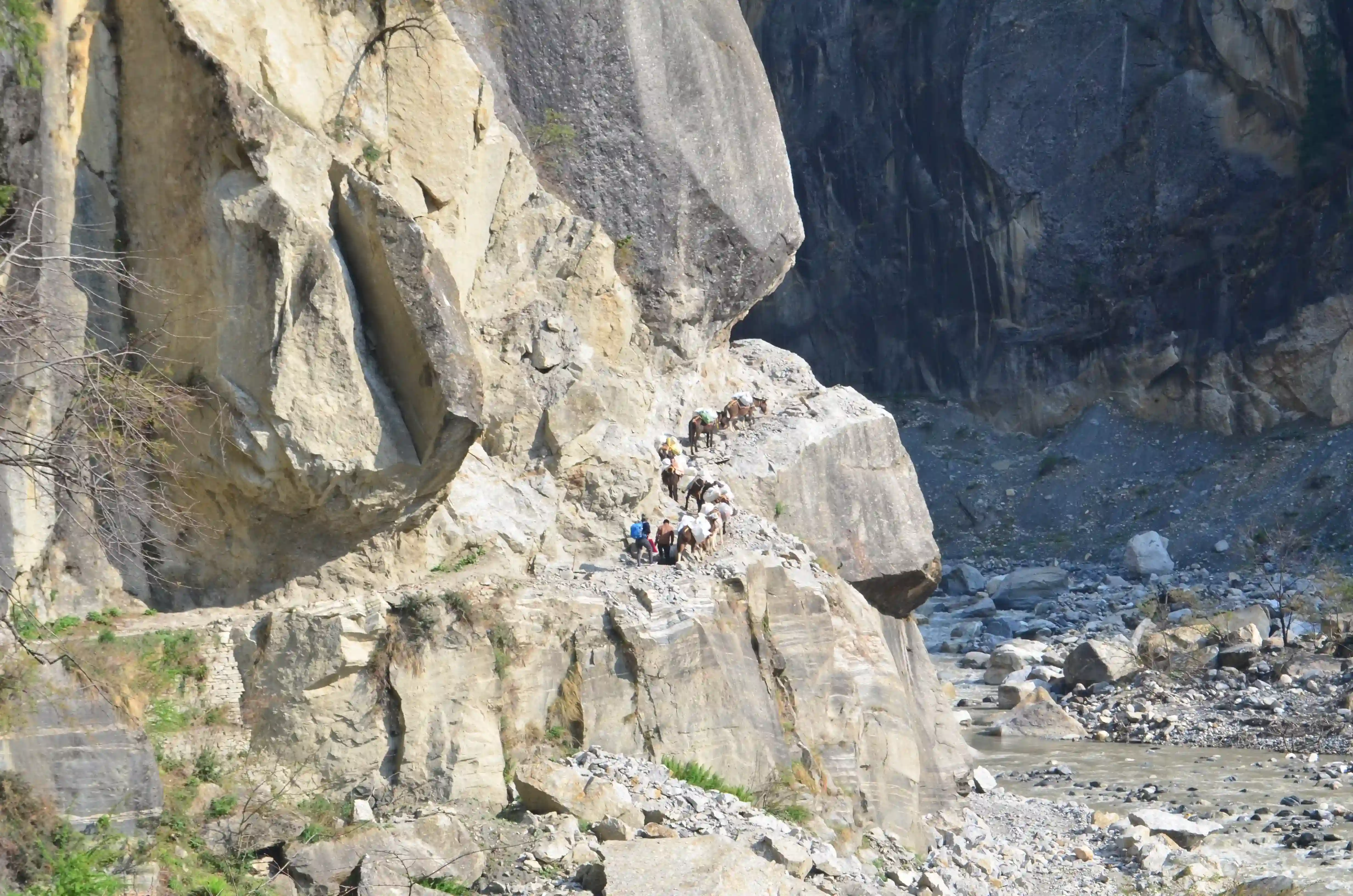
We start our trek from Koto after crossing the suspension bridge over the Marsyandgi River. After breakfast, we enjoy the breathtaking view of Annapurna II  and the snow-capped upper regions from the lodge. After about 40 minutes to an hour, we reach another suspension bridge, where you might spot donkeys carrying supplies along the trail. The second day of the Nar Phu trek route takes us through a pine forest with huge rocks scattered along the way, accompanied by the soothing sound of the Nar Phu River.

Deserted and rocky route filled with donkeys and people on the way to Meta from Koto during Narphu trek clicked by North Nepal Trek
Photo: On the way from Koto to Meta

The trail isn't well-marked from here, so an experienced guide is essential. There are no water sources, so you must carry enough drinking water. The trek from Koto to Chamche Odar takes around 3 hours. We will have our lunch here and continue our trek. The climb goes through the pine trees, and we'll come to a spot where we walk under a rock overhang with a waterfall above.

After this exciting stretch, the route ascends continuously towards Meta, also known as Methang village, our destination for the day. From Chamche Odar the trek to Meta takes around 3 - 4 hours.

The trek to Meta takes around 7 to 8 hours, including a lunch break at Chamche Oodar, a narrow valley near the edge of the Khola (river) with dim lighting inside the gorge.

Meta itself is not a settlement but rather a stopping point with 4 to 5 basic hotels. From here, you can admire the stunning back views of Pisang Peak, Nar Peak, and Annapurna II., which were visible from Koto. Along the trail, you'll also catch glimpses of Lamjung Peak. To the left or straight ahead, you can spot the Nar route and even the trail itself.

Day 3

Trek form Meta (3560 m|11680 ft) to Kyang (3840 m|12598 ft)

HIGHEST ALT. (3840 m|12598 ft)
DURATION 5 - 6 hrs
Distance
DISTANCE ~ 9.6 km

After having breakfast, we continue our trek. First, we reach a Buddhist stupa (chorten). After some time, we come to a point where the trail splits - the left path goes to Nar village, but we take the right path towards Phu. Along the way, we pass several traditional stone houses (goths) built on the sides of huge boulders. We continue our Narphu trek to Kyang via Chyaku (3500m). The path is good, with ridges marking the way. It takes about 3 hours to trek from Meta to Chyaku and 1-2 hours from Chyaku to Kyang.

Deserted and rocky route filled with donkeys and people on the way to Kyang from Meta during Narphu trek clicked by North Nepal Trek
Photo: On the way to Kyang from Meta

We climb up to a stupa at Jhunam, an old settlement of now Nar people previously Khampas. A line of stupas guides us past abandoned fields to Chyakhu. 

Historically, Chyaku holds significance due to the Khamba, people who sought to reclaim their power to fight against China during the Tibet vs. China war. They moved here after crossing the Terila Pass (5,595 m), strategically capturing the Chyaku area. To bolster their strength, they received support from the US between the 1960s and 1970s. Exploring the area, we'll come across old ruins, remnants of their kitchens, and evidence of their way of life.

This place also holds historical significance, as it was once a site of torment for people from Nar and Phu. The Khampas tortured people from Nar and Phu, harassed women, and even slaughtered yaks for their meals, taking advantage of the lack of governmental presence. In response, the locals sought help from the government in Kathmandu, which sent army forces in civilian attire to engage and capture the perpetrators, eventually driving them away. Khampas who had married into the community remained with their spouses.

We will have our lunch at Chyaku and continue our trek. The trail then goes further down to the stream and finally arrives at Kyang, where the Phu villagers live in winter. Kyang has amazing views of mountain peaks like Pisang, Annapurna II, Kangaru, and Pokarkang. We'll stay overnight in the teahouse.

Day 4

Kyang (3840 m|12598 ft) to Phu (4110 m|13485 ft)

HIGHEST ALT. (4110 m|13485 ft)
DURATION 5 - 6 hours
Distance
DISTANCE ~ 10 km

Today's path has gentle uphill slopes as we walk alongside the Phu river towards the remote village of Phu Gaon. This area, including Phu village and the bigger Manang region, is part of the Annapurna Conservation Area Project (ACAP). As we trek, we will see many beautiful Blue Sheep, Himalayan Thar, and snow leopards along the way. However, we need to be careful because from Kyang to Phu, the trail has dangerous rocky areas and places where landslides can happen sometimes.

Sign board on the way to Phu from Kyang during Narphu trek clicked by North Nepal Trek
Photo: Sign Board on the way to Phu village.

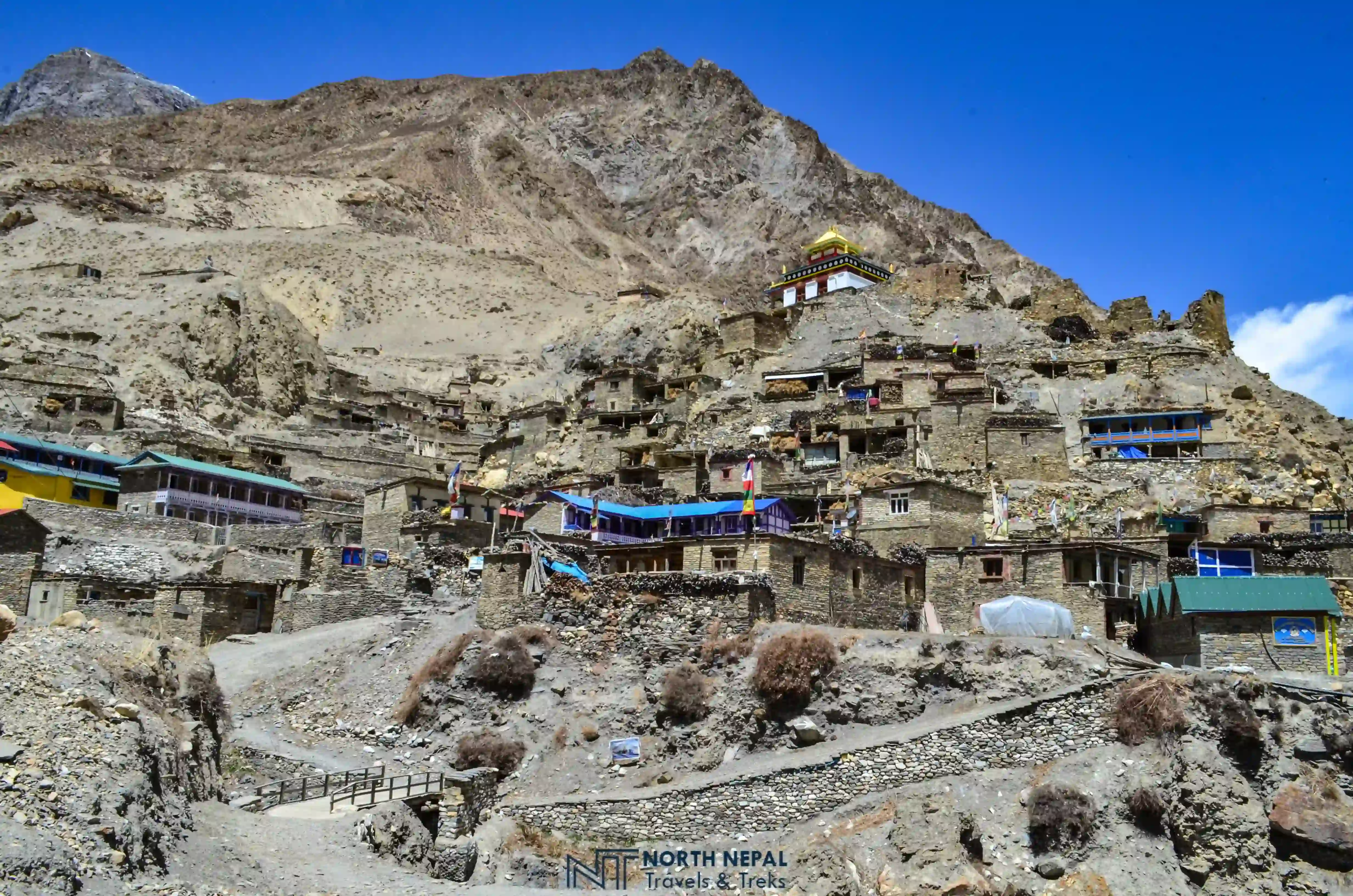
After leaving Kyang, we quickly enter the dry, desert-like gorge of Phu Khola stream. We keep walking along the east side of the valley, crossing a wooden bridge and climbing up some steps past a smooth, worn-down rock. After a short walk, we reach the Phupi Gyalgoe gate, which means we have entered the special Phu region. Phu, meaning "Head of Valley" in the local language, is an interesting village with around 30 - 40 households built on a cliff-like structure. We'll explore the village, including the Buddhist monasteries like the important Tashi Lhakhang Gompa, built by the 10th Karmapa. After walking for around five hours on this terrain, we finally arrive at Phu Gaon, where we experience how the local Bhote people live traditionally. We will rest for the night at Phu.

Day 5

Acclimatization at Phu (4110 m|13485 ft)

HIGHEST ALT. 4110 m |13485 ft
DURATION 2 - 3 hrs hiking

On this day, we will acclimatize to the high elevation as we take a rest and explore the village of Phu. It is a hidden valley with some exclusive cultures and traditions. Ethnic groups like Gurung, Lama, and Ghale live here with agriculture and animal husbandry being their means of livelihood. There are traditional stone houses all over the village, and the Thashi & Sandu Choling Gompa are the must-visit places; we can also see a helipad in the Phu Valley.

Phu Village, clicked by North Nepal Trek during Nar Phu Circuit Trek.
Photo: Phu Village Exploration.

We stroll around the Phu Valley visiting Gompas and understanding the Tibetan Culture, we will also visit the Tashi Lakhang Monastery, which is regarded as one of the greatest monasteries in the world. Visiting the second oldest civilization offers a glimpse of traditional houses and cultural practices that go way back in history. The chances of snowfall in Phu Village are high, so you can enjoy the snow in Phu Valley's rocky, desert-like terrain. Overnight stay at Phu Village. 

Day 6

Trek from Phu village to Nar Phedi (3,490 m|11450 ft)

HIGHEST ALT. 4110 m|13485 ft
DURATION 6-7 hrs
Distance
DISTANCE ~ 18.5 km

After breakfast, we begin our trek from Phu Village toward Nar Phedi, descending mainly along rocky terrains. We hike alongside the banks of Phu Khola, passing through the entrance gate of Phu Valley. The trek continues through wide grasslands where we often see Blue Sheep. The trail then takes us to Kyang Village, a Buddhist settlement surrounded by rocky terrain. We pass through the villages of Jhunum before stopping for lunch at Chyakhu.

Broken Wooden bridge previously used by the people of Nar and Phu with the backdrop of chortens and hills during Narphu trek clicked by North Nepal Trek
Photo: Previously used wooden bridge on the way to Nar Phedi from Phu.

Continuing along the ridges, we cross suspension bridges that offer breathtaking views of the Nar Phu River flowing through vast valleys, creating a dramatic gorge. Along the way, we encounter Mani stones inscribed with ancient Tibetan writing, showcasing the unique culture of the region. 

We eventually arrive at Nar Phedi after 6 - 7 hours of trekking and settle into the Nar Phedi monastery, which is essentially the heart of Nar Phedi. In the evening we can witness the puja (blessing) they usually perform. We also have the opportunity to leave a contribution in the small donation box for the monastery's maintenance.

Day 7

Nar Phedi to Nar Valley (4110 m|13484 ft ) and acclimatization

HIGHEST ALT. 4110 m | 13484 ft
DURATION 5 - 6 hrs
Distance
DISTANCE ~ 7 km

After breakfast on the 6th day of the Nar Phu trek, we start our journey towards the Nar Valley from Nar Phedi, marveling at the prominent, snow-capped Kang Garu summit along the way. The trek ascends on a rocky, windy path, with traditional stairs at some sections. Three hills separate Nar Phedi from Nar, and we cross these hills after trekking for about 5-6 hours.

Gompas on the way to Nar from Nar phedi clicked by North Nepal trek during Nar Phu Trek.
Photo: Mani Wall Chorten on the way to Nar.

As we cross the third hill, the entrance gate of the Nar Valley welcomes us, with Tibetan writing carved into the wall, visible from afar. From this vantage point, we can take in stunning views of the Himalayas, including Annapurna II, Himlung Himal, Tilicho Peak, Gangapurna, and Manaslu.

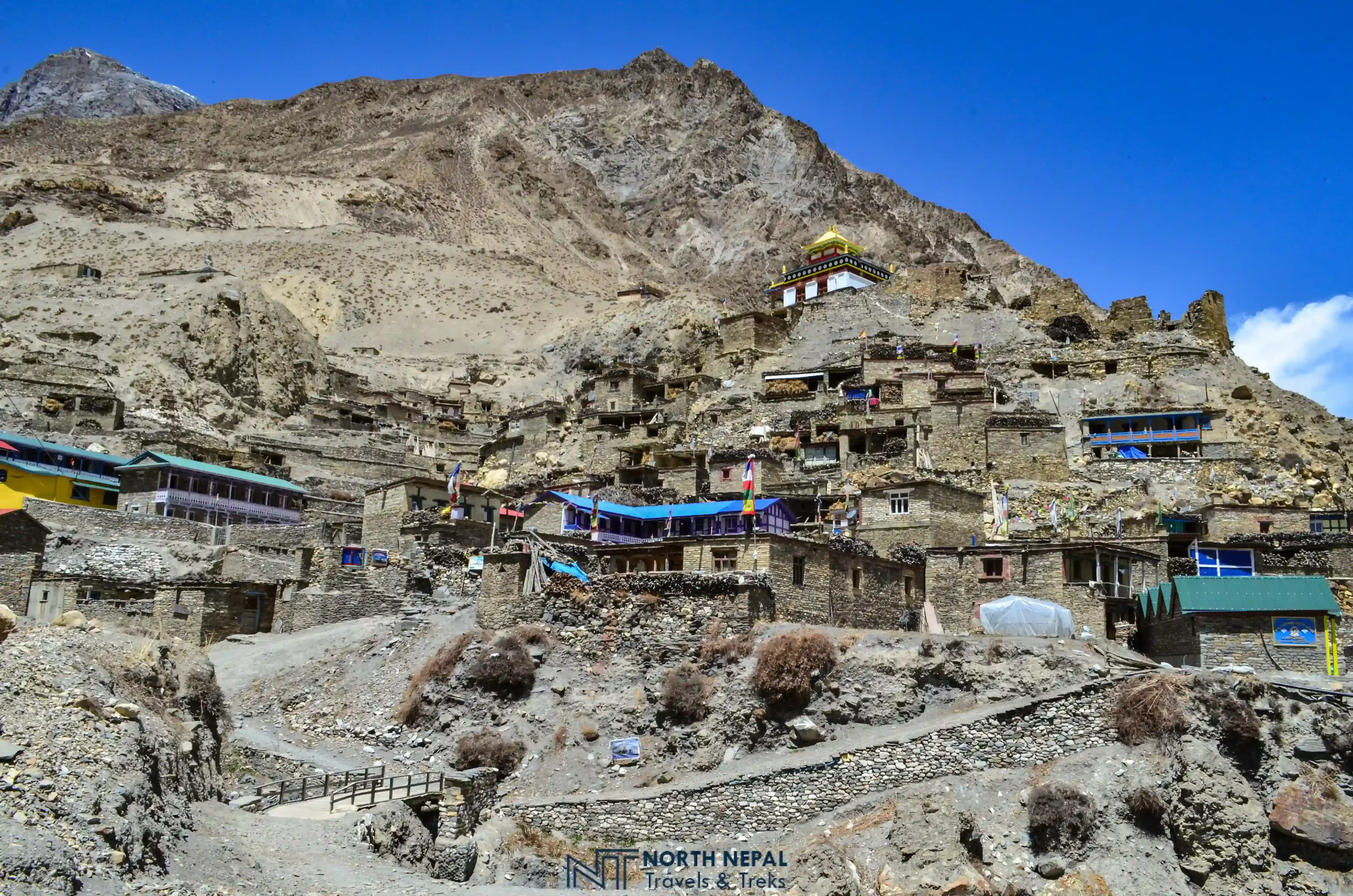
Upon entering Nar village, we are greeted by a unique experience, with its barley farming, stunning views of Kang Garu and Pisang Mountain, and distinctive local culture. The beautifully painted Chortens adorned with bamboo roofs captivate us, and we take the opportunity to explore the village, acclimatize to the environment, and remain active.

Wandering through Nar Village, we soak in the surrounding charm and have the chance to interact with the locals, gaining insight into their culture and way of life. We can also visit four monasteries and Chortens in the area. From Nar Village, we are treated to breathtaking views of Pisang Peak, Amotsang Himal, Kang Garo, and Pokhar Khang.

As we prepare for the upcoming Kang La Pass, it's worth noting that every household in Nar has at least one child studying Buddhism, a fascinating aspect of the village's culture. We spend the night in Nar Village, resting and enjoying the unique experiences this remote Himalayan community offers.

Day 8

Nar to Ngawal (3650 m | 11975 ft) via Kangla Pass (5306 m | 17409 ft)

HIGHEST ALT. 5306 m | 17409 ft
DURATION 7-8 hrs
Distance
DISTANCE ~ 14 km

The day begins before sunrise, around 4 am, after an early breakfast and packing lunch for the challenging trek ahead. We wake up early to take on the longest and most challenging trekking day over Kangla Pass.

Two trekkers from North Nepal Trek on their way to Kangla Pass during Narphu Trek.
Photo: On the way to Kangla Pass

The trek starts with a gentle 2-hour climb from Nar to Kangla Phedi at 4600 meters. After this, the path becomes steeper, with many turns for most of the way to the 5300-meter high pass. Although there are no dangerous gorges, there are 2 to 3 difficult uphill sections along the route. Trekkers can hire horses at 100 USD each to help carry gear or themselves up to the pass.

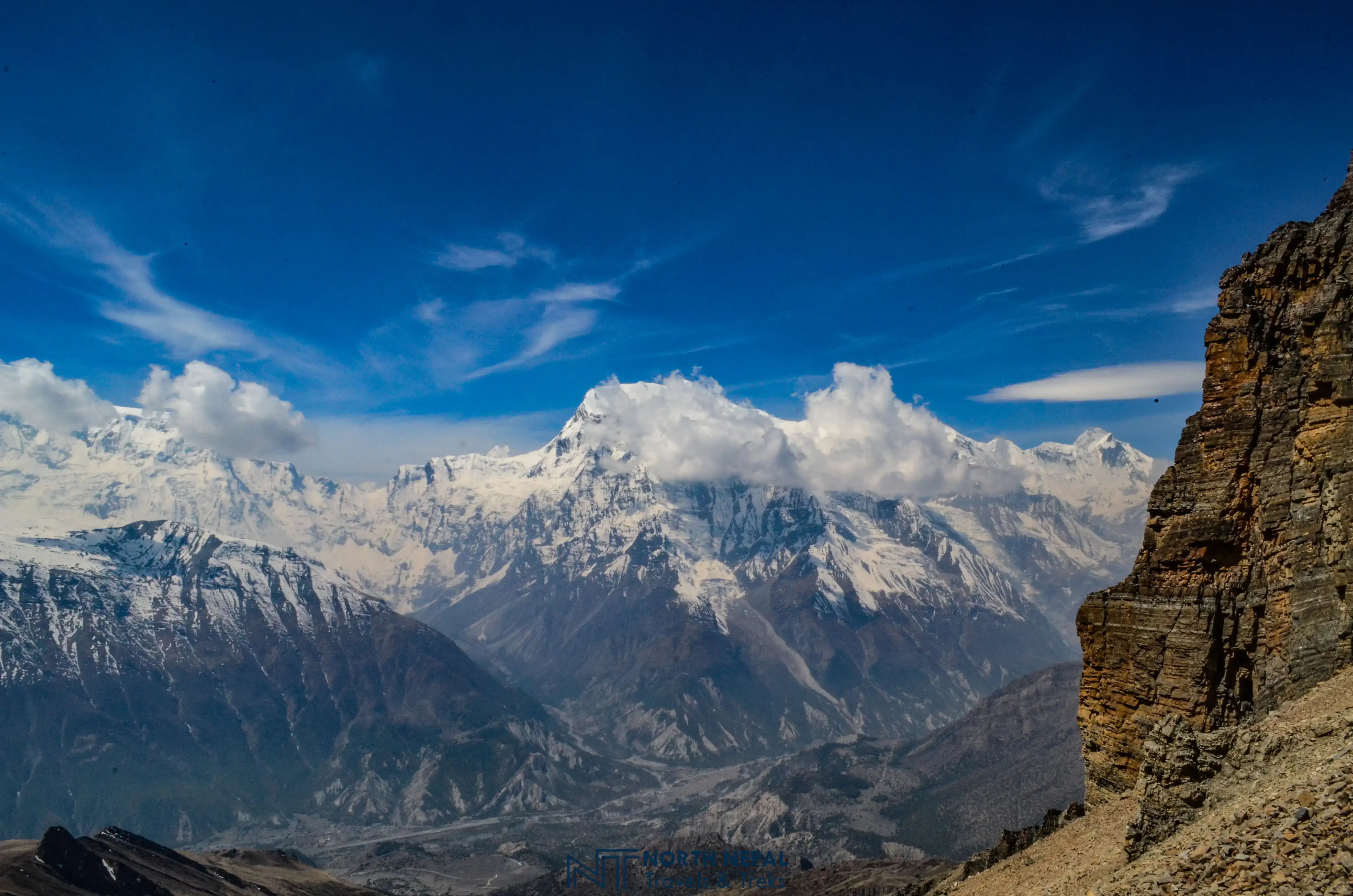
The altitude makes it more challenging as we cross Kangla Phedi and trek towards Kangla Pass. After ascending for a couple of hours and crossing some landslide-prone areas and bridges, we will finally reach the top of Kangla Pass. The views from here are breathtaking and otherworldly. Once at the pass, all fatigue and tiredness fade away as we take in stunning panoramas of the Annapurna range, including Annapurna II, Gangapurna, Tilicho Peak, Chulu Peak, Lamjung Himal, Machhapuchhre (Fishtail), Annapurna I-IV, Tare Kang, and more. These sights make the landscape unforgettable, engraved in memory forever.  

The descent is steep at the first section, so we must cautiously trek downhill through a moraine slope to 4800 meters, where trekking poles are essential. After this gnarly section, the grassy trail becomes less challenging for the 3-4 hour trek down to Ngawal village. We view Chulus Waterfall along the way before reaching Ngawal for an overnight stay. The entire journey takes around 10-11 hours from the early 4 am start to 2 pm, including lunch and rest breaks.

Day 9

Ngawal to Manang (3519 m | 11545 ft)

HIGHEST ALT. 3519 m | 11545 ft
DURATION 5 - 6 hrs
Distance
DISTANCE ~ 6 km

After breakfast, we leave for Manang, and the trek is straight forward compared to our strenuous trek over the Kangla Pass. We descend during the first half of the trail and trek along motorable roads.

View of Nawal Village during Nar Phu Trek clicked by North Nepal Trek.
Photo: Nagwal Village

After about 4 hrs of trekking, we reach Braka and have lunch here at Braka. We can visit the famous Gompa, named Braga Gompa or Bhraka Gompa, which is around 900 years old. After having lunch, we trek towards Manang, and it only takes about 30 minutes for this trek. Manang is a beautiful Northern Nepal district with stunning landscapes, diverse culture, and ancient monasteries. The region is a popular trekking destination that attracts adventurers & nature enthusiasts alike and offers breathtaking views of the Annapurna and Dhaulagiri mountain ranges. Overnight stay at Manang.

Day 10

Drive from Manang to PKR|KTM

HIGHEST ALT. (3519 m | 11545 ft)

After breakfast, we take an early Jeep from Manang and begin our drive with scenic views of the Marsyangdi River, alpine trees, and wildlife such as deer and wild rabbits. We pass through lush greenery and apple gardens in Barthang.

Kumari living goddess of kathmanduPhoto: Kumari living goddess of kathmandu.

The sight of the Himalayas, which we saw up close during our trek, continues to captivate us as we drive through many villages, including Upper Pisang, Chame, and Dharapani. We stop for lunch and take a break during the long drive, experiencing the bumpy off-roads of Nepal that challenge us almost as much as the trek itself.

After driving for about 6-7 hours, we reach Besisahar. From here, we continue our journey either to Pokhara or Kathmandu. The drive from Besisahar to Pokhara takes 4-5 hours, offering scenic views that bring a sense of achievement and accomplishment for completing the Nar Phu Valley Trek. Upon reaching Pokhara, North Nepal Trek organizes a farewell dinner to celebrate the last day of our trek.

Alternatively, if we choose to drive to Kathmandu, the journey from Besisahar takes about 5-6 hours. North Nepal Trek also arranges a farewell dinner in Kathmandu, marking the end of this remarkable journey.

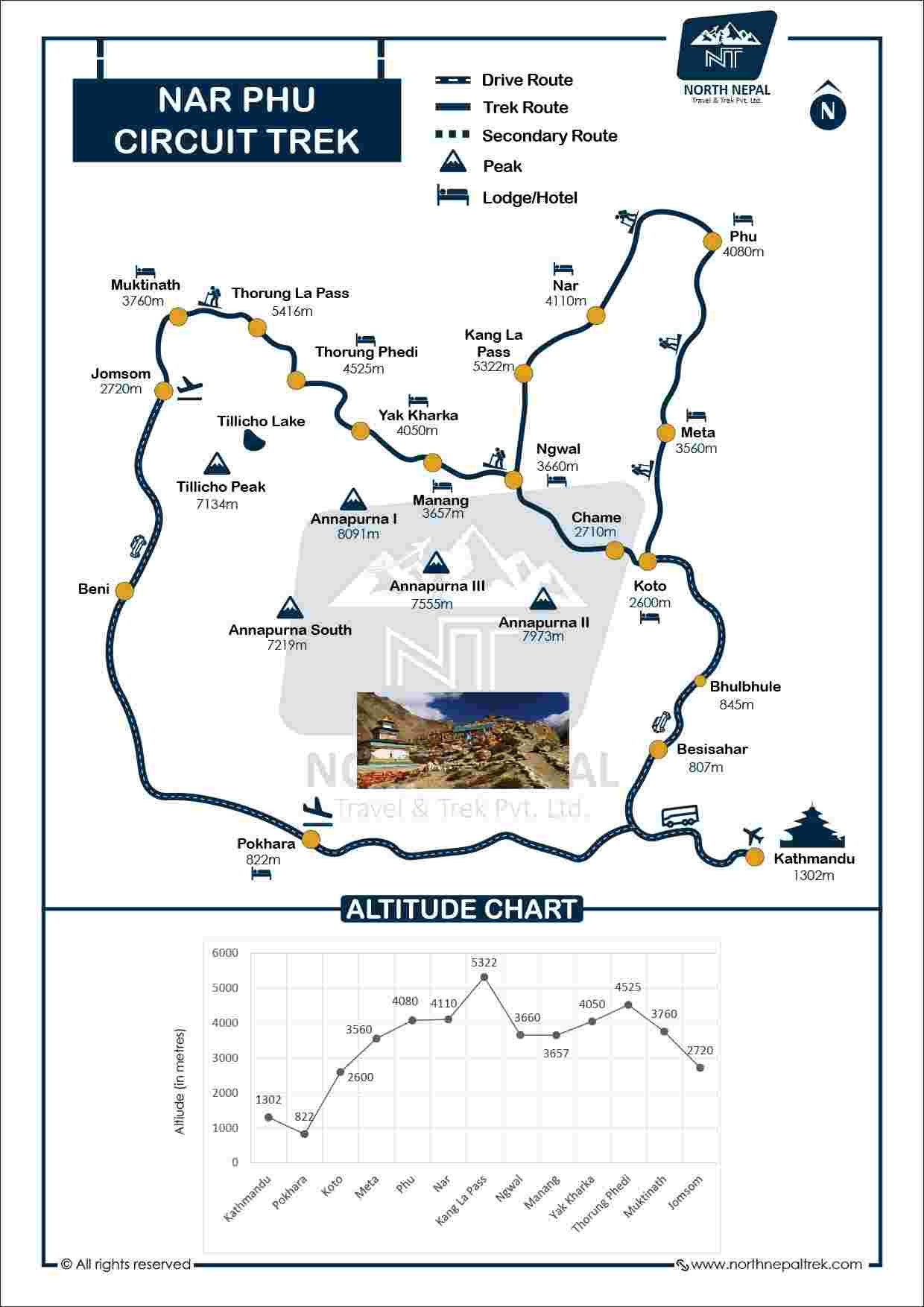
Nar Phu Circuit Trek Map and Altitude Graph

Nar Phu Circuit Trek Map and Altitude Graph

What's Included & Excluded

  • We provide 3 meals per day (Breakfast, Lunch, and Dinner) and Tea twice daily. Please note that each meal is served as a single serving.
  • Tea house/Lodge accommodation during the trek.
  • Pokhara – Besisahar - Koto by public bus & sharing Jeep (depending on group size).
  • Professional English-speaking, Eco Trained trekking guide his food, accommodation, salary, insurance, equipment, medicine, transportation, etc. 
  • The company guarantees rescue services in case of an emergency; please hand over your insurance policy copy to us.
  • All the necessary paperwork, Restricted Area permit, and ACAP conservation entry permit.
  • Sleeping Bag and Trekking poles (to be returned after trip completion).
  • First Aid Medical Kit Box with Oximeter.
  • Water bottle to store hot water overnight.
  • Service charges, Government Taxes, and VAT.
  • Anything related to International flight airfares such as Nepal entry visa fees, excess baggage charges, International flight tickets, and so on.
  • Extra night accommodations due to changes in itinerary. 
  • Supporter/porter to carry your luggage during the trekking. 
  • Personal expenses before the trek such as (renting sleeping bags, buying trekking shoes, and so on), during the trek (any shopping, boiled water, tea coffee(if more than 3 times), cold drinks, alcoholic beverages, hot showers, telephone call, Wifi, cell-phone, camera battery recharges and so on).
  • Travel insurance covers high-altitude helicopter rescue and evacuation along with medical costs.
  • Tips and gratuities for guides and porters.
  • Extra permit costs if you wish to stay in Nar Phu Valley for longer days
  • Additional costs, such as additional days due to delays caused by natural/uncontrollable phenomena such as bad weather, landslides, and change of plans(itinerary modifications) due to safety concerns, illness, and soon.
  • Lastly, all of the costs and expenses that aren’t listed in the “What’s Included?” section.

Note:

You can include a porter ( carries up to 20 kg ), with an extra cost of $ 25 per day.

Complete Guide to the Nar Phu Trek

Toggle all

Best Time to Trek Nar Phu Valley

Choosing the right season to trek the Nar Phu Valley ensures a memorable journey. Each season presents unique challenges and advantages. Spring and autumn are considered the best times for this trek. Spring, running from March to May, boasts beautiful weather. The trails come alive with vibrant rhododendrons. The temperature is moderate, and the skies are generally clear.

Autumn, spanning September to November, is another ideal period. It offers stable weather conditions and dry paths. The atmosphere is clear, providing panoramic views of the majestic peaks. Monsoon season, from June to August, presents challenges. Heavy rainfall leads to slippery trails and a chance of landslides. Clouds obstruct mountain views, making it less appealing for trekkers.

Winter, from December to February, is harsh in the region. Frigid temperatures and snow make trekking difficult and less comfortable.

Seasonal Summary

  • Spring (March-May): Moderate weather, blooming flowers.
  • Autumn (September-November): Clear skies, reliable trails.
  • Monsoon (June-August): Wet and challenging.
  • Winter (December-February): Cold with snow.

Planning your trek in either spring or autumn enhances the experience. Both seasons offer the best blend of weather conditions and scenery. Trekkers should be flexible and prepared for sudden weather changes, no matter the season.

Nar Phu Valley Trek Difficulty and Physical Preparation

The Nar Phu Valley trek is a blend of awe-inspiring views and demanding trails. Tackling high altitudes poses a significant challenge to trekkers. Elevations exceed 5,000 meters, testing physical endurance and adaptability. Preparation is vital for a successful trek. Training should begin several months in advance. Focus on building stamina and leg strength through exercises like hiking, running, and cycling.

Acclimatization plays a crucial role in the trek. Plan your itinerary with sufficient rest days. They are essential to adjust to the altitude and avoid altitude sickness. Mental readiness is just as important. Prepare yourself for long, tiring days. The rewards, however, are worth the effort, with breathtaking landscapes rewarding the effort.

Physical Fitness Recommendations

  • Cardiovascular Fitness: Engage in cardio exercises like running.
  • Strength Training: Focus on leg workouts like lunges and squats.
  • Hiking Practice: Regular hikes prepare you for varying terrain.
  • Maintaining hydration: Drink plenty of water throughout your journey.

Consulting with a doctor prior to the trek is advisable. They can offer insights into health considerations for high-altitude trekking. With the right preparation, embracing the Nar Phu Valley trek becomes not only feasible but immensely rewarding.

Permits for Narphu Trek

The Nar Phu Valley trek is remote and less traveled in the Annapurna region of Nepal. Due to its location and regulations, you need restricted area permits to trek in this region. Here are the details on the required permits for the Narphu trek:

1. Restricted Area Permit (RAP) for Nar and Phu Valleys

     - September to November: USD 100 per week and USD 15 per day beyond the first week.

     - December to August: USD 75 per week and USD 10 per day beyond the first week.

This permit must be obtained through a registered trekking agency in Nepal, as independent trekking is not allowed in restricted areas.

2. Annapurna Conservation Area Permit (ACAP)

   Cost:  NPR 3,000 (approximately USD 25) for foreign nationals.

3. Trekkers' Information Management System (TIMS) Card Cost

     - For organized trekkers (through a trekking agency): USD 10

     - For independent trekkers: USD 20

Important Considerations:

  • Always carry permits while trekking.
  • Check validity dates to avoid issues.
  • Ensure permits are secured before leaving Kathmandu or Pokhara.

Culture and Local Life in Nar and Phu Villages

The Nar and Phu villages offer a rich tapestry of culture and tradition. Nestled in the remote regions of the Annapurna circuit, these villages remain steeped in history. Here, ancient Tibetan customs shape daily life.

The people of Nar and Phu are primarily of Tibetan descent. Their lives revolve around agriculture and pastoralism. You’ll encounter fields of barley, buckwheat, and potatoes during your trek.

Hospitality is a hallmark of these communities. Villagers welcome trekkers with warmth and genuine curiosity. Engaging with locals provides insight into their unique way of life.

Cultural Highlights

  • Traditional Tibetan festivals
  • Ancient Buddhist monasteries
  • Unique architectural styles
  • Traditional handicrafts and art
  • Tibetan-inspired cuisine

Visiting the monasteries reveals the spiritual essence of the region. These sites echo with chants and prayers, offering a serene atmosphere for reflection. The monasteries are not only places of worship but also centers of cultural learning.

The simplicity and resilience of life in Nar and Phu are striking. Observing the villagers’ dedication to their traditions offers a humbling perspective. Experiencing their culture can deeply enrich your trekking journey.

Responsible and Sustainable Trekking

The Nar Phu Valley is a no-smoking, no-alcohol, and no-tobacco zone as soon as you enter Meta. Moreover, the area is strictly against killing wild or domestic animals, so this is a vegetarian zone. The Nar and Phu area is Vegetarian, not Vegan, so you can get yak curds and yogurt here. So be sure to prepare yourself to abstain from any alcoholic and meat products during your stay in the restricted area of Nar and Phu Village.

As the Nar Phu Trek lies in between the Annapurna Circuit Trek and the Manaslu Circuit Trek both of the treks can be easily combined with the Nar Phu Trek.

Trekking in Nar Phu Valley offers a chance to connect with nature. Ensuring that connection is sustainable requires conscious efforts. Responsible trekking protects this pristine area for future generations.

Trekkers should adhere to "Leave No Trace" principles. Keeping waste minimal is crucial for the environment. Respecting local customs enhances the cultural experience.

Responsible Practices:

  • Carry reusable water bottles
  • Follow designated trails
  • Support local businesses
  • Minimize plastic use

Sustainability involves more than environmental care. It includes engaging respectfully with the local communities. Encouraging responsible tourism boosts the region’s economy and preserves its unique way of life.

Additional Information for Narphu Trek

Group Size: A minimum of two trekkers is required to enter the restricted areas.

Guide Requirement: You must be accompanied by a registered guide, enlisted within a trekking agency.

Packing List for Nar Phu Circuit Trek

Nar Phu Valley is restricted to outside visitors, and you need a special area permit to access this region. You need to make a packing list free of any tobacco, beer, alcohol, and meat while you trek the Nar Phu region.

These items are prohibited because of religious and spiritual significance. Check out the detailed packing list before you pack for Nar Phu trek.

Nar Phu Valley Trek Cost

We offer three different kinds of Nar Phu trek packages to provide service according to our client's needs: 

1. Full Board Package (100 $ per person a day)
This package is perfect for those who want to avoid any inconvenience during the trek. The full board Nar Phu Valley trek package includes:


  • All the permits include Restricted area permits required for the Nar Phu Trek.
  • Transportation by Jeep or bus to start the trek from Pokhara or Kathmandu to Koto, and back from the trek according to your needs.

  • Tea House accommodation or lodge during the trek.

  • Three sets of meals include Breakfast, Lunch, and Dinner, and 3 sets of tea/coffee during the trek.

  • An experienced English-speaking, government-licensed trekking guide, his salary equipment, insurance, meals, transportation, and accommodation.


2. Half Board Package (per person 70$ a day)

This is the perfect package for those who want to be in control of their lunch and dinner.The half- board Nar Phu trek package includes the following:

  • All of the permits for the duration of the trek.

  • Ground transportation at the start of the trek, from Pokhara/Kathmandu to Koto, and back from the trek according to your needs.

  • Tea House accommodation or lodge during the trek.

  • Set  Breakfast with tea/coffee during the trek.

  • An experienced English-speaking, government-licensed trekking guide, his salary equipment, insurance, meals, transportation, and accommodation.

Note: You can hire a porter for an additional $22 per day, which includes porter meals, accommodation, insurance, and equipment.


3.Guide and porter service( 40$ a day for a guide and 22$ a day for a porter)

 If you are ready to manage everything during your Nar Phu Valley trek, we can provide you with our experienced guide and porters. 

  •  One Porter for two trekkers and only carries weight up to 20 kg.

The above rates are standard. However, the price range may vary depending on the selected plans and any special requests. We also provide custom itineraries with flexible schedules. Email us to customize your Nar Phu Trek with us.

Wildlife and Natural Beauty

The Nar Phu Valley is a sanctuary for many wildlife species. Its isolation creates a perfect habitat for rare animals. Trekkers might spot blue sheep grazing on rugged cliffs.

Among the elusive creatures, the snow leopard prowls these terrains. Although rare, sightings add an exciting element to your trek. Birdwatchers also enjoy spotting Himalayan vultures soaring above.

Notable Wildlife:

  • Blue sheep
  • Snow leopard
  • Himalayan marmots
  • Himalayan vultures

The landscape in the valley is breathtaking. Towering peaks and deep canyons display nature's grandeur. Glaciers carve impressive paths through the mountains.

Spring paints the region with vibrant wildflowers. Rhododendron forests bloom, creating a colorful backdrop. Trekkers can enjoy these natural wonders throughout their journey.

The convergence of natural beauty and abundant wildlife defines the valley. Such diverse ecosystems provide a dynamic experience. Nature lovers will find Nar Phu Valley to be a true paradise.

Nar Phu Valley Trek Map and Route Options

The Nar Phu Valley trek offers multiple route options, each offering unique experiences. A detailed map is crucial for navigation and planning. Understanding the terrain will enrich your trekking adventure. Treks typically start from Koto, which is accessible from Besishahar. Besishahar is a gateway for many Annapurna treks. From Koto, trekkers enter the secluded Nar Phu Valley.

Key stops include the ancient settlements of Nar and Phu villages. These villages are rich in Tibetan culture. With their traditional monasteries and hospitable locals, they are essential stops. The trek can either loop back to the Annapurna Circuit or continue towards the Tilicho Lake. The choice depends on your adventure preferences. Both options deliver breathtaking views.

Each route requires careful planning and consideration of your fitness level. Some areas are challenging and demand adequate acclimatization. Understanding your limits is essential for a safe journey.

Key route options are as follows:

  • Koto to Nar: Dive into cultural exploration
  • Nar to Phu: Experience deeper remote village life
  • Return via Annapurna Circuit: Enhance the trek with iconic trails
  • Extend to Tilicho Lake: Add an extra challenge with beautiful lake views

These routes offer a variety of cultural and natural experiences. Whether seeking solitude or testing your endurance, there's something for every adventurer. With a map in hand, navigate through scenic trails and make the most of your trekking expedition. 

Tips for a Successful Nar Phu Valley Trek

Preparation is key to enjoying your trek in Nar Phu Valley. Understanding the challenges and requirements makes for a safer and more enjoyable experience. Start by researching the trek thoroughly.

Stay flexible with your schedule. Mountain weather can be unpredictable. Allow extra days for unforeseen circumstances and acclimatization.

Hydration is crucial at high altitudes. Drink plenty of water throughout the trek. It helps you acclimatize and stay healthy.

Helpful Tips:

  • Train beforehand to improve fitness
  • Pack light but include essential gear
  • Hire a local guide for added safety
  • Start early to avoid afternoon weather changes

Lastly, immerse yourself in the region's unique culture. Respect local customs and engage positively with villagers. It enriches your trekking experience and supports community.

Live Trail Update of Nar Phu Trek - 10 Days Live

Last updated:

Updated:

Trail Condition Good
Weather Clear
Wifi/Network Weak above 2000m
Teahouses Open

Trekker Alerts

Best Season: May-June and September-October are best for the Nar Phu Valley, tucked in a rain shadow behind the Annapurna range. A special Restricted Area Permit is required and must be arranged with a registered agency in advance.

Reviews From The Trail

Hear it from those who've walked with us.

★★★★★

Best travel company in Pokhara!

Mohan was extremely accommodating and went above and beyond to help us with everything I did in Nepal. He is the go-to guy for everything and I owe many of my best experience in Nepal to him. Highly recommend this travel company. Also, shout out to Bharat who was an excellent guide!

M
Mitchell E
Nepal · Nar Phu Trek - 10 Days · Jan 2023

Safety Policy

Professional & Certified Guides

Every trek is accompanied by an experienced, licensed, English-speaking local guide trained in high-altitude wilderness survival, remote navigation, and first-aid response. Guides carry comprehensive medical kits equipped with essential high-altitude pharmaceuticals and pulse oximeters to monitor oxygen saturation levels daily during the ascent through the remote Nar Phu Valley and over the high Kang La Pass (5,320 m).

High-Altitude Acclimatization & AMS Management

Itineraries are structured with careful elevation profiles and designated acclimatization stops in traditional settlements like Phu Village and Nar Village to ensure proper preparation before reaching high-altitude points. Guides conduct rigorous daily health assessments for early symptoms of Acute Mountain Sickness (AMS). If severe symptoms appear, standard protocol mandates immediate descent to lower elevations.

Emergency Rescue Coordination

In cases of severe injury, acute altitude illness, or extreme weather conditions on remote trails, emergency helicopter evacuation is coordinated directly through local rescue services, adhering strictly to regional aviation regulations set by CAAN. Evacuations are initiated promptly upon assessment by your guide in communication with our Kathmandu and Pokhara offices.

Mandatory Travel Insurance

All trekkers must hold comprehensive travel insurance covering emergency medical treatment, high-altitude trekking (up to 6,000 m), and emergency helicopter rescue/evacuation. Insurance details must be submitted prior to the departure of the trek to streamline emergency logistics if required.


Nar Phu Trek Departure Date for 2026/2027

Secure the Nar Phu Trek for 2026/2027 before the seat gets fully booked.


Terms, Conditions & Feasibility

  1. All bookings are made with North Nepal Travel & Trek Pvt. Ltd Registered Company Number 162883/073/074 (hereafter referred to as The Company) whose office is in Lakeside, Pokhara-6, Nepal.
  2. The term "trip" used in this website and booking conditions refers to all itineraries described on this website including those which might otherwise be known as walking, tours, trekking trips, sightseeing, climbing, mountaineering, expeditions, or holidays.
  3. We accept your last-minute booking as well, but full payment of the total tour cost should be made in advance if necessary or can be paid fully on arrival day. See More

Frequently Asked Questions

General Information

1. What is the Nar Phu Valley trek?

The Nar Phu Valley trek is a 10-day restricted-area trek in the Manang district of Nepal's Annapurna region, leading into one of the most remote and culturally preserved valleys in the Himalayas. The route passes through dramatic gorges, pine and rhododendron forests, and high-altitude desert terrain to reach the ancient Tibetan-Buddhist villages of Phu (4,080m) and Nar (4,130m). The trek culminates in a crossing of Kang La Pass at 5,320m with panoramic views of Annapurna II, Gangapurna, Tilicho Peak, Himlung Himal, and the Manaslu range, before descending to join the Annapurna Circuit at Ngawal.

2. How long is the Nar Phu Valley trek, and how far does it cover?

The standard Nar Phu Valley trek is 10 days and 9 nights, covering 75 to 80 km of trekking from Koto to Ngawal via Phu and Nar villages and Kang La Pass. Of those 10 days, 7 are full trekking days and the others include drive days and an acclimatization day in Phu. The itinerary can be extended if you want extra time in the valley or a side hike to Himlung Himal Base Camp.

3. How difficult is the Nar Phu Valley trek?

The Nar Phu Valley trek is moderate to challenging. The trail through the valley itself is well-graded, but the difficulty concentrates on Kang La Pass at 5,320m, which involves a steep 1,200m ascent from Nar village and some technical sections with rocky and moraine terrain. Daily walking ranges from 5 to 8 hours. Previous trekking experience at altitude is strongly recommended. Tell us about your background and we'll advise honestly.

4. What are the major highlights of the Nar Phu Valley trek?

The major highlights are crossing Kang La Pass (5,320m) with a panorama of Annapurna II, Gangapurna, Tilicho Peak, Himlung Himal, and Manaslu; exploring the ancient Tibetan-Buddhist villages of Phu and Nar; visiting the monasteries of Tashi Lhakhang, Phu Gompa, Lhogaon Monastery, and Nar Gompa; walking through dramatic deep gorges and high-altitude desert; and experiencing one of Nepal's most culturally intact communities, still largely untouched by modern tourism.

5. What is Kang La Pass, and how difficult is it to cross?

Kang La Pass sits at 5,320m (17,408 ft) and is one of the most challenging mountain passes on any standard Himalayan trekking route in Nepal. The ascent starts from Nar village at 4,130m and climbs roughly 1,200m over rocky and moraine terrain with some technical sections. It requires good physical fitness, proper acclimatization, crampons or microspikes in icy conditions, and an experienced guide. From the summit you get a sweeping 360-degree panorama of the Annapurna and Manaslu ranges, glaciers, and alpine lakes. The descent to Ngawal at 3,660m is long and steep.

6. What views can I expect from Kang La Pass?

From the summit of Kang La Pass at 5,320m you see an unobstructed 360-degree panorama. The major peaks in view are Annapurna II (7,937m), Gangapurna (7,455m), Tilicho Peak (7,134m), Pisang Peak (6,091m), Kang Garu, and Himlung Himal (7,126m). On a clear day the Manaslu range is also visible. It's a genuinely extraordinary vantage point and worth every difficult step of the ascent.

7. How can I include the Nar Phu Valley trek in my Annapurna Circuit itinerary?

The Nar Phu Valley trek fits naturally into the Annapurna Circuit (northnepaltrek.com/annapurna-circuit-trek) as a side loop. You leave the main Circuit trail at Koto, trek through Phu and Nar, cross Kang La Pass, and rejoin the Circuit at Ngawal. From there you continue to Manang and over Thorong La. Adding the Nar Phu loop extends a standard Annapurna Circuit by 7 to 10 days. Tell us your total available days and we'll design the combined itinerary.

8. Are there alternative routes for the Nar Phu Valley trek?

The standard route starts at Koto and exits over Kang La Pass to Ngawal on the Annapurna Circuit. If you prefer not to cross Kang La, you can retrace from Nar back to Koto on the same trail. Alternative entry points include Jagat (longer, via the lower Marsyangdi Valley) and Besisahar. Combining the trek with the Annapurna Circuit adds even more route variety. Tell us your fitness and time and we'll recommend the right option.

Trekking Permits & Logistics

1. What permits are required for the Nar Phu Valley trek?

The Nar Phu Valley trek requires three permits: the Restricted Area Permit (RAP), which costs USD 100 per person per week from September to November and USD 75 per person per week from December to August; the Annapurna Conservation Area Permit (ACAP) at USD 30. All three must be arranged through a registered trekking agency, as individual permit purchase is not possible for restricted areas. North Nepal Trek handles all permit processing as part of the package.

2. Do I need a guide for the Nar Phu Valley trek, and can I trek solo?

A licensed guide is mandatory for the Nar Phu Valley trek, as it is a restricted area. As of March 2026, Nepal now allows solo trekkers in restricted areas, so you no longer need to find a second trekking partner. However, you must still be accompanied by a government-licensed guide arranged through a registered agency, which is also a legal requirement for permit issuance. Our guides are licensed, trained in altitude first aid, and know this remote valley's trails and checkpoints thoroughly.

Accommodation & Food

1. What accommodation is available on the Nar Phu Valley trek?

Accommodation on the Nar Phu Valley trek is in simple teahouses in the villages along the route, including Meta, Phu, and Nar. Rooms are basic twin-bed setups with shared bathrooms and blankets, getting progressively simpler as you go deeper into the valley. A warm sleeping bag is essential because teahouse blankets are not enough at these altitudes. There is also the option of an overnight stay at Satek Monastery on some itineraries, which is a unique experience.

2. What food is available on the Nar Phu Valley trek?

The Nar Phu Valley is a remote restricted area, so the menu at village teahouses is straightforward: Tibetan dishes like thukpa (noodle soup) and momo, Nepali dal bhat, roti, simple vegetable curries, eggs, and soups. Don't count on pasta, pizza, burgers, or sandwiches — unlike the main Annapurna teahouse circuit, these remote lodges cook what's grown and available locally. The food is filling, hot, and freshly cooked. Tell us about any dietary requirements in advance.

Packing Gear & Rental

1. What gear do I need for the Nar Phu Valley trek?

Because the Nar Phu Valley trek crosses Kang La Pass at 5,320m, the gear list is more serious than for standard Annapurna treks. Essentials include a four-season sleeping bag rated for sub-zero temperatures, a down jacket, thermal base layers, waterproof shell, warm gloves and hat, sturdy high-ankle trekking boots, crampons or microspikes for the icy pass sections, trekking poles, a headlamp, and UV sunglasses. We send a full route-specific packing list after booking. See our all-seasons packing guide (northnepaltrek.com/all-seasons-trek-packing-list) for the foundation.

Payments & Extra Costs

1. How much does the Nar Phu Valley trek cost?

Our standard Nar Phu Valley trek package costs USD 90 to 100 per person per day, with a half-board option at USD 70 to 80 per person per day. The per-day rate decreases with group size. The package covers the three required permits (RAP, ACAP), a licensed guide, teahouse accommodation, all meals, and jeep transfers. Message us with your group size and dates for a firm, itemized quote.

Booking & Company Policies

1. When should I book the Nar Phu Valley trek, and what's the process?

Book 2 to 3 months ahead during the peak seasons of spring (March to May) and autumn (September to November), mainly to secure your restricted area permit and guide. The RAP must be processed through a registered agency, so you can't arrange it last-minute independently. Contact us with your preferred dates and group size and we'll handle permits, guide, transport, and itinerary planning from there.

Weather & Seasons

1. When is the best time for the Nar Phu Valley trek, and what weather should I expect?

Spring (March to May) and autumn (September to November) are the best seasons. Spring brings clear mornings, blooming rhododendrons on the lower trail, and milder temperatures before the monsoon. Autumn has the crispest visibility and the most stable weather for crossing Kang La Pass. The Nar Phu Valley sits in a trans-Himalayan rain shadow, so it stays drier than most Nepal trekking regions even in monsoon. Winter (December to February) is technically possible but genuinely extreme: temperatures at Kang La drop to minus 20°C or colder, heavy snow can block the pass, and the trail requires specialist cold-weather preparation. We generally don't recommend winter unless you have serious high-altitude experience.

Health & Safety

1. What are the health and safety concerns on the Nar Phu Valley trek?

Altitude sickness is the primary health risk and deserves serious attention. Phu village sits at 4,080m, Nar at 4,130 to 4,200m, and Kang La Pass at 5,320m — these are genuine high-altitude destinations, not safe zones. Our itinerary includes an acclimatization day at Phu with a short day hike to help your body adjust before climbing higher. Kang La Pass itself is the most demanding and exposed part of the trek, with rocky and icy terrain. Our guides carry a first-aid kit with a pulse oximeter and are trained in AMS management. Tell your guide immediately about any headache, nausea, or dizziness.

2. Are acclimatization days needed on the Nar Phu Valley trek?

Yes, acclimatization is essential. Our itinerary includes a rest day at Phu village (4,080m), during which we do a short acclimatization hike to higher ground to follow the climb-high-sleep-low principle before ascending to Nar and Kang La. Rushing the ascent is the most common cause of altitude problems on this trek. If you feel any symptoms at altitude, your guide will slow the schedule or descend.

3. Is safe drinking water available on the Nar Phu Valley trek?

Yes, but it requires care. Filtered water and boiled water are available at teahouses along the route, and we recommend both over bottled water where possible. Never drink unfiltered tap or spring water directly, as contamination risk in remote high-altitude areas is real. Carry purification tablets or a filter as backup, especially between villages on longer walking days. Staying well hydrated is one of the most effective ways to prevent altitude sickness.

4. What happens in an emergency on the Nar Phu Valley trek?

Your guide contacts emergency services and coordinates helicopter evacuation to the nearest medical facility if needed. Because this is a restricted area with no road access, helicopter rescue is the primary evacuation method. This is why travel insurance covering high-altitude helicopter evacuation above 5,500m is required for this trek. Our Pokhara and Kathmandu offices maintain communication with guides throughout the trek.

Cultural Insights

1. What is the history and culture of Nar Phu Valley?

The inhabitants of Nar and Phu are believed to have descended from Tibetan migrants who came to Nepal around the 8th century. Both villages practice Tibetan Buddhism and share the same ancestral lineage; the communities first settled at Nar and later some moved to Phu. They live traditional herding and farming lives with yak, sheep, and limited access to modern infrastructure. Despite sharing ancestry, the two villages have developed distinct settlement patterns: Nar sits at 4,130m on a hillside ridge, and Phu, more remote and more involved in animal husbandry and handicrafts, sits at 4,080m beside a river. The annual Mani Rimdu festival at Tashi Lhakhang Monastery is one of the most significant cultural events in the valley.

2. What ancient monasteries and cultural sites are in Nar Phu Valley?

The major monasteries and cultural sites are Tashi Lhakhang Monastery (home of the Nar Phu Mani Rimdu festival), Phu Gompa, Lhogaon Monastery, Nar Gompa, and the ancient stone-walled village architecture of both Nar and Phu. An overnight stay at Satek Monastery is available on some itineraries and is one of the most atmospheric experiences on the trek. Your guide explains the significance of each site and introduces you to the monks and villagers.

Wildlife & Nature

1. What wildlife might I see on the Nar Phu Valley trek?

The Nar Phu Valley is within the Annapurna Conservation Area and supports diverse high-altitude wildlife. Commonly spotted species include Himalayan tahr, musk deer, Himalayan griffon vultures, bearded vultures (lammergeier), and the Himalayan monal (danphe), Nepal's national bird. The valley is also known snow leopard habitat, though sightings are rare. Yak herds are a common and distinctive sight throughout the upper sections of the trail.

Transportation

1. How do I get to the starting point of the Nar Phu Valley trek?

The trek starts at Koto, a small village in the Manang district. From Kathmandu or Pokhara, a jeep drives you to Besisahar and then on to Koto, which takes around 6 hours total from Besisahar. From Koto, a permit check at the Restricted Area entrance gate begins the trekking. The trek exits over Kang La Pass to Ngawal on the Annapurna Circuit, from where you can continue the Circuit or jeep back to Pokhara. We arrange all transport as part of the package.

Wifi/Network and Communication

1. Is there phone signal and charging on the Nar Phu Valley trek?

Mobile reception is available in most lower villages in the Annapurna region, but once you enter the Nar Phu Valley the network becomes poor and unreliable. Expect limited or no signal in Phu, Nar, and on the Kang La section. You can charge electronic devices at teahouses along the route for a small fee of around NPR 100 to 200, though availability depends on the lodge's solar supply. Carry a fully charged power bank and bring a local Nepal Telecom SIM for the best coverage in the lower sections.

PRIVATE TRIP

10 Days

Price Start from USD 1100

USD 920 pp pp

We Offer Group Discount

No. of PersonsPrice per Person
2 Paxes US$ $920
3 - 6 Paxes US$ $890
7 - 12 Paxes US$ $850
13 - 25 Paxes US$ $790
RECOGNISED · CERTIFIED · TRUSTED

We are associated with