Upper Mustang Trek - 14 Days
The 14-Day Upper Mustang Trek starts from Kathmandu via Pokhara & Jomsom into the trans-Himalaya...
OVERVIEW & HIGHLIGHTS
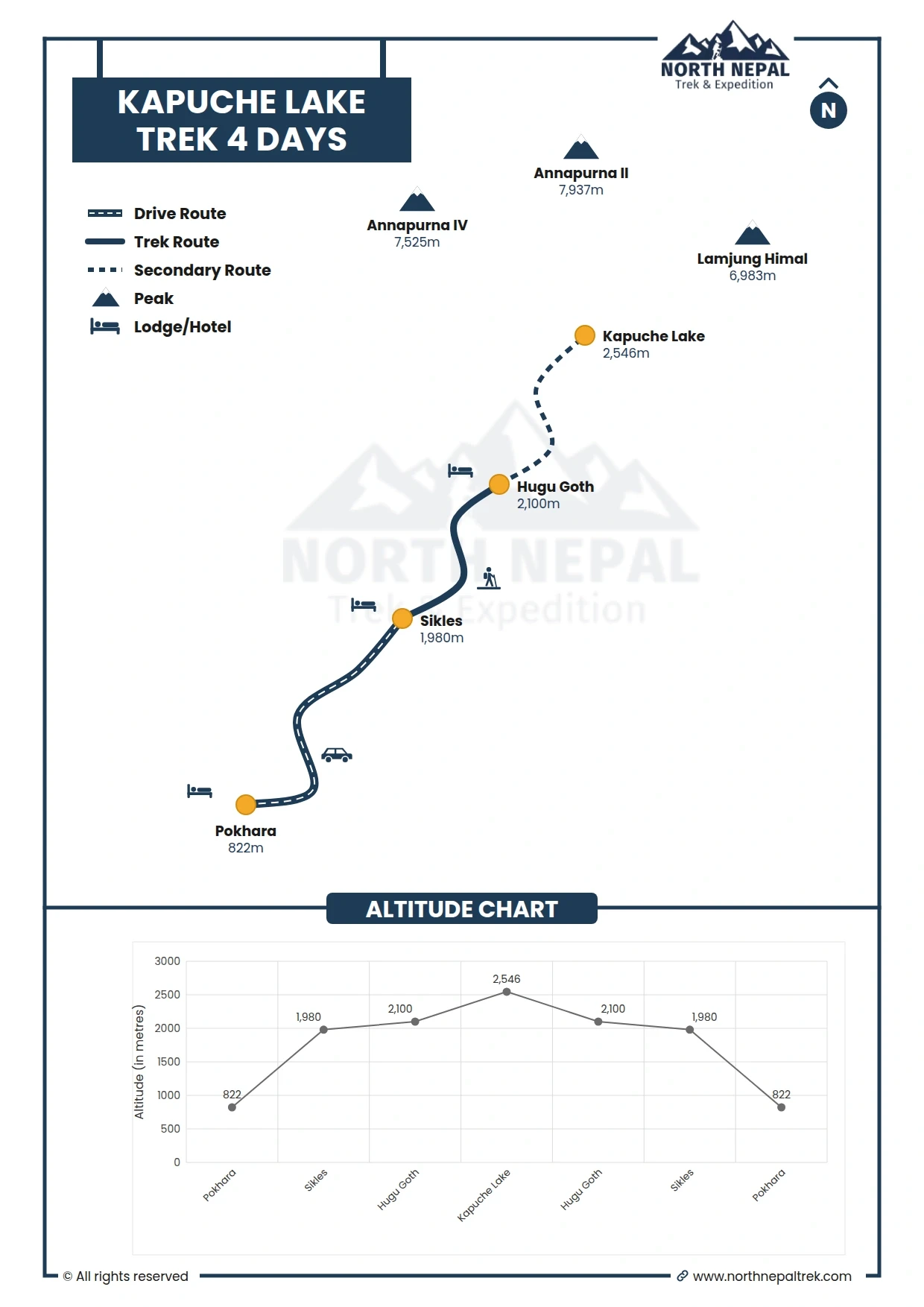
Kapuche Glacier Lake Trek is a short but striking Himalayan route, covering about 32 km from the Gurung village of Sikles to one of Nepal’s lowest glacier lakes at 2,450 m. The trail climbs through Sikles, dense forests, and the forceful Madi river before entering a narrow glacial valley where the lake sits in bright, icy-blue stillness. Along the way, you get constant views of Annapurna II, Lamjung Himal, and Machhapuchhre, rising sharply above the terrain.
|
Trek Day |
Destination |
Elevation |
Trek Distance |
|---|---|---|---|
|
Day 1 |
Pokhara → Sikles |
~1,980 m |
3-4 hrs drive |
|
Day 2 |
Sikles → Hugu Goth |
~2,100 m |
~14 km |
|
Day 3 |
Hugu Goth → Kapuche Lake → Return |
~2,450 m |
~ 8 km |
|
Day 4 |
Return to Sikles → Pokhara |
~822 m |
n/a |
Sikles village, settled on the eastern hills of Pokhara, this native Gurung community perfectly blends modernity and traditional lifestyle. The path itself is moderate with an organized trail, making the trek accessible while still feeling wild and remote. Villages like Sikles and Hugu Goth bring cultural warmth, traditional homes, and peaceful landscapes that balance the raw glacial atmosphere at the lake. It’s a compact trek that delivers Himalayan scenery without the push of high altitude.
Find the comparison table between Kapuche Lake vs. Mardi vs. Kori ; shortest trek Pokhara
Milan Tamang, Assistant Trekking Guide
Kapuche Glacier Lake Trek route and pacing are drawn from 12+ years guiding the Annapurna region. Mohan founded North Nepal Trek in 2015; since then, Milan has led 10+ Kapuche Trek.
Before Kapuche, we will first reach Hugu, which comes two hours earlier. Hugu has an ancient settlement with animal husbandry as a means of livelihood at 2,100 meters elevation. Hugu itself is about 6 hours away from the nearest human village Sikles.
We trek to Kapuche lake which is about a 2-hour trek. We’ll spend a couple of hours to explore a lowest glacier lake of Nepal. After spending couple of hours at Kapuche lake we will hike back to Hugu where we will spend the night.
On the last day, we begin early and hike towards Sikles for about 6 hours. We will take lunch at Sikles village and back to Pokhara or Jeep by bus which takes another 3 hours.

Note:
Best Season: March-May and September-November offer the clearest views and stable trail conditions for reaching Kapuche Lake, an off-the-beaten-path glacial lake beneath the Annapurna South face.
Mohan, without you our trekking trip would have failed. You truly helped us in everything.. before, after and also during.. when we nearly missed our flight from Kathmandu, Mohan and his yonger ambitious brother arranged for us a last minute trip to Kathmandu with a brand new car ;) and we were super thankful. You’ve made a friend Mohan. I wish you the best of luck !!
Oct 2024 • Family
Just returned from completing a 2 day trek with Rohit as our guide to Kapuche Glacier lake. This was organised just the day before by North Nepal Travel and treks. It was a challenging but fantastic experience thanks to Rohits professional skills his passion for the mountains and his outgoing and friendly personality. He was always there to guide and motivate us even up the never ending stairs !! The track was overgrown and narrow in places and we had the added challenges of negotiating blocked paths with landslides and on one occasion a snake which was not moving out of the way. His support and sense of humour got us safely to our destination and back again . If we return to Nepal we will definitely meet again … thank you north Nepal travel and treks for organising and to Rohit for guiding is and helping create these memories 💕
While the Kapuche Glacier Lake Trek reaches a modest maximum altitude of 2,450 m (8,058 ft)—making altitude sickness minimal—our itineraries feature balanced pacing through rugged terrain like the Madi river valley and Sikles ridges. Guides conduct routine daily check-ins to ensure everyone is comfortable, hydrated, and pacing themselves well.
In cases of unexpected injury, acute illness, or adverse weather conditions, emergency evacuation support is coordinated directly through local rescue services. Evacuations are initiated promptly upon assessment by your guide in communication with our Pokhara and Kathmandu offices.
All trekkers must hold comprehensive travel insurance covering emergency medical treatment, standard mountain trekking, and emergency rescue/evacuation. Insurance details must be submitted prior to the departure of the trek to streamline any emergency logistics if required.
Secure the Kapuche Glacier Lake Trek for 2026/2027 before the seat gets fully booked.
The Kapuche Glacier Lake trek is a short, beginner-friendly 4-day route near Pokhara in the Annapurna region, reaching Kapuche Glacier Lake at 2,546m — one of the lowest-altitude glacier lakes in Nepal. The trail passes through Sikles, one of the largest traditional Gurung villages in Nepal, and through dense rhododendron and oak forests to Hugu Goth, the base before the final approach to the lake. You get dramatic close-up views of Annapurna II, Lamjung Himal, and Machhapuchhre without any of the altitude demands of classic Annapurna treks.
The standard Kapuche Glacier Lake trek is 4 days from Pokhara and back. A relaxed version with more cultural time in Sikles takes 5 days. Trail runners or fast hikers can complete it in 2 to 3 days. The itinerary is flexible — tell us how many days you have and we’ll design the right version.
The Kapuche Glacier Lake trek is rated easy to moderate and is one of the most beginner-friendly Himalayan treks near Pokhara. The maximum altitude is 2,546m, which keeps serious altitude sickness uncommon, and the distance of 32 to 40 km is manageable over the standard 4-day itinerary. The lower sections pass through stone-stepped Sikles village, the mid-section is a forested uphill through rhododendron that can be tiring, and the final approach to the lake is easier. Rain makes parts of the trail slippery, so caution on rocky sections is needed. No technical skills are required.
The highest point is Kapuche Glacier Lake itself at 2,546m, making it one of the lowest-altitude glacier lakes in Nepal — most comparable glacial lakes sit above 4,000m. Because of this low elevation, the risk of altitude sickness is very low compared to high Himalayan treks, and no acclimatization days are needed.
The highlights are Kapuche Glacier Lake itself — a deep turquoise glacial basin beneath Annapurna II, where you can hear and sometimes watch ice and rock fall from the surrounding walls; Sikles village, one of the largest traditional Gurung settlements in Nepal; Hugu Goth, a peaceful high grazing area surrounded by alpine forest; and wide mountain views of Annapurna II, Lamjung Himal, and Machhapuchhre throughout the upper trail.
The trail breaks into distinct sections. The lower section passes through the stone-stepped lanes of Sikles village and terraced farmland. The mid-section is a forested uphill through dense rhododendron and oak — this is the most tiring part of the trek. The approach to Kapuche Lake is relatively easier terrain once you reach Hugu Goth. The route is well-defined, safe, and far less crowded than Poon Hill or Annapurna Base Camp. Rain can make the mid-section slippery, so decent grip on your boots matters.
Camping beside the lake is allowed in summer when conditions permit and the lake is unfrozen. Camping gear can be arranged at Hugu Goth, or you can carry it from Pokhara. In winter the lake freezes and camping is not practical. There is no permanent teahouse at the lake itself, so most trekkers visit the lake as a day trip from their overnight at Hugu Goth. Tell us if you want a camping option and we’ll arrange the gear.
Yes. It’s one of the best short treks near Pokhara, combining glacier lake scenery, traditional Gurung culture in Sikles, and Himalayan mountain views within a compact 4-day itinerary. The low altitude means no acclimatization concerns, and the quiet trail feels genuinely remote compared to the busier Annapurna routes.
Yes. The route is increasingly popular among trail runners because of its moderate elevation, varied terrain, and short distance. Dry-season conditions in spring and autumn are ideal for fast-and-light running. Trail runners typically complete the route in 2 to 3 days.
It’s noticeably quieter than Poon Hill or the ABC trail. Expect peaceful villages, fewer trekkers on the trail, and an authentic rural atmosphere. It’s remote enough to feel like a genuine off-the-beaten-path experience but close enough to Pokhara for safe, supported access. If you want the Annapurna scenery without the crowds, this is one of the best options near Pokhara.
The Kapuche Glacier Lake trek requires two permits: the Annapurna Conservation Area Permit (ACAP) at NPR 3,000 (about USD 25), and the TIMS card at NPR 2,000. No restricted area permit is required — this is an open Annapurna Conservation Area route. Both permits can be obtained in Kathmandu or Pokhara. North Nepal Trek arranges both as part of the package.
Yes. As of 2026, a licensed guide is mandatory for trekking in the Annapurna Conservation Area under Nepal Tourism Board regulations. On the Kapuche Lake trail specifically, a guide is also practically important: the trail through the Sikles wilderness is easy to lose, teahouses are limited, and a local guide adds significant cultural depth to the Gurung village experience. All our guides are government-licensed and cover first-aid and emergency coordination.
You stay in basic teahouses and community homestays in Sikles village, with simple lodges or homestays near Hugu Goth. Rooms are twin-bed basics with shared bathrooms and limited heating. There is no permanent teahouse at Kapuche Lake itself, so the lake is visited as a day trip from your overnight base. Food highlights the local Gurung cuisine: dhedo (buckwheat porridge), rotis, and vegetable curries, alongside standard trekking staples like dal bhat, noodles, and eggs. The cultural food experience in Sikles is one of the trek’s genuine pleasures.
Essentials for this short Himalayan trek: comfortable trekking shoes with grip, a light down jacket, a waterproof jacket and pants, warm layers (fleece or merino), gloves, beanie, a 30 to 40 litre backpack, headlamp, reusable water bottle or hydration bladder, trekking poles, snacks and energy bars, a power bank, sunscreen, and sunglasses. Bring personal medication and any specific medical supplies. See our all-seasons packing guide for the full checklist.
Contact us for current pricing based on your group size and preferred dates — costs vary based on whether you want a private or group trek, porter service, and accommodation level. Beyond the package, budget for your Nepal visa, travel insurance, personal spending in Pokhara, hot showers and device charging at teahouses (small fee each), and tips for your guide and porter. ATMs and card machines are only available in Kathmandu and Pokhara, so carry enough Nepalese Rupees in cash before the drive to Sikles.
Solo, unguided trekking is not permitted under 2026 Nepal Tourism Board regulations. You must trek with a licensed guide through a registered agency. To book, contact North Nepal Trek via our website, WhatsApp at +977 9856016904, or email. We customize the trek around your dates, group size, and interests, whether you want a 4-day lake focus or a 5-day cultural extension through Sikles. Porter service is also available and recommended if you prefer not to carry 12 to 15 kg yourself.
The best seasons are spring (March to May) and autumn (September to November), offering clear skies, stable conditions, and the most rewarding mountain views. Winter (December to February) is also beautiful and walkable given the low altitude, but nights drop to 0°C to 5°C and conditions near the lake are very cold and windy. Monsoon (June to August) is lush and green but brings slippery trails, leeches in the forest sections, and reduced visibility. Near the lake, expect colder conditions and strong afternoon winds regardless of season.
The risk is low at 2,546m but not completely zero. Sensitive trekkers may experience mild symptoms like a light headache or fatigue. Staying hydrated, walking at a steady pace, and avoiding alcohol helps. Serious altitude sickness is extremely rare on this route, and no acclimatization days are needed. Your guide monitors for symptoms and knows when to rest.
Some sections near Hugu Goth can be muddy or unstable during heavy rainfall, and the glacial basin is safe for trekkers but you may hear occasional icefall from the surrounding Annapurna slopes. Rain makes parts of the mid-section trail slippery. We monitor weather and conditions, and your guide knows which sections require extra care in wet weather.
Boiled water is available at teahouses along the route and is the safest option. We recommend using purification tablets or a filter as backup rather than drinking unfiltered tap or spring water directly. Carry a reusable bottle and stay well hydrated throughout, especially on the longer uphill sections.
Sikles village is the cultural heart of this trek — one of the largest and most traditional Gurung communities in Nepal, with stone houses, tea gardens, and the Eco-Museum and Chili Kohinbo Temple where you can learn about Gurung history, Buddhism, and the Bon religion. The Gurung people are famously warm hosts, and staying in a homestay in Sikles is one of the most authentic cultural experiences available on any short Annapurna route. Your guide helps connect you with local families and explains the traditions, architecture, and daily life.
The forested trail to Hugu Goth passes through Annapurna Conservation Area habitat supporting Himalayan tahr, musk deer, barking deer, Himalayan black bears, and wild boar. Birds include Himalayan griffon vultures, bearded vultures, Himalayan monal pheasants, and various forest species in the rhododendron and oak woodland. The glacial basin at Kapuche Lake itself is raw and dramatic, with the surrounding cliffs occasionally producing icefall visible from the lake shore.
From Pokhara, a 4WD jeep drives you about 40 km to Sikles village, taking 3 to 4 hours depending on road conditions. The road is narrow, partly off-road, and scenic but rough in places. Sikles is the starting point for the trekking. At the end of the trek, a jeep returns you to Pokhara from Sikles. We arrange all transport as part of the package.
Mobile reception is available in Sikles village and some lower sections, but becomes unreliable above Sikles and near Hugu Goth and the lake. You can charge devices at teahouses in Sikles for a small fee, but charging options become limited higher up. Bring a fully charged power bank for the upper days. ATMs and card machines are only available in Kathmandu and Pokhara, so ensure you carry enough cash before departure.