Upper Mustang Trek - 14 Days
The 14-Day Upper Mustang Trek starts from Kathmandu via Pokhara & Jomsom into the trans-Himalaya...
OVERVIEW & HIGHLIGHTS
A complete guide for the Annapurna base camp trek with its cost, itinerary, and best season. ABC trekking is one of the most classic treks that Nepal has to offer, starting with local villages and slowly making its way to the breathtaking mountain views in the heart of the Annapurna region. The sensation of standing on the feet of the tenth-highest peak itself piques the interest of trekkers throughout the world; hence, there are thousands of tourists trekking to the Annapurna Base Camp every year. The Guided tour to Annapurna Base Camp will become one of the best memories in the Himalayas of Nepal, which you will remember for life lifetime.
Basanta Subedi, Tour Guide
Since founding North Nepal Trek in 2015, Mohan Raj Bhandari has kept a close eye on the Annapurna Base Camp Trek, and Basanta Subedi shares firsthand insight from personally leading this trek, so you know exactly what to expect before you go.
Trek through terraced paddy fields and subtropical forests to reach the beautiful Gurung village of Chhomrong (2,170m) with stunning panoramic views of Annapurna South and Machhapuchhre
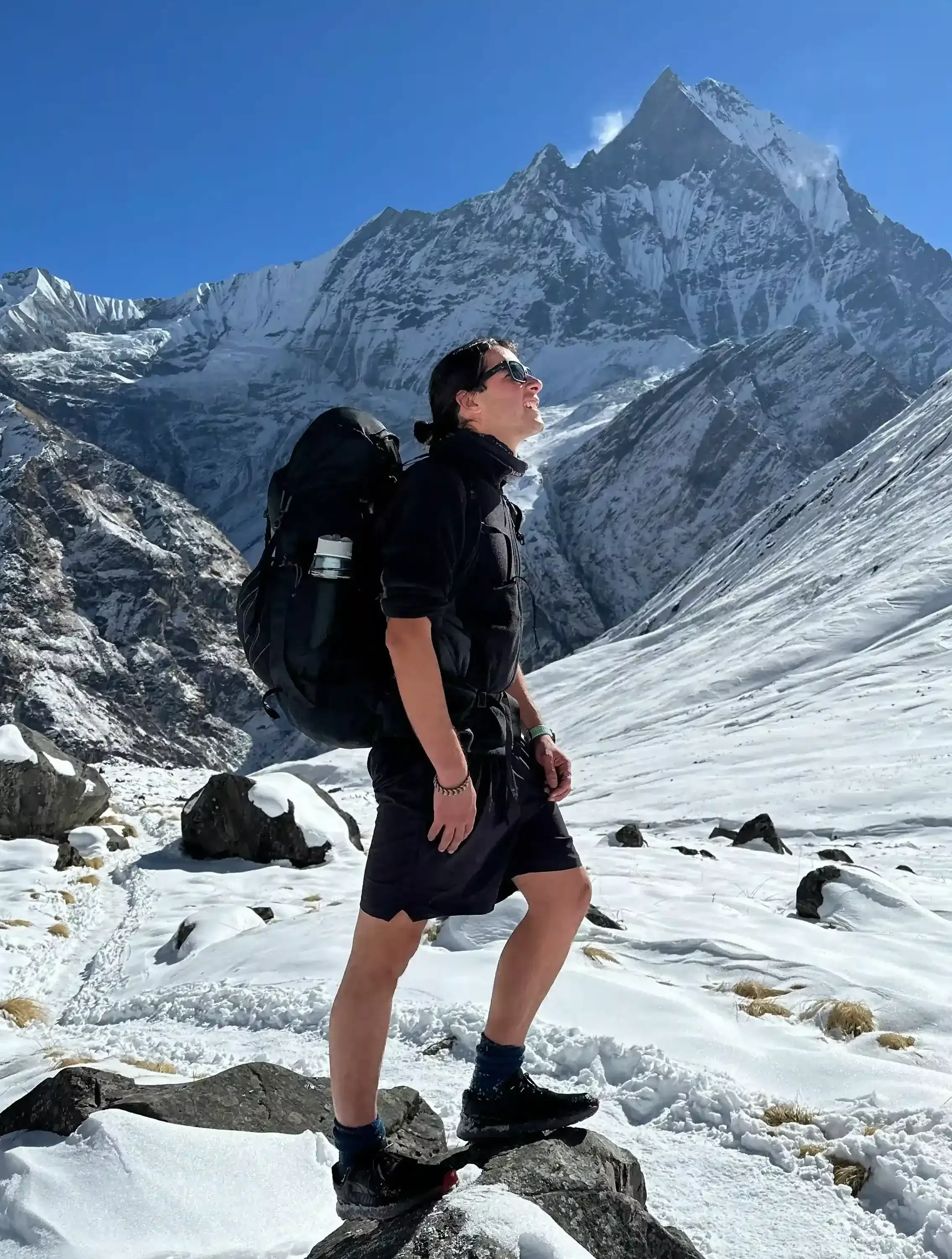
We leave early from Deurali after having our breakfast at the Teahouse. The trek from Deurali to ABC takes 4 - 5 hours depending upon your walking speed. However, as we will be trekking in the high altitude it's best to take it slow and easy. Take short breaks, rest, and drink water during your hikes. From Deurali to Machhapuchhre Base Camp it’s a walk filled with scenic views of the Himalayas, and it is not as steep as one thinks it will be. However, I again remind you a slow but steady trek with breaks is the best approach.

Photo: Sunrise in Annapurna base camp, golden rays on top of Annapurna.
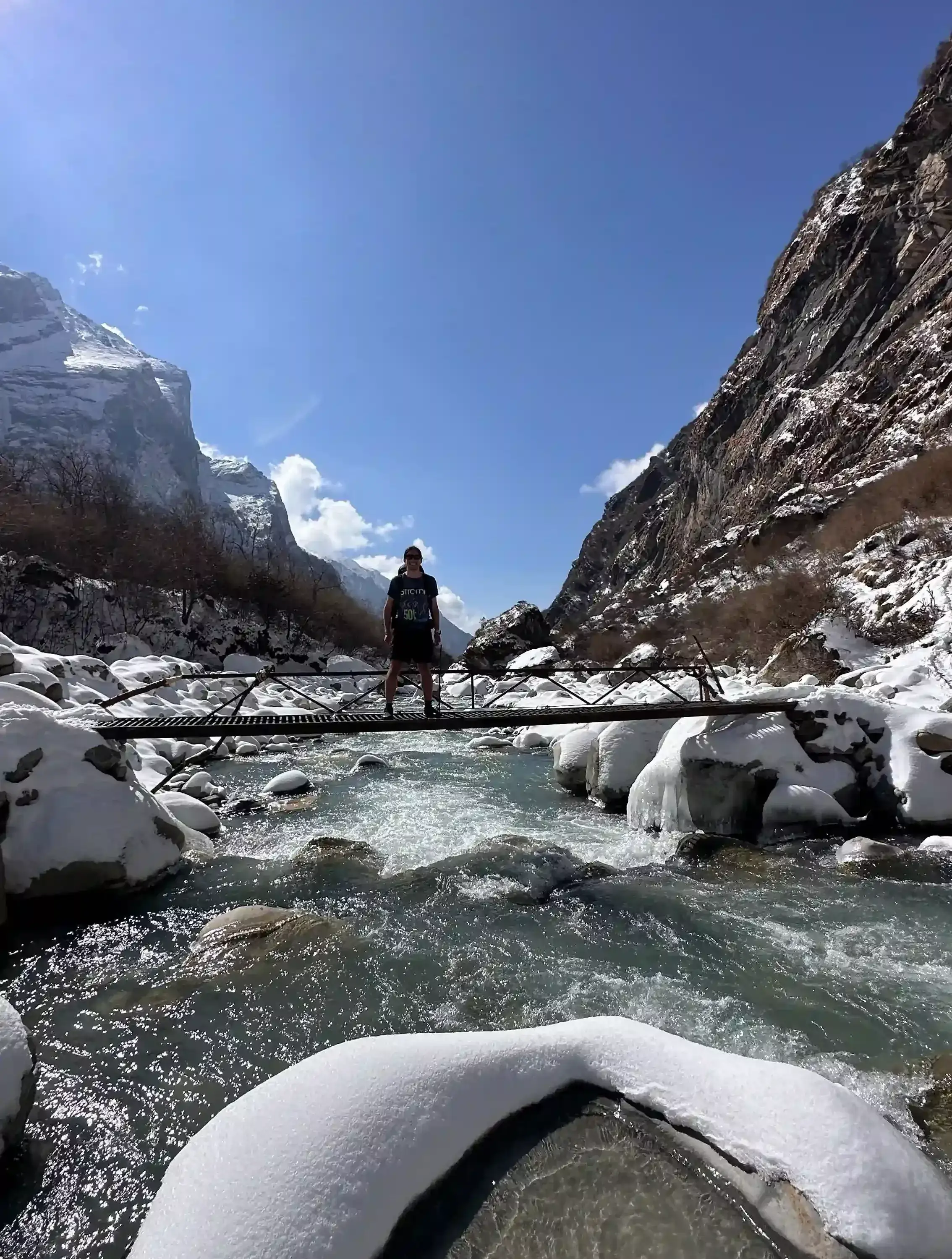
You can see several lodges in the distance that mark, the MBC. The trek from Deurali to MBC takes 2 - 3 hours. From MBC, ABC takes 2 hrs at max and just like MBC we can see the lodges from a bit distance that marks the ABC. During your walk from MBC to ABC you will cross some small streams, and you will be walking on the snow during February March, and April depending on the amount of snowfall.
From Annapurna Base Camp you can enjoy the mesmerizing views of the Annapurna I (8,091 m | 13,549 ft), Annapurna III (7,555 m | 24,787 ft), Annapurna South (7,219 m | 23,684 ft), Machhapuchhre (6,993 m | 22,963 ft), Gangapurna (7,455 m | 24,459 ft), Khangsar Kang (7,485 m | 24,557 ft), Hiunchuli (6,441 m | 21,132 ft), Singhu Chuli (6,501 m | 21,329 ft), Gandarba Chuli (6,248 m | 20,499 ft), Bharha Chuli (7,647 m | 25,088 ft) and many more. The panoramic view from the base camp is a sight worth remembering lifetime. Starting from Hiunchuli the ridge line expands up to Annapurna III across Annapurna I, Annapurna II to Gangapurna, making it the major highlight of the Anapurna base camp trek.
After our breakfast at ABC, we trek back to Dovan. From ABC to Dovan we need to trek very early in the morning so that we can cross Deurali before noon. The trek becomes comparatively easier as we will be trekking the same path you trekked a day ago and descending is easier than ascending, especially during the higher altitudes.

We can have our lunch at Bamboo or Dovan according to your preferences. After 5 - 6 hours of trekking from ABC, we reach Dovan. Overnight stay at Dovan.
After having breakfast at the tea house we trek from Dovan to Chhomrong. The walk through the rhododendron filled forest and bridges offer a refreshing feeling after spending our days in high altitudes.

Photo: Dovan to Chhomrong during Annapurna Base camp trek.
After trekking for 5 hours of trekking we reach Chhomrong via the village of Sinuwa. The go-to accommodation during your stay at Chhomrong is teahouses. However, if you want to experience the rural lifestyle of people living in the Himalayan villages, we can offer you a homestay experience. However, as we need to manage this, you need to talk about this with us before starting the trek.
After having breakfast at the teahouse / local homestay we start our final day of the 6 day Annapurna base camp trek. The trek from Chhomrong to Jhinu Danda takes 2 hours, and we further trek 30 min to Jhinu Danda Hotspring.

Photo: Way to Jhinu Danda.
We have a relaxed bath on the Hotspring washing fatigue and dirt from our body, and also offers a calming sensation. After taking a bath we trek back to Jhinu Danda and take a drive back to Pokhara.
Autumn Trail Alert: Expect steep stone staircases and dry days with chilly nights on the Annapurna Base Camp Trek this season. Signal gets patchy above Deurali, and comfortable teahouses line the entire route.
We completed a 5 day Annapurna Base Camp trek with North Nepal Treks and had a fabulous time! Communication with Mohan before the trek was excellent, and we felt well-prepared. Upon arrival we were picked up and met our guide (Shiva) and porter (Don) and made our way to the start of the trek on a long jeep ride.
Typically Annapurna Base Camp is done in 7 days or so, so we knew 5 would be aggressive. It ended up being more difficult than we anticipated (especially living at sea level), but Shiva did an outstanding job keeping us on track and setting expectations. I feel like we really lucked out getting both Shiva and Don as both were *outstanding* and far exceeded my high expectations. With 25 years of experience in the mountain, Shiva seemed to know everything and everyone. We were always staying in the best accommodations and receiving the best meal service. At one point my wife had a small bout of stomach illness at Annapurna Base Camp, and both Shiva and Don were extremely helpful in navigating a stressful situation (she was ultimately fine hours later and we enjoyed a beautiful sunrise view at the top!). Don was also frequently helping us out with various tricky hiking areas, and in taking many amazing photos. We also got very lucky with weather and had perfectly clear views each day.
After a long five days, we made our way back to Pokhara, and at Mohan's office they even arranged for a surprise anniversary cake to celebrate our 3rd anniversary (which occurred on the final day of our trek)! I had mentioned our anniversary casually to Shiva, and it was so awesome they thought to do this!
At some point we will come back to Nepal and do a longer trek, and we will absolutely be doing it again with North Nepal Treks, and requesting both Shiva and Don if they are available to go lead us once again. Everything went extremely well and we are very, very happy with out experience. Everyone at North Nepal Trek's office (including Mohan himself) and our guide/porter were simply fantastic.
The organization of Mr. Mohan, the head of the agency, gave us a wonderful 7 days in the Annapurna area.
Lalu our guide led us to our long-dreamed-of destination to the MBC and on to the ABC. His care and his professional experience made this advancement possible for us. It was an incredible, fantastic experience. We felt safe and in good hands at all times. Lalu is a wonderful person and funny companion
We will carry this incredibly great experience in our hearts forever
While this 6-day itinerary moves at an efficient pace through the Annapurna region, our itineraries are carefully structured to manage elevation gains safely. Guides conduct daily health assessments for symptoms of Acute Mountain Sickness (AMS). If severe symptoms appear, standard protocol mandates immediate descent to lower elevations.
In cases of severe injury, acute altitude illness, or extreme weather conditions on the mountain sanctuary, emergency helicopter evacuation is coordinated directly through local rescue services. Evacuations are initiated promptly upon assessment by your guide in communication with our Pokhara and Kathmandu offices.
All trekkers must hold comprehensive travel insurance covering emergency medical treatment, high-altitude trekking (up to 4,500 m), and emergency helicopter rescue/evacuation. Insurance details must be submitted prior to the departure of the trek to streamline emergency logistics if required.
Secure the Annapurna Base Camp Trek for 2026/2027 before the seat gets fully booked.
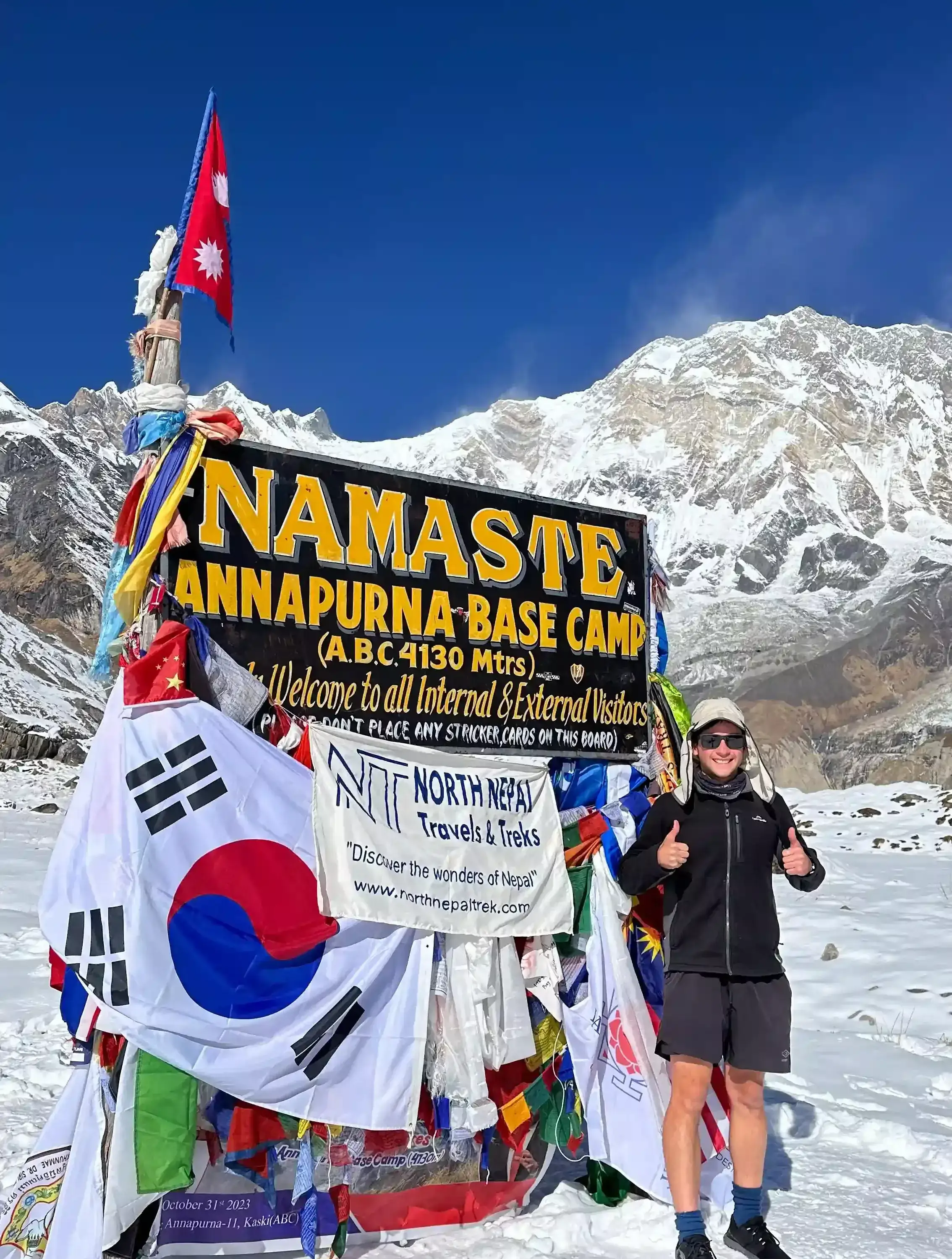
The Annapurna Base Camp (ABC) Trek is one of Nepal's most classic treks, leading you into the Annapurna Sanctuary, a natural amphitheatre of towering peaks in the Annapurna Rural Municipality, Ghandruk, Kaski district. The trek ends at Annapurna Base Camp itself, at 4,130 m (13,550 ft), surrounded by Annapurna I, Annapurna South, Machhapuchhre (Fishtail), and Hiunchuli.
The ABC Trek is a moderately difficult trek that has become more accessible in recent years. With 5 to 6 hours of trekking each day, it suits beginners with good fitness levels as well as experienced trekkers. Difficulty also depends on season, so Autumn and Spring are the ideal times to trek. Beginners should avoid the off-season Summer and Winter months.
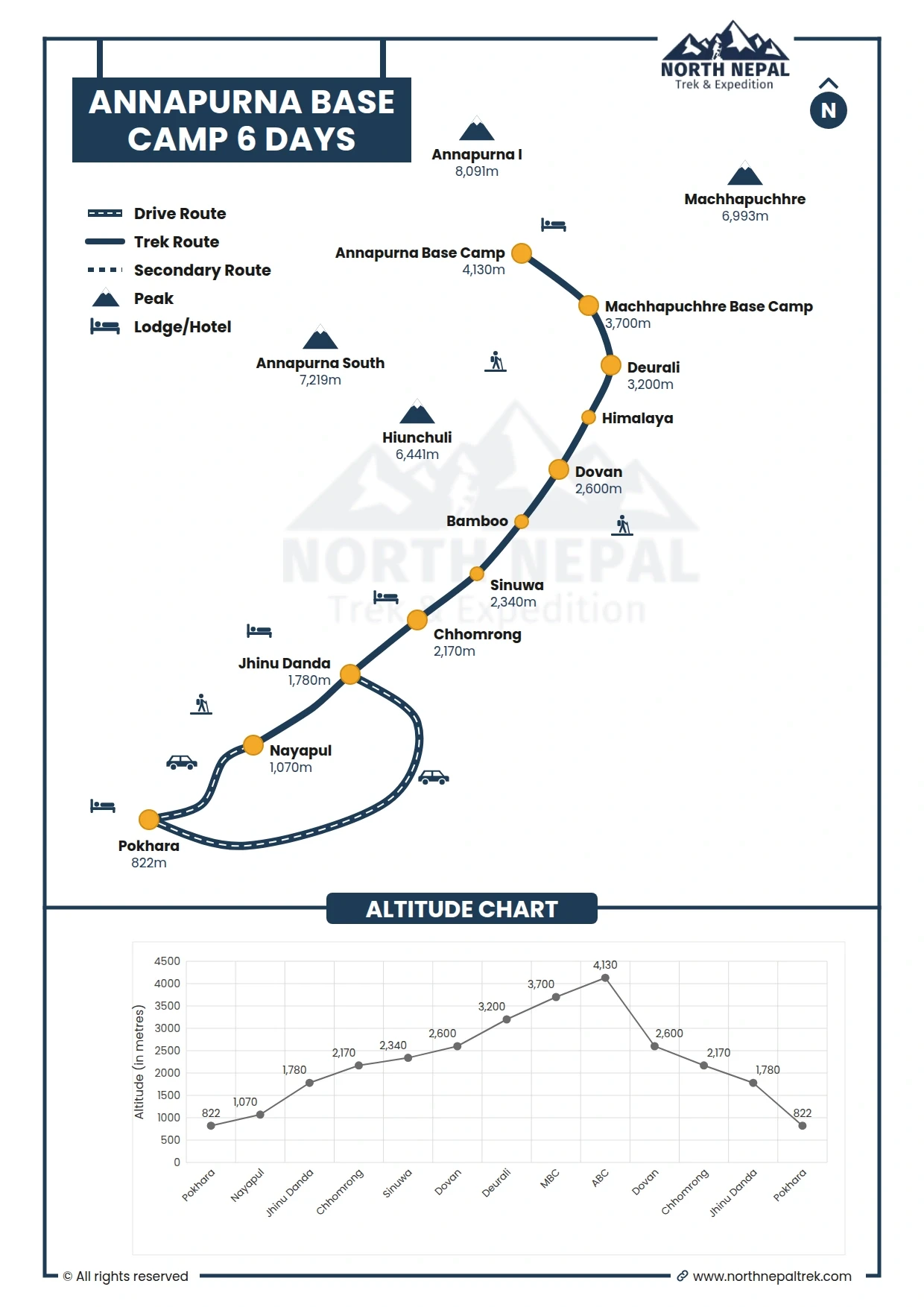
The highest point of the trek is Annapurna Base Camp itself, at 4,130 m (13,550 ft). The second-highest point is Machhapuchhre Base Camp (MBC) at 3,700–3,712 m (about 12,150 ft), which you pass through on your way to ABC.
Yes, as long as you have a reasonable level of fitness and trek during Autumn or Spring. Our 6-day itinerary is paced to manage elevation gain safely, unlike the rushed 5-day versions some agencies promote, which push trekkers to 4,130 m too quickly and raise the risk of altitude sickness. If you are a complete beginner and want an easier high-altitude experience, the shorter Mardi Himal Trek is also worth considering.
Our 6-day itinerary runs: Day 1 Pokhara to Nayapul to Jhinu Danda; Day 2 Jhinu Danda to Chhomrong; Day 3 Chhomrong to Deurali and on to Annapurna Base Camp; Day 4 ABC to Dovan; Day 5 Dovan to Chhomrong; and Day 6 Chhomrong to Jhinu Danda, with a drive back to Pokhara. Full day-by-day details, including altitude, distance, and duration, are on the Itinerary tab above.
Our standard 6-day trek drives up to Jhinu Danda by jeep and starts trekking from there, reaching Chhomrong on Day 1. The alternative 7-day route instead drives to Ghandruk, a scenic Gurung village, and adds a day of trekking through Kimrong Danda to reach Chhomrong, giving you extra mountain views along the way and a chance to explore Ghandruk itself. Both routes join the same trail from Chhomrong onward to Annapurna Base Camp.
You need an Annapurna Conservation Area Permit (ACAP), since the entire route runs through the Annapurna Conservation Area, plus a TIMS (Trekkers' Information Management System) card. Both permits are arranged as part of your package and are included in the trek cost.
Yes. Every trek is accompanied by a licensed, English-speaking local guide trained in eco-tourism, wilderness navigation, and first-aid response. Guides carry comprehensive medical kits with pulse oximeters to monitor oxygen levels daily as you ascend toward Machhapuchhre Base Camp and Annapurna Base Camp.
You'll stay in regulated teahouses and community lodges throughout the trek, in functional twin-share rooms with two single beds and foam mattresses. Lower elevations like Jhinu Danda and Ghandruk sometimes offer private en-suite bathrooms, while higher stops such as Deurali and ABC use shared facilities. We recommend using your provided sleeping bag over the lodge blankets for extra warmth and hygiene.
Meals are prepared fresh with local Himalayan ingredients, and menus are standardized by the Annapurna Conservation Area Project to keep pricing and quality fair. Breakfast typically includes oats, Gurung bread, eggs, and ginger-lemon-honey tea. Dal Bhat (lentil soup, rice, and vegetable curry) is the staple for lunch and dinner and the most reliable energy source for the daily elevation gains. Western options like pasta, vegetable momos, and potato dishes are also available, though we recommend avoiding meat above Chhomrong since it is portered up manually.
Spring (mid-February to mid-May) and Autumn (September to early December) are the best seasons, offering clear skies, minimal rainfall, and the best mountain views. Autumn is widely considered the prime trekking season in Nepal, while Spring brings vibrant rhododendron forests. Summer brings rain and leeches, and Winter brings heavy snowfall and extreme cold, so both are best left to experienced trekkers.
Cost depends on the package type and group size. Our full package basis is $80 per person per day, covering transportation, accommodation, all three meals, permits and TIMS, and a licensed guide with all their expenses. A half package basis is $55 per person per day, covering transportation, accommodation, breakfast, permits, and a guide, with lunch and dinner excluded. Guide-only or porter-only service is also available at $30 per day and $25 per day respectively.
Yes. If you're short on time, you can fly straight to Annapurna Base Camp on a 20-minute helicopter flight instead of trekking in on foot. It costs more than the trekking package, but it's a great option if your schedule is tight.
Pack warm layers for chilly nights at higher elevations, sturdy trekking boots, and rain gear if trekking outside Autumn or Spring. A good sleeping bag is essential, both for warmth and for extra hygiene over the lodge blankets provided at teahouses. Since the trek climbs to 4,130 m, altitude-appropriate gear like a warm hat, gloves, and a headlamp are also recommended.
Yes, comprehensive travel insurance is mandatory for all trekkers. It must cover emergency medical treatment, high-altitude trekking up to 4,500 m, and emergency helicopter rescue and evacuation. We ask that you submit your insurance details before departure so emergency logistics can be arranged quickly if ever needed.
Wifi is generally available and reliable at the lower teahouses, such as those in Jhinu Danda and Chhomrong. As you climb higher toward Deurali and Annapurna Base Camp, signal and wifi reliability drop off, so expect patchy connectivity for the final stretch of the trek.